At 19, George Enescu stitched taraf tunes into an orchestral score; at 21 he conducted it at the Athenaeum. What the twelve minutes hold — and what nobody wrote down.
Marius Comper · September 2026
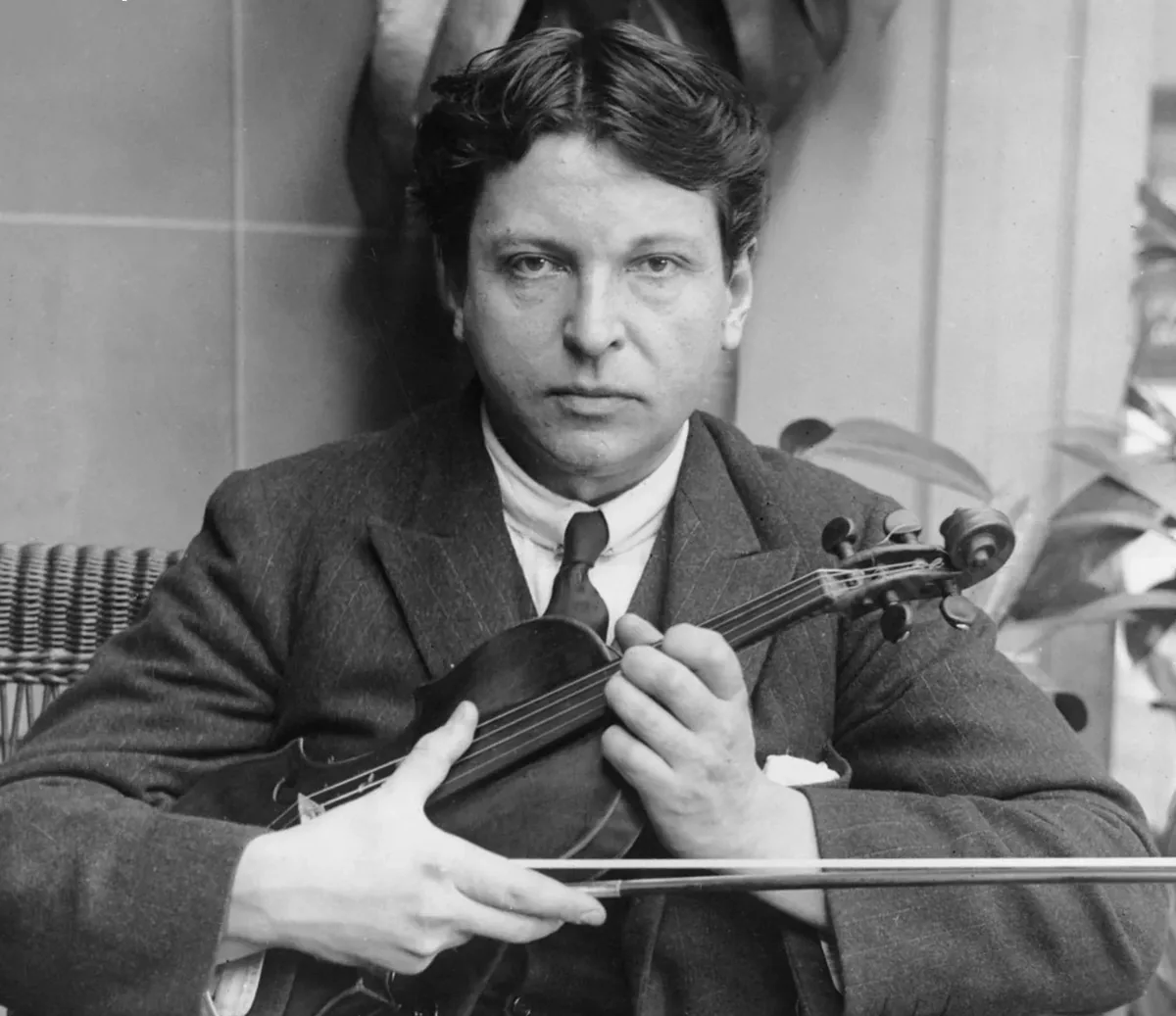
Enescu in the 1920s, two decades after the night he conducted the premiere.George Enescu în anii 1920, autor necunoscut · Wikimedia Commons, domeniul public
The oak sprig, after the silvered branch the Museum holds from the premiere night.
What the twelve minutes are sewn from: each borrowing as it enters, with the voice Enescu gave it.
The order follows the Boston Symphony's note, tune by tune; the eighth name is attested once.
01
Am un leu și vreau să-l beu
“I have a leu and I want to drink it”
Solo clarinet, then oboe, then full orchestra
A drinking song opens the piece, dreamy as a shepherd's shawm — thrice stated, each time larger and faster.
02
Hora lui Dobrică
“Dobrică's hora”
Violins with an upward swing, two harps
A wedding circle dance; the harps stand in for the taraf dulcimer.
03
Sârba
“The sârba”
Interpolated dance episode
A dotted-rhythm circle dance slips between the hora's returns.
04
Mugur, mugurel
“Sprout, little sprout”
Somber song episode
The score's darkest minutes — quickly lightened when the dances return.
05
Ciobănașul
“The little shepherd”
Song episode
A pastoral tune on the road from the opening songs to the closing dances.
06
Hora morii
“The mill hora”
Dance episode
Another circle dance feeding the gathering whirl.
07
Ciocârlia
“The lark”
Woodwinds over string eighth-notes
A bird concert in the winds — then the round spins to Prestissimo.
08
Jumătatea de joc
“Half of the dance”
Attested once, position undocumented
ARTmania names it eighth; no second source confirms its place.
“Jumătatea de joc” is the eighth name; its position in the order is undocumented.
Names: ARTmania's Romanian list; order and voices: the BSO note; Chioru: the Brooklyn notes.
I
The ear
Liveni · Iași · Vienna
Born
19 August 1881
Village
Liveni-Vârnav
First violin
at age 4
Vienna
1888–1894
He was three when the taraf found him. A band was playing at a spa near his native village, and the boy stood listening; the next day he tried to become the band himself — a violin of sewing thread on a piece of wood, a cimbalom of sticks, a nai blown between his lips.
His father gave him his first musical notions at four, and his parents gave him a little three-stringed violin. Furious at not being taken seriously, the child threw the toy into the fire — then, given the dreamed-of real violin, began playing by ear on a single string, with a single finger, melodies heard in the village. His guides were his parents and a famed lăutar, Niculae Chioru.
In 1886 Eduard Caudella, composer and professor at the Iași Conservatory, noticed the boy's extraordinary talent and steered him toward musical studies; the first attempts at composition date from the next year, when Enescu was six. Between 1888 and 1894 he studied at the Vienna Conservatory — violin with Bachrich and Hellmesberger junior, piano with Ludwig, harmony and composition with Fuchs — made his violin debut at eight, and the Viennese press called him a Romanian Mozart.
Paris followed, 1895 to 1899: violin with White and Marsick, composition with Massenet and Fauré, counterpoint with Gédalge, classmates including Ravel. On 6 February 1898, aged sixteen, his Poema Română opened the Concerts Colonne — the composing debut, under his protectress Elena Bibescu's wing.
Enescu in the 1920s. At three he had heard his first taraf; at eight he made his violin debut.George Enescu în anii 1920, autor necunoscut · Wikimedia Commons, domeniul public
Meanwhile Born the same year, 1881: Béla Bartók — who would take the opposite road, the systematic collection of traditional music.
II
The stitching
Age 19 · Op. 11 No. 1
Finished
14 August 1901
Age
19
Model
Liszt
Dedication
Crocé-Spinelli
Nineteen years old — five days short of twenty when he finished it on 14 August 1901 — Enescu wrote the First Rhapsody the way he had learned music: from memory. He never did field research and never chased authenticity; his exceptional memory kept the tunes he had heard as a child, and he set them for orchestra, probably noting them down by ear.
The model was Liszt's Hungarian Rhapsodies, and like Liszt he drew on popular rather than folk sources: a drinking song, wedding horas, a shepherd's tune, a showpiece lark. The piece opens with “Am un leu şi vreau să-l beu” — I have a leu and I want to drink it — on a dreamy solo clarinet, like a distant shepherd's shawm; the oboe continues, and the song returns twice more, each time with larger forces and a faster step.
After it, dance chases dance and the tempo keeps climbing: Hora lui Dobrică with its upward violin swing over two harps standing in for the dulcimer, an interpolated sârba, the somber “Mugur, mugurel”, “Ciobănaşul”, “Hora morii”, and “Ciocârlia”, the lark — a bird concert in the woodwinds over string eighth-notes — before the music spins to its Prestissimo close. The connecting motives between the borrowings are Enescu's own, folk-inspired melodies.
He later waved the piece away as just a few tunes thrown together without thinking. The sketches say otherwise: he worked out the order of the melodies, and the best instrumental dress for each, with care. He dedicated the score to his Paris classmate, the composer and teacher Bernard-Louis Crocé-Spinelli.
Enescu's signature. The sketches show the order of the melodies was worked out with care.Semnătura lui George Enescu · Wikimedia Commons, domeniul publicIII
The evening
Romanian Athenaeum · Bucharest
Date
23 February 1903
Hall
Romanian Athenaeum
Conductor
the composer, 21
Rest of the programme
E. Wachmann
The hall first heard it from a lone clarinet. On 23 February 1903 — 8 March by the new calendar — a 21-year-old stepped onto the podium of the Romanian Athenaeum and conducted the absolute premiere of his two Romanian Rhapsodies, Op. 11. Bucharest's symphony orchestra was Eduard Wachmann's; for the rest of that evening's programme, Wachmann took the baton back.
What else was played that night is not documented: the Museum's account names no other titles. What the Museum does hold is Wachmann's esteem made solid — a silvered-metal oak branch given to the young violinist-composer, inscribed “Violonistului şi compozitorului român George Enescu”.
Two days later, on 25 February, Enescu was on the same stage as soloist, composer and conductor at once, for the premiere of his First Orchestral Suite — a separate concert, not the same evening. And no Bucharest press review of those February nights survives in the Museum's archive: the triumph is certain, its contemporary words are not.
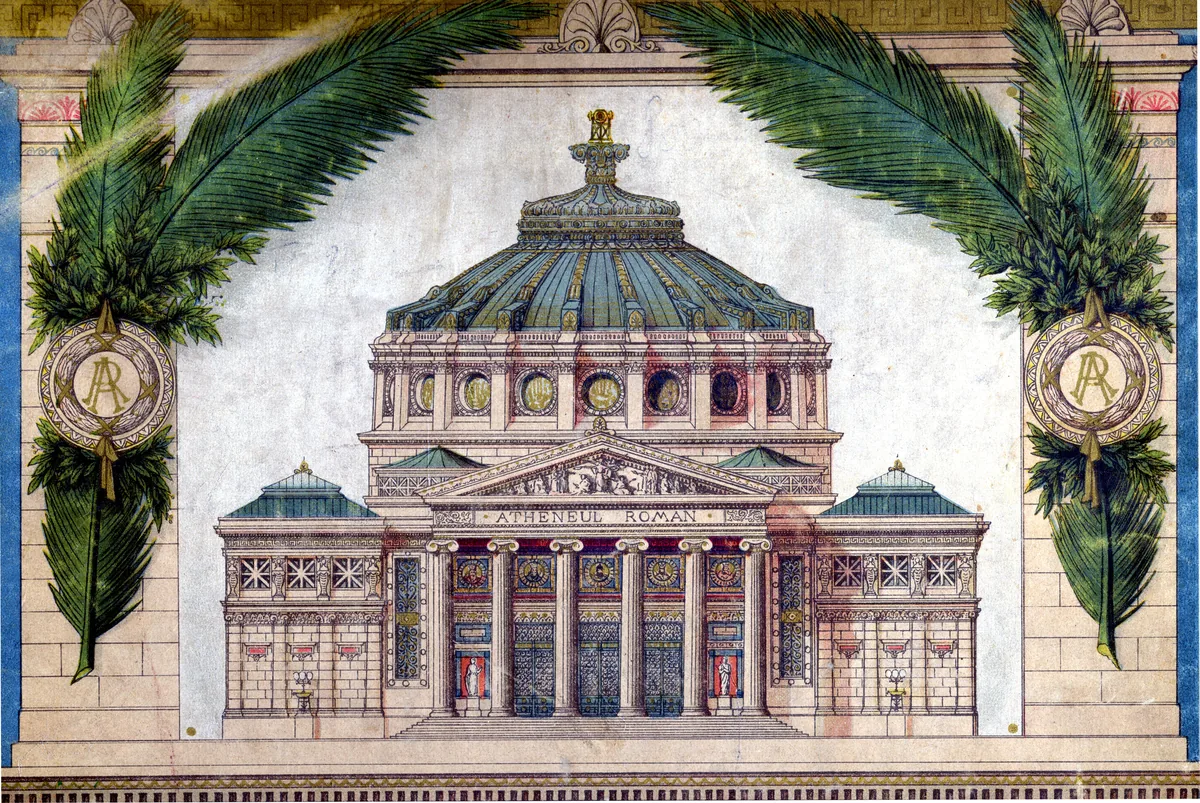
The Athenaeum after Galleron's 1886 design. The premiere took place on 23 February 1903.Albert Galleron, proiectul Ateneului, 1886 · Wikimedia Commons, domeniul public
Meanwhile Two months earlier, a 14 December 1902 announcement promised a public dress rehearsal: Saint-Saëns and Paganini on the young man's violin. That same year, Cuba leased Guantánamo Bay to the United States “in perpetuity”.
IV
The print and the shadow
Paris · Philadelphia · Boston
Print
Enoch, Paris
America
Stokowski, Philadelphia
Boston
1912 · 1939
Catalogue
33 opus numbers
The score reached print years after the premiere, at Enoch in Paris — the surviving Enoch full score is dated [1909], plate E. & C. 6058, though some references give [1905]. Whatever the year, the exotic, dynamic, melodically beautiful piece with its spectacular orchestration walked straight into the repertoire of the great orchestras, conducted in concert and on record by most of the world's great conductors.
International fame came above all through the First Rhapsody: it was heard across the seas in the USA under Leopold Stokowski with the Philadelphia Orchestra. Boston took it into repertoire in February 1912 under Max Fiedler; by the 1930s it was a Boston Pops staple; the last subscription performances before 2022 were led by the composer himself, in January 1939.
One opus out of thirty-three — and it covered the other thirty-two. Enescu grew bitter about the singular popularity of a youthful piece, a subtle and serious composer eclipsed by his own warhorse; yet the appeal proved indestructible. Oedipus, premiered in 1936, was hailed as the masterpiece and summation of his art. He died in Paris on 4 May 1955.
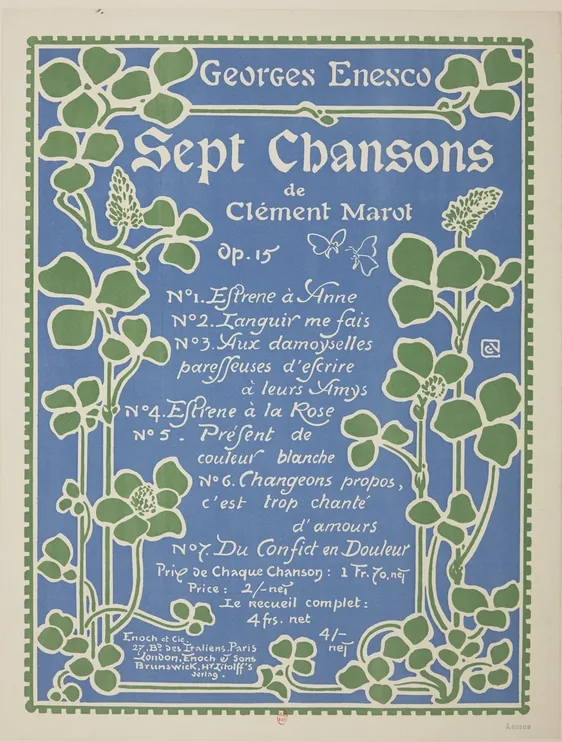
George Auriol's cover for the Songs on Clément Marot, Op. 15 — the same Paris publisher, Enoch, 1909. The Rhapsody was likewise printed at Enoch, years after the premiere.George Auriol, Enoch & Cie, Paris, 1909 (BnF) · Wikimedia Commons, domeniul public
Meanwhile At the 1936 Oedipus premiere, critics hailed the opera as the masterpiece and summation of his art.
Twelve minutes
12
from a lone clarinet to a full Romantic orchestra — eight borrowed tunes, a new one every minute and a half, on average
that is how much of the official catalogue the First Rhapsody covered — and it covered all of it
33 opus numbers (BSO); “eclipsed all his other works” (Brooklyn).
Nineteen, then twenty-one
19 → 21
he composed it at 19 and conducted it at 21 — a year and a half between the two dates
Finished 14 August 1901 (Brooklyn); premiered 23 February 1903 (Enescu Museum).
The road to the Rhapsody
He never collected folk music in the field — he carried it. Six places made the carrier.
Pick a stop to read its line.
1. Liveni · 1881 Born 19 August 1881, Liveni-Vârnav — today the village of George Enescu, Botoșani county. At three he hears his first taraf at a nearby spa.
Liveni · 1881 Born 19 August 1881, Liveni-Vârnav — today the village of George Enescu, Botoșani county. At three he hears his first taraf at a nearby spa.
Iași · 1886 In 1886 Eduard Caudella of the Iași Conservatory notices the boy; the first composition attempts follow in 1887.
Vienna · 1888 The Conservatory, 1888–1894: violin, piano, harmony. Violin debut at eight; the press calls him a Romanian Mozart.
Paris · 1895 The Conservatoire, 1895–1899, with Massenet and Fauré; Ravel among his classmates. Composing debut, 6 February 1898.
Bucharest · 1903 The Athenaeum, 23 February 1903: at 21 he conducts the absolute premiere of the two Rhapsodies.
Sinaia · 1903 Guest at Peleș Castle of Queen Elisabeth — Carmen Sylva — who sets some of his lieder in motion.
Stops: the Enescu Museum's biography; positions: OpenStreetMap. Mountain bands are schematic.
On the podium
Twenty-one years old, baton in hand, facing an orchestra and a hall full of Bucharest. Six calls to make: taraf borrowing or Enescu's own?
Pick one answer per card; each card's payoff says where the fact comes from.
01
“Am un leu”
The opening drinking song — taraf tune or Enescu invention?
From the taraf
Taraf. It was played by the lăutar Lae Chioru, who gave the four-year-old Enescu his first violin lessons (Brooklyn notes).
02
“Hora lui Dobrică”
The wedding circle dance with the upward violin swing — taraf or Enescu?
From the taraf
Taraf. A hora danced at weddings and festivals; Enescu's harps stand in for the dulcimer (BSO note).
03
“Ciocârlia”
The lark's bird concert in the woodwinds — taraf or Enescu?
From the taraf
Taraf. The BSO's note lists it among the quoted tunes, over string eighth-notes.
04
The links
The motives stitching the borrowings together — taraf or Enescu?
From Enescu
Enescu. They derive from his own folk-inspired melodies, like Liszt before him (Interlude).
05
The order
The sequence of the entrances — found or worked out?
From Enescu
Worked out. The sketches show he carefully fixed the order of the melodies and each one's dress (Brooklyn notes).
06
The blaze
The spectacular orchestration, two harps and all — taraf or Enescu?
From Enescu
Enescu. The Museum credits the exoticism, drive, melodic beauty and above all the spectacular orchestration.
Correct: 0 of 6
Still in the stalls
Two or fewer right: stay seated — the clarinet is about to begin again, and this time you know its name.
Five or six right: the silvered oak branch is yours — “to the Romanian violinist and composer”. The verdict is sealed with his signature, as Enescu signed.
Enescu's signature. The sketches show the order of the melodies was worked out with care.Semnătura lui George Enescu · Wikimedia Commons, domeniul public
The Rhapsody in numbers
1,881
born at Liveni
19
years old at the writing
8
borrowed tunes
12
minutes of music
1,903
the Athenaeum premiere
33
opus numbers in the catalogue
Three things it is not
Short corrections, each with its source.
The score was printed in 1903.False
No 1903 print is documented: Enoch of Paris printed the full score years after the premiere — the surviving Enoch score is dated [1909], plate E. & C. 6058 (IMSLP), with some references giving [1905].
Enescu collected folklore in the field.False
He never did systematic field research and never sought authenticity; he worked from the tunes his exceptional memory had kept since childhood (BSO note).
The First Suite shared the premiere evening.False
The Suite in C, Op. 9 had its own night: 25 February 1903, same hall, Enescu as soloist, composer and conductor at once (Enescu Museum).
Sources
How this page was made
Every fact on the page traces to a source named in the Sources section; the working ledger holds one row per claim with the exact quoted line. Ages and intervals are computed from the Museum's dates — including the premiere age of 21, where the Museum's own page slips to 22. Durations are cited program-note facts; no recording is embedded or transcribed anywhere on this page.
What the sources do not give is marked as missing on the page itself: no Bucharest review of February 1903, no titles for the rest of the premiere programme, no collection localities for the tunes. The map shows the documented road, not the tunes.