Seven stops in Moldavia, Wallachia and Transylvania, 1659–1661
An Ottoman counted the houses of Iași and the people of Brașov. How much did he exaggerate?
Evliya Çelebi made three journeys through Moldavia, Wallachia and Transylvania and counted everything he saw: houses, monasteries, shops, cellars, towers, people. Sometimes he is exact – eleven monasteries in Iași, the same number a Catholic bishop had counted thirteen years earlier. Sometimes he writes a hundred thousand people into a town the 1850 census still found with 21,782.
Three journeys in two years
Evliya Çelebi set out north from Edirne in the autumn of 1659 with the escort taking Ștefăniță, son of Vasile Lupu, to Iași to be made prince of Moldavia. He stayed in the region until the winter of 1661: forty days in Iași, a winter of raiding through Wallachia, the summer of 1660 in the Banat and at the siege of Oradea, then the Transylvanian campaign.
The map follows each stage as you read. A solid line runs through the places he names; a dashed line marks a stretch where the text gives the places but not the order or the crossing. Beside the map stands the pair: what he wrote, and what the other count says.
Stop I
Iași
December 1659 – January 1660 · capital of Moldavia, forty days of winter
- When
- 4 December 1659, the day named in the letter
- What he counted
- 20,000 houses, 11 monasteries, 2,060 shops, 1,060 cellars
- Checked against
- Marco Bandini, 1646: 15,000 houses and 11 monasteries
The letter that brought him to Moldavia carried a date: the twentieth day of Rebiülevvel 1070, that is 4 December 1659. It came from Ștefăniță, son of Vasile Lupu, whom the Porte had just made prince. Iași was held by Constantin Șerban, put on the throne with the help of George II Rákóczi; the Ottoman text calls him Burunsuz, “the noseless”, and the Romanian chronicles call him Cârnul.
The battle was fought in snow on the plain outside Iași, the enemy's wagon-fort drawn up across the town's lake at Galata. Constantin Șerban fled, and Evliya stayed on for forty days – “in forty days we came to know their ways”, he writes.
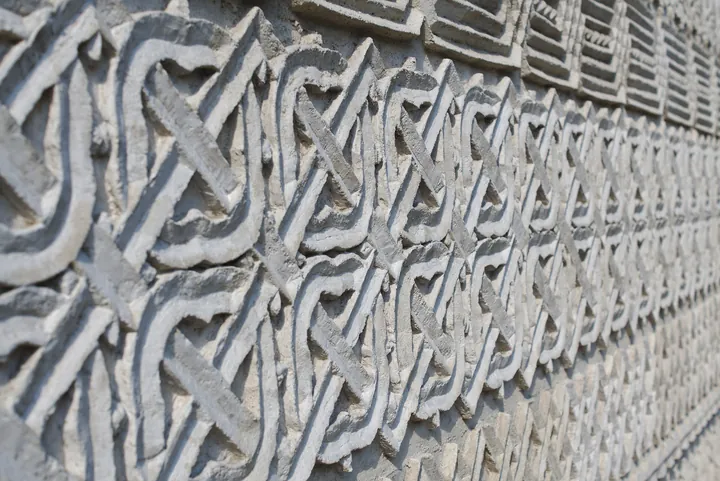

His count: some twenty thousand houses, not one roofed with tile or lead, masonry rare, seven hundred streets floored with planks, 2,060 shops, 1,060 cellars with taverns above them, six merchants' inns, and not a single fountain – water came in barrels on carts.
جمله یکرمی بیك قدر معمور قورتهلردر
Cümle yigirmi bin kadar ma‘mûr kurtelerdir.
“Some twenty thousand well-kept houses in all.”
The word he writes for the houses, kurte, sounds like the Romanian curte.

Some thirteen years earlier the Catholic bishop Marco Bandini had written about the same town, in Latin: fifteen thousand houses, sixty churches in all, eleven monasteries in the town and near it. On houses, Evliya adds a third. On monasteries he writes the same number: eleven.
What he describes around the princely court checks out as well. The lake below the palace, he says, was made by Vasile Lupu in the year 1045 of the Hijra, 1635–36, by damming a stream between two hills, and its lease brought in forty thousand gold pieces. The bath built on its shore was, he writes, brighter than any bath in all Frankish lands. Archdeacon Paul of Aleppo, who stayed in Iași in 1653, saw both the lake behind the palace and the bath “built by Vasili the Voivode, on the plan of the Turkish baths, with cupolas and an abundance of marble”. Lupu himself Evliya places exactly: a prisoner in Yedikule, in Istanbul, where he died in March 1661.
Stop II
Târgoviște and Bucharest
winter 1659–1660 · the winter raid, from Buzău to Giurgiu
- When
- January–February 1660
- What he counted
- 500 captives ransomed at Bucharest; 17,000 dead, “so they relate”
- Checked against
- Paul of Aleppo, 1657: 6,000 houses and 40 churches in Bucharest
From Moldavia the army crossed into Wallachia. He gives the reason himself: Mihnea III, the prince the Porte had installed two years before, had turned against it and sent word to his men to kill the Muslim merchants and soldiers in the towns.
The figure he gives for those days is the largest in the chapter – seventeen thousand killed in three days, in Bucharest, Târgoviște and the other towns – and it is the one he twice holds at arm's length: “so they relate”, and, in Arabic, “the responsibility rests with the teller”. No other source gives a number at all.
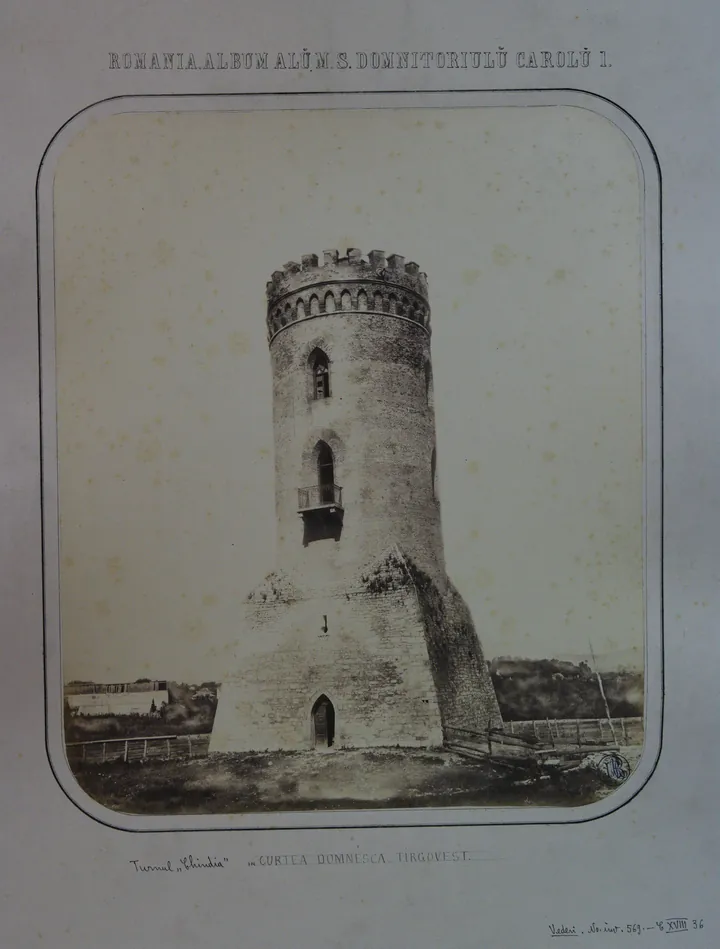

The march through the country he writes as an inventory of burnt villages and captives taken: three hundred here, a thousand there, two thousand along the Argeș. On the way back, he says, the people of Târgoviște brought gifts and ransomed their captives by the hundred, and in Bucharest the inhabitants “beginning to come down from the mountains” paid for five hundred.
ترقووش شهرینه کلدك هنوز اعمار اولنمغه باشلامش ایدی
Tırgoviş şehrine geldik, henüz i‘mâr olunmağa başlamış idi.
“We came to the town of Târgoviște; it had only just begun to be rebuilt.”

One of his sentences about Târgoviște can be checked from the other side. Evliya writes that the town had only just begun to be rebuilt. Archdeacon Paul of Aleppo, who had passed through two years earlier, recorded why: in Lent 1658 the Pasha had ordered Târgoviște to be set on fire, “walls and all”.
Bucharest he does not count. The only count of the town from those years is Paul of Aleppo's: it is “said to have contained for many years about six thousand houses”, with “forty churches and convents”.
Stop III
Timișoara
June 1660 · the Ottoman town, measured differently
- When
- June 1660, on the way to Oradea
- What he counted
- 1,200 houses in the fortress, 1,500 in the town, four baths, four mosques, 400 shops
- Checked against
- Nobody else counted the same thing in those years.
In June 1660 he set out north from Belgrade to catch the siege of Oradea. At Timișoara, an Ottoman town for a hundred years by then, he writes the most detailed description of the whole journey.
The fortress, he says, is built of oak rather than stone: two rows of palisade packed with lime, cement and gypsum, fifty feet thick, because stone would have to be carted from far away and brick would sink into the marsh of the Timiș. Inside he counts twelve hundred houses, all shingled, four mosques, seven schools, three inns, four baths and four hundred shops. The streets are laid with planks, there is no well at all, and the water comes from the river through filters.
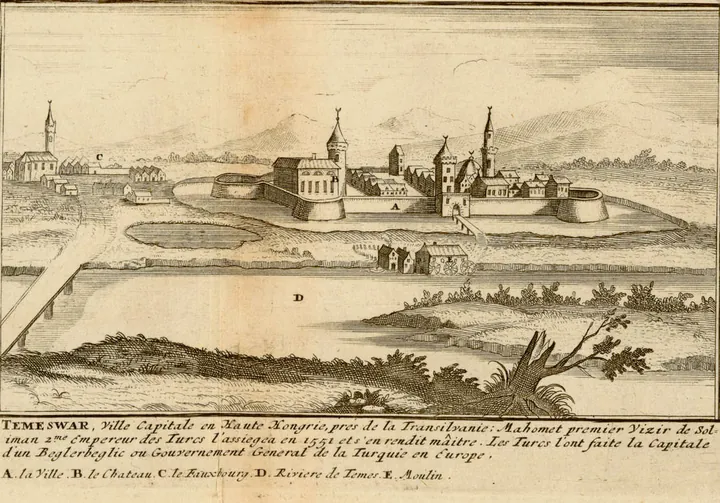

The difference from the Christian towns is in the list itself. In Iași he had counted cellars and monasteries; here he counts baths and mosques. The same categories do not appear on both sides of the border, so the two lists do not compare directly.
For Timișoara in 1660 there is no other count to set beside his. His figures stand alone: nothing contradicts them and nothing supports them.
Stop IV
Oradea
July–August 1660 · a siege of forty-four days
- When
- 27 August 1660, the day of the surrender
- What he counted
- 73,000 captives, as the Tatars told it
- Checked against
- The garrison numbered 850 men and marched out with 300 wounded
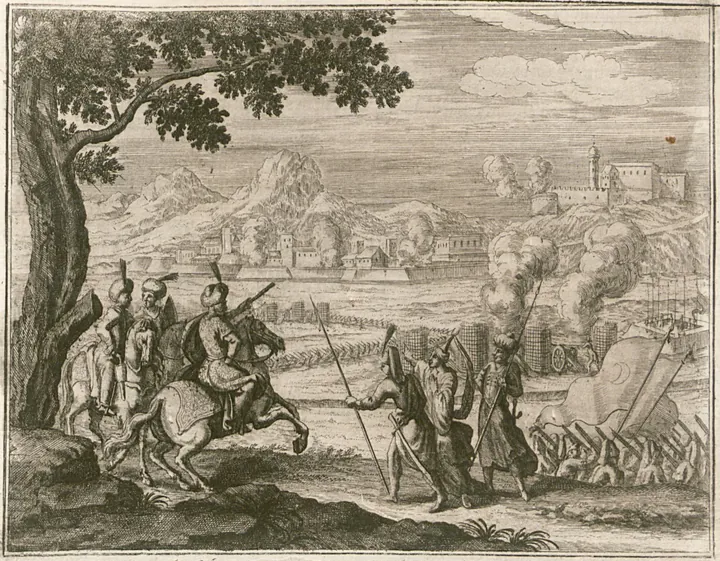
He reached Oradea in midsummer and stayed to the end. The fortress was surrounded on 14 July and surrendered on 27 August, after forty-four days.
His account is that of a man standing in camp rather than over a map: the rumours going round the besiegers, the quarrel between the commanders, the woman who showed where the moat's sluice was, the Hungarian who slipped out of the fortress with news of a mine. Then the surrender: of the seven commanders in the fortress, some come out unarmed first, as hostages, to ask for a week's truce, and at the end the whole garrison marches out.
.jpg)
The figure he gives for captives he does not claim as his own: he heard it from the Tatars, “our warriors hold seventy-three thousand captives”. On the other side, the garrison that held the fortress for forty-four days numbered 850 men at the start and 300 wounded at the end.
“A szélgyorsaságú tatár katonáktól hallottam, midőn mondták: »A mi harczosainknál hetvenháromezer fogoly van.«”
“I heard it from the wind-swift Tatar soldiers, when they said: ‘our warriors hold seventy-three thousand captives.’”
From Karácson Imre's Hungarian translation, 1904, p. 40.
What he watched himself agrees with what is known elsewhere. In front of the fortress stood the gilded bronze statues of the kings of Hungary, among them the mounted Saint Ladislaus cast in 1390 by the brothers Márton and György of Cluj. Evliya describes an agha riding at them with a sword and the statues being cut to pieces and loaded onto carts with the bells. The statues were indeed destroyed then, in August 1660. What he adds are the eyes of night-shining stone and the nails of twenty-carat diamond.
Stop V
Cluj
summer 1661 · the town that opened its gates after its suburb burned
- When
- August 1661
- What he counted
- A wall 4,000 paces round, 40 towers, 4 gates, 11 monasteries
- Checked against
- Nobody else counted the same thing in those years.
In the summer of 1661 Ali Pasha's army entered Transylvania to remove János Kemény and install Mihály Apafi. Evliya rode with it, and the campaign let him see the towns inside the Carpathian arc one after another: Hațeg, Orăștie, Alba Iulia, Turda.
At Cluj the fortress at first refused to submit: inside, he writes, were three thousand of the emperor's soldiers. Once the suburb had been attacked and burned, the flags of submission went up on the bastions and the captain came out with gifts. Evliya writes one sentence that is pure curiosity: “I too, poor man, went in and looked about.”
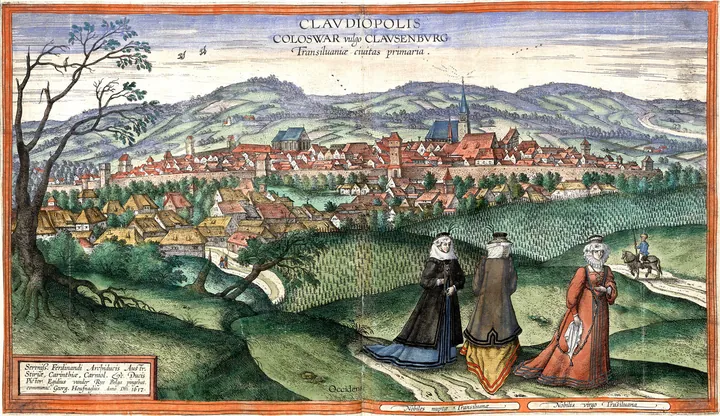

He paced the wall – four thousand paces round – and counted forty towers, four gates and eleven monasteries with tin-covered spires, each with a gilded cross on top. Inside, the villagers of the whole district had crowded in for fear of the army, “so that hardly a foot's width of space was left”.
“Tizenegy szép kolostora van, mindegyiknek cziprushoz hasonló magas tornya van.”
“It has eleven fine monasteries, each with a spire tall as a cypress.”
From Karácson Imre's Hungarian translation, 1904, p. 84.
For the buildings of Cluj in 1661 there is no independent count. What can be said is the order of magnitude of the town: the first modern census, in 1850, found 17,465 people there.
Stop VI
Brașov
autumn 1661 · ten days as a guest, for money
- When
- October–November 1661
- What he counted
- 100,000 people in the fortress, 70 churches, 2,000 shops, 17 inns
- Checked against
- The 1850 census: 21,782 inhabitants
He was sent to Brașov with four thousand soldiers to collect the tribute. The Saxons met them outside the town on horseback, silver staves in hand, and said exactly how long the hospitality would last: “for ten days you are our guests, and on the eleventh we let you go”. In the meantime, Evliya walked the town.
His count here is the largest of the whole journey. Ten thousand rooms inside the walls, forty thousand in the town outside them “so the judges said”, two thousand shops, seventeen inns, seventy churches of which twenty-two belong to monasteries, each holding two hundred priests. And at the end, the judges' reckoning: a hundred thousand people inside.
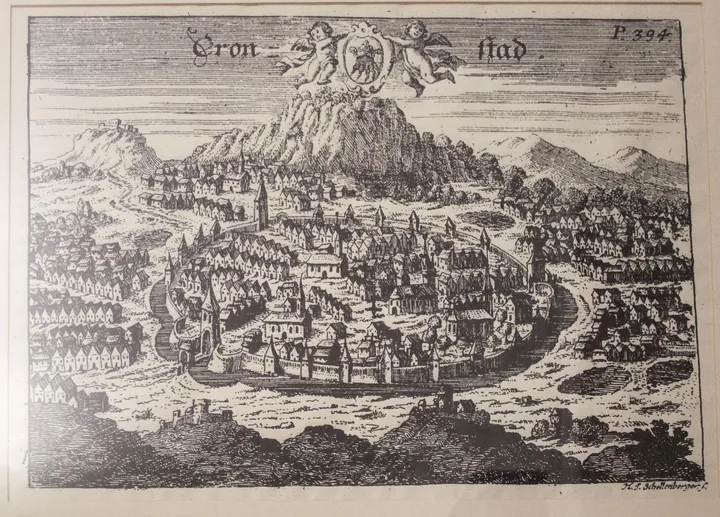

He explains why there were so many: for fear of the Ottoman army, the country around had shut itself inside the walls. The explanation is plausible; the figure is not. The first modern census, in 1850, counted 21,782 people in the whole of Brașov with its suburbs – after nearly two centuries of growth.
“Bíráinak számítása szerint a várban százezer ember volt.”
“By the judges' reckoning there were a hundred thousand people in the fortress.”
From Karácson Imre's Hungarian translation, 1904, p. 146.
The monasteries are a different kind of problem. Brașov had gone over to Lutheranism in the 1540s under Johannes Honterus, and the monastic houses were dissolved then. Twenty-two monasteries had nowhere to stand in the town of 1661, and the four thousand four hundred priests he puts in them would be a fifth of everyone the census found in the whole town two centuries later.
Stop VII
Sibiu
autumn 1661 · the fortress they could not take
- When
- November 1661
- What he counted
- 74 towers, 70 churches, 70 inns, more than 100,000 souls
- Checked against
- The 1850 census: 12,765 inhabitants
From Brașov the road ran to Sibiu. Evliya walked right round the fortress in an hour and a half, and the next day went inside with Ali Pasha's steward.
He counted seventy-four towers, eleven brick bastions, five gates, seventy churches, seventy inns and forty schools. For people he gives two figures in the same description: first six thousand soldiers and sixty thousand men, then, a few lines later, “more than a hundred thousand souls”. The 1850 census found 12,765.
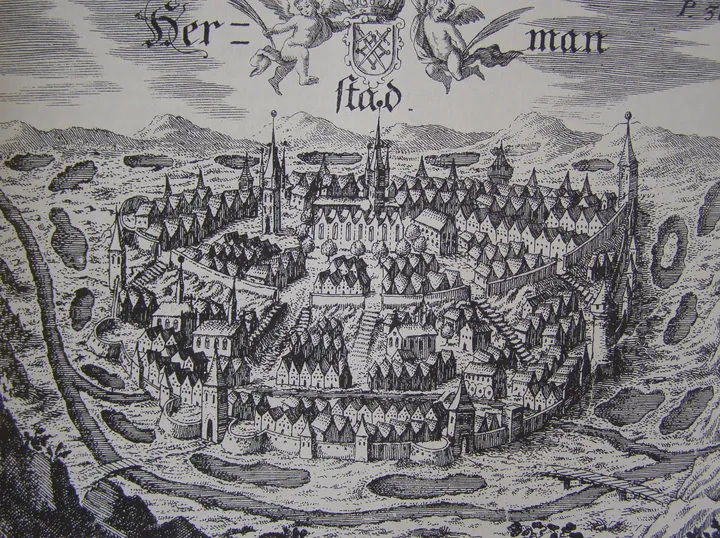

The reason he lingers on the walls is military: he describes the marshes around them, says which side the fortress is weak on, and adds a sentence that leaves nothing to interpretation – should the Ottomans ever besiege Sibiu, a road can be made through the marsh.
“Hetvennégy tornyu, erős erődítmény… benne százezerét felülhaladó lélek van.”
“A strong fortification of seventy-four towers… within it are more than a hundred thousand souls.”
From Karácson Imre's Hungarian translation, 1904: two sentences from the same description, pp. 149 and 150.
He also supplies the proof that the walls held. Two years earlier George II Rákóczi had shut Ákos Barcsay inside them and kept the town under siege, Evliya writes, for a full seven months. The Hungarian archives show the same span: the siege began at the end of 1659 and Rákóczi was still attacking the town in May 1660. Here his figure falls inside what the documents give.
How far off he is
Four of his figures can be set beside an independent count of the same thing. The bar shows how many times larger his figure is than the checked one.
| What he counted | Him | Checked | Times larger |
|---|---|---|---|
| Houses in Iași | 20,000 | 15,000Bandini, 1646 | ×1.3 |
| Monasteries in Iași | 11 | 11Bandini, 1646 | the same |
| People inside Brașov | 100,000 | 21,782The 1850 census | ×4.6 |
| Souls in Sibiu | 100,000 | 12,765The 1850 census | ×7.8 |
The counts are not from the same year: Bandini wrote in 1646, thirteen years before Evliya, and the Austrian census is from 1850, nearly two centuries after him. The towns grew in between, so for Brașov and Sibiu the ratio in the table is smaller than the real one in 1661.
Who wrote the number?
Eight numbers from this page. For each one, guess whether it is Evliya's, the count we checked him against, or both.
-
1
20,000 houses
Iași
The answer
Evliya, in the winter of 1659. Bandini had counted 15,000 thirteen years earlier.
-
2
11 monasteries
Iași
The answer
Both. Evliya writes “eleven”, and Bandini, in 1646, also eleven in the town and near it.
-
3
100,000 people
Brașov
The answer
Evliya, by the town judges' reckoning. The 1850 census found 21,782.
-
4
12,765 inhabitants
Sibiu
The answer
The Austrian census of 1850. Two centuries earlier Evliya had written “more than a hundred thousand souls”.
-
5
7 months of siege
Sibiu
The answer
Evliya. The Hungarian archives give the same span: Rákóczi began the siege at the end of 1659 and was still attacking in May 1660, about half a year.
-
6
850 defenders
Oradea
The answer
Military historians, for the garrison of 1660. Evliya does not count the defenders; he notes what the Tatars told him, that they held 73,000 captives.
-
7
6,000 houses
Bucharest
The answer
Paul of Aleppo, who stayed in the town in the summer of 1657. Evliya passed through Bucharest twice and never counted its houses.
-
8
2,060 shops
Iași
The answer
Evliya. Nobody else counted the shops of Iași in those years, so the figure stands unchecked.
Your score appears here after the first answer.
What cannot be checked
Four places in the text where there is nothing to set alongside – and where he sometimes steps back from the claim himself.
The seventeen thousand dead
For the killing of Muslims in the Wallachian towns in the autumn of 1659, Evliya writes “so they relate” and adds the Arabic formula that leaves the responsibility with the teller. That Mihnea III revolted and struck at the Porte's people is known; the number appears nowhere else.
The coffin from Silivri
He tells how, in the year 1061 of the Hijra (1650–51), when his uncle was grand vizier, he was sent to inspect a marble coffin in an old church near Silivri, holding the untouched body of a girl of three thousand years ago, and how Vasile Lupu paid twenty thousand gold pieces to bring it to Iași. The only relics Vasile Lupu is known to have brought to Iași are those of Saint Parascheva, which arrived on 13 June 1641, a decade before the date in the text.
The mosque in Iași
Of the church in front of the princely court he writes that it had been a mosque in the time of Sultan Bayezid, and that a door was later cut where the mihrab stood and it became a church again. Iași was never under direct Ottoman rule and had no mosque at that date.
The diamond nails
The royal statues at Oradea were of gilded bronze and were indeed destroyed in August 1660. The eyes of night-shining stone and the nails of twenty-carat diamond are his addition.
His Hungarian translator, Karácson Imre, wrote in the introduction to his 1904 volume that his figures for inhabitants and buildings must be brought down to their real value, “because sometimes it is as if he had looked into a multiplying mirror”.
The names, as he wrote them
Copyists mangled many proper names, and he heard them from the people around him. The forms below are those of the printed Ottoman edition and of the Hungarian translation.
| In the Ottoman text | Read as | In Karácson | Today |
|---|---|---|---|
| یاش | Yaş | Jászvásár | Iași |
| بکرش | Bükreş | Bukarest | București |
| ترقووش | Tırgoviş | Tergovistye | Târgoviște |
| یرکوکی | Yergöği | Gyurgyevó | Giurgiu |
| بوزاو | Buzav | Buzó | Buzău |
| فوقشان | Fokşan | Foksány | Focșani |
| تکوج | Tekuç | Tekucs | Tecuci |
| برلاد | Berlad | Berlád | Bârlad |
| وسلوی | Vasluy | Vaszló | Vaslui |
| طمشوار | Temeşvar | Temesvár | Timișoara |
| لیپوه | Lipova | Lippa | Lipova |
| یانووه | Yanova | Jenő | Ineu |
| واراد | Varad | Nagyvárad | Oradea |
| خاصک | Hasek | Hátszeg | Hațeg |
| اردل بلغرادی | Erdel Belgradı | Gyulafehérvár | Alba Iulia |
| قولوژوار | Kolojvar | Kolozsvár | Cluj |
| براشو | Braşov | Brassó | Brașov |
| سبین | Sebin | Szeben | Sibiu |
Sources and method
His text is read in the edition printed in Istanbul by the newspaper İkdam after 1897, from the copy scanned by the University of Toronto library. Joseph von Hammer's English translation, the only old one in English, stops at books I and II and contains nothing of the Romanian lands, so the pages on Moldavia and Wallachia were read directly in Ottoman Turkish, with every figure verified on the page image rather than on the machine-read text. For the Banat and Transylvania this page uses Karácson Imre's Hungarian translation, printed in Budapest in 1904.
The standard Romanian translation, volume VI of Călători străini despre Țările Române (edited by Mustafa Ali Mehmet, 1976), is in copyright: it is cited here as the edition a reader should go to, but no figure on this page comes from it.
The checks are independent counts made by other people: Bishop Marco Bandini's report on Moldavia of 1646; the journal of Archdeacon Paul of Aleppo, who crossed both principalities between 1652 and 1658; the Austrian census of 1850 in Varga E. Árpád's tables. Distances on the map are measured through the places the text names, and the relief is drawn from a thirty-arc-second terrain model.
His text
- Evliya Çelebi, Seyahatnâme, book V, İkdam edition, Istanbul, after 1897 (University of Toronto copy, Internet Archive)
- Evliya Çelebi, Seyahatnâme, book VI, İkdam edition (Transylvania, 1661)
- Karácson Imre (tr.), Evlia Cselebi török világutazó magyarországi utazásai 1660–1664, Budapest, 1904
- Joseph von Hammer (tr.), Narrative of Travels in Europe, Asia, and Africa, London, 1834–1850 (books I–II, without the Romanian lands)
- Călători străini despre Țările Române, vol. VI, ed. Mustafa Ali Mehmet, Bucharest, 1976 (the standard Romanian translation, in copyright)
The counts we checked against
- Marco Bandini, report of the 1646 visitation, in V. A. Urechia (ed.), Codex Bandinus, Bucharest, 1895, p. 83 (Central University Library, Iași)
- Paul of Aleppo, The Travels of Macarius, tr. F. C. Belfour, London, 1829–1836, vols I and II
- Varga E. Árpád, Erdély etnikai és felekezeti statisztikája, county tables, 1850 census row
- The 1660 siege of Oradea: garrison, dates and surrender
- The Hungarian National Archives on the siege of Sibiu, 1659–1660
- The arrival of the relics of Saint Parascheva in Iași, 13 June 1641
- The destruction of the royal statues at Oradea, August 1660
Images
- Photo: Alexander Klink, CC BY 4.0 · Wikimedia Commons
- Carol Popp de Szathmari, 1867; public domain · Wikimedia Commons
- Nicolas Sanson, 1656; public domain · Wikimedia Commons
- Johann Andreas Thelot, 1694; public domain · Wikimedia Commons
- Civitates Orbis Terrarum, 1617; public domain · Wikimedia Commons
- Johann Jakob Schollenberger, 17th century; public domain · Wikimedia Commons
- Unknown author, 17th century; public domain · Wikimedia Commons