Chapter 3 · Inside the EarthLesson 3.1
Earth’s internal structure: crust, mantle and core
The deepest borehole is 12 km deep. How, then, can anyone know what lies 3,000 or 6,000 km beneath your feet?
Before you read: what do you think?
At the centre of Earth, the temperature reaches about 6,000 °C. What state is the iron there in?
See the answer
Solid. The inner core is solid, even at about 6,000 °C: immense pressure holds the iron atoms tightly together. Only the outer core above it is liquid.
The deepest borehole ever drilled, on the Kola Peninsula, reached 12 km. The centre of Earth is about 6,370 km away, so the borehole covered roughly 0.2% of the journey. Almost everything known about the rest comes from measurements at the surface, especially earthquake waves.
Earthquake waves reveal the planet’s interior
The answer comes from earthquakes. A powerful earthquake sends vibrations through the whole planet. Seismographs thousands of kilometres from the broken rock record them after their journey through the depths. These vibrations are called seismic waves.
There are two kinds of seismic wave that travel through the interior. P waves (primary waves) compress and expand rock in the direction they travel; they are the fastest and pass through both solids and liquids. S waves (secondary waves) move rock at right angles to their direction of travel; they are slower and stop in liquids.
The speed of the waves depends on the material they pass through. Where the material changes, their speed changes suddenly and the waves change direction. A surface inside Earth where seismic-wave speed changes suddenly is called a discontinuity. Two major discontinuities divide the planet into three layers.
Three layers: crust, mantle and core
The crust is the outer layer: cold, rigid and very thin. Beneath the oceans it is about 5 km thick and consists mainly of basalt: this is oceanic crust. Beneath continents it averages 30 km and extends much deeper under major mountain ranges; its upper part consists mainly of granite: this is continental crust.
The base of the crust is the Mohorovičić discontinuity, or Moho for short. Below it, seismic waves suddenly speed up, a sign that the rocks are of a different type.
The mantle extends from the Moho to a depth of about 2,900 km. It consists of hot rocks rich in iron and magnesium. The mantle is solid: S waves travel all the way through it.
At the base of the mantle lies the Gutenberg discontinuity. Beyond it begins the core, made mostly of iron and nickel. The outer core, about 2,200 km thick, is liquid. The inner core, with a radius of about 1,250 km, is solid, even though the temperature near the centre reaches about 6,000 °C: immense pressure holds the iron atoms tightly together.
For the curious
The Moho is named after the Croatian seismologist Andrija Mohorovičić.
The crust occupies just 1% of the planet’s volume, and the mantle 84%.
The movement of liquid metal in the outer core produces Earth’s magnetic field.
How the outer core was found to be liquid
At the Gutenberg discontinuity, P waves slow down suddenly and S waves disappear. Seismographs on the opposite side of the planet from an earthquake receive no direct S waves. S waves cannot pass through liquids, so the outer core is liquid.
The same rule shows that the mantle is solid. The picture of a sea of lava with continents floating on it is wrong: magma occurs only locally, in pockets small compared with the volume of the mantle, where rocks partially melt.
For the curious
The core was discovered in 1906 from earthquake records. At the Gutenberg discontinuity, P-wave speed falls by about 40%.
Lithosphere and asthenosphere: dividing the planet by rigidity
The crust, mantle and core differ in composition. The upper part of the planet can also be divided according to how rigid its rocks are.
The lithosphere is the rigid outer layer, made up of the crust and the cold, rigid upper part of the mantle. Across most of the planet it is at least 80 km thick. The lithosphere is broken into plates. It includes the crust and is thicker than it.
Below the lithosphere lies the asthenosphere, a layer of the mantle where rocks are close to their melting temperature. The rocks remain solid, yet deform and flow very slowly, at a few centimetres a year. The lithospheric plates slide on this layer.
For the curious
Lithosphere thickness varies from less than 15 km beneath young ocean floor to 200 km or more beneath old parts of continents.
Worked example
Drawing Earth to scale in your notebook
Draw a cross-section of Earth at a scale of 1 mm for 100 km. The radius of 6,370 km becomes a circle with a radius of 63.7 mm, which fits on a notebook page.
Divide each thickness by 100. The inner core, with a radius of 1,250 km, measures 12.5 mm. The outer core, 2,200 km thick, measures 22 mm. The mantle, about 2,900 km thick, measures 29 mm. Continental crust of 30 km measures 0.3 mm, thinner than the line made by a well-sharpened pencil.
Check: 12.5 + 22 + 29 + 0.3 = 63.8 mm, very close to the radius of the drawing. The small difference comes from rounding the thicknesses. In textbook drawings the crust appears much thicker than it is so that it can be seen.
In Romania
Vrancea earthquakes start below the crust
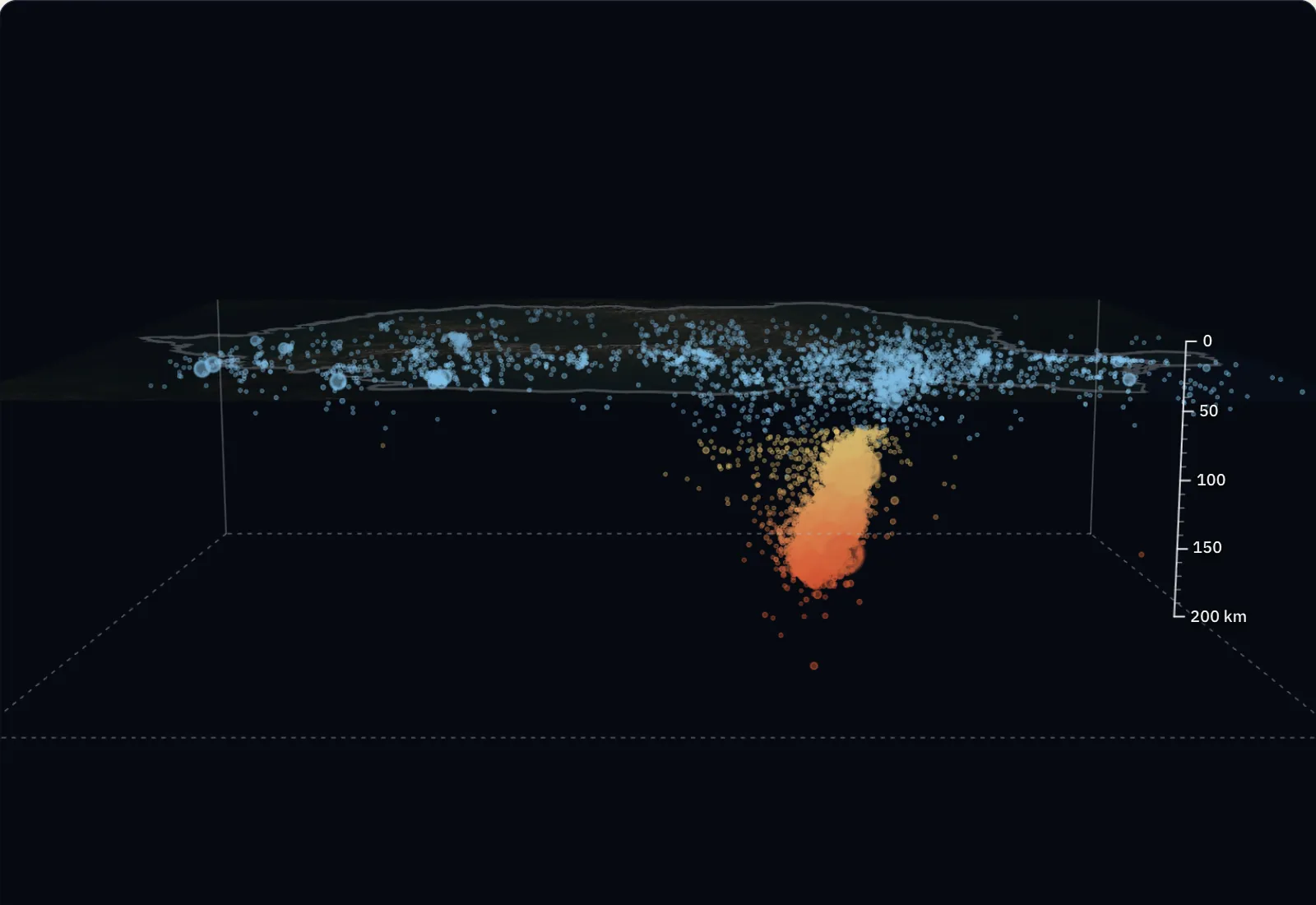
Most earthquakes worldwide occur in the crust, at shallow depths. In the Vrancea area, at the bend of the Carpathians, the main seismic activity occurs at depths of 60–180 km. At these depths the crust has ended: the rocks that break belong to the rigid part of the mantle, within the lithosphere.
The earthquake of 4 March 1977 began at a depth of 94 km, and the one on 10 November 1940 at 150 km. These depths are almost eight and more than 12 times the depth of the Kola borehole. They too were found from seismic waves: the times at which P and S waves reach several seismographs allow the location of their deep starting point to be calculated.
In brief
- Earth’s interior is known indirectly from how P and S seismic waves travel through the planet; the deepest borehole reaches just 12 km of the approximately 6,370 km to the centre.
- Earth has three layers: the crust (about 5 km beneath oceans, averaging 30 km beneath continents), the mantle (down to about 2,900 km) and the core (liquid outside, solid inside).
- The Mohorovičić discontinuity (Moho) separates the crust from the mantle, and the Gutenberg discontinuity separates the mantle from the core.
- The mantle is solid; the only liquid layer is the outer core, which S waves cannot cross.
- The lithosphere is the rigid layer made up of the crust and the upper part of the mantle; beneath it, the asthenosphere slowly deforms and allows the plates to move.
- Oceanic crust is thin and basaltic, while continental crust is thick and has granitic rocks in its upper part.
Common mistakes
WrongThe mantle is liquid lava and the continents float on it.
RightThe mantle is solid: S waves, which stop in liquids, travel through it. Rocks in the asthenosphere deform very slowly, and magma occurs only locally.
WrongThe crust and the lithosphere are the same thing.
RightThe lithosphere includes the crust and the rigid upper part of the mantle, so it is thicker than the crust.
WrongAt the centre of Earth it is so hot that everything is molten.
RightThe inner core is solid, even at about 6,000 °C, because the pressure is immense. Only the outer core is liquid.
Test yourself
Six questions. For the first five you see the explanation at once, with the paragraph of the lesson that supports it; for the ones with a written answer you compare with a good answer.
Which layers does the Mohorovičić discontinuity separate?
Answer
c) Crust and mantle. The Moho is the base of the crust. The Gutenberg discontinuity separates mantle and core.
Which of Earth’s layers is liquid?
Answer
a) Outer core. S waves cannot pass through the outer core. The mantle, including the asthenosphere, and the inner core are solid.
What is the lithosphere made of?
Answer
d) The crust and the rigid upper part of the mantle. The lithosphere is defined by rigidity and includes the crust and the top of the mantle.
What observation showed that the outer core is liquid?
Answer
b) S waves cannot pass through it. S waves stop in liquids. P waves travel through the core, but slow down. No borehole has passed 12 km, and lava comes from local melting of rocks in the mantle and crust.
On a drawing at a scale of 1 mm for 100 km, how many millimetres thick is the mantle, at about 2,900 km?
mmAnswer
29 mm. 2,900 km ÷ 100 km/mm = 29 mm.
In a film, the heroes dig a tunnel and find, 50 km beneath a continent, an ocean of lava with the crust floating on it. What is wrong with this picture, and what is actually there?
A good answer
At 50 km beneath a continent lies the upper mantle, part of the lithosphere; it is solid and rigid. The mantle is solid: S waves, which stop in liquids, travel through it. Magma occurs only locally, and the planet’s only liquid layer is the outer core, below 2,900 km.
A complete answer says that the mantle is solid, gives the evidence of S waves and names the outer core as the only liquid layer.
Terms
- seismic waves
- Vibrations produced by earthquakes that travel through Earth’s interior (P and S waves) and along its surface.
- discontinuity
- A surface inside Earth where seismic-wave speed changes suddenly because the material changes.
- Mohorovičić discontinuity
- The boundary between crust and mantle, called the Moho for short.
- Gutenberg discontinuity
- The boundary between mantle and core, at a depth of about 2,900 km.
- lithosphere
- Earth’s rigid outer layer, made up of the crust and upper mantle and divided into plates.
- asthenosphere
- A layer of the mantle beneath the lithosphere, where rocks are solid but deform slowly.
- core
- The layer at Earth’s centre, made mainly of iron and nickel, with a liquid outer part and a solid inner part.
Sources and link to the programme
- USGS – This Dynamic Earth: Inside the Earth – Crust thickness (about 5 km beneath oceans, averaging 30 km beneath continents), mantle about 2,900 km thick, liquid outer core 2,200 km thick and solid inner core 1,250 km in radius; lithosphere at least 80 km thick over much of Earth (in the text alongside the range from the page on plates); asthenosphere.
- USGS – The Interior of the Earth – Kola borehole (12 km), the Moho and Andrija Mohorovičić, discovery of the core in 1906, S waves unable to cross the outer core, speed dropping by about 40% at the mantle–core boundary (PREM model: from 13.7 to 8.1 km/s), volumes of 1%, 84% and 15%.
- USGS – Earthquakes: How earthquakes happen – Depth to Earth’s centre, about 6,370 km.
- ScienceDaily (comunicat ESRF, 25 aprilie 2013) – Earth's center is 1,000 degrees hotter than previously thought – Temperature of about 6,000 °C near Earth’s centre (Anzellini et al., Science, 2013).
- INCDFP – Raportul proiectului AFROS, 2021 – Main intermediate-depth seismic activity in Vrancea, 60–180 km; crustal domain between 0 and 60 km.
- INCDFP – Turul ghidat „Bucureștii și Cutremurele”, 28 februarie 2026 – Earthquake of 4 March 1977: depth 94 km.
- INCDFP – Turul ghidat „Bucureștii și Cutremurele”, 8 noiembrie 2026 – Earthquake of 10 November 1940: depth 150 km.
- USGS – Understanding plate motions (This Dynamic Earth) – Plate thickness: under 15 km for young oceanic lithosphere, around 200 km or more for old continental lithosphere.
From the programme: “Earth’s internal structure. Minerals and rocks” (common core). Programme competences covered: 1.1, 2.1, 2.3.