
Growing the sky…
Simulated sky: the rings, arcs and their colours are computed; clouds and hills are painted.
This browser cannot draw the live sky, so a still picture of it is shown.
Light, ice and geometry
Halo around the Sun: the rings and arcs made by falling ice
That pale ring around the Sun is sunlight bent through billions of six-sided ice crystals, and it is always the same size. Scroll to watch each ring and arc form in a sky traced from the optics of ice, then see which ones the sky over your town can make, and when.
1
Every ring starts as a six-sided crystal#
High, thin cirrus clouds are made of ice. Some of their crystals are clean hexagonal prisms: flat plates, or longer columns, the six-sided shape of a snowflake without its branches.
Sunlight that enters one side face of a prism and leaves through the next face but one crosses a 60° wedge of ice. In the sky here, millions of such crystals tumble at every angle, and together they draw one ring.
2
Why the ring is 22 degrees#
A 60° wedge of ice cannot bend yellow light by less than 21.8°. Crystals turned other ways bend it more, but the bent light is densest just beyond that angle, and none falls inside it.
That is why the ring has a sharp inner edge and the sky within it looks darker. The angle follows from one measured property, the refractive index of ice: 1.3097 for yellow light. At arm’s length, a hand spread from thumb to little finger covers about 25°, a little more than the ring’s radius.
3
Red inside, blue outside, noted 1,400 years ago#
Ice bends red light a little less than blue: the red edge sits at 21.7°, the blue at 22.3°. So the inner rim is red, and further out the colours overlap and wash to white. Most halos look pale with a reddish edge.
The Book of Jin (晉書), the official history compiled at the Tang court in the 640s, puts it in twelve characters: 日旁有氣,員而周匝,內赤外青, “beside the Sun a vapour, round and closed, red inside, blue-green outside”. It calls this 暈, yun, and reads it as an omen: 日暈者,軍營之象, “the halo is the image of an army camp”.
4
Sundogs: plates that fall flat#
Thin plates drift down with their broad faces nearly level, the way a leaf or a sheet of paper settles. Their side faces are then upright, and every plate sends light sideways through the same kind of 60° wedge.
The result is two bright spots level with the Sun, one on each side: sundogs, or parhelia. They are red on the side facing the Sun, and with the Sun near the horizon they sit right on the 22° ring.
5
If the plates rock, the sundogs smear#
Now the plates rock: their typical tilt grows from half a degree to 12° and back. Each tilt sends the light a little up or down, so the bright spots stretch into strokes and then into the ring.
Sharp, compact sundogs therefore mean the plates are falling very flat.
6
As the Sun climbs, the sundogs move out#
Seen from a higher Sun, a level plate acts like a prism of denser glass. With the Sun on the horizon the sundogs stand 21.8° from it; at a height of 30°, 24.8°; at 50°, 32.4°.
They also grow fainter as they move out, and above about 61° no flat plate can send light that way at all. In the sky here the Sun rises and sets on a loop.
7
The upside-down rainbow#
Light can also enter a plate through its flat top and leave through a side face. That path crosses a 90° edge of ice, and it lands high overhead, in an arc around the point straight above you, bowed toward the Sun: the circumzenithal arc.
It needs a low Sun. With the Sun higher than about 32° (32.5° for red light, 31.2° for blue), the light meets the side face too steeply, is reflected back inside the crystal, and the arc cannot form. A 90° edge spreads the colours wider than a 60° one, and because every plate is turned the same way the colours are not smeared: this arc is vivid where the 22° ring is pale.
8
The circumhorizontal arc, often shared as a “fire rainbow”#
Reverse the path, in through a side face and out through the flat bottom, and the light arrives low in the sky, in a long band level with the horizon, far below the Sun. This one needs a high Sun: above 57.5° for its red edge, above 58.8° for the whole band.
North of about 56° N the Sun never climbs that high (55° N for the whole band). London can show at least the arc’s red edge on 73 days a year, and the whole band on 61, all around midday in late spring and summer; Edinburgh only its red edge, on a few days around the longest day.
Photos shared online as “fire rainbows” often show something else: iridescent cloud, pastel colours made, usually, by tiny water droplets close to the Sun. A true circumhorizontal arc lies about two outstretched hand-widths below the Sun, runs level, and is red along its top.
9
Columns: the arcs that touch the ring#
Long columns fall with their length level, pointing any way along the horizon. They throw an arc that touches the top of the 22° ring like a pair of wings, and a fainter one under it, which stays below the horizon while the Sun is lower than 22°.
As the Sun climbs the wings fold down, and with the Sun above about 32° the two arcs join into one oval around the ring.
10
Stockholm, 20 April 1535#
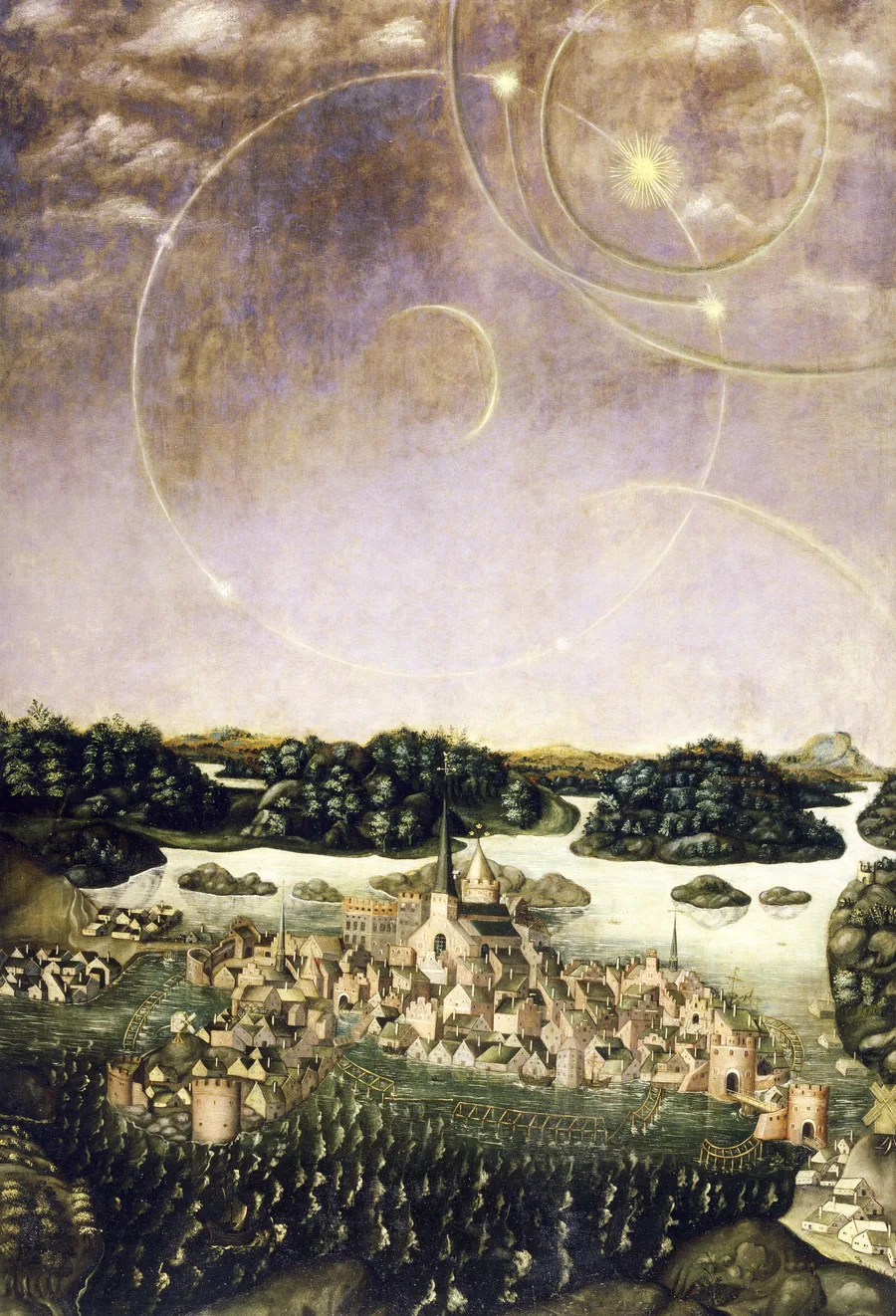
That morning the sky over Stockholm filled with rings and mock suns, and someone painted it for the city’s great church. The panel that hangs there now is a copy made in 1636 by Jacob Heinrich Elbfas; the original is lost.
This is the whole sky as if you lay on your back, with plates, columns and tumbling crystals in one cloud. The ring through the Sun at its own height, the parhelic circle, is on the painting too.
Make your own sky#
Choose the crystals and the height of the Sun. The arcs form as the rays arrive; dragging a slider lets the old sky fade into the new one.
Which arcs your sky can make, and when#
Click the map or type a town. The answer comes from the height of the Sun there, hour by hour through the year. It says when each arc is possible; thin ice cloud still has to be there.
How often can you see a halo?#
More often than most people look. In Germany and nearby, volunteers of the Arbeitskreis Meteore have logged halos since 1979: more than 185,000 entered since 1986, each ring or arc counted separately. Wolfgang Hinz in Schwarzenberg has averaged 111 days a year with a halo over 37 years; Hartmut Bretschneider, with the network’s longest record, 95 days over 44 years. In 2022 Kevin Boyle in Stoke-on-Trent logged 125 halo days, about one day in three.
A sky camera at the German Weather Service observatory in Lindenberg, checked image by image, found halos on 143 days or nights of 2022: 239 halos, 71 of them around the Moon. A camera that tracked the Sun in Munich for over two years saw the 22° ring in about 2% of the daylight time it was recording, and in about a quarter of the time cirrus was overhead. Its authors read that as about one cirrus cloud in four holding enough smooth, clean prisms to draw a ring.
The Atmospheric Optics site says halos appear far more often than rainbows. No count of rainbow days comparable to these halo logs could be found, so that comparison cannot yet be checked with numbers.
Does a ring around the Sun or Moon mean rain?#
Sometimes. Halos come from thin, high cirrus, and the Met Office notes that this cloud often signals an approaching weather front, so a ring can be an early sign of rain. It is a hint, not a forecast.
Moonlight makes the same rings and arcs, with moon dogs (paraselenae) in place of sundogs, only much fainter, so the eye sees little colour in them.
Old records of halos#
The Book of Jin (晉書, compiled in the 640s), in its treatise on astronomy, names the parts of a halo display as omens, mostly for war. Beside 暈, the ring, it lists 珥, “earrings”: 青赤氣員而小,在日左右, small round patches of blue-green and red to the left and right of the Sun, which is where sundogs sit. It also names 抱, a half-ring facing the Sun, and 背, an arc like a young moon turned away from the Sun. Matching those two to modern arcs is a reading, not a certainty. It is a detailed early record, not the first: the passage itself quotes the older Rites of Zhou, and in Greece Aristotle wrote about the halo and mock suns in the 4th century BC.
Stockholm’s Vädersolstavlan, the “sundog painting”, records the display of 20 April 1535. The panel in the Storkyrkan is the 1636 copy by Jacob Heinrich Elbfas; dendrochronology dated its wood to no earlier than about 1620, so it cannot be the 1535 original. In Rome on 24 January 1630, around midday, Christoph Scheiner and others watched what was called seven suns; his drawing of an earlier display, in 1629, went round Europe’s scholars and set Descartes thinking about halos.
What on this page is measured, and what is chosen?#
Measured or computed
The refractive index of ice at every wavelength from 400 to 700 nm, from the table of Warren and Brandt (2008). The paths of light through each crystal: rays enter a face chosen in proportion to its area as seen from the Sun, then reflect or refract at every face by the Fresnel equations, with total internal reflection where it applies. The colours: sunlight taken as a 5,778 K black body, through the CIE 1931 colour-matching functions, white-balanced so the Sun itself is white. The Sun’s height for any place and time: the NOAA solar equations.
The tracer is checked against the formulas it must obey: the 22° and 46° minimum deviations, the sundogs’ distance from the Sun at every height (Bravais’s formula), the Sun heights where the upside-down rainbow and the circumhorizontal arc begin and end. The table below compares them.
Chosen
Which crystals are in the cloud and how much they rock, the thickness of the plates and the length of the columns: real clouds mix all of these, and no measurement here says what was in Stockholm’s sky in 1535. The brightness of the arcs against the sky is set for the screen; real halos are often fainter. The blue of the sky, the cirrus and the hills are painted. Smooth, perfect prisms are assumed; real crystals are often rough or hollow, which dims the arcs and is one reason most cirrus shows none.
Where the windows for your place come from
An arc is “possible” when the Sun is at a height where the crystals can make at least its red edge: below 32.5° for the upside-down rainbow, below 60.9° for sundogs, above 57.5° for the circumhorizontal arc. Red light is the last colour to leave the first two and the first to reach the third; the table above uses yellow light, hence its slightly different heights. Whether an arc appears depends on thin ice cloud with the right crystals, which this page cannot know. Days are counted for 2026, from the Sun’s geometric height without atmospheric refraction, which shifts only the first and last days by a day at most.
| Quantity | Formula | Traced on this page |
|---|---|---|
| Smallest bend through a 60° wedge | 21.8° | 21.8° |
| Smallest bend through a 90° wedge | 45.7° | 45.6° |
| Sundogs from the Sun, Sun at 10° | 22.1° | 22.0° |
| Sundogs from the Sun, Sun at 30° | 24.8° | 24.6° |
| Sundogs from the Sun, Sun at 50° | 32.4° | 32.1° |
| Highest Sun with sundogs | 60.8° | 60.7° |
| Highest Sun with an upside-down rainbow | 32.2° | 32.3° |
| Lowest Sun with a circumhorizontal arc | 57.8° | 57.8° |
Sources#
- Warren, S. G. & Brandt, R. E. (2008). Optical constants of ice from the ultraviolet to the microwave: a revised compilation. Journal of Geophysical Research 113, D14220. Data table.
- Hinz, C. & Hinz, W. (2023). Halos 2022 – Jahresübersicht. Meteoros 26 (3), Arbeitskreis Meteore. PDF.
- Forster, L., Seefeldner, M., Wiegner, M. & Mayer, B. (2017). Ice crystal characterization in cirrus clouds: a sun-tracking camera system and automated detection algorithm for halo displays. Atmospheric Measurement Techniques 10, 2499–2516. Article.
- Sassen, K., Zhu, J. & Benson, S. (2003). Midlatitude cirrus cloud climatology from the Facility for Atmospheric Remote Sensing. IV. Optical displays. Applied Optics 42, 332–341. doi:10.1364/AO.42.000332.
- 晉書 (Book of Jin), 卷十二, 天文志中, 十煇. Wikisource text.
- Vädersolstavlan, Storkyrkan, Stockholm: copy by Jacob Heinrich Elbfas, 1636 (the Commons file credits the lost original to Urban målare, a traditional and doubtful attribution). Wikimedia Commons, public domain.
- Royal Meteorological Society, Haloes and sun dogs. rmets.org.
- Met Office, Optical effects. metoffice.gov.uk.
- World Meteorological Organization, International Cloud Atlas: tangent arcs. cloudatlas.wmo.int.
- Hong Kong Observatory, Circumhorizontal arc. hko.gov.hk.
- EarthSky, Iridescent cloud or circumhorizon arc? How to tell the difference (with Les Cowley). earthsky.org.
- Atmospheric Optics, Frequent halos. atoptics.co.uk.
- Vädersolstavlan, Wikipedia (date of the display, the 1636 copy by Elbfas, the dendrochronology of 1998–1999; the Stockholm city museum record gives the copy as probably 1636). en.wikipedia.org.
- Scientific American, The Seven Suns of Rome (Scheiner, 1629–1630). scientificamerican.com.
- Aristotle, Meteorology, Book III, parts 2–6 (halo and mock suns), trans. E. W. Webster. classics.mit.edu.
- NASA Night Sky Network: the span of an outstretched hand from thumb to little finger, about 25°. nightsky.jpl.nasa.gov.
- dexonline: cearcăn, țărcălan (DEX, CADE, DLRLC). dexonline.ro.
- GeoNames, cities with more than 15,000 people (CC BY 4.0). geonames.org.
- NOAA Global Monitoring Laboratory, solar calculation details. gml.noaa.gov.
