Histria, c. 630 BC – 1914
Who were the Greeks who lived in Romania for a thousand years?
Around 630 BC ships from Miletus founded Histria by the Danube mouths. For nearly 1,300 years the city lived on grain, fish and coins – until the harbor filled with sand, and its name went out in the seventh century.
Histria in four chapters
Representative routeSilt (symbol)
From Miletus to Histria, three ways
Around 630 BC Milesian settlers beached near the Danube mouths; around 480 BC the city struck coins; in AD 100 Rome fixed its boundaries in stone – and in the seventh century the harbor closed with sand.
Below, Histria in four chapters – the founding, the city, Rome and the silt. The routes on the map are representative, drawn through the verified places of the story; the sand discs are a symbol.
Chapter I
The founding
c. 630 – c. 550 BC · c. 630–c. 550 BC, the Milesian settlers
- Chapter
- c. 630 – c. 550 BC
- The founding
- 657/656 or 630 BC
- The name
- from Istros, the Danube
- The walls
- 600–550 BC, earth on stone
Miletus, the city that sent ships all over the Black Sea, founded Histria in the mid-seventh century BC – so say the sources: Eusebius puts the foundation in 657/656 BC, Pseudo-Scymnus in 630 BC. It was the first urban settlement on today's Romanian territory, a port for trade with the native Getae.
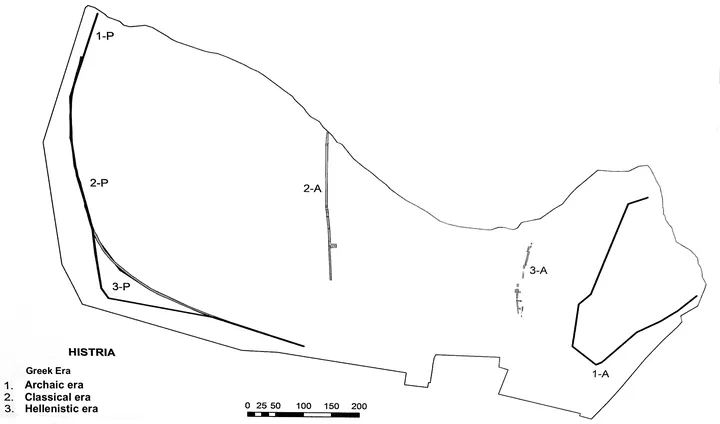
The city's name comes from Istros, the Greeks' Danube: Histria means 'by the Danube'. Strabo wrote that it lies 500 stadia from the sacred mouth of the Ister. Between 600 and 550 BC the city raised earth walls on stone plinths against the Scythians; at the end of the sixth century BC it was destroyed, then rebuilt, with new temples.


In the north-east corner of the acropolis, the Sacred Area worked from the seventh century BC: a small temple for Apollo Ietros, the Healer, under the protection of Zeus Polieus. After the middle of the sixth century BC 4 temples rose, 3 of yellow limestone, with painted terracotta roofs, all facing south, about 8 by 16 metres.
Miletus had just then come to the very height of its prosperity and was the ornament of Ionia.
Herodotus, 5.28, Macaulay translation
Meanwhile Meanwhile, local potters were learning the trade: pottery, metal and glass were made on the spot from the mid-sixth century BC.
Chapter II
The city
c. 550 – 30 BC · c. 550–30 BC, the polis
- Chapter
- c. 550 – 30 BC
- The coin
- the 8-gram drachma, c. 480 BC
- The grain
- Histria fed Greece
- The ransom
- 5 talents for Zoltes, c. 200 BC
Histria joined the Delian League and passed, through a revolt of its inhabitants, from oligarchy to democracy – the change Aristotle records in the Politics. Between the Odrysian kingdom and the Scythians of Ariapeithes, the city kept its balance: Athenian ships came to collect contributions in the years of the Peloponnesian War, 431–404 BC.
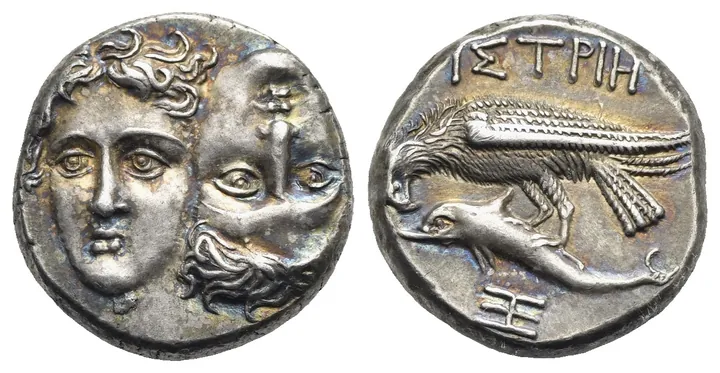
Around 480 BC Histria struck the first coins on Romanian territory: cast silver drachmas, with eagle on dolphin and the city's legend. Its coins circulated through the whole region, and the city became a major grain supplier for Greece.


Hard centuries followed: the 260 BC defeat by Byzantion, the siege of the Getan Zoltes lifted for 5 talents around 200 BC, the garrison of Mithridates, then Burebista, before 30 BC. At the end of the Hellenistic age the city was subjugated, but whole.
At Massalia the oligarchy became more like a constitutional government, but at Istros ended in a democracy.
Aristotle, Politics V.6, Jowett translation
Meanwhile Meanwhile, the city was building its theatre, gymnasium and temple of the great god.
Chapter III
Rome
29 BC – AD 295 · 29 BC–AD 295, the province
- Chapter
- 29 BC – AD 295
- The boundary
- AD 100, to the Delta
- The baths
- a 20-kilometre aqueduct
- The rebuilding
- 6–7 hectares after 238
In 29 BC Crassus annexed Dobrogea, and Histria came under Roman rule. Two centuries of prosperity followed: a new city wall, baths, temples, laws cut in stone. In AD 100 the governor of Moesia Inferior, Laberius Maximus, confirmed in a long inscription the Histrian boundaries, to the Danube Delta, where the city drew its income from salted fish.
Under Caracalla (211–217) the inscriptions call Histria 'the most brilliant city of the Histrians'. Thermae I, enlarged at the start of the second century, took water through a Roman aqueduct 20 kilometres long; Thermae II, from the start of the same century, covered 1,000 square metres.
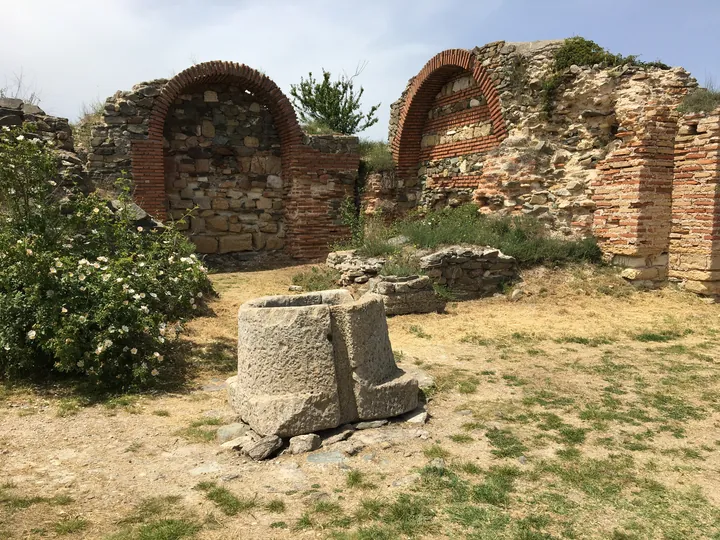

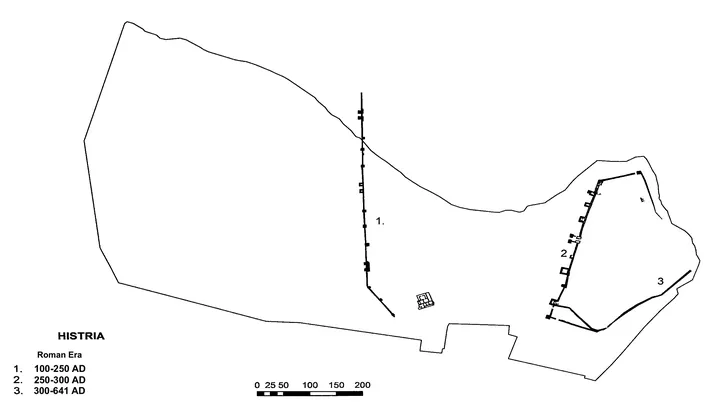

Prosperity broke in 238, when the Carpi (Goths) razed the city. Histria was rebuilt on 6–7 hectares, with a stronger wall, and kept its Greek identity. The walls fell again in 295 and were rebuilt under Diocletian and Constantine.
'FINES HISTRIANORVM HOS ESSE…': these are to be the boundaries of the Histrians.
The Horothesia of Laberius Maximus, AD 100 (own translation)
Meanwhile Meanwhile, on the Tabula Peutingeriana Histria stands 11 Roman miles from Tomis and 9 from Ad Stoma.
Chapter IV
The silt
295 – 1914 · 295–1914, the silting
- Chapter
- 295 – 1914
- The gulf
- Halmyris, today Lake Sinoe
- The bishopric
- the 60 by 30 metre basilica
- The dig
- Pârvan, from 1914; the museum, 1982
The Halmyris gulf slowly closed with sand, and the way out to sea was gradually cut – but trade held into the sixth century, when luxurious houses with atria and colonnades rose. In the fifth and sixth centuries Histria became a bishopric: the episcopal basilica in the city centre, over 60 by 30 metres, was brought to light in 1969 by Alexandru Suceveanu.
In the seventh century the invasions of the Avars and Slavs destroyed the city, and its name was lost. Today's Lake Sinoe was once the gulf open to the sea; parts of the city lie under its murky waters, and the old port in the southern bay became dry land.
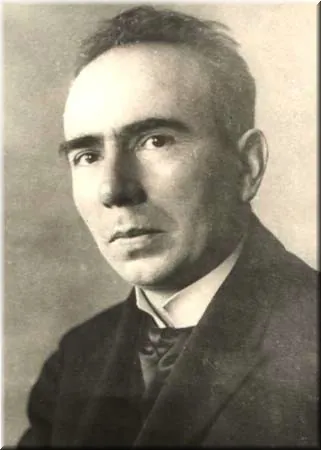

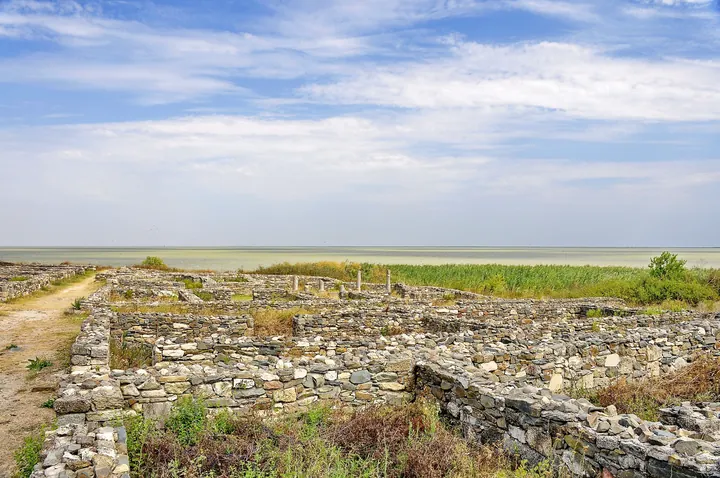

The ruins were identified in 1868 by the Frenchman Ernest Desjardins, and Vasile Pârvan started the digs in 1914 – in the very first campaign he found the Horothesia, the boundary stone. Lambrino, Condurachi, Pippidi, Alexandrescu and Suceveanu followed, and from 2010 Avram and Angelescu; the museum opened in 1982.
I say then that the silting up of the Pontus has gone on from time immemorial and still continues.
Polybius, 4.40, Loeb 1922 (own translation)
Meanwhile Meanwhile, at Sulina, another harbor was being killed by alluvium too – the story is told at length on the Sulina 1856 page.
Read the stone
Four stones about the coin, the ransom, the boundary and the brilliance. Choose, then check against the sources.
-
1
The coin
The drachm reads ISTPIE. What does the legend mean?
What happened
Of the Histrians: the free city's coin, struck from around 480 BC. The first coins on Romanian territory came out of Histria's moulds.
-
2
The ransom
Around 200 BC the Getan Zoltes besieges the city. The stone says he lifted the siege for:
What happened
5 talents: the price in decree ISM I 15. Histria bought its quiet with silver, about 30,000 drachmas.
-
3
The boundary
The stone found by Pârvan in the first campaign, 1914, begins: FINES HISTRIANORVM HOS ESSE. What does it say?
What happened
The boundaries: in AD 100 governor Laberius Maximus fixed the city's territory in stone, to the Danube Delta.
-
4
The brilliance
Under Caracalla (211–217), an inscription calls Histria 'the most brilliant city'. What kind of city?
What happened
The most brilliant: the formula honors the glorious past and the city's then-boom, still Greek under Rome.
Answer a stone to begin.
Seven plates
Seven images, in the order of the story: the plan, the city from above, the coin, the walls, the baths, the dig, Pârvan.
Plate 2024The site plan
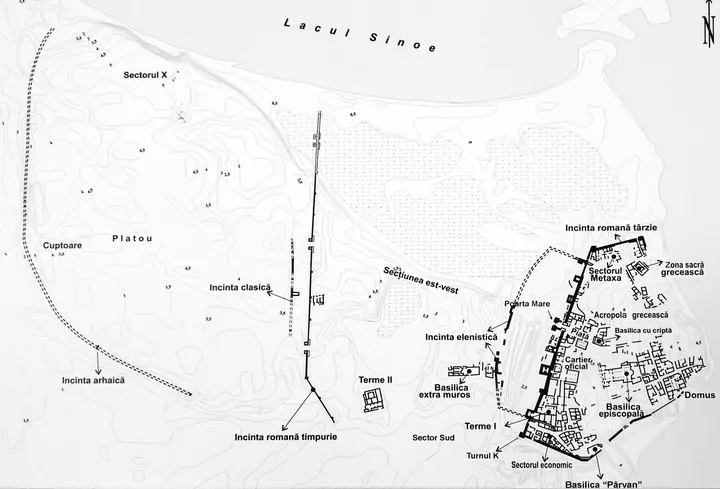
The site plan Rjdeadly, 2024 · Wikimedia Commons - The acropolis, the civil plateau and the necropolis, at a glance.
- Plan drawn in 2024, after a century of digs started in 1914.
- Lake Sinoe was the open gulf; the port lay south.
Plate 2018The city from above
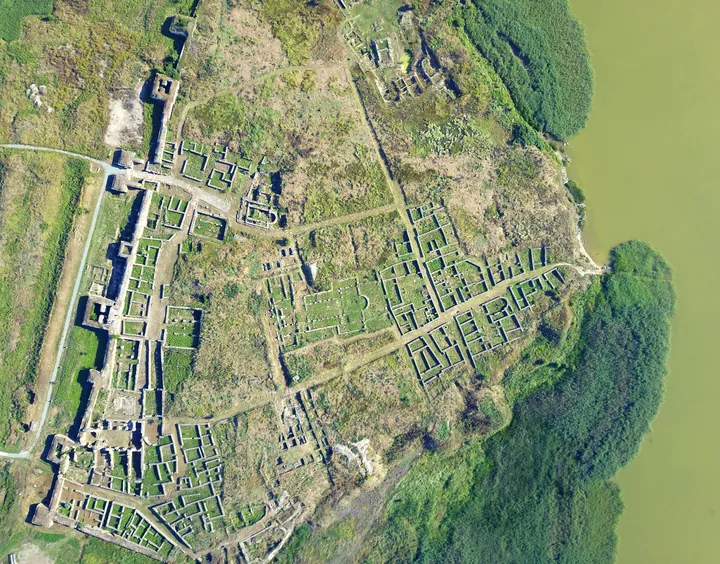
The city from above Neighbor's goat, 2018 · Wikimedia Commons - Aerial photograph from 2018: the late walls read like a map.
- The acropolis on the lakeshore; the civil town, 800 metres west.
- This page's opening image: no 'mysterious' fortress looks like this.
Plate 2025The drachm
The drachm Asi7777, 2025 · Wikimedia Commons - The Dioscuri heads, eagle on dolphin, the ISTPIE legend.
- A fourth-century BC coin, photographed in 2025.
- The first coins on Romania's territory, from around 480 BC.
Plate 2024The Greek walls
The Greek walls Rjdeadly, 2024 · Wikimedia Commons - From the 600–550 BC earth rampart to the Hellenistic stone circuit.
- The Hellenistic wall marks the retreat: the harbor had begun to silt.
- Plan drawn in 2024.
Plate 2024The baths
The baths Rjdeadly, 2024 · Wikimedia Commons - The palaestra of Thermae I, photographed in 2024.
- The baths were enlarged at the start of the second century and destroyed in 238.
- Water came through a 20-kilometre aqueduct.
Plate 2015The dig
The dig Mtoderic, 2015 · Wikimedia Commons - Dug-out walls, photographed in 2015.
- Digs started in 1914, continued by Lambrino, Condurachi, Pippidi, Alexandrescu, Suceveanu, Avram and Angelescu.
- A 2019 volume is called 'Histria. One hundred archaeological campaigns'.
Plate 1882 – 1927Pârvan
Pârvan Unknown photographer · Wikimedia Commons - Vasile Pârvan (1882–1927), who opened the dig in 1914.
- In the very first campaign he found the Horothesia, the boundary stone.
- Period portrait, undocumented photographer, public domain.
Photographs via Wikimedia Commons (public domain, CC0, or CC BY or CC BY-SA with credit). Dates are plate references.
Histria in six numbers
Every figure below comes from the cited sources. The years are the spine, 630 BC – 1914.
- 630
- the foundation after Pseudo-Scymnus (BC)
- 480
- the first coins (BC)
- 100
- the boundary fixed in stone
- 238
- the city razed by the Carpi
- 1,868
- Desjardins identifies the ruins
- 1,914
- Pârvan opens the dig
Three things people get wrong
A mysterious fortress
False: Histria is among the most dug sites in the country – a dig since 1914, a museum since 1982, first on the 2000 priority-zones list, plus a 2019 volume titled 'One hundred archaeological campaigns'. The trenches are still visible.
The Greeks stayed briefly
False: nearly 1,300 years of unbroken development, from the seventh century BC to the seventh century AD – polis, democracy, own coinage, then a Greek city under Rome.
The harbor died overnight
False: the silting started in the Hellenistic age – Polybius already saw it –, and trade held into the sixth century. The end was brought by the seventh-century invasions, not the sand alone.
Sources and methods
The story follows the Histria histories (English and Romanian); the ancient quotes come from public-domain translations – Macaulay, Jowett, Loeb 1922 –, and the stone formulas are our own translations, marked as such. All eight images are public domain, CC0 or CC with credit, via Wikimedia Commons.
The dates are the sources': old-era years take BC, new-era years AD. City names follow the period – Istros, then Histria under Rome.
What could not be proven is not claimed: no Pârvan quote (no public-domain text was found), no rounded number. 'One hundred campaigns' is the title of a 2019 volume, not our own count.
The founding
- The Milesian foundation in the mid-7th century BC: 657/656 BC after Eusebius, 630 BC after Pseudo-Scymnus; the oldest urban settlement on Romanian territory
- Miletus, the ornament of Ionia, and the 600–550 BC walls; the Sacred Area from the 7th century BC, Apollo Ietros and Zeus Polieus
- Herodotus 5.28 on Miletus in the Macaulay translation (public domain, Project Gutenberg)
The city
- Aristotle, Politics V.6: at Istros the oligarchy ended in a democracy (Jowett translation, public domain)
- The first coins on Romanian territory, the 8-gram silver drachma of c.480 BC; trade with Miletus, Rhodes, Samos and Athens; grain for Greece
- Zoltes lifts the siege for 5 talents c.200 BC; the 260 BC defeat; the Mithridates garrison; Burebista before 30 BC
Rome
- The 29 BC annexation; Laberius Maximus confirms in AD 100 the Histrian boundaries to the Danube Delta; under Caracalla, the most brilliant city
- The Horothesia found by Pârvan in the very first campaign, 1914; the Tabula Peutingeriana: 11 Roman miles from Tomis, 9 from Ad Stoma
- The 238 destruction, the rebuilding on 6–7 hectares; the walls destroyed in 295, rebuilt under Diocletian and Constantine
The silt
- Polybius 4.40–41 on the silting Pontus (Loeb 1922, public domain): the Danube alluvium, the sandbank, the grounded ships
- The southern bay, the port; the silting of the Halmyris gulf; trade into the 6th century; Avars and Slavs in the 7th; nearly 1,300 years of development
- Desjardins 1868, Pârvan from 1914, the 1982 museum; another harbor killed by alluvium: Sulina 1856
The seven plates
Images
- Rjdeadly, 2024 · Wikimedia Commons
- Neighbor's goat, 2018 · Wikimedia Commons
- Asi7777, 2025 · Wikimedia Commons
- Unknown photographer · Wikimedia Commons
- Rjdeadly, 2024 · Wikimedia Commons
- Rjdeadly, 2024 · Wikimedia Commons
- Rjdeadly, 2024 · Wikimedia Commons
- Mtoderic, 2015 · Wikimedia Commons