Apuseni – Deva – Alba Iulia, 1784–1785
What did Horea's rising demand?
Between 31 October 1784 and 28 February 1785 the serfs of the Apuseni rose, wrote their program into an ultimatum, lost the winter war, and watched two of their leaders broken on the wheel – then, on 2 August 1785, the emperor freed them from the soil.
Representative road
Four weeks, four demands
On 31 October the serfs swore at Mesteacăn, on 3 November they burned their first manor, on 11 November they wrote their program into an ultimatum at Deva – and on 28 February two of their leaders died on the wheel at Alba Iulia. Below, the rising in four chapters: the spark, November, the winter, the wheel.
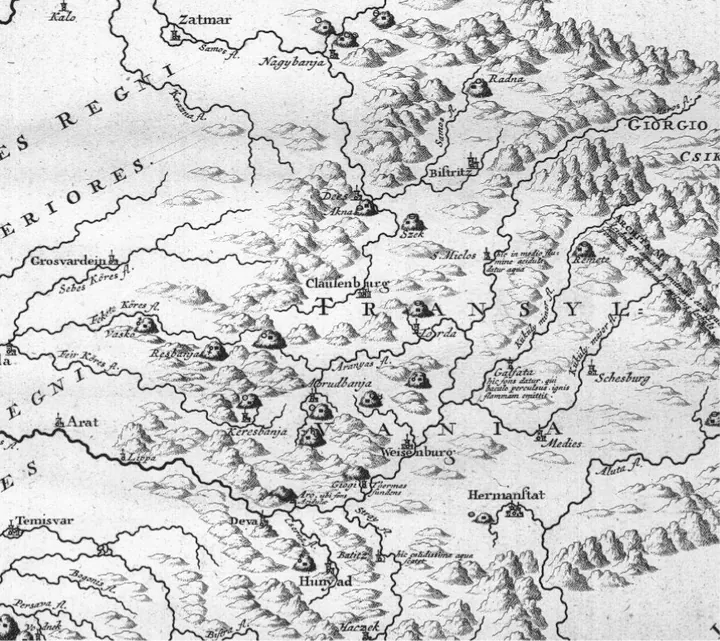
The roads on the map are representative: Mesteacăn–Curechiu–Crișcior, the first march; Brad–Deva, the November push down the Mureș; Câmpeni–Alba Iulia, the winter road from defeat to prison.
Chapter I
The spark
31 October – 3 November 1784 · Zarand, 1784, the oath
- Chapter
- 31 October – 3 November 1784
- The oath
- 31 October, Mesteacăn, 500–600 peasants
- The night
- Curechiu, the hussars repelled
- The turn
- 3 November, Crișcior
On 31 January 1784 Joseph II ordered lists of volunteers for the Transylvanian border regiments: arms, no more serf duties, the land in use becoming theirs. In June a misread proclamation at the Alba Iulia fair started a rush – by August, villeins from some 80 villages had signed up and many stopped doing corvée – until Governor Samuel von Brukenthal, pressed by the Hungarian nobility, annulled the whole enrollment.
On 28 October Crișan came to the Brad weekly fair with news that Horea had brought new orders from the emperor, to be read the next Sunday at the Mesteacăn church. On 31 October 500–600 serf peasants gathered; Crișan showed them a gilt cross, Horea's warrant from the emperor, and they resolved to march to Alba Iulia and take imperial service.

They crossed the mountain past Brad by night and slept at Curechiu, where the hussars attacked them – and were beaten and disarmed. The attack changed the plan: the rebels turned back toward Brad and on 3 November stormed the Kristyory manor at Crișcior. One column climbed toward Abrud through Mihăileni; the other took Brad, Baia de Criș, Ribița, Hălmagiu and the Criș valley.
Meanwhile Meanwhile, in Vienna, nobody yet knew: the court would only hear of the rising on 12 November.
Chapter II
November
4 – 29 November 1784 · The Mureș valley, 1784, the ultimatum
- Chapter
- 4 – 29 November 1784
- The push
- 4 November, Brănișca burns
- The ultimatum
- 11 November, Deva
- The victories
- Brad 27th, Lupșa and Râmeț 29th
On 4 November the peasants burned Baron Anton Iosika's castle at Brănișca on the Mureș, and in the next two days every noble manor in the communes down the valley – Sulighet, Bretea, Ilia, Sârbi, Gurasada, Tătărești, Leșnic, Dobra, Roșcani, Geoagiu. On 5 November the rising reached the edge of Deva but failed to take the town – and there the nobles, with hussars, crushed the local rising and summarily executed 56 prisoners.
On 11 November Horea addressed the nobility sheltered in Deva an ultimatum that put the rising's program in writing: the noble county and every landlord to swear on the cross; nobles no more, each to live by a trade he can find; the landlords to leave their estates once and for all; nobles to pay taxes like the common people; peace in exchange, sealed with white flags on the fortress. The program added the freeing of the arrested peasants.

The rising spread to Arad and Sibiu, and Saxon and Hungarian peasants joined it. To gain time, the authorities signed truces at Tibru, Valea Bradului and Sălciua – and at Brad on 27 November, at Lupșa and Râmeț on 29 November, the rebels beat the imperial troops in hard fighting.
Nobles no more – and they to pay taxes like the common people. And in sign of peace to raise, on the fortress, white flags on poles as high as may be.
The ultimatum to the Deva nobility, 11 November 1784
Meanwhile Meanwhile in Vienna, between 12 and 19 November, Joseph II put two regiments on alert, set 300 ducats on the leaders' heads, and sent Jankovics to investigate.
Chapter III
The winter
December 1784 – January 1785 · The Apuseni, the defeat, the betrayal
- Chapter
- December 1784 – January 1785
- The defeat
- 7 December, Mihăileni
- The capture
- 27 December, Scorușet forest
- The prison
- 30 January 1785, Alba Iulia
On 7 December Kray routed Crișan's men at Blăjeni – the defeat the chronicles call Mihăileni – and four days later Schultz's artillery scattered the Zalatna insurgents. About a week after that, Horea called his men home for the winter. On 14 December, at Câmpeni, he formally ended the rising.
The emperor's orders of 13 December had already set the end in motion: General Fabris took command, and two columns of 750–800 men each closed on the mountains – Kray's through the Căian valley, Schultz's through the Ompoi valley toward Abrud and Câmpeni.

Vienna had set 300 ducats on the leaders' heads, the passes into Wallachia and Moldavia were watched, and Constantinople was asked to give the rebels no asylum. On 27 December, through the forester Anton Melzer and seven peasants, Horea and Cloșca were taken in the Scorușet forest; on 30 January 1785 Crișan, sold by nine Cărpeniș peasants, followed them into the Alba Iulia prison and the hands of Baron Anton Iankovic's commission.
Horea drew a handful of papers from his bosom and threw them into the flames.
David Prodan, Răscoala lui Horea, vol. II (1984), p. 143, on the capture of 27 December 1784
Meanwhile Meanwhile in Vienna, on 10 January 1785, the emperor ordered the execution to be a spectacle the villeins would not forget – his will, not the Gubernium's.
Chapter IV
The wheel
28 February – 2 August 1785 · Alba Iulia, 1785, the patent
- Chapter
- 28 February – 2 August 1785
- The wheel
- 28 February, Dealul Furcilor
- The rewards
- 600 galbeni and freedom
- The patent
- 2 August, freed from the soil
Crișan hanged himself in prison. On 28 February at 9:00 the procession set out: Horea and Cloșca in two separate carts with priest Rațiu beside them to the end, a Toscana cavalry squadron and about 300 infantry and hussars around them, and 2,500–3,000 serfs driven in from over 400 villages. Cloșca died first, under 20 blows, with Horea watching on his feet; then Horea took 4 blows to the legs, the executioner Grancea Rakoczi of Alba Iulia crushed his chest, and after 8–9 more blows he gave up his soul. Both bodies were quartered and impaled across Alba and Hunedoara, and Crișan's body was treated the same.
The emperor's rewards, tallied by Prodan, were prompt: the seven moți 600 galbeni and freedom from serfdom, the forester 100, Crișan's betrayers 30, a gold medal for archpriest Iosif Adamovici, 70 for Crișan's captors, and 1,000 florins for Bishop Ghedeon Nichitici – dealt out with due solemnity on market days, before the usual crowd.


Hundreds of moți were deported to Banat and Bucovina with their cattle and tools. Those who stayed kept pasture freedom, exemption from cartage, marriage without the noble's consent, and schooling – and on 2 August 1785 Joseph II decreed the villeins no longer bound to the soil, reiterating 16 July 1783. The socage reform itself failed; the only concrete change was that villeins became free to move. Europe kept the pictures: the broadsheets, the «Rex Daciae» nickname, Brissot's banned letter – and in 1791 the Supplex Libellus Valachorum took the demands back to paper at Cluj.
Meanwhile Meanwhile in Paris, Brissot's open letter to Joseph II defended the subjects' right to revolt – and France banned it.
Four demands, three verdicts
What the ultimatum said on 11 November, what 1784 answered, and what the August 1785 patent kept.
| x | The ultimatum, 11 November | 1784's answer | The patent, 2 August 1785 |
|---|---|---|---|
| No more nobles | Swear on the cross: nobles no more, each to live by a trade. | Refused: the Deva nobles fought and waited for the army. | The noble stayed; the villein was freed from the soil, not from dues. |
| The estates | The landlords to leave their estates, once and for all. | Manors burned in November, retaken by December. | No land changed hands; the plot could no longer be taken away. |
| The taxes | Nobles to pay taxes like the common people. | Never conceded: the winter columns came instead. | Not granted: the patent freed the person, not the purse. |
| The peace | Peace for white flags on the fortress and at the town edge. | No white flags: 56 executed at Deva, then the wheel. | Peace by decree: some 300 freed, some 180 flogged, the rest jailed. |
Would you sign the ultimatum?
Four demands, four cards: stand where they stood at Deva on 11 November 1784, choose, then read 1784's answer.
-
1
The oath
You are a noble fled to Deva. The rebels demand an oath on the cross: nobles no more.
The answer
Deva held: the nobles fought off the rising and summarily executed 56 prisoners. No oath was ever sworn.
-
2
The estates
You command the county hajdús. The demand: every landlord off his estate, for good.
The answer
Truces at Tibru, Valea Bradului and Sălciua bought time; Kray's and Schultz's columns settled it in December.
-
3
The taxes
You are a serf in the camp before Deva. Snow is coming and the emperor's troops are marching.
The answer
Horea himself called the men home for the winter after Mihăileni, 7 December. The rising never reassembled.
-
4
The white flags
You hold Alba Iulia's keys in February 1785. The ultimatum promised peace for white flags.
The answer
The scaffold: Horea and Cloșca were broken on the wheel on 28 February 1785 before thousands of driven-in serfs.
Answer a card to begin.
Seven plates, 1726–1791
Seven images in the story's order: the leaders, the emperor, the pair, the Viennese print, the wheel, the memory, the sequel.
Plate c.1784The leaders
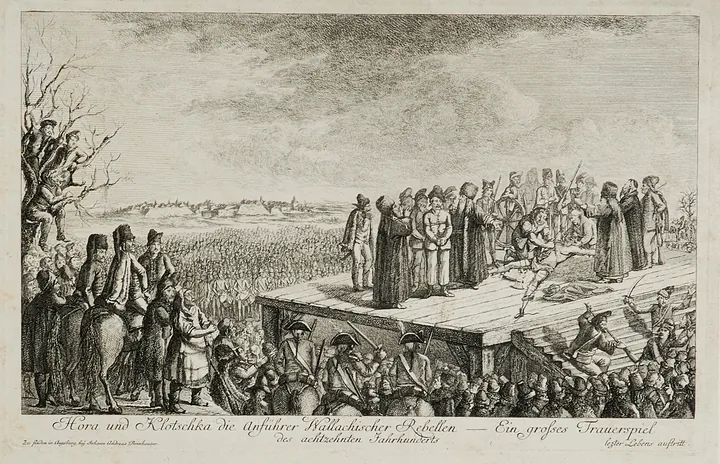
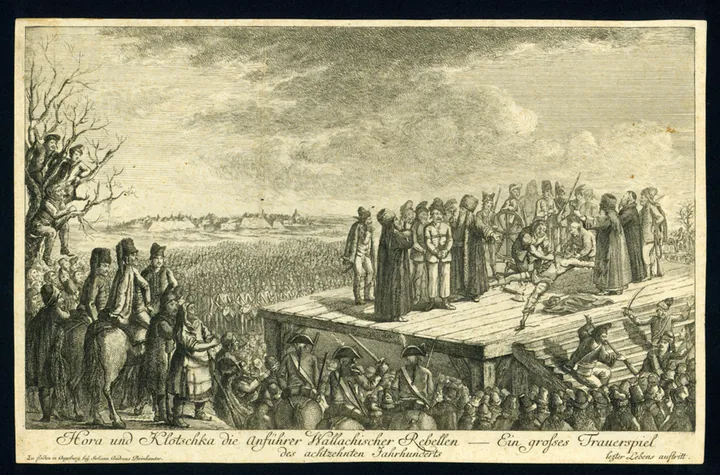
The leaders Augsburg print, c.1784 · Wikimedia Commons - «Hora und Klotschka, die Anführer Wallachischer Rebellen», sold at Augsburg by Brinhauser.
- The rebel leaders as Europe pictured them, while the rising still burned.
- A German legend for a Transylvanian rising: leaders of the «Wallachian rebels».
Plate sec. XVIIIThe emperor
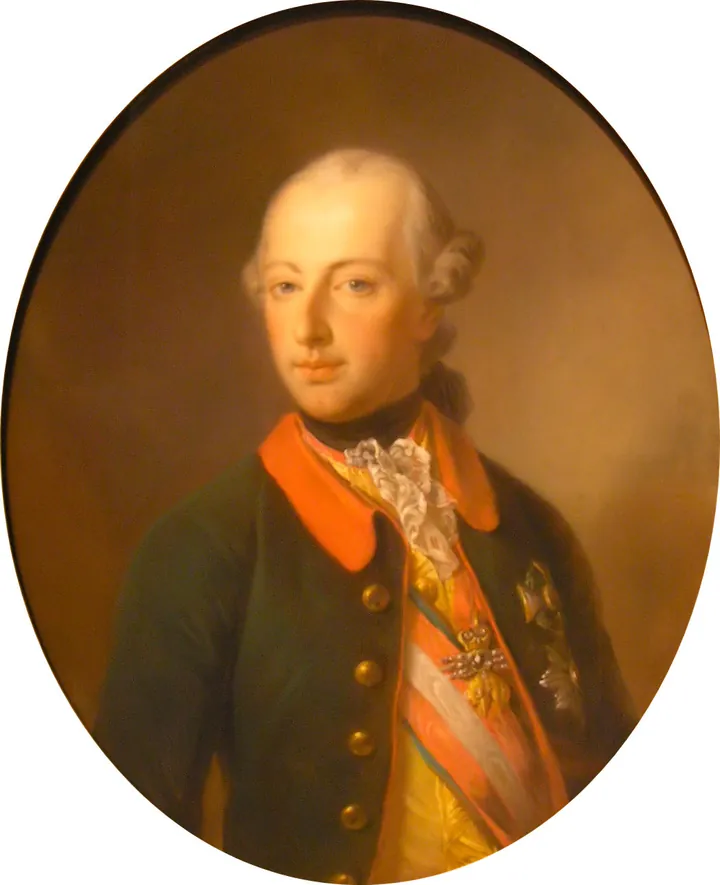
The emperor Georg Decker · Wikimedia Commons - Joseph II, painted by Georg Decker: the emperor in whose name everything was done.
- In 1773 he gathered some 19,000 petitions in Transylvania; Horea came to Vienna four times.
- His border-guard order of 31 January 1784 lit the fuse; his patent of 2 August 1785 closed the account.
Plate sec. XVIIIThe pair
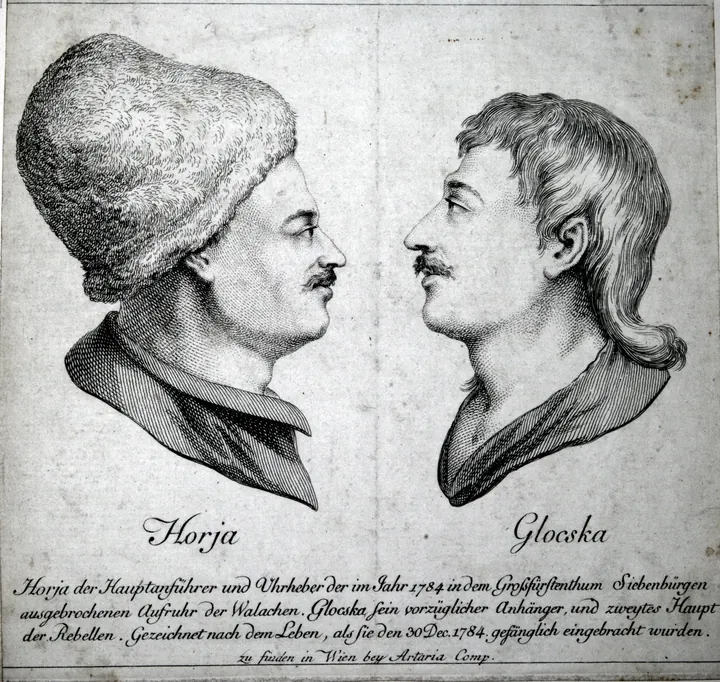
The pair eighteenth-century print · Wikimedia Commons - «Horja and Clocska» in an eighteenth-century print, side by side.
- Three leaders, two faces: the broadsheets always pair these two.
- Crișan, who called the Mesteacăn gathering, is the third the pair leaves out.
Plate 1785The Viennese
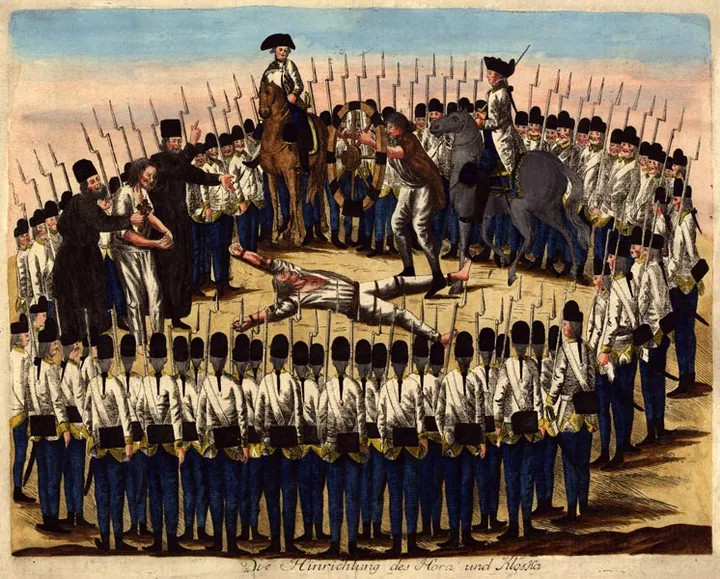
The Viennese Hieronymus Löschenkohl, Vienna 1785 · Wikimedia Commons - The execution as Vienna pictured it: Hieronymus Löschenkohl, 1785.
- Broadsheets carried the rising from Austria to Portugal.
- Stockholm followed it too, through correspondences dated 7 January 1785.
Plate sec. XVIIIThe wheel
The wheel eighteenth-century engraving · Wikimedia Commons - An eighteenth-century engraving of the execution of Horea and Cloșca.
- Cloșca first, Horea watching; then Horea's turn under the wheel.
- Dealul Furcilor, Alba Iulia, 28 February 1785.
Plate c.1865The memory
The memory Retrospective print, c.1865 · Wikimedia Commons - A retrospective print of c.1865: the next century remembers the leaders.
- Its title misdates the execution to 1784.
- The wheel turned on 28 February 1785 – the plate's one error, kept on record.
Plate 1791The sequel
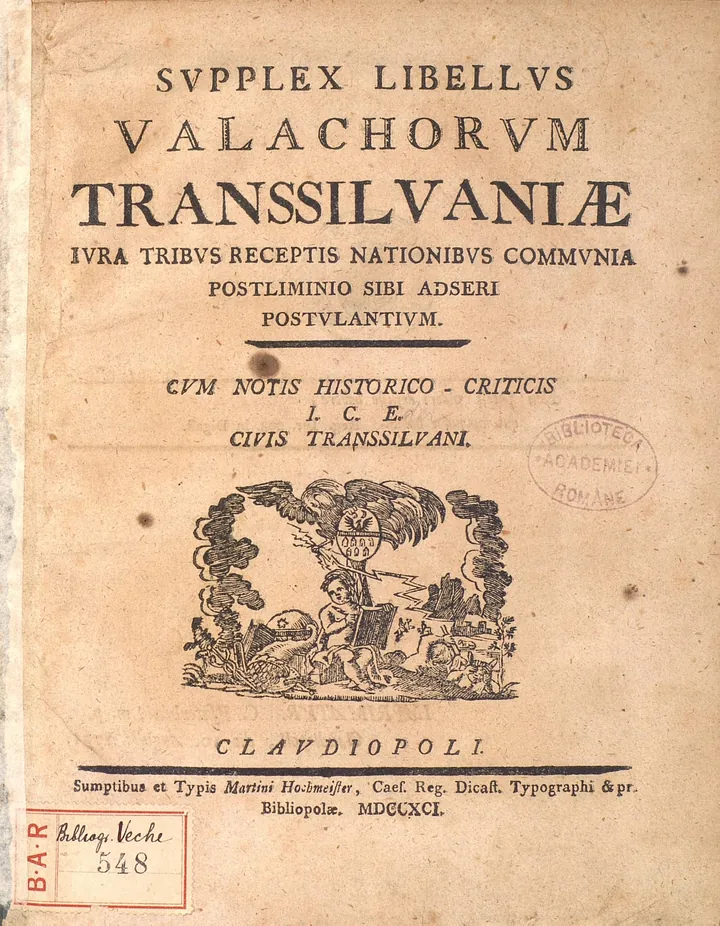
The sequel Cluj, 1791 · Wikimedia Commons - Supplex Libellus Valachorum, first edition, Cluj 1791.
- The petition of the Transylvanian Romanians, six years after the wheel.
- What the wheel could not settle, paper tried next.


Images via Wikimedia Commons (all public domain). Dates are the prints' own, corrected where the plate says so.
The rising in six numbers
Every number below comes from the cited sources: the year, the ultimatum, the capture, the wheel, the bounty, the patent.
- 1,784
- the year of the rising
- 11
- November: the Deva ultimatum
- 27
- December: the Scorușet capture
- 28
- February: the Alba Iulia wheel
- 600
- galbeni for the seven moți
- 2
- August: the patent frees the soil
Three things we get wrong
A Romanian national revolution
Partly false: the demands text is social – nobles, estates, taxes. Hungarians and Saxons fought in the rising, the Romanian intelligentsia stayed out; the national effect, the «tolerated» debate, is real, the national program is not in the text.
Horea wrote the ultimatum
Unproven: the leaders were illiterate and elsewhere at the time, and the text matches counsellor Borie's Vienna proposal. Authorship is undocumented; the clauses are undisputed.
The rising inspired the French Revolution
Unproven: Brissot's 1785 letter defending the revolt is real, the inspiration is attributed opinion – «considered by many» – and «Rex Daciae» is a European-press nickname, not a program.
Sources and method
The story follows the two Wikipedia histories and Trócsányi's History of Transylvania chapter, cross-checked date by date; the ultimatum and the short quotations come from public-domain texts. All eight images are public domain, via Wikimedia Commons.
Figures keep the sources' own words – «500–600 peasants», «about 19,000 petitions» – never numbers rounded by us. Quotations from Romanian sources appear in our English translation.
Beyond the cited clauses nothing is claimed: no hidden thoughts of the leaders, no certain death toll, no settled author for the ultimatum. What could not be proven stayed out.
The spark
- 31 January 1784: the order enlisting frontier-guard volunteers; in June the Alba Iulia fair rumour; by August about 80 villages signed up, then the Gubernium's annulment
- 28 October: Crișan at the Brad fair; 31 October: 500–600 peasants at the Mesteacăn church, the gilt cross, the decision to march on Alba Iulia
- The Curechiu night: the hussar attack repelled; 3 November: the Kristyory manor at Crișcior; Abrud via Mihăileni, Brad, Baia de Criș, Ribița, Hălmagiu
- Horea four times in Vienna, last audience April 1784; Joseph II in Transylvania in 1773 (about 19,000 petitions) and 1783
November
- 4 November: the Iosika castle at Brănișca burned; within two days the manors of Sulighet, Bretea, Ilia, Sârbi, Gurasada, Tătărești, Leșnic, Dobra, Roșcani, Geoagiu
- 5 November: the revolt at Deva's edge, the town untaken; the nobles with hussars crush the local rising and summarily execute 56 prisoners
- 11 November: the ultimatum to the Deva nobility – oath on the cross, no nobles, estates abandoned, taxes like the commons, peace for white flags; freeing the arrested
- 12–19 November in Vienna: the notification, two regiments, the order of the 15th, the 300-ducat reward, the letter of the 17th, Jankovics sent to the spot
- The Tibru, Valea Bradului and Sălciua truces; the peasant victories at Brad (27 November), Lupșa and Râmeț (29 November)
The winter
- 7 December: the Mihăileni defeat (Kray routs Crișan's men at Blăjeni); 11 December: Schultz's artillery; Horea calls his men home for the winter
- 13 December: the emperor's instructions; General Fabris; the Kray (Căian valley) and Schultz (Ompoi valley toward Abrud and Câmpeni) columns
- 27 December: Horea and Cloșca taken in the Scorușet forest through forester Anton Melzer and the peasants Trif, Matieș and five others; the papers thrown into the flames (Prodan II, p. 143)
- 30 January 1785: Crișan taken, sold by nine Cărpeniș peasants; the Alba Iulia prison; Baron Anton Iankovic's commission
- 10 January 1785: the execution must be a spectacular deterrent under Jankovics's commission; over 600 examined, 120 capital convictions, 37 death sentences commuted but the leaders'
The wheel
- 28 February 1785, 9:00: the procession (priest Rațiu, the Toscana squadron, about 300 infantry and hussars); 2,500–3,000 serfs driven in from over 400 villages
- Cloșca first (20 blows, Horea watching), then Horea (4 blows, the chest crushed by executioner Grancea Rakoczi); quartered and impaled across Alba and Hunedoara
- Crișan hanged in prison the night before; Horea and Cloșca broken on the wheel at Dealul Furcilor, Alba Iulia, 28 February 1785
- The rewards (Prodan II): the seven moți 600 galbeni and freedom, the forester 100, Crișan's betrayers 30, a gold medal for archpriest Adamovici, bishop Nichitici 1,000 florins
- 2 August 1785: Joseph II declares the villeins freed from the soil, reiterating the 16 July 1783 decree; the socage reform fails
- 1785: Brissot's «Seconde lettre d'un défenseur du peuple à l'Empereur Joseph II... sur la révolte des Valaques»; the subjects' right to revolt; banned in France
The seven plates
Images
- Augsburg print, c.1784 · Wikimedia Commons
- eighteenth-century print · Wikimedia Commons
- eighteenth-century engraving · Wikimedia Commons
- Hieronymus Löschenkohl, Vienna 1785 · Wikimedia Commons
- Retrospective print, c.1865 · Wikimedia Commons
- Georg Decker · Wikimedia Commons
- Cluj, 1791 · Wikimedia Commons
- L. F. Marsigli, 1726 · Wikimedia Commons