The song that waited 142 years
How did our anthem wait 142 years?
In June 1848, at Brașov, a fresh poem found a tune older than itself. Only on 24 January 1990, after six official anthems and two bans, did “Deșteaptă-te, române!” become law.
Four chapters, 142 years
Chapter I
The Echo
May–June 1848 · the poem finds its tune
- Chapter
- 1848
- Words
- Andrei Mureșanu, 1816–1863
- Tune
- Anton Pann, died 1854
- First sung
- Brașov, June 1848
At Brașov, in late May 1848, the teacher Andrei Mureșanu wrote “Un răsunet”, an answer to Vasile Alecsandri's “Către Români”. The original was in Romanian Cyrillic; today's title came later.
The verses needed a tune. He asked Gheorghe Ucenescu, the singer of the Șchei church, who sang him several lay melodies. Mureșanu chose Anton Pann's “Din sânul maicii mele”, written after a poem by Grigore Alexandrescu and printed in the 1852 “Spitalul amorului”.
In late June 1848 the song was heard for the first time on the streets of Brașov's Șchei quarter. The group of Bălcescu, Magheru, Brătianu and Bolliac sang it at Brașov; then it resounded in the Apuseni Mountains. Bălcescu called it the “Romanian Marseillaise”.
The exact day “Un răsunet” was born is unknown: somewhere between the Blaj Assembly (3–5 May) and the first singing, in late June. What is certain is that within weeks it became the revolution's unwritten anthem.
Wake up, Romanian, from the sleep of death!
Andrei Mureșanu, “Un răsunet”, 1848
Meanwhile: a month earlier, the National Assembly at Blaj (3–5 May 1848) had given the impulse for the whole story.
Chapter II
Unofficial
1848–1947 · a century without a crown
- Chapter
- 1848–1947
- Status
- unwritten hymn, never official
- 1877
- Bucharest, 9 May
- 1919
- the Consiliul Dirigent decision
For a century, “Deșteaptă-te, române!” was the anthem the state did not want and the crowd would not forget. The kingdom had “Trăiască Regele”; the song of 1848 was sung on great days, on no order from above.
On 9 May 1877 it was sung at Bucharest, with independence. On 21 November 1917 it resounded at Chișinău, at the opening of Sfatul Țării; in 1917–1918 it served at solemn ceremonies in the Moldavian Democratic Republic. In 1919 the Consiliul Dirigent made it Transylvania's national hymn.
Meanwhile a rival had appeared: Alecsandri's “Hora Unirii”, on Flechtenmacher's music, sung at the Union of 1859. The hora was joy; “Deșteaptă-te” was an oath.
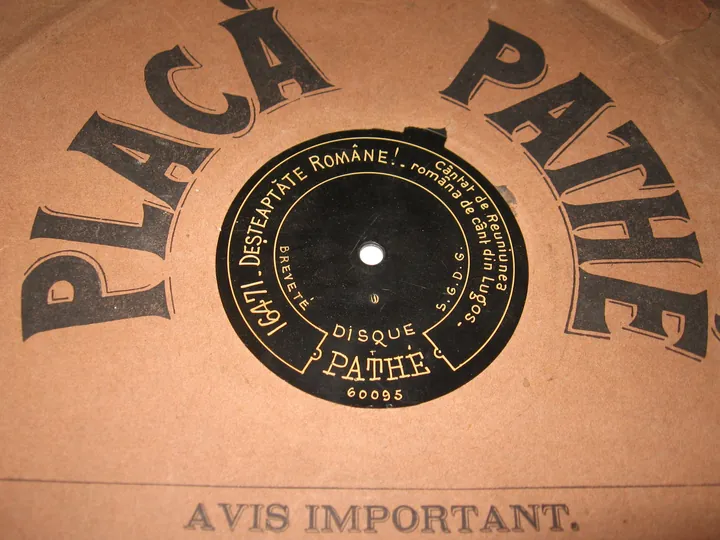
In 1910 the “Ion Vidu” choir of Lugoj gave it its first recording, on a Pathé disc. The song entered the twentieth century two ways: on lips and on wax.
Behold, mighty shades: Mihai, Ștefan, Corvinus!
Andrei Mureșanu, the second stanza
Meanwhile: in 1881 Romania became a kingdom, and the crown's anthem stayed “Trăiască Regele”.
The waiting line: seven anthems, one song
Between 1848 and 1990 the Romanian state had six official anthems; the seventh is the song that outwaited them all. Open each to see the years, the authors and what “Deșteaptă-te” was doing meanwhile.
official anthem
-
1862–1884Marș triumfalA march without words
Eduard Hübsch's instrumental for the Principalities' army (1862–1884). “Deșteaptă-te” was 14 years old and had no status.
Eduard Hübsch · official anthem
-
1884–1948Trăiască RegeleThe king's anthem
Vasile Alecsandri's lyrics on Hübsch's music (1884–1948). The crowd's song stays unofficial.
Eduard Hübsch · Vasile Alecsandri · official anthem
-
1948–1953Zdrobite cătușeThe rupture anthem
The first communist anthem, music by Matei Socor (1948–1953). The old song is outlawed.
Matei Socor · official anthem
-
1953–1975Te slăvim, RomânieThe long anthem
Socor, Frunză and Deșliu, from August 1953 to 1975. Over two decades of “Te slăvim”.
Matei Socor · Eugen Frunză, Dan Deșliu · official anthem
-
1975–1977E scris pe tricolor UnireThe Porumbescu intermezzo
“Pe-al nostru steag e scris Unire” (1880), the same tune as Albania's anthem. Two years: 1975–1977.
Ciprian Porumbescu · official anthem
-
1977–1990Trei culoriThe communist generation's anthem
Porumbescu again, with adapted text, from October 1977 to 1990.
Ciprian Porumbescu · official anthem
-
1990–Deșteaptă-te, române!Home
24 January 1990: the song of 1848 becomes law. The end of the 142-year wait.
Anton Pann / Gheorghe Ucenescu · Andrei Mureșanu · official anthem
the song that waits
- 1849: banned in Transylvania (no documented end)
- 1948–1966: banned
- 1967–1989: tolerated, unofficial
Years follow the standard template; the 1866 (triumphal march) and 1881 (royal lyrics) variants are flagged as disputed in the method.
Chapter III
Banned
1948–1989 · outlawed, then tolerated
- Chapter
- 1948–1989
- 1948
- outlawed
- 1967
- tolerated, no status
- 1987
- Brașov, 15 November
On 30 December 1947 the communists abolished the monarchy and, with it, the songs of the old regime. “Deșteaptă-te, române!” was outlawed; in its place came, one after another, “Zdrobite cătușe”, “Te slăvim”, “E scris pe tricolor Unire” and “Trei culori”.
The ban did not last forever. From 1967 propaganda tolerated the song for nationalist ends, and Ceaușescu's regime let it be sung in public, without granting it state recognition. It was allowed; it was not the anthem: the perfect trap.
At Brașov, on 15 November 1987, the song resounded in the middle of a workers' revolt. The crackdown was brutal: some 300 arrested, sentences between 6 months and 3 years, deportations to other cities.
In December 1989 “Deșteaptă-te” was sung in the streets again, this time with no way back. The revolution gave it back what decrees had taken: the voice of the crowd.
Banned by the totalitarian regimes for almost half a century.
The Foreign Ministry, Anthem Day communiqué
Meanwhile: from October 1977 the anthem was “Trei culori”, still on Porumbescu's music.
Chapter IV
The Anthem
1990–today · home, at last in law
- Chapter
- 1990–today
- Adopted
- 24 January 1990
- Law
- 75/1994: stanzas 1, 2, 4, 11
- Anthem Day
- 29 July (Law 99/1998)
On 24 January 1990, “Deșteaptă-te, române!” became the national anthem after 142 years of waiting. The 1991 Constitution enshrined it; Law 75/1994 fixed its text: 11 stanzas, of which stanzas 1, 2, 4 and 11 are sung.
Across the Prut the same song lived a parallel life: at solemn ceremonies in 1917–1918, then as Moldova's anthem between 1991 and 1994, until “Limba noastră”.
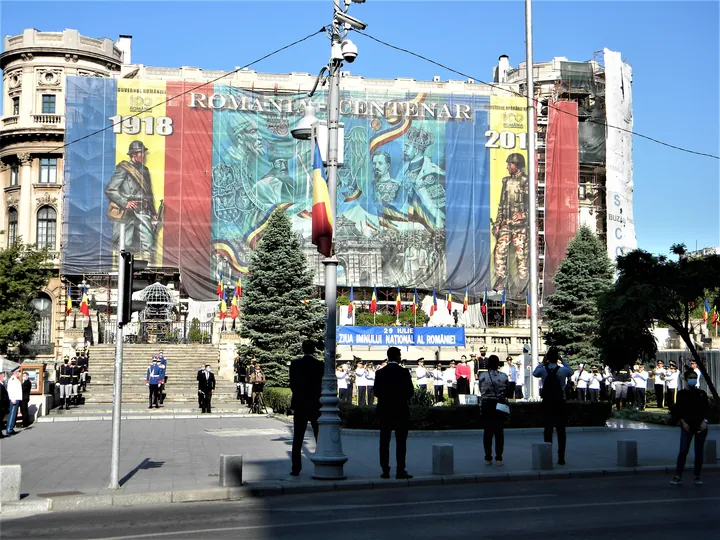
Since 1998, 29 July is National Anthem Day. Every year, at Bucharest, the song of 1848 is sung at official ceremonies, before the state that kept it waiting 142 years.
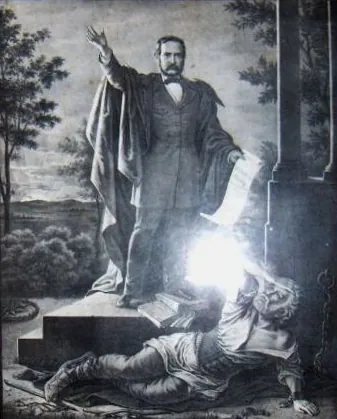
From “Un răsunet” to anthem of state: 142 years, six official anthems, two bans and an 1864 Viennese allegory that already pictured it triumphant. Pann's tune and Mureșanu's verses travelled, unchanged in essence, from Brașov's Șchei into the Constitution.
Now or never forge yourself another fate!
Andrei Mureșanu, the first stanza
Meanwhile: in 1994 Moldova gave it up for “Limba noastră”.
Banned or not?
Six years, six places. Guess when singing got you arrested and when it did not. The year 1970 is the trap: read carefully.
-
1
1849 · Cluj
You sing “Deșteaptă-te” at a student party, a year after the revolution.
The answer
Banned: in 1849, after the revolution’s defeat, the song was forbidden in Transylvania. That is why it crossed the mountains.
-
2
1877 · Bucharest
It is 9 May, independence is proclaimed, and the crowd sings “Deșteaptă-te”.
The answer
Free: on 9 May 1877 the song resounded at Bucharest, before everyone.
-
3
1952 · Brașov
You hum it at the factory, between shifts.
The answer
Banned: in 1952 the old regime’s songs were outlawed, as since 30 December 1947.
-
4
1970 · Bucharest
The brass band plays it at an official school feast, before the activists.
The answer
Free, with a trap: in 1970, as since 1967, the regime tolerated it patriotically, but it still was not the anthem. The anthem was “Te slăvim”.
-
5
1987 · Brașov
It is 15 November and you sing it in the street, amid the workers' revolt.
The answer
Banned: in 1987 the revolt ended with some 300 arrested and sentences between 6 months and 3 years.
-
6
1991 · Chișinău
You sing it at an official ceremony, across the Prut.
The answer
Free: between 1991 and 1994 it was actually Moldova's anthem.
No answers yet
The tune: stanza one, 76 notes
Pann's tune as the scores sing it: 76 notes, 83 crotchets, 71 syllables. Press “play” and read along with the sound. No historic recording: everything is synthesised live, from the transcribed notes.
De-ștea-ptă-te,ro-mâ-ne,dinsom-nulceldemoar-te,
Înca-re-te-a-a-dân-ci-răbar-ba-riideti-ra-ni,
bar-bar-riideti-ran!
A-cumorini-cio-da-tăcroi-eș-eș-te-țial-tăsoar-te,
Laca-resăse-se-nchi-neșicru-ziităiduș-man,
șicru-ziităiduș-duș-duș-man!
A-man!
Official text, stanza 1 (Law 75/1994)
Deșteaptă-te, române, din somnul cel de moarte,
În care te-adânciră barbarii de tirani!
Acum ori niciodata croiește-ți altă soarte,
La care să se-nchine și cruzii tăi dușmani!
Literal gloss (translator’s own)
Wake up, Romanian, from the sleep of death,
into which barbaric tyrants sank you!
Now or never forge yourself another fate,
to which even your cruel enemies will bow!
The source score uses the archaic singular “tiran”/“dușman” in the repeats; the official text (Law 75/1994) has the plural “tirani”/“dușmani”. Rhythms are rendered exactly, including four three-crotchet bars from the amateur engraving.
Own transcription from the Cantorion engraving, checked two ways: the syllables of Law 75/1994 and the 0–9/9–22/22–31/31–45 second windows of the PD US Navy Band recording (Commons timed text).
Faces and traces
Seven images, seven anchor dates. Each tells its own piece of the story.
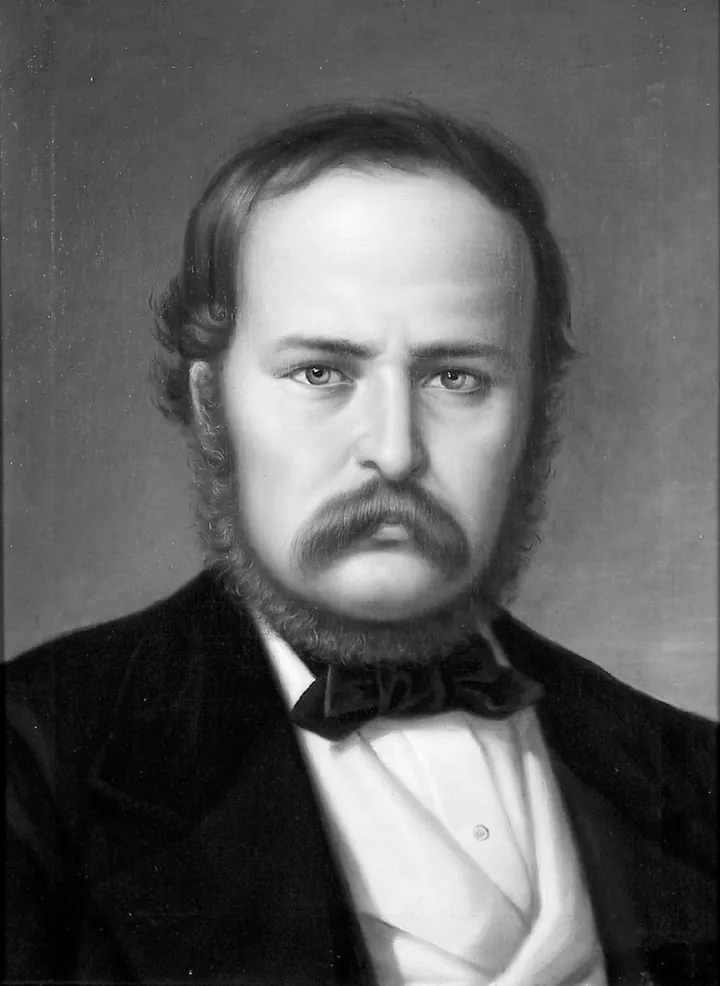
Plate 1816–1863The poet of “Un răsunet”
The poet of “Un răsunet” Mișu Popp, portrait (public domain) · Wikimedia Commons - A teacher at Brașov from 1838; he published the poem in 1848, first titled “Un răsunet”.
- The original was in Romanian Cyrillic, answering Alecsandri's “Către Români”.
- He died at Brașov in 1863, 127 years before the verses became the anthem.
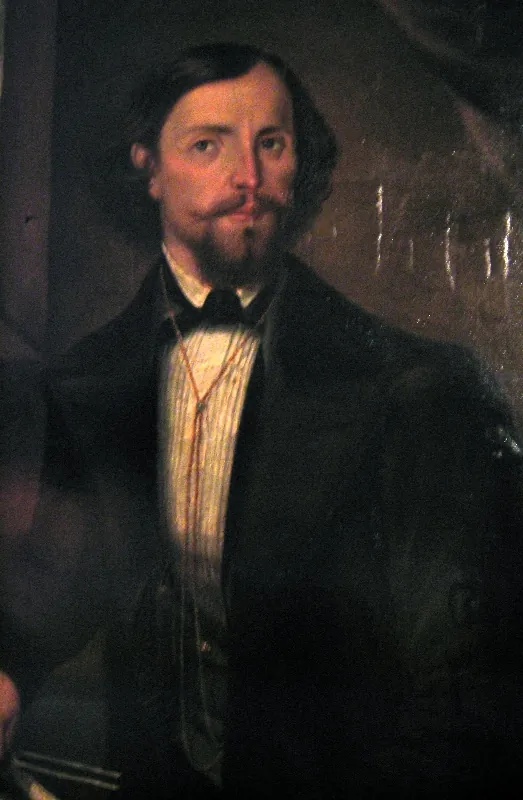
Plate 1854The man of the tune
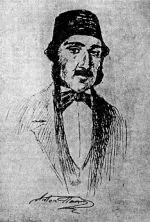
The man of the tune Portrait by an unknown artist (public domain) · Wikimedia Commons - The anthem's music is by Anton Pann, a Bucharest singer and printer.
- “Din sânul maicii mele”, after Alexandrescu, was printed in the 1852 “Spitalul amorului”.
- He died of typhus on 2 November 1854, aged 57: the tune is long public domain.
Plate 1830–1896The man who chose
The man who chose Period photograph (public domain) · Wikimedia Commons - Singer of the church in Brașov's Șchei (1830–1896).
- He sang Mureșanu several lay melodies; the poet chose Pann's.
- His name stands on the anthem next to Pann's: music “Pann/Ucenescu”.
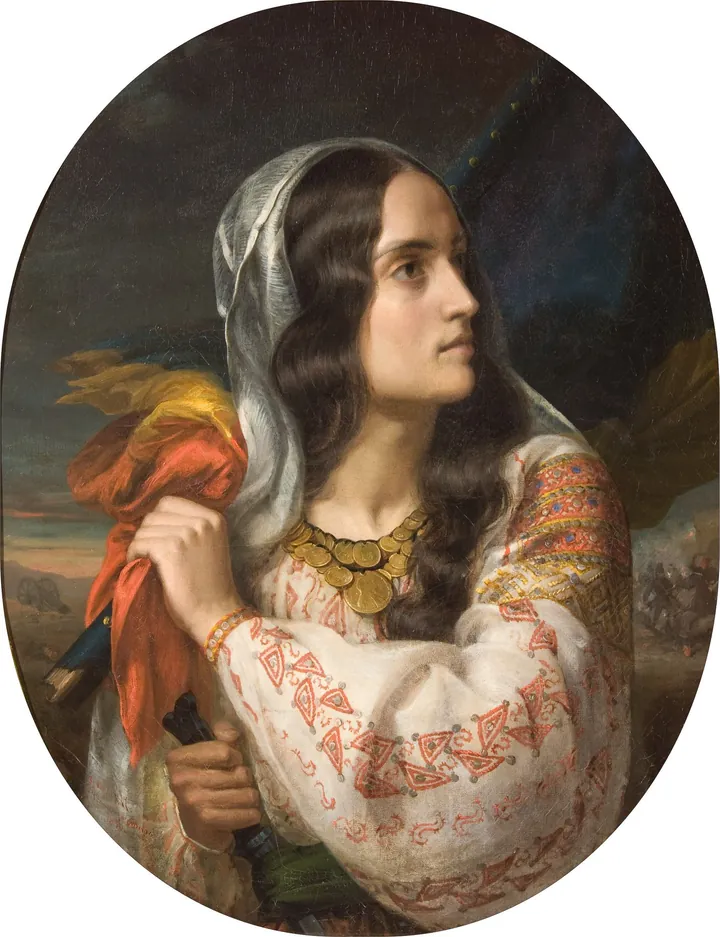
Plate 1850“Revolutionary Romania”
“Revolutionary Romania” C. D. Rosenthal, 1850 (public domain) · Wikimedia Commons - The allegory of Constantin Daniel Rosenthal (1820–1851), painted in France in 1850.
- The model: Maria Rosetti, the flag on her shoulder and the dagger in her hand.
- Two years after the poem, the revolution already had its icon: 1850.
Plate 1910The first recording: 1910
The first recording: 1910 Adrian Andronic, CC BY-SA 3.0 · Wikimedia Commons - A choral Pathé disc: the “Ion Vidu” choir of Lugoj, 1910.
- 62 years after the poem, the song could be bought in a shop.
- Between 1948 and 1966 the same disc could have got you into trouble.
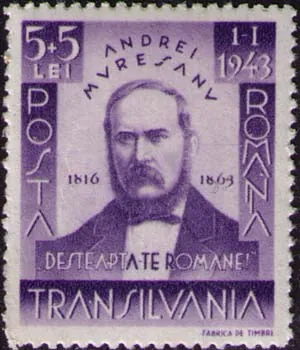
Plate 1942The poet on a stamp
The poet on a stamp Romanian Post, 1942 (public domain) · Wikimedia Commons - The Romanian Post, 1942: the “Andrei Mureșanu” series, 5+5 lei.
- Honoured in full war, banned six years later.
- A grey-violet stamp: the moustached poet, finely engraved.
Plate 2020Anthem Day
Anthem Day Britchi Mirela, CC BY-SA 4.0 · Wikimedia Commons - 29 July 2020, Bucharest: singing the anthem at the official ceremony.
- 29 July has been Anthem Day since 1998 (Law 99/1998).
- 30 years after adoption, the song of 1848 had a state, a fanfare and a day in the calendar.


Every image is public domain, with two credited CC BY-SA exceptions (the disc and the ceremony).
The waiting in numbers
Six numbers that tell the whole story.
- 1,848
- 1848, the year of the poem and the tune
- 142
- 142 years of waiting (1990–1848)
- 6
- 6 official anthems meanwhile
- 11
- 11 stanzas Mureșanu wrote
- 4
- 4 stanzas sung today: 1, 2, 4, 11
- 1,990
- 1990, the year it became the anthem
Myths
“Always our anthem”
No: between 1862 and 1990 the state had six official anthems, from “Marș triumfal” to “Trei culori”. “Deșteaptă-te” waited 142 years and lost every time, until 1990.
“It was sung at Blaj”
Not at the Great Assembly of 3–5 May 1848: the poem was born after it, at Brașov. The first singing is in late June, on the Șchei streets. For the September assembly there is no evidence: undocumented.
“Only the communists banned it”
No: the first ban struck Transylvania after 1849, when the song crossed the mountains. The communists outlawed it in 1948 and tolerated it from 1967.
“It belongs only to Romania”
No: the Bessarabians sang it too, at Sfatul Țării in 1917–1918 and as Moldova's anthem between 1991 and 1994, until “Limba noastră”.
Sources and method
The facts come from laws (75/1994, 99/1998), from the Monitorul Oficial, from two Romanian musicology studies and from encyclopaedia articles checked against each other. Every date is cited; what could not be proven is marked disputed or undocumented.
“142 years” is arithmetic (1990–1848), as are “127” (1990–1863), “62” (1910–1848) and “30” (2020–1990). The anthem years follow the standard template; the 1866 and 1881 variants are flagged as disputed.
The tune is an own transcription (76 notes, 83 crotchets) from a modern engraving of Pann's melody, checked against the law's syllables and the PD recording's timings. Details live in the repository's SOURCES.md.
The Echo
- Mureșanu's “Un răsunet” (1848), answering Alecsandri's “Către Români”; the original in Romanian Cyrillic
- The melody: Pann's “Din sânul maicii mele” (after Alexandrescu); Ucenescu sang several tunes, Mureșanu chose Pann's; printed in “Spitalul amorului” (1852)
- First sung in late June 1848, Brașov, in the Șcheii streets; at once a revolutionary anthem
- Sung at Brașov in June 1848 by the Bălcescu–Magheru–Brătianu–Bolliac group, then in the Apuseni; banned in Transylvania, it crossed the mountains
Unofficial
- The Blaj assembly, 3–5 May 1848, as the impulse for words and music; the Brașov meeting at the end of May; the “where first sung” debate
- Sung at Bucharest, 9 May 1877, and at Chișinău, 21 November 1917 (Sfatul Țării); national hymn by the Consiliul Dirigent, 1919
- Used at solemn occasions in the Moldavian Democratic Republic, 1917–1918
- “Hora Unirii” (Alecsandri/Flechtenmacher), sung at the 1859 Union – the unofficial rival
- Bălcescu: the “Romanian Marseillaise”; the 1910 Pathé disc, Lugoj's “Ion Vidu” choir – the first recording (file description)
Banned
- 30 December 1947: the monarchy abolished, the song outlawed; Ceaușescu permitted it in public, without state recognition
- “Banned by the totalitarian regimes for almost half a century” (foreign ministry)
- Tolerated from 1967 for nationalist purposes (communist propaganda)
- It resounded at the 1987 Brașov revolt and in the December 1989 Revolution
- The Brașov rebellion, 15 November 1987: some 300 arrested, 6-month to 3-year sentences, deportations
The Anthem
- Adopted as the national anthem on 24 January 1990, replacing “Trei culori”
- Law 75/1994, annex 2 (Monitorul Oficial 237): the official text; stanzas 1, 2, 4 and 11 of 11 are sung
- Enshrined in the 1991 Constitution; 29 July = National Anthem Day (Law 99/1998)
- Moldova's anthem, 1991–1994, replaced by “Limba noastră”
.png)
The anthem line
- The sequence of official anthems and their years (the standard template)
- The 1866 (instrumental triumphal march) and 1881 (royal lyrics) variants – marked disputed
- Socor: the music of both communist anthems; “Te slăvim” – Frunză/Deșliu, from August 1953; Porumbescu adopted 1975; “Trei culori” from October 1977
- “E scris pe tricolor Unire”: Porumbescu 1880, the same tune as Albania's anthem
Images
- Mișu Popp, portrait (public domain) · Wikimedia Commons
- Portrait by an unknown artist (public domain) · Wikimedia Commons
- Period photograph (public domain) · Wikimedia Commons
- C. D. Rosenthal, 1850 (public domain) · Wikimedia Commons
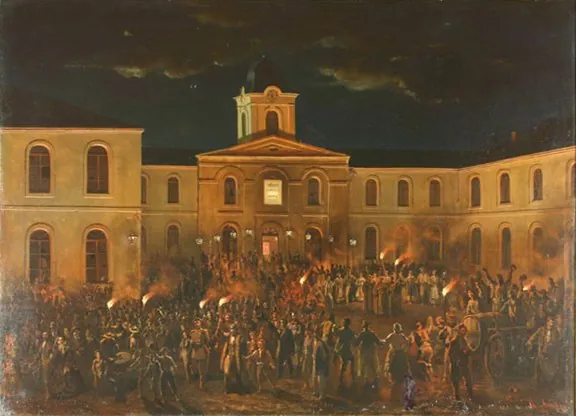
- Theodor Aman (public domain) · Wikimedia Commons
- Adrian Andronic, CC BY-SA 3.0 · Wikimedia Commons
- Romanian Post, 1942 (public domain) · Wikimedia Commons
- Mișu Popp, circa 1864 (public domain) · Wikimedia Commons
- Britchi Mirela, CC BY-SA 4.0 · Wikimedia Commons

