one companymany roads, or untracedCivil War names on the hullscamps
Paris, 24 August 1944 · 21:22
La NueveThe Spanish Republicans who rode first into Paris
La Nueve, “the Nine”, was a company of General Leclerc's French armoured division. On the evening of 24 August 1944, while Paris was still fighting, its half-tracks were in the first Allied column to reach the Hôtel de Ville. Most of its men were Spaniards who had lost their own war five years before, and the half-tracks carried the names of that war's battles. Their roads to Paris ran from the Ebro through the French camps, North Africa and a park in Yorkshire.
Scroll: the line on the map follows them
24 August 1944 · 20:45–21:22
Thirty-seven minutes from the city gate to the Hôtel de Ville
At 20:45 a small column came through the Porte d'Italie into a city in revolt against its occupiers. In front was a jeep with Captain Raymond Dronne. He remembered that a woman in Alsatian dress jumped onto its bonnet at the gate and rode it all the way. The column included three Sherman tanks, a section of engineers and the half-tracks of two of La Nueve's three sections, among them Teruel, Ebro and Guadalajara.
Dronne recalled that at the gate an Armenian on a small motorbike, Lorenian Dikran, offered to guide them. The column went through the 13th arrondissement, down the boulevard de l'Hôpital, over the pont d'Austerlitz and along the quays. At 21:22 by the great clock of the Hôtel de Ville the vehicles stopped in the square. Most of the infantry in the half-tracks were Spaniards; the company was known as La Nueve, Spanish for “the Nine”.
The clock was on German summer time, two hours ahead of Greenwich. The sun had set 35 minutes earlier; Dronne remembered that it was still light.
The accounts consulted do not give a full order of the vehicles; on the map, the three names simply follow the head of the column.
1936–1938
Seven names on the hulls recalled the war they had lost
According to the historian Marine Garnier, the half-tracks had been named earlier that summer in Yorkshire, where the company was billeted. Seven of the names are places of the war fought against Franco from 1936 to 1939: Madrid, Guadalajara, Guernica, Brunete, Santander, Teruel, the Ebro.
The map marks the places they recall. To follow the line that leads to Paris, you have to start here, eight years before.
November 1936 – March 1937
Madrid held, and the Republic won at Guadalajara
The Nationalist ground assault on Madrid began on 7 November 1936. The city held out until March 1939, and its name went onto a half-track of the first section.
In March 1937, north-east of the capital, the Republic won a battle: at Guadalajara, between 8 and 18 March, an offensive by Mussolini's expeditionary corps was driven back. Seven years later the name entered Paris on a half-track of the third section.
April – August 1937
Guernica, Brunete, Santander: the year of the losses
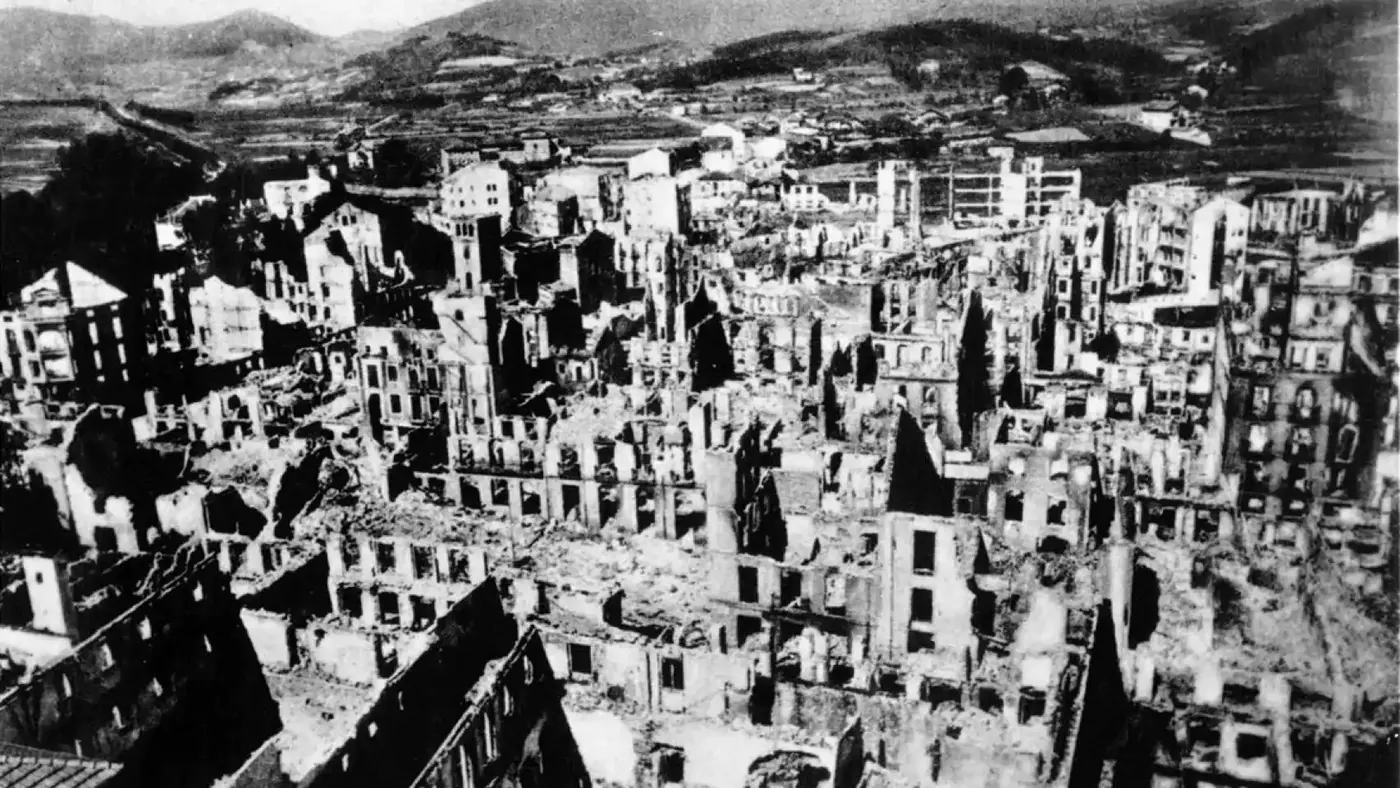
On 26 April 1937 the German Condor Legion, with Italian aircraft, bombed Gernika, the Basque town. The death toll is still disputed.
In July the Republic attacked west of Madrid, at Brunete. On 26 August Santander fell. Both names went onto vehicles of La Nueve; Guernica was the half-track Rafael Gómez drove.
Gernika after the bombing of 26 April 1937 · CDBG · public domain · Wikimedia Commons
December 1937 – February 1938
Teruel, taken and lost again
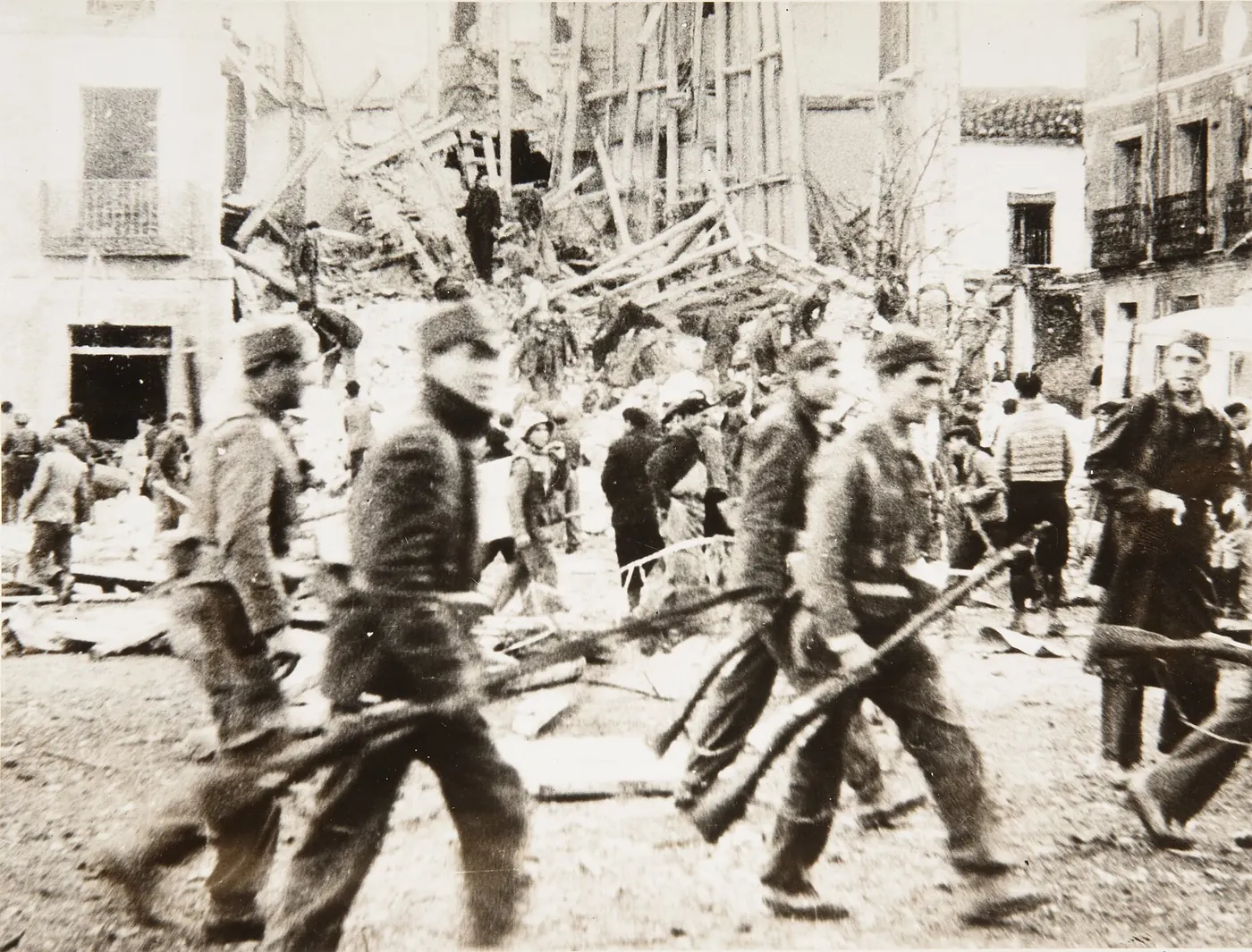
The battle began in December 1937. Republican troops took Teruel, and by 22 February 1938 Franco's army had taken it back. Teruel was the command half-track of La Nueve's second section, and was in the column that reached the Hôtel de Ville.
Republican troops entering Teruel, winter 1937–38 (Museo Reina Sofía) · Museo Reina Sofía · public domain · Wikimedia Commons
July – November 1938
The Ebro: 115 days
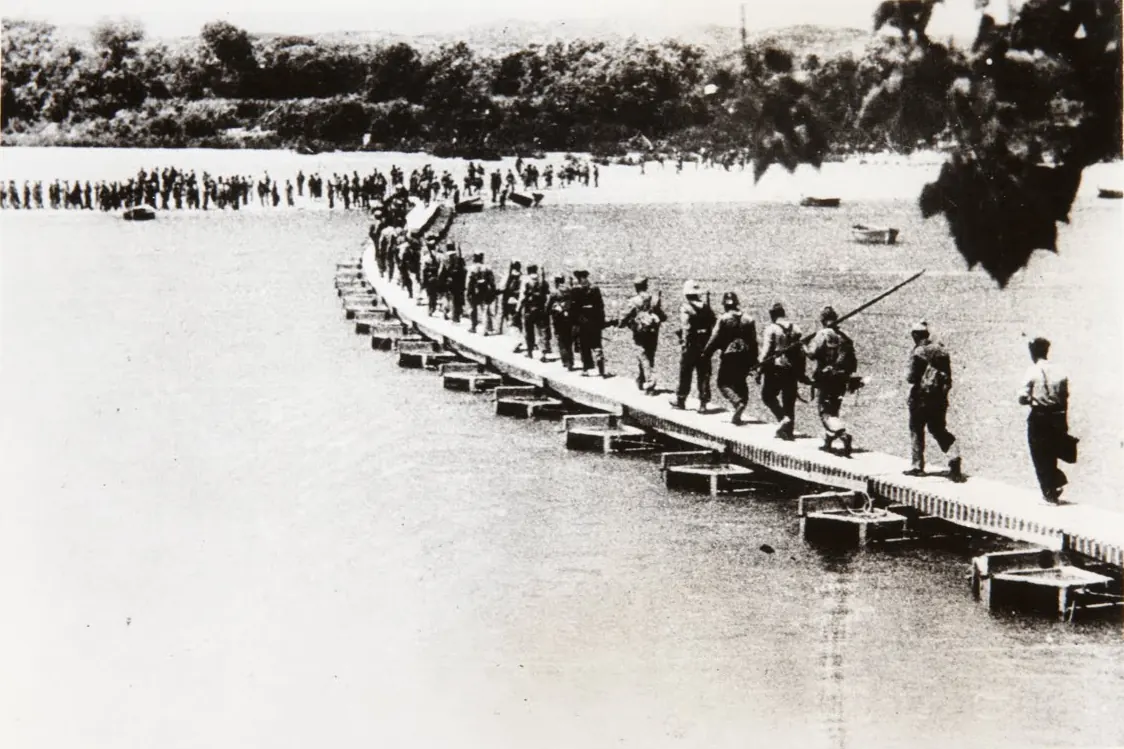
The Battle of the Ebro lasted 115 days, from 25 July to 16 November 1938, and ended in defeat for the Republic.
From here the map follows a line. It is dashed where the men who later made up La Nueve came from many units and took many roads, or where the route is not known. Solid stretches begin in 1943, when they were one company.
Republican troops cross the Ebro on a pontoon footbridge, 1938 (Museo Reina Sofía) · Museo Reina Sofía · public domain · Wikimedia Commons
January – February 1939
Nearly half a million people cross into France
Barcelona fell on 26 January 1939. In the weeks that followed, about 450,000 people crossed the Pyrenees into France: the official French estimate was 440,000, of whom 220,000 were soldiers. Each dot on the map is a thousand people.
Disarmed soldiers were allowed across at Le Perthus from 16:30 on 5 February. The Spanish call this exodus la Retirada, the retreat.
February – March 1939
Behind barbed wire, on the beach
In the first weeks Argelès and Saint-Cyprien held two-thirds of all the internees, with nothing built; at Argelès the beach was closed off with barbed wire. More than 100,000 people passed through Argelès between February and June, most of the early arrivals without any shelter.
Further inland came Gurs, which held 20,542 Spaniards and 6,808 International Brigaders in 13 months, and Le Vernet, a disciplinary camp for men, built for 4,000 and holding more than 13,500 on 14 July 1939.
The documented ways out: by the summer of 1939 more than 250,000 people had been sent back to Spain; more than 7,000 joined the Foreign Legion; about 55,000 served in labour companies for foreigners.
1939–1943
One man's road, through the Sahara
Others never saw the French beaches. About 15,000 Spaniards reached North Africa from the last Republican ports in March 1939, into camps the historian Rocío Negrete describes as similar to or worse than those in France. The coal ship Stanbrook sailed from Alicante to Oran. Robert Coale found two future men of La Nueve, Amado Granell and Federico Moreno, listed twice each among those it landed, at the end of April.
Moreno's file, as Coale reads it, shows what came next: Camp Morand, the labour gangs building the trans-Saharan railway, the Foreign Legion from June to November 1940, then the Kenadsa coal mines in the Algerian Sahara, under Vichy. In June 1943 he joined the Corps franc d'Afrique, a unit created for the men the colonial army would not take: communists, Gaullists, anti-fascist foreigners, Jews. In September 1943 he was in La Nueve.
The map draws his road. Other men took other routes.
The line follows Coale's account of Moreno's file. The file as quoted does not name the place of his Legion service; the map puts it at the Legion's depot, Sidi Bel Abbès.
1943 – spring 1944
Spanish Republicans in a French division
Spaniards serving in the Corps franc and in Giraud's army left without permission to join General Leclerc's Free French. In 1943 they were gathered into the 3rd battalion of the Régiment de marche du Tchad, under Joseph Putz, who had held a command in the International Brigades. Its 9th company used Spanish as well as French. It was known as La Nueve, and also as la Española.
Its captain was a Frenchman from the Sarthe, Raymond Dronne, who had been wounded in Tunisia that spring. Marine Garnier places the company at Bordj Skhirat, on the Moroccan coast between Rabat and Casablanca, until April 1944.
May 1944
From Oran towards Britain
The historian Carmen Góngora dates the departure of Miguel Campos's section from Oran, on the liner Franconia, to 21 May 1944.
The division's veterans date its stay in Britain from April to July 1944. The sources consulted do not give the route or the port where La Nueve landed, so the line at sea is dashed.
June – July 1944
Yorkshire and the half-track names
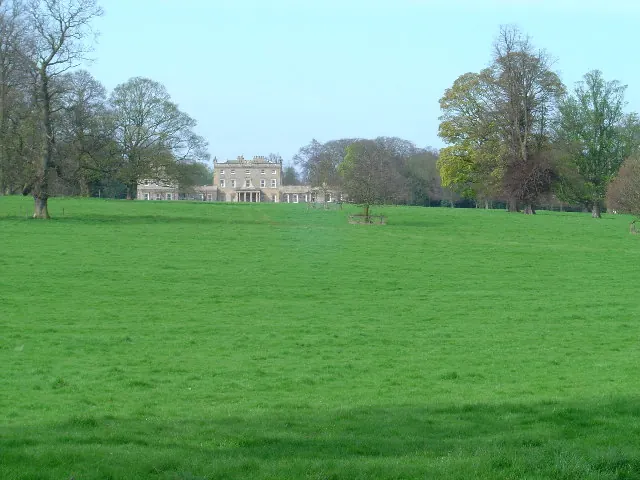
Leclerc set up his headquarters at Dalton Hall, the Hotham family's house near Beverley, in the East Riding. Marine Garnier places Putz's battalion around Pocklington, about ten miles away, and writes that this is where the men named their half-tracks. The billeting table lists the battalion at “Kilwick”, a spelling that fits two villages nearby.
On 3 July General Koenig presented the regiments with their colours in the park at Dalton Hall. A Pocklington girl, Vera Kidd, collected the autographs of some of the Spaniards in her notebook. It survived, and in 2024 the town's history group was told the story.
In Normandy the division would serve in XV Corps of General Patton's US Third Army.
Dalton Hall, East Yorkshire, in 2005. In 1944 it was Leclerc's headquarters · Ian Lavender, geograph.org.uk · CC BY-SA 2.0 · Wikimedia Commons
End of July – early August 1944
From Southampton to Utah Beach
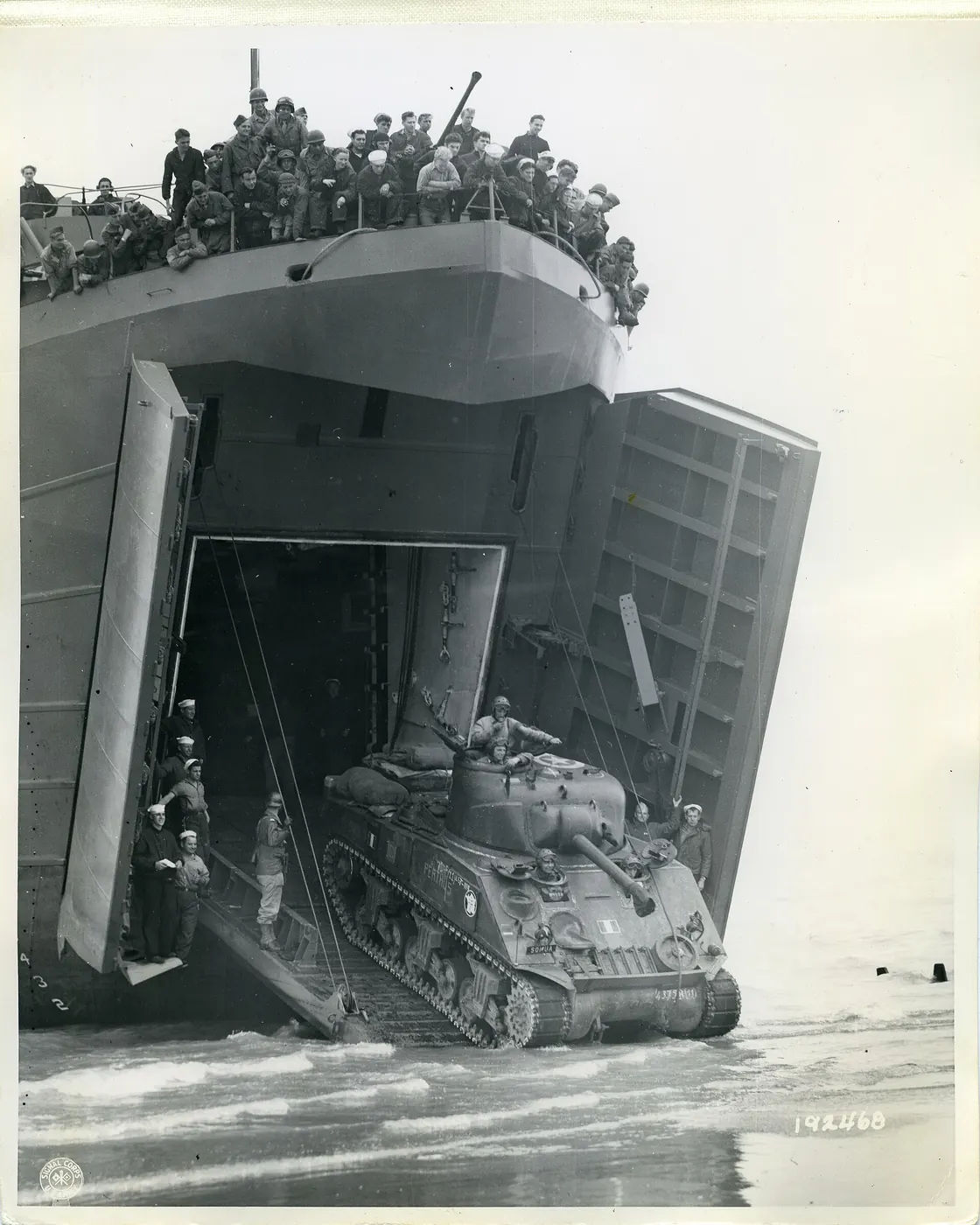
According to Carmen Góngora, the division embarked at Southampton in the last days of July. It landed at Utah Beach from 1 August: 16,000 men and more than 5,000 vehicles. La Nueve came ashore in the first days of August; Góngora gives 4 August, the City of Paris the night of 31 July.
2e DB tanks leave LST 517 at Utah Beach, 1 August 1944 (Signal Corps caption) · U.S. Army Signal Corps (SC 192468) · public domain · Wikimedia Commons
August 1944
Écouché: La Nueve's first fight
The division went through Alençon on 12 August. On 13 August, at Écouché, La Nueve went into action for the first time. The fighting there lasted until 20 August; for the division it was the hardest of the Normandy campaign. The half-track Don Quichotte was destroyed; a Don Quichotte II replaced it.
22–24 August 1944
Paris rose before the Allies came
The Allies had planned to go round Paris. The city did not wait: the Musée de la Libération de Paris dates the uprising to 19 August. On the evening of 22 August, after Eisenhower's decision, General Bradley ordered Leclerc's division to Paris, with the US 4th Infantry Division.
On 24 August fighting held the division up around the Croix-de-Berny, south of the city. Dronne recalled that at about 19:30 Leclerc found him there, dismissed a radio order to stop, and sent him straight into Paris.
“Dronne, filez droit sur Paris, entrez dans Paris.” (Dronne, go straight to Paris, get into Paris.)Raymond Dronne, Carnets de route, 1984
24 August 1944 · 19:30–20:45
Through the southern suburbs to the Porte d'Italie
Dronne took two of the company's three sections (the first was still fighting), three tanks and a section of engineers. He recalled that a man from Antony guided them. They went through Fresnes, L'Haÿ-les-Roses, Cachan, Arcueil and Le Kremlin-Bicêtre.
At 20:45 they reached the Porte d'Italie. The battalion's war diary notes the same time.
24 August 1944 · 21:22
21:22 at the Hôtel de Ville
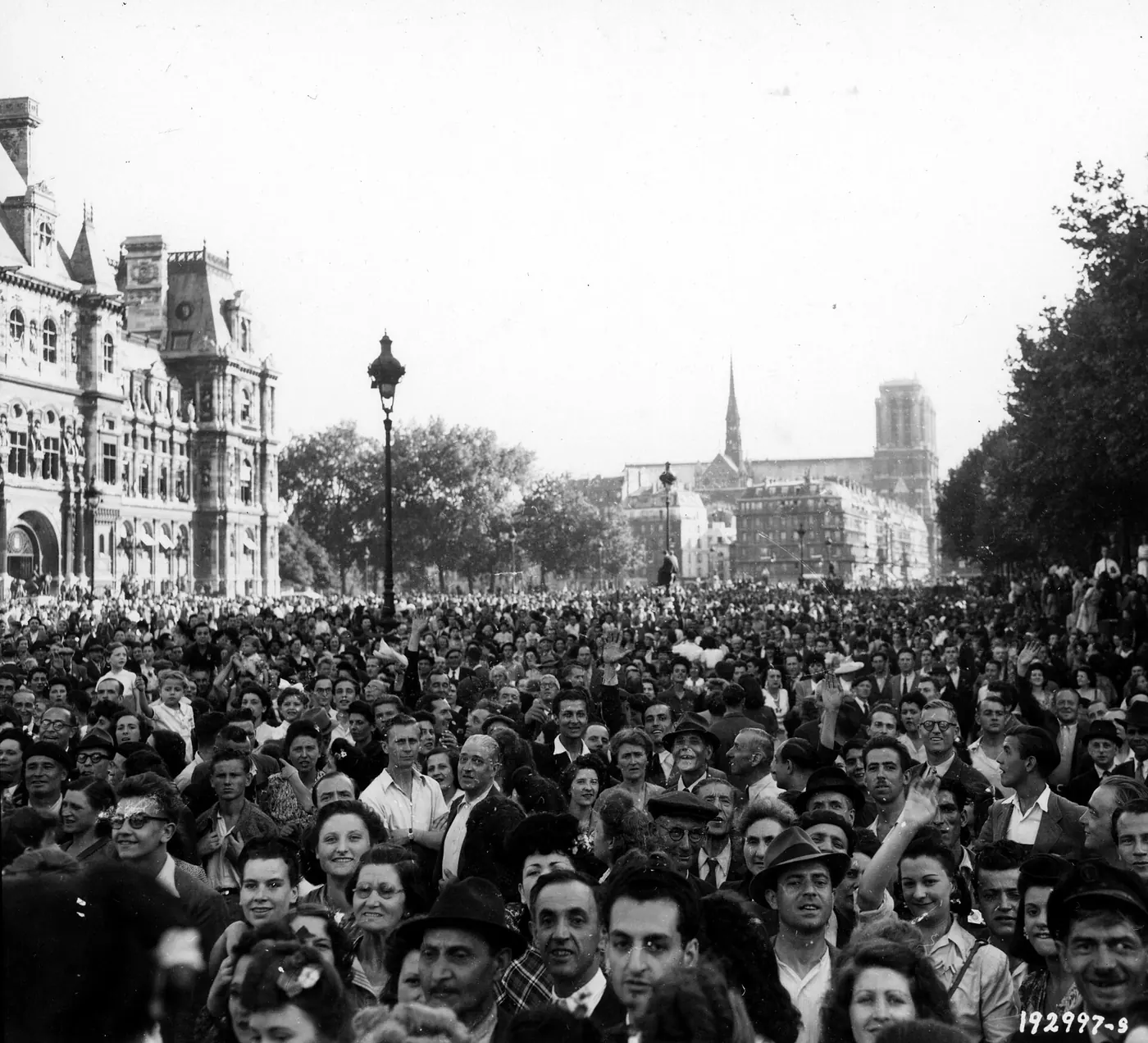
Dronne went in and was received by Georges Bidault, the head of the National Council of the Resistance, then went on to the Préfecture de Police. That evening the great bell of Notre-Dame rang, and the bells of Saint-Gervais with it.
German forces were still in Paris. Leclerc had told Dronne to announce that the whole division would arrive in the morning.
Parisians near the Hôtel de Ville, 25 August 1944; the towers of Notre-Dame behind · U.S. Army Signal Corps (SC 192997) · public domain · Wikimedia Commons
The City of Paris writes that the half-track Ebro fired the first shots, at a German machine-gun post; Robert Coale writes that no shot was fired on the way in, and Carmen Góngora that there was no fighting that night. Granell's place as the first officer received is also disputed. See below.
25–26 August 1944
The surrender, and the parade
On 25 August the German commander, General von Choltitz, was taken at the Hôtel Meurice and signed the surrender at the Préfecture de Police at about four in the afternoon. According to the 2026 Spanish government catalogue, La Nueve's third section guarded the Hôtel de Ville and the second took the telephone exchange in the rue des Archives; the City of Paris has the company securing the Chamber of Deputies. The first section, left behind the day before, fought its way in at the Porte d'Orléans.
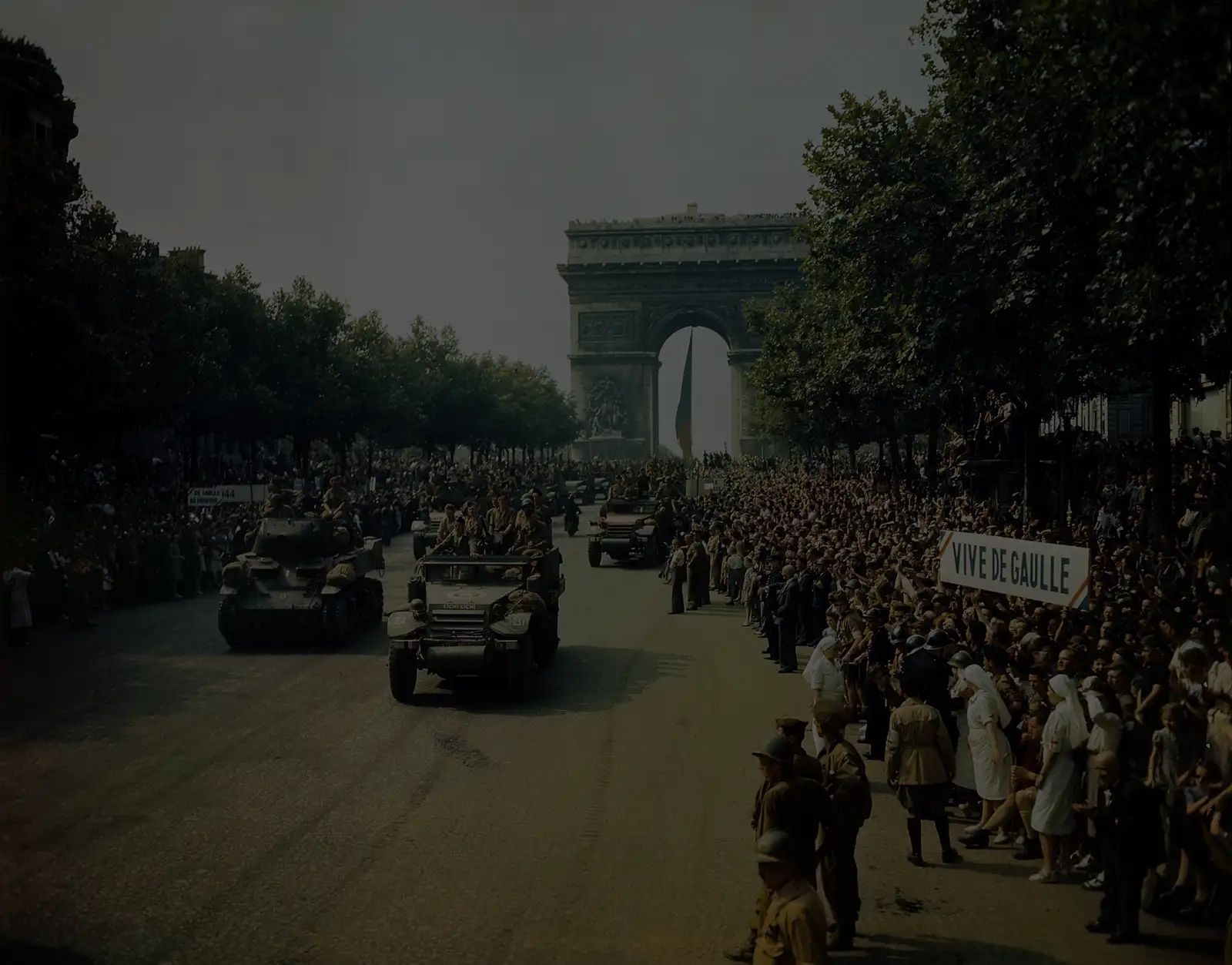
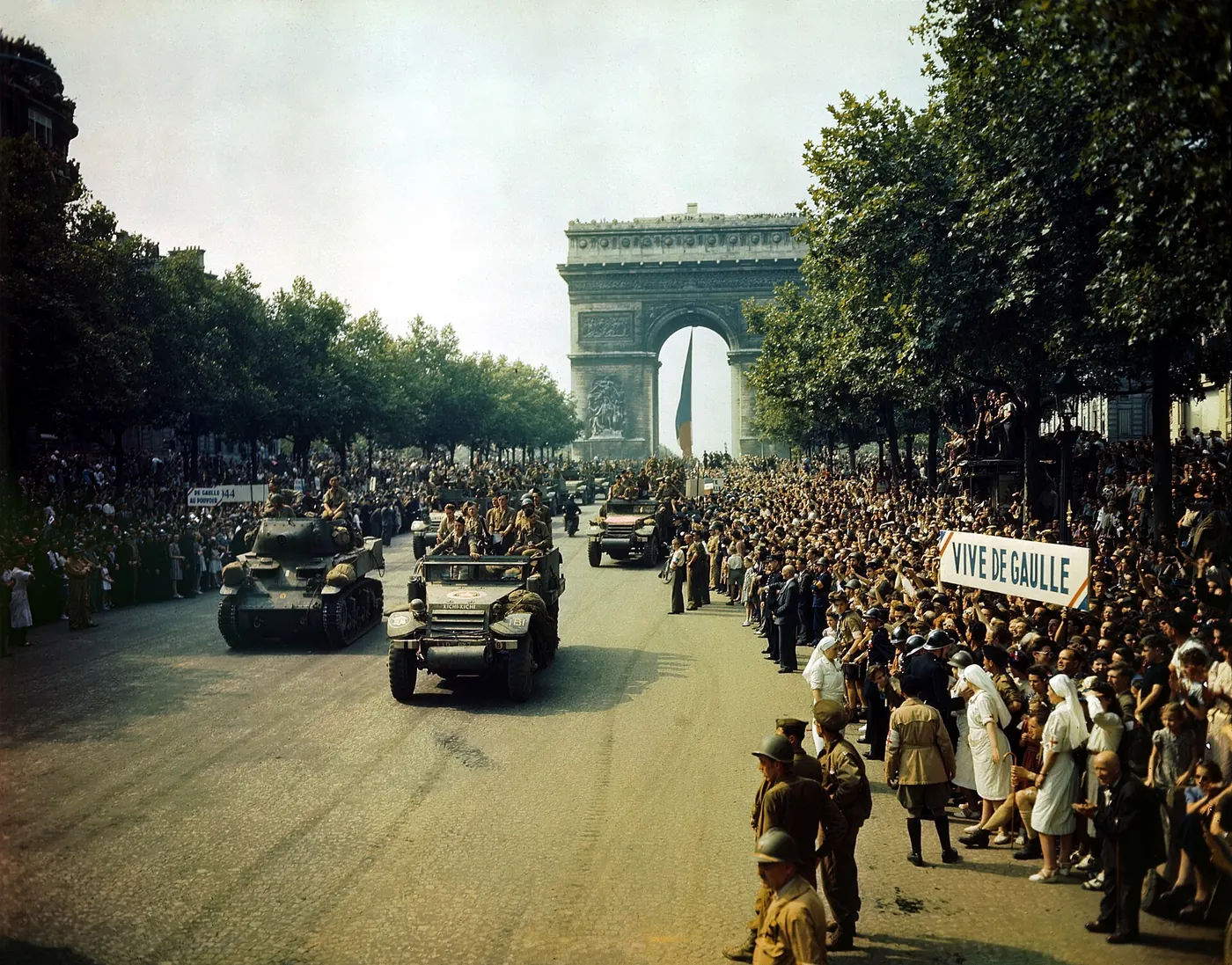
On 26 August de Gaulle walked down the Champs-Élysées. Four half-tracks of La Nueve escorted him; Robert Coale places Don Quichotte II directly behind him.
Tanks and half-tracks of the 2e DB pass the Arc de Triomphe, 26 August 1944. Colour photograph · Jack Downey, U.S. Office of War Information · public domain · Wikimedia Commons
September 1944 – January 1945
Lorraine, Strasbourg, and fewer and fewer Spaniards
The company left Paris on 8 September. According to the City of Paris, it took 300 prisoners at Andelot on 12 September. From 15 to 18 September it fought at Châtel-sur-Moselle: three killed, twenty wounded.
Between 31 October and 17 November, at Vacqueville and Badonviller, it counted 15 killed, almost 30 wounded and five missing, recorded as deserters. When the division took Strasbourg on 23 November, La Nueve's part was secondary. French recruits were filling the gaps. Granell left at the end of November. The last Spaniard of La Nueve killed in Europe, Corporal Pablo Moraga, fell near Grussenheim on 26 January 1945; Putz died in the same fighting.
2e DB ceremony at Wasselonne, west of Strasbourg, November 1944 · Émile Beck (1890–1945) · public domain · Wikimedia Commons
May 1945
Bavaria, May 1945
The war ended for the company in Bavaria, after a last fight at Inzell and Ramsau on 4 and 5 May 1945. US troops reached Berchtesgaden first, by John C. McManus's account; La Nueve's men visited the Eagle's Nest afterwards.
By the City of Paris's count, only 16 Spaniards were still in the ranks. They had helped free France. In Spain, Franco was still in power, and stayed there until his death in 1975.
Which names were painted on La Nueve's half-tracks?
Eleven names are backed by a historian's account or a credited photograph. Seven recall places or events of the Spanish Civil War. Of the other four, one comes from Cervantes, two refer to Tunisia, and the origin of Les Pingouins is unclear. Pick a name to see where it came from.
Guadalajara
Battle · 8–18 March 1937
A Republican victory north-east of Madrid: Mussolini's expeditionary corps was driven back. The half-track belonged to the third section; two later vehicles were named Guadalajara 2 and Guadalajara 3.
Name attested by Robert Coale and the City of Paris. Coale's photograph shows the later Guadalajara 2.
Teruel
Battle · December 1937 – February 1938
Taken by the Republic, then retaken by Franco's army by 22 February 1938. Command half-track of the second section, in the column of 24 August.
Name attested by Marine Garnier and Robert Coale.
Ebro
Battle · 25 July – 16 November 1938
A battle of 115 days. Second section; written L'Ebre in French accounts. The City of Paris says it fired the first shots in front of the Hôtel de Ville; historians doubt any shots were fired.
Name attested by Marine Garnier and Robert Coale.
Brunete
Battle · July 1937
The Republican offensive west of Madrid in July 1937. Third section, according to Jordi Siracusa.
Name attested by Marine Garnier and Robert Coale.
Madrid
Siege · November 1936 – March 1939
The capital held out for almost the whole war. The half-track belonged to the first section, which entered Paris on 25 August.
Name attested by Robert Coale and the City of Paris.
Guernica
Bombing · 26 April 1937
The Basque town bombed by the Condor Legion. First section: the half-track Rafael Gómez drove, the last Spanish veteran of the company, who died in 2020. The vehicle was destroyed on 26 January 1945.
Name attested by Robert Coale.
Santander
Fall of the city · 26 August 1937
The northern city that fell in the summer of 1937. The half-track belonged to the third section and flew a small Republican flag.
Name attested by Marine Garnier and Robert Coale.
Don Quichotte
A novel
Cervantes's knight, in French spelling. First section. Destroyed at Écouché on 13 August 1944 and replaced by Don Quichotte II, which, according to Robert Coale, drove directly behind de Gaulle on the Champs-Élysées.
Name attested by Robert Coale.
Les Pingouins
Origin unclear
“The Penguins”. First section. The sources consulted do not explain the name.
Name attested by Robert Coale.
Cap Serrat
A cape in Tunisia
A headland on the north coast of Tunisia. Many of the men had served in the Corps franc d'Afrique, which fought in the Tunisian campaign of 1943. First section.
Name attested by Robert Coale.
Tunisie 43
A campaign
The Tunisian campaign of 1943. Command half-track of the third section, under Miguel Campos, photographed on the Champs-Élysées on 26 August.
Named in the 2026 Spanish government catalogue, with a credited photograph.
An enthusiasts' site, Pingüinos en París, lists six more names: Nous Voilà, Résistance, Amiral Buiza, España Cañí and Les Cosaques with photographs, and Rescousse from Dronne's writings. The photographs cited for Belchite, a name often listed, show vehicles of other units. The column's three Shermans belonged to a French tank regiment, the 501e RCC; Dronne wrote that they carried names of Napoleon's battles: Romilly, Montmirail, Champaubert.
How many men served in La Nueve, and how many were Spanish?
More than 360 men of 14 nationalities passed through the company between 1943 and 1945. 181 of them were Spanish, the count the historian Diego Gaspar Celaya published in 2022 and the one the Spanish government now uses. The figure often quoted, 146 Spaniards out of 160, is the City of Paris's: a snapshot of the company at one moment, not a roll of everyone who served.
360 dots for the more than 360 men who served: killed (37) the others
Between August 1944 and May 1945 the company counted 37 killed, 112 wounded and one missing, all nationalities together (Robert Coale's count from the archives). Of about 23 sergeants at the start, two-thirds were killed or wounded.
A line repeated in many articles says only 16 of the Spaniards survived the war. The City of Paris wrote something different: by the end, only 16 Spaniards were still serving in the company. Men left through wounds and transfers, and French recruits took their places. Most members of La Nueve survived the war.
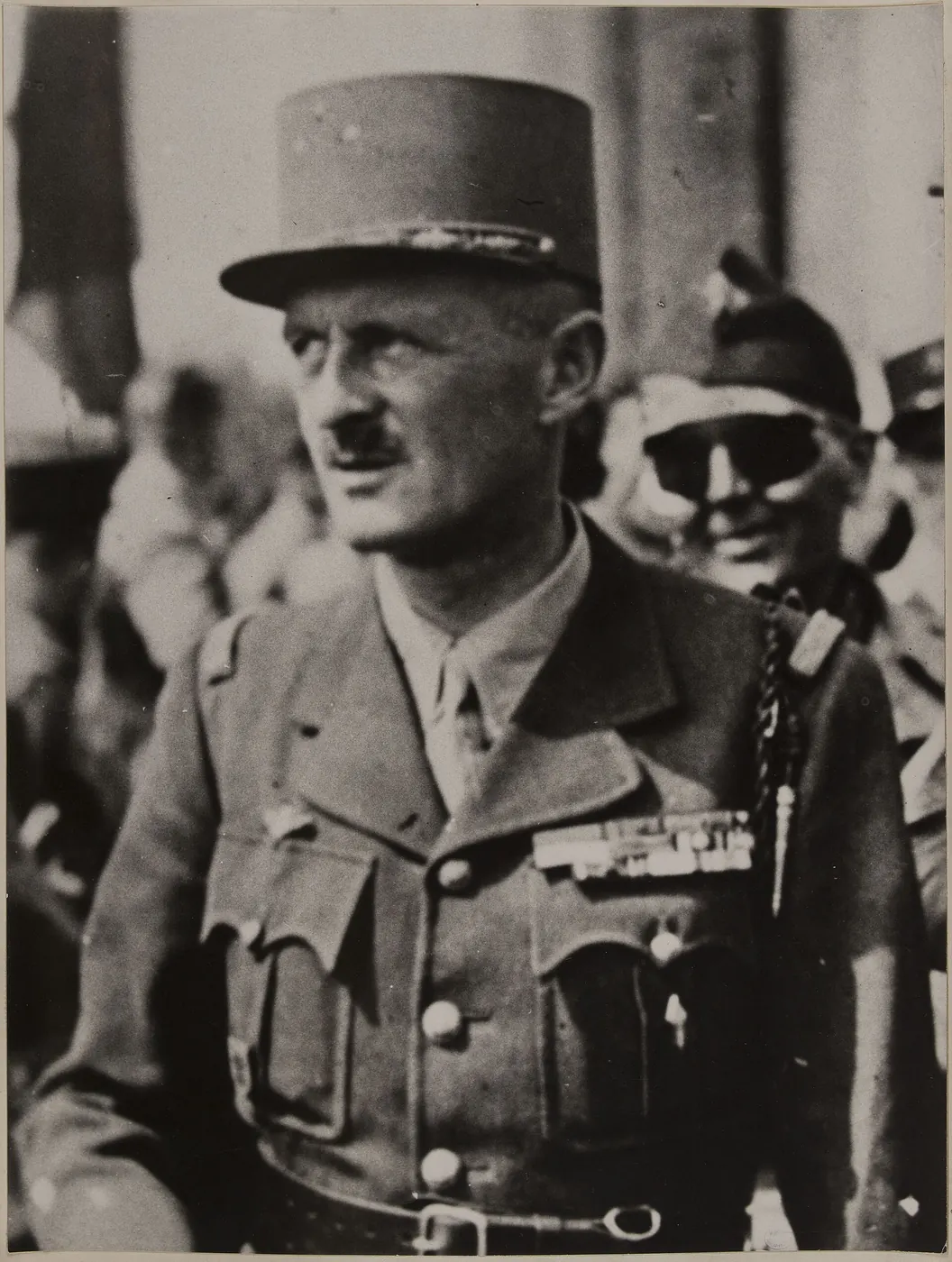
General Leclerc in Paris, 26 August 1944 · Agence LAPI, Musée Carnavalet · CC0 · Wikimedia Commons
What do the sources disagree on?
Eighty years of anniversaries have blurred the differences between the accounts. These are the points where later retellings part from the documents.
20:45 or 21:22?Dronne gives both times. At 20:45 the column passed the Porte d'Italie, and the battalion's war diary agrees; at 21:22 it stopped in front of the Hôtel de Ville. The French defence ministry's page gives 20:45 for the Hôtel de Ville, which merges the two.
How many went in?Two of the company's three sections, with three tanks and a section of engineers: about 130 men, by the Airborne Museum's count. The first section was still fighting at the Croix-de-Berny and entered on 25 August.
Were shots fired?The City of Paris says the half-track Ebro opened fire on a German machine-gun post. Robert Coale writes that not one shot was fired on the way in; Carmen Góngora writes that there was no fighting in Paris that night.
Who was first through the door?Paris names Amado Granell as the first Allied officer received at the Hôtel de Ville. The cartoonist Paco Roca, citing Coale, writes that there was no race between Granell and Dronne: the men of the column arrived together. Who stands beside Granell in the photograph published in Libération on 25 August is also disputed.
Dompaire?Many accounts put La Nueve in the tank battle of Dompaire on 12–13 September 1944. That was another battle group. La Nueve fought at Châtel-sur-Moselle, on 15–18 September.
The Eagle's Nest?La Nueve is often called the first unit into Hitler's mountain retreat. The historian John C. McManus places the US 3rd Infantry Division first in Berchtesgaden, on the afternoon of 4 May 1945, about four hours before the first French troops. Coale writes that other men of the same French battle group reached the Eagle's Nest before La Nueve.
The veterans of 2010In 2010 Paris awarded its Grande Médaille de Vermeil to three Spanish veterans, crediting them with the entry of 24 August. None of the three had been in the column that night.
How was La Nueve remembered?
The French post-war account of the Liberation left the Spaniards out, and Spain did not recognise them officially until the 2000s. Most of the tributes since then have come from Paris.
2004On 25 August Paris put up a plaque on the quai Henri-IV: "To the Spanish Republicans, the main component of the Dronne column". Two veterans were there.
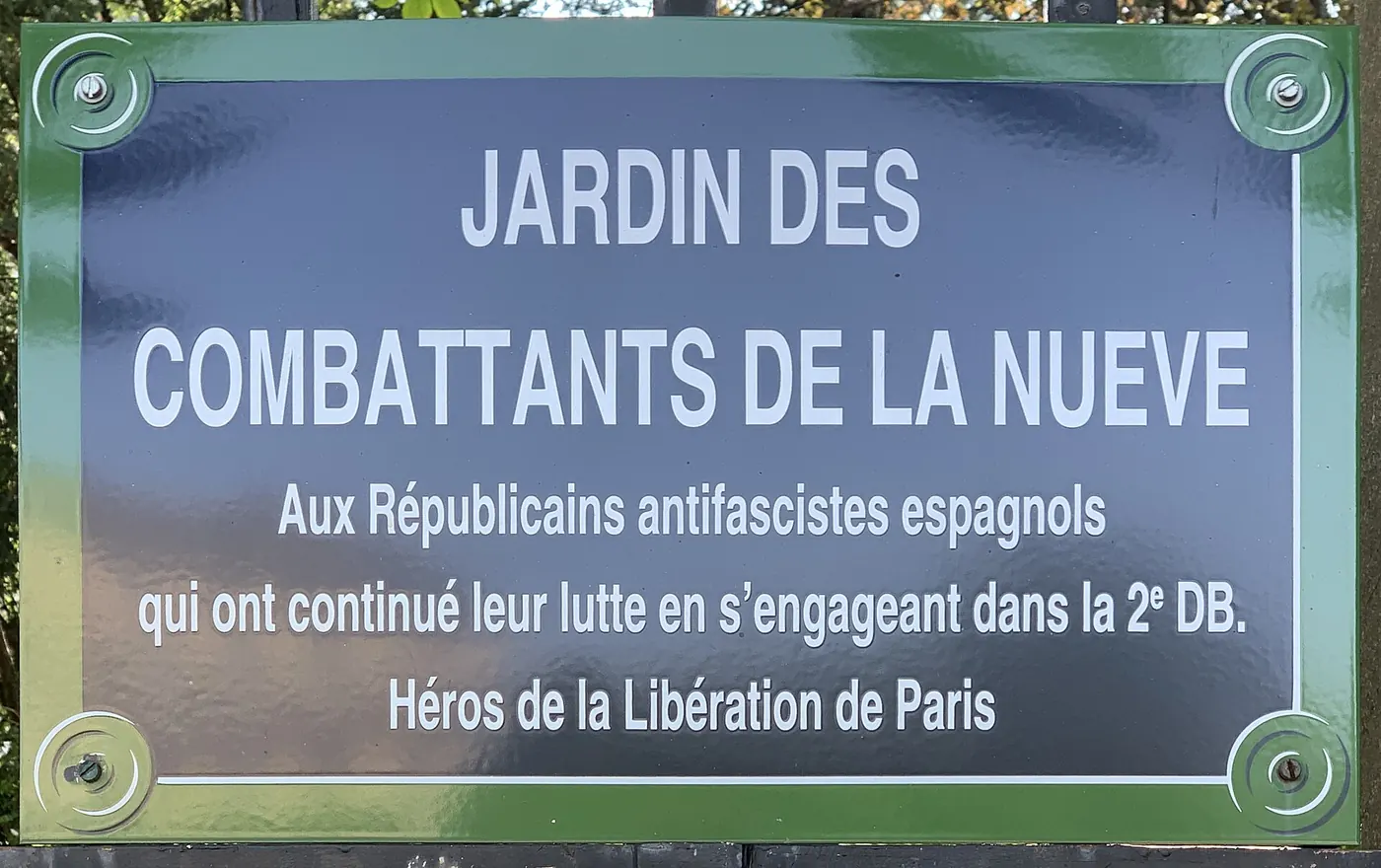
2015King Felipe VI and Queen Letizia, with the mayor Anne Hidalgo, inaugurated the Jardin des Combattants de la Nueve behind the Hôtel de Ville; Xataka dates the ceremony to 3 June.
2017On 20 April, according to Gacetín Madrid, Madrid announced that a garden in Ciudad Lineal would bear the company's name; Rafael Gómez, its last Spanish veteran, was there.
2020Rafael Gómez Nieto died near Strasbourg on 31 March, of COVID-19, aged 99. He had driven the half-track Guernica, and entered Paris on 25 August with the first section.
2024For the 80th anniversary, a plaque to the Dronne column was put up at 1 rue Brillat-Savarin, in the 13th arrondissement. In Yorkshire, Pocklington's local history group was told the story of the autographs in Vera Kidd's notebook.
2025On 25 August Spain declared the Paris garden a Lugar de Memoria Democrática, a place of democratic memory.
2026In March an exhibition on the 181 Spaniards of La Nueve opened in Madrid.