Marius Comper

Lisbon · the Channel · Ireland · May to November 1588

The Spanish Armada, 1588: the battle sank a handful of ships. The coasts of Ireland and Scotland took far more

In the summer of 1588 about 130 ships sailed from Lisbon to carry an invasion army into England. Scroll through the calendar and watch each ship leave the fleet where and when it was lost: red for those the English and Dutch took or sank, blue for those the sea and the rocks destroyed, weeks after the last shot.

  • with the fleet
  • lost in the fighting
  • wrecked
  • lost otherwise
  • home

28–30 May 1588 · Lisbon

What sailed from Lisbon

The fleet that left the Tagus between 28 and 30 May was not a Spanish navy in the modern sense. Its core was some twenty purpose-built galleons, ten of them in the Portuguese squadron: Philip II had been king of Portugal since 1580. Around them sailed armed merchantmen requisitioned in Biscay, Gipuzkoa and Andalusia or hired from Venice and Ragusa, four oared galleasses from Naples, and over twenty urcas, broad cargo hulks, many from the Baltic.

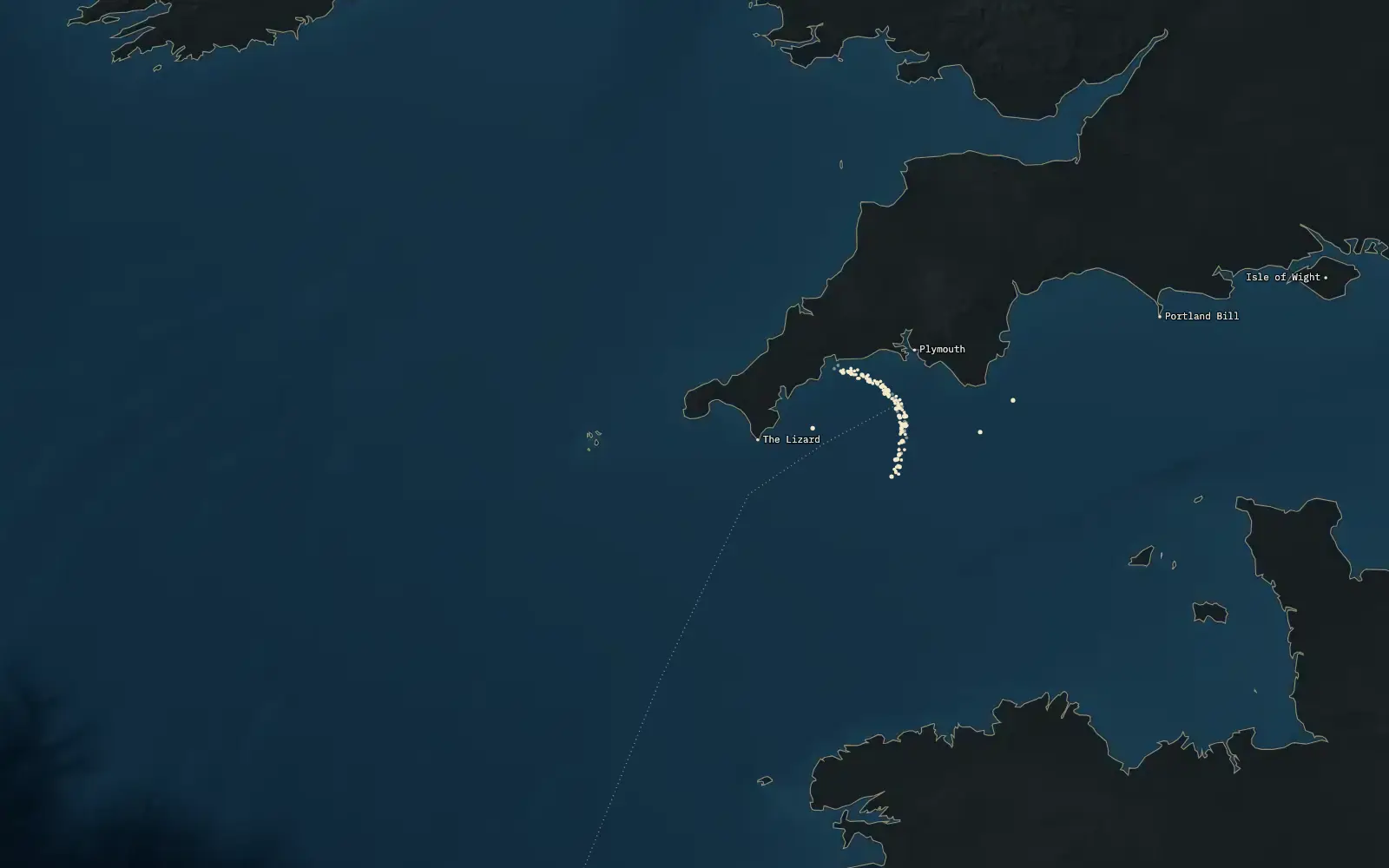
Its orders were narrow: sail up the Channel without seeking battle, meet the Duke of Parma off Flanders and cover his barges while they carried an army across to Kent. The commander, the Duke of Medina Sidonia, had never fought at sea and had asked the king to spare him the post. Each dot on the map is one ship.

Two weeks earlier, the Day of the Barricades (12 May) had driven Henry III out of Paris, his capital, into the hands of the Catholic League. Philip's ambassador, Bernardino de Mendoza, had urged its leader, the Duke of Guise, to keep the French king busy. France would not interfere.

19 June – 22 July · A Coruña

A storm, a month in port and the first sick men

The fleet needed three weeks to beat north to Cape Finisterre. On 19 June a storm scattered it; Medina Sidonia and most of the ships ran into A Coruña, others sheltered in smaller Galician harbours, a few were blown as far as the Scilly Isles. Casks of green wood had leaked, salted food had rotted, and men were falling ill.

Medina Sidonia wrote to the king suggesting the enterprise be dropped. Philip refused. Repaired and restocked, the Armada put to sea again on 21 and 22 July.

22–28 July · the Bay of Biscay

The same day, ten days apart

Spain had adopted Pope Gregory XIII's new calendar in 1582; Protestant England kept the old Julian one until 1752. So the two fleets dated the same morning ten days apart: the day Medina Sidonia logged as 29 July was 19 July in Lord Howard's letters. English accounts put the battles in late July, Spanish ones in August.

The box in the corner of the map shows both. The text on this page uses the Spanish (new style) date, the calendar used across Europe today.

29–30 July · off Cornwall

The Lizard, and the beacons

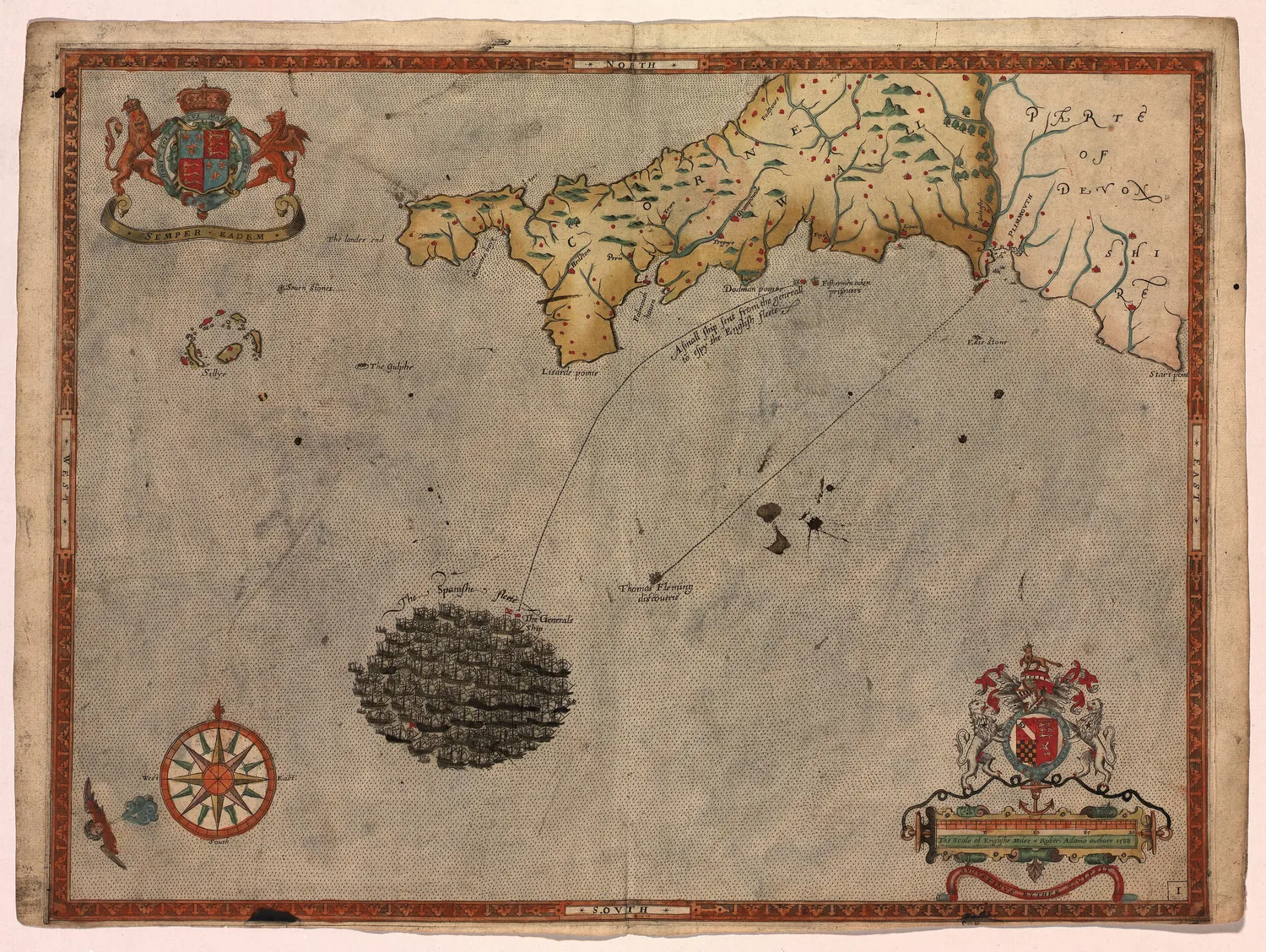
On 29 July the Armada was sighted off the Lizard, the southern tip of Cornwall. Beacons on hilltops passed the news towards London. The English fleet lay in Plymouth; during the night it worked out of the harbour and, by the morning of the 31st, had got upwind of the Spaniards, the position from which a sailing fleet can attack when it chooses.

Hand-coloured chart: the Cornish coast at the top, the Spanish fleet as a cloud of ships below
The Armada off Cornwall, on one of the English charts printed in 1590 · Robert Adams, Augustine Ryther (1590) · public domain · Library of Congress

31 July – 5 August · the Channel

A week of gunfire up the Channel, and two ships lost to accidents

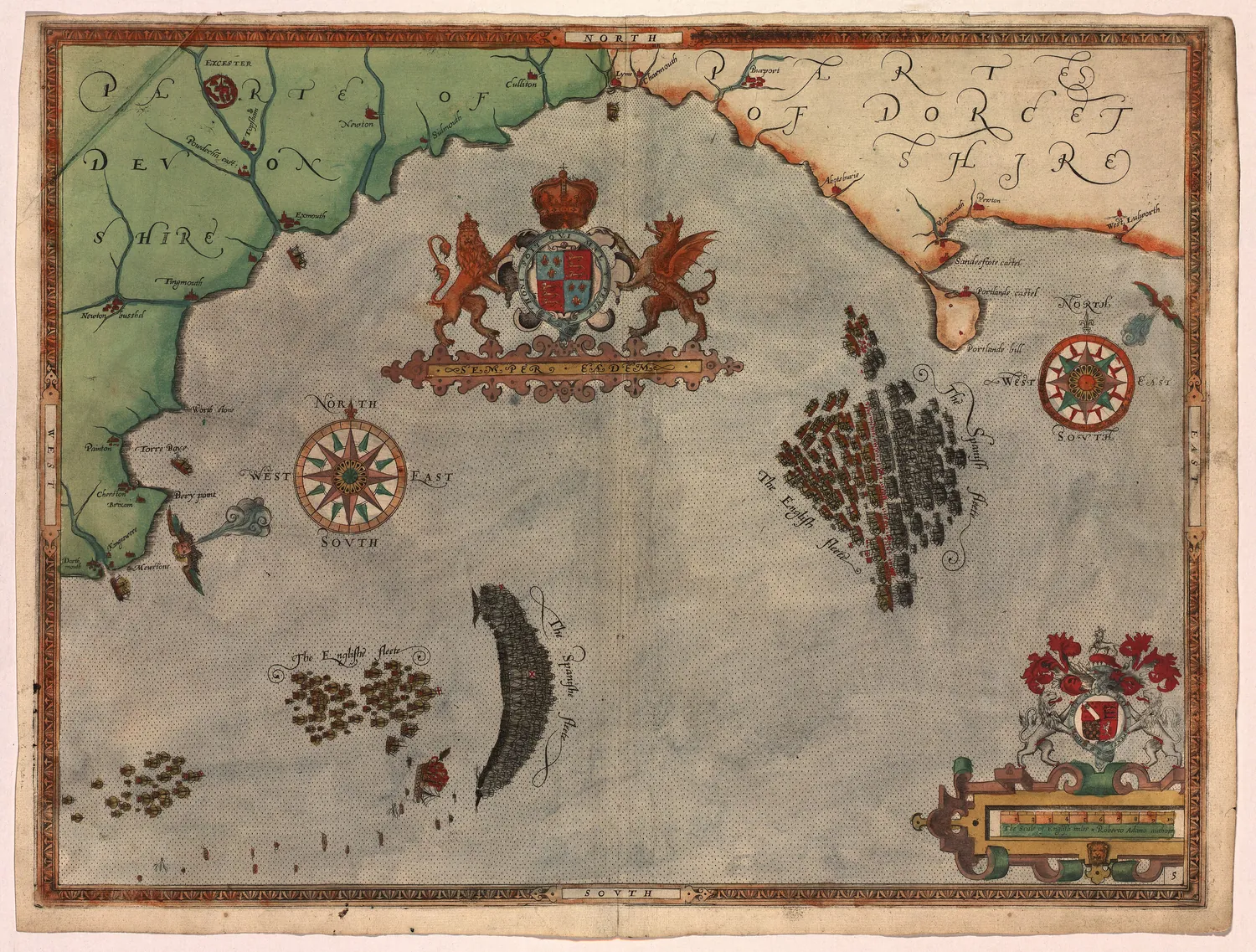
The Armada sailed in a crescent several miles wide, its strongest ships on the horns and the transports in the middle. The English, in lighter, handier ships, kept their distance and fired. They fought off Plymouth on 31 July, off Portland Bill on 2 August and off the Isle of Wight on 4 August, and used up most of their powder.

In those days the Armada lost two ships, neither of them to English gunfire. The Nuestra Señora del Rosario lost her bowsprit and foremast in a collision and fell behind; Drake took her surrender the next morning. The San Salvador was wrecked by an explosion in her powder store and was towed into Weymouth.

The Spanish fleet in a crescent with the English fleet behind it, on a coloured chart
The Armada's crescent pursued by the English fleet up the Channel (1590 chart) · Robert Adams, Augustine Ryther (1590) · public domain · Library of Congress

6–7 August · Calais

Anchored off a French port, waiting for an army that could not come

On 6 August the fleet anchored off Calais, a French town that England had lost only thirty years before. Medina Sidonia now learned that Parma's barges were not ready, and that they could not leave the Flemish ports in any case: Dutch flyboats under Justinus of Nassau held the shallows, where the deep-draught galleons could not follow.

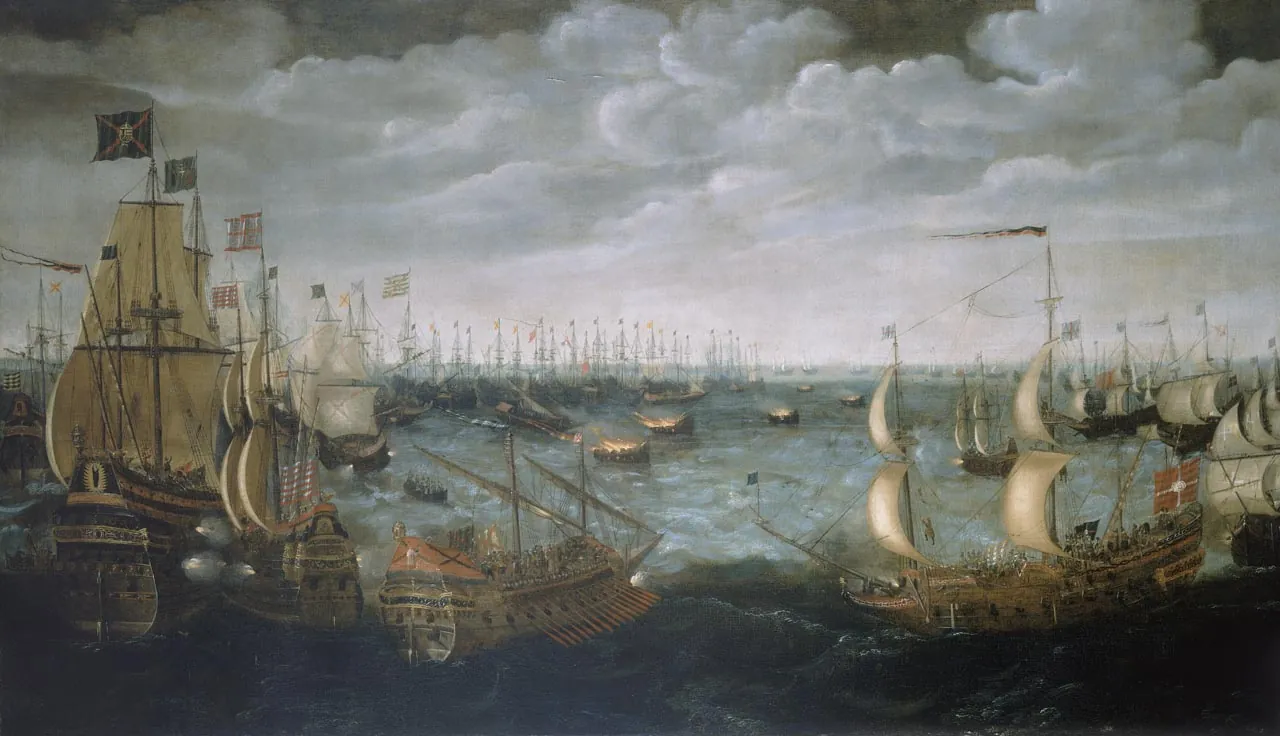
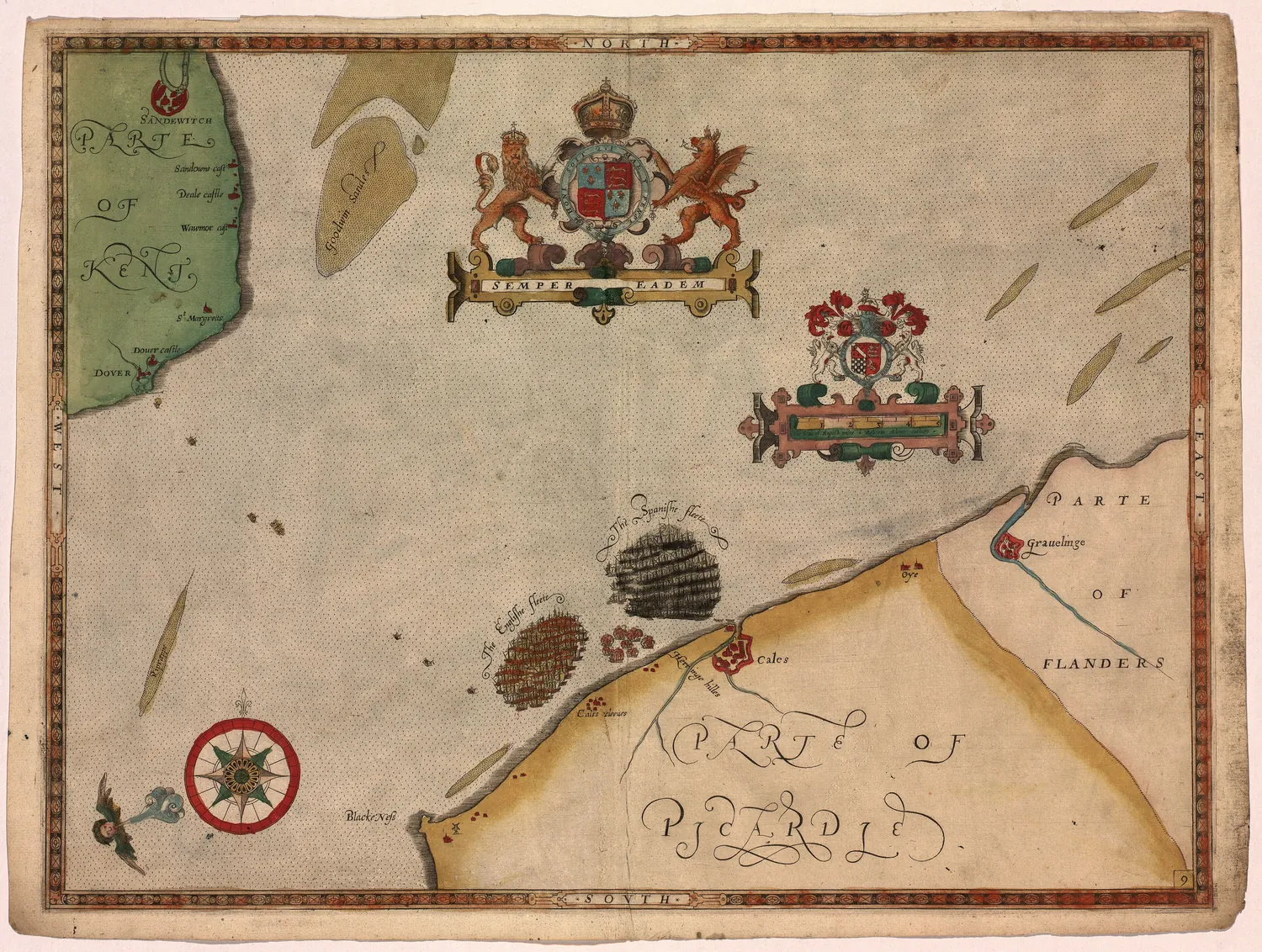
Around midnight on 7 August the English sent eight burning ships down the wind into the anchored fleet. Most captains cut or slipped their cables and ran. No Spanish ship burned, but the formation was broken, and many ships left anchors on the bottom off Calais. In Ireland, a month later, that would matter.

Painting: burning ships driven by the wind towards a crowd of anchored ships
English fireships sent into the anchored fleet, the night of 7–8 August · anon., c. 1590 · public domain · Royal Museums Greenwich / Wikimedia Commons

8–10 August · off Gravelines

Gravelines: the one real battle

At dawn on 8 August the English fell on the scattered fleet off Gravelines and fought at close range for most of the day, until their shot ran out. This was the day English guns did the damage. The María Juan sank. The galleass San Lorenzo, rudder gone, ran aground under the walls of Calais; English boats stormed her, and the French governor's guns drove them off. The crippled Portuguese galleons San Mateo and San Felipe drifted onto the Flemish banks and were taken by the Dutch and English from Flushing.

Counting the two accidents in the Channel and a small patache captured off Blankenberge, 7 ships were lost in the Channel and off Flanders. No English ship was lost to Spanish fire.

Chart of the Flemish coast with the two fleets mixed offshore
The fight off Flanders, 8 August (1590 chart) · Robert Adams, Augustine Ryther (1590) · public domain · Library of Congress

9–19 August · the North Sea

The wind turns, and the long way home begins

On 9 August the wind was pushing the Armada onto the sandbanks of Zeeland when it backed and let the fleet escape into the North Sea. With no friendly deep-water port to repair in and the wind against a return through the Channel, the council of war chose to go round Scotland. The English followed to about 55 degrees north, level with the Scottish border and far out at sea, and turned back on 12 August, short of food and powder. The fighting was over.

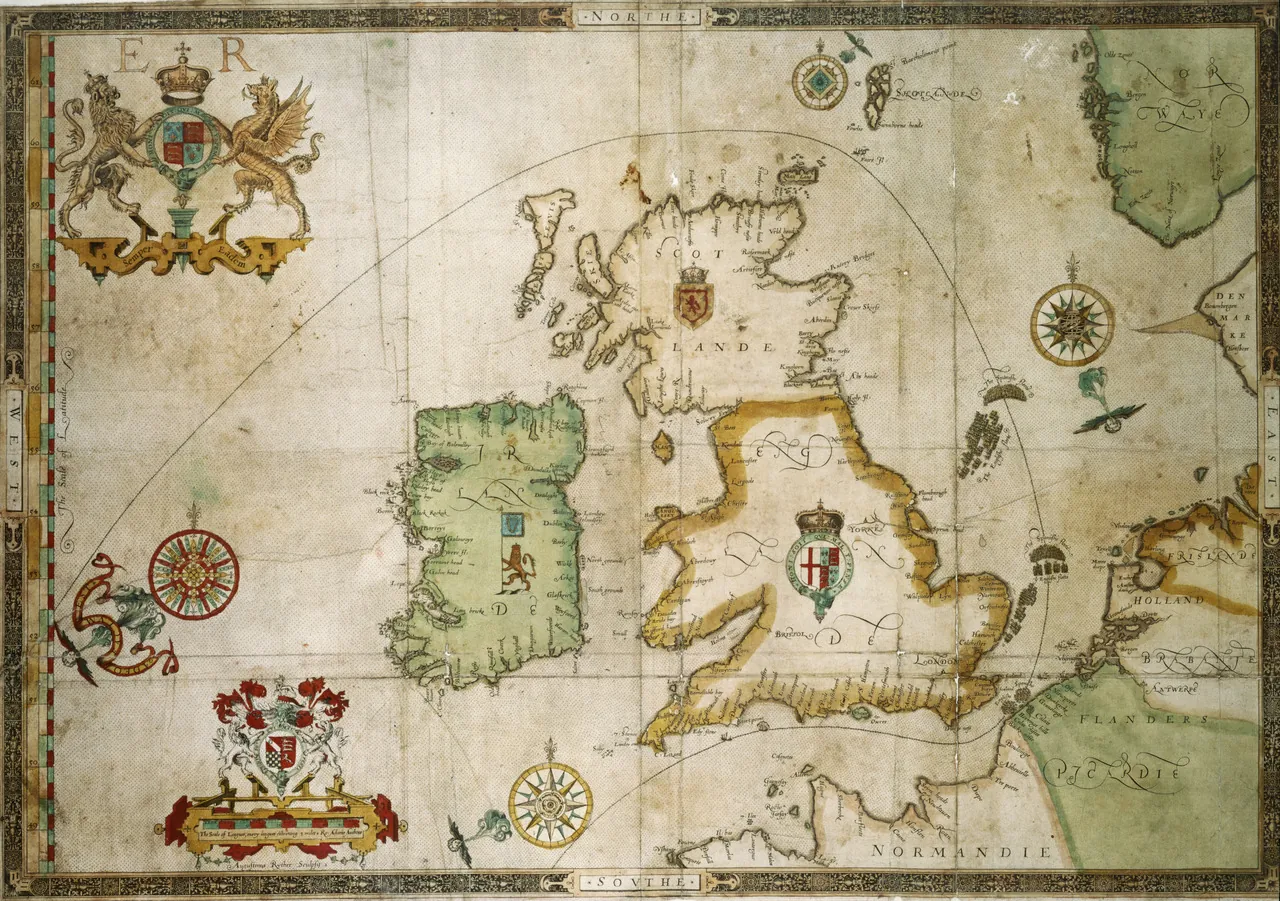
Medina Sidonia's sailing order told every pilot to stand north to 61½ degrees, then west-south-west and south-west into the open Atlantic, before turning for Spain. The dotted gold line on the map is that course.

“…and then to take great heed lest you fall upon the island of Ireland, for fear of the harm that may happen unto you upon that coast.”Medina Sidonia's sailing order, English copy (Laughton, 1894)

20 August – 2 September · north of Scotland

Where they thought they were

The fleet passed between Orkney and Fair Isle on about 20 August, further south than ordered, and entered the Atlantic. Sixteenth-century pilots could measure latitude from the sun but not longitude: they estimated how far west they had come from speed, heading and time. Head winds, fog and the current kept pushing them back east.

Marcos de Aramburu, inspector and accountant of the Castilian galleons, kept a log aboard their vice-flagship. On 9 September he put himself at 54 degrees north and about 100 leagues, more than 500 km, from Ireland. A reconstruction of his track by climate historians at the University of East Anglia places him probably less than 100 miles from the coast. Two days later he sighted land.

One hulk, El Gran Grifón, never got clear: she was wrecked on Fair Isle, and some 260 survivors lived on the island for weeks before being taken to mainland Shetland and on to Scotland.

early September · off Ireland

The gales of September

In the first days of September gales broke up what was left of the formation. Most ships held out to sea and reached Spain. About two dozen, leaking, with shot-torn masts, short of water and often with few anchors left, turned for the Irish coast to find shelter, water and food.

Ireland's west coast was barely charted. From here on, every cross on the map is the work of rocks and weather, weeks after the last English shot.

15–28 September · Blasket Sound, Kerry

Blasket Sound: one captain who knew the coast

Juan Martínez de Recalde, the fleet's most experienced seaman, had landed troops in this corner of Kerry in 1580. On 15 September, guided, Aramburu says, by a Scot taken from a captured boat, he took his galleon through a narrow gap into Blasket Sound and anchored behind the Great Blasket, out of the swell. Aramburu's ship followed.

On 21 September the Santa María de la Rosa came in with her sails in shreds, dragged her last anchor and sank by Stromboli reef; one man reached the shore alive. Recalde got his ship back to A Coruña on 7 October and died there on 23 October.

21 September · Streedagh, County Sligo

Streedagh: three ships in an hour

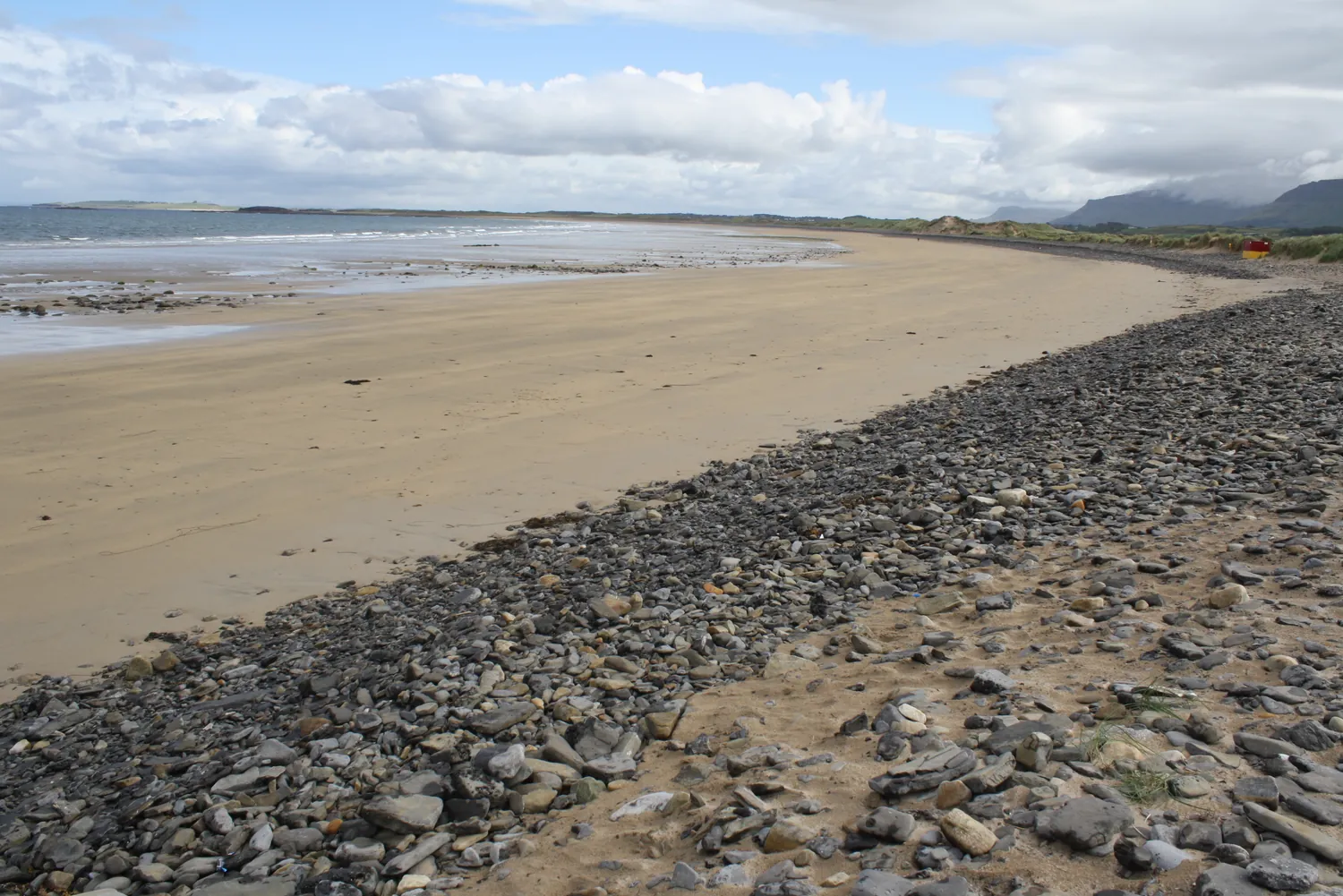
Off Streedagh Strand in County Sligo three big merchantmen from the Levant squadron, the Lavia, the Juliana and the Santa María de Visón, lay at anchor more than half a league offshore for four days. On the fifth a storm drove all three onto the beach. Irish archaeologists put the dead at more than 1,100.

Captain Francisco de Cuéllar was aboard the Lavia. He could not swim; he came ashore on a piece of wreckage, past men being stripped on the sand. His letter, written in Antwerp a year later, is the fullest account of the Armada in Ireland. The dashed orange line follows his escape: sheltered by Irish lords, through the hills of Leitrim, holding MacClancy's castle on Lough Melvin with eight other Spaniards while MacClancy and his people fled to the hills, then north-east to the country near Derry, where a bishop found him a boat. It was driven to Shetland before reaching Scotland.

“Within the space of an hour all three ships were broken in pieces.”Francisco de Cuéllar, letter of 4 October 1589 (Allingham's translation, 1897)

September–October · Ulster and Connacht

Ashore in Ireland

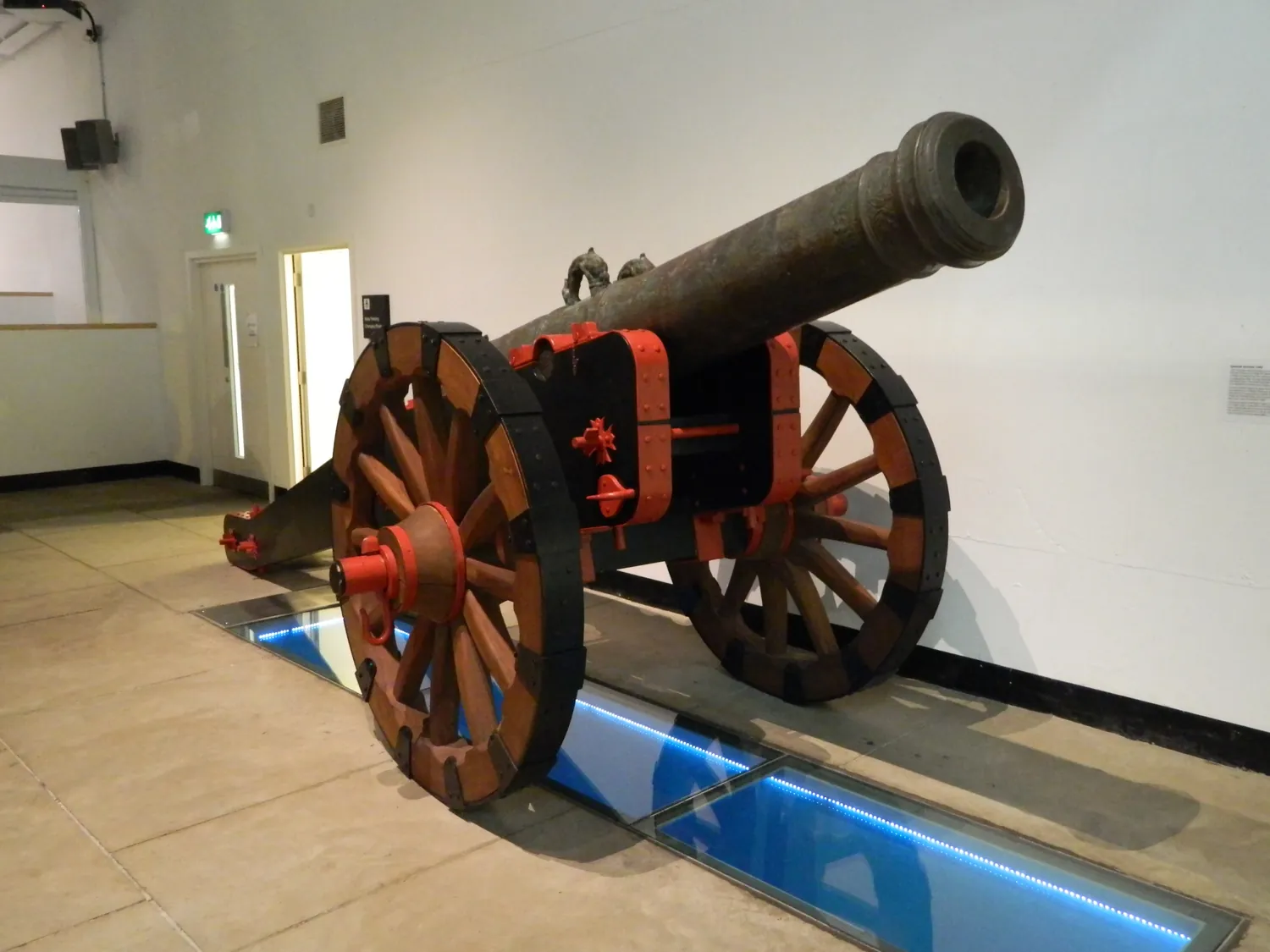
Reaching land did not mean surviving. The Lord Deputy in Dublin, William Fitzwilliam, ordered that Spaniards be taken and executed and that anyone sheltering them be treated as a traitor. In Connacht most of the survivors who were caught were killed. In Inishowen, men from La Trinidad Valencera, wrecked in Kinnagoe Bay on 14 September, surrendered on a promise of safe conduct; several hundred were then massacred.

Some Irish lords did the opposite. Brian O'Rourke in Leitrim, the MacSweeneys in Donegal and Sorley Boy MacDonnell in Antrim fed survivors and passed them on to Scotland, from where many reached Flanders.

Long bronze gun on a carriage with large wheels, in a museum room
Bronze siege gun from La Trinidad Valencera, raised from Kinnagoe Bay in 1971 · Bazonka · CC BY-SA 3.0 · Wikimedia Commons

from 21 September · northern Spain

Coming home

From 21 September the first ships limped into Santander and Laredo, their crews dying of typhus, scurvy and hunger even at anchor. Two squadron commanders, Recalde and Miguel de Oquendo, died within weeks. Medina Sidonia went home to recover; the king did not blame him.

In England the sailors who had won were dying too. Disease spread through the fleet at Margate and Harwich, and the crews were discharged largely unpaid. Lord Howard paid some of them out of his own purse.

28 October · Lacada Point, Antrim

The Girona

The galleass Girona was patched up at Killybegs in Donegal and took on board the survivors of two other wrecks, among them Alonso Martínez de Leiva, the fleet's most celebrated nobleman. She set out for neutral Scotland with about 1,300 people aboard. Off the Antrim coast her rudder failed and she struck Lacada Point. The usual figure is nine survivors.

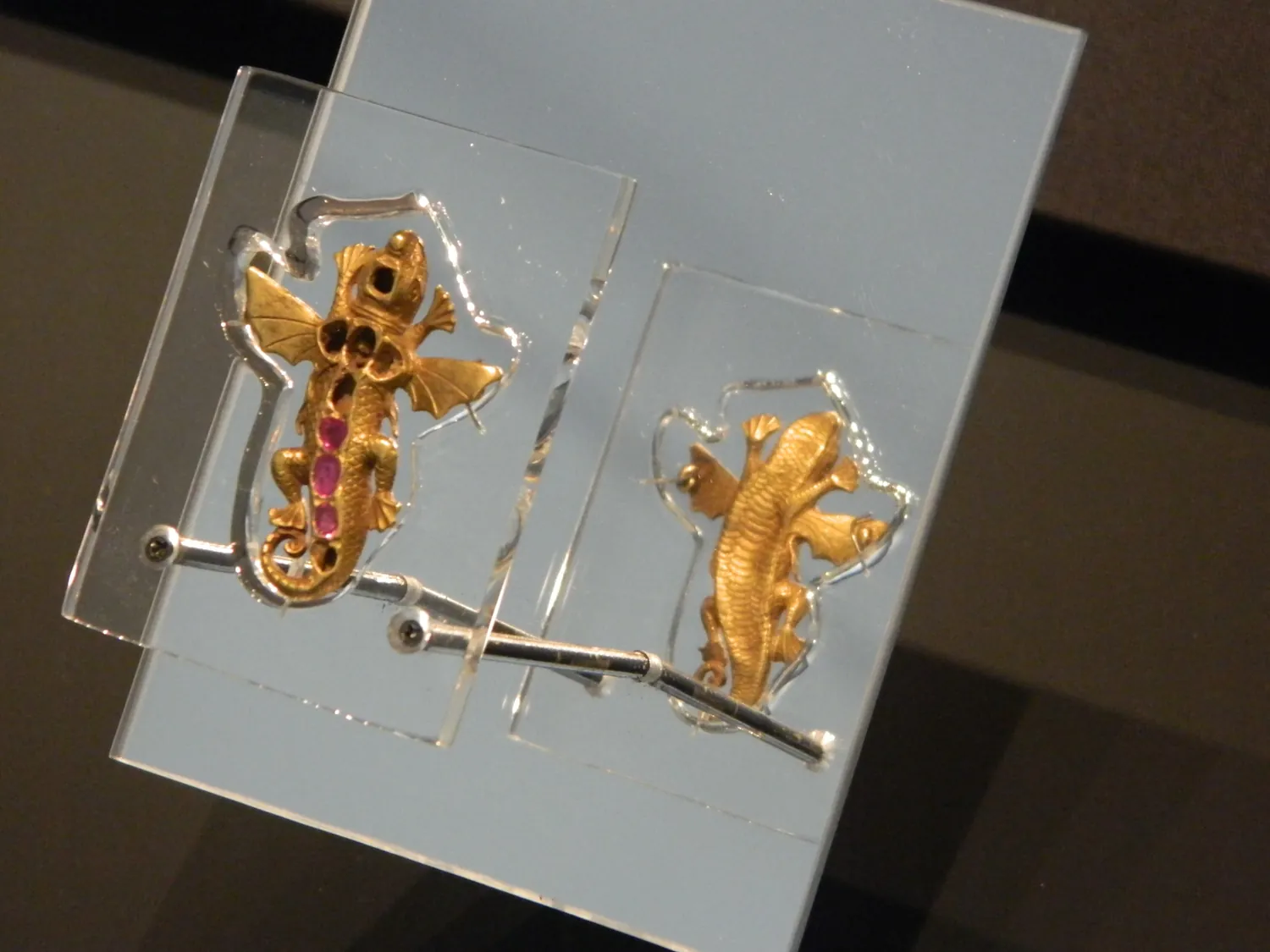
Her wreck, found by divers in 1967, gave the largest haul of Armada treasure ever raised: gold chains, rings, coins and a gold and ruby salamander, now in the Ulster Museum in Belfast.

Gold salamander-shaped pendant set with rubies, in a display case
The gold and ruby salamander from the wreck of the Girona, now in the Ulster Museum, Belfast · Bazonka · CC BY-SA 3.0 · Wikimedia Commons

the whole campaign

Who sank the Armada?

Here is every loss at once. Of the 110 ships traced one by one, 7 were lost in the Channel and off Flanders between 1 and 10 August, in the fighting or because of it. A small boat and a galley had already been lost on the way north, before the Channel. After the fighting, 35 more were wrecked, lost at sea, burned, abandoned or blew up, 22 of them off or on the coasts of Ireland and Scotland. 57 ships are confirmed home and 9 have no established fate.

The English and their allies won the campaign: no army landed. But most of the losses, in ships and in men, came on the voyage home.

  • with the fleet
  • lost in the fighting
  • wrecked
  • lost otherwise
  • home

The losses, ship by ship and day by day

Each dot is one ship lost between July and November, placed on the day it was taken, sank or ran aground. The red dashed line marks the last day of fighting, 8 August. A few dots stand at estimated dates (the register marks them); ships lost on dates nobody recorded at all are left out.

Armada ships lost, by date and causeOne dot per ship lost between July and November 1588: the red dots sit in early August, the blue ones in September and October.AugustSeptemberOctoberNovemberlast day of fighting, 8 AugustSan Blas la Menor: Lost off the Scilly IslesCapitana (galleys): Ran aground near Bayonne in July, before the Channel, and was broken upNuestra Señora del Rosario: Disabled in the Channel and captured by the English, 1 AugustSan Salvador: Disabled in the Channel and captured by the English, 1 AugustMaría Juan: Sank from battle damage off Gravelines, 8 AugustSan Lorenzo: Ran aground at Calais and was stormed by English boats, 8 AugustSan Felipe: Crippled at Gravelines, taken by the Dutch and English off Flushing; sank, 9 AugustSan Antonio de Padua: Captured off Blankenberge, Flanders (date not recorded)San Mateo: Crippled at Gravelines, taken by the Dutch and English off Flushing; sank, 10 AugustNuestra Señora del Carmen: Lost at sea, 21 AugustConcepción de Nuestra Señora: Lost off OrkneyNuestra Señora de la Ydra: Lost at sea, 23 AugustNuestra Señora de la Concepción: Lost off NorwayBarca de Amburg: Foundered off Malin Head when her pumps failed, 1 September; crew taken offCastillo Negro: Lost at sea, 4 SeptemberLa Trinidad Valencera: Wrecked at Kinnagoe Bay, Donegal, 14 September; most of the men got ashore, hundreds were then killedTrinidad: Last seen near Valentia Island, Kerry, 15 September; no wreck foundNuestra Señora del Puerto: Wrecked at Clew Bay, Mayo, 16 SeptemberSantiago: Wrecked at Mosterhamn, near Bergen, 18 September; carried soldiers' wives, some of whom survivedAnunciada: Emptied and set on fire in the Shannon estuary, 19 September; her crew moved to the Barca de DanzigNuestra Señora de Castro: Lost off the north coast of SpainSanta Ana: Sank off Le Havre, 19 SeptemberSanta Bárbara: Wrecked at Mutton Island, Clare, 20 SeptemberSan Martín de Santander: Lost off IrelandNuestra Señora del Buen Viaje: Lost at sea, 20 SeptemberLa Juliana: Wrecked at Streedagh, Sligo, 21 SeptemberLa Rata Santa María Encoronada: Ran aground and was burned by her crew at Ballycroy, Mayo, 21 SeptemberSanta María de la Rosa: Sank in Blasket Sound, Kerry, 21 September; one survivorLa Lavia: Wrecked at Streedagh, Sligo, 21 SeptemberSanta María de Visón: Wrecked at Streedagh, Sligo, 21 SeptemberSan Esteban: Wrecked at Doonbeg, Clare, 21 SeptemberSan Nicolás Prodaneli: Wrecked at Clew Bay, Mayo, 22 SeptemberCiervo Volante: Wrecked at Broadhaven, Mayo, 22 SeptemberSan Marcos: Wrecked at Lurga Point, Clare, 22 SeptemberGran Grín: Wrecked at Clare Island, Mayo, 22 SeptemberLa Anunciada (falúa): Lost at sea, 23 SeptemberDuquesa Santa Ana: Wrecked at Loughros Mór Bay, Donegal, 24 SeptemberFalcón Blanco Mediano: Wrecked at Inishbofin, Galway, 25 SeptemberSan Juan Bautista (Fernandome): Emptied and set on fire in Blasket Sound, Kerry, 26 SeptemberEl Gran Grifón: Wrecked at Fair Isle, 28 September; most of the men lived on the island for weeksSan Pedro Menor: Sank in Morbihan, Brittany, 20 OctoberGirona: Wrecked at Lacada Point, Antrim, 28 October with about 1,300 aboard; few survivedSan Juan de Sicilia: Blew up at anchor in Tobermory Bay, Mull, 5 November after weeks in harbour; cause disputed (accident or sabotage)San Pedro Mayor: Wrecked at Hope Cove, Devon, 6 November; the hospital ship's men were taken prisonerRed: lost in the fighting · Blue: wrecked or lost at sea · Violet: burned, abandoned or blown up

How many men came home

Spanish pay records give the best count. Figures published by the Spanish navy's Institute of Naval History (José María Blanco Núñez) give 25,696 men sailing from A Coruña and 13,399 coming back. Each circle below is a hundred men; the empty ones did not return.

Not every missing man died: some hundreds were prisoners in England, Ireland and the Netherlands, and some survivors reached Spain later through Scotland and Flanders. Estimates of the Spanish dead run from 8,000–9,000 (Fernández Duro) to over 10,000 and perhaps near 15,000 (Gracia Rivas); most died of disease, hunger and drowning. On the English side, an officer reckoned that fewer than 60 men had been killed in the fighting. Disease in the English fleet afterwards killed thousands.

Why the totals differ

The number of ships lost depends on who counted and what they counted. Cesáreo Fernández Duro, who published the Spanish documents in 1884–85, reached 63, but 35 of those were ships whose fate he simply did not know. José Luis Casado Soto, who traced the later service of each ship, found 34 or 35 real losses: 28 to storms and six in the Channel. Garrett Mattingly, recounting Duro's list, put the ceiling at 44.

This page follows the ship-by-ship appendix of Colin Martin and Geoffrey Parker's 2022 edition, checked against the English state papers and Fernández Duro's documents. It includes small craft that older counts left out, and it marks where a place or date is an inference or local tradition rather than record. About two dozen hulks and small vessels of the Lisbon fleet are not traced individually; they appear as faint dots on the map.

What the record says, and what came later

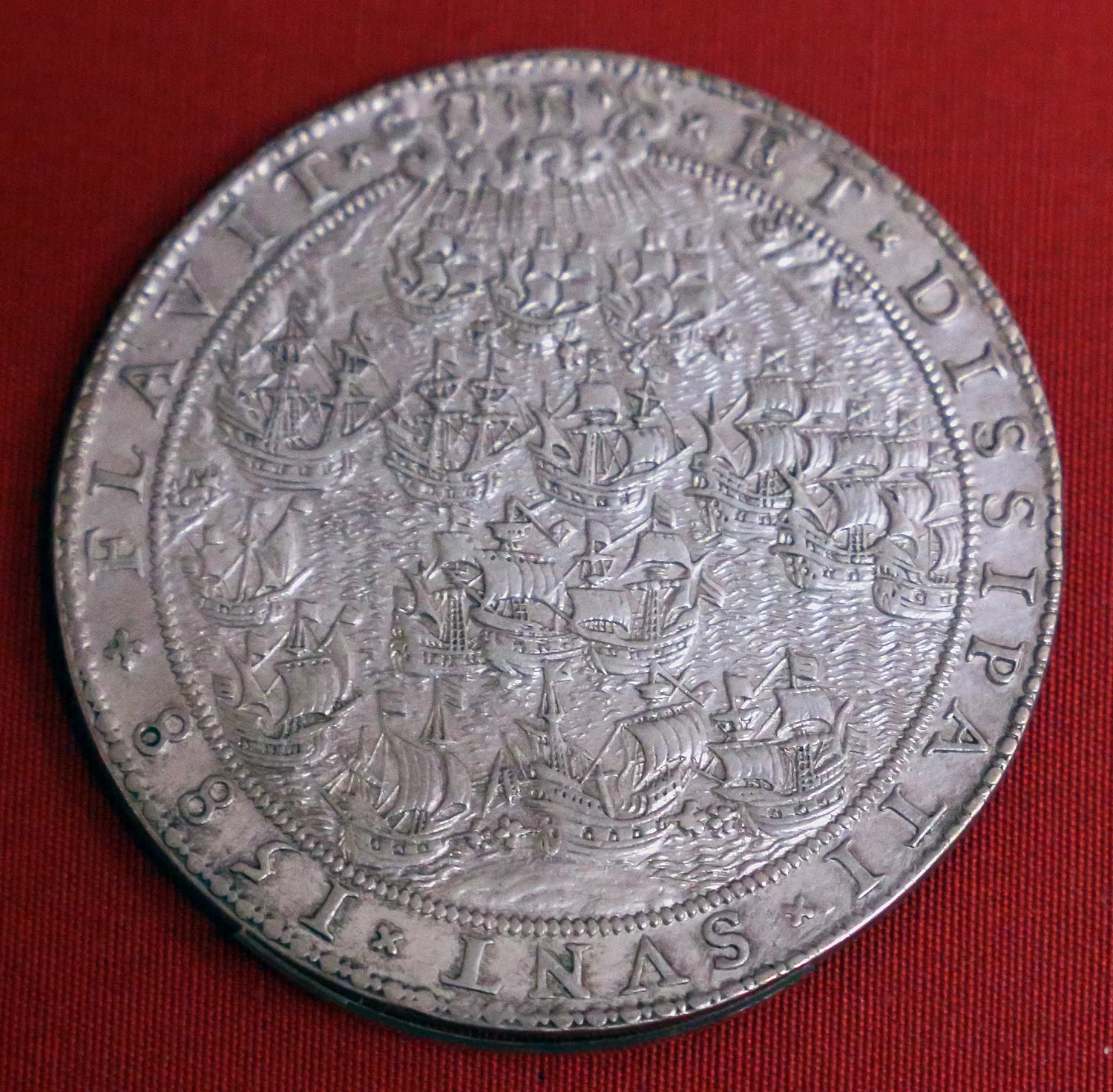
Silver medal with ships at sea and a Latin inscription round the rim
The Dutch medal of 1588: 'Flavit et dissipati sunt', He blew and they were scattered · Gerard van Bylaer (1588); Sailko · CC BY 3.0 · Wikimedia Commons

“He blew and they were scattered.” A medal struck in 1588 for Prince Maurice of Orange carries the words Flavit et dissipati sunt and the Hebrew name of God in the clouds. It credits the wind. The weather was real: 1588 brought an unusual run of North Atlantic gales. But the fleet had already been broken off Calais and Gravelines before the gales began.

“Invincible.” Spain's own name for it was the Grande y Felicísima Armada, the great and most fortunate fleet. “Invincible” spread later, mostly with irony.

The Tilbury speech. Elizabeth's “heart and stomach of a king” survives in several versions written down afterwards. She spoke at Tilbury on 19 August by the Spanish calendar (9 August in England), when the Armada was already far up the North Sea.

“I sent my ships against men, not against the wind and waves.” Later accounts attribute the line to Philip II; no letter of his or eyewitness record with these words has been found.

Armada descendants. Stories of dark-haired Irish families descended from shipwrecked Spaniards have no support in the records. So few survivors stayed that at the turn of the year Fitzwilliam heard that only about a hundred remained in the country.

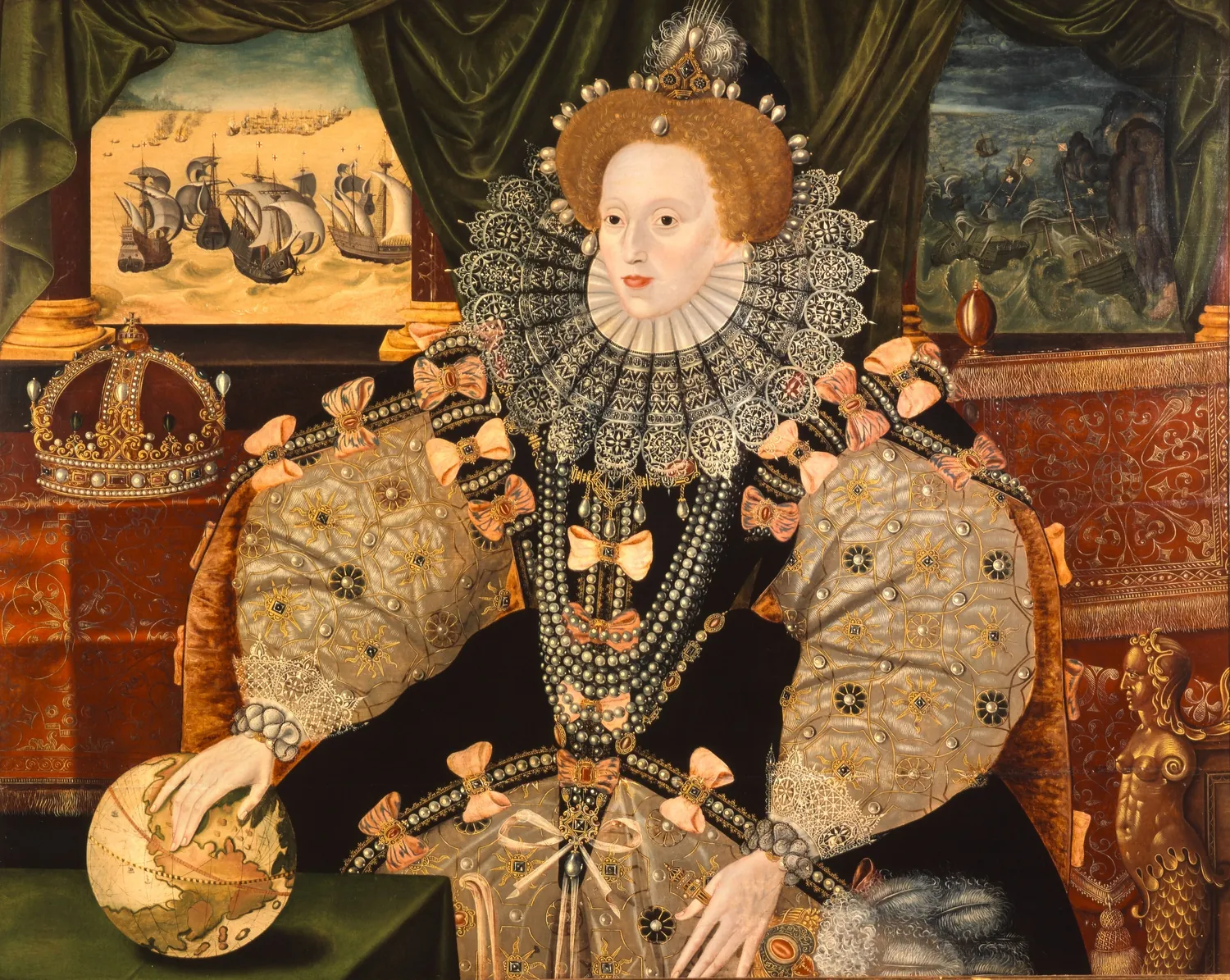
Queen Elizabeth I in a rich gown, with two windows behind her showing sea scenes
The Armada Portrait: Elizabeth I with her hand on the globe; fireships in the left window, shipwreck in the right · anon., c. 1588 · public domain · Wikimedia Commons

1589: the English Armada

The next spring England sent its own fleet south under Francis Drake and John Norris: to burn the damaged Spanish galleons in their ports, raise Portugal against Philip and seize the Azores. It failed on every count.

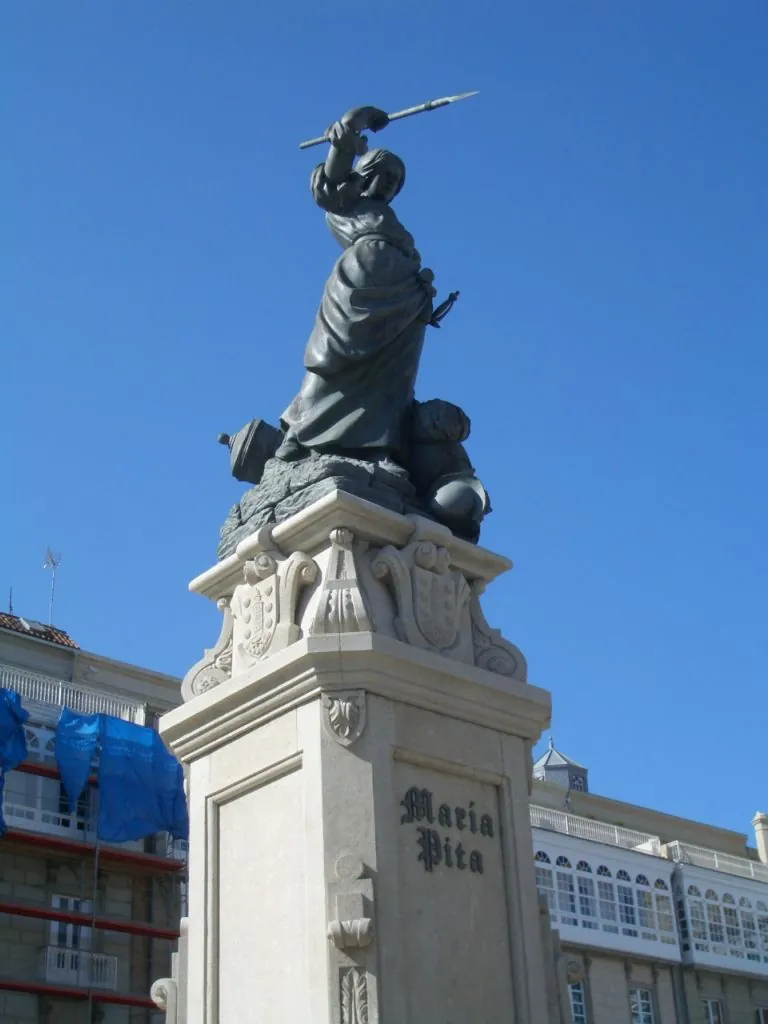
At A Coruña the townspeople held the walls; María Pita, who took up arms when her husband was killed in the assault, became the city's heroine. The march on Lisbon raised no revolt. Disease and desertion cost the expedition thousands of men. Spanish schoolbooks remember 1589 as clearly as English ones remember 1588.

Bronze statue of a woman raising a lance, on a stone plinth
The statue of María Pita in A Coruña, the city that held off the English assault of May 1589 · Núria · CC BY 2.0 · Wikimedia Commons
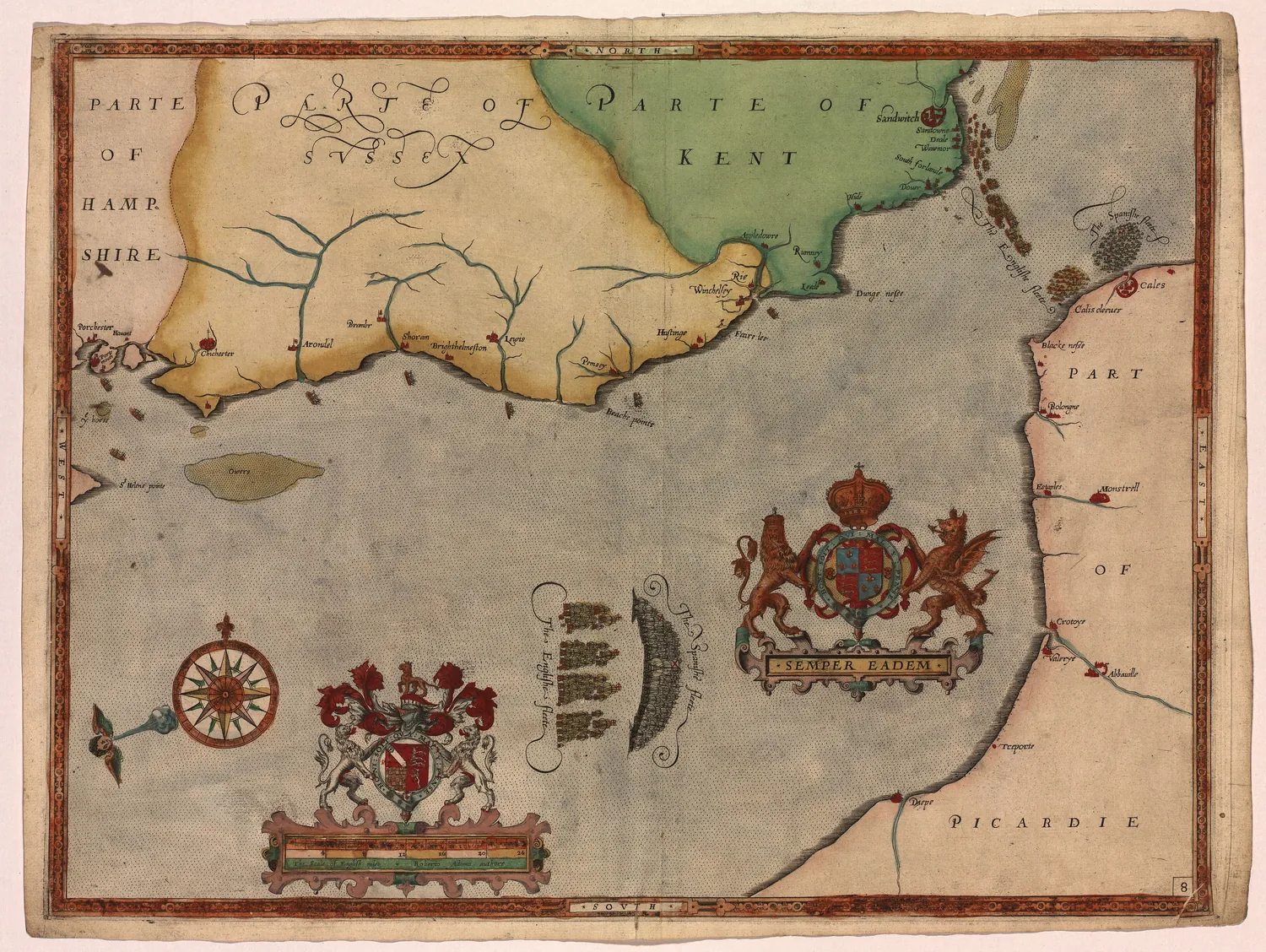
Chart with Kent at the top, France on the right and the Spanish fleet bunched off Calais
The fleet at anchor off Calais, the Kent coast above (1590 chart) · Robert Adams, Augustine Ryther (1590) · public domain · Library of Congress

What the sea has kept

The wrecks have been found one by one: the Girona off Antrim in 1967, the Santa María de la Rosa in Blasket Sound in 1968, La Trinidad Valencera in Kinnagoe Bay in 1971, the first of the Streedagh wrecks in 1985. In 2015 storms uncovered more timbers and guns at Streedagh, which Irish archaeologists then raised; one of the three Streedagh ships has still not been located.

The wrecks also hold a clue to the battle: ammunition found on several of them had not been fired, which fits the view that Spanish gunners fired slowly and their captains planned to board.

Long sandy beach with a band of stones and mountains in the distance
Streedagh Strand, County Sligo, where three Armada ships broke up in a single storm · Oimabe · CC BY-SA 4.0 · Wikimedia Commons
Old chart of the British Isles with a line looping round Scotland and Ireland
The Armada's track around Britain and Ireland, as the English drew it in 1590 · Robert Adams, Augustine Ryther (1590) · public domain · Royal Museums Greenwich

The register of the 110 ships traced

Each ship traced on the map, with its squadron, its type, the men aboard at the muster and what became of it. Where a place or a date rests on inference or local tradition, it is marked.

Men: soldiers and sailors at the muster, at A Coruña in July 1588 for the ships lost or of unknown fate (Martin & Parker), at Lisbon in May for the ships that came home. Dates in the Spanish (new style) calendar.
ShipSquadronTypeMenWhat happened
Nuestra Señora del RosarioAndalusianao359Disabled in the Channel and captured by the English, 1 August
San SalvadorGipuzkoanao371Disabled in the Channel and captured by the English, 1 August
María JuanBiscaynao306Sank from battle damage off Gravelines, 8 August
San LorenzoNaples (galleasses)galleass368Ran aground at Calais and was stormed by English boats, 8 August
San FelipePortugalgalleon439Crippled at Gravelines, taken by the Dutch and English off Flushing; sank, 9 August
San Antonio de PaduaCastilepatache46Captured off Blankenberge, Flanders (date not recorded)inference
San MateoPortugalgalleon389Crippled at Gravelines, taken by the Dutch and English off Flushing; sank, 10 August
San Blas la MenorLisbon boatsfalúa5Lost off the Scilly Isles
Nuestra Señora del CarmenLisbon boatsfalúa5Lost at sea, 21 August
Concepción de Nuestra SeñoraDespatch boatspatache18Lost off Orkneyinference
Nuestra Señora de la YdraLisbon boatsfalúa5Lost at sea, 23 August
Nuestra Señora de la ConcepciónDespatch boatszabra18Lost off Norwayinference
Barca de AmburgHulkshulk287Foundered off Malin Head when her pumps failed, 1 September; crew taken offinference
Castillo NegroHulkshulk203Lost at sea, 4 Septemberinference
La Trinidad ValenceraLevantmerchantman413Wrecked at Kinnagoe Bay, Donegal, 14 September; most of the men got ashore, hundreds were then killed
TrinidadCastilenao241Last seen near Valentia Island, Kerry, 15 September; no wreck foundinference
Nuestra Señora del PuertoLisbon boatsfalúa5Wrecked at Clew Bay, Mayo, 16 Septemberinference
SantiagoHulkshulk65Wrecked at Mosterhamn, near Bergen, 18 September; carried soldiers' wives, some of whom survivedinference
Nuestra Señora de CastroDespatch boatszabra18Lost off the north coast of Spain
Santa AnaBiscaynao482Sank off Le Havre, 19 September
Nuestra Señora del Buen ViajeLisbon boatsfalúa5Lost at sea, 20 September
San Martín de SantanderDespatch boatszabra–Lost off Irelandinference
Santa BárbaraHulkshulk50Wrecked at Mutton Island, Clare, 20 Septemberinference
La JulianaLevantmerchantman412Wrecked at Streedagh, Sligo, 21 September
La LaviaLevantmerchantman302Wrecked at Streedagh, Sligo, 21 September
La Rata Santa María EncoronadaLevantmerchantman448Ran aground and was burned by her crew at Ballycroy, Mayo, 21 September
San EstebanGipuzkoanao274Wrecked at Doonbeg, Clare, 21 September
Santa María de VisónLevantmerchantman325Wrecked at Streedagh, Sligo, 21 September
Santa María de la RosaGipuzkoanao323Sank in Blasket Sound, Kerry, 21 September; one survivor
Ciervo VolanteHulkshulk171Wrecked at Broadhaven, Mayo, 22 Septemberinference
Gran GrínBiscaynao336Wrecked at Clare Island, Mayo, 22 September
San MarcosPortugalgalleon386Wrecked at Lurga Point, Clare, 22 Septemberinference
San Nicolás ProdaneliLevantnao294Wrecked at Clew Bay, Mayo, 22 Septemberinference
La Anunciada (falúa)Lisbon boatsfalúa5Lost at sea, 23 September
Duquesa Santa AnaAndalusiahulk272Wrecked at Loughros Mór Bay, Donegal, 24 September
Falcón Blanco MedianoHulkshulk80Wrecked at Inishbofin, Galway, 25 Septemberinference
El Gran GrifónHulkshulk279Wrecked at Fair Isle, 28 September; most of the men lived on the island for weeks
San Pedro MenorHulkshulk198Sank in Morbihan, Brittany, 20 October
GironaNaples (galleasses)galleass349Wrecked at Lacada Point, Antrim, 28 October with about 1,300 aboard; few survived
San Pedro MayorHulkshulk144Wrecked at Hope Cove, Devon, 6 November; the hospital ship's men were taken prisoner
Capitana (galleys)Galleysgalley428Ran aground near Bayonne in July, before the Channel, and was broken up
AnunciadaLevantnao266Emptied and set on fire in the Shannon estuary, 19 September; her crew moved to the Barca de Danzig
San Juan Bautista (Fernandome)Castilenao240Emptied and set on fire in Blasket Sound, Kerry, 26 September
San Juan de SiciliaLevantmerchantman320Blew up at anchor in Tobermory Bay, Mull, 5 November after weeks in harbour; cause disputed (accident or sabotage)
Concepción de Juanes del CanoBiscaynao225Fate not established: possibly the ship wrecked at Carna, Galway, or back at Laredo
La Concepción de CastroDespatch boatspatache19Fate not established
Nuestra Señora del SocorroCastilepatache35Fate not established
San Francisco (patache)Despatch boatspatache57Fate not established
Santa CatalinaAndalusianao307Fate not established
Santa María de JuncalAndalusianao285Fate not established
Spiritu Santo (patache)Despatch boatspatache47Fate not established
TrinidadAndalusianao252Fate not established
Trinidad (zabra)Despatch boatszabra24Fate not established
AsunciónCastilegalleon240Came home to Santander
Asunción (patache)Gipuzkoapatache34Came home to Gipuzkoa
AugustaPortugalzabra92Came home to Santander
Barca de DanzigHulkshulk178Came home to Gijón, carrying the crew of the Anunciada; sank later
Casa de Paz GrandeHulkshulk38Came home to Laredo; abandoned there in December
ConcepciónAndalusianao270Came home to Laredo
Concepción de ZubelzuBiscaynao219Came home to Gipuzkoa
DianaGalleysgalley260Came home to A Coruña
DoncellaGipuzkoahulk141Came home to Santander; sank in Santander harbour two days later
Espíritu SantoAndalusiapatache33Came home to Santander
IsabelaBiscaypatache53Came home to A Coruña
JuliaPortugalzabra135Came home to Santander
MagdalenaBiscaynao244Came home to Gipuzkoa
Magdalena (pinaza)Gipuzkoapinnace14Came home to Gipuzkoa
ManuelaBiscaynao172Came home to Santander
María San JuanGipuzkoanao194Came home to Lisbon
María de AguirreBiscaypatache44Came home to Santander
María de Miguel SusoBiscaypatache45Came home to Gipuzkoa
NapolitanaNaples (galleasses)galleass521Came home to Laredo
Nuestra Señora de BegoñaCastilenao283Came home to Cangas (Galicia) after a stop in Blacksod Bay
Nuestra Señora de GuadalupeGipuzkoapinnace12Came home to Gipuzkoa
Nuestra Señora del BarrioCastilegalleon283Came home to Santander
RegazonaLevantmerchantman413Came home to A Coruña (via Muros), badly damaged; wrecked at Ferrol in December
San BartoloméAndalusianao267Came home to Santander
San Bautista de la EsperanzaLevantmerchantman–Came home to Santander
San BernabéGipuzkoapatache34Came home to Gipuzkoa
San BernardoPortugalgalleon236Came home to A Coruña
San BuenaventuraGipuzkoanao208Came home to Gipuzkoa
San CristóbalCastilegalleon318Came home to Santander
San CristóbalPortugalgalleon211Came home to Santander
San Esteban (patache)Biscaypatache35Came home to A Coruña
San Felipe y SantiagoCastilegalleon279Came home to Santander
San FranciscoAndalusianao312Came home to Santander
San Francisco (Florencia)Portugalgalleon383Came home to Santander
San GabrielHulkshulk47Came home to Santander
San Juan BautistaAndalusiagalleon333Came home to Santander
San Juan Bautista (Aramburu)Castilenao334Came home to Santander on 14 October after sheltering in Blasket Sound
San Juan Bautista (Lezo)Biscaynao190Came home to Santander
San Juan de GargarínAndalusianao213Came home to Santander
San Juan de PortugalPortugalgalleon543Came home to A Coruña on 7 October after sheltering in Blasket Sound; Recalde died on 23 October
San Juan el MenorCastilegalleon308Came home to Laredo
San LuisPortugalgalleon439Came home to Santander
San MartínPortugalgalleon478Came home to Santander
San Medel y San CeledónCastilegalleon275Came home to Laredo
San PedroCastilegalleon274Came home to Santander
Santa AnaGipuzkoanao438Came home to Gipuzkoa; blew up at Pasajes a month later
Santa AnaCastilegalleon152Came home to Laredo
Santa BárbaraGipuzkoanao215Came home to Gipuzkoa
Santa CatalinaCastilenao327Came home to Santander
Santa CruzGipuzkoanao167Came home to Santander
Santa MartaGipuzkoanao256Came home to Gipuzkoa
Santa María de MontemayorBiscaynao205Came home to Santander
SantiagoPortugalgalleon373Came home to Santander
SantiagoBiscaynao310Came home to Gipuzkoa
Santiago el MayorCastilegalleon393Came home to Laredo
Trinidad de EscalaLevantmerchantman408Came home to Santander
ZúñigaNaples (galleasses)galleass526Came home to Santander in August 1589, after sheltering at Liscannor and Le Havre

Sources

Dates are in the Spanish (Gregorian) calendar; English documents of 1588 run ten days behind. Positions at sea between dated points are estimates; wreck sites follow the archaeological record where there is one.

  1. Colin Martin & Geoffrey Parker, Armada: The Spanish Enterprise and England's Deliverance in 1588 (Yale, 2022), appendices 1–5: every ship, its musters and fate. dhjhkxawhe8q4.cloudfront.net
  2. John Knox Laughton (ed.), State Papers relating to the Defeat of the Spanish Armada, 2 vols (Navy Records Society, 1894). English letters and reports, Julian calendar; vol. II pp. 239–240 for Medina Sidonia's sailing order. archive.org
  3. Cesáreo Fernández Duro, La Armada Invencible, 2 vols (Madrid, 1884–85). Spanish documents, including Aramburu's journal (doc. 178) and the loss lists. archive.org
  4. Hugh Allingham & Robert Crawford, Captain Cuellar's Adventures in Connacht & Ulster, A.D. 1588 (1897): Cuéllar's letter in translation. archive.org
  5. Robert Adams & Augustine Ryther, Expeditionis Hispanorum in Angliam vera descriptio (1590), the day-by-day charts. www.loc.gov
  6. José Luis Casado Soto, “La construcción naval atlántica española del siglo XVI y la Armada de 1588”, Cuadernos monográficos del IHCN 3: the 34–35 actual losses. armada.defensa.gob.es
  7. José Ignacio González-Aller Hierro, the Portuguese ships and the galleys of 1588, Revista de Historia Naval 110 (2010) and 116 (2012). armada.defensa.gob.es
  8. José María Blanco Núñez, “La Contrarmada (1589)”, Cuadernos monográficos del IHCN 87, p. 68: 25,696 men sailed from A Coruña, 13,399 returned. armada.defensa.gob.es
  9. K. S. Douglas, H. H. Lamb & C. Loader, A meteorological study of July to October 1588: the Spanish Armada storms (Climatic Research Unit, UEA, 1978): Aramburu's track and the weather. a.storyblok.com
  10. Colin Martin, PhD thesis on the Armada wrecks in Ireland and Scotland (University of St Andrews). research-repository.st-andrews.ac.uk
  11. National Monuments Service / Underwater Archaeology Unit, Ireland: the Streedagh wrecks. www.uchireland.ie
  12. National Museums NI, Ulster Museum: Armada shipwrecks collection (Girona, Santa María de la Rosa, Trinidad Valencera). collections.nationalmuseumsni.org
  13. Trove (Historic Environment Scotland): El Gran Grifón, Fair Isle. www.trove.scot
  14. Historic England, Heritage Gateway: San Pedro Mayor, Hope Cove. historicengland.org.uk
  15. Royal Museums Greenwich: the Flavit medal by Gerard van Bylaer, MEC0022. www.rmg.co.uk
  16. The National Archives (UK): Howard's report of the first sighting. www.nationalarchives.gov.uk
  17. Garrett Mattingly, The Armada (1959; 1987 edition, p. 426). archive.org
  18. Mack P. Holt, The French Wars of Religion, 1562–1629: the Day of the Barricades and Mendoza. ndl.ethernet.edu.et
  19. NOAA NCEI, ETOPO 2022 (relief and sea depth); Natural Earth (coastlines). www.ncei.noaa.gov