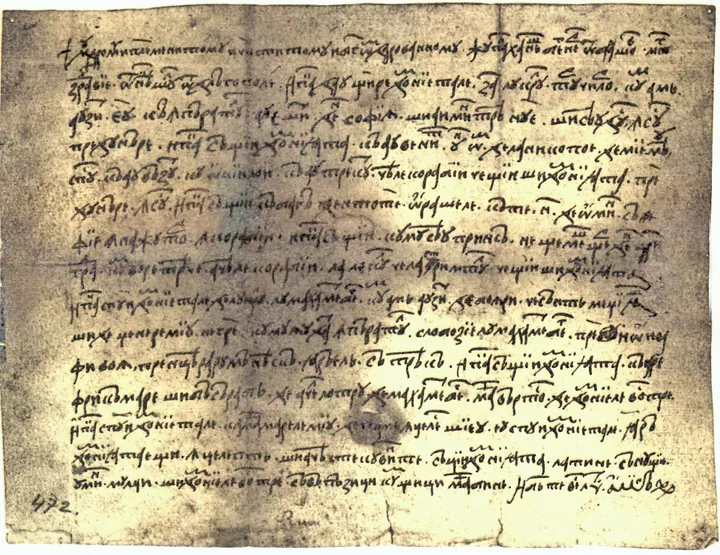
“and again”: the opening words of Neacșu's letter, of 1521.
106 – 2026 · a Romance language alone among strangers
The Latin Island
Romanian is a Romance language spoken by 22 million people as a first language — 1,137 kilometres from Rome, with its article glued to the end of the word and the infinitive sharply receded, surviving only in restricted forms. Two thousand years of receipts, from “torna, fratre” to Weigand's atlas.

One family, one island
From Lisbon to Bucharest, six points hold the Latin family together, and the arc from Rome to Bucharest measures 1,137 kilometres. Four areas schematically redraw the dialects of Weigand's map of 1908.
- Rome–Bucharest: 1,137 km
- Schematic: points and the arc are computed; dialect areas are representative, after Weigand.
One sentence, three graphic forms
The first Romanian sentence of Neacșu's letter — Cyrillic original, scholarly transliteration, modern transcription.
ипаⷦ даꙋ щире доⷨнїе тале за лꙋкрꙋⷧ тꙋⷬчилоⷬ кꙋⷨ амь аꙋзиⷮ еꙋ къ ꙟпъратꙋⷧ аꙋ ешиⷮ деⷩ софїѧ ши аимиⷩтрѣ нꙋ е ши сѣꙋ дꙋⷭ ꙟ сꙋⷭ пре дꙋнъре
i pak dau štire domnïetale za lukrul turčilor kum amĭ auzit èu kŭ ĩpŭratul au èšit den sofïę ši aimintrě nue ši sěu dus ĩ sus pre dunŭre
I pak dau știre domniie tale za lucrul turcilor, cum am auzit eu că împăratul au eșit den Sofiia, și aimintrea nu e, și se-au dus în sus pre Dunăre.
In English: And again I let Your Highness know of the Turks' deeds, as I heard that the Emperor has left Sofia, and sailed up the Danube, and the truth is no other, but this.
Chapter I
The Island
106 – 271 · the province
One morning, in the years after 106, the streets of Sarmizegetusa ring with voices from across the empire — colonists brought in, as Eutropius puts it, “from the whole Roman world” after Trajan's two Dacian wars, of 101–102 and 105–106, unloading their sacks in a barely founded province. The Latin they brought would stay long after the administration left.
The province lasted nearly 170 years. Around 271 Aurelian sanctioned the final abandonment of Dacia and withdrew behind the Danube, founding a new Dacia Aureliana in the south, later split in two, one half governed from Serdica — today Sofia. North of the river, the Latin kept being spoken, cut off from Rome.
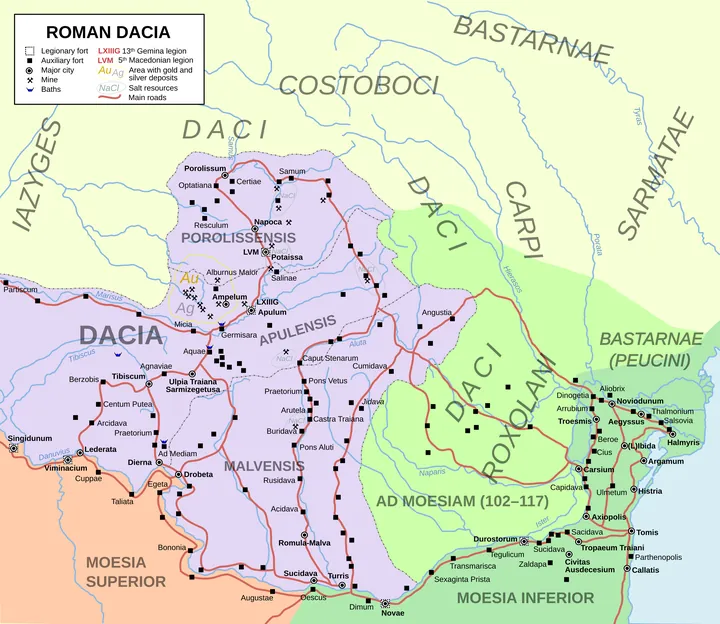

Cut off is the word: Romanian took shape between the fifth and the seventh centuries, in the linguist G. Ivănescu's dating, and grew up alone — a Latin island 1,137 kilometres from Rome, as the Rome–Bucharest arc shows.
Dacia Traiana was a Roman province for nearly 170 years, until the reigns of Gallienus and Aurelian when it was abandoned (c. 271 CE).
World History Encyclopedia, “Dacia”Rome–Bucharest, along the arc
1,137 kilometres
As far as 27 marathons run end to end.
1,137 ÷ 42.195 — the official length of a marathon.
Chapter II
The Papers
587 – 1582 · the receipts
In 587, on campaign against the Avars and Slovenes, a soldier shouted “torna, torna, fratre!” — turn, turn, brother — in his native tongue, as Theophylact Simocatta and Theophanes tell it. Romanian scholars long read it as the first written trace of Balkan Romance; a 2024 study by Elisabeta Negrău hears army Latin instead, and finds the form “fratre” only in later copies.
Then paper. The Hurmuzaki Psalter, copied, by its watermarks, around the first decade after 1500, is the oldest known writing in Romanian — a bilingual copy. The oldest precisely dated document is a merchant's letter: in late June 1521 Neacșu of Câmpulung wrote in Cyrillic to the mayor of Brașov, warning that the Turks had left Sofia and sailed up the Danube. The letter even names “Țara Rumânească” — the Romanian Land.
Print followed: the Sibiu Gospel of 1551–1553, then Coresi's Tetraevangelion at Brașov in 1561 — the first edition with the Gospel solely in Romanian — and the Palia de la Orăștie in 1582, the first Old Testament books, translated by Transylvanian Calvinist pastors.
I pak dau știre domniie tale za lucrul turcilor, cum am auzit eu că împăratul au eșit den Sofiia…
Neacșu's letter, Câmpulung, late June 1521Chapter III
The Bones
1561 – 1780 · the grammar
Around 1561, while Coresi was setting his type at Brașov, a buyer at the market would ask for “pâinea” — the bread, with the article glued to the end of the word, as today: omul, the man. Romanian is the Romance language that put its article last — the -l of omul is Latin illum, the dictionaries say, a demonstrative, as in the other Romance languages — and it shares the trick with Albanian, Bulgarian and Macedonian: the Balkan sprachbund.
The infinitive mostly went the same way: Romanian says vreau să cânt, “I want to sing”, with the conjunctive where Latin had an infinitive. The future is built with a vrea, “to want”; the genitive and dative merged; Slavic loans piled up. Old bones, new joints.
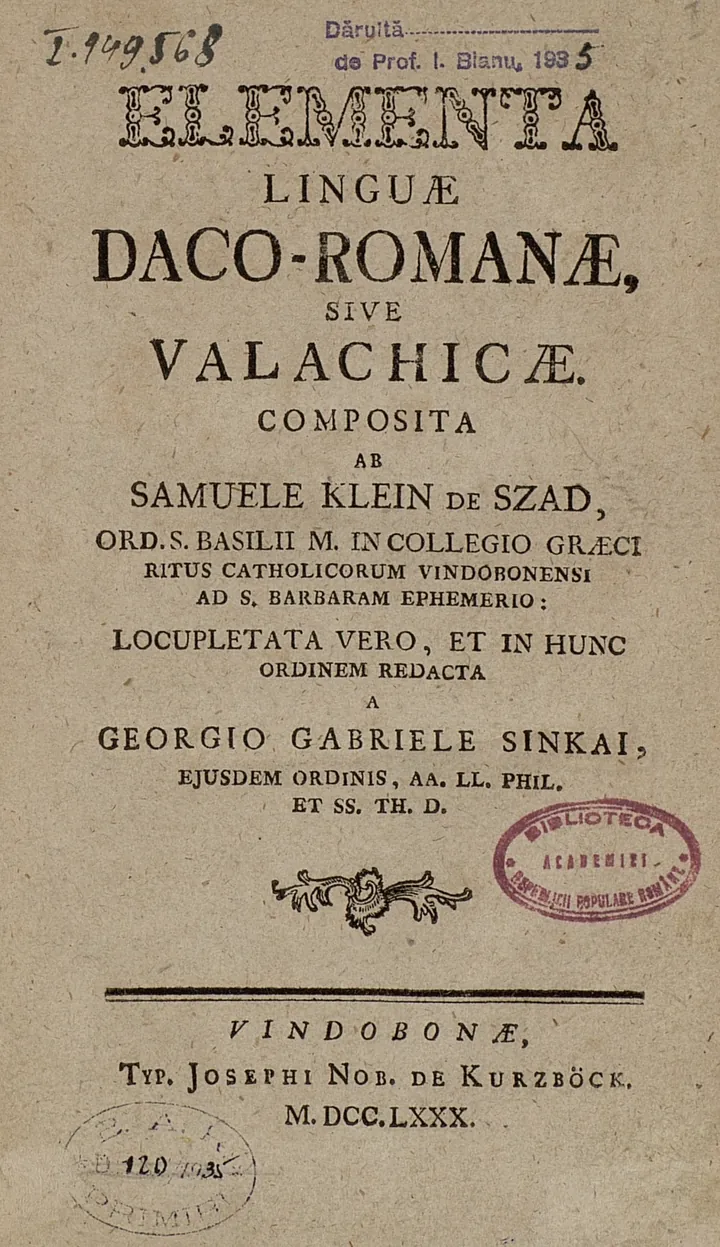

And the old bones are real: cases where French keeps none, a neuter gender, a vocative in -e — frate! The first printed grammar to describe all this, Micu and Șincai's Elementa linguae daco-romanae, came off Joseph von Kurzböck's press in Vienna in 1780 — Micu was then chaplain at the Greek-Catholic college of St Barbara there — and pushed for a Latin alphabet.
The definite articles are usually attached to the end of the noun as enclitics.
the grammar books' own summaryChapter IV
The Atlas
1860 – 2023 · the map
Between 1895 and 1907 Gustav Weigand went from village to village, 752 of them, notebook in hand, asking how people said everyday words: the answers fill the Linguistischer Atlas des dacorumänischen Sprachgebietes, issued at Leipzig in nine parts and completed in 1909. From Common Romanian, spoken until about the tenth century, descend four dialects: Daco-Romanian north of the Danube, Aromanian and Megleno-Romanian south of the Jireček Line, and Istro-Romanian — perhaps as few as 120 fluent speakers left in Istria.
Romanian was written in Cyrillic until the late nineteenth century: transitional alphabets mixed Latin letters in from 1830 to 1860, and the Latin alphabet became official in Wallachia and Transylvania in 1860, in Moldavia in 1862. The earliest Latin-script writing is older — a late sixteenth-century Transylvanian text in Hungarian spelling.
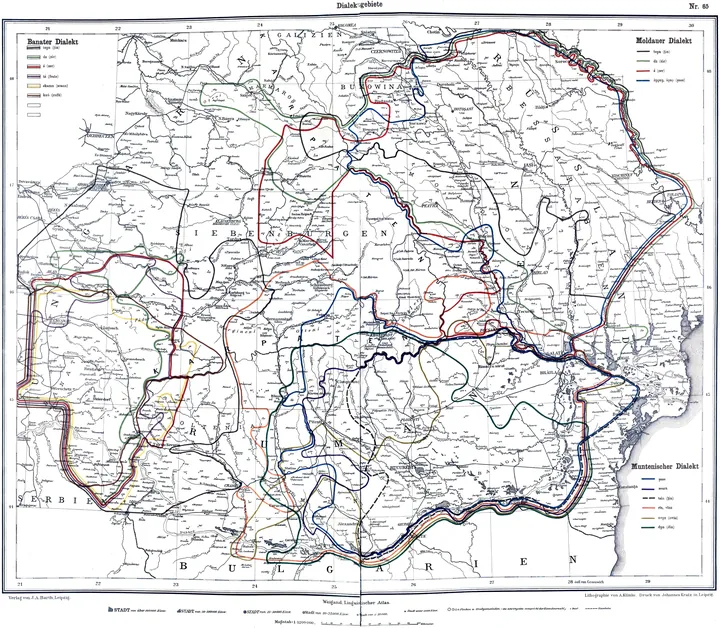

Today Romanian is official in Romania and Moldova and spoken as a first language by some 22 million people, by Ethnologue's count. Moldova's Constitutional Court ruled in December 2013 that the state language is Romanian; Parliament wrote it into every law on 16 March 2023, promulgated on 22 March.
the Declaration of Independence made a clear distinction, expressly opting for the term “Romanian language”.
Constitutional Court of Moldova, Judgment no. 36 of 5 December 2013, §108 (official English translation)First-language speakers, today
22,000,000 people
About 183,000 times the perhaps 120 fluent Istro-Romanian speakers left in Istria.
22 million (Ethnologue 2024) ÷ 120 (Oxford's hISTROX project).
Brașov · 1561
How much Latin do you know?
Brașov, 1561: at Coresi's press, an apprentice sets Romanian words and hunts for their Latin root. Four proof sheets — guess before the master turns the page.
-
1
Water
Apă comes from the Latin…
What happened
aqua, -ae — water. Apis is the bee.
-
2
Bread
Pâine comes from the Latin…
What happened
panis, -is — bread. Pinus is the pine.
-
3
Sun
Soare comes from the Latin…
What happened
sol, solis — sun. Sors is the lot, fate.
-
4
Brother
Frate comes from the Latin…
What happened
frater, fratris — brother. Fragor is the crash. “Torna, fratre!” shouted the soldier of 587.
The printer's verdict
Answer a card to begin.
The island in six numbers
Six years hold the island up, from 106 to 1909.
- 106
- the province of Dacia founded
- 271
- the Aurelianic withdrawal
- 587
- “torna, fratre”
- 1,521
- Neacșu's letter
- 1,780
- the first printed grammar, Vienna
- 1,909
- Weigand's atlas
Three things people get wrong
Romanian is the closest language to Latin
Not quite: Pei's divergences from Classical Latin run 8% for Sardinian, 12% for Italian, 20% for Spanish and 23.5% for Romanian. Romanian keeps old bones — cases, neuter, the vocative in -e — but is brand new elsewhere: the enclitic article, the conjunctive for the infinitive, the Slavic loans.
Romanian begins with Neacșu's letter
1521 is the oldest precisely dated document, not the first writing: the Hurmuzaki Psalter is dated by its watermarks to around 1500–1510, and “torna, fratre” was shouted in 587.
Moldovan is a different language
Chișinău's Constitutional Court ruled in 2013 that Moldova's official language is Romanian; Parliament wrote it into every law on 16 March 2023, promulgated 22 March.
Sources and method
The story follows the English histories of the Romanian language, the Dacian province and the first grammars; Wikisource carries the 1521 letter, Wiktionary the four etymologies, Pei the myth numbers. All four images are public domain or attribution CC via Wikimedia Commons, licences read per file.
Day-dates are new style throughout. City names follow the period — Dlăgopole for 1521 Câmpulung, Serdica beside Sofia. “1,137 km” is computed on this page (haversine), and the dialect areas are schematic by design.
Menus of detail stay out: alphabet history is background here, dialectology stops at the four named dialects, and the Neacșu letter's full story belongs to its own page, linked as exhibit A. What the sources dispute — 1908 or 1909, 29 or 30 June, 271 or 275 — the page says so.
The Island
- Trajan's wars of 101–102 and 105–106; Dacia a province “for nearly 170 years”, abandoned c. 271; Dacia Aureliana south of the Danube, later divided, Dacia Mediterranea with its capital at Serdica (World History Encyclopedia)
- Eutropius, Breviarium VIII.6: Trajan had brought settlers to Dacia “ex toto orbe Romano”, from the whole Roman world
- The 1911 Britannica, “Dacia”: colonists brought in after the conquest; Aurelian (270–275) settles them south of the Danube, in Dacia Aureliani
- Vasile Frățilă, “The origin of Romanian dialects in G. Ivănescu's view” (2012): Romanian formed between the 5th and 7th centuries; Common Romanian until about the 10th
The Papers
- Elisabeta Negrău, “Torna, torna, frater revisited”, Studia Ceranea 14 (2024): the 587 episode in Theophylact Simocatta and Theophanes; the Balkan Romance reading disputed, the form “fratre” only in 11th–12th-century copies
- Gheorghe Chivu, “The alphabets of our old church writings” (2016): the Hurmuzaki Psalter copied around the decade after 1500 (by watermarks, after Al. Mareș 2000); the first Romanian text printed in Latin letters, in Hungarian spelling, Cluj 1571–1575
- The full text: Cyrillic original, transliteration, modern transcription
- Romanian National Archives, 2022 press release: Neacșu's letter to the mayor Johannes Benkner, kept in Brașov from June 1521 to September 1916
- Giuseppe Stabile (Diacronia): the Slavo-Romanian Tetraevangelion printed at Sibiu between 1551 and 1552–53
- The 1911 Britannica, “Rumania”, literature: Coresi's Gospels, Brașov 1560–1561, the first book printed in Romanian; the Palia, Orăștie 1582
The Bones
- The definite article -l: Latin illum (I.-A. Candrea, Dicționarul enciclopedic ilustrat, 1931, on dexonline)
- Cristina-Valentina Dafinoiu (2015): the Balkanisms – the postposed article, the conjunctive for the infinitive, the future with volo, genitive–dative syncretism
- The 1911 Britannica, “Rumania”: the suffixed article (frate, fratele), shared with Albanian
- The Elementa's title page (Romanian Academy Library): Klein, chaplain at the college of St Barbara; Șincai; Kurzböck's press, Vienna 1780. The first grammar in Latin, in manuscript, is the Institutiones linguae Valachicae, c. 1770 (Chivu)
- Supplex Libellus Valachorum, 1791 (CEEOL document)
The Atlas
- Irina Condrea (State University of Moldova): the Latin alphabet official in Wallachia and Transylvania in 1860, in Moldavia in 1862 (an order of the minister V. A. Urechia)
- Florin-Teodor and Veronica Olariu, “A hundred years of Romanian linguistic cartography”: Weigand's atlas, nine parts, Leipzig 1898–1909; the survey 1895–1907, 752 points
- Linguistischer Atlas des dacorumänischen Sprachgebietes, Leipzig, J. A. Barth, 1909 (digitised copy, BCU Cluj)
- hISTROX (University of Oxford): Istro-Romanian, “maybe as few as 120 active and fluent speakers” in Istria
- Constitutional Court of Moldova, Judgment no. 36 of 5 December 2013 (official translation in the UNDP edition of the Constitution)
- Law no. 52 of 16 March 2023 (Monitorul Oficial no. 97–99, 24 March 2023): “Romanian language” in every legal act
- Moldova's National Bureau of Statistics, final 2024 census results: Romanian as the usually spoken language 33.7% (23.1% in 2014)
- Mario Pei, “A New Methodology for Romance Classification”, Word 5 (1949), pp. 135–146: the divergences from Classical Latin
Images
- province map · Wikimedia Commons
- facsimile, 1521 · Wikimedia Commons
- title page, 1780 · Wikimedia Commons
- Weigand, atlas map 65, 1908 · Wikimedia Commons