GODS, DICTATORS AND LYING NUMBERS
Why do you live by two dead dictators' calendar?
July is Julius Caesar. August is Augustus. The rest hide two gods, a purification rite, three disputed etymologies and four lying numbers: September means “seventh”, but it is ninth.
In short: Rome named its months after gods and men, then moved the start of the year from March to January without renumbering the months. The numbers stayed stuck in the wrong seats — and that is why you live, today, by two dead dictators' calendar.
- VII IN SEAT 9
- September counts from March, not January
- 445 DAYS
- the year 46 BC lasted, to catch up with the sun
- 12 OF 12
- months Commodus renamed; none survived
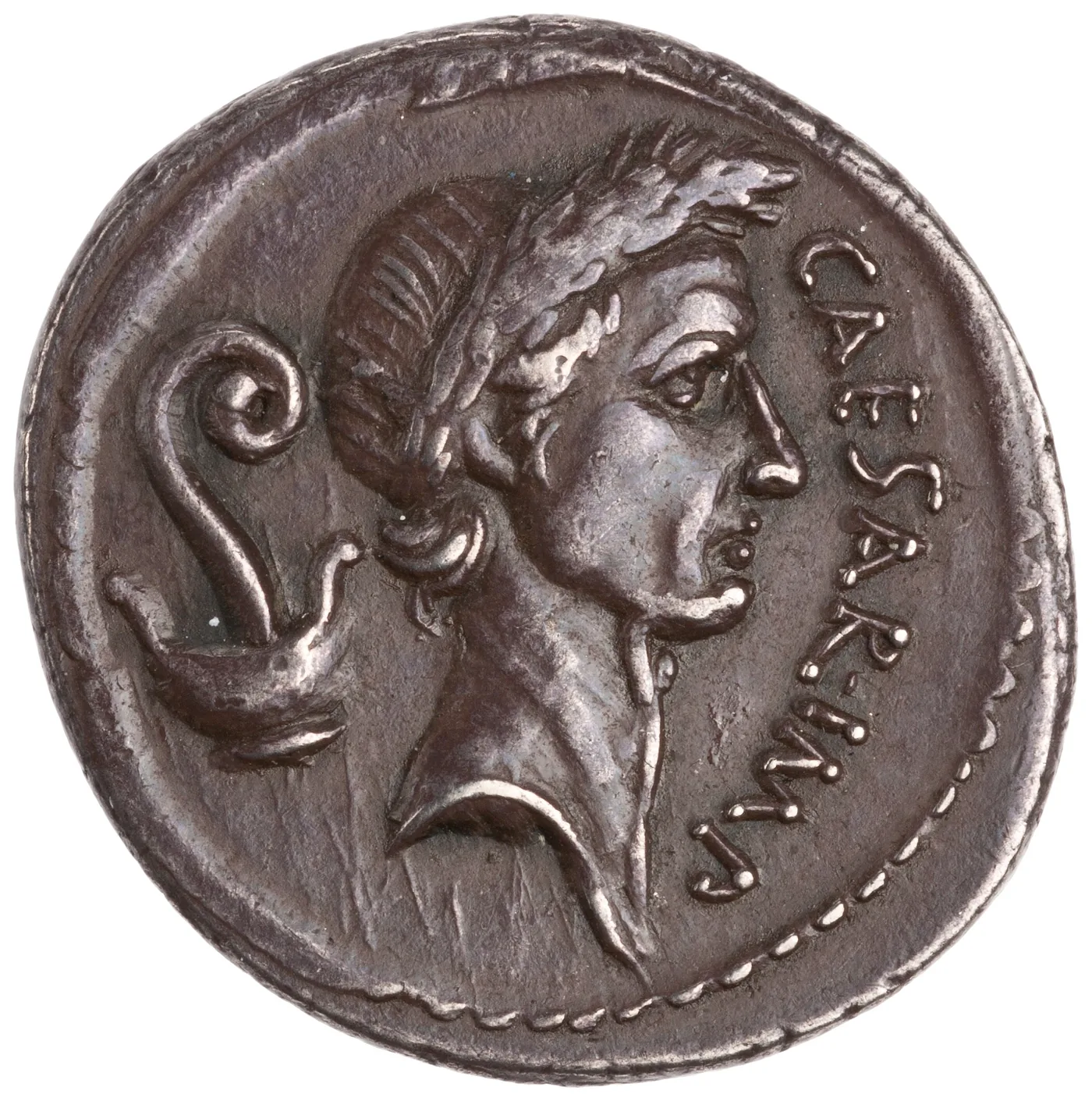

Your year, in Latin:
- January IANVARIVS
- February FEBRVARIUS
- March MARTIVS
- April APRILIS
- May MAIVS
- June IVNIVS
- July IVLIVS ← QVINTILIS
- August AVGVSTVS ← SEXTILIS
- September SEPTEMBER · VII
- October OCTOBER · VIII
- November NOVEMBER · IX
- December DECEMBER · X
Three old months
The gods and the rite
Three months tell their story without dispute: a two-faced god, a war god and a purification rite.
January ← Janus
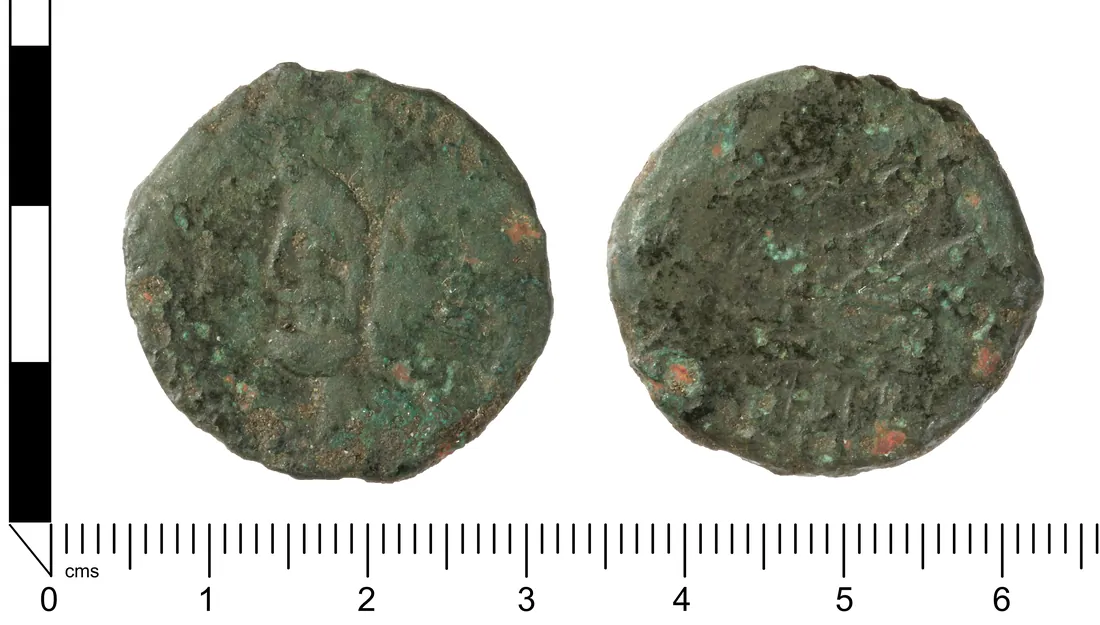
The god of doors and beginnings, with two faces: one toward the coming year, one toward the leaving one. The coin below shows both faces at a glance.

March ← Mars
The war god. The year began in March, when war resumed after winter — which is why the months are still numbered from there.
February ← februa
February comes from a rite: the februa, the instruments of purification around the middle of the month, near the Lupercalia of 15 February. Ovid writes it plainly: “Februa Romani dixere piamina patres”. A minority theory invokes a god Februus; Varro, Festus and Censorinus side with the rite.
Three uncertain etymologies
The three disputed months
For April, May and June, Ovid himself offers two explanations each and never settles. This page does not choose for him: it shows both theories.
April
DISPUTEDFirst theory
Aphrodite — Ovid's choice (Fasti, book 4): the month of the goddess born from sea foam.
Second theory
aperire, “to open” — the common view, after Verrius Flaccus: the month when the earth opens.
May
DISPUTEDFirst theory
Maia — the mother of Mercury.
Second theory
maiores, “the elders” — Ovid, Fasti 6.88: the month of the old, mirroring June, the month of the young.
June
DISPUTEDFirst theory
Juno — the queen of the gods.
Second theory
iuniores, “the young” — the pair of maiores from the same book of the Fasti.
None of the three has a winner. The uncertainty is documented, not an oversight.
Two renamed months
The two dictators
Quintilis and Sextilis — “fifth” and “sixth” — lost their numbers to two men.
July
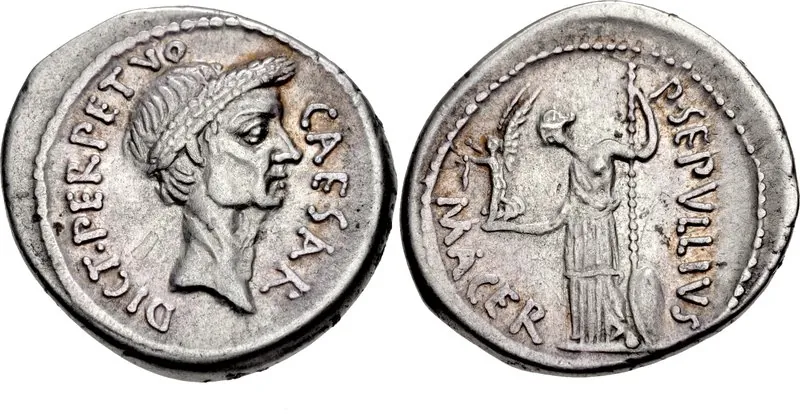
Quintilis → Julius, 44 BC
Quintilis became Julius after Caesar's murder: it was the month of his birth. The renaming came a year after the calendar reform that carries his name.

August
Sextilis → Augustus, 8 BC
Sextilis became Augustus by decree of the senate: too many of Augustus's victories fell in this month — the first consulship, the triple triumph, the fall of Alexandria. The decree survives in Macrobius, Saturnalia 1.12.
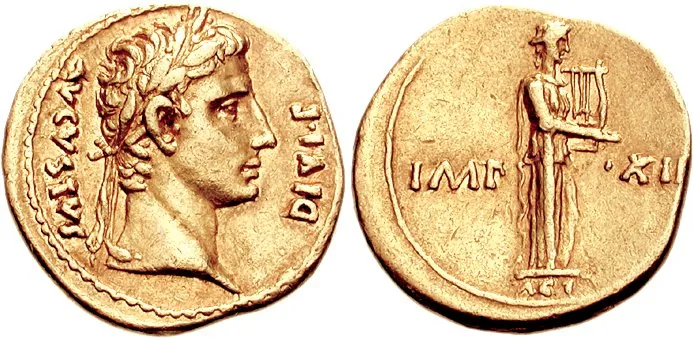

The renaming of August came 37 years after the month had received 31 days. The order matters: it proves the February-theft legend false.
The renames that did not stick
The graveyard of renames
Other emperors tried the same trick. No name outlived the man who imposed it.
Caligula, AD 37
- September → Germanicus
Nero, AD 65
- April → Neroneus
- May → Claudius
- June → Germanicus
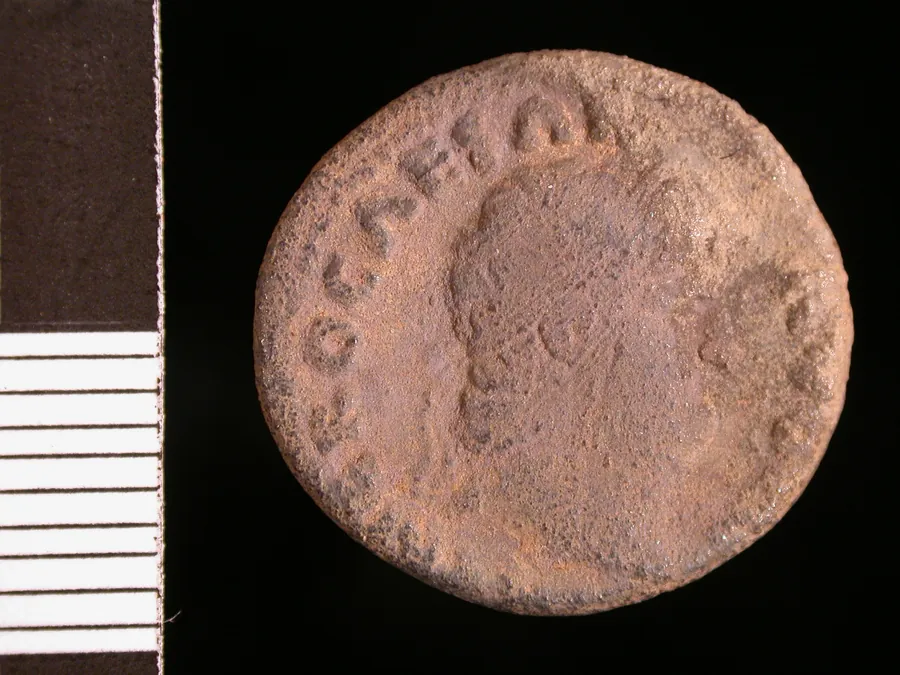
A denarius with Nero, author of three renames at once. Photo: Royal Institution of Cornwall, Anna Tyacke, Wikimedia Commons, CC BY-SA 2.0 Domitian, AD 84
- September → Germanicus
- October → Domitianus

Six imperial renames, plus twelve by Commodus. Survival score: zero.
Four numbers in the wrong seats
The lying numbers
September comes from septem, seven. It is ninth. This is no counting error: the year began in March, and when January and February moved to the front, nobody renumbered the months.
| September | septem, seven | VII | 7 → 9 |
| October | octo, eight | VIII | 8 → 10 |
| November | novem, nine | IX | 9 → 11 |
| December | decem, ten | X | 10 → 12 |
The Romanian forms septembrie–decembrie are learned 19th-century reborrowings from Latin; older forms like decemvrie, arrived through Byzantine Greek, sound archaic today, not wrong.
The Year Machine
Pick a year and watch the months rearrange: names, lengths, positions. The Roman numeral is the month's name; the Arabic digit is the seat it sits in.
All six years, in brief
| Month | Days | № | seat |
|---|---|---|---|
| Martius | 31 | — | 1 |
| Aprilis | 30 | — | 2 |
| Maius | 31 | — | 3 |
| Iunius | 30 | — | 4 |
| Quintilis | 31 | — | 5 |
| Sextilis | 30 | — | 6 |
| September | 30 | VII | 7 |
| October | 31 | VIII | 8 |
| November | 30 | IX | 9 |
| December | 30 | X | 10 |
Total: 304 days. Ten months, 304 days, the year starts in March. September is seventh for real — the numbers tell the truth, for now.
| Month | Days | № | seat |
|---|---|---|---|
| Ianuarius | 29 | — | 1 |
| Februarius | 28 | — | 2 |
| Martius | 31 | — | 3 |
| Aprilis | 29 | — | 4 |
| Maius | 31 | — | 5 |
| Iunius | 29 | — | 6 |
| Quintilis | 31 | — | 7 |
| Sextilis | 29 | — | 8 |
| September | 29 | VII | 9 |
| October | 31 | VIII | 10 |
| November | 29 | IX | 11 |
| December | 29 | X | 12 |
Total: 355 days. Tradition credits Numa with two new months, January and February, placed first. September slides into seat nine and never comes back.
| Month | Days | № | seat |
|---|---|---|---|
| Ianuarius | 29 | — | 1 |
| Februarius | 28 | — | 2 |
| Martius | 31 | — | 3 |
| Aprilis | 29 | — | 4 |
| Maius | 31 | — | 5 |
| Iunius | 29 | — | 6 |
| Quintilis | 31 | — | 7 |
| Sextilis | 29 | — | 8 |
| September | 29 | VII | 9 |
| October | 31 | VIII | 10 |
| November | 29 | IX | 11 |
| December | 29 | X | 12 |
| Mercedonius extra month | 23 | — | — |
| Intercalaris I extra month | 33 | — | — |
| Intercalaris II extra month | 34 | — | — |
Total: 445 days. 355 + Mercedonius 23 + 33 + 34 = 445. Three extra months, glued into the year so the calendar could catch the sun.
| Month | Days | № | seat |
|---|---|---|---|
| Ianuarius | 31 | — | 1 |
| Februarius | 28 | — | 2 |
| Martius | 31 | — | 3 |
| Aprilis | 30 | — | 4 |
| Maius | 31 | — | 5 |
| Iunius | 30 | — | 6 |
| Quintilis | 31 | — | 7 |
| Sextilis | 31 | — | 8 |
| September | 30 | VII | 9 |
| October | 31 | VIII | 10 |
| November | 30 | IX | 11 |
| December | 31 | X | 12 |
Total: 365 days. From 1 January 45 BC: February 28, August 31 — the lengths you know. The names still old: Quintilis, Sextilis.
| Month | Days | № | seat |
|---|---|---|---|
| Ianuarius | 31 | — | 1 |
| Februarius | 28 | — | 2 |
| Martius | 31 | — | 3 |
| Aprilis | 30 | — | 4 |
| Maius | 31 | — | 5 |
| Iunius | 30 | — | 6 |
| Iulius | 31 | — | 7 |
| Augustus | 31 | — | 8 |
| September | 30 | VII | 9 |
| October | 31 | VIII | 10 |
| November | 30 | IX | 11 |
| December | 31 | X | 12 |
Total: 365 days. Sextilis becomes Augustus. The lengths do not move: August had 31 days for 37 years.
| Month | Days | № | seat |
|---|---|---|---|
| January | 31 | — | 1 |
| February | 28 | — | 2 |
| March | 31 | — | 3 |
| April | 30 | — | 4 |
| May | 31 | — | 5 |
| June | 30 | — | 6 |
| July | 31 | — | 7 |
| August | 31 | — | 8 |
| September | 30 | VII | 9 |
| October | 31 | VIII | 10 |
| November | 30 | IX | 11 |
| December | 31 | X | 12 |
Total: 365 days. Your months, today. VII has sat in seat 9 for over two thousand years.
A 445-day year
The hinge: 46 BC
Before straightening the calendar, Caesar had to pay the old debt: the year 46 BC lasted 445 days, the longest year on record.
- 355
- the ordinary year
- 23
- Mercedonius
- 33 + 34
- two months between November and December
- 445
- total
The arithmetic belongs to Sosigenes, the astronomer of the reform. The ancient sources round in places; 445 is where modern consensus settled.
On 1 January 45 BC the Julian year began: 365 days, with a leap day every fourth year.

The neighbours who skipped Roman names
The Slavic mirror
Four Slavic neighbours name their months after nature, not gods and emperors: the linden, the sickle, the falling leaves. Except they do not fall in the same month.
| № | Romanian | Polish | Czech | Ukrainian | Croatian |
|---|---|---|---|---|---|
| 1 | ianuarie | styczeń | leden | січень | siječanj |
| 2 | februarie | luty | únor | лютий | veljača |
| 3 | martie | marzec | březen | березень | ožujak |
| 4 | aprilie | kwiecień | duben | квітень | travanj |
| 5 | mai | maj | květen | травень | svibanj |
| 6 | iunie | czerwiec | červen | червень | lipanj |
| 7 | iulie | lipiec | červenec | липень | srpanj |
| 8 | august | sierpień | srpen | серпень | kolovoz |
| 9 | septembrie | wrzesień | září | вересень | rujan |
| 10 | octombrie | październik | říjen | жовтень | listopad |
| 11 | noiembrie | listopad | listopad | листопад | studeni |
| 12 | decembrie | grudzień | prosinec | грудень | prosinac |
- lipiec is July in Polish, but lipanj is June in Croatian — both from lipa, “linden”.
- listopad is November in Polish, Czech and Ukrainian, but October in Croatian — from the falling leaves.
- sierpień is August in Polish, but srpanj is July in Croatian — from the sickle.
Not every Slavic name comes from nature: Polish marzec and maj keep Latin roots.
And not every Slav: Russian, Bulgarian and Serbian use Latinate names, like Romanian.




Four wrong stories
Myths
Four things heard about the months. Three are false, one is a misunderstanding.
“Augustus stole a day from February.”
False.
The story surfaces in the 13th century, with Sacrobosco, and has no basis: February had 28 days since 45 BC, and August had 31 from the same reform — 37 years before it was called Augustus. Every piece of period evidence, including dual dates with the Alexandrian calendar, contradicts Sacrobosco.
“September was seventh, so the Romans could not count.”
Misunderstanding.
The Romans counted well: their year began in March, and September was seventh indeed. Today's numbers are fossils, not errors.
“All Slavs name their months after nature.”
False.
Only some: the Poles, Czechs, Ukrainians and Croats in the table above. Russians, Bulgarians and Serbs use Latinate names.
“Every month comes from a god.”
False.
Only two for certain — January and March — plus three disputed. The rest: two dictators, four numbers and a purification rite.
Five cards
Who named your month?
Five months, five answers. The last card is a trap: the right answer is “nobody knows for sure”.
The right answers show under each question.
1
March
Who named March?
Mars. The year began in March, the month war resumed.
2
February
Who named February?
The februa rite, the instruments of purification at mid-month. The god Februus is a minority theory.
3
August
Who named August?
Augustus, in 8 BC — for the victories in the month of Sextilis, the fall of Alexandria first among them.
4
October
What does October mean?
The eighth from March. “The god Octavius” does not exist; it is a trap.
5
April
Who named April?
Nobody knows for sure: Aphrodite (Ovid) or aperire, “to open” (Verrius Flaccus). Nero only renamed it Neroneus, without success.
Score: 0 of 5
You finished all five cards.
A jump in 1919
The names stayed, the days jumped: a March 1919 decree deleted 13 days from April — 1 April old style became 14 April new style. The whole story, with a converter and the missing days, lives at calendarul-1919. See calendarul-1919
Sources
The ancients first, then dictionaries and calendars. Every risky claim links to its source.
Ancients and records
- Ovid, Fasti 1: the 10 months of Romulus (Kline transl.)
- Ovid, Fasti 2: the februa (Kline transl.)
- Ovid, Fasti 4: the April theories (Kline transl.)
- Ovid, Fasti 6: maiores and iuniores (Kline transl.)
- Historia Augusta: Commodus (only five months named explicitly)
- Calendar FAQ: the theft legend, a Sacrobosco fabrication
- The senate decree for Augustus, in Macrobius (Wordinfo)
Dictionaries and calendars
- ianuarie (DEX, Romanian)
- decembrie: a 19th-century reborrowing (Wiktionary)
- The Julian calendar, with the renames (EN-wiki)
- 46 BC: the 445-day year (EN-wiki)
- Quintilis (EN-wiki)
- Sextilis (EN-wiki)
The Slavic months
- The Polish month list (PL-wiki)
- The Czech month list (CS-wiki)
- The Ukrainian month list (UK-wiki)
- The Croatian month list (HR-wiki)
- The Slavic offsets month by month (Futility Closet)
- Commodus's 12 names, commonly cited version (Nancarrow)
Type: Fraunces, Newsreader and Atkinson Hyperlegible, under the SIL Open Font Licence.