Romanian schools teach a single Miorița: three shepherds, a clairvoyant lamb, a wedding with the sun and moon. But the carol printed in 1859 has no talking sheep, and at Cucueți, in Teleorman, the hero stands alone, the killers are nine, and the dead man is carried home — never wedded to the world. Three complete texts from three places, side by side.
By Marius Comper · 20 September 2026 · Three public-domain texts
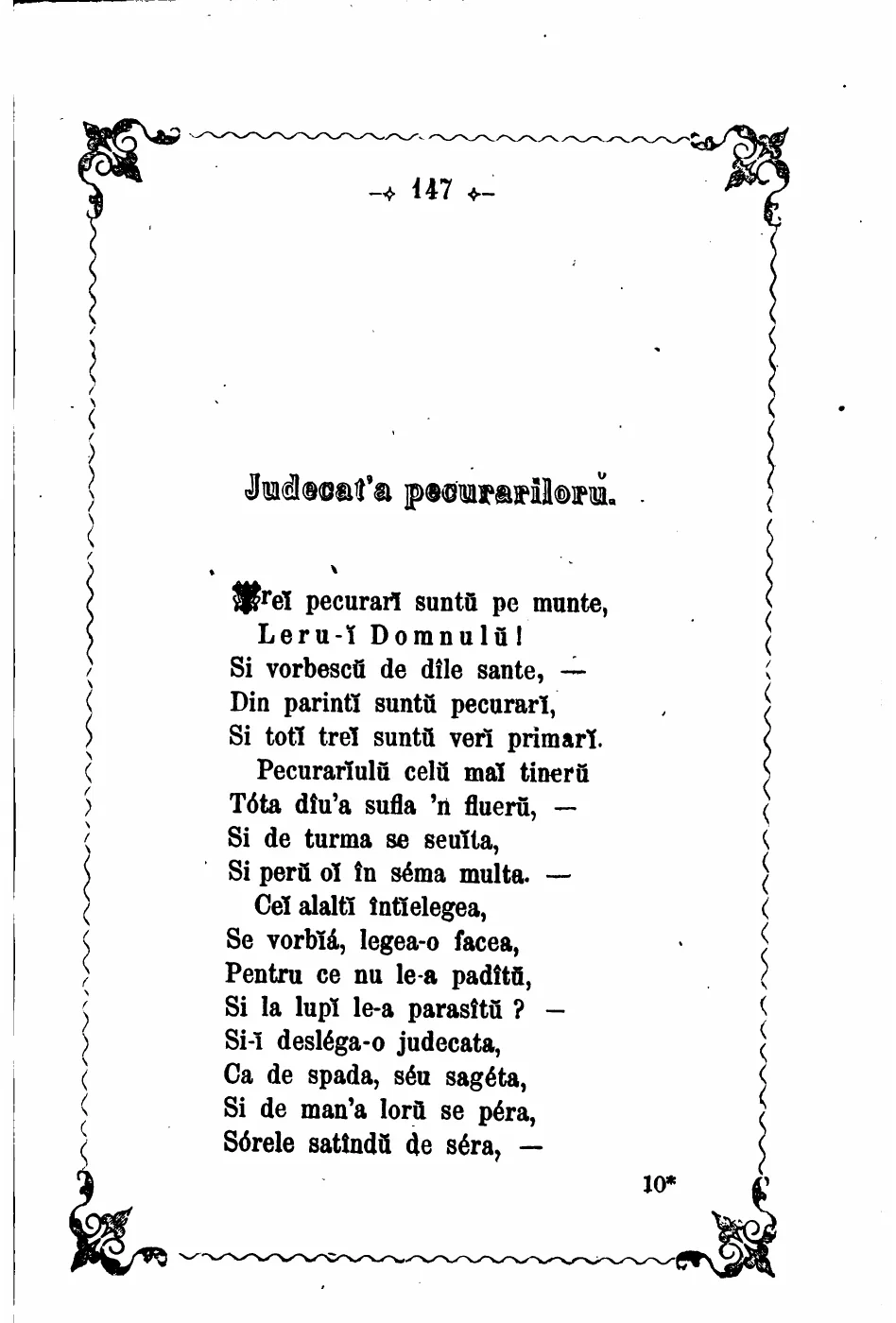
“Judecata păcurarilor”, the carol printed at Pesta in 1859: the youngest of three cousins stands trial for the lost sheep, with no lamb in sight.Marienescu, Poesia populara. Colinde, Pesta, 1859, p. 147 · Internet Archive, Public domain
Long before it was a school ballad, Miorița was sung in winter, from door to door. The oldest known writing is a carol noted around 1792–1794 in a Bistrița-Năsăud garrison by officer Ioan Șincai; the manuscript surfaced only toward the end of the twentieth century, in the Târgu Mureș archives, and was printed in 1991. It sat unprinted for nearly two hundred years.
The folklorist Adrian Fochi, who gathered everything known about the ballad in 1964, drew the line plainly: the primary version is the carol, attested in Transylvania, Banat, Crișana, and Maramureș; the lamb ballad rules south and east of the Carpathians, in Oltenia, Muntenia, Dobrogea, and Moldavia. The ballad's map is really a map of two songs.
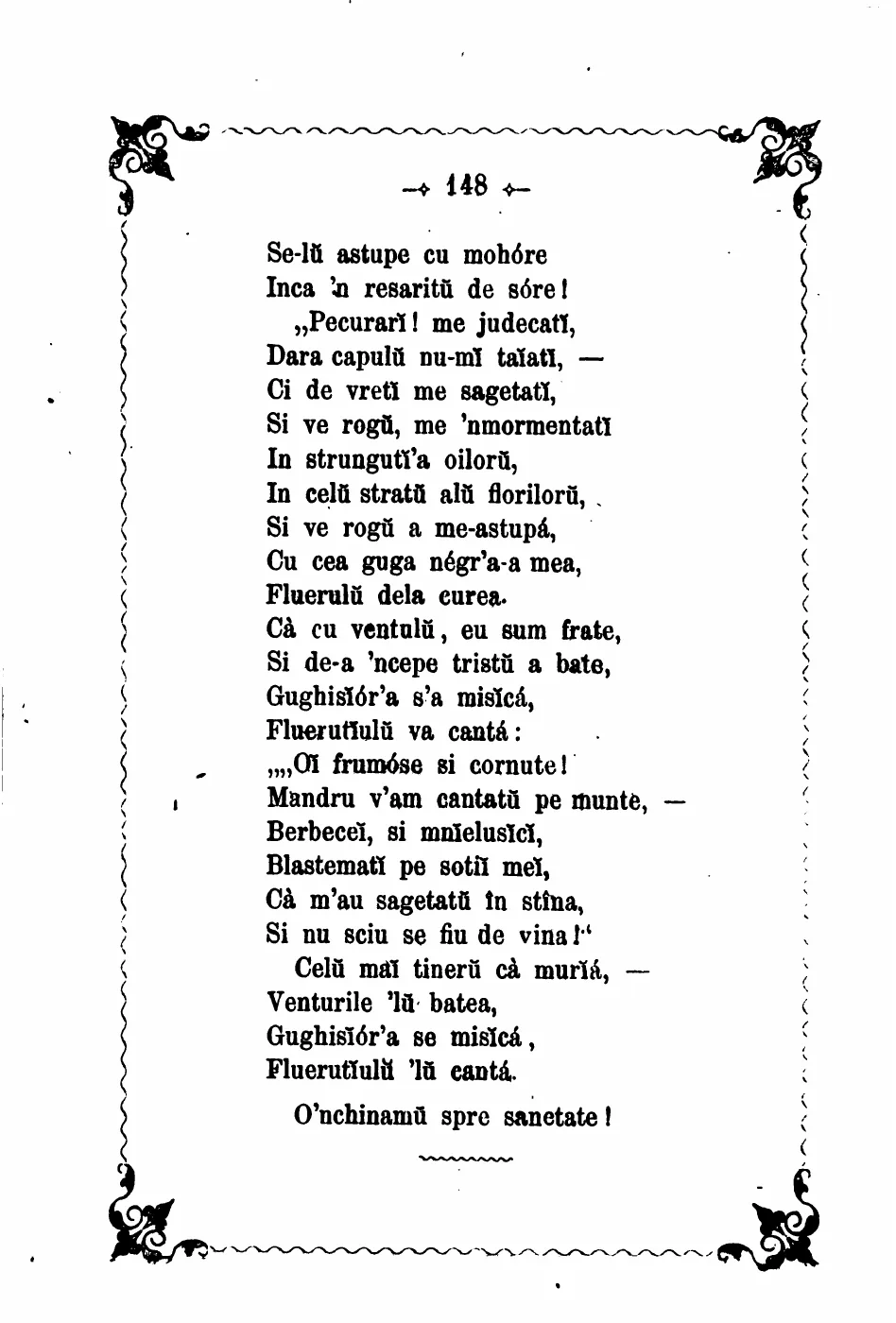
The carol on this page was printed at Pesta in 1859, in Atanasie Marian Marienescu's collection: “Judecata păcurarilor”, the shepherds' judgment. Three cousins hold court: the youngest played his flute all day and lost the sheep to wolves. No sheep speaks, no wedding is prepared. The price of the sheep is his life — and a curse sung by the flute over the grave.
The end of the “Judecata păcurarilor”: the sheep are called to curse their masters, and the wind plays the dead man's flute.Marienescu, Poesia populara. Colinde, Pesta, 1859, p. 148 · Internet Archive, Public domain
Meanwhile, Between 5 and 24 January 1859, five months before Marienescu dates his Pesta preface, Moldavia and Wallachia elect the same man as prince, Alexandru Ioan Cuza.
II
Soveja
1842–1850 · Two origins, one pen
First printed
18 February 1850, Cernăuți
Title then
“Mieoara”
Soveja, via Russo
March 1846
Ceahlău, via Udrea
summer 1842
On a fine summer evening in 1842, a young poet climbed to a sheepfold on Mount Ceahlău, where he had heard the horn of the head shepherd Udrea ringing. After night scattered the sky with stars, he sat with Udrea and other shepherds around a fire and stayed till dawn with the mountain songs. That is how Vasile Alecsandri, in 1866, says he collected Miorița: from Udrea's lips.
But in 1850 he had told another story. Sending the ballad to Alexandru Hurmuzachi for the Bucovina gazette, Alecsandri wrote that Alecu Russo had brought it to him, “together with many others”, and that Russo had found it in the Soveja mountains in March 1846. Soveja or Ceahlău, Russo or Udrea, 1846 or 1842 — the pen is the same, but the origins are two, and no one has ever reconciled the two letters.
What is certain is the printing: on Saturday, 18 February 1850, “Mieoara” appears in the Bucovina gazette at Cernăuți, and on 28 August it is reprinted by Zimbrul in Iași. The title “Miorița” is also Alecsandri's proposal, by convention, and it sticks. Here begins the life of the ballad everyone knows — a life of paper, not of sheepfolds.
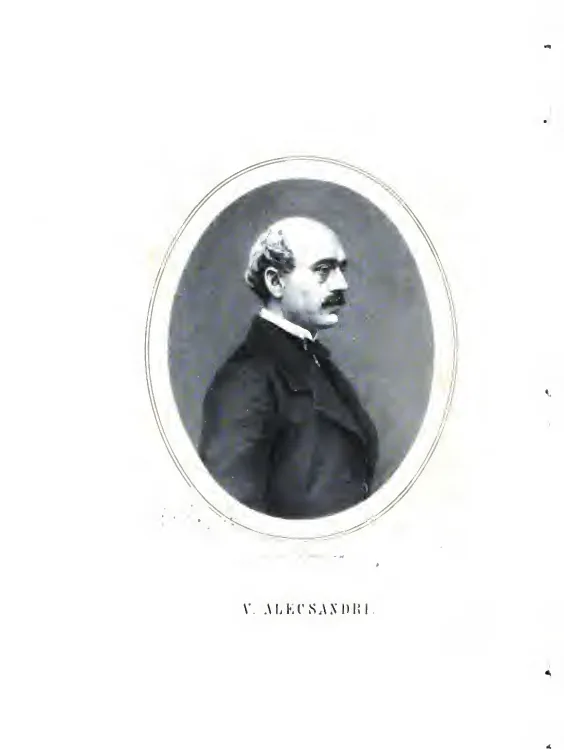
The poet at the time of the definitive edition: frontispiece of the 1866 volume, with the Udrea note printed on page 57.Frontispiciul volumului Poesii populare ale românilor, București, 1866 · Internet Archive, Public domain
Meanwhile, In 1848, between Soveja (1846) and the printing (1850), Wallachia rises in revolution: the Proclamation of Islaz demands rights and a tricolour flag.
III
The print
1850–1866 · The ballad goes abroad
First collection
1852, “Poesii poporale”
In English
1854, London, “Miora”
Definitive edition
1866, București
Lines
123
The school text runs to 123 lines and opens on a high pasture, at heaven's gate: three flocks, three shepherds — Moldavian, Hungarian, Vrâncean — and the clairvoyant lamb warning its master that at sunset he will be killed. Then come the will, the three little flutes, and the wedding with the whole world, closing with the old mother searching for her son.
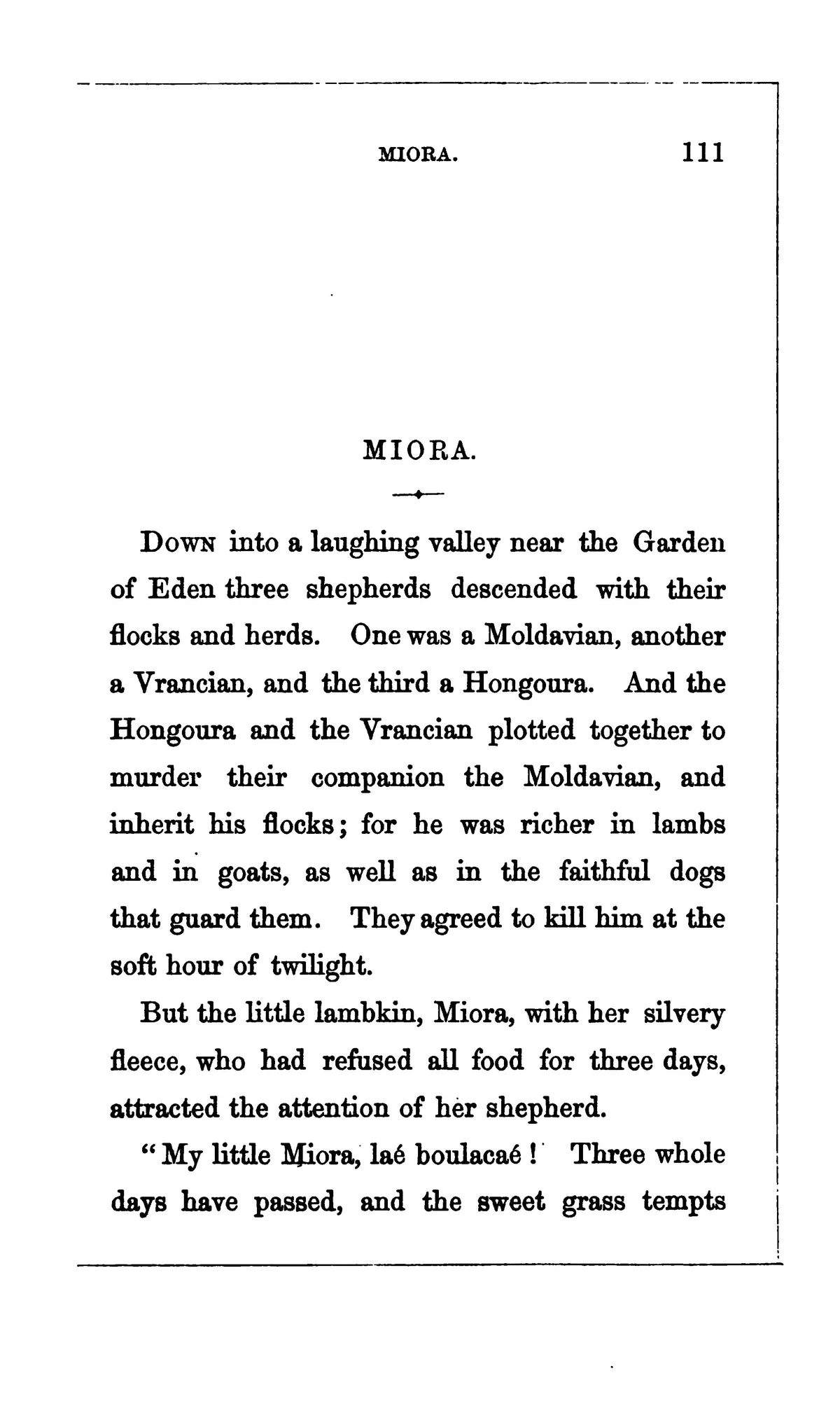
Only four years after the first printing, the ballad reaches London. E. C. Grenville Murray, an English journalist who had gathered Romanian songs with Bolintineanu's help, prints “Miora” in 1854, in English prose. His flutes sound different from ours: of fir, of linden, and of ivory — not beech, bone, and elder. That is the translator's hand, not the people's, but it shows how fast Europe learned the song.
In 1866 Alecsandri gathers his collection at București, in the definitive edition: “Poezii populare ale românilor”. There too, on page 57, stands the note about Udrea and Ceahlău — the second origin, set calmly beside the ballad that, sixteen years earlier, had arrived from Soveja.
“Miora” in London, 1854: the first page of the English translation, with its laughing valley and three shepherds.Murray, Doĭne, Londra, 1854, p. 111 · Internet Archive, Public domain
Meanwhile, In the year of the London “Miora”, cholera strikes Soho on 31 August 1854, and John Snow draws its dot map — the first map of an epidemic.
IV
Teleorman
1900 · The other Miorița
Collector
Chr. N. Țapu
Voice
the cobzar Stancu Ion
Village
Cucueți, Teleorman
Lines
111
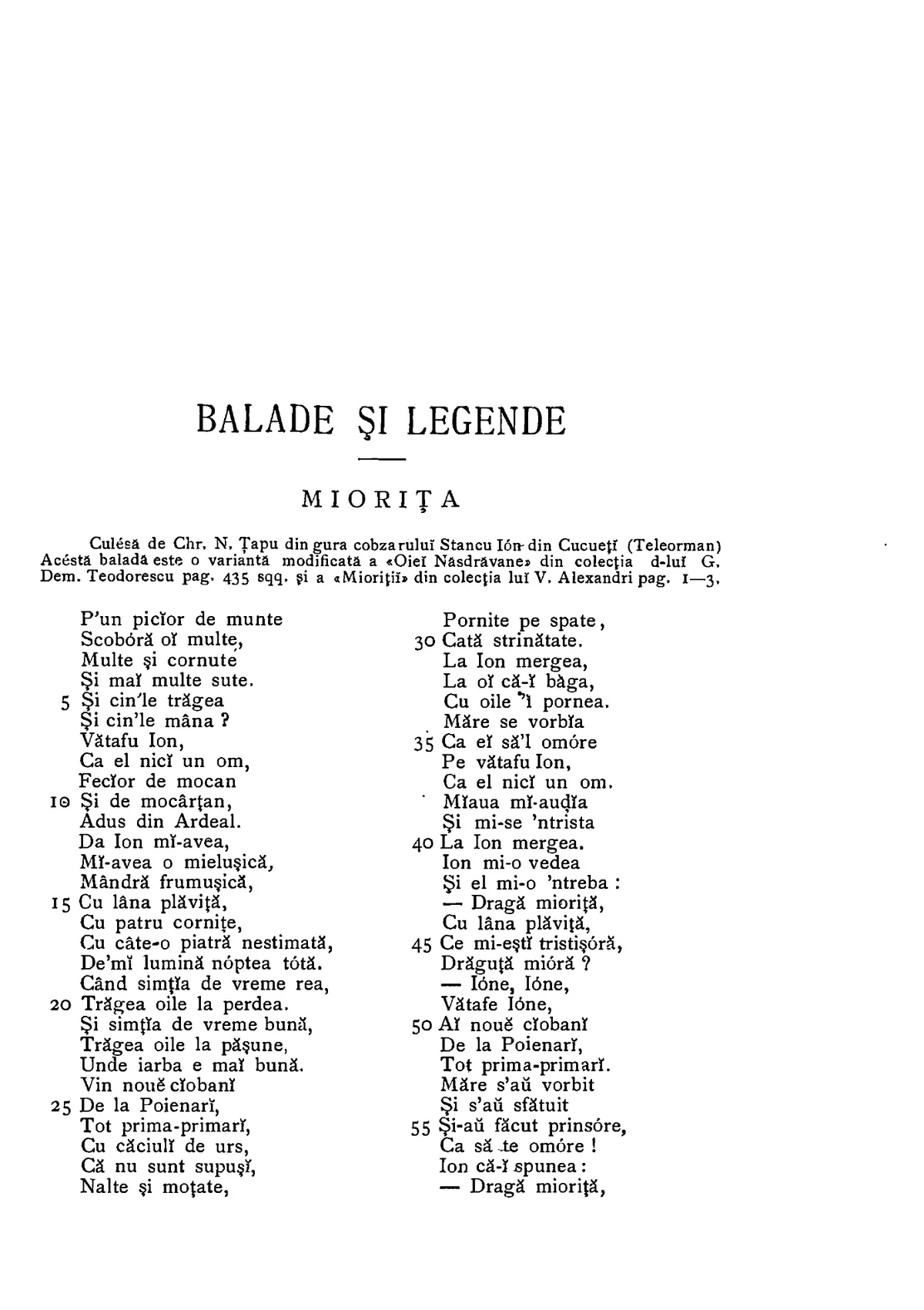
Toward the century's end, a cobzar from Cucueți in Teleorman, Stancu Ion, sings a 111-line Miorița to the collector Chr. N. Țapu; Tocilescu prints it in 1900. The hero is no longer one of three: he is Vătafu Ion, a mocan's son brought from Transylvania, alone against nine shepherds from Poienari, who swear a wager to kill him.
Much remains: the milking pen, the back of the sheepfold, the dogs that must be heard. But at his head stand no three flutes — a single caval instead — and the wedding with the world is gone entirely. In its place comes, in a green cart drawn by two dark-dun foals, a nun white of skin and black of habit, who mourns Ion, wakes him, takes him in her arms, and carries him home.
From the same county comes a fragment too: teacher I. Florescu notes it down from Florea Drăgan of Bragadiru, and Tocilescu sends the reader from page 1254 back to page 3, to the Miorița. Here again the nine shepherds are from Poienari — proof that Teleorman sang its own story, not the manual's.
The first page of the Cucueți Miorița: 111 lines taken “from the lips of the cobzar Stancu Ion”.Tocilescu, Materialuri folkloristice, vol. 1, partea 1, București, 1900, p. 3 · Wikimedia Commons, Public domain
Meanwhile, In the year of Tocilescu's volume, Paris opens its Universal Exposition, 14 April – 12 November 1900, with over fifty million visitors.
The number
930
That is how many papers about a single ballad Adrian Fochi counted in 1964: 702 variants, 123 fragments, and 105 notes. Read one a day and you finish after one year and 337 days.
Fochi, Miorița, 1964, via the inspected summary
Where it was collected
Of the variants with a known home, nearly two in three come from Transylvania. The rest divide among five more regions.
Transylvania 329
Banat 14
Oltenia 31
Muntenia 67
Dobrogea 10
Moldavia 51
Fochi 1964: 329 + 14 + 31 + 67 + 10 + 51 = 502 variants with a known region, via the inspected summary
At his head
Soveja · three flutes
Fluieraș de fag,
Mult zice cu drag;
Fluieraș de os,
Mult zice duios;
Fluieraș de soc,
Mult zice cu foc!
Cucueți · one caval
Stâlp ce mi-i punea?
Căvălașul lui,
Crivăț ca-mi bătea
Cavalul urla,
Pe Ion jelea.
Pesta · the belt flute
Și vă rog a mă-astupa,
Cu cea gugă neagră-a mea,
Fluierul de la curea.
three villages, three altars
Eight episodes, three voices
The same story told three times: the Soveja ballad, the Pesta carol, and the cobzar's song from Cucueți. Seven episodes part ways; one alone — the will — is spoken the same. The filter shows the differences first.
Pick a number to read the episode in all three voices; the old spelling stands beside, exactly as printed.
Episodes
Episode 6: The flute
Soveja · Alecsandri, 1850
same
Aste să le spui,
Iar la cap să-mi pui
Fluieraș de fag,
Mult zice cu drag;
Fluieraș de os,
Mult zice duios;
Fluieraș de soc,
Mult zice cu foc!
Exactly as printed
Ear la cap se'mĭ puĭ
Flueraş de fag,
Mult ḑice cu drag!
Flueraş de os,
Mult ḑice duĭos!
Flueraş de soc,
Mult ḑice cu foc!
WitnessSoveja · 1850 · 123 lines
Cucueți · Stancu Ion, 1900
changed
Stâlp ce mi-i punea?
Căvălașul lui,
Crivăț ca-mi bătea
Cavalul urla,
Pe Ion jelea.
Exactly as printed
Stâlp ce mi-ĭ punea?
Căvălașul luĭ,
WitnessCucueți, Teleorman · 1900 · 111 lines
Pesta · Marienescu, 1859
changed
Și vă rog a mă-astupa,
Cu cea gugă neagră-a mea,
Fluierul de la curea.
Că cu vântul, eu sunt frate,
Și de-a-ncepe trist a bate,
Gughișor-a s-a mișca,
Fluieruțul va cânta:
Exactly as printed
Cu cea guga négra-a mea,
Fluerulŭ dela curea.
WitnessPesta · 1859 · 43 lines
Three flutes — beech, bone, elder — at school; a single caval at Cucueți; the black hood and the belt flute at Pesta. The page's motif.
Episode 1: The openingchanged
Soveja · Alecsandri, 1850
same
Pe-un picior de plai,
Pe-o gură de rai,
Iată vin în cale,
Se cobor la vale
Trei turme de miei,
Cu trei ciobănei.
WitnessSoveja · 1850 · 123 lines
Cucueți · Stancu Ion, 1900
changed
Pe-un picior de munte
Se coboară oi multe,
Multe și cornute
Și mai multe sute.
Exactly as printed
P’un picĭor de munte
WitnessCucueți, Teleorman · 1900 · 111 lines
Pesta · Marienescu, 1859
changed
Trei păcurari sunt pe munte,
Leru-i Domnului!
Și vorbesc de zile sfinte, —
Exactly as printed
Trei pecurari suntu pe munte,
WitnessPesta · 1859 · 43 lines
All three begin on the mountain, but only the school text knows the high pasture and heaven's gate: Cucueți drives down “many sheep”, and the carol calls on the Lord from its first line.
Episode 2: The shepherdschanged
Soveja · Alecsandri, 1850
same
Unu-i moldovan,
Unu-i ungurean
Și unu-i vrâncean.
Iar cel ungurean
Și cu cel vrâncean,
Mări, se vorbiră,
Ei se sfătuiră
Pe l-apus de soare
Ca să mi-l omoare
Pe cel moldovan,
Că-i mai ortoman
Ș-are oi mai multe,
Mândre și cornute
Și cai învățați
Și câni mai bărbați.
WitnessSoveja · 1850 · 123 lines
Cucueți · Stancu Ion, 1900
changed
Vătafu Ion,
Ca el nici un om,
Fecior de mocan
Și de mocârtan,
Adus din Ardeal.
…
Vin nouă ciobani
De la Poienari,
Tot prima-primari,
Exactly as printed
Fecĭor de mocan
Și de mocârtan,
Adus din Ardeal.
WitnessCucueți, Teleorman · 1900 · 111 lines
Pesta · Marienescu, 1859
changed
Din părinți sunt păcurari,
Și toți trei sunt veri primari.
Păcurarul cel mai tânăr
Exactly as printed
Si toti trei suntŭ veri primari.
WitnessPesta · 1859 · 43 lines
Three by origin at school, a lone man brought from Transylvania at Cucueți, three first cousins at Pesta — and only at Pesta is the youngest guilty of anything.
Episode 3: The guiltchanged
Soveja · Alecsandri, 1850
same
Iar cel ungurean
Și cu cel vrâncean,
Mări, se vorbiră,
Ei se sfătuiră
Pe l-apus de soare
Ca să mi-l omoare
Pe cel moldovan,
Că-i mai ortoman
Ș-are oi mai multe,
Mândre și cornute
Și cai învățați
Și câni mai bărbați.
WitnessSoveja · 1850 · 123 lines
Cucueți · Stancu Ion, 1900
changed
Mare se vorbea
Ca ei să-l omoare
Pe vătafu Ion,
Ca el nici un om.
…
Mare s-au vorbit
Și s-au sfătuit
Și-au făcut prinsoare,
Ca să te omoare!
Exactly as printed
Și-aŭ făcut prinsóre,
Ca să te omóre!
WitnessCucueți, Teleorman · 1900 · 111 lines
Pesta · Marienescu, 1859
changed
Ceilalți înțelegea,
Se vorbea, legea-o făcea,
Pentru ce nu le-a pădit,
Și la lupi le-a părăsit? —
Și-i dezlega-o judecată,
Ca de spadă, său săgeată,
Și de mâna lor se piară,
Soarele satând de seară, —
Exactly as printed
Se vorbĭa, legea-o facea,
WitnessPesta · 1859 · 43 lines
At school, wealth condemns the Moldavian (“for he is richer”); at Cucueți, a wager; at Pesta, a fair trial for the sheep the wolves ate.
Episode 4: The ewechanged
Soveja · Alecsandri, 1850
same
Dar cea mioriță,
Cu lână plăviță,
De trei zile-ncoace
Gura nu-i mai tace,
Iarba nu-i mai place.
…
Stăpâne, stăpâne,
Îți cheamă ș-un câine,
Cel mai bărbătesc
Și cel mai frățesc,
Că l-apus de soare
Vreau să mi te-omoare
Baciul ungurean
Și cu cel vrâncean!
WitnessSoveja · 1850 · 123 lines
Cucueți · Stancu Ion, 1900
changed
Dar Ion mi-avea,
Mi-avea o mielușică,
Mândră frumușică,
Cu lâna plăviță,
Cu patru cornițe,
Cu câte-o piatră nestemată,
De-mi lumina noaptea toată.
…
— Ioane, Ioane,
Vătafe Ioane,
Ai nouă ciobani
De la Poienari,
Tot prima-primari.
Mare s-au vorbit
Și s-au sfătuit
Și-au făcut prinsoare,
Ca să te omoare!
Exactly as printed
Cu patru cornițe,
Cu câte-o piatră nestemată,
WitnessCucueți, Teleorman · 1900 · 111 lines
Pesta · Marienescu, 1859
missing
This voice has no such episode.
WitnessPesta · 1859 · 43 lines
The talking sheep is the ballad's dowry: grey-fleeced at school, horned with gems at Cucueți — and wholly absent from the Pesta carol.
Episode 5: The willsame
Soveja · Alecsandri, 1850
same
Ca să mă îngroape
Aice, pe-aproape,
În strunga de oi,
Să fiu tot cu voi;
În dosul stânii,
Să-mi aud cânii.
WitnessSoveja · 1850 · 123 lines
Cucueți · Stancu Ion, 1900
same
Ei tot să mă îngroape
La stână aproape,
În strunga de oi,
Să fiu tot cu voi,
Cam în dosul stânii,
Să-mi aud câinii!
WitnessCucueți, Teleorman · 1900 · 111 lines
Pesta · Marienescu, 1859
changed
Și vă rog, mă-nmormântați
În strunguța oilor,
În cel strat al florilor,
Și vă rog a mă-astupa,
Cu cea gugă neagră-a mea,
Fluierul de la curea.
Exactly as printed
In celŭ stratŭ alŭ florilorŭ,
WitnessPesta · 1859 · 43 lines
The only episode spoken the same: the milking pen, the back of the sheepfold, the dogs that must be heard. The carol, though, buries him “in the flower bed”.
Episode 6: The flutechanged
Soveja · Alecsandri, 1850
same
Aste să le spui,
Iar la cap să-mi pui
Fluieraș de fag,
Mult zice cu drag;
Fluieraș de os,
Mult zice duios;
Fluieraș de soc,
Mult zice cu foc!
Exactly as printed
Ear la cap se'mĭ puĭ
Flueraş de fag,
Mult ḑice cu drag!
Flueraş de os,
Mult ḑice duĭos!
Flueraş de soc,
Mult ḑice cu foc!
WitnessSoveja · 1850 · 123 lines
Cucueți · Stancu Ion, 1900
changed
Stâlp ce mi-i punea?
Căvălașul lui,
Crivăț ca-mi bătea
Cavalul urla,
Pe Ion jelea.
Exactly as printed
Stâlp ce mi-ĭ punea?
Căvălașul luĭ,
WitnessCucueți, Teleorman · 1900 · 111 lines
Pesta · Marienescu, 1859
changed
Și vă rog a mă-astupa,
Cu cea gugă neagră-a mea,
Fluierul de la curea.
Că cu vântul, eu sunt frate,
Și de-a-ncepe trist a bate,
Gughișor-a s-a mișca,
Fluieruțul va cânta:
Exactly as printed
Cu cea guga négra-a mea,
Fluerulŭ dela curea.
WitnessPesta · 1859 · 43 lines
Three flutes — beech, bone, elder — at school; a single caval at Cucueți; the black hood and the belt flute at Pesta. The page's motif.
Episode 7: The weddingchanged
Soveja · Alecsandri, 1850
same
Iar tu de omor
Să nu le spui lor.
Să le spui curat
Că m-am însurat
C-o mândră crăiasă,
A lumii mireasă;
Că la nunta mea
A căzut o stea;
Soarele și luna
Mi-au ținut cununa.
Brazi și păltinași
I-am avut nuntași,
Preoți, munții mari,
Păsări, lăutari,
Păsărele mii,
Și stele făclii!
WitnessSoveja · 1850 · 123 lines
Cucueți · Stancu Ion, 1900
missing
This voice has no such episode.
WitnessCucueți, Teleorman · 1900 · 111 lines
Pesta · Marienescu, 1859
changed
„Oi frumoase și cornute!
Mândru v-am cântat pe munte, —
Berbecei, și mnielușici,
Blestemați pe soții mei,
Că m-au săgetat în stână,
Și nu știu să fiu de vină!“
Exactly as printed
Blastemati pe sotii meĭ,
Câ m’au sagetatŭ în stina,
WitnessPesta · 1859 · 43 lines
The wedding with the sun and moon exists only at school. At Cucueți nothing takes its place, and at Pesta the sheep are called to curse their masters.
Episode 8: The remnantchanged
Soveja · Alecsandri, 1850
same
Iar dacă-i zări,
Dacă-i întâlni
Măicuță bătrână,
Cu brâul de lână,
Din ochi lăcrimând,
Pe câmp alergând,
De toți întrebând
Și la toți zicând
„Cine-a cunoscut
Cine mi-a văzut
Mândru ciobănel,
Tras printr-un inel?
WitnessSoveja · 1850 · 123 lines
Cucueți · Stancu Ion, 1900
changed
Cucia-mi venea,
Mare mi-aducea,
D-o călugăriță
Albă la peliță,
Neagră la hăiniță.
La târlă-mi trăgea,
Pe Ion striga:
— Ioane, Ioane,
Vătafe Ioane.
El nu răspundea.
La mormânt mergea
Și ea mi-l jelea
Și mi-l deștepta.
În brațe că-l lua,
În cucie mi-l punea
Și acasă că mi-l ducea.
Exactly as printed
În cucie mi-l punea
Și acasă că mi-l ducea.
WitnessCucueți, Teleorman · 1900 · 111 lines
Pesta · Marienescu, 1859
changed
Cel mai tânăr că murea, —
Vânturile-l bătea,
Gughișor-a se mișca,
Fluieruțul îl cânta.
O-nchinăm spre sănătate!
Exactly as printed
Fluerutĭulŭ ’lŭ canta.
WitnessPesta · 1859 · 43 lines
The old mother searches for her son at school; a nun carries him home at Cucueți; at Pesta, the wind plays his flute to the dead man.
The ballad's geography
Twelve places with a year and a proof: where it was collected, where it was printed, and where it was said to have been collected. The verse under each place is quoted only from public-domain printings; elsewhere, the place stands with its year and source, and no verse.
Pick a dot to see its card below; London, 1854, will not fit the map and stands aside.
The carol–ballad border is drawn schematically, after Fochi 1964. Dots use real coordinates, checked against the printed names; country outlines: Natural Earth.
1792
Bistrița
Collected, restricted edition · colinda din garnizoană, ms. Șincai
Restricted edition: the place is cited, the verse is not.
1843
Cleja, Bacău
Collected, restricted edition · ungurește, pr. Petrás
Restricted edition: the place is cited, the verse is not.
1842
Ceahlău
As Alecsandri told it · Udrea, spus de Alecsandri
An unprinted on-the-spot claim: cited, no verse.
1846
Soveja, Vrancea
Collected, the school text · Russo → Alecsandri
“Pe-un picior de plai,”
1850
Cernăuți
Printed · Bucovina, „Mieoara”
It prints the Soveja text, quoted above.
1850
Iași
Printed · Zimbrul, 28 august
It prints the Soveja text, quoted above.
1854
Londra
Printed · Murray, „Miora”
“Down into a laughing valley near the Garden of Eden…”
1859
Pesta
Printed · „Judecata păcurarilor”
“Trei păcurari sunt pe munte,”
1866
București
Printed · ediția definitivă
It prints the Soveja text, quoted above.
1900
Cucueți, Teleorman
Collected, scan verified · cobzarul Stancu Ion
“Pe-un picior de munte”
1900
Bragadiru, Teleorman
Collected, scan verified · Florea Drăgan, fragment
“Foaie bob de linte,”
1969
Lungani–Pașcani
Collected, restricted edition · Costăchescu
Restricted edition: the place is cited, the verse is not.
At the fire, with Udrea
“I sat down with Udrea and other shepherds around a fire, and stayed till dawn.” — Alecsandri, 1866. For each verse, name the village that sang it.
Twelve true verses in three voices. None is invented: each stands in its complete text, higher up this page.
Three villages at every question: Alecsandri's Soveja, the cobzar's Cucueți, and the carol printed at Pesta.
Round 1 · The opening
Three song openings. Which village begins this way?
01
Round 1 · The opening
Three song openings. Which village begins this way?
“Pe-un picior de plai,”
Which village sang it?
Soveja · Alecsandri
“Pe-un picior de plai” opens the Soveja text, the one that reached the manuals.
02
Round 1 · The opening
Three song openings. Which village begins this way?
“Pe-un picior de munte”
Which village sang it?
Cucueți · Stancu Ion
“Pe-un picior de munte” opens the cobzar Stancu Ion's song, from Cucueți.
03
Round 1 · The opening
Three song openings. Which village begins this way?
“Trei păcurari sunt pe munte,”
Which village sang it?
Pesta · the carol
The Pesta carol begins straight in with the three cousins, on the mountain.
Round 2 · At his head
What does each village set at the dead man's head?
04
Round 2 · At his head
What does each village set at the dead man's head?
“Căvălașul lui,”
Which village sang it?
Cucueți · Stancu Ion
A single caval stands as pillar at Cucueți — no three flutes in sight.
05
Round 2 · At his head
What does each village set at the dead man's head?
“Fluierul de la curea.”
Which village sang it?
Pesta · the carol
At Pesta the dead man asks for the black hood and “the belt flute”.
06
Round 2 · At his head
What does each village set at the dead man's head?
“Fluieraș de fag,”
Which village sang it?
Soveja · Alecsandri
The school text knows three: of beech, of bone, and of elder.
Round 3 · The ewe
Who talks to the sheep — and what do they say?
07
Round 3 · The ewe
Who talks to the sheep — and what do they say?
“Blestemați pe soții mei,”
Which village sang it?
Pesta · the carol
At Pesta nobody talks to the sheep: the flute calls them to curse their masters.
08
Round 3 · The ewe
Who talks to the sheep — and what do they say?
“— Mioriță laie,”
Which village sang it?
Soveja · Alecsandri
“Mioriță laie, laie bucălaie” — the shepherd's question in the school text.
09
Round 3 · The ewe
Who talks to the sheep — and what do they say?
“Cu patru cornițe,”
Which village sang it?
Cucueți · Stancu Ion
The Cucueți lambkin wears four little horns of gemstone.
Round 4 · The remnant
How does the song end in each village?
10
Round 4 · The remnant
How does the song end in each village?
“Și stele făclii!”
Which village sang it?
Soveja · Alecsandri
The school text ends with the wedding: the stars stay tapers.
11
Round 4 · The remnant
How does the song end in each village?
“Și acasă că mi-l ducea.”
Which village sang it?
Cucueți · Stancu Ion
At Cucueți the nun takes him in her arms and carries him home.
12
Round 4 · The remnant
How does the song end in each village?
“O-nchinăm spre sănătate!”
Which village sang it?
Pesta · the carol
The carol ends with the singers' toast: “O-nchinăm spre sănătate!”
You named 0 of 12.
Twelve verses and no doubt: you tell the voices apart like a folklorist.
More than half: your ear already catches the differences.
Under half: walk the episodes once more, then come back to the fire.
The ballad in numbers
1,792
oldest writing, Bistrița-Năsăud
1,850
first printing, “Mieoara”, Cernăuți
930
documents Fochi counted in 1964
702
variants in Fochi's corpus
111
lines in the Cucueți Miorița
3
complete texts face each other on this page
Three sayings, three answers
What people say about Miorița — and what the papers say.
“The ballad is one: the manual's.”No.
Adrian Fochi counted no fewer than 702 variants in 1964, plus 123 fragments and 105 notes — 930 documents. By 2005 the count had passed 1400, after Dorin Ștef. The manual prints a single fixing, from 1850.
“Alecsandri collected it from a shepherd.”So he says — twice, differently.
In 1850 Alecsandri writes that Alecu Russo brought him the ballad from Soveja, in 1846. In 1866 he prints that he collected it himself from the shepherd Udrea, on Ceahlău, in 1842. Both statements stand under the same name; which is true is not known.
“Miorița was always a ballad.”A carol first.
The primary form is the carol, says Fochi: it travels in Transylvania, Banat, Crișana, and Maramureș, and the oldest writing, from around 1792, is a carol too. The clairvoyant lamb and the wedding with the world arrive only in the ballad dress of the south and east.
Sources
How this was worked
The page's texts: Alecsandri in the modern transcription (spot-checked against page 2 of the 1866 edition); Cucueți and the “Judecata” modernized by the author from his own transcription of the scanned pages. Changed episodes quote the old spelling exactly.
Episode statuses (same / changed / missing) are the author's collation across the three complete texts; the only “same” episode is the Cucueți will. The map uses real coordinates; verses are quoted only from public-domain printings.
The Fochi (930 / 702) and Ștef (over 1400) figures are cited via the inspected summary, the volumes being out of reach; texts from restricted editions (1792, 1843, Lungani–Pașcani) are cited, not reproduced.