Explainer · updated 17 October 2026
MOAB, the “mother of all bombs”: how far its blast reaches, and what it cannot reach
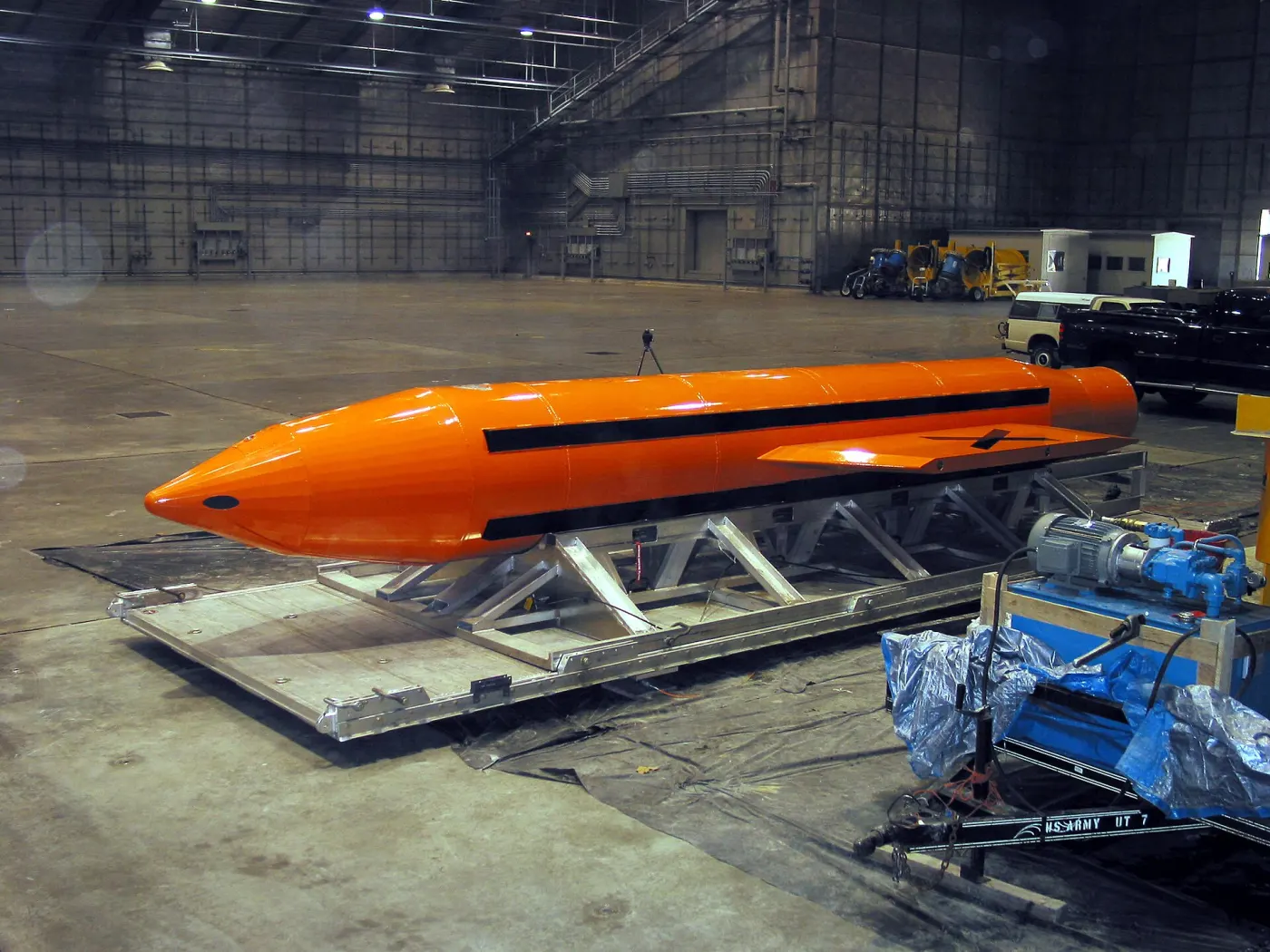
US war plans for Iran include the GBU-43/B, CNN reported on 15 October. It has been dropped in war once, in Afghanistan in 2017. It holds 8.5 tonnes of explosive, more than any other American non-nuclear bomb in service, and it bursts just above the ground. Here it is drawn to scale: the bomb, its blast, and the rock it cannot get into.
Scroll on: the drawing changes with each paragraph.
01 · The object
Nine metres long, and nearly all of it explosive#
The GBU-43/B Massive Ordnance Air Blast is 9.2 metres long and about a metre wide. It weighs 9.8 tonnes, and 8.5 tonnes of that is H-6, a blend of TNT, RDX and aluminium powder: 87% of its weight is explosive, an unusually thin case for a bomb.
No bomber carries it. It rides on a sled in the hold of an MC-130 transport aircraft and leaves through the open rear ramp; fins and GPS steer it down. The US Air Force Research Laboratory rushed it out for the invasion of Iraq: the first test came on 11 March 2003, days before the war began, and it was not used there. Reportedly about 15 were made; the Air Force’s mid-2000s estimate of the unit cost was about $170,000.
02 · Biggest by what?
Not the heaviest American bomb, but the one in service with the most explosive#
Headlines call it the biggest American bomb. By weight it is not. The GBU-57 bunker buster weighs 13.6 tonnes, and the T-12 of the 1950s, never used in war, almost 20. What sets MOAB apart, among the bombs in service, is how much of it explodes.
The bar under each bomb is its weight; the coloured part is explosive. The GBU-57 carries about 2.4 tonnes of explosive inside a thick steel body built to survive hitting rock: about a fifth of its weight. Britain’s Grand Slam of 1945 weighed as much as MOAB, with about half the explosive.
03 · The energy
As TNT, its blast is a block 1.9 metres on each side#
MOAB’s explosion is usually rated at 11 tonnes of TNT. Pressed into solid TNT, that is a cube 1.9 m on each side, taller than the person beside it.
The rating is approximate. NATO’s tables count H-6 as 1.38 times TNT for peak pressure and 1.15 times for impulse, so the same 8.5 tonnes are worth 9.8 to 11.7 tonnes of TNT depending on what is measured. This page uses 11.
The ladder · 1
Beirut 2020 was about 45 MOABs#
In January 1917 a TNT works at Silvertown in east London blew up: about 50 tonnes of explosive, roughly 4.5 MOABs, 73 people killed. In August 2020 ammonium nitrate stored in the port of Beirut exploded. From 16 videos, Rigby and colleagues estimated 0.5 kilotons of TNT, with an upper limit of 1.12: about 45 MOABs, a cube 6.7 m on a side.
The ladder · 2
Hiroshima: about 1,400 MOABs, from a bomb half its weight#
Little Boy weighed 4.4 tonnes, less than half of MOAB, and released about 15 kilotons, give or take 20%: some 1,400 MOABs. Its TNT would be a cube 21 m high, the height of a seven-storey building. “Mother of all bombs” describes the top of the non-nuclear scale; the bottom of the nuclear one starts far above it.
The ladder · 3
Tsar Bomba, 1961: a cube as tall as the Eiffel Tower#
The largest bomb ever exploded, the Soviet Tsar Bomba, released about 50 megatons: 4.5 million MOABs. As TNT it would be a cube 310 m high, close to the Eiffel Tower’s 330 m. The red dot at the foot of the tower is MOAB’s cube.
04 · The blast
What MOAB’s blast does to the houses around it#
MOAB is set to burst about 1.8 m above the ground, according to DW. The shock spreads as a dome. The rings here come from a formula British engineers derived from data on brick houses bombed in the Second World War, revised in 1994 to allow for energy taken up by a casing, and printed in the UN’s ammunition guidelines:
- about 100 mbrick houses demolished
- about 140 mdamaged beyond repair
- about 250 muninhabitable, needing extensive work
- about 430 muninhabitable until repaired
- about 850 mhabitable, but ceilings, tiles and glass need repair
The coloured line shows how far the shock front has travelled, in real time: about 2.7 seconds to reach a kilometre.
05 · One kilometre
At a kilometre, broken windows#
Al Jazeera, reporting the view of a military analyst on 15 October, wrote that the blast would destroy everything above ground within a kilometre. The measurements behind the blast tables do not support that. At 1 km the peak overpressure is about 2 kPa, a fiftieth of normal air pressure. That breaks windows, and flying glass injures people; walls stand.
The pressure usually taken to wreck a house, 5 psi or 34 kPa, is reached about 130 m from the burst. In Achin in 2017, imagery analysts at Alcis counted 38 buildings and 69 trees destroyed within about 150 m, and added that much of the damage appeared to come from ground fighting.
06 · Underground
How deep it reaches: zero metres#
Everything MOAB does happens in the air. It explodes before it touches anything and leaves little crater: at Achin the BBC found “no big crater”, and an Afghan officer pointed to green trees still standing 100 m away. The blast presses on the ground; it does not dig into it.
The American bomb built for buried targets is the GBU-57. Its steel body is designed “to penetrate up to 200 feet underground before exploding”, about 61 m, in the US Air Force’s words, which do not say through what. On 22 June 2025 (Iran time) seven B-2s dropped 14 of them on Iran, a dozen on Fordow, their first use in war.
Fordow’s halls are reported to lie at least 80 m down. The tunnels at Pickaxe Mountain near Natanz, named in the new plans, were estimated in 2023 from the rock dug out at 80 to 100 m; digging has continued since. These depths are public estimates, drawn as bands.
The same distances on a square you know#
Pick a square. The rings are the house-damage distances from the drawing above, at true scale on OpenStreetMap outlines, with the number of buildings whose centre lies inside each; every ring counts the buildings in the rings closer in too. These are counts of outlines, not of people, and a city of stone and concrete would fare better than the brick houses the formula was built on.
Drawing…
Choose a square
Trafalgar Square, London: 18 buildings within 140 m would be damaged beyond repair; 2,421 lie within 850 m.
Inside each ring
- about 100 m · brick houses demolished7
- about 140 m · damaged beyond repair18
- about 250 m · uninhabitable, needing extensive work151
- about 430 m · uninhabitable until repaired514
- about 850 m · habitable, but ceilings, tiles and glass need repair2,421
Map data © OpenStreetMap contributors.
Bigger or smaller than one MOAB?#
Eight explosions. Guess whether each released more energy than MOAB’s 11 tonnes of TNT.
The only time it was used: Achin, 13 April 2017#
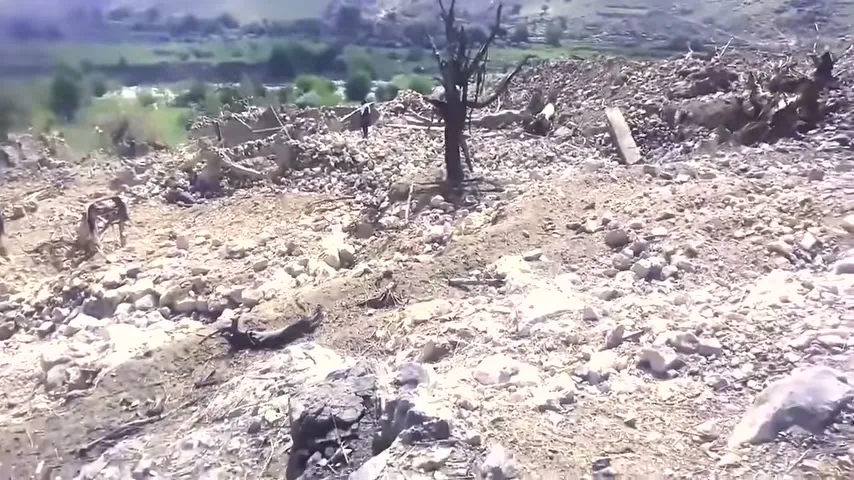
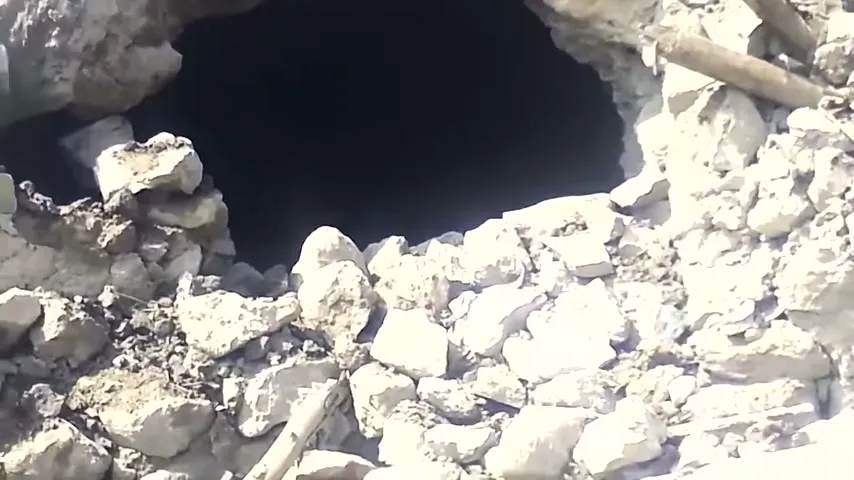
At 7:32 in the evening, local time, an MC-130 dropped a MOAB on tunnels used by the Islamic State’s Afghan branch in Achin district, Nangarhar province, near the Pakistani border. General John Nicholson, the US commander, called it “the right weapon against the right target” and said he saw no evidence of civilian casualties. Asked whether he had approved it, President Trump said: “What I do is I authorize my military.”
The death toll was never established independently. Afghan officials first said 36 fighters, then 82, 92, 94 and finally 96. The Islamic State denied any losses. An Afghan member of parliament relayed local reports of civilians killed, a teacher and his son among them; Afghan officials said no civilians died. A Reuters witness, viewing the site from several hundred yards away, saw no obvious crater or bodies; a BBC reporter saw “no big crater”, and the US defence secretary said that digging into tunnels to count bodies was “probably not a good use of our troops’ time”.
Why it is in the news: the Iran war of 2026#
US and Israeli forces began striking Iran on 28 February 2026; Israel killed Supreme Leader Ali Khamenei. A ceasefire on 7 April was followed by a memorandum signed on 17 June. US strikes resumed on 26 June after Iranian attacks on shipping, and after heavy strikes on 7 July President Trump declared the memorandum over. By September the Congressional Research Service described limited strikes on both sides and a sanctions campaign. On 8 October President Trump said the US would not attack Iran before the 3 November midterm elections.
On 15 October CNN, citing unnamed officials, reported that strike plans drafted in case combat resumes could use the MOAB on Iranian energy infrastructure and nuclear sites, and that plans for Pickaxe Mountain “explicitly” call for it. A source familiar with the planning told CNN it “is definitely not designed as a deep penetration warhead”. The White House said it does not comment on “sensitive military plans that may or may not exist”. Asked about it, Mr Trump told Newsmax: “The mother of all bombs is not nuclear.” As of 17 October no strike had been reported.
Two practical limits follow from the drawing above. The weapon’s effect is above ground, so it can wreck entrances, roads, surface plant and buildings, and cannot reach halls 80 metres down. And it travels in a slow, non-stealthy transport aircraft that has to fly close to its target.
Before MOAB: the big bombs it followed#
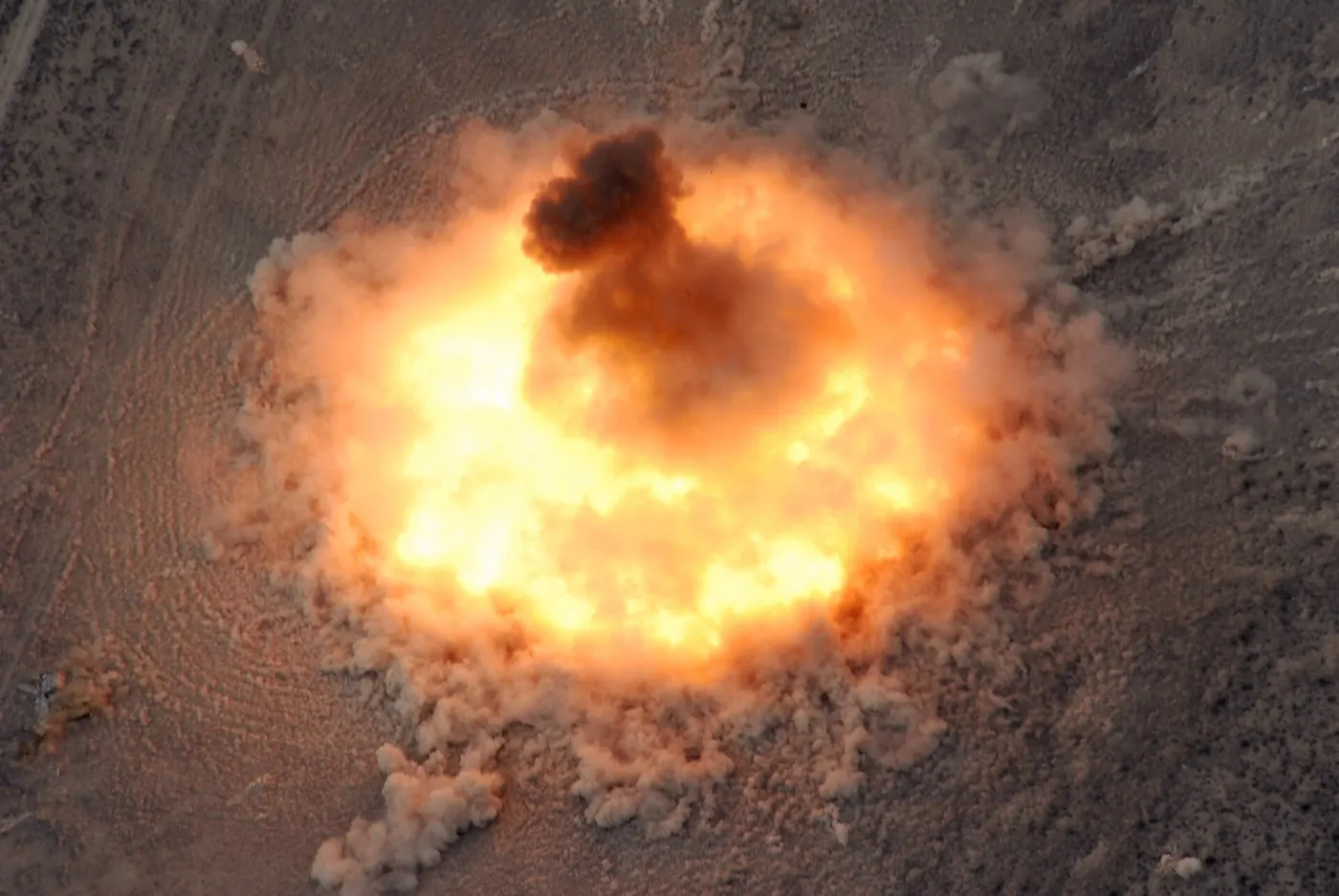
MOAB replaced the BLU-82 “Daisy Cutter”, a 6.8-tonne drum of explosive slurry designed to blast helicopter landing zones out of the jungle in Vietnam, first dropped over Laos in 1970 and later used in the Gulf in 1991 and in Afghanistan from 2001. Both leave a transport aircraft on a pallet. The Daisy Cutter’s designer, Al Weimorts, worked on MOAB too.

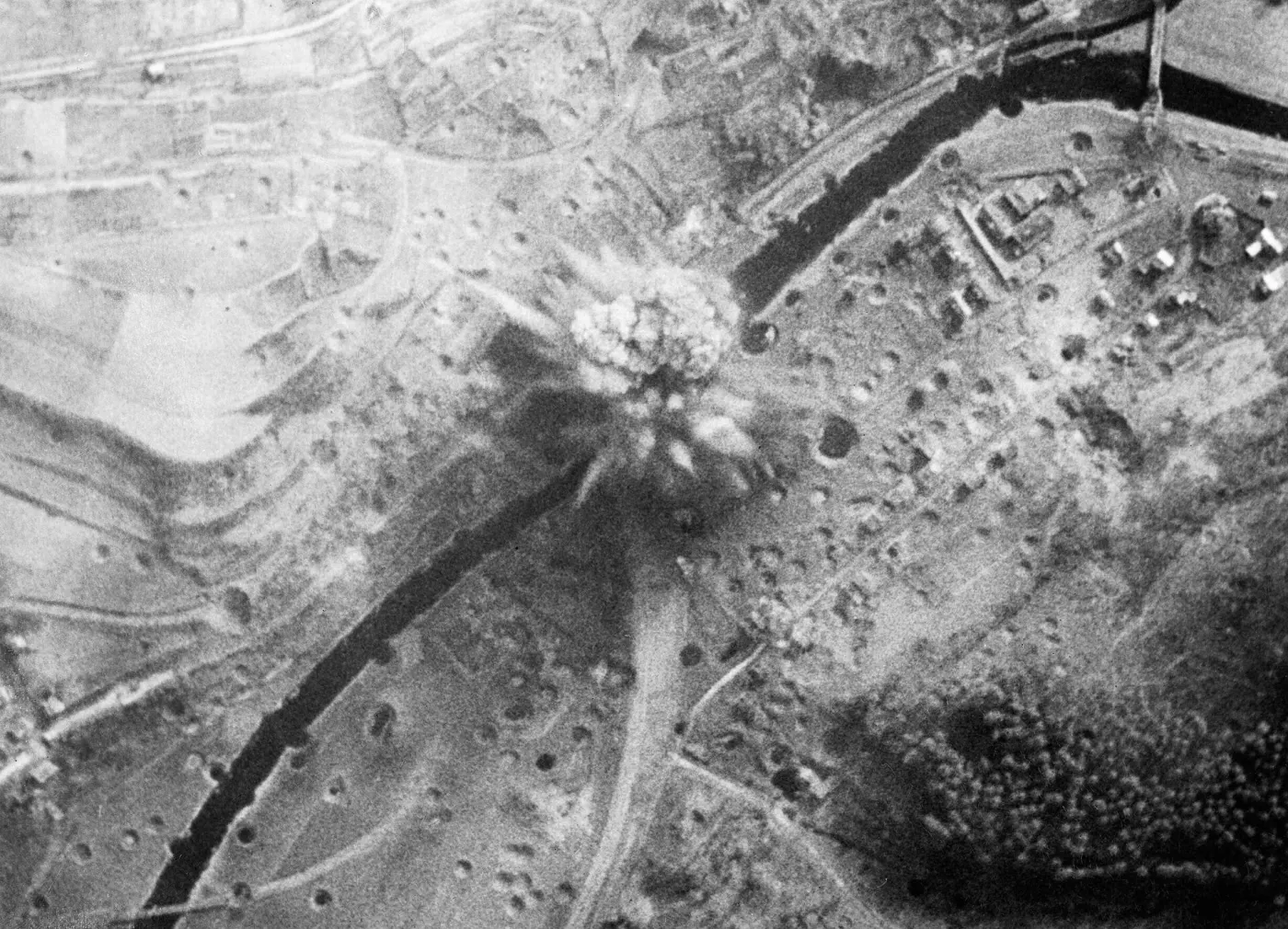
The heaviest bombs of the Second World War were British: Barnes Wallis’s Tallboy and Grand Slam, built to hit the ground at high speed and burrow before exploding: they brought down viaducts by shaking them from beneath and broke through the roofs of U-boat pens. The GBU-57, not MOAB, is their descendant.

Russia announced in 2007 a “father of all bombs” it claimed was four times as powerful as MOAB, about 44 tonnes of TNT. No independent measurement has been published.

How the numbers were worked out#
Blast. Peak overpressure, arrival time and pulse length come from the Kingery–Bulmash curves for a hemispherical burst of 11 tonnes of TNT on the ground, in Swisdak’s 1994 fits. My code reproduces the worked examples in Table 5 of the UN’s IATG 01.80 to within half a percent. The arrival-time curve stops about 890 m out; beyond that the front is extended at the speed of sound. A burst about 1.8 m up (DW’s figure) is close enough to the ground to treat as a surface burst.
Houses. The five rings use R = K·M^(1/3) / [1 + (3175/M)²]^(1/6), with M the mass of explosive in kilograms (8,482 kg of H-6), as IATG 01.80 defines it, and the constants that Gilbert, Lees and Scilly revised in 1994 to allow for a casing (Tables 40–42). Jarrett’s original constants give a smaller “beyond repair” ring, 110 m, but a larger outer one, 1.1 km. Using the 11-tonne TNT rating instead of the explosive mass would make every ring about 10% larger. The formula comes from British brick houses; modern concrete frames resist more, and terrain changes everything: at Achin the bomb fell in a narrow valley.
Energy. The TNT rating is the commonly stated 11 tonnes; the band of 9.8 to 11.7 comes from NATO’s H-6 factors. The TNT cubes use a density of 1.654 tonnes per cubic metre. Grenade, Mk 84 and Grand Slam are computed from their explosive weights; Silvertown, Beirut and Halifax are published estimates; the Russian figure is a claim.
Not modelled: heat and fragments. The distances are for buildings; the model does not estimate casualties.
Squares. Building outlines, streets and water within 1.5 km of each square were downloaded from OpenStreetMap on 17 October 2026. A building is counted inside a ring when the centre of its outline is.
Sources#
- Air Force Armament Museum, “GBU-43/B Massive Ordnance Air Blast”
- Air & Space Forces Magazine, “GBU-43/B MOAB”
- US Air Force, “Five years later, it’s still known as ‘Mother of all bombs’” (archived copy)
- Eglin Air Force Base, photo caption of the 11 March 2003 test (archived copy)
- Military.com, “After US drops ‘Frankenbomb’ on Afghanistan, questions linger”, 22 April 2017
- DW, “What makes MOAB the ‘mother of all bombs’?”, 14 April 2017
- NPR, “Giant bomb was ‘right weapon’ for attack on ISIS, U.S. general says”, 14 April 2017
- Stars and Stripes, Afghan official: death toll rises to 94, April 2017
- Reuters, “Few clues to casualties at site of huge U.S. bomb in Afghanistan” (reprint)
- BBC, “The Mother of All Bombs: How badly did it hurt IS in Afghanistan?”, 27 April 2017
- Fox News, “Analysts downplay effectiveness of MOAB strike in Afghanistan”, 7 May 2017 (Alcis imagery)
- CBS News, “U.S. drops ‘mother of all bombs’ in Afghanistan”, 13 April 2017
- Resolute Support Public Affairs, “Site of GBU-43/B” (video, Afghan Local Police footage), Wikimedia Commons
- United Nations, International Ammunition Technical Guideline 01.80 (3rd ed., 2021), Tables 5, 10, 40–42
- C. N. Kingery & G. Bulmash, Airblast parameters from TNT spherical air burst and hemispherical surface burst, ARBRL-TR-02555 (1984); fits by M. Swisdak (1994), as coded in the open kingery-bulmash package
- S. E. Rigby et al., “Preliminary yield estimation of the 2020 Beirut explosion using video footage from social media”, Shock Waves 30 (2020)
- London Museum, “Silvertown 1917: London’s largest explosion”
- Guinness World Records, largest man-made explosion before nuclear weapons (Halifax, 1917)
- Atomic Archive, Little Boy and Fat Man specifications
- Atomic Heritage Foundation, “Tsar Bomba”
- Federation of American Scientists, “The end of the B53 era” (B83, 1.2 megatons), 2011
- Memorial Flight Club, “14 March 1945: the first Grand Slam raid”
- The War Zone, “Our best look yet at the Massive Ordnance Penetrator” (stencil weights and fill)
- US Air Force, photo caption: MOP “designed to penetrate up to 200 feet underground before exploding” (archived copy)
- US Department of Defense, transcript of the 22 June 2025 briefing by Secretary Hegseth and Gen. Caine (archived copy)
- DOD News, “Historically successful strike on Iranian nuclear site was 15 years in the making”, 26 June 2025
- CSIS, “Satellite imagery of Pickaxe Mountain”, September 2026
- Associated Press, “What to know about Iran’s Pickaxe Mountain”, 22 July 2026
- CNN, “US considering using ‘mother of all bombs’ against Iran, sources say”, 15 October 2026 (syndicated copy)
- AFP in the Taipei Times, “US considering hitting Iran with ‘MOAB’”, 16 October 2026
- Al Jazeera, “What is the ‘Mother of All Bombs’ US could use in Iran?”, 15 October 2026
- Fox News live coverage, 15 October 2026 (Trump on Newsmax)
- Congressional Research Service, “U.S. Conflict with Iran”, R48887, 18 September 2026
- AP via FOX19, Trump: no US strikes on Iran before the midterm elections, 8 October 2026
- Wikipedia articles on the BLU-82, Tallboy, T-12 Cloudmaker and Father of All Bombs (dimensions and the Russian claim; each traced to its references where possible)
- Wikipedia, “2017 Nangarhar airstrike” (the successive Afghan tolls and the civilian reports, with their sources: NYT, AFP, the Guardian)
- OpenStreetMap contributors (building outlines, streets and water, downloaded 17 October 2026; ODbL)