Oină, Romania's bat-and-ball game
Oină: you hit the ball, then run while the other team throws it at you
In oină the ball is thrown at you. Your teammate serves it, you hit it with a bat and run up one corridor and back down the other while the other side tries to hit you with it. Below you play one turn on the rulebook pitch, then see, date by date, what is known about oină and what is only said.
- 11 players a side
- 70 × 32 m the pitch
- 140 g the ball, stuffed with hair
- 2 points for each runner hit
Play with a finger or a mouse. Keyboard: arrows and Space.
Want to see a real match first? The federation's film of the 11-a-side game also exists in Romanian, Spanish and French.
Game
One turn at oină
You are batting. Hit the ball when the ring closes on it, then run up the left corridor to the end and back down the right one. Move sideways to dodge, tap to raise a palm.
The rules
How oină is played, by the federation rulebook
The rulebook for 11-a-side oină was approved by the Federal Bureau of the Romanian Oină Federation on 1 December 2022. The numbers below come from its text.
Two teams of 11
One is "la bătaie" (batting), the other "la prindere" (fielding). After one period they swap. There is no time limit: a period ends when all 11 batters have hit the ball and run both corridors. Art. 1.4 and 5.1.
A teammate serves you the ball
The batter does not toss their own ball. A teammate throws it straight up from the palm, no higher than 2 m. You may refuse the first ball, but the second must be hit. If you swing and miss, the hit counts as made. Art. 6.1.1.
After the hit, you run both corridors
You run the outgoing corridor to the far line, cross the end zone and come back down the other corridor to the escape line. On the way the fielders throw the ball at you. You cannot be hit in the batting zone or the end zone. Art. 6.2.1.
You defend with your palms
You may deflect the ball with a palm, catch it in the air (then set it on the ground, not throw it back) and dodge, jump or crouch. You are hit when the ball touches you directly, anywhere except the palms, without touching the ground first. Art. 6.2.1 c, 8.1.
Points come from both sides
Batting: one point if the ball lands in the three-quarter zone (beyond 45 m), two if it reaches the end zone. Fielding: two points for each runner hit correctly. Art. 8.
"Prinsul la mijloc"
If a hit ball is caught in the air, a runner still on the pitch is held between two fielders at least 15 m apart. They pass the ball at most three times and may throw at the runner. Art. 9.
The words of the game
- La bătaie / la prindere
- The team hitting and running, and the team standing in the field and throwing. In art. 5.2 the rulebook calls the batting side "in defence" (its players defend their bodies) and the fielding side "in attack".
- Baston
- The wooden bat, 100 cm for seniors. The handle has small grooves so it does not slip.
- Outgoing / return corridor
- The two halves of the pitch, split by the centre line. You run the first to the far end and come back on the second.
- Escape line
- The end of the return corridor, on the batting line. Whoever crosses it has finished the run.
- End zone, three-quarter zone
- The end zone begins beyond the 70 m line. The three-quarter zone starts at 45 m and runs to the far line.
- Fruntaș, fundaș
- The two fielders who throw from outside the pitch: the fruntaș from the batting zone, the fundaș from the end zone.
- Mijlocaș, mărginaș
- The fielders in the nine circles: three on the centre line (mijlocași) and three on each side line (mărginași).
- Prinsul la mijloc
- The phase after a hit ball is caught in the air: two fielders pass the ball with the runner between them.
The game above simplifies: one batter, one ball, no "prinsul la mijloc", and the runner does not wait in the zones. The full rulebook runs to 45 pages and also exists for 8-a-side and 6-a-side oină, on joc-oina.ro.
What is known
What is known about oină, and what is only said
Almost everything said about oină starts with a date: 1310, 1364, 1596. We traced each date to the oldest place where we can read it. Some hold. Others stop at a 1990 news story, a stage play or a book we could not open. The oldest open text that describes the game and a contest between schools is from 1898.
- Record: the text can be opened now, and the words quoted are its own. It does not mean what it says is true.
- Later report: someone reports the fact, but the original was not opened here. It may be right; we did not check.
- Tradition: told for a long time, no document.
- Unsupported: the text we can open does not say this, or the claim starts from a stage play or from a document that is named nowhere.
- Ancient timessaidTradition
Oină is a shepherds' game
Shepherds are said to have played it among themselves in their free time, with a stick and a ball of animal hair. The story is repeated in a school-journal article from 2017 and in a 1990 AP story that pushes it back to "the first century". We found no old text describing such a game. The hair-stuffed ball does survive today, in the rulebook.
1990 AP story2017 articleold text: none found - 1310"documents"Unsupported
Documents from 1310 are said to describe "hoina" in southern Romania
The claim comes from a 1990 AP story about oină in which Cristian Costescu, president of the newly founded Romanian Baseball Federation and, per AP, a former head of the oină federation, says oină inspired baseball. The reporter writes, without naming a source, that "Romanians claim" oină was invented by shepherds in the first century and that documents from 1310 describe the game. No document is named, no archive. Protoball, the archive of bat-and-ball game history, asks whether the document exists in English translation. We found nobody who has shown it.
Romanians claim oina was invented by shepherds in the first century and say documents from 1310 describe a variation of the game called hoina being played in southern Romania.Rob Gloster, AP, Bucharest, in the Seattle Times, 22 April 1990
AP story, Bucharest, 1990"Romanians claim": no source namedthe 1310 document: unnamed - 1364Vlaicu VodăUnsupported
Oină is attested in the time of Vlaicu Vodă, in 1364
1364 is the year Vlaicu's reign began (1364–1377), not the date of a document. The federation wrote in 2012 that oină was played "around 1364" and, on its history page, points to Davila's play. The play opened on 12 February 1902. In 1968 an article in Sportul dated oină "over six centuries" back from a character's line in that very play. No charter and no chronicle is cited for 1364.
Şi de ce? Că fug de curte, că-n ogoi mă joc de-a hoina?Alexandru Davila, Vlaicu-Vodă, act I, scene II (the play opened in 1902)
Davila's play, 1902Sportul, 1968: "over six centuries"federation page, 2012: "1364"1364 document: none citedThe play, 1960 edition · Sportul, 8 Dec 1968 · Federation history page · Federation, 2012 (archive)
- 1596AnaniaUnsupported
The cosmographer Anania mentioned oină in 1596
Romanian Wikipedia says, without a source, that Giovanni Lorenzo d'Anania describes the game in his chapter on Upper Wallachia. We read the chapter in the 1582 and 1596 editions (Trattato primo, pp. 154–155). It speaks of regions "fertile in grain and livestock, above all sheep and oxen", of Târgoviște, of the pitch the Wallachians make candles from, of religion, language and horsemen. No game, no ball. We did not open the 1573 and 1576 editions.
ro.wikipedia: "1596", no sourceAnania, 1596 ed., pp. 154–155: no game - 1762 or 1787MátyusLater report
A health manual by Mátyus is said to recommend oină
The federation cites the Diaetetica of István Mátyus of Cluj, 1762; a 2014 article gives 1782. No work by Mátyus carries 1782: the first part of the Diaetetica appeared in Cluj in 1762, and Ó és új diaetetica in Bratislava between 1787 and 1793. The books are in Hungarian. A medical-history study (Zeidler) lists among his exercises labdázás, "ball play", not the word "oină"; "oină" may be a later translation. We could not open the pages.
federation, 2012: "1762"ziare.com, 2014: "1782"Mátyus's text: not openedFederation, 2012 (archive) · ziare.com, 2014 (archive) · Study on Mátyus (PDF)
- 1763TimișoaraLater report
The Stoica de Hațeg chronicle: "lopta mică"
The Dicționar enciclopedic gives 1763 as the first documentary mention of oină. It would be the chronicle of Nicolae Stoica de Hațeg, with a game called "lopta mică" played at Timișoara. Later authors made the link to oină (as a 2014 article reports it), and the name is different. We did not open the chronicle.
Dicționarul enciclopedic: "1763"ziare.com, 2014: Stoica de Hațeg, "lopta mică"the chronicle: not openedDicționar enciclopedic, at dexonline · ziare.com, 2014 (archive)
- 1875–76the wordLater report
The oldest dated use of the word
The Academy dictionary quotes a journal of 1875–76 that names hoina among "some three ball games". It is the oldest dated place where we found the word as the name of a game. The quote comes from the dictionary; we did not open the journal issue.
Sînt vreo trei jocuri cu mingea: țicul, hoina și poarca.Convorbiri literare IX, p. 7 (1875–76), as quoted in the Dicționarul limbii române (DLR)
Convorbiri literare IXDLR, letter O - 1893BucharestLater report
The first official game and Radu Corbu's rules
The federation's 2025 statute says the first official game was played in Bucharest in 1893 and that the first rules for a national competition were drawn up by Radu Corbu, under the minister Spiru Haret, and printed in 1898. Other sources put the first contest in 1899. We found no document from 1893.
Primul joc oficial de oină s-a desfăşurat la Bucureşti in anul 1893, iar primul regulament de desfăşurare a unei competiţii oficiale de oină la nivel naţional, a fost întocmit de Radu CorbuStatute of the Romanian Oină Federation, 2025, p. 4
federation statute, 20251893 document: not opened - 10 May 1898the contestRecord
The oldest school contest we can read about
The magazine Albina says the minister Spiru Haret "took the initiative" for a contest between Bucharest secondary schools on the 10 May holiday, and that oină was played. Seven schools took part and the Șincai gymnasium won the prize. Foaia Populară of 17 May 1898 reports the same festival, and its issue of 21 June carries the photograph of the winning team. Here the contest is a fact read in two publications of the time, not a story. The prize was to be contested again the following year, on the same day. The date is Old Style: 10 May was the national holiday, and on today's calendar it would be 22 May.
Concursul în București s'a ținut între următoarele școli: Liceul Matei Basarab, Sf. Sava, Mihai Viteazul, Lazăr, Gimnaziul Cantemir, Șincai, Școala normală de Institutori. Rezultatul a fost că, după o luptă care a dat loc la destule incidente, gimnasiul Șincai a obținut premiul.D. Ionescu, gymnastics master, "Oina", Albina, year I, no. 35, 31 May 1898, p. 1109 (diacritics modernised)
Albina, 31 May 1898Foaia Populară, 17 May and 21 June 1898 - 31 May 1898the rulesRecord
The game, described with the rules of the day
The Albina article is the oldest description of the game we could open: 16–24 players, a space of 100 × 80 m, a bat of 50–70 cm, an "escape place" 60–70 m away. The ball is thrown by "Șeful partidei la prindere" (the chief of the fielding side), so by the opposing team, not by a teammate of the batter as today. The author says he describes "the simple form", chosen for the contest, not the game "in all its splendour". In a footnote the author writes that oină is played "only in Moldavia", meaning the province of Moldavia. The comparison with the 2022 rulebook is below, under "History".
Oina este un joc cu mingea și după caracterul lui, pare a fi mai mult, un joc resboinic. Moldovenii îl pronunță Hoina.D. Ionescu, Albina, 31 May 1898, p. 1106 (diacritics modernised); note 1: "Oina este unul din jocurile ce se joacă numai în Moldova" (oină is one of the games played only in Moldavia)
Albina, 1898 - 1898HaretLater report
Haret: "oină should become our national sport"
The Minister of Education, Spiru Haret, is said to have asked in a circular of 4 July 1898 that oină become "our national sport, as tennis, cricket and rowing are elsewhere". The quote comes from a 2014 article, which takes it from older books. The first rules, from April 1898, would have fitted on "two loose sheets", says a 2017 school journal. We found neither the circular nor the sheets.
circular of 4 July 1898books of 1903 and 1911ziare.com, 2014 - 18991 FebruaryLater report
The rules in the Official Gazette
A 2017 school journal and the Dicționar enciclopedic say the first official rules were published in the Monitorul Oficial in 1899; the journal gives 1 February. The edition of Haret's works gives another date for the contest regulation: 15 January 1899, from his 1903 report, with no Gazette reference. Romania used the Julian calendar then. We did not find the Gazette issue.
Monitorul Oficial, 1899Dicționarul enciclopedicCoca, 2017Coca, 2017 · Dicționar enciclopedic · Haret, collected works, vol. III
- 18999 MayLater report
The first general contest: 18 lycées, Brăila wins
The federation and a 2026 news item say that on 9 May 1899, in Bucharest, 18 lycées played the first general contest and the winner was the "Nicolae Bălcescu" lycée of Brăila, coached by Radu S. Corbu. The information passes through the federation from Nicolae Postolache's 2009 book. If the date is Old Style, as was usual then, it would be 21 May on today's calendar.
Postolache, 2009the federationdigi24, 2026 - 1902the playRecord
A stage text with "hoina", from 1902
In the play Vlaicu-Vodă, staged at the National Theatre on 12 February 1902, the young Mircea says he plays "at hoina", and a boyar recalls how he used to play it ("bătea hoina"). Davila had the idea for the play as early as 1888 but read it to friends only in 1901. It is stage text: it shows the game was familiar to the audience in 1902, not that it was played in 1364.
Cînd de mine pomeneşte, spune că nu-s încă bun / Nici de cușma bărbătească, nici de numele străbun. / Şi de ce? Că fug de curte, că-n ogoi mă joc de-a hoina?Davila, Vlaicu-Vodă, act I, scene II, Biblioteca pentru toți edition, 1960; editor's note: "Hoină: oină, joc cu mingea" (oină, a ball game)
Davila, 1902 - 1912 → 1932the federationLater report
From an oină commission to a federation
By the federation's own chronology: an oină commission inside the Federation of Sports Societies (December 1912), a central commission (December 1925), the Romanian Oină Federation (June 1932). Then oină shares federations with rugby (1940), gymnastics (1942) and "national games" (1944), and has none of its own between 1946 and 1949. From 6 September 1950 the federation has carried the same name without a break. These are the federation's dates about itself; we have not seen the documents.
federation statute, 2025federation archive - 1990baseballUnsupported
Baseball descends from oină
The same AP story has Costescu say that two Transylvanians from Alba Iulia taught oină to American soldiers, among them Abner Doubleday, who changed a few rules and created baseball in 1839. Costescu himself claimed less: "some little inspiration". We found no source that shows a route from oină to America; a similar structure is an opinion, not a descent.
We are not saying that Romania invented baseball. … some little inspiration for baseball was from oina.Cristian Costescu, quoted by AP, 1990
Costescu, 1990route to America: no source - 20221 DecemberRecord
The rules in force
The rulebook for 11-a-side oină, 45 pages, was approved by the Federal Bureau on 1 December 2022 and applies to all the federation's competitions. The rules and numbers on this page come from it.
Prezentele regulamente intră în vigoare la data de 01.12.2022.Rulebook for 11-a-side oină, Romanian Oină Federation
FRO rulebook, 2022 - 2023AprilRecord
Oină is the national sport, by law
The text of the law passed by Parliament says oină is the national sport of Romania and 9 May is National Oină Day. The Senate file for L300/2022 records it as Law no. 87 of 11 April 2023, published in Monitorul Oficial no. 310 of 12 April 2023. We did not see the Gazette page itself.
(1) Oina este sportul național al României. (2) Se instituie ziua de 9 mai - Ziua națională a Oinei.Law amending Law 69/2000 on physical education and sport, art. 11¹, file L300/2022
law text, senat.roSenate file record - TodayUNESCOUnsupported
Oină is on the UNESCO heritage list
UNESCO's list for Romania (checked on 13 November 2026) has căluș, doina, Horezu ceramics, colindat and more, but not oină, and no open nomination exists for it. A 2012 report said Romania was preparing a proposal; we found no file sent. The 2009 national repertoire mentions oină only in a footnote, in a list of traditional games.
UNESCO list, 13 Nov 2026: absentnational repertoire, 2009: footnote
The word
Where "oină" comes from: nobody knows
Today's dictionaries agree: the DEX notes "etymology unknown", and the Academy dictionary (DLR) adds only a comparison with Turkish oyun, "game". An old proposal is V. Bogrea's, from 1920–21: Cuman oyn, "game". Tiktin compared the word with Russian vojna, "war", and Cioranescu finds that less likely. All of these are proposals, not proof.
The story that it comes from oaie ("sheep") has no support in any dictionary. A different word, oină, "mutton", comes from Latin ovina, but it is an unrelated homonym.
The game had many names before "oină" stuck. A 2017 study lists those it carried through villages, taken from the object played with or the trade of the players.
- hoinăthe old form, in Moldavia and in Davila
- pilăafter the ball
- hapucthe hair ball
- hălcăafter the ball
- laptaalso Russian, for a related game
- șucăafter the ball
- baciafter the players' trade
- strungarafter the trade
Cousins
What oină resembles and what it does not
Bat-and-ball games form a large family. Oină resembles Russian lapta, German Schlagball and Polish palant most: in all of them the runner can be put out by being hit with the ball. Baseball went the opposite way: the Knickerbocker club rules of 1845 forbid throwing the ball at the runner.
| Game | Who serves the ball | How the runner is put out | Worth knowing |
|---|---|---|---|
| Oină, 2022 Romania, Republic of Moldova | A teammate of the batter; the ball goes straight up, 2 m at most | Hit by the thrown ball; may defend with the palms | Federation rulebook, art. 6–8 |
| Oină, 1898 Romania | The chief of the fielding side, so the opposing team | Hit by the ball; if the ball is caught in the air, the batter goes between the chief and the catcher and may be hit | D. Ionescu, Albina, 31 May 1898 |
| Lapta Russia | A player of the attacking side, ball on an open palm | Touched by the ball in the field; sides swap | A full run without being hit is worth 2 points; in oină a run earns nothing, it only spares you the opponent's 2 points. Official rules, 2024 |
| Schlagball Germany | The batter tosses the ball to himself | Hit by the thrown ball; a hit on the batting side swaps roles at once | Last German championship: 1954 |
| Palant Poland | The batter tosses the ball to himself, bat in one hand | Hit directly by the ball while not on a base | Revived since 2014; the federation switched to baseball in 1978, per a 2019 leaflet |
| Méta Hungary | One of the fielders feeds the batters | Catches the hit ball and hits the runner with it | Hungarian Wikipedia only; no rulebook found |
| Pesäpallo Finland | The fielding side's pitcher, ball straight up | The ball reaches the base before the runner | Invented in 1920; the bases zig-zag |
| Rounders Britain, Ireland | The fielding side's bowler, underarm | Today's rules: the ball touches the base post | Rules in print from 1828. Per Protoball (summary read, page blocked), early accounts often put out a runner hit by the ball |
| Baseball, 1845 United States | The fielding side's pitcher | Touched with the ball; rule 13: "in no instance is a ball to be thrown at him" | Knickerbocker club rules, 1845: banned what older games did |
| Baseball, 2025 Worldwide | The fielding side's pitcher | Tagged with the ball while off the base | MLB official rules, 2025 |
Oină is a relative within a European family of bat-and-ball games, closer to lapta, Schlagball and palant than to baseball. We found no source showing that baseball descends from oină, or the reverse. The comparison also depends on the year: in 1898 the fielding side served the ball, as in baseball; today a teammate of the batter does, as in lapta. The rows for Schlagball, méta, palant, pesäpallo and rounders rest partly on secondary sources; the lapta row rests on the official 2024 Russian rules.
For readers coming from baseball
- la bătaie
- the side that hits the ball and runs, like the team at bat
- la prindere
- the side in the field; in oină it throws the ball at the runner
- baston
- the bat
- linia de scăpare
- where the run ends; there is no base or plate
- țintirea
- throwing the ball at the runner; the Knickerbocker club rules of 1845 banned it, in oină it earns 2 points
- repriză
- half an inning: one side bats, the other fields; no time limit, and it ends when all 11 have batted
History
From school to federation and back
From what we could open, the thread starts in 1898: the minister Spiru Haret sets up an oină contest between Bucharest schools, and the game enters schools and, later, a federation. The dates after 1898 for the printed rules, the first "general contest" and the federation come from reports we could not check in documents.
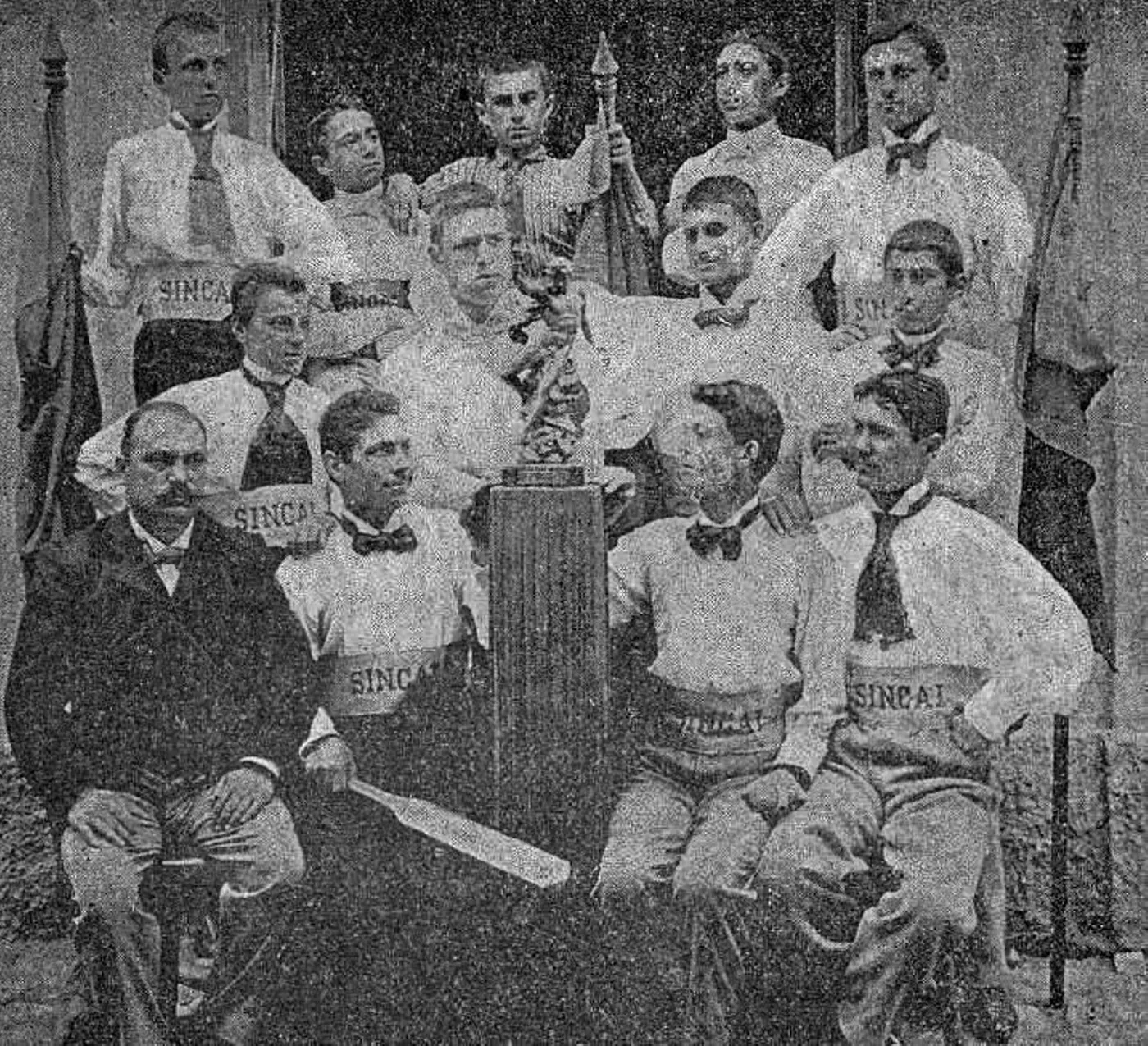

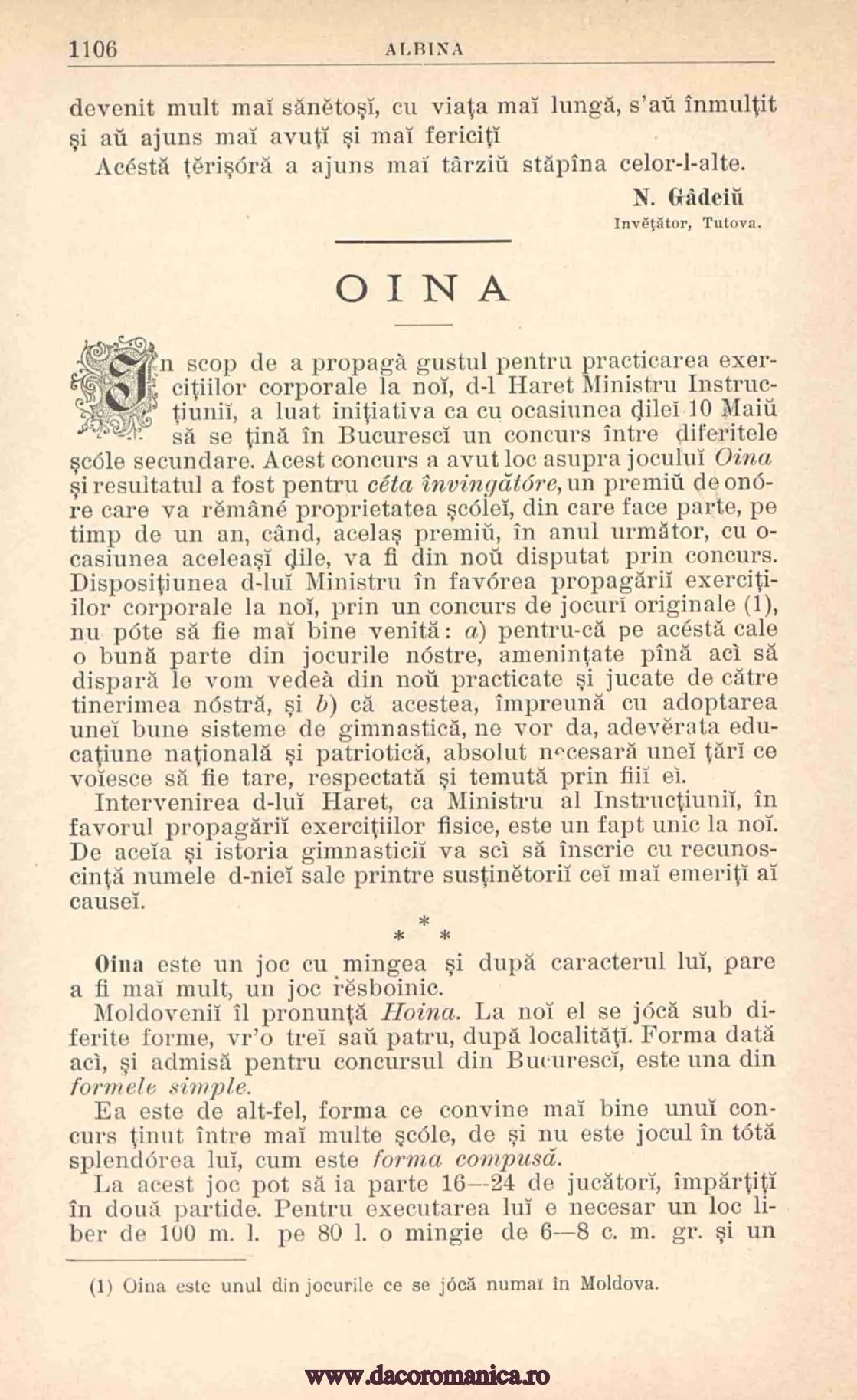
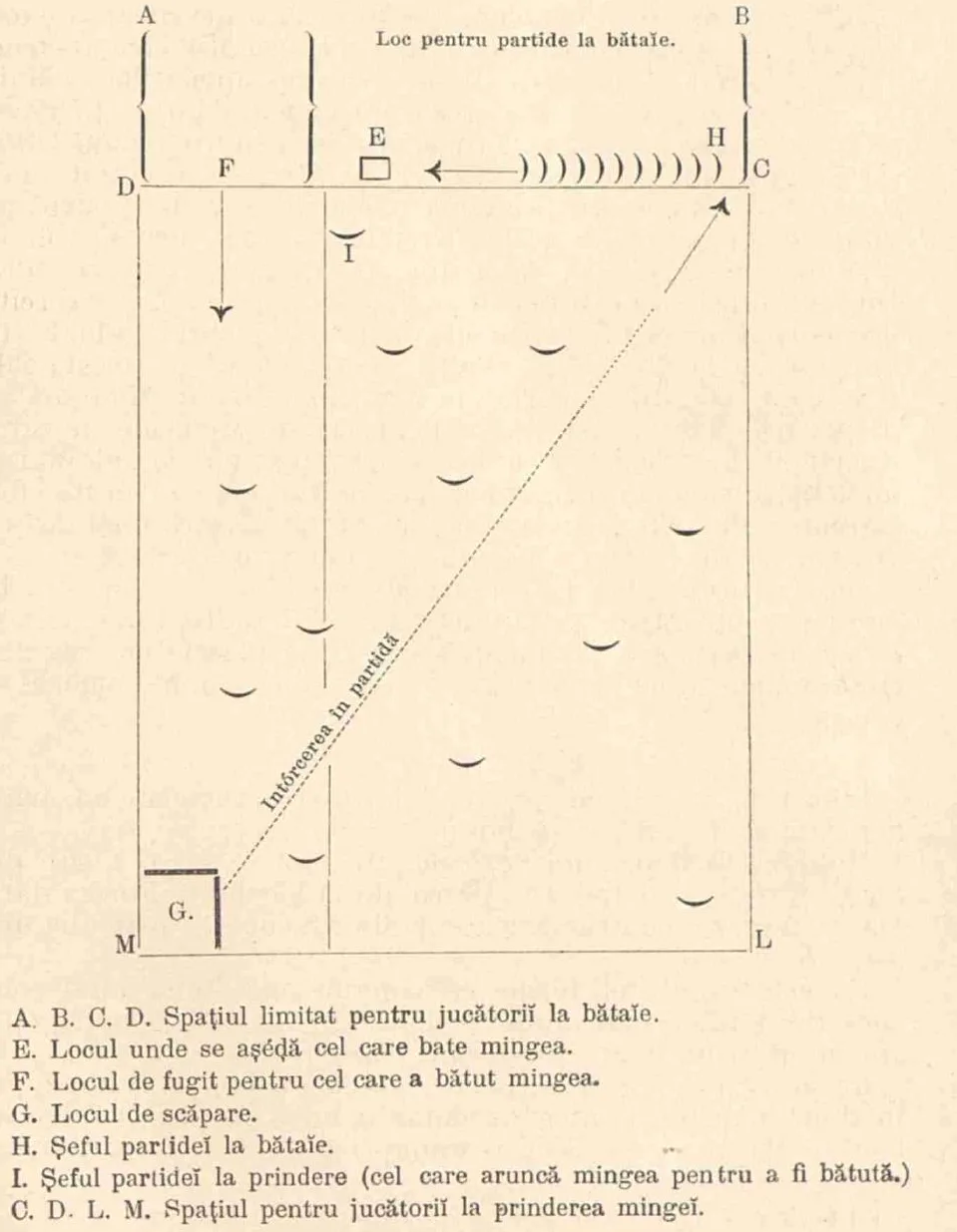
Oină in 1898 and today
In Albina of 31 May 1898, a gymnastics teacher, D. Ionescu, describes the game and the contest between seven Bucharest schools. Set beside the 2022 rulebook, the text shows what stayed and what changed.
| Albina, 1898 | Rulebook, 2022 | |
|---|---|---|
| Players | 16–24, in two sides | 11 a side, plus at most 5 substitutes |
| The pitch | a free space of 100 × 80 m | 70 × 32 m, with two corridors |
| Bat and ball | bat of 50–70 cm, broad at the hitting end; ball of 6–8 cm | round 100 cm bat; ball of 8 cm and 140 g |
| Who serves | the chief of the fielding side | a teammate of the batter |
| The run | to the "escape place", 60–70 m away, and back, on the diagonal | two corridors, out and back, 70 m each |
| Points | a point for the batting side when the chief runs to the "escape place" and back unhit; a point for the fielding side when it catches the ball in the air and hits the batter with it, or hits a runner. Between two schools it is won at 5, 7, 9, 11, etc. points; between several schools a single point decides | 1–2 points from the bat, by where the ball lands; 2 points for the fielding side for each runner hit |
| Ball caught in the air | the batter "goes between the chief and the one who caught it", who must hit him; he is safe if he catches the ball in hand or turns it aside with a palm | "prinsul la mijloc", art. 9: between two fielders, at most three passes; he may defend with the palms |
| Words | "locul de scăpare"; "the Moldavians pronounce it Hoina" | "linia de scăpare" |
Albina describes "the simple form", chosen for the contest; "the compound form" was the game "in all its splendour", which the article does not describe. The basic idea and a few words survive: hitting the runner with the ball, the palm raised by the player caught between two opponents, "scăpare" as the name of the place where you are safe, and "the middle", where the batter whose ball is caught in the air is put. What changed is the number of players, the pitch, who serves, the path of the run and how points are counted. In a footnote in 1898 the author writes that oină is "one of the games played only in Moldavia", meaning the province of Moldavia.
Today
Where oină is played today
The federation register (froina.ro, modified 5 November 2026) lists 54 affiliated clubs and five county associations, in 23 counties and Bucharest. Pick your county to see the structures near you. A register does not prove play: the town is the registered seat, which can differ from the team's ground.
The numbers do not form a curve. In 1990 AP writes, without naming a source, 1,675 teams. In 2023 the federation strategy counts 43 affiliated structures and about 1,500 registered athletes. The 2026 register has 59 entries, accumulated since 2016. These are different units, so we do not join them into a fall or a rise.
Champions. The latest titles published on froina.ro: men 2025, CSM Râmnicu Sărat; women 2024, CS Dacia Mioveni 2012. The 2026 results had not been published on 13 November 2026.
Still to come in 2026 (federation calendar, checked 13 November 2026). The indoor championship at Bușteni, 13–15 November; at Mioveni, 26–29 November (girls and women); the Unity Cup, Romania and the Republic of Moldova (which has its own oină federation), 20–22 November, in Chișinău. National Oină Day is 9 May, and the law also sets up a "Redescoperă oina" programme for schools.
To see a match. The federation has films presenting the 11-a-side game in Romanian, English, Spanish and French. For a club in your county, start from the federation's contact page.
Sources and what we could not find
Every date on the "What is known" ladder shows what was opened and what was not. "Record" means the text can be opened now and the words quoted are its own. It does not mean what the text says is true: a play is a record of the play, not of the Middle Ages.
The rules and numbers in the game come from the federation rulebook for 11-a-side oină. The game simplifies them: one batter, one ball, no "prinsul la mijloc", and the runner sets off at once instead of waiting in the batting and end zones as in a match (art. 6.2.1 d). Where a rule in the game differs from the rulebook, the rulebook is right.
We did not find: the 1899 Monitorul Oficial, Haret's 1898 circular, Mátyus's book, Stoica de Hațeg's chronicle, the Convorbiri literare issue, the 1573 and 1576 Anania editions, an official national intangible-heritage list with oină on it. If you have any of them, tell us.
- RecordRulebook for 11-a-side oină, Romanian Oină Federation, approved 1 December 2022. joc-oina.ro
- RecordAlexandru Davila, Vlaicu-Vodă, Biblioteca pentru toți no. 19, 1960 (text after the 1929 edition, collated with those of 1902–1925). archive.org
- RecordLaw amending Law no. 69/2000, art. 11¹, file L300/2022. senat.ro
- RecordRob Gloster (AP), "Romanians Say Oina Inspired Baseball", Seattle Times, 22 April 1990. archive.seattletimes.com
- RecordGiovanni Lorenzo d'Anania, L'universale fabrica del mondo, Venice, 1582 and 1596, Trattato primo, pp. 154–155. 1596, 1582
- RecordUNESCO, Intangible Cultural Heritage lists, Romania page, checked 13 November 2026. ich.unesco.org
- Later reportStatute of the Romanian Oină Federation, 2025, chronology of structures. froina.ro
- Later reportConstantin Coca, "Oina, sportul național al românilor", Convorbiri didactice 14, Tulcea, January 2017. ccdtulcea.ro
- Later reportL. Dologa, "Mitul oinei: Inventia sportului național (I)", ziare.com, 30 January 2014. archive
- Later report"Ziua Națională a Oinei 2026", digi24, 9 May 2026. digi24.ro
- Later reportDicționarul limbii române (DLR), vol. X, s.v. oină; DEX; Cioranescu, Dicționarul etimologic al limbii române; Scriban, 1939; CADE, 1931. dexonline.ro
- Later reportProtoball, entry 1310.1 (archive). protoball.org
- Later reportRomanian Oină Federation, history page, 2012 (archive) and 2026. 2012, 2026