mariuscomper.uk Română
Film: APNB

Bucharest · Băneasa Forest

The woodpeckers of Băneasa ForestSeven species on the edge of Bucharest, each with its own sound

Romania has ten species of woodpecker. Seven have been found in Băneasa, an oak forest on the northern edge of Bucharest that is not yet a protected area. You can tell them apart by how they drum or call.

Drum a rhythm yourselfListen to the seven

The seven

Seven woodpeckers, and how each one makes itself heard

Woodpeckers do not sing as other birds do. To hold a territory and attract a mate, most of them drum: they strike a dry, resonant branch with the bill about twenty times a second. Each species has its own length and rhythm.

Below, every vertical line is one strike of the bill in a real recording. All rows share one time scale, so the short drummers and the long ones can be compared.

Each species’ card also gives the number of public records made inside the forest. The list of seven comes from the scientific study by Asociația Parcul Natural București (the Bucharest Nature Park Association, APNB), which is campaigning for the forest to be protected. Four of the seven are in Annex I of the EU Birds Directive, the list of species whose habitat member states must take special measures to conserve.

Great spotted woodpecker15 strikes in 0.64 s
Syrian woodpecker21 strikes in 0.89 s
Middle spotted woodpeckercall; rarely drums
Lesser spotted woodpecker24 strikes in 1.07 s
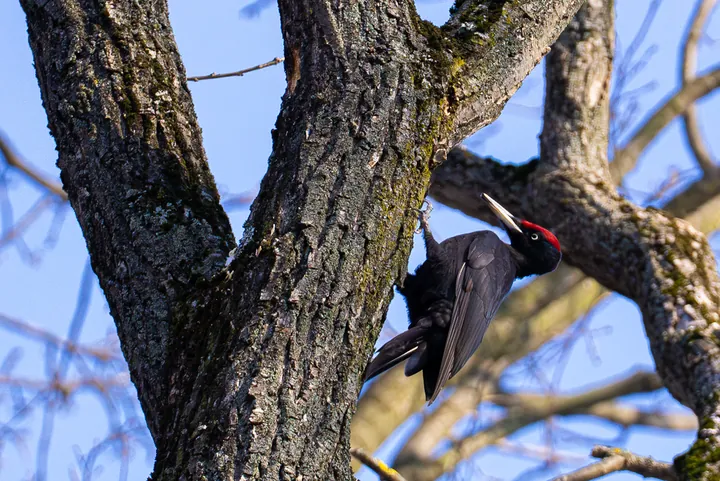
Black woodpecker36 strikes in 2.29 s
Green woodpeckercall; rarely drums
Grey-headed woodpecker31 strikes in 1.54 s

Left to right is 2.5 seconds. The strikes were detected automatically in each recording and checked by eye. The faintest strikes at the end of a roll may be missing from the drawing. The middle spotted and green woodpeckers drum very rarely; their rows show the call instead.

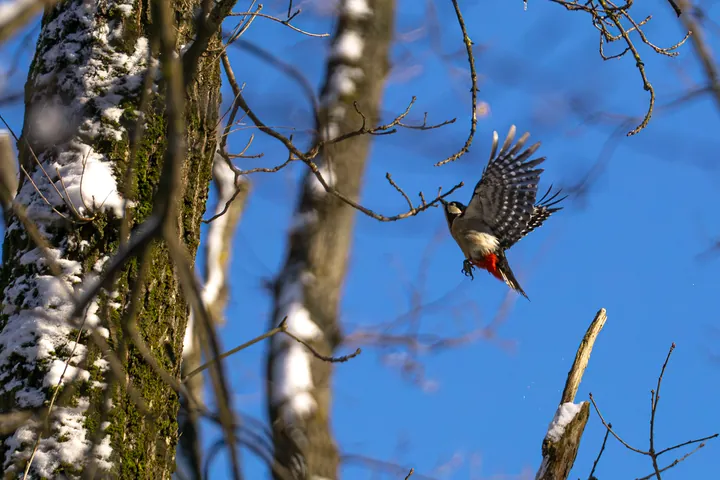
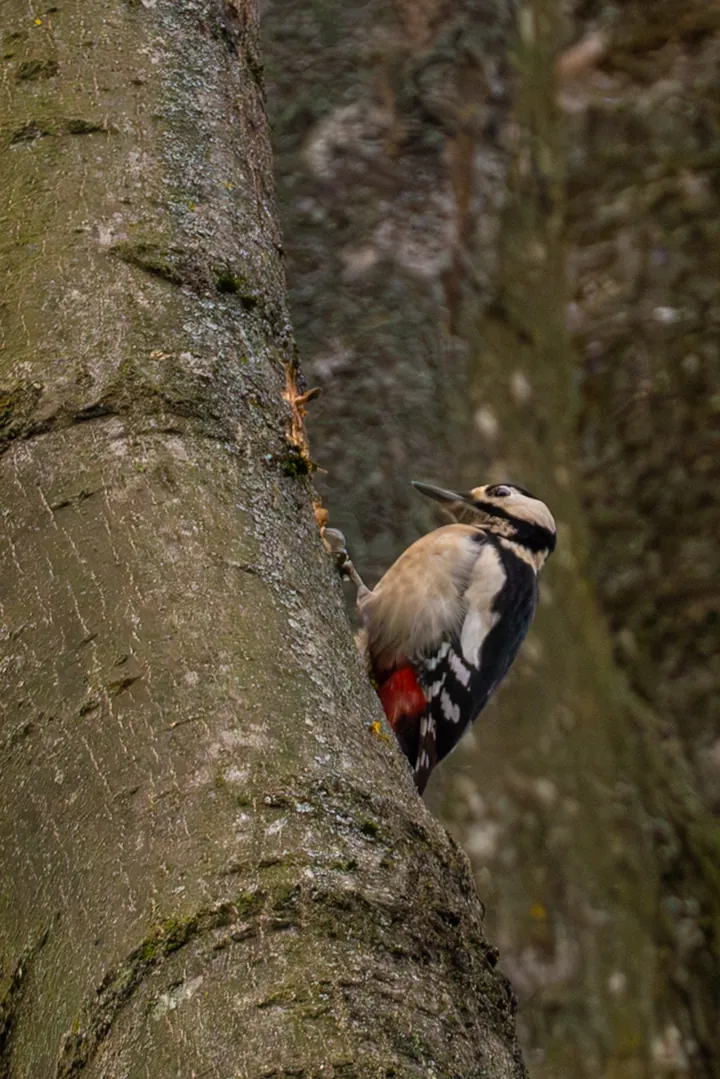
A great spotted woodpecker on a thick trunk: black back, buff-white breast and bright red under the tail.
Great spotted woodpecker, Băneasa Forest, 3 January 2026. Photo: Viorel Lorand / APNB.

Great spotted woodpecker

Dendrocopos major
How it sounds
Short and speeding up: on average 13 strikes in two thirds of a second, the gaps shrinking towards the end. It has no territorial call; the drum roll does that job.
What it needs
Dry wood that resonates. Each pair keeps a few dead branches or trunks in its territory and returns to them to drum, and it usually digs a new nest hole every year.
In Băneasa
24 public records from 11 observers, between 2006 and 2026. It is the woodpecker with the most records in the forest.
15 strikes in 0.64 s

Recording: Nicolae Șerban-Pârâu, Albeștii Pământeni (RO), xeno-canto XC619070, CC BY-NC-SA 4.0.

A Syrian woodpecker on a lichen-covered branch, its white cheek without a black bar reaching the nape.
Syrian woodpecker. This photograph was not taken in Băneasa: Hobbyfotowiki, CC0, Wikimedia Commons.

Annex I, EU Birds Directive

Syrian woodpecker

Dendrocopos syriacus
How it sounds
Like the great spotted, but it lasts longer: about 19 strikes in one second, also speeding up. It has no territorial call either.
What it needs
It lives mostly among people, in orchards, parks and gardens. It reached Romania in the twentieth century: it was seen near Buzău, north-east of Bucharest, in 1931, and had crossed the Carpathians by the 1950s.
In Băneasa
One public record in the forest, in January 2024; the species is also in the association’s study.
21 strikes in 0.89 s

Recording: András Schmidt, Vác (HU), xeno-canto XC1048152, CC BY-NC-SA 4.0.

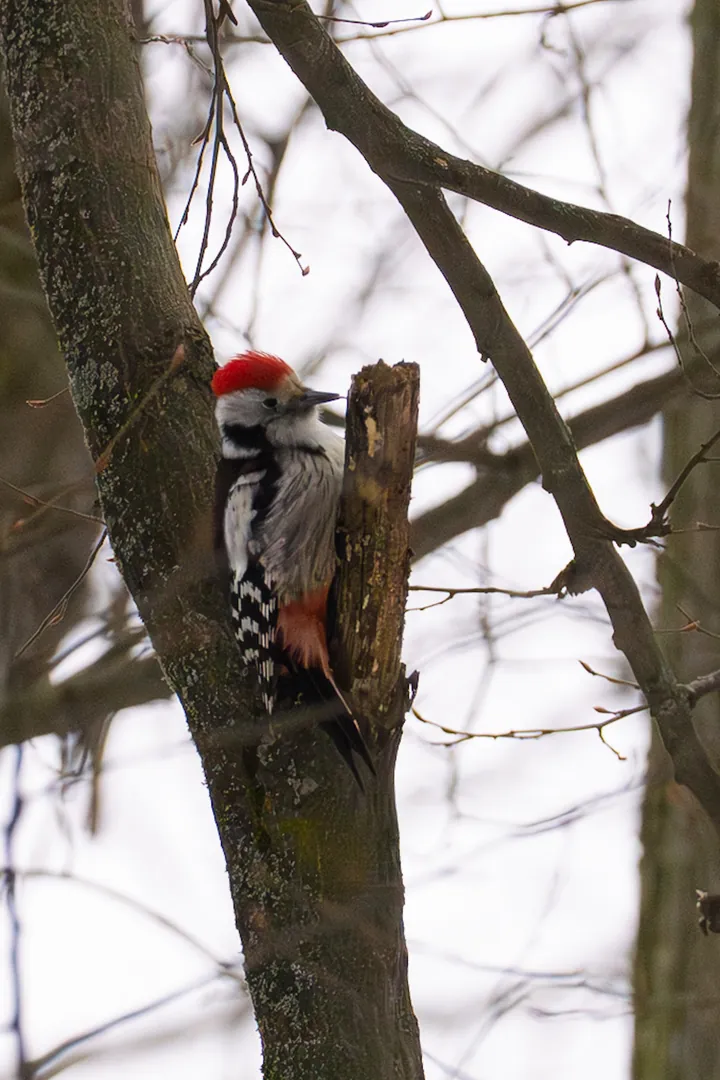
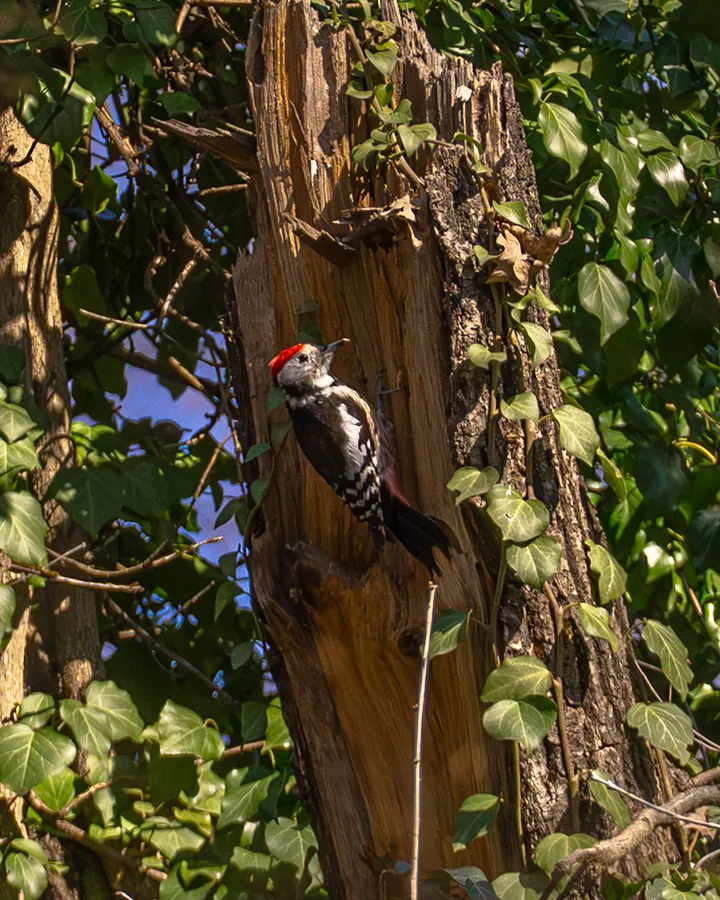
A middle spotted woodpecker clinging to a stump: an all-red crown, white face, streaked belly turning pink towards the tail.
Middle spotted woodpecker, Băneasa Forest, 28 February 2026. Photo: Viorel Lorand / APNB.

Annex I, EU Birds Directive

Middle spotted woodpecker

Dendrocoptes medius
How it sounds
It hardly drums at all. It announces its territory with a nasal call repeated slowly, rather like a cat mewing.
What it needs
Mature forest with dead wood. It rarely breaks into wood for food: three quarters of the time it searches and probes the cracked bark of thick trees. In Switzerland, pairs with more large oaks (over 36 cm across) made do with a smaller territory, and middle spotted woodpecker numbers fell most in the oak woods that became more isolated.
In Băneasa
18 public records from 10 observers, between 2006 and 2024. Among the woodpeckers it has the second highest number of records.
call; rarely drums

Recording: Oliver Bedő, Sfântu Gheorghe (RO), xeno-canto XC783525, CC BY-NC-SA 4.0.

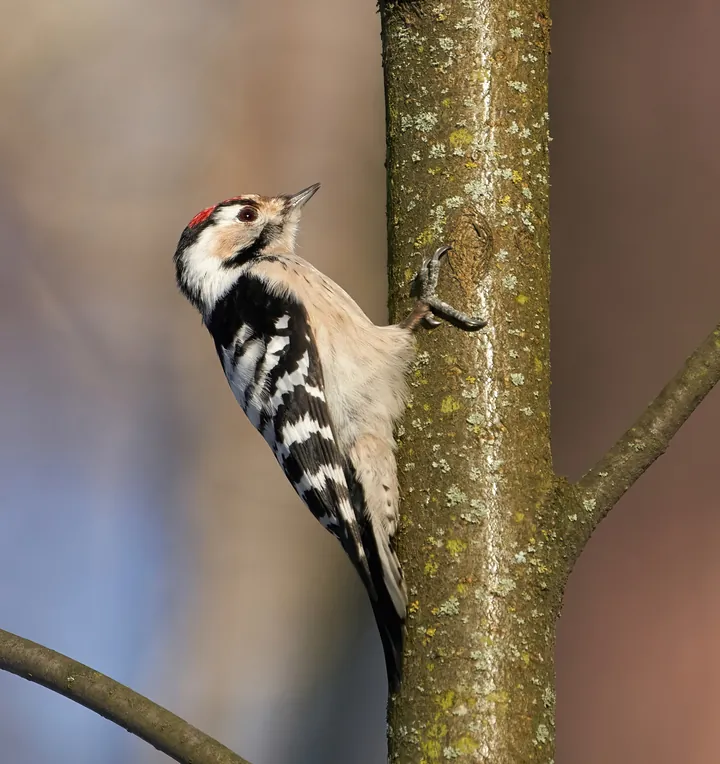
A male lesser spotted woodpecker with a red crown on a slender tree trunk.
Lesser spotted woodpecker. This photograph was not taken in Băneasa: Andrey Gulivanov, CC BY 2.0, Wikimedia Commons.

Lesser spotted woodpecker

Dryobates minor
How it sounds
Long and even: about 21 strikes in just over a second, without speeding up. It is the smallest woodpecker in Europe, 14–16 cm long.
What it needs
Dead trees or dry limbs to nest in. Its hole has an entrance of 3–3.5 cm, which later suits small birds that have no use for the wide holes of the other woodpeckers.
In Băneasa
12 public records from 5 observers, between 2006 and 2024.
24 strikes in 1.07 s

Recording: Sonnenburg, Dahme-Heideseen (DE), xeno-canto XC173905, CC BY-NC-SA 4.0.

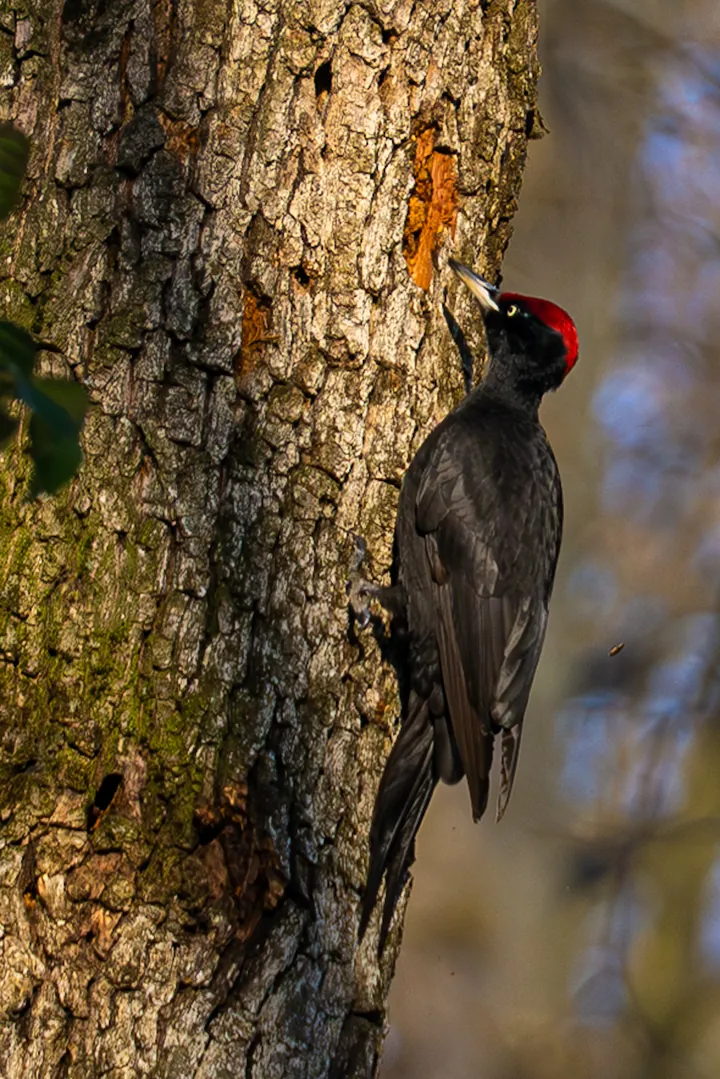
A male black woodpecker with an all-red crown on a trunk it has chiselled down to the orange wood.
Black woodpecker, Băneasa Forest, 17 January 2026. Photo: Viorel Lorand / APNB.

Annex I, EU Birds Directive

Black woodpecker

Dryocopus martius
How it sounds
The longest roll and the slowest rhythm of the five species that drum often: about 31 strikes in almost two seconds, some 17 a second.
What it needs
Tall, thick trees. It is the largest woodpecker in Europe, 45–50 cm long, and digs the largest holes any bird makes on the continent. In southern Germany, cameras at 72 such holes recorded 28 species of vertebrate.
In Băneasa
3 public records from 2 observers, between 2006 and 2022.
36 strikes in 2.29 s

Recording: Adam Gruszczyński, Gmina Ścinawa (PL), xeno-canto XC532121, CC BY-NC-SA 4.0.

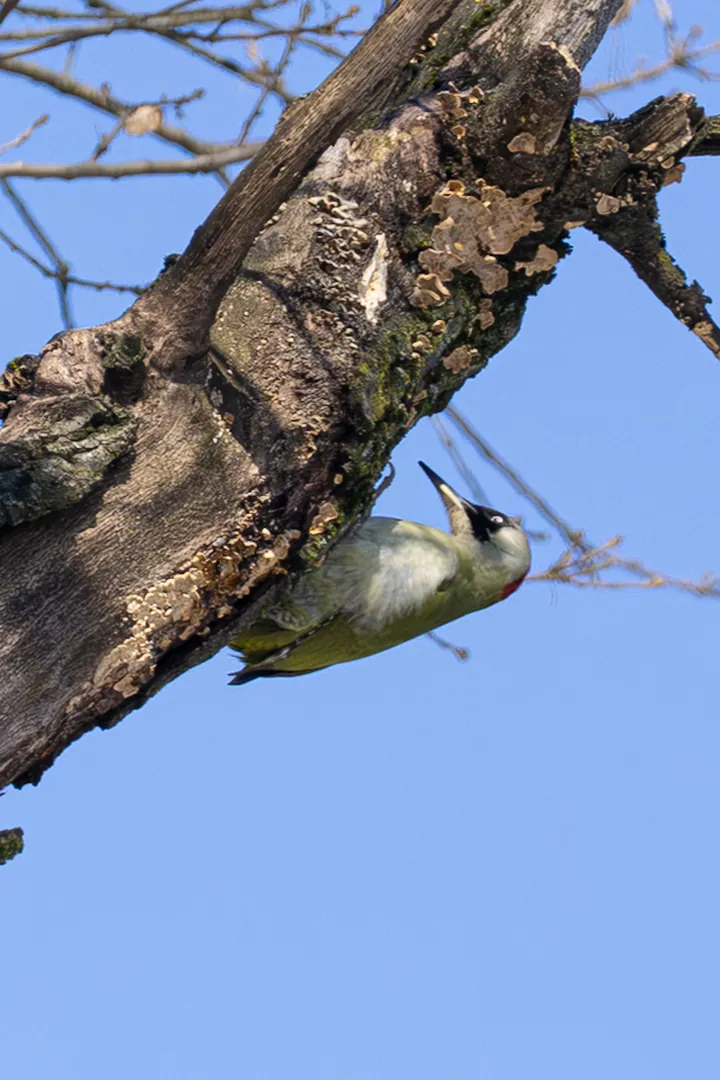
A green woodpecker hanging upside down under a dead limb covered in bracket fungus, a black mask around its white eye.
Green woodpecker, Băneasa Forest, 22 February 2026. Photo: Viorel Lorand / APNB.

Green woodpecker

Picus viridis
How it sounds
Its call is a run of loud notes, like a laugh. It rarely drums.
What it needs
Ants, the bulk of its diet, which it looks for in meadow anthills, and tall dead or soft-wooded trees to nest in. In the photograph it hangs under a dead limb covered in bracket fungus.
In Băneasa
7 public records from 4 observers, between 2022 and 2024.
call; rarely drums

Recording: Stelian Bodnari, Colacu (RO), xeno-canto XC505258, CC BY-NC-SA 4.0.

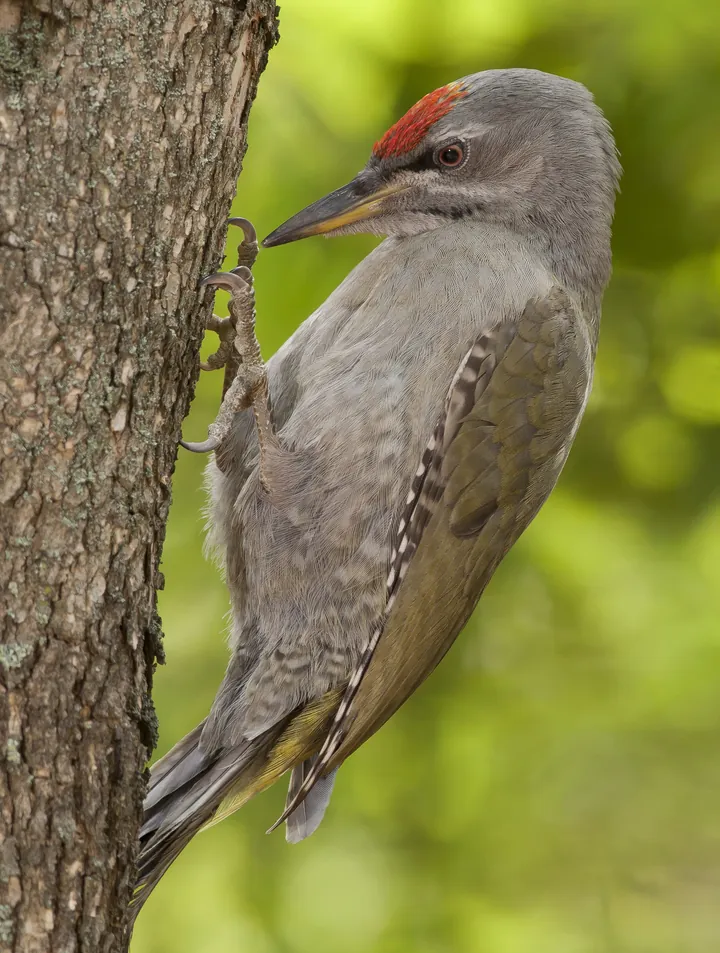
A grey-headed woodpecker on a trunk: grey head, a red patch on the forehead and a greenish back.
Grey-headed woodpecker. This photograph was not taken in Băneasa: Бусел В.А., CC BY-SA 4.0, Wikimedia Commons.

Annex I, EU Birds Directive

Grey-headed woodpecker

Picus canus
How it sounds
Long, even and fast: about 31 strikes in a second and a half, some 20 a second. For the same number of strikes the black woodpecker takes almost two seconds.
What it needs
Natural, unaltered forest. The Romanian Ornithological Society describes it as a species with strict requirements, threatened by the removal of dead, diseased and old trees.
In Băneasa
3 public records from 3 observers, between 2006 and 2022.
31 strikes in 1.54 s

Recording: Ireneusz Oleksik, ROD Browarnik (PL), xeno-canto XC623148, CC BY-NC-SA 4.0.

Your turn

Drum a rhythm on the trunk. Which of them drums like that?

  1. Tap the trunk at least eight times in a row. On a computer the space bar works too.
  2. Keep it even, speed up or slow down, and stop when you like: after a second of silence the roll is over.
  3. Two things count, both within your control: how many strikes, and how the rhythm changes. Speed does not count, because no hand keeps up with a bill.
The usual drum roll of the five species that drum often
SpeciesStrikesDurationStrikes per secondRhythm
Great spotted woodpecker130.65 s20speeds up
Syrian woodpecker19.40.97 s20speeds up
Lesser spotted woodpecker21.11.16 s18even
Black woodpecker311.86 s17speeds up a little
Grey-headed woodpecker31.51.57 s20even

Means of 8 to 832 rolls per species, analysed by Florentin, Dutoit and Verlinden (2016). Strikes per second is the number of strikes divided by the duration. For the Syrian woodpecker the mean rests on only eight rolls.

After the woodpecker

Who moves into the holes

Many forest birds and mammals raise their young in tree holes but cannot dig one. They are left with holes made by woodpeckers and holes formed by decay in old trees.

In southern Germany, researchers put cameras on 72 black woodpecker holes. At 69 of them at least one animal was filmed, and 28 species of vertebrate appeared in all: some nested, others only visited, among them predators after the young. Sixteen of those species are also recorded at Băneasa, in the study or in public records: black woodpecker, grey-headed woodpecker, green woodpecker, middle spotted woodpecker, great spotted woodpecker, tawny owl, common buzzard, jackdaw, great tit, blue tit, nuthatch, starling, jay, collared flycatcher, red squirrel and common noctule bat.

Not every hole is made by a woodpecker. In Poland’s primeval Białowieża Forest, only 16% of the nests of birds that cannot dig were in holes dug by woodpeckers or other birds; the rest were in holes formed by decay. The authors of that study say the future of hole-dwelling animals depends largely on one thing: forests no longer losing their old trees.

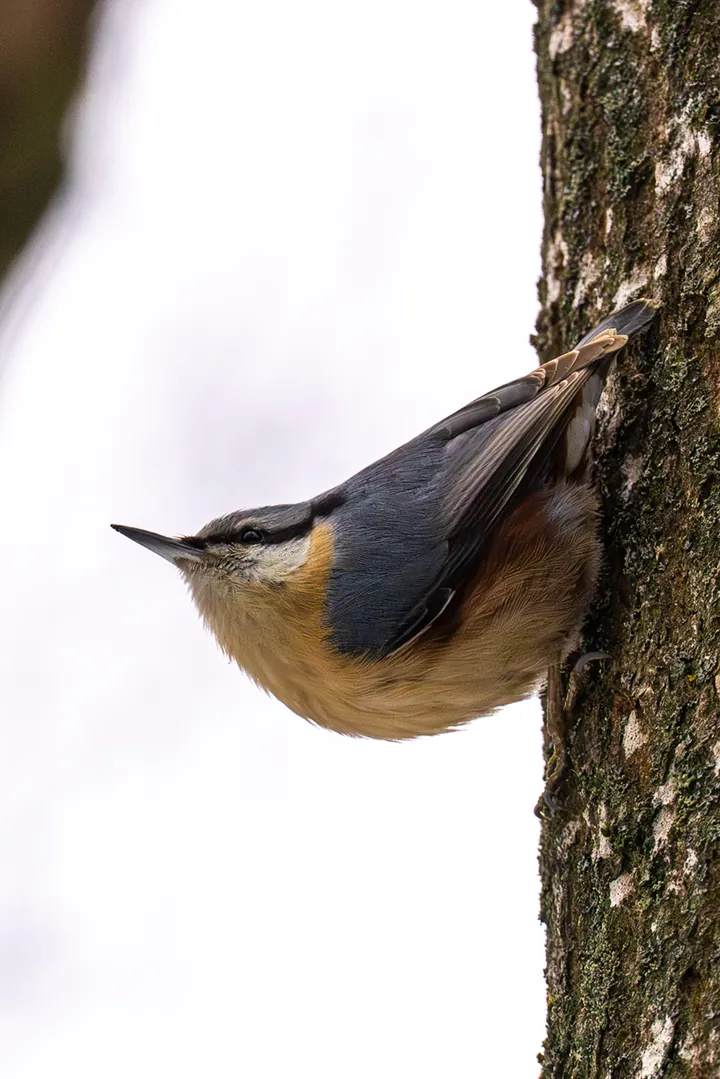
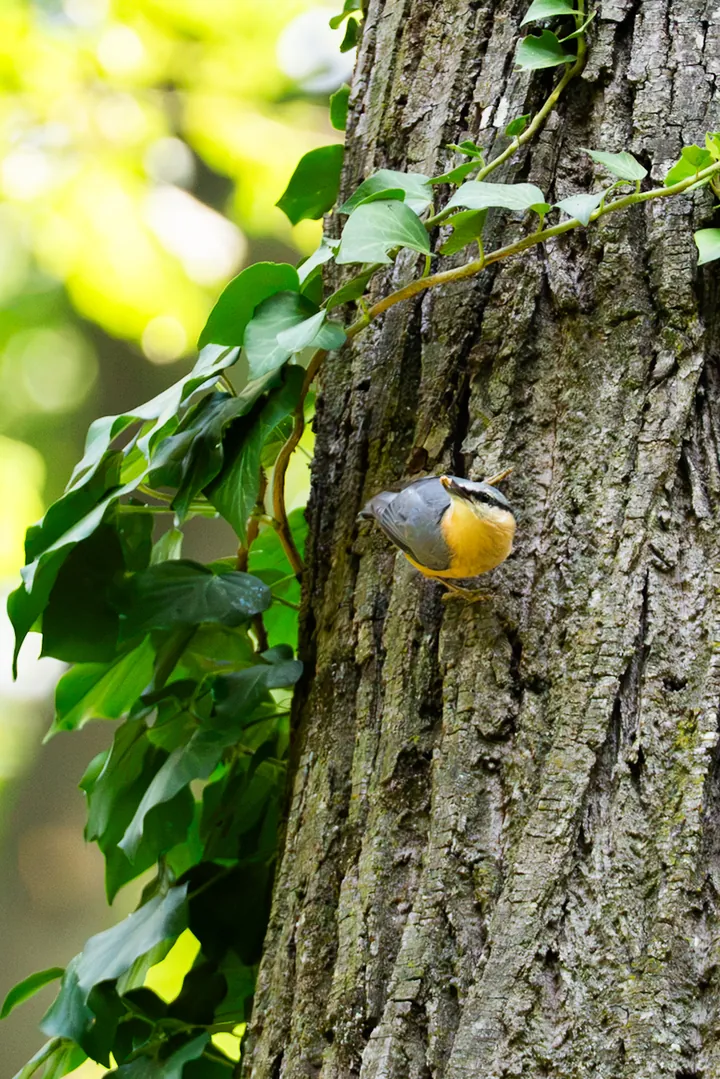
Nuthatch in Băneasa Forest
The nuthatch nests in holes and adjusts the entrance to its own size: it narrows it by plastering mud around the edge. Photo: Viorel Lorand / APNB, 28 February 2026.
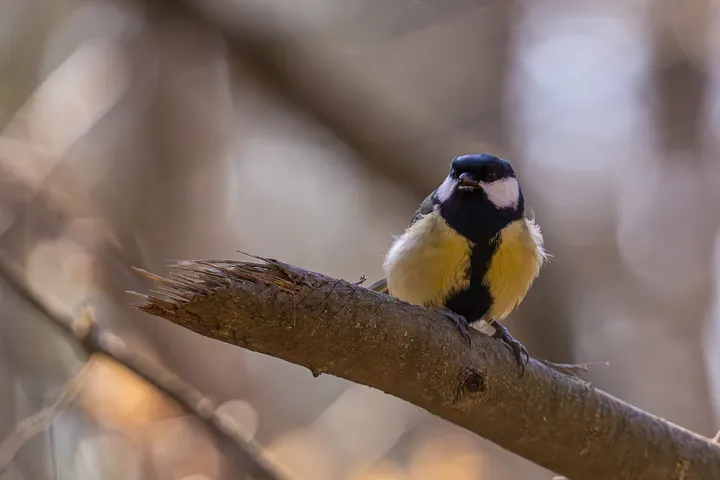
Great tit in Băneasa Forest
The great tit is one of the species filmed at black woodpecker holes. Photo: Viorel Lorand / APNB, 7 March 2026.
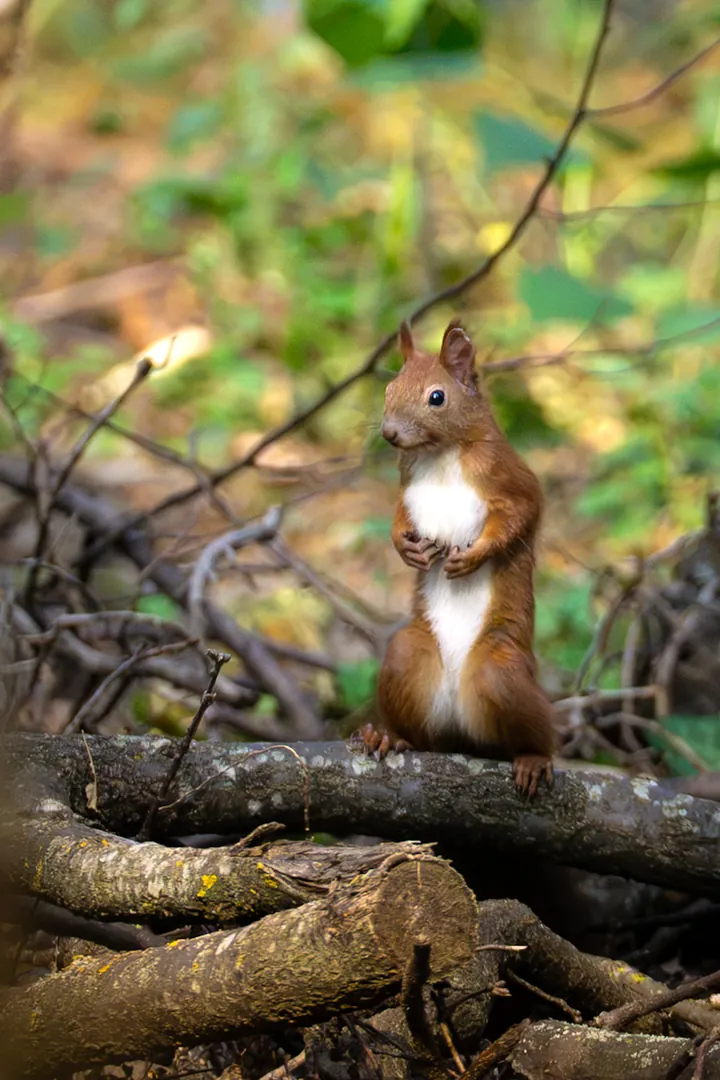
Red squirrel in Băneasa Forest
The red squirrel is also on the German list of visitors to the holes. Photo: Viorel Lorand / APNB, 19 September 2026.
11bat species on the Băneasa study’s list of mammals. One of them, the common noctule, was filmed in Germany at a black woodpecker hole.
3–3.5 cmthe entrance of the hole dug by the lesser spotted woodpecker, according to the Romanian Ornithological Society.
16%of the nests of birds that cannot dig were in holes dug by woodpeckers or other birds at Białowieża. The rest: holes formed by decay.

What others have seen

Birds recorded in the forest that are missing from the study’s table

The study submitted to the Romanian Academy lists 49 species of bird “known so far” in the forest. Separately, between 2006 and 2026, 46 observers sent 563 records of birds from inside the forest to the recording platforms eBird, Observation.org, iNaturalist and Birda, where anyone can log the birds they see.

Those records include 42 of the study’s 49 species, among them all seven woodpeckers. They also include species the table lacks. The ones below have at least five records, made on at least four different days.

Species with at least 5 records on at least 4 days inside the forest that are absent from Table 6 of the study
SpeciesRecordsDaysObserversMonths
Blackcap
Sylvia atricapilla
1497April and May
Collared flycatcherAnnex I
Ficedula albicollis
1065April and May
Golden oriole
Oriolus oriolus
767April, May and June
Feral pigeon
Columba livia
545January, May and July
Spotted flycatcher
Muscicapa striata
545April and May

The collared flycatcher is, like four of the woodpeckers, in Annex I of the EU Birds Directive. It nests in tree holes.

A record shows that someone saw or heard the bird there that day; it does not show that the species breeds in the forest. The location attached to a list is chosen by the observer and may be far from the bird: another 42 species, many of them waterbirds, appear in the forest with fewer records and were left out of the table above.

Two rows of the study’s table carry a Romanian name and a scientific name that do not match; here the Romanian name was followed. One of them is the common redstart, printed beside the scientific name of the black redstart, Phoenicurus ochruros. Both species appear in the public records: the common redstart 13 times, the black redstart 4 times. The other is the hooded crow, printed beside Corvus corone, the carrion crow.
The surroundings

What has been built around the forest since 1990

The forest has three blocks, separated by roads and housing: one west of the DN1 (the main road north out of Bucharest), one in the middle, reaching the city zoo, and one to the east, towards Pipera and Tunari in the neighbouring county of Ilfov. The area proposed for protection covers 1,332 hectares, of which 1,221.5 are forest.

In the one-kilometre strip around the three blocks, buildings covered 104 ha in 1990 and 413 ha in 2020: four times as much. These are European Commission estimates made from satellite images.

western blockmiddle blockeastern blockZooBăneasa AirportDN1 to PloieștiRing roadPipera1 km

2020: 413 ha covered by buildings in the 1 km strip around the forest, or 14.7% of it.

1990104 ha
2000160 ha
2010293 ha
2020413 ha

Orange: ground covered by buildings, in cells of roughly 70 × 90 m, from the European Commission’s Global Human Settlement Layer (2023 release). Solid colour marks the one-kilometre strip around the forest, where the total is calculated. Values for 2010 are interpolated and those for 2020 are estimated from 2018 images. Forest outline: OpenStreetMap.

Who owns it, and where protection stands

According to the study, 35.9% of the forest is publicly owned and 64.1% privately owned. The proposed status, that of a nature park, does not change who owns the land; the rules for each plot would be set in a management plan, in consultation with the owners.

  • The association has submitted the scientific study supporting the proposal to the Romanian Academy, whose commission gives its opinion on protected areas; the current version is dated September 2026.
  • The local council of Sector 1, the Bucharest district that contains part of the forest, backed the proposal in two decisions, in January and April 2025.
  • The authorities of Voluntari and Tunari, a town and a commune in Ilfov county that contain the rest of the forest, were informed in September 2025. Their councils have not yet been asked for a decision.
  • Consultation with private owners has begun but is not finished.

Separately, according to the study, Romania’s environment ministry has begun the procedure for declaring Natura 2000 sites (the EU’s network of protected areas) on or next to the forest.

In a survey of 816 people published in 2025 by Dușcu and Rîșnoveanu and cited in the study, 86.4% supported declaring the forest a protected natural area.

Asociația Parcul Natural București, the association that won protection for the Văcărești wetland in the south of the city, is collecting signatures for Băneasa. According to the association, more than 30,000 people had signed by early October 2026.

The association’s petition (in Romanian)

Go and listen

When to hear them, and what else there is to see

Drumming is heard mostly in late winter and spring. Of 685 recordings with drumming by the seven species, made in Romania and 12 other countries, from Germany to Turkey, 72% date from February, March and April. In autumn, woodpeckers give themselves away mostly by their calls and by the tapping they make while feeding, which has no rhythm.

The association has laid out a biodiversity trail in the forest with seven information panels; the third is about birds. The Pădurea Băneasa bus stop is on Aleea Privighetorilor, on the southern edge of the middle block.

The association’s panels and audio guide

The forest, recorded by the association’s rangers

Four recordings made in the forest by the association’s rangers on the morning of 7 March 2026.

Recording 1, 10:50
23 seconds

Recording 2, 11:11
103 seconds

Recording 3, 11:50
54 seconds

Recording 4, 11:58
39 seconds

A red squirrel in Băneasa Forest. Film: APNB.

The forest in 2026, photographed by Viorel Lorand

Sources and method

Where the numbers come from

The seven species. The list is the one in the scientific study by Asociația Parcul Natural București (Table 6, 49 bird species; where a row’s Romanian and scientific names do not match, the Romanian one was used). All seven also appear in public records from inside the forest. Romania’s other three woodpeckers are the wryneck, which neither drums nor digs its own hole, the white-backed woodpecker of beech forests and the three-toed woodpecker of mountain conifer forests.

The strikes. Each drum roll drawn here comes from a recording on xeno-canto, the public archive of bird sounds, chosen for a clean roll: from Romania for the great spotted woodpecker, from Hungary, Poland and Germany for the others. Recordings whose licence does not allow editing were left out. The strikes were detected automatically, from the peaks of energy in the sound, and checked by eye on each recording. Where a strike is too faint to detect, the row has a gap, and the faintest closing strikes may be missing. Each species’ “usual” numbers are the means published by Florentin, Dutoit and Verlinden (2016).

Matching your roll. The number of strikes and the change of rhythm (the gaps in the second half against those in the first) are compared with the means of the five species that drum often. When two species are equally close, the result names both. It is a recognition game, not an identification.

Public records. 563 records of birds from GBIF, the Global Biodiversity Information Facility, downloaded on 8 October 2026, lying inside the three forest outlines in OpenStreetMap. An OpenStreetMap outline is not the boundary of the proposed protected area.

Buildings around the forest. Built-up area from the GHS-BUILT-S dataset of the European Commission’s Joint Research Centre, summed over the cells lying up to 1 km outside the forest outlines.

Who did what. Asociația Parcul Natural București (the Bucharest Nature Park Association) proposed the subject and supplied the study, the photographs, the films and the forest recordings. The text, the calculations and the conclusions are Marius Comper’s.

Sources

Photographs, films and sounds

Photographs from Băneasa Forest: Viorel Lorand / Asociația Parcul Natural București, 2026. Films and forest recordings: Asociația Parcul Natural București. Used with the association’s consent.

The species’ sounds come from xeno-canto and were trimmed and normalised to the same loudness; the resulting clips are shared under the same licence as the originals.

More on this site