Văcărești Nature Park · Bucharest
Listen to the wetland that grew in Ceaușescu's lake
In 1989, four kilometres from the centre of Bucharest, Romania's capital, a dike more than 5 kilometres long was finished for a lake that never came to be. Reeds and ponds spread through the pit, and the people who go there and log what they see in birding apps have recorded 155 bird species. Pick a month and hear who is there.
What can you hear in Văcărești this month?
October
This browser cannot play the sounds; the species list and cards still work.
Choose a dot or a name to see how often the species is recorded and who recorded its voice.
October and April have the most voices: 48 and 44 bird species turn up on at least one checklist in ten, counting the neighbouring months. In winter the rooks arrive; in summer the reed warblers sing.
Each dot is a species recorded in the park in the chosen month and, counting the neighbouring months, on at least one checklist in ten. The more often it is recorded, the bigger the dot and the more often you hear it. Blue: in the air; green: in willows and scrub; ochre: in the reeds; teal: on the water. Underneath, all the time, is the city: the background is a recording made in the park on 27 April 2024, a red-backed shrike singing over the traffic.
The voices are recordings of each species, chosen for clarity: from Bucharest first, then the rest of Romania, and where we found no good one, from elsewhere in Europe. Only the background, with the red-backed shrike, was recorded in the park (Diana Tudor, xeno-canto XC962979). Checklists are made by day; of the observations with a time, more than half fall between 8 and 11 in the morning. What calls at night is not here.
When do the birds arrive in Văcărești, and when do they leave?
The rooks come to town
Rooks are absent from May and June checklists; in October they are on 14 of 19. In winter northern populations move south and rooks gather in cities (SOR, the Romanian Ornithological Society).
Spring comes from the south
In April the cuckoo, the swallows, the reed warblers and the whiskered tern arrive; the tern is a marsh bird that hunts on the wing over the water, for insects and small fish. It is on 9 of 15 checklists in June and 8 of 12 in July, and is no longer recorded from September.
The pygmy cormorant, all year
The pygmy cormorant is recorded every month, from 28% of checklists in May to 92% in July. With it all year are the mute swan and the coot, the most frequent overall: it is on 71% of all checklists.
A rare duck
The ferruginous duck is on the IUCN list of near-threatened species. In Văcărești it is recorded mostly from February to October, on up to 55% of checklists (in March); the association that campaigned for the park lists it among the species that breed here.
A species appears in the table in the month it starts turning up on at least one checklist in ten, and drops out when it falls below that line. The number beside each month is how many species clear the line then.
| Month | Species | Arrive | Leave |
|---|---|---|---|
| January | 36 | Rock Dove, Fieldfare | European Robin, Eurasian Penduline Tit, Grey Wagtail, Bearded Reedling, Dunnock |
| February | 30 | Ferruginous Duck, Common Starling | Common Blackbird, Gadwall, Common Buzzard, Northern Shoveler, Eurasian Wren, Eurasian Wigeon, Fieldfare, Long-tailed Tit |
| March | 42 | Great Cormorant, Eurasian Collared Dove, House Sparrow, Common Blackbird, Gadwall, Garganey, Great Crested Grebe, Common Chiffchaff, Savi's Warbler, Northern Shoveler, European Robin, Eurasian Wren, Eurasian Penduline Tit, Western Marsh Harrier, Black Redstart, Water Rail | Rook, Grey Heron, Great Spotted Woodpecker, Redwing |
| April | 44 | Whiskered Tern, Common Cuckoo, Red-backed Shrike, Barn Swallow, Great Reed Warbler, Eurasian Reed Warbler, Lesser Whitethroat, Common Swift, Eurasian Hobby, Eurasian Blackcap, Common Whitethroat, Black-necked Grebe | European Goldfinch, Common Reed Bunting, Gadwall, Eurasian Sparrowhawk, Eurasian Blue Tit, Eurasian Teal, European Greenfinch, Eurasian Wren, Black Redstart, Water Rail |
| May | 42 | Eurasian Golden Oriole, Black-crowned Night Heron, Marsh Warbler, Spotted Flycatcher | Common Chaffinch, Rock Dove, Common Chiffchaff, Northern Shoveler, European Robin, Western Marsh Harrier |
| June | 42 | Grey Heron, Rock Dove, Eurasian Blue Tit, Common House Martin | Red-backed Shrike, Garganey, Spotted Flycatcher, Black-necked Grebe |
| July | 38 | Rook, Red-backed Shrike, Little Egret, Great Spotted Woodpecker, Common Tern | Great Tit, Common Blackbird, Great Crested Grebe, Common Starling, Savi's Warbler, Eurasian Blue Tit, Marsh Warbler, Eurasian Blackcap, Common Whitethroat |
| August | 43 | Great Tit, Common Blackbird, Eurasian Sparrowhawk, Great Crested Grebe, Common Chiffchaff, Eurasian Blue Tit, European Greenfinch, Eurasian Blackcap, Spotted Flycatcher, Willow Warbler | Common Cuckoo, Great Reed Warbler, Common Swift, Eurasian Hobby, Eurasian Penduline Tit |
| September | 38 | European Goldfinch, Common Starling, Eurasian Teal, Eurasian Hobby, Western Jackdaw | Whiskered Tern, Eurasian Reed Warbler, Eurasian Golden Oriole, Great Crested Grebe, Lesser Whitethroat, Common Tern, Black-crowned Night Heron, European Greenfinch, Eurasian Blackcap, Common House Martin |
| October | 48 | Common Chaffinch, Common Reed Bunting, Gadwall, Common Buzzard, Northern Shoveler, Redwing, European Robin, European Greenfinch, Eurasian Wren, Grey Wagtail, Bearded Reedling, Common Kingfisher | Barn Swallow, Willow Warbler |
| November | 39 | Dunnock | Ferruginous Duck, Red-backed Shrike, House Sparrow, Rock Dove, Little Egret, Common Starling, Eurasian Hobby, Spotted Flycatcher, Western Jackdaw, Common Kingfisher |
| December | 39 | Eurasian Wigeon, Eurasian Penduline Tit, Long-tailed Tit | Great Cormorant, Eurasian Collared Dove, Common Chiffchaff |
How did the Văcărești wetland form?
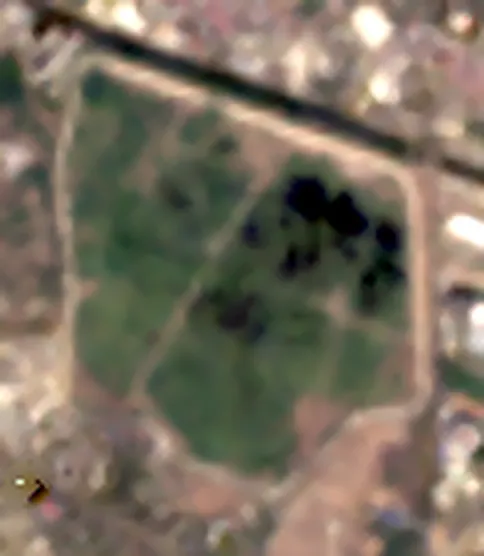
Choose the year. There is one image a year, from summer or early autumn (the date is shown beside it), at 30 metres a pixel; the bright line from 1989 on is the dike.
2025
Image from 2025-08-30: 92% of the ground inside the dike is covered by vegetation, 0% shows as water or wet ground.
Landsat 4–9, USGS / NASA
Before the works, the site of the park was gardens and spring-fed ponds; according to the study behind its protection, the owners were still working their gardens in 1988. Văcărești Monastery, founded in the 1720s on the hill beside it, was demolished in 1986; according to the Romanian daily Jurnalul, Nicolae Ceaușescu, Romania's communist leader, visited the site in December 1986, after the demolition.
The land was expropriated in 1988–89, and the dike and basin were finished in 1989: about 155 hectares of floor inside 26 hectares of dike, concreted on the inner face. The water was to come from the Argeș river, through Lake Mihăilești west of the city, along a 27-kilometre channel of which 14 kilometres were built. What the lake was for is still unclear: sources speak of water for a planned Danube port, irrigation for greenhouses, or a leisure lake; some texts, citing no source, add flood defence. We found no engineering document that settles it.
After the December 1989 revolution that ended communist rule, the site was abandoned. The water was already there: the spring-fed ponds, plus the pits dug for the dike's earth. The founding study says the basin was filled once, by pumping from the Dâmbovița, the river that runs through Bucharest, and that the water seeped under the dike into nearby greenhouses; we found no record of the episode from the time. In the images from July 1990 and August 1991, nearly a third of the floor shows wet or under shallow water.
In the years that followed, reeds covered almost everything. In 2002 the Romanian government approved leasing the land for 49 years to a company promising a culture and sports complex; in 2005 a court ruled the leasing decision illegal, and the government appealed. In May 2012 National Geographic Romania called the place "the delta between the tower blocks", and on 11 May 2016 the government declared it a nature park, Romania's first urban nature park. The Enache family, who lived in the marsh for nearly 20 years and had to leave once the park was declared, is the subject of the documentary "Acasă, My Home" (2020).
The satellite images also show what came next. Water visible from space covered 5–10% of the floor between 2001 and 2011 and fell below 1% from 2020. The park administration says the water level depends mainly on rainfall; the association blames drought and the reeds, which hold water "like a sponge". At the end of 2024 the administration said water had again covered the vegetation at the edges. The management plan approved in May 2025 provides for a channel from the Dâmbovița. Pixels 30 metres wide miss small pools and the water under the reeds.
How do you get to Văcărești, and what will you hear now?
Hours
Daily, 7 am to 9 pm, according to the park administration.
Entrances
The administration's map shows two: in the north-west from Strada Glădiței, by Splaiul Unirii (Mihai Bravu metro), and in the south from Strada Săvinești, by Șoseaua Olteniței (Piața Sudului metro). The management plan lists a third, at the corner of Splaiul Unirii and Șoseaua Vitan-Bârzești.
Rules
Dogs on a lead only. No fires, fishing or swimming; drones may fly below 100 metres only with the administration's consent. Dry reed catches fire often, mostly in late winter and spring; in February 2020 about 50 hectares burned.
In October
Most often recorded: Hooded Crow, Eurasian Coot, Pygmy Cormorant, Eurasian Magpie, Mute Swan, Black-headed Gull.
Arriving this month: Common Chaffinch, Common Buzzard, Common Reed Bunting, Northern Shoveler, Redwing, Gadwall, Eurasian Wren, Grey Wagtail, European Greenfinch, European Robin, Bearded Reedling, Common Kingfisher.
How do we know who is there?
There is no monthly census of the birds of Văcărești. There are, however, people who go there and log what they see on eBird, Observation.org and iNaturalist; their data are public through GBIF. We kept everything that falls inside the dike: 9,342 observations, 7,669 of them birds, of 155 species.
We grouped them into outings (same observer, same day) and kept the 276 outings with at least five bird species. These are the "checklists", made by 115 observers between 2009 and 2026. For each month we worked out the share of checklists on which each species appears, with the month before and after given half weight, so that a single outing does not swing the result. A species shows on the page in a month only if it clears one checklist in ten and was recorded at least once in that very month. The percentages shown are that month's own, unsmoothed.
What the data do not say: how many birds there are, and what calls at night. Outings are made by day; of the observations with a time, more than half fall between 8 and 11 in the morning. Some months have few checklists: 9 in February, 12 in July, 15 in June. Shy birds, heard rather than seen, are probably recorded less often than they occur. The list kept by the association that campaigned for the park has 176 species, seen over the years (2021); the public data from inside the dike have 155.
Frogs are not on the checklists. The fire-bellied toad and the marsh frog were photographed in the park in spring, and the founding study lists them among the park's four amphibian species; you hear them here from March to May. They are not counted among the bird species.
Whose voices are these?
Each species, with the month it is recorded most often and the recording you hear. The recordings carry Creative Commons licences and belong to their authors.
| Species | Where | Most often | Recording |
|---|---|---|---|
| Barn Swallow Hirundo rustica | in the air | August · 54% | XC720070, Aladdin · Danube Delta: Caraorman, Romania · CC BY-NC-SA 4.0 |
| Bearded Reedling Panurus biarmicus | in the reeds | December · 19% | XC582021, Sławomir Karpicki-Ignatowski · Gmina Powidz, Poland · CC BY-NC-SA 4.0 |
| Black Redstart Phoenicurus ochruros | in willows and scrub | March · 17% | XC999196, Catalin Ionescu · Brașov, Romania · CC BY-NC-SA 4.0 |
| Black-crowned Night Heron Nycticorax nycticorax | in the reeds | June · 27% | XC1068503, Csont-Kelemen Mátyás · Drăgășani, Romania · CC BY-NC-SA 4.0 |
| Black-headed Gull Chroicocephalus ridibundus | in the air | March · 72% | XC639078, Sven Kransel · Peine, Germany · CC BY-NC-SA 4.0 |
| Black-necked Grebe Podiceps nigricollis | on the water | April · 15% | XC376211, Ralf Wendt · Thuringia, Germany · CC BY-NC-SA 4.0 |
| Common Blackbird Turdus merula | in willows and scrub | August · 42% | XC1059970, Diana Tudor · Bucharest, Romania · CC BY-NC-SA 4.0 |
| Common Buzzard Buteo buteo | in the air | November · 43% | XC703678, Török Tamás · Mediaș, Romania · CC BY-NC-SA 4.0 |
| Common Chaffinch Fringilla coelebs | in willows and scrub | March · 38% | XC783979, Oliver Bedő · Sfântu Gheorghe, Romania · CC BY-NC-SA 4.0 |
| Common Chiffchaff Phylloscopus collybita | in willows and scrub | March · 38% | XC724629, Török Tamás · Căpeți, Romania · CC BY-NC-SA 4.0 |
| Common Cuckoo Cuculus canorus | in willows and scrub | June · 60% | XC505924, Stelian Bodnari · Comuna Pojorâta, Romania · CC BY-NC-SA 4.0 |
| Common House Martin Delichon urbicum | in the air | June · 20% | XC1175786, Beatrix Saadi-Varchmin · Getränkemarkt, Germany · CC BY-NC-SA 4.0 |
| Common Kestrel Falco tinnunculus | in the air | June · 47% | XC505944, Stelian Bodnari · Colacu, Romania · CC BY-NC-SA 4.0 |
| Common Kingfisher Alcedo atthis | in the reeds | October · 16% | XC1040282, Catalin Ionescu · Voila, Romania · CC BY-NC-SA 4.0 |
| Common Moorhen Gallinula chloropus | in the reeds | July · 58% | XC815233, Ireneusz Oleksik · Jurilovca, Romania · CC BY-NC-SA 4.0 |
| Common Pheasant Phasianus colchicus | in willows and scrub | June · 33% | XC799489, Regina Eidner · Gosen-Neu Zittau, Germany · CC BY-NC-SA 4.0 |
| Common Pochard Aythya ferina | on the water | March · 93% | XC468197, Ireneusz Oleksik · Tychy, Poland · CC BY-NC-SA 4.0 |
| Common Reed Bunting Emberiza schoeniclus | in the reeds | January · 38% | XC1090311, Marketa Rusarova · Javorník, Czechia · CC BY-NC-SA 4.0 |
| Common Starling Sturnus vulgaris | in willows and scrub | April · 35% | XC234593, Tora BENZEYEN · Drăgășani, Romania · CC BY-NC-SA 4.0 |
| Common Swift Apus apus | in the air | June · 40% | XC331848, Timo Schnabel · Rüttenscheid, Germany · CC BY-NC-SA 4.0 |
| Common Tern Sterna hirundo | in the air | August · 35% | XC815228, Ireneusz Oleksik · Jurilovca, Romania · CC BY-NC-SA 4.0 |
| Common Whitethroat Sylvia communis | in willows and scrub | June · 27% | XC1028482, Catalin Ionescu · Coșeni, Romania · CC BY-NC-SA 4.0 |
| Common Wood Pigeon Columba palumbus | in willows and scrub | August · 73% | XC1086136, Romuald Mikusek · Stolowe Mts. National Park, Poland · CC BY-NC-SA 4.0 |
| Dunnock Prunella modularis | in willows and scrub | December · 25% | XC893704, Georg Amann · Gemeinde Dünserberg, Austria · CC BY-NC-SA 4.0 |
| Eurasian Blackcap Sylvia atricapilla | in willows and scrub | April · 27% | XC565928, Emanuel Contac · Strada Teilor, Romania · CC BY-NC-SA 4.0 |
| Eurasian Blue Tit Cyanistes caeruleus | in willows and scrub | October · 32% | XC215981, Tora BENZEYEN · Drăgășani, Romania · CC BY-NC-SA 4.0 |
| Eurasian Collared Dove Streptopelia decaocto | in willows and scrub | August · 42% | XC997140, Catalin Ionescu · Brașov, Romania · CC BY-NC-SA 4.0 |
| Eurasian Coot Fulica atra | on the water | October · 84% | XC234594, Tora BENZEYEN · Drăgășani, Romania · CC BY-NC-SA 4.0 |
| Eurasian Golden Oriole Oriolus oriolus | in willows and scrub | August · 42% | XC471427, Nicolae Șerban-Pârâu · Albeștii Pământeni, Romania · CC BY-NC-SA 4.0 |
| Eurasian Hobby Falco subbuteo | in the air | June · 27% | XC960301, Csont-Kelemen Mátyás · Grindul Chituc, Romania · CC BY-NC-SA 4.0 |
| Eurasian Magpie Pica pica | in willows and scrub | October · 84% | XC1101009, Catalin Ionescu · Rucăr, Romania · CC BY-NC-SA 4.0 |
| Eurasian Penduline Tit Remiz pendulinus | in the reeds | June · 27% | XC1134894, Stanislas Wroza · Kerkini Lake, Greece · CC BY-NC-SA 4.0 |
| Eurasian Reed Warbler Acrocephalus scirpaceus | in the reeds | June · 53% | XC815183, Ireneusz Oleksik · Jurilovca, Romania · CC BY-NC-SA 4.0 |
| Eurasian Sparrowhawk Accipiter nisus | in the air | October · 32% | XC721201, Franz Lindinger · Kreisfreie Stadt Köln, Germany · CC BY-NC-SA 4.0 |
| Eurasian Teal Anas crecca | on the water | December · 31% | XC358597, Mark Horvath · Csombárd, Hungary · CC BY-NC-SA 4.0 |
| Eurasian Wigeon Mareca penelope | on the water | December · 25% | XC1084342, Lars Burnus · Wildenloh-Ort, Germany · CC BY-NC-SA 4.0 |
| Eurasian Wren Troglodytes troglodytes | in willows and scrub | December · 25% | XC785212, Török Tamás · Târgu Mureș, Romania · CC BY-NC-SA 4.0 |
| European Fire-bellied Toad Bombina bombina | on the water | March–May (photos) | Wikimedia Commons, Jakob Jilg · Eberswalde, Germany · CC BY 4.0 |
| European Goldfinch Carduelis carduelis | in willows and scrub | January · 56% | XC920525, Catalin Ionescu · Vadu Roșu, Romania · CC BY-NC-SA 4.0 |
| European Greenfinch Chloris chloris | in willows and scrub | January · 25% | Wikimedia Commons, Marie-Lan Taÿ Pamart · Hermonville, France · CC BY-SA 4.0 |
| European Robin Erithacus rubecula | in willows and scrub | March · 34% | XC245851, minsksupplier · Comuna Vânători, Romania · CC BY-NC-SA 4.0 |
| Ferruginous Duck Aythya nyroca | on the water | March · 55% | XC424887, Gerard Kenter · Comuna Corbu, Romania · CC BY-NC-SA 4.0 |
| Fieldfare Turdus pilaris | in willows and scrub | January · 25% | XC1093963, Catalin Ionescu · Rucăr, Romania · CC BY-NC-SA 4.0 |
| Gadwall Mareca strepera | on the water | December · 38% | XC359036, Lars Lachmann · Karower Teiche, Germany · CC BY-NC-SA 4.0 |
| Garganey Spatula querquedula | on the water | March · 34% | XC1162312, Arjun Dutta · Illmitz, Austria · CC BY-NC-SA 4.0 |
| Great Cormorant Phalacrocorax carbo | on the water | August · 69% | XC1134928, Stanislas Wroza · Kerkini Lake, Greece · CC BY-NC-SA 4.0 |
| Great Crested Grebe Podiceps cristatus | on the water | June · 47% | XC1134998, Stanislas Wroza · Kerkini Lake, Greece · CC BY-NC-SA 4.0 |
| Great Reed Warbler Acrocephalus arundinaceus | in the reeds | June · 60% | XC1028244, Catalin Ionescu · Coșeni, Romania · CC BY-NC-SA 4.0 |
| Great Spotted Woodpecker Dendrocopos major | in willows and scrub | September · 31% | XC717369, Ileana Șerban-Pârâu · Albeștii Pământeni, Romania · CC BY-NC-SA 4.0 |
| Great Tit Parus major | in willows and scrub | August · 42% | XC962981, Diana Tudor · Bucharest, Romania · CC BY-NC-SA 4.0 |
| Grey Heron Ardea cinerea | in the reeds | December · 56% | XC1148549, okarina · Düsseldorf, Germany · CC BY-NC-SA 4.0 |
| Grey Wagtail Motacilla cinerea | in willows and scrub | November · 21% | XC738337, Csont-Kelemen Mátyás · Satu Mare, Romania · CC BY-NC-SA 4.0 |
| Hooded Crow Corvus cornix | in willows and scrub | October · 89% | XC340791, Tora BENZEYEN · Drăgășani, Romania · CC BY-NC-SA 4.0 |
| House Sparrow Passer domesticus | in willows and scrub | June · 47% | XC986044, Catalin Ionescu · Brașov, Romania · CC BY-NC-SA 4.0 |
| Lesser Whitethroat Sylvia curruca | in willows and scrub | June · 33% | XC1010121, Catalin Ionescu · Arini, Romania · CC BY-NC-SA 4.0 |
| Little Egret Egretta garzetta | in the reeds | August · 35% | XC383366, Joost van Bruggen · Achaia, Greece · CC BY-NC-SA 4.0 |
| Little Grebe Tachybaptus ruficollis | on the water | March · 59% | XC1097365, Norman Schiwora · Mittelsachsen, Germany · CC BY-NC-SA 4.0 |
| Long-tailed Tit Aegithalos caudatus | in willows and scrub | December · 19% | XC1097313, Norman Schiwora · Mittelsachsen, Germany · CC BY-NC-SA 4.0 |
| Mallard Anas platyrhynchos | on the water | March · 66% | XC720100, Török Tamás · Târgu Mureș, Romania · CC BY-NC-SA 4.0 |
| Marsh Frog Pelophylax ridibundus | on the water | March–May (photos) | Wikimedia Commons, Llivermore · Basildon, UK · CC BY-SA 4.0 |
| Marsh Warbler Acrocephalus palustris | in the reeds | June · 40% | XC1007612, Catalin Ionescu · Arini, Romania · CC BY-NC-SA 4.0 |
| Mute Swan Cygnus olor | on the water | June · 80% | XC1073156, Johannes Worona · Berlin-Kreuzberg, Germany · CC BY-NC-SA 4.0 |
| Northern Shoveler Spatula clypeata | on the water | March · 34% | XC630273, brickegickel · Gießen, Germany · CC BY-NC-SA 4.0 |
| Pygmy Cormorant Microcarbo pygmaeus | on the water | July · 92% | XC770338, Michel Veldt · Poroszló, Hungary · CC BY-NC-SA 4.0 |
| Red-backed Shrike Lanius collurio | in willows and scrub | August · 58% | XC290109, R. Martin · Comuna Racoș, Romania · CC BY-NC-SA 4.0 |
| Redwing Turdus iliacus | in willows and scrub | November · 36% | XC1076734, Lars Lachmann · Waldgelände Frohnau, Germany · CC BY-NC-SA 4.0 |
| Rock Dove Columba livia | in willows and scrub | August · 31% | XC1005047, Radek Grochowski · Chania, Greece · CC BY-NC-SA 4.0 |
| Rook Corvus frugilegus | in willows and scrub | October · 74% | XC709332, Török Tamás · Târgu Mureș, Romania · CC BY-NC-SA 4.0 |
| Savi's Warbler Locustella luscinioides | in the reeds | June · 53% | XC476521, Hauptmann · Sfântu Gheorghe, Romania · CC BY-NC-SA 4.0 |
| Spotted Flycatcher Muscicapa striata | in willows and scrub | September · 23% | XC1038440, Catalin Ionescu · Voila, Romania · CC BY-NC-SA 4.0 |
| Syrian Woodpecker Dendrocopos syriacus | in willows and scrub | July · 50% | XC819751, Grzegorz Lorek · Jurilovca, Romania · CC BY-NC-SA 4.0 |
| Water Rail Rallus aquaticus | in the reeds | March · 17% | XC1047391, Adam Gruszczyński · "Torfowisko Lis", Poland · CC BY-NC-SA 4.0 |
| Western Jackdaw Coloeus monedula | in willows and scrub | September · 15% | XC725584, Török Tamás · Târgu Mureș, Romania · CC BY-NC-SA 4.0 |
| Western Marsh Harrier Circus aeruginosus | in the air | April · 19% | XC130668, Lars Lachmann · Karower Teiche, Germany · CC BY-NC-SA 3.0 |
| Whiskered Tern Chlidonias hybrida | in the air | July · 67% | XC815223, Ireneusz Oleksik · Jurilovca, Romania · CC BY-NC-SA 4.0 |
| Willow Warbler Phylloscopus trochilus | in willows and scrub | September · 19% | XC1106092, Stephan Risch · Fahrländer See, Germany · CC BY-NC-SA 4.0 |
| Yellow-legged Gull Larus michahellis | in the air | October · 47% | XC918132, Catalin Ionescu · Brașov, Romania · CC BY-NC-SA 4.0 |
Background sound: XC962979, Diana Tudor, Văcărești Nature Park, 27 April 2024, CC BY-NC-SA 4.0. Every clip on the page is trimmed and normalised from the original recording and shared under the original's licence.
Sources
- GBIF.org (1 October 2026), observations inside the dike of Văcărești Nature Park: eBird (CC BY 4.0), Observation.org (CC BY-NC 4.0), iNaturalist (CC BY-NC 4.0), Pl@ntNet gbif.org/occurrence/search?geometry=POLYGON(…
- Outline: OpenStreetMap, "Parcul Natural Văcărești" (way 88105780), © OpenStreetMap contributors, ODbL openstreetmap.org/way/88105780
- xeno-canto: species recordings, Creative Commons licences (see the table) xeno-canto.org/
- Landsat 4, 5, 7, 8, 9 Collection 2 Level-2, USGS, via Microsoft Planetary Computer planetarycomputer.microsoft.com/dataset/land…
- Stoican F., Lascu C., Ignat H. et al., Scientific foundation study for the protected area Văcărești Nature Park (2013, updated 2015) main.components.ro/uploads/0a90a3b699e571866…
- Government Decision 349 of 11 May 2016 declaring the "Acumulare Văcărești" natural area a nature park, Official Gazette 371/13.05.2016 legeaz.net/monitorul-oficial-371-2016/hg-349…
- Anastasiu P. et al. (2017), Nature reclaiming its territory in urban areas. Case study: Văcărești Nature Park, Acta Horti Bot. Bucurest. 44: 71–99 parculnaturalbucuresti.ro/wp-content/uploads…
- Văcărești Nature Park management plan, approved by Environment Ministry Order 1363/2025, Official Gazette 456/16.05.2025 legislatie.just.ro/Public/DetaliiDocument/29…
- Văcărești Nature Park Administration, draft management plan (November 2023) apnv.ro/planul-de-management/
- Văcărești Nature Park Administration, access to the park apnv.ro/accesul-in-parc/
- Park regulation, draft (ANANP, 2021): visitor rules parculnaturalbucuresti.ro/wp-content/uploads…
- Cristian Lascu, "Delta dintre blocuri", National Geographic Romania no. 109, May 2012 (per Wikipedia) ro.wikipedia.org/wiki/Parcul_Natural_V%C4%83…
- Asociația Parcul Natural București (formerly Văcărești), list of birds observed in the park (2021) parculnaturalbucuresti.ro/wp-content/uploads…
- HotNews, 13 February 2006, on the "Acumulare Lac Văcărești" concession hotnews.ro/?p=865128
- Europa Liberă Romania, 7 September 2024, drought in Văcărești Park romania.europalibera.org/a/parcul-vacaresti-…
- Puterea, 26 December 2024, water returns to the park puterea.ro/?p=427869
- Jurnalul, 29 May 2020, the Bucharest delta jurnalul.ro/special-jurnalul/reportaje/delta…
- Romanian Ornithological Society, birds of the month for November: crows sor.ro/pasarile-lunii-noiembrie-ciorile/
- SOR Ornitodata: Romanian names of the species pasaridinromania.sor.ro/