The Treaty of Paris, 30 March 1856
Was Romania invented in Paris?
In 1856 the great powers redrew the Principalities on paper: no more Russian protectorate, Ottoman suzerainty, a collective guarantee – and assemblies to ask the people. The paper worked, but not as written. Read the articles, then the nine years to union.
The union in four chapters
Representative route
From the articles to the union
On 30 March 1856 the Treaty of Paris unmade the Russian protectorate over Moldavia and Wallachia and ordered each province an ad hoc Divan. Below, what the articles set in motion: the wishes of 1857, the Convention of 1858, the double election of 1859 – and what stayed.
The routes on the map are representative, drawn through the verified places of the union. The portraits further down are its people.
Chapter I
The treaty
1856 · 1856, the articles
- Chapter
- 1856
- Signed
- 30 March 1856
- The articles
- XX–XXVII
- Counties ceded
- Cahul, Bolgrad, Ismail
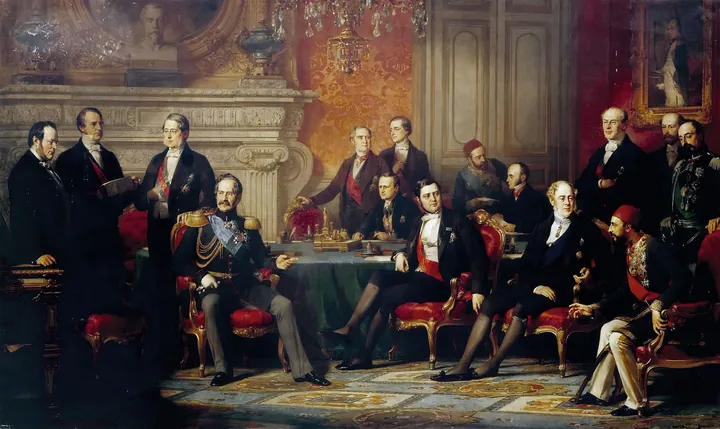
The Crimean War ended at Paris on 30 March 1856, and articles XX–XXVII of the treaty rewrote the Principalities' place in Europe. Moldavia and Wallachia stayed separate, under the Sultan's suzerainty – but under the guarantee of all the contracting powers, with 'no exclusive protection' by any one of them. The Russian protectorate was finished.
Russia also gave ground: the frontier was rectified in Southern Bessarabia, and the ceded land – organised as the counties of Cahul, Bolgrad and Ismail – was annexed to Moldavia. A European commission sat at Bucharest to work with what the treaty ordered next: in each province, an ad hoc Divan, 'to express the wishes of the people'.


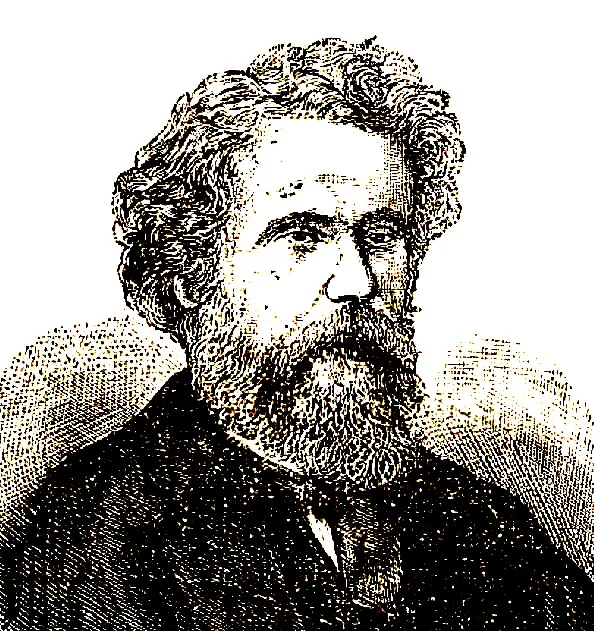
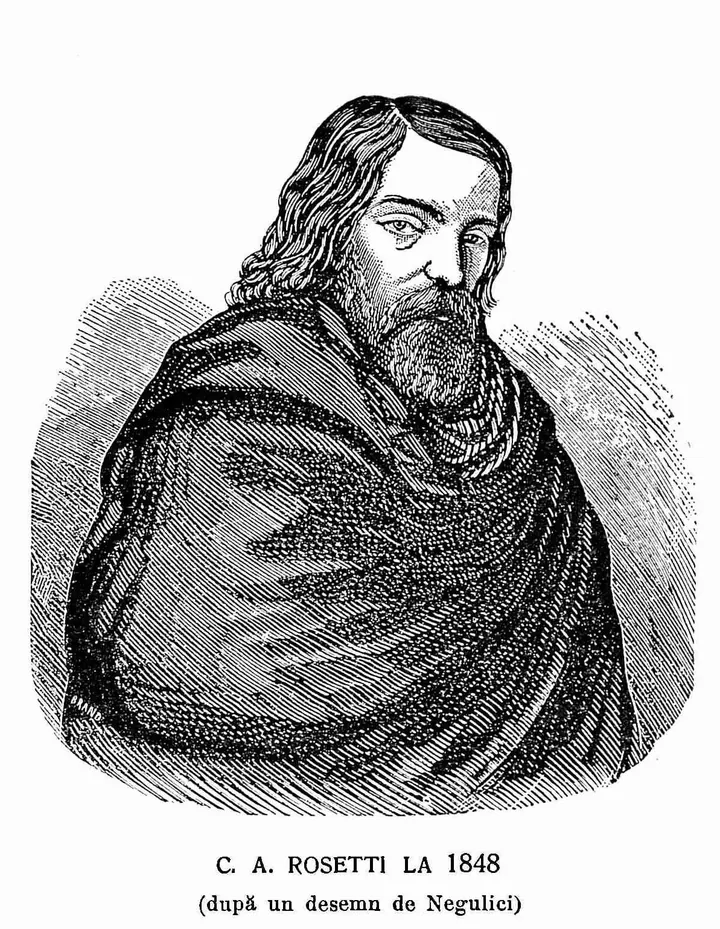
The men who would use these articles were already in Paris. Ion C. Brătianu, exiled since 1848, lobbied French opinion for union and autonomy and published his pamphlets in French; C. A. Rosetti, in Paris since December 1848, campaigned in exile papers for unification. Both had sat at the feet of Michelet and Quinet; both would sit in the Divans.
The Principalities of Wallachia and Moldavia shall continue to enjoy under the Suzerainty of the Porte, and under the Guarantee of the Contracting Powers, the Privileges and Immunities of which they are in possession. No exclusive Protection shall be exercised over them by any of the guaranteeing Powers.
Treaty of Paris, 30 March 1856, art. XXII
His Majesty the Sultan promises to convoke immediately in each of the two Provinces a Divan ad hoc, composed in such a manner as to represent most closely the interests of all classes of society.
Treaty of Paris, art. XXIV
Meanwhile The treaty was signed in the Salon des Ambassadeurs, on the Quai d'Orsay.
Chapter II
The Divans
1857 · 1857, the wishes
- Chapter
- 1857
- Osborne
- 6–10 August 1857
- The four wishes
- 7/19 October 1857
- One law for all
- 73 of 77
The Divans almost never met freely. The Moldavian caimacam Nicolae Vogoride, working with the Austrian-Turkish anti-unionists, falsified the elections; France, Russia, Prussia and Sardinia broke with the Porte over it. At Osborne, on 6–10 August 1857, Victoria and Napoleon III agreed, after 'reciprocal concessions' and with no document signed, to cancel the Moldavian vote.
The re-run elections gave unionist Divans at Iași and Bucharest, sitting from September to December 1857. On 7/19 October the Moldavian Divan adopted the four wishes – autonomy, union, a foreign hereditary prince, constitutional government; on 29 October, on a commission including Kogălniceanu, it voted one law for all, conscription for all and the end of rank exemptions, 73 of 77, with 4 abstentions.


A contemporary Britannica called the vote unanimous: the Divans, it wrote, proceeded at once to vote 'the union of the two principalities into a single state under the name of Romania... to be governed by a foreign prince'. Paris had asked for wishes; it got a programme.
They at once proceeded to vote with unanimity the union of the two principalities into a single state under the name of Romania... to be governed by a foreign prince.
Encyclopaedia Britannica, ninth ed., vol. 21
Meanwhile No document was signed at Osborne – the deal was sealed by conciliation alone.
Chapter III
The union
1858 – 1862 · 1858–1862, the double election
- Chapter
- 1858 – 1862
- The Convention
- 7/19 August 1858
- Double election
- 5 and 24 January 1859
- The merger
- 5 February 1862
Paris answered the wishes with a Convention, signed 7/19 August 1858: the 'United Principalities of Moldavia and Wallachia' – but no full union and no foreign prince. Two native hospodars for life, two governments, two assemblies, two capitals; only a Central Commission at Focșani, a High Court and a common army organisation were shared.
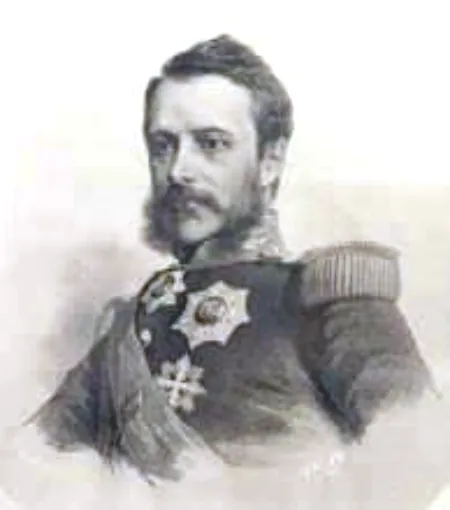
The Convention forbade one throne but not one man on two thrones. On 5 January 1859 Iași elected Alexandru Ioan Cuza; on 24 January Bucharest elected him too – nineteen days apart, a personal union the powers had to swallow. The Sultan's 1861 firman recognised the administrative union for Cuza's lifetime only.

_-_Trei_Ierahi_Monastery_(Raffet_1837).jpg)
The merger was proclaimed on 24 January/5 February 1862, Bucharest the capital, under the name 'Romanian United Principalities' – Romania, informally. The first all-Romanian government, Barbu Catargiu's, lasted from 22 January to June 1862; Catargiu was assassinated on 8 June.
Meanwhile 24 January is still celebrated as Union Day – the Mica Unire.
Chapter IV
The trace
1866 – 1958 · 1866–1958, what stayed
- Chapter
- 1866 – 1958
- Carol I
- 10 May 1866
- Independence
- 9 May 1877
- The museum
- 1958
Cuza fell in February 1866; a plebiscite called in Prince Karl of Hohenzollern-Sigmaringen, who entered Bucharest as Carol I on 10/22 May 1866. Independence was proclaimed on 9/21 May 1877 and sanctioned the next day; at Berlin in 1878 Romania kept its crown but gave back Southern Bessarabia – for Northern Dobruja.
The traces are visitable. The Union Museum in Iași, Cuza's residence of 1859–62, has been a museum since 1958; the Kogălniceanu memorial and the Ruginoasa palace stand in the same museum family. In Paris the signing room, the Salon des Ambassadeurs, still belongs to the Quai d'Orsay – but no plaque to 1856's Romanian hour has been found.


So was Romania invented in Paris? The treaty kept the Principalities separate and suzerain; the union was voted in Iași and Bucharest, seized by Cuza's double election, and paid for in wars. Paris supplied the paper and the pressure – the catalogue's companion page tells the French half; this one told the articles.
Meanwhile The companion page covers 1848–1859 from the French side.
The Paris quiz
Four questions about the articles, the Divans, and the prince. Choose, then check against the sources.
-
1
The treaty
The Treaty of Paris (30 March 1856) left Moldavia and Wallachia:
What happened
Separate. Suzerain to the Sultan, guaranteed by all the powers, protected exclusively by none – union would take another nine years.
-
2
The Divan
The ad hoc Divans of 1857 voted for:
What happened
Union and the rest. The four wishes of 7/19 October 1857 – then, on 29 October, one law for all, 73 of 77.
-
3
The prince
Cuza took both thrones:
What happened
Nineteen days apart. Iași on the 5th, Bucharest on the 24th – 24 January is still Union Day.
-
4
Bessarabia
In 1856 Moldavia recovered:
What happened
The south only. Three counties on the Danube mouths – retroceded to Russia in 1878, for Northern Dobruja.
Answer a card to begin.
Seven portraits of the union
Seven contemporary images, in the order of the story: the negotiators, the prince, the tribune twice, the map, the two capitals. Tap a portrait to study it – or read the whole union straight through.
Portrait 1856The negotiators
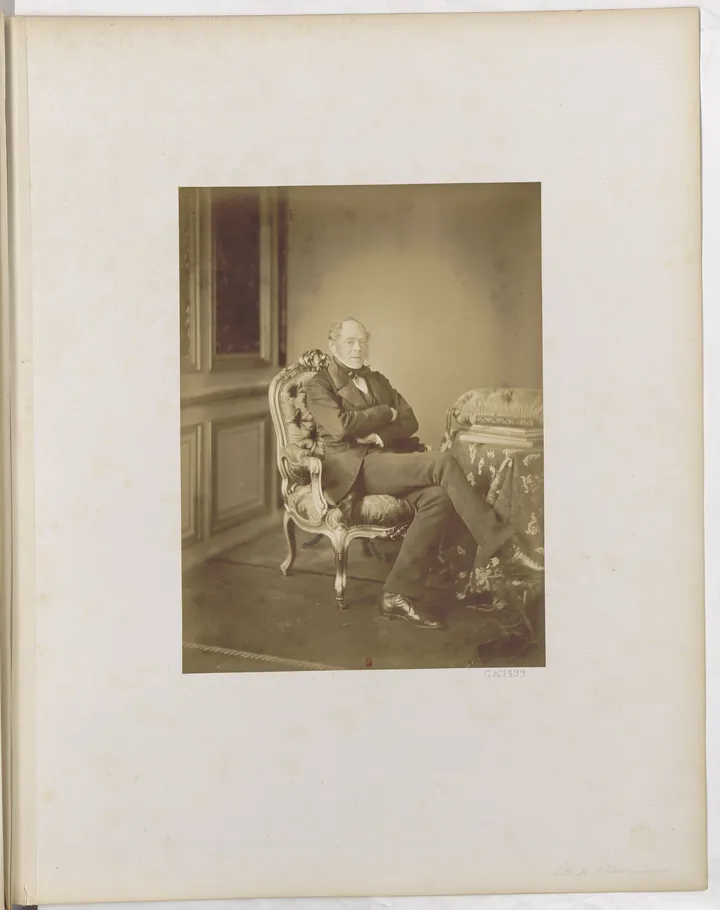
The negotiators Mayer & Pierson, 1856 (BnF) · Wikimedia Commons - Walewski, Clarendon, Cavour and Buol, photographed by Mayer & Pierson in Paris, 1856.
- The Congress sat at the Quai d'Orsay; the treaty was signed in the Salon des Ambassadeurs.
- BnF scan, via Wikimedia Commons.
Portrait c.1865The prince photographed
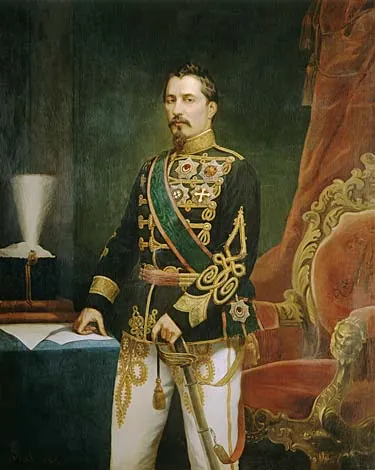
The prince photographed Carol Szathmari, c.1865 · Wikimedia Commons - Cuza around 1865, photographed by Carol Szathmari, Romania's first war photographer.
- Prince since January 1859; deposed in February 1866.
- The double election made him the union in person.
Portrait Misu PoppKogălniceanu painted
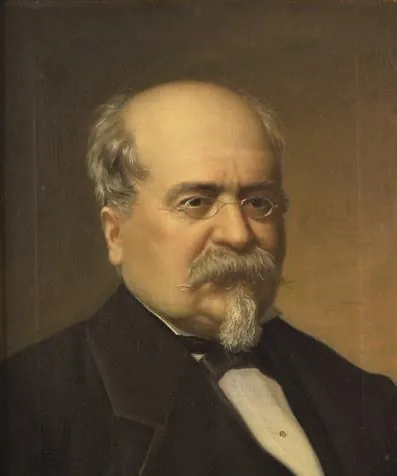
Kogălniceanu painted Mișu Popp · Wikimedia Commons - Mihail Kogălniceanu, painted by Mișu Popp.
- In the Moldavian Divan he sat on the commission behind the 29 October 1857 laws.
- 73 of 77 voted one law for all.
Portrait 1855The eve of the Congress
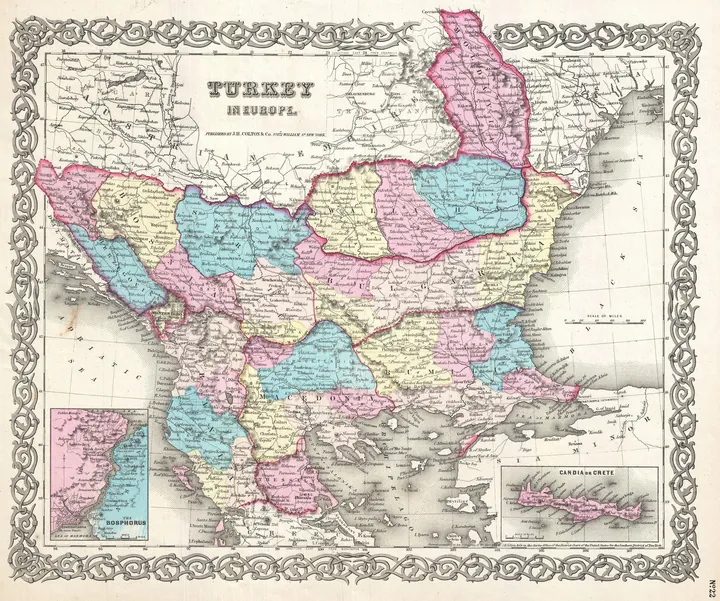
The eve of the Congress J. H. Colton, 1855 · Wikimedia Commons - J. H. Colton's 1855 map: Turkey in Europe on the eve of the Congress.
- The Principalities, the Danube, the Bessarabian frontier as Paris would redraw it.
- An American atlas view of the Eastern Question.
Portrait 1856The Wallachian capital
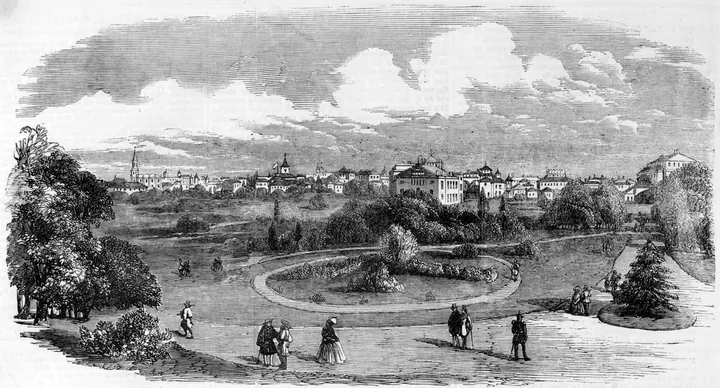
The Wallachian capital Illustrated London News, 1856 · Wikimedia Commons - Bucharest in 1856, from the Illustrated London News.
- Seat of the European commission – and of the Wallachian Divan of 1857.
- Austrian occupation troops paraded here the same year.
Portrait 1837The city that voted first
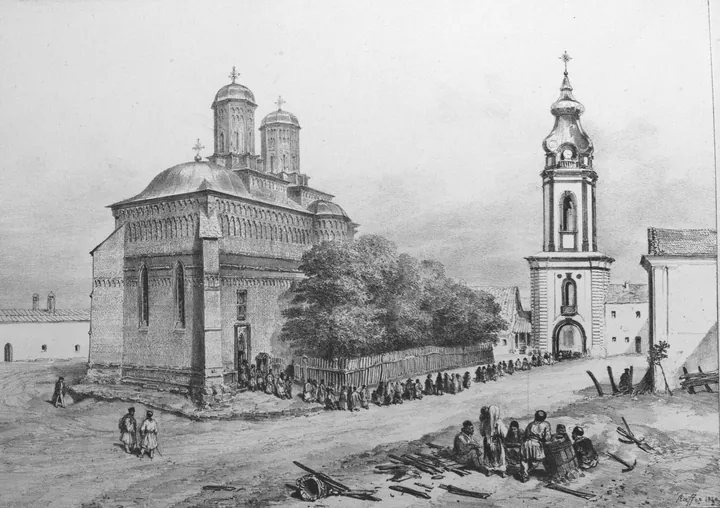
The city that voted first Auguste Raffet, 1837 · Wikimedia Commons - Iași in 1837, the Trei Ierarhi Monastery, by Auguste Raffet.
- Moldavian capital; on 5 January 1859 it elected Cuza first.
- The Union Museum keeps his house today.
Portrait 1857The Divan years
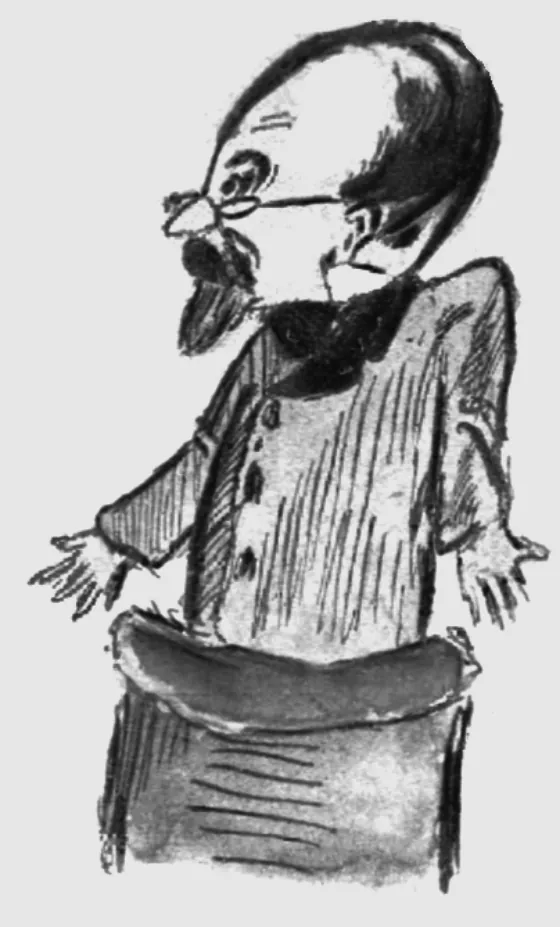
The Divan years Henric Cortazzi, 18 December 1857 · Wikimedia Commons - Kogălniceanu on 18 December 1857, drawn by Henric Cortazzi.
- The Divans sat from September to December 1857.
- Dated to the union struggle itself.
.jpg)


Portraits and views via Wikimedia Commons (all public domain). Dates are the works' own.
The union in six numbers
Every figure below comes from the treaty text and the cited histories. Disputed figures stay out.
- 1,856
- the treaty is signed in Paris
- XX–XXVII
- articles on the Principalities
- 73
- votes for one law for all, 29 October 1857
- 2
- thrones, one man
- 1,859
- Cuza elected twice
- 1,958
- the Union Museum opens in Iași
Three things people get wrong
Paris created Romania
False as stated: the treaty kept the Principalities separate, suzerain and guaranteed – it ended the Russian protectorate and ordered assemblies, not a state. Union came by the 1859 double election, the 1861–62 administrative merger, the 1866 name and the 1877–78 independence.
Cuza was elected the same day
False: nineteen days apart, Old Style – Prince of Moldavia on 5 January 1859, of Wallachia on 24 January. The 24th is celebrated as Union Day, the Mica Unire.
Bessarabia was returned in 1856
True only for the south: Cahul, Bolgrad and Ismail counties, with part of the Danube mouths. The rest stayed Russian – and the south went back in 1878, exchanged for Northern Dobruja.
Sources and methods
The treaty is quoted from the English text (ECF PDF); the Divans from Britannica's ninth edition (Wikisource), both public domain. The Romanian renderings are our own.
Day-dates follow their source's calendar; Old Style/New Style pairs are given where verified – Paris events New Style, Principalities events Old Style, the style of Romanian historiography.
Brătianu's return month, the Divans' exact tallies and any Paris plaque to 1856 are unverified here – so none is claimed. The French half of the story belongs to the companion page.
The treaty
The Divans
- D. Ivănescu, Revue Roumaine d'Histoire (2004): the Vogoride fraud, Osborne 6–10 August 1857 (PDF)
- Wikipedia, 1857 Wallachian parliamentary election: the fall-1857 Divans, the unionist votes
- Britannica, 9th ed. (Wikisource): the Divans vote 'with unanimity' the union under the name of Romania (public domain)
- Wikipedia, Mihail Kogălniceanu: the four wishes (7/19 October 1857), the 29 October law (73 of 77)
The union
The trace
- Carol I, 10/22 May 1866; independence, 9/21 May 1877; Southern Bessarabia retroceded 1878 for Northern Dobruja
- The Iași Union Museum (Cuza's 1859–62 residence, museum since 1958); the signing at the Salon des Ambassadeurs, Paris
- The companion page in the catalogue: France in the making of modern Romania, 1848–1859
Images
- Édouard Dubufe, 1856 · Wikimedia Commons
- Mayer & Pierson, 1856 (BnF) · Wikimedia Commons
- August Strixner · Wikimedia Commons
- Carol Szathmari, c.1865 · Wikimedia Commons
- Mișu Popp · Wikimedia Commons
- Henric Cortazzi, 18 December 1857 · Wikimedia Commons
- Amicul Familiei, 1884 · Wikimedia Commons
- Ion Negulici, c.1850 · Wikimedia Commons
- J. H. Colton, 1855 · Wikimedia Commons
- Illustrated London News, 1856 · Wikimedia Commons
- Auguste Raffet, 1837 · Wikimedia Commons