Plevna, 1877 – 1878
What did Plevna actually win?
In May 1877 Romania proclaimed independence; in August its soldiers stormed the Grivitsa redoubt; by December Plevna had fallen – and in July 1878 Berlin recognised what the war had won. This is the mechanism behind the slogan, in four chapters, seven plates and four dispatches.
Representative route Redoubts: schematic positions
The siege in four chapters
In May 1877 Romania proclaimed independence; in August its soldiers paid for the proclamation at the Grivitsa redoubt; in December Plevna fell; in July 1878 Berlin sealed the outcome. The siege lasted 143 days, from 20 July to 10 December.
The map below is a drawn schematic: the Danube, the Vit, the towns and the ring of redoubts. Dates pair the Old Style of Romanian tradition with the New Style of the military histories – 30 August on the Romanian calendar is 11 September on the Russian one.
Chapter I
9 May
April – July 1877 · the proclamation
- Chapter
- April – July 1877
- Convention with Russia
- Bucharest, 4/16 April 1877
- Independence read
- 9/21 May 1877, parliament
- Calafat batteries
- facing Vidin, early May
On 4 April 1877, Old Style, Romania signed a convention at Bucharest: Russian armies could cross Romanian soil toward the Danube, and Russia would respect Romania's integrity. Bucharest mobilised, and in early May the Romanian batteries at Calafat, on the northern bank, were already trading fire with the guns of Vidin across the river.
On 9 May, Old Style – 21 May by the modern calendar – Mihail Kogalniceanu rose in parliament and read the act of independence as the will of the Romanian people. Prince Carol signed it the next day. Five centuries of Ottoman suzerainty were repudiated in a speech; making the repudiation stick would take a war.

The war came quickly. The Russians crossed the Danube and took Nikopol on 16 July; Osman Nuri Pasha, marching from Vidin with some 12,000 men and 54 guns, found Nikopol already lost and turned south instead. On 19 July he occupied Plevna with about 15,000 men – the same morning some 9,000 Russians arrived before it. The siege began the next day.
Mihail Kogalniceanu read the act of independence of Romania as the will of the Romanian people.
Romanian War of Independence, English Wikipedia (21 May [O.S. 9 May] 1877)
Meanwhile While the armies march, London plays: the first Wimbledon Championship runs 9–19 July 1877.
Chapter II
The Siege
July – September 1877 · the redoubt
- Chapter
- July – September 1877
- First battle
- 20 July 1877
- Great Assault
- 30 August OS / 11 September
- The guns
- 112 Romanian Krupp pieces
On 20 July the Russians tried to take Plevna on the march. General Schilder-Schuldner's men drove the Ottomans from the outer works, then Osman Pasha counterattacked and threw them back out: 3,000 Russian casualties against 2,000 Ottoman. A second battle in late July, ordered from three sides at once, broke against the redoubts north and east of the town.
Bucharest answered the Russian call for help. Carol I took command of the joint Russian-Romanian armies before Plevna; Skobelev cut the supply road at Lovech on 3 September; General Cernat crossed the Danube with 43,414 men. On 11 September – 30 August in the Romanian calendar – the Great Assault went in: Skobelev seized two southern redoubts, and the Romanian 4th Division under General Manu, with Prince Carol alongside, stormed the Grivitsa redoubt.

.jpg)
It took four bloody assaults, and Captain Valter Maracineanu among others did not come back. The Turks retook Skobelev's two redoubts but could not dislodge the Romanians from Grivitsa – the one redoubt the allies would keep to the end of the siege. After September the frontal assaults stopped and General Totleben, the engineer of Sevastopol, took over the siege works.
The Romanian 4th division led by General George Manu took the Grivitsa redoubt after four bloody assaults, personally assisted by Prince Carol.
Siege of Plevna, English Wikipedia (11 September 1877)
Meanwhile At Shipka, on 21 August, the Russians repulse the second Ottoman attack on the pass.
Chapter III
The Fall
October 1877 – January 1878 · the surrender
- Chapter
- October 1877 – January 1878
- Rahova
- 19–21 November 1877
- The breakout
- 9 December, across the Vit
- The surrender
- 28 November OS / 10 December
While Plevna starved, the allies removed its outer supports. In November a Romanian-Russian force under Slaniceanu and Meyendorf stormed Rahova on the Danube, the garrison that could still have supplied Osman Pasha. The noose around Plevna closed to a single question: breakout or surrender.
On the night of 9 December the Ottomans tried the breakout: silently over the Vit on thrown bridges, on a two-mile front, through the first Russian trench line. Osman Pasha was wounded in the fighting, and on the next day – 10 December, 28 November in the Romanian calendar – he surrendered the city, the garrison and his sword to the Romanian colonel Mihail Cerchez.

After the fall, the Romanian army turned back to the Danube and fought the Vidin–Smardan operations of January 1878. The campaign was over for Plevna; for Romania the prestige was secured, but the legal work – the recognition no army can grant itself – still lay ahead, in March at San Stefano and in July at Berlin.
On 9 December the Ottoman forces silently emerged in the dead of night, threw bridges over and crossed the Vit River, attacked on a two-mile front, and broke through the first line of Russian trenches.
Siege of Plevna, English Wikipedia (9 December 1877)
Meanwhile In the east, the fortress of Kars falls to the Russians in November 1877.
Chapter IV
The Treaties
March – July 1878 · the seal
- Chapter
- March – July 1878
- San Stefano
- 3 March 1878
- Berlin Congress
- 13 June – 13 July 1878
- The exchange
- Northern Dobruja in, southern Bessarabia out
On 3 March 1878 Russia and the Ottoman Empire signed their peace at San Stefano. Europe's great powers refused to recognise it, and the treaty went back to the table: in June a congress gathered at Berlin to redraw what San Stefano had drawn.
The Treaty of Berlin was signed on 13 July 1878. It recognised Romania's independence – and it imposed the exchange: Northern Dobruja and the Danube Delta to Romania, the three southern-Bessarabian counties of Cahul, Bolgrad and Ismail to Russia, despite the pleas of the Romanian delegates. The Russian occupation of Bulgaria was capped at nine months.
_%C3%96lskizze.jpg)
So the slogan needs its three dates. Independence was proclaimed in Bucharest in May 1877, paid for at the Grivitsa redoubt in August, and recognised in Europe in July 1878. The war was necessary; the treaty was sufficient. Read the first myth below before repeating the slogan.
On the 13th of July 1878 the Treaty of Berlin was signed: Rumania received their independence (but was made to cede Bessarabia to Russia, receiving instead the Dobruja).
1911 Encyclopaedia Britannica (13 July 1878)
Meanwhile At Constantinople, the correspondent MacGahan dies of typhus on 9 June 1878.
The dispatches
The siege had an audience because it had correspondents. Four dated cards – the soundtrack of the map above – follow MacGahan of the Daily News from the Bulgarian atrocities to Pera.

-
July–August 1876
The atrocities letters
In July and August 1876 MacGahan rides through the desolated Bulgarian districts for the Daily News, questioning villagers in Russian. His letters are reprinted in London as the pamphlet “Turkish Atrocities in Bulgaria”.
-
1877
The war correspondence
Assigned to the 1877 war, MacGahan attaches himself to the Russian army; his and Archibald Forbes's dispatches are gathered the same year into “The war correspondence of the Daily News, 1877” – from Shipka Pass to the fall of Plevna.
-
1877
The line that stuck
Of the 1877 invasion MacGahan writes: “I can safely say I have done more to smash up the Turkish empire than anybody else… except the Turks themselves.” The dispatches make Romania famous between battles.
-
9 June 1878
Pera
During the San Stefano talks MacGahan stays at Pera through a spotted-typhus epidemic and catches it himself. He dies on 9 June 1878 and is buried in the Greek cemetery before diplomats, war correspondents and General Skobelev.
No dispatch line is invented: the soundtrack uses dated facts and one verified quotation, each cited in the sources.
Grivitsa, 30 August
Four decisions inside the documented frame – the assaults, the guns, the command, the dispatches, the seal. The dates, units and outcomes are sourced; the choices are illustrative. Choose, then check against the sources.
-
1
30 August, three in the afternoon
Three assaults have broken before the Grivitsa No. 1 redoubt. Manu's 4th Division is bleeding in front of the ditches. What do you order?
What happened
The fourth assault took the redoubt – “after four bloody assaults”, as the histories record – and the Romanians held it to the end of the siege.
-
2
The headquarters
After two lost battles the Russians ask Bucharest for help. Who commands the united armies before Plevna?
What happened
Carol I was named commander of the joint Russian-Romanian troops before Plevna, with 112 modern Romanian Krupp guns in line.
-
3
The dispatch
London wants to know what is happening at Plevna. Where does it read it?
What happened
The Daily News dispatches of 1877, gathered with Forbes into a PD volume the same year, run from Shipka to the fall of Plevna.
-
4
13 July 1878
Plevna fell in December. Is independence won?
What happened
Berlin recognised Romania's independence on 13 July 1878: Dobruja in, southern Bessarabia out. The war was necessary; the treaty was sufficient.
Answer a card to begin.
Seven plates of Plevna
Seven images in story order: the siege map, the battlefield, the assault, the defender, the correspondent, the headquarters, the seal.
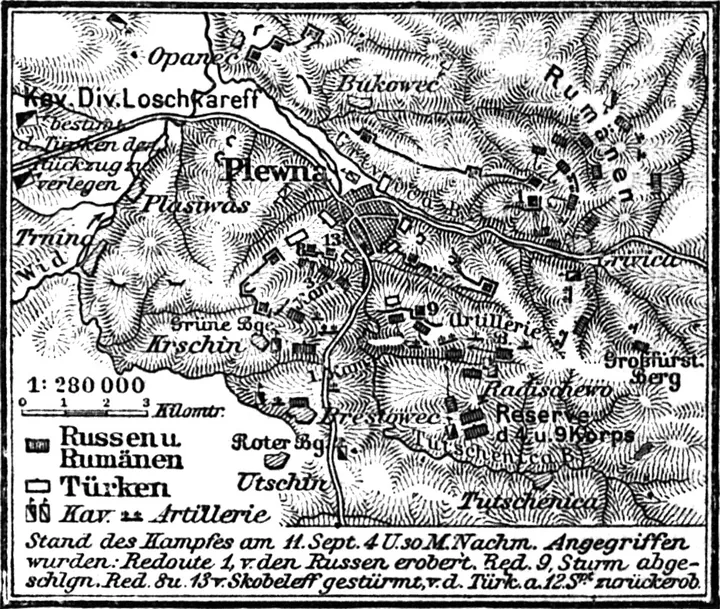
Plate 1890The siege map
The siege map Meyers Konversations-Lexikon, 1890 · Wikimedia Commons - Meyers Konversations-Lexikon, 1890: the siege as the encyclopaedias drew it a decade later.
- Plevna at the centre, the redoubt ring around it, the allies closing from every side.
- The page's own map is a new schematic – this is the period one.
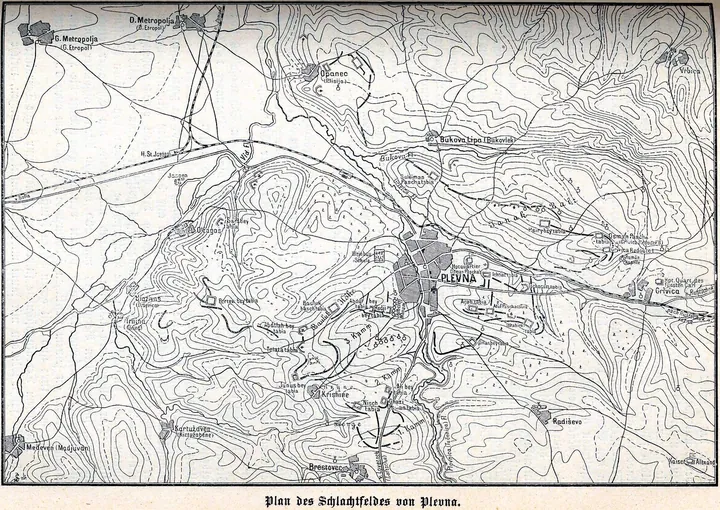
Plate 1900The battlefield
The battlefield Anonymous, 1900 · Wikimedia Commons - “The battlefield of Plevna and Grivitsa”, 1900: the ground of the third battle.
- The Vit curls past the town; the Grivitsa heights stand to the north.
- Plevna was a town among vineyards in a deep rocky valley – good ground to defend.
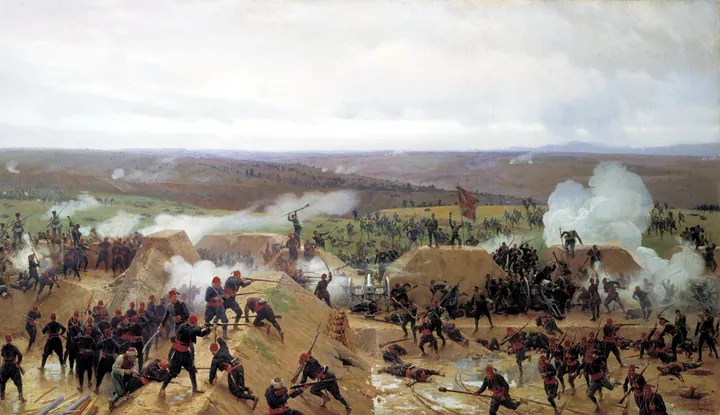
Plate 1885The assault
The assault Nikolai Dmitriev-Orenburgsky, 1885 · Wikimedia Commons - Nikolai Dmitriev-Orenburgsky, 1885: the storming of the Grivitsa redoubt.
- The Romanian 4th Division, General Manu, Prince Carol alongside – the fourth assault.
- The one redoubt the allies took and kept.
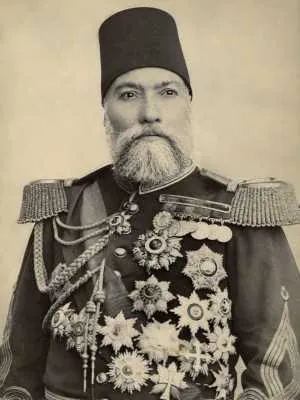
Plate c.1895The defender
The defender Abdullah frères, c.1895 · Wikimedia Commons - Osman Nuri Pasha by Abdullah frères, Constantinople, about 1890–1895.
- A post-war portrait: the beard is whiter than it was in the trenches.
- 19 July to 10 December 1877 – 143 days of defence.
Plate 1878The correspondent
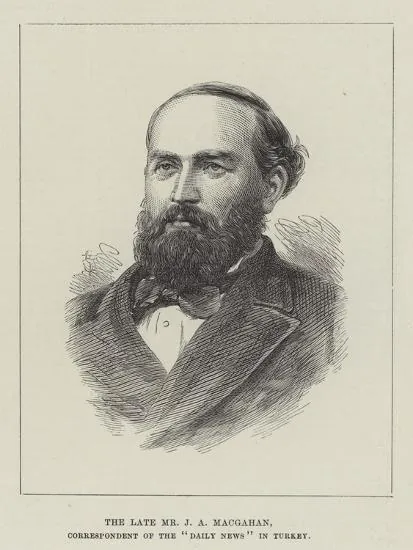
The correspondent Thomas Dewell Scott, ILN 1878 · Wikimedia Commons - “The late Mr. J. A. MacGahan”, Illustrated London News, 22 June 1878.
- Daily News correspondent: Bulgaria 1876, the Russian army 1877, Pera 1878.
- The illustrated press carried the war – and Romania – to the world.
Plate 1877The headquarters
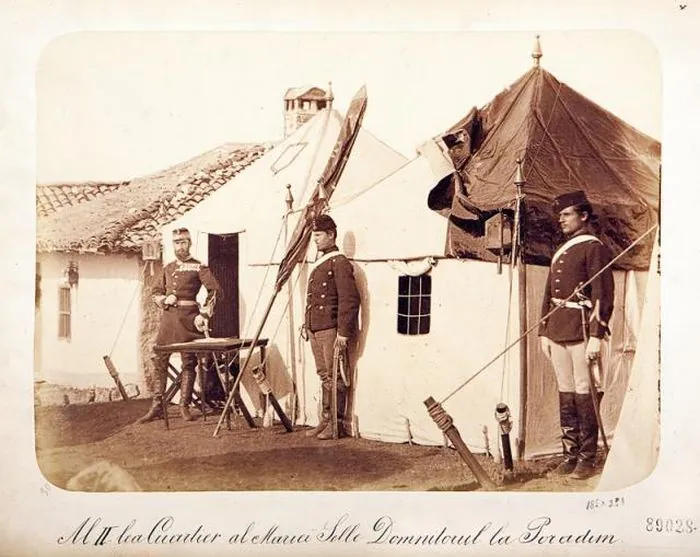
The headquarters Carol Szathmari, 1877 · Wikimedia Commons - Carol Szathmari, 1877: Prince Carol's headquarters at Poradim, Bulgaria.
- The court photographer followed his prince to the front.
- His plates became the album “Suvenir din Resbelul 1877-78”.
Plate c.1878The seal
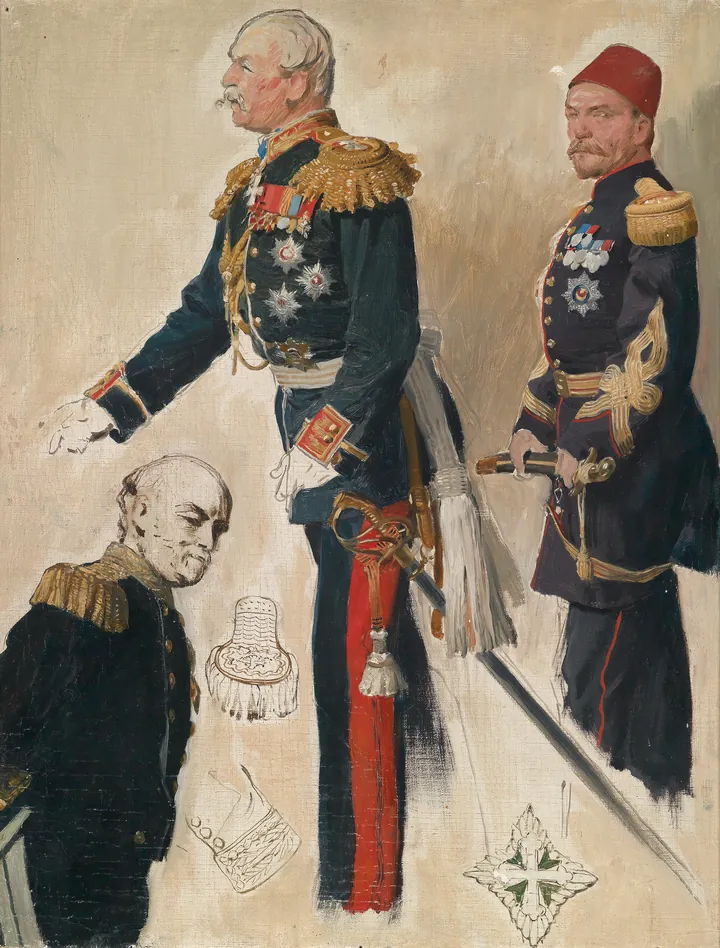
The seal Anton von Werner, c.1878 · Wikimedia Commons - Anton von Werner, oil sketch, c.1878: Shuvalov, Bismarck, Mehmed Ali.
- No Romanians in the frame – the delegates pleaded from the corridor.
- Signed 13 July 1878: independence, with the Bessarabian price.

Images via Wikimedia Commons, all public domain with per-file verification. Dates are the plates' own.
Plevna in six numbers
Every number below comes from the cited histories. The 143 days are recomputed from the siege dates, 20 July to 10 December 1877.
- 1,877
- the independence war begins
- 9
- May – the proclamation, Old Style
- 30
- August – Grivitsa, Old Style
- 143
- days of siege, 20 July – 10 December
- 1,878
- the peace: San Stefano, then Berlin
- 13
- July – the treaty signed
Three things people get wrong
Independence was won at Plevna
Half-true, and the page's whole point: independence was proclaimed in Bucharest on 9 May 1877, paid for at the Grivitsa redoubt on 30 August, and recognised in Europe at Berlin on 13 July 1878. The war was necessary; the treaty was sufficient.
Plevna fell to an assault
False: after September the frontal assaults were halted and Totleben starved the fortress instead. Plevna fell to a failed breakout on 9 December and a surrender on 10 December – not to a storming.
Dobruja was the reward
Misleading: Northern Dobruja and the Delta came bundled with the forced cession of southern Bessarabia – Cahul, Bolgrad, Ismail – to Russia, despite the Romanian delegates' pleas. An imposed exchange, not a prize.
Sources and method
The story follows the English histories of the siege and of the Romanian war, the 1911 Britannica, and two specialist papers; every material date is paired Old Style / New Style, except Rahova, Kars and Smardan, kept at month precision and marked as such.
The map is a drawn schematic, not a survey: redoubt positions are approximate and every route is a representative dashed line. Chapter scenes quote the cited sources verbatim; the game plays inside the documented frame with illustrative choices.
All seven images are public domain, verified file by file through the Commons API. Nothing is quoted from inside the Daily News volume beyond its cited listing; what could not be proven is excluded, never approximated.
9 May
- The Romanian–Russian convention, Bucharest, 4/16 April 1877: Russian troops may cross Romania, integrity to be respected
- 9/21 May 1877: Mihail Kogălniceanu reads the independence act in parliament; signed by Prince Carol on 10/22 May
- In early May the Romanian batteries at Calafat engage the Vidin guns across the Danube
- 13 July: Osman leaves Vidin (about 12,000 men, 54 guns); Nikopol falls on 16 July; he occupies Plevna with about 15,000 men on 19 July
- Meanwhile: the first Wimbledon Championship, 9–19 July 1877, won by Spencer Gore
The Siege
- The siege, 20 July – 10 December 1877; first battle 20 July (3,000 Russian vs 2,000 Ottoman casualties); second battle in late July
- The Great Assault, 11 September (30 August OS): Skobelev takes two southern redoubts; the Romanian 4th Division (Gen. George Manu), with Prince Carol alongside, takes the Grivitsa redoubt “after four bloody assaults”
- 143 days of siege; Lovech reduced on 3 September; Cernat crosses the Danube with 43,414 men; Totleben takes over the siege
- 112 modern Romanian Krupp guns; Carol I named commander of the joint Russian-Romanian troops before Plevna
- Captain Valter Mărăcineanu (1840 – 30 August/11 September 1877), 8th Line Regiment, killed at Grivitsa
- Meanwhile: Shipka, 21 August 1877 – the second Ottoman attack on the pass is repulsed
The Fall
- 9 December: the Ottomans cross the Vit by night on a two-mile front and break the first line; Osman wounded; on 10 December (28 November OS) he surrenders the city, garrison and sword to Col. Mihail Cerchez
- Rahova (Oryahovo), 19–21 November 1877: taken by the Romanian–Russian coalition (Slăniceanu + Meyendorf) so it could no longer supply Osman
- After Plevna: the Vidin–Smârdan operations, January 1878 (attacks from 29 December/10 January; encirclement on 11/23 January)
- Meanwhile: Kars falls to the Russians, November 1877
The Treaties
- San Stefano, 3 March 1878: the Russian–Ottoman peace, rejected by the Central Powers
- The Congress of Berlin gathers on 13 June 1878 to revise San Stefano
- The Treaty of Berlin, signed 13 July 1878: recognises Romania's independence – which cedes southern Bessarabia to Russia and receives Dobruja
- Only Northern Dobruja passes to Romania (Cahul, Bolgrad, Ismail stay Russian); the Russian occupation of Bulgaria capped at 9 months
- Meanwhile: MacGahan dies at Constantinople, 9 June 1878
The game
The seven plates
Images
- Meyers Konversations-Lexikon, 1890 · Wikimedia Commons
- Anonymous, 1900 · Wikimedia Commons
- Nikolai Dmitriev-Orenburgsky, 1885 · Wikimedia Commons
- Abdullah frères, c.1895 · Wikimedia Commons
- Thomas Dewell Scott, ILN 1878 · Wikimedia Commons
- Carol Szathmari, 1877 · Wikimedia Commons
- Anton von Werner, c.1878 · Wikimedia Commons