Departure
Iași, km 0
From Iași station, line 600 heads south-east, past Nicolina and Socola: 21.6 km of measured rail to the bridge, on European gauge, 1,435 mm.
Scroll on: Socola.
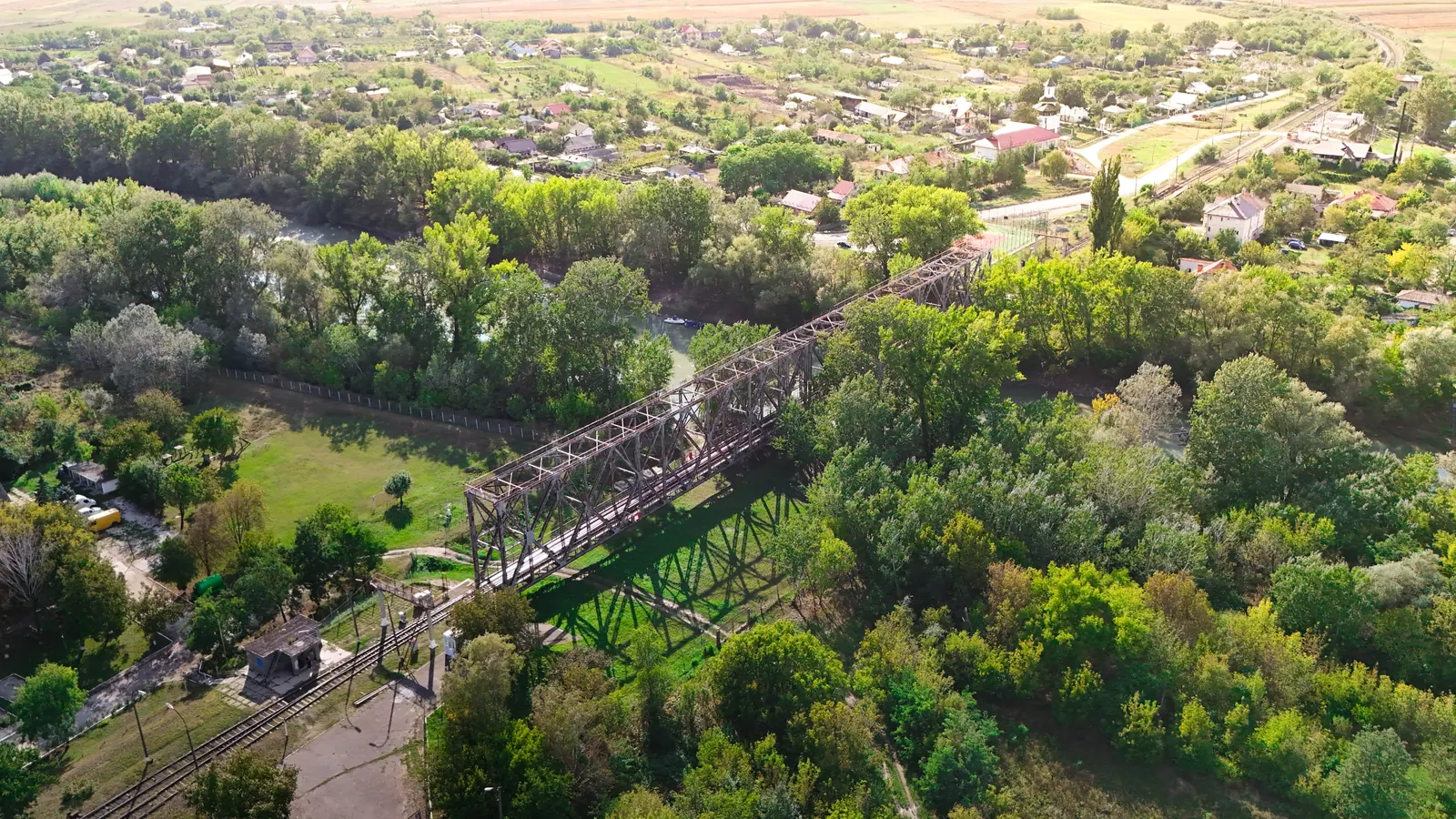
A famous bridge carries a 14-year-old name. Under it runs the Prut, and over it the passenger railway to Chișinău. The train's wheels change in the station beyond, at Ungheni.
130.3 km of line, two gauges, one bridge, and three places with one name.
The railway bridge over the Prut, on the Romania–Moldova border, from the air. Photo: Ungheni shoot, Wikimedia Commons, CC0.
Or pick an Ungheni: Ungheni, IașiUngheni, MureșUngheni, Moldova
The calculation runs locally in your browser, from the corridor data.
At the eastern edge of Ungheni commune, Iași county, the railway leaves Romania on a two-span steel bridge: 140.5 metres end to end, with the Prut — and the border — passing under it. The frontier point sits on the deck: west end in Romania, east end in Moldova. The bridge carries the line over the river, toward Ungheni station. 2026 marks 149 years since the first trains.
It is called the Eiffel Bridge, but the name is recent: the town council of Ungheni, Moldova, christened it “Podul Gustave Eiffel” by decision 2/33 of 20 April 2012, specialists unconsulted. In October 2014 the authorities centred it in the European Heritage Days.
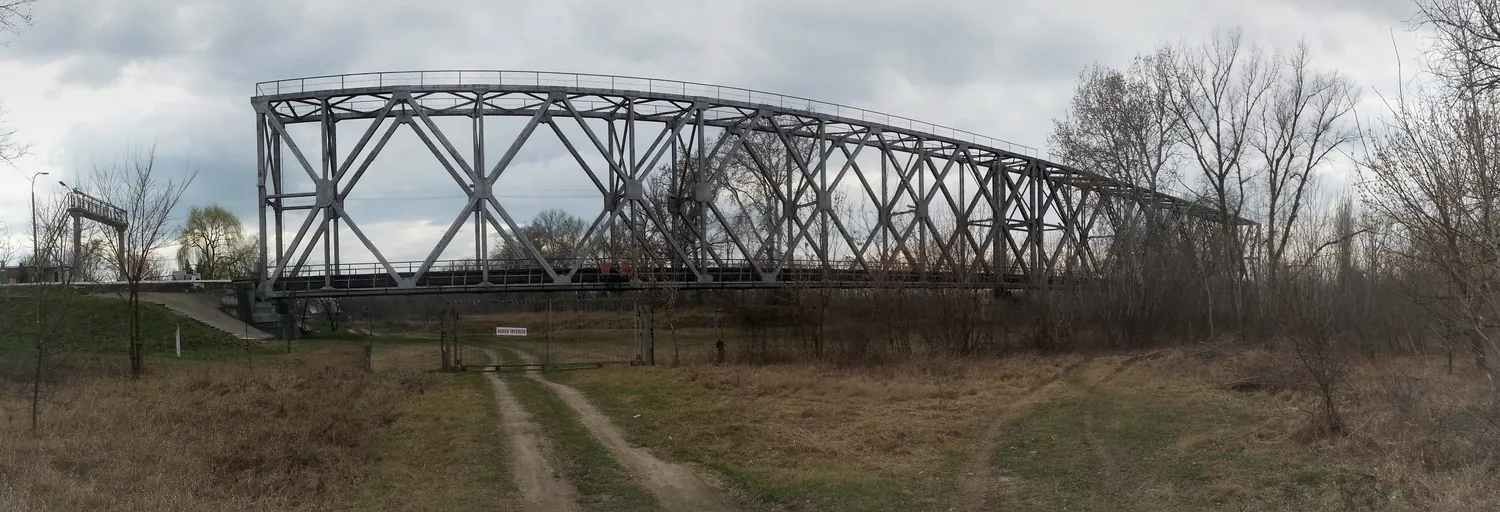
Gustave Eiffel has nothing to do with the bridge — neither today's nor its predecessor, writes the historian Vasile Iucal, after the Russian archives. The story was born in the Moldovan press — “Noua generație”, a school magazine, in April 1998, then “Nezavisimaia Moldova”, a Russian-language newspaper (2001, though Iucal also mentions 2000) — and it reached even a 2012 historical study, which names Eiffel as the builder, citing a newspaper.
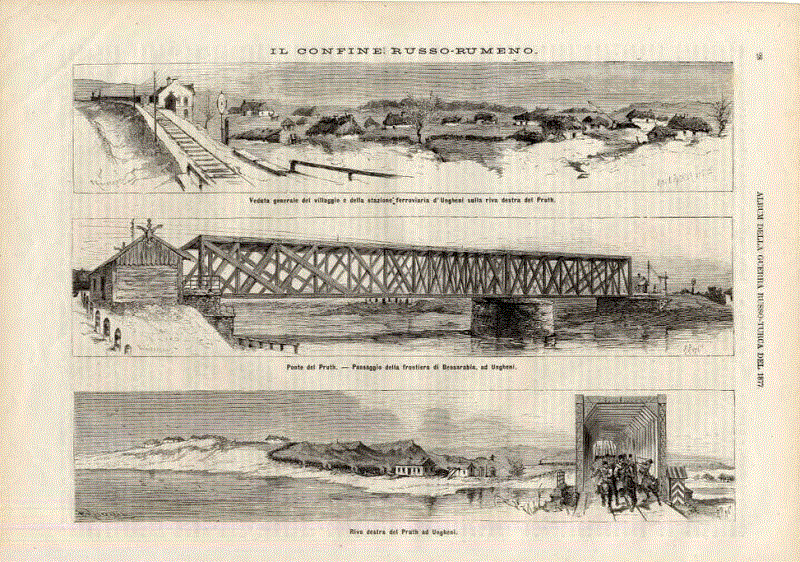
The original bridge was designed by the Russian engineer Nikolai Belelubsky: the technical council approved it on 24 March 1874; it was raised in 1875–1876 under the supervising engineers Balinski and Stamatopulo (Iucal: finished by 1876 at the latest, exact day unknown), and the first Russian military trains crossed the Prut in April 1877, on a bridge still untested, at the start of the Russo-Turkish war. Two iron spans of 71.3 metres each; 280,000 rubles, split with the Odessa railway board; acceptance only in 1881 — the year, not the month. It still stands in Belelubsky's list of designed bridges, known through Lopatto (1975).
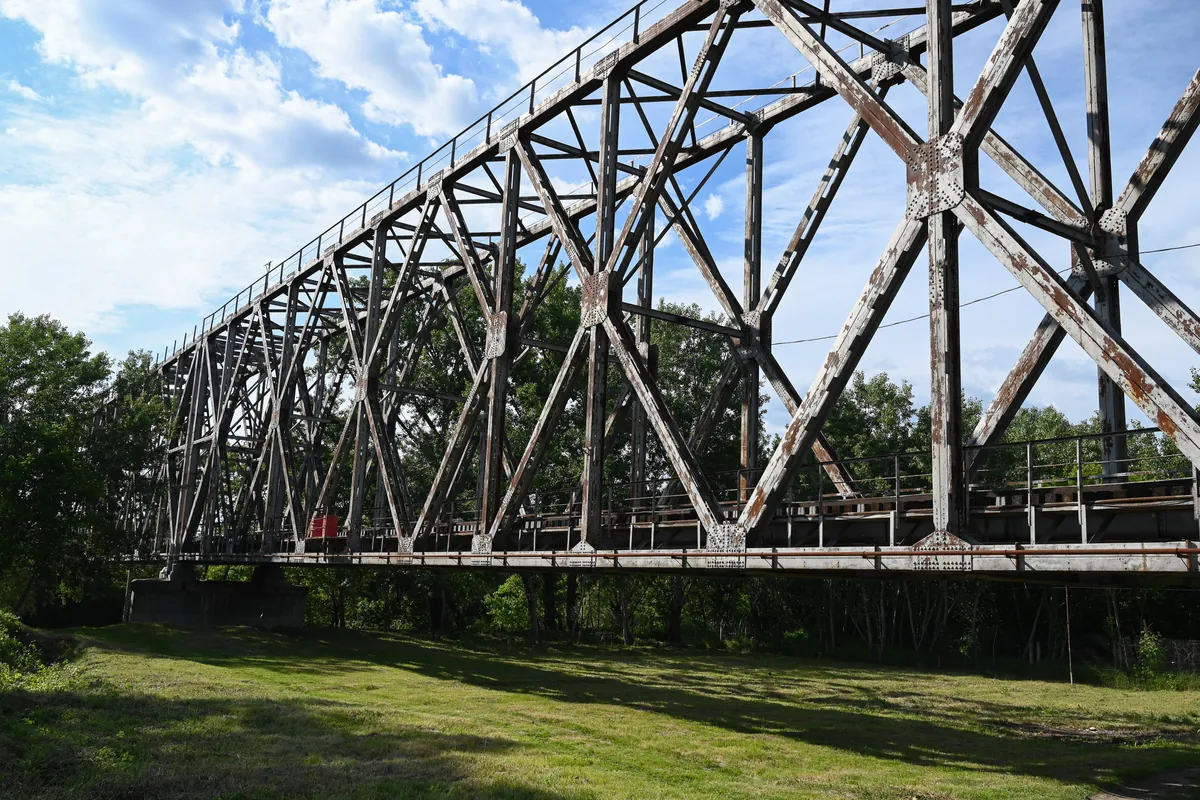
Today's iron is not even Belelubsky's. The old bridge was blown up by the Soviets on 22 June 1941, rebuilt by the Romanian–German authorities and used through the war, destroyed again in 1944. Today's bridge is Soviet: raised in 1946 by Glavmostostroi (the Soviet bridge trust) to a 1944 type design, two spans of 70.6 metres each, inspected in October 1949 and tested in March 1950, with a favourable verdict. Eiffel's firm did build in Romania — Ploiești–Predeal, under Émile Nouguier — just not here; their story is linked below.
Romania runs on 1,435 mm, Moldova on 1,520 mm — the figures stand in annex 5 of the Romanian railway's 2026 Network Statement (CFR). Between them lie 85 millimetres: ordinary carriages cross only on new bogies.
At Ungheni, in the Moldovan station, 1.2 km past the border: the carriages are uncoupled, lifted on jacks, the 1,435 bogies drawn out and the 1,520 ones pushed in. Passengers stay aboard throughout (seat61.com, the rail guide, 2026). In capacity language (the 2023 European strategy): at most 70 wagons a day through the border changes.
But the two worlds overlap for a few kilometres: the Russian rail enters Romania to Socola — 18 metres past the station — and the European rail crosses the bridge and runs 3.2 km in a straight line toward Berești, on combined track. The bridge is mixed: both gauges cross the Prut on one deck.
Not always: in 1921–1923, Romania converted Bessarabia's lines (today's Moldova) to normal gauge — Charles Upson Clark saw the third rail laid — and by 1927 through sleeping-cars ran Chișinău–Bucharest and Chișinău–Czernowitz, with no change at all.
Kilometre on the map: 0–130.3
Touch a station on the map or a name below: each tells its kilometre.
The line from the records
Lengths: measured on OpenStreetMap geometry; gauge: CFR annex 5, 2026.
The line from the records
“But Russian tracks run just to Iaşi Socola marshalling yard station ….”
Jakub Pieńkowski, “The knotted rails”, 2012 (“just to Socola”) — and the open map proves him right.
The line from the records
The 2005 engineering report (two 70.6 m spans), quoted by Iucal 2019; measurement: ways 912772474 and 1272769495.
The line from the records
“The present bridge … has nothing in common with the celebrated French engineer Gustave Eiffel, just as its predecessor had no connection with him either.”
Vasile Iucal, “Destrămarea mitului” (Debunking the myth), the Tyragetia journal, 2019; translation by Marius Comper.
The line from the records
“Each carriage is jacked up to have its bogies changed … You remain on board while this is done.”
seat61.com, the Moldova page, 2026; capacity: the EC strategy, 2023.
The line from the records
Published figure: the RailwayPro journal, 31 August 2012; measurement: the plotted route on OpenStreetMap geometry.
The line from the records
“Through sleepers run from Kishineff to Czernowitz and to Bucharest.”
Charles Upson Clark, Bessarabia, New York, 1927, p. 22.
The line from the records
The EC strategy for the Ukrainian and Moldovan railways, July 2023; status: 28 September 2026 (Moldpres).
The line from the records
Lengths: the plotted measurement; changes: the corridor rules, at Cities.
Nine selected stops on the measured rail — amber (1,435 mm) to the bridge, green (1,520 mm) to Chișinău. The train on the map travels with the reading.
Departure
From Iași station, line 600 heads south-east, past Nicolina and Socola: 21.6 km of measured rail to the bridge, on European gauge, 1,435 mm.
Scroll on: Socola.
The overlap
At Socola, 4.9 km from Iași, the map shows both colours: the 1,520 mm line enters the country and holds 18 metres past the station. Here the Russian world ends, not at the border.
Scroll on: the bridge.
The bridge
At km 21.6 the rail climbs onto the bridge: combined track, 140.5 metres of mapped geometry against 141.2 metres of engineering spans in the 2005 report — a 0.7 metre discrepancy. The frontier point stands on the deck.
Scroll on: the name.
The name
The name on the plates is from 2012; the iron from 1946; Belelubsky's project from 1874. Eiffel has nothing to do with any of them — though even a 2012 study named him builder, citing a newspaper.
Scroll on: the change.
The change
Past the bridge, 1.2 km on, Ungheni station: carriages uncoupled and jacked up, bogies swapped, passengers left aboard. At most 70 wagons a day pass through the border changes.
Scroll on: the loop.
The loop
From Ungheni the line heads north — Unțești, Cornești — only then turning south-east, through Călărași. The loop explains the 107.5 km to Chișinău, measured on the rail (107.533 km unrounded, against 107.6 published: 0.07 km discrepancy).
Scroll on: the unbroken years.
Once
After 1923, no wheels changed here: Bessarabia had gone over to normal gauge in 1921–1923, and Clark saw the third rail laid. Through sleeping-cars linked Chișinău with Bucharest and Czernowitz.
Scroll on: the future.
The future
The 2023 European strategy proposes a new 1,435 mm track beside the old one, Ungheni–Chișinău: €264.808 million without modernising the broad rail, €473.017 million with it (2023 estimates). The rail is only proposed; it does not exist yet. Feasibility was being prepared with JASPERS support in September 2026.
Scroll on: the arrival.
Arrival
Past Strășeni and Ghidighici, the line enters Chișinău: 130.3 km from Iași, 107.5 km from Ungheni. Kyiv: no wheel changed; Bucharest: one, at Ungheni; Madrid: one or two, depending on the route.
Scroll on: the cities.
The map shows the Iași–Ungheni–Chișinău line as openly mapped: amber for the 1,435 mm rail, green for the 1,520 mm rail, both for the combined track. The dots are stations; the train marks the kilometre being read.
OpenStreetMap geometry, simplified for the screen; 57.5 m of dead-end links and 1,148 m of service tracks are included in the 130.3 km and declared here.
Each answer is computed from two facts: the home gauge and the corridor to Chișinău. Below, six worked answers; the box at the top knows 28 places.
From Bucharest to Chișinău, the wheels change once: at Ungheni, from 1,435 to 1,520 mm. The capital stands on normal gauge (the CFR network), and “Prietenia” (“Friendship”, 401/402) runs the same rail to the border; the change happens in Ungheni station, with the passengers aboard.
CFR Călători (train 401/402); seat61 (the change); the EC strategy, 2023 (the corridor).
From London to Chișinău, the road passes through Vienna and Bucharest, then the “Prietenia” eastward: one change, at Ungheni. All along, one change: at Ungheni, where the Russian world begins.
seat61, the Moldova page: “from London via Vienna to Bucharest … then … the Prietenia”.
From Madrid to Chișinău, count the changes by route: the exit from the Iberian world (1,668 mm) to the normal one (1,435 mm) — Spanish trains pass through a gauge-changing shed, on adjustable axles (seat61) — then Ungheni, from 1,435 to 1,520 mm. On the standard-gauge fast route to France, only the Ungheni change. Barcelona answers the same; Lisbon, twice.
seat61, the Spain page (the changing shed and the fast route to France); the Iberian gauge: 1,668 mm.
From Kyiv to Chișinău no wheel changes: the whole road is 1,520 mm. The Ungheni change awaits only toward Bucharest — the direct Kyiv–Bucharest train (IR 99/401 and IR 402/100, via Ungheni), announced by CFR Călători on 10 October 2025, changes its bogies there.
CFR Călători, 10 October 2025 (IR 99/401 and IR 402/100, via Ungheni); Moldpres, Moldova's state news agency, 10 October 2025.
From Bălți to Chișinău no wheel changes: both stand on 1,520 mm. The Ungheni change is at the other end of the country.
The EC strategy, 2023: Moldova's network, 1,520 mm.
Ungheni of Iași is the commune on the Romanian bank, its marker 0.4 km from the bridge in a straight line: the train crosses the Prut to the change beyond. Its Mureș namesake is in Transylvania, 265 km west in a straight line: from there you cross the whole country, and the wheels still change at the Ungheni on the Prut. Ungheni of Moldova is the town of the change, beyond the bridge: its station is 1.2 km past the border.
Distances: Nominatim, the OpenStreetMap geocoder, 2026 (in a straight line); the change: seat61; the namesakes: the atlas of names knows them too.
The bridge stands on the border; the “Prietenia” crosses it toward the Ungheni change. Three things deserve a look from the Romanian side.
The Romanian end of the line: the Ungheni-Prut halt platform, under 300 metres from the bridge, on the Romanian bank — where the rail leaves the country.
The village on the bank: the commune's marker is 0.4 km from the bridge in a straight line. Do not confuse it with the Mureș namesake, 265 km west in a straight line — the game told them apart already.
With the “Prietenia” from Bucharest, wake up at Ungheni: the change passes unnoticed, but the shunting will not let you sleep — as a traveller quoted by seat61 tells it.
And if you cross into Moldova, Ungheni station is 1.2 km past the border: there the carriages are jacked up.
At Ungheni, read the bridge in its order: the Soviet iron of 1946, on the 1874 bridge's site, Eiffel's name — of 2012 — above. Three ages in a 140.5 metre deck. Won or lost in the game, Ungheni sends you back to your city — and the box above tells you where your wheels change.
Further: Cernavodă 1895, with the Eiffel dossier in Romania · Transnistria, from the Romanian side · The atlas of names: all three Unghenis.


