Fetești–Cernavodă · 1890–1895
The bridge that taught a country engineering
Between 1890 and 1895 a Romanian team led by Anghel Saligny spanned the Danube and the Borcea at Fetești–Cernavodă: 4,087.95 m of steel, the longest bridge complex in Europe, tested by 15 locomotives while its designer watched from a boat underneath.
The bridge in four chapters
Representative line
Two railheads, one river, three bridges
Between 1860 and 1895 Romania laid two railways that stopped at the water: Constanța–Cernavodă on the Dobruja bank, București–Fetești on the Muntenia bank. The 21 km between Fetești and Cernavodă took two failed contests, one Scottish research trip and five years of works.
Below, the bridge in four chapters – the gap, the design, the work and the trace. The lines on the map are representative, drawn through the verified places of the story.
Chapter I
The gap
1860 – 1887 · Two railheads and a river between
- Chapter
- 1860 – 1887
- Dobruja railhead
- Cernavodă, since 1860
- Muntenia railhead
- Fetești, from 1879
- Rejected projects
- 8 + 5
In 1860 the Offenheim company laid the Constanța–Cernavodă line while Dobruja was still Ottoman ground; after the 1877–78 independence war returned the province, Romania began the București–Ciulnița–Fetești line in 1879 and bought the Cernavodă–Constanța line back on 10 December 1882. Between the two railheads stood the Danube, crossed only by ferry and steamboat – Eminescu himself took the Giurgiu–Cernavodă boat to see the sea, 13 years before the opening.
The Ion C. Brătianu government answered with two international contests: 8 projects in 1883, 5 in 1886, every one rejected though French, German, Swiss and Belgian firms competed. Gustave Eiffel's firm, fresh from the Ploiești–Predeal bridges under Émile Nouguier, drew a Danube superstructure – then the talks broke, and the legend that its steel sailed to Senegal's Faidherbe bridge began its long, false life in tourist guides.

The nearest Danube bridge stood 955 km upstream, at Novi Sad, opened 1883. In December 1887 the Public Works Ministry stopped shopping abroad and entrusted the crossing to a Romanian: the contests' own secretary, Anghel Saligny.
Meanwhile Meanwhile, the second Tay bridge opened on 13 July 1887: 3,264 m of iron, Europe's longest – for eight years.
Chapter II
The design
1887 – 1890 · Seven checks and two innovations
- Chapter
- 1887 – 1890
- Design commissioned
- December 1887
- Final design
- 1 December 1889
- Calculation checks
- 7
Anghel Saligny (19 April 1854 – 17 June 1925) had learned bridges at Charlottenburg, raised the Adjud–Târgu Ocna line in 1881–82 and the 430 m Cosmești bridge, and was pouring the world's first reinforced-concrete silos when the December 1887 commission reached him. He gathered seven engineers of the National School of Bridges and Roads – Baiulescu, Herjeu, Gheorghiu, Bădescu, Christescu, Cazimir, Zahariade – and went to look at the future in Scotland.
The Firth of Forth, 2,521 m and still rising, was the biggest bridge of that hour; Saligny studied its cantilevers and came home to draw a Romanian answer. The final design of 1 December 1889 proposed two worldwide innovations at full scale: the Gerber cantilever lattice and mild cast steel instead of puddled iron – and Saligny had to fight the routine technicians to impose them both. The calculations were checked seven times.

On paper the crossing read: 190 m in the middle, four times 140 m, a 15-opening viaduct beside; 3 times 140 m with 11 times 50 m over the Borcea; 34 times 42 m over the marsh. At 4,087.95 m the system outran every bridge complex in Europe before a single caisson had sunk.
The right man in the right time.
His contemporaries, via the CFR brochure
Meanwhile Meanwhile, the Forth Bridge opened on 4 March 1890: 2,467 m of cantilever, spans of 521 m – the measure Saligny had gone to see.
Chapter III
The work
1890 – 1895 · Five years, one river, no flaws
- Chapter
- 1890 – 1895
- Total, with viaducts
- 4,087.95 m
- Steel, mild / puddled
- 9,554 t / 310 t
- Cost, rails and stations
- 35M gold lei
Works opened on 9/21 October 1890 in the king's presence – one account says 26 November instead, and the page keeps both dates. The 21 km of single track had to cross a live river, a second arm and 14 km of marsh, so the decks went up on scaffolding while the piers went down in compressed-air caissons: 19,000 cubic metres of digging, 610 t of steel in the caissons, some 62,850 cubic metres of masonry.
The metalwork came from French and Belgian firms and landed by ship at Constanța: 9,554 t of mild cast steel against 310 t of puddled, millions of rivets, 3 million cubic metres of embankments and 200,000 square metres of facings. On 14/26 September 1895 the special train left Gara de Nord at 9:05 and reached Fetești at 12:30; the last rivet was silver, the document was walled in, and the service was sung. Catargiu's salute to the king ran: “With the nation's wrights you subdued the Danube!”


Then the test: 15 heavy locomotives at 60 km/h, whistles, Danube sirens and fanfares, then the guests' train at 80 – without a single recorded flaw. Saligny watched from a shallop under the bridge, beside the workers and designers, guaranteeing the work with his life under the old builders' custom. Asked what he would have done had it fallen, he answered: “I knew it will hold!”
From today, nothing divides Romania on the left of the Danube from Dobruja…
The commemorative act read by Carol I, 14 September 1895
Meanwhile Meanwhile, on 18 October 1895, The Times called it “a surprising achievement at Cernavodă”.
Chapter IV
The trace
1895 – 1987 · Two wars and a second bridge
- Chapter
- 1895 – 1987
- Borcea rebuilt
- 1921
- Electrified
- 31 May 1977
- New complex
- 1986–87
Renamed “Eng. Anghel Saligny” after the events of 1944, the complex paid for its strategic place in both wars. In October 1916 the retreating Romanians tried to cut it: the Danube bridge was only damaged and rebuilt by MAN of Augsburg-Nürnberg, while the Borcea bridge fell and rose again on its intact piers, by Romanian hands, in 1921.
In 1941 Soviet bombs broke braces and slid a deck off its bearings without bringing the bridge down; CFR, Reșița and MAN repaired it in about four months with the traffic fully stopped. The Iezer viaduct vanished in 1969 when the marsh was drained, and the 31 May 1977 electrification lifted the upper braces by 1.50 m – then the new Borcea bridge (May 1986) and the new Danube bridge (October 1987) doubled the crossing 30–80 m upstream, and the old bridge was decommissioned.

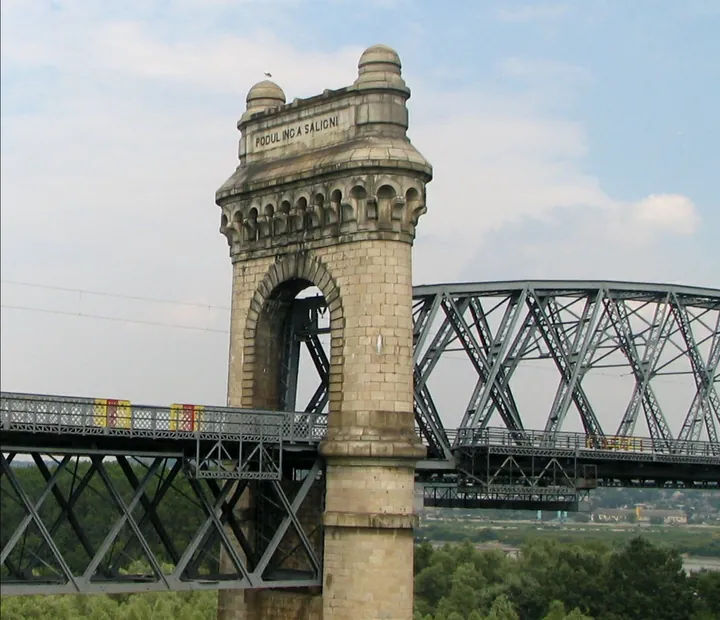

It stands listed as CT-II-m-A-02872, the maturity exam of Romanian engineering, the silver bridge of Vlahuță's childhood tales. Eighteen centuries earlier another empire had spanned the same river at Drobeta – the sister project tells that crossing, pier by pier.
Silver bridges out of childhood tales…
Alexandru Vlahuță, Picturesque Romania
Meanwhile Meanwhile, in 1919, the Quebec Bridge took the cantilever span record with a single 549 m opening.
The bridge, drawn as a machine
One elevation, eight parts, four stages: pick a part to read its documented figures, or switch the stage to see the same steel on paper, on scaffolding, on its opening day and today.
The design. Final design, 1 December 1889: the calculations checked seven times, two worldwide innovations on paper – the Gerber cantilever and mild steel.
The worksite. 1890–95: scaffold assembly, compressed-air caissons, Franco-Belgian steel landed at Constanța.
The day. 14/26 September 1895: the silver last rivet, 15 locomotives at 60 km/h, the guests at 80.
Today. Decommissioned 1987; historic monument CT-II-m-A-02872; doubled upstream by the 1986–87 road-and-rail complex.
Pick a part of the machine
Opening 1 · 140 m
First Danube opening, 140 m of Gerber lattice. Its own steel tonnage is undocumented; the 9,554 t of mild steel are complex-wide.
Opening 2 · 140 m
Second opening, 140 m: the lattice grid with two 50 m consoles reaching past the piers, the seat of the middle beam.
The central opening · 190 m
A 90 m beam resting on two 50 m consoles covers the full 190 m – the largest span in continental Europe. The girders rise 32 m above the piers.
Opening 4 · 140 m
Fourth opening, 140 m, mirroring the second: its left console carries the other end of the 90 m middle beam.
Opening 5 · 140 m
Fifth Danube opening, 140 m. Five openings make 750 m of great spans; with the 913 m access viaduct, 1,663 m – one metre of rounding from the documented 1,662 m.
The access viaduct · 913 m
15 openings of 60.85 m each, 913 m in all, carrying the single track to the great spans.
The Borcea bridge · 970 m
3 openings of 140 m plus a viaduct: 3 of 50 m toward Fetești, 8 of 50 m toward Cernavodă – 970 m over the Borcea arm. Destroyed in October 1916, rebuilt on intact piers by 1921.
The Iezer relief viaduct · 1,455 m
34 openings of 42.80 m, 1,455 m across the marsh to let flood waters through; drained away and replaced by an embankment in 1969.
The drawing is representative; only the labelled figures are documented. Per-part steel, per-pier caisson depths and the workforce headcount are undocumented, and the panels say so.
Build it
Four decisions Saligny's team faced – sink or float, spend or save, span or block. Choose as the chief engineer chose.
-
1
The caissons
The piers must stand in a live river. Air or audacity?
What happened
Caissons it was: 19,000 cubic metres dug under compressed air, 610 t of steel in the caissons.
-
2
The steel
The new steel is stronger but untried at this scale. The old iron is safe.
What happened
9,554 t of mild steel against 310 t of puddled – after a fight with the routine technicians.
-
3
The 190 m opening
The middle opening gapes 190 m wide. No beam ever cast spans it whole.
What happened
90 + 2 × 50 = 190: the Gerber lattice, the largest span in continental Europe.
-
4
The flood season
Spring floods drown the Iezer marsh. Block them or let them pass?
What happened
34 × 42.80 = 1,455 m of relief viaduct over the Iezer marsh – until the 1969 drainage.
Build a card to begin.
Seven plates
Six public-domain witnesses and one modern photograph: look at the steel before you believe a word.
Plate 1854–1925The engineer
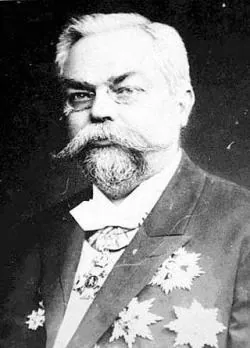
The engineer Saligny portrait, unknown author, public domain · Wikimedia Commons - The unknown photographer's portrait: orders on the chest, the Academy president after 1907.
- Secretary of the 1883 commission, designer from December 1887, railways director from 7 October 1895.
- No date on the file – the plate is filed under his life years, 1854–1925.
Plate c.1890–95The span on scaffolding
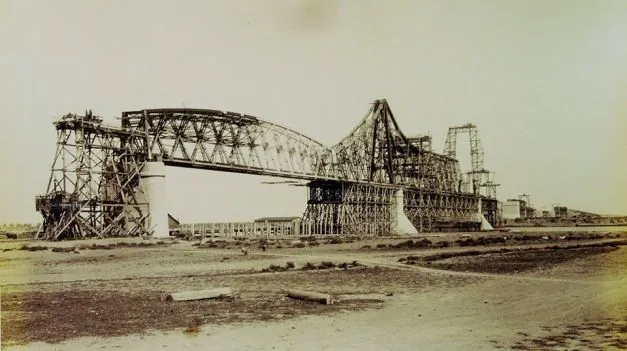
The span on scaffolding Construction span 1890–95, public domain · Wikimedia Commons - A great span hangs on full scaffolding: the documented scaffold assembly.
- White piers, bare ground, stacked timber – the marsh worksite between 1890 and 1895.
- One of the few surviving views of the steel going up.
Plate 1895The woodcut
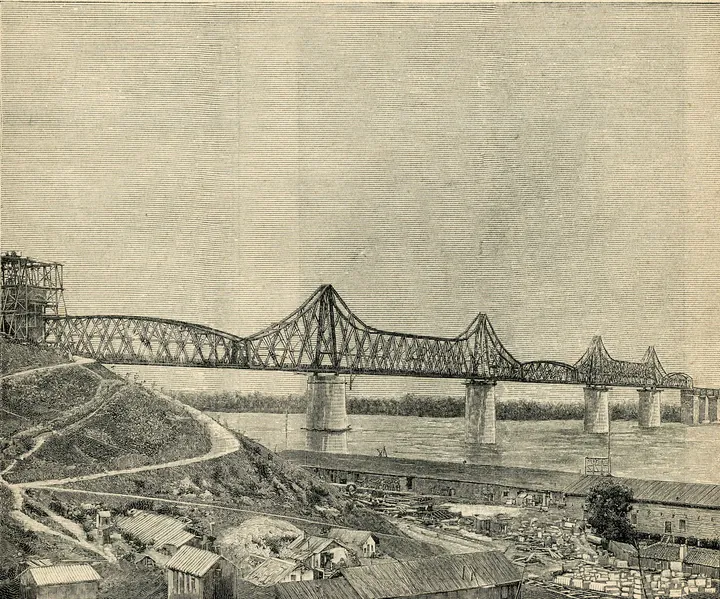
The woodcut Italian woodcut 1895, public domain · Wikimedia Commons - “The new great Danube bridge at Cernavodă, just inaugurated” – the Italian press celebrates.
- Five great openings over the water, the worksite barracks still at the foot.
- Cut in 1895, the same year the Times wrote of Cernavodă.
Plate c.1895Deck and piers
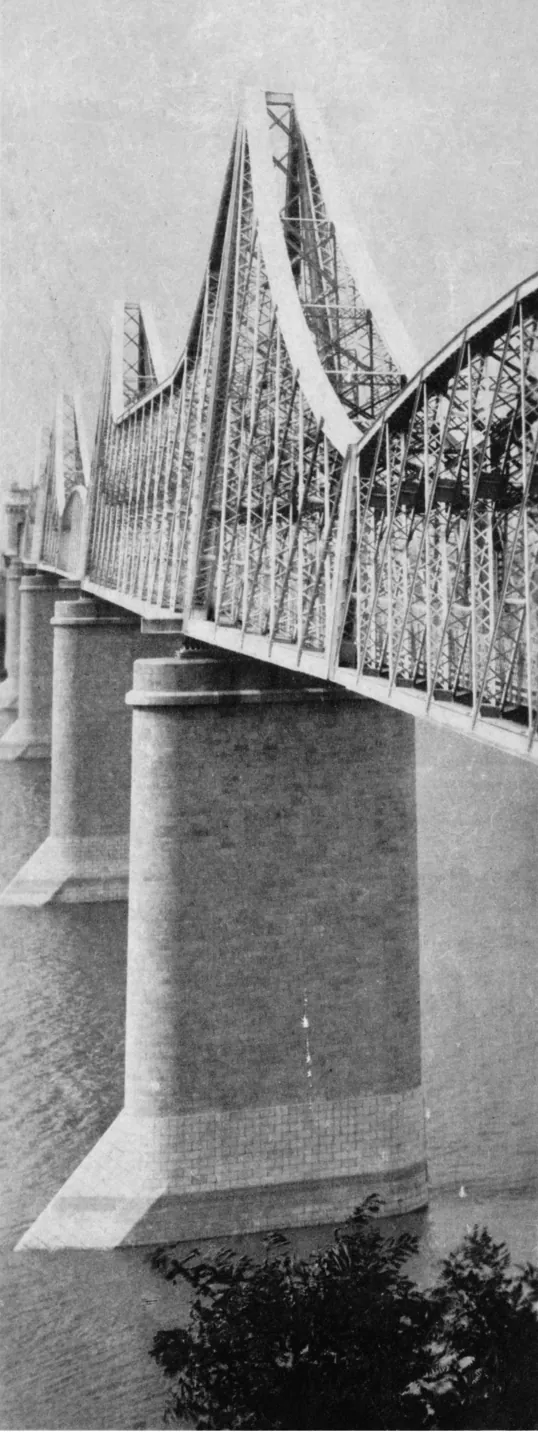
Deck and piers Deck and piers c.1895, public domain · Wikimedia Commons - Portrait format, deck level: the lattice girders march over round stone piers.
- Dated 1895 from the title alone – hence the cautious c. on this plate.
- The closest period view of the Gerber latticework.
Plate 1901–04Antoniu's view
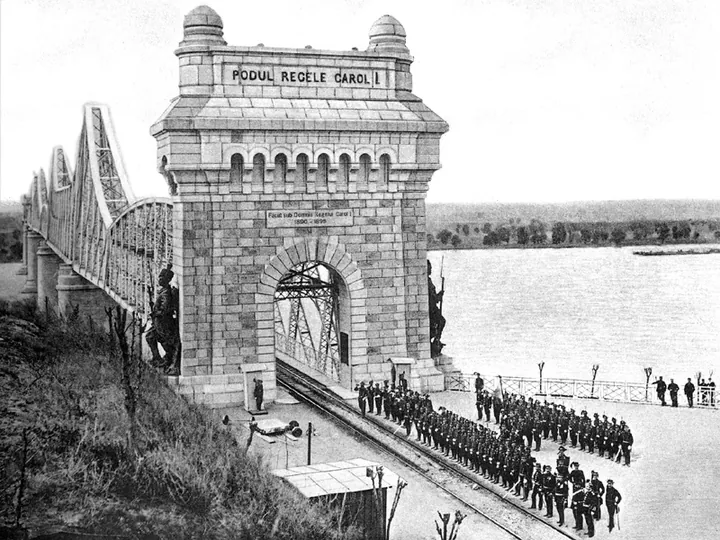
Antoniu's view Alexandru Antoniu, published 1901–04, public domain · Wikimedia Commons - Alexandru Antoniu's photograph, published 1901–04: the finished complex at rest.
- Single track on the deck, thirty metres of air beneath.
- A decade after the test, not a rivet visibly out of place.
Plate 19071907
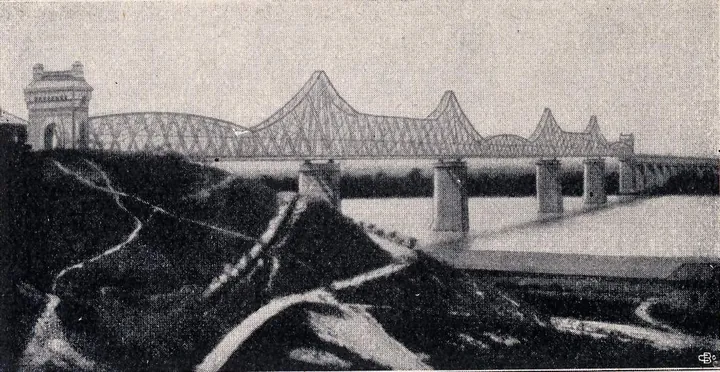
1907 Bridge view 1907, public domain · Wikimedia Commons - 1907: the bridge in its working prime, twelve years after the opening.
- Trains had crossed for over a decade; the wars were still ahead.
- The last calm portrait before the demolition orders of 1916.
Plate 2014The dorobanți
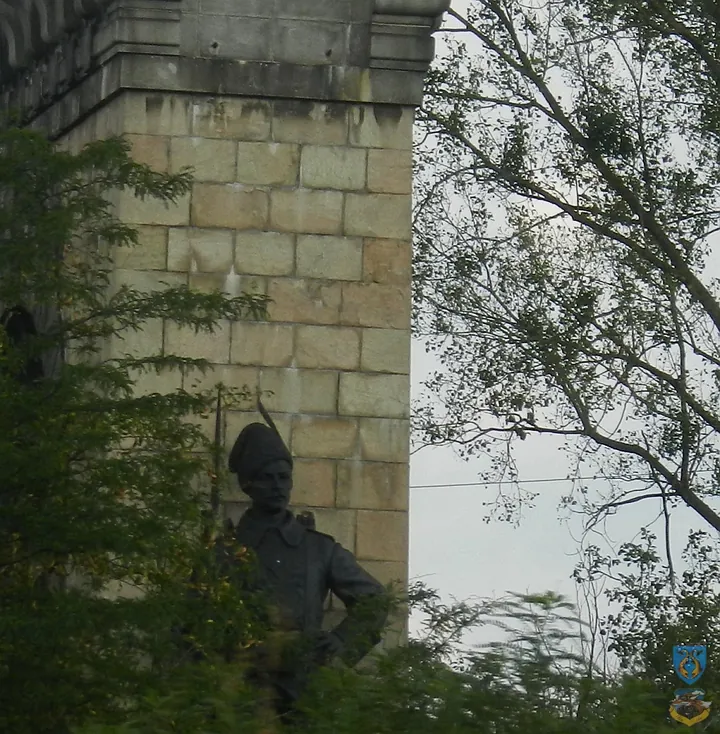
The dorobanți The dorobanți 2014, photo: Rotaru Florin, CC BY-SA 4.0 · Wikimedia Commons - Pilet's bronze at the Cernavodă end: two dorobanți for the 1877 heroes.
- Five models, the king's choice, cast in three pieces in France.
- Photographed in 2014 by Rotaru Florin, CC BY-SA 4.0.


Dates follow the file pages; the c.1895 deck photograph is dated from its title alone.
The bridge in numbers
Six figures that survived every cross-check between the Romanian and English records.
- 4,088
- metres of bridge complex, viaducts included
- 190
- metres: the central opening
- 30
- metres above high water
- 35
- million gold lei, rails and stations
- 15
- locomotives in the test convoy
- 9,554
- tonnes of mild cast steel
Four myths, examined
The longest bridge in the world.
Documented: the longest bridge complex in Europe. English sources say second in the world, Romanian sources third – and neither names the longer bridges. Against the Forth (1890): 2,467 m overall with 521 m spans – Cernavodă ran longer, span for span it stood shorter. The bare world title is a myth.
Eiffel built it – and the steel sailed to Senegal.
Eiffel's firm drew a Danube superstructure for the contest, then the talks broke and the CFR built Saligny's design. The legend that the French steel was reused for the Faidherbe bridge at Saint-Louis was disproved by French specialists – yet tourist guides still repeat it.
Saligny stood alone under the bridge.
He stood in the shallop with the workers, the designers and the team leaders – the sources agree on the company, differing only on its exact list. The lone genius on the water is the myth; the crew is the fact.
The test ran at 80 km/h.
The convoy of 15 ran at 60, the guests' train at 80 – two sources, brochure and bridge article, agree. One article gives the convoy 80, one biography 85. The single “80 for all” is a simplification, not a lie.
Sources and method
Figures follow the cited sources: metres stay metres, and every disputed figure keeps all its variants on the page – the October and November starts, the 14th and 15th of September, the 60, 80 and 85 km/h, the second and third places in the world. What cannot be proven – flood events on the worksite, caisson depths, the headcount, per-span tonnage, Saligny's titles – is marked undocumented, never invented.
The elevation is a representative schematic, not a survey: only the labelled figures are documented, and the parts add to 4,087 m against the documented 4,087.95 m because the sources round the Danube bridge and the Iezer viaduct. The map lines are representative too, drawn through the verified places.
The period voices are public domain: the king's 1895 act, Catargiu's speech, Saligny's answer, Vlahuță's page, the 1895 woodcut and the photographs. The two modern photographs are credited CC BY-SA; the world-rank claim is refused wherever the sources stay silent.
The gap
- Constanța–Cernavodă 1860 (Offenheim); București–Fetești designed 1879; the 10 December 1882 buyback; the 1883 contest under Ion C. Brătianu; the Winkler–Collignon commission, Saligny secretary
- Two contests: 1883 (8 projects), 1886 (5 projects); all rejected; French, German, Swiss, Belgian firms
- The superstructure designed by Gustave Eiffel (Émile Nouguier); talks broken; the Faidherbe/Senegal reuse legend disproved by French specialists; the last bridge: Franz Josef, Novi Sad, 955 km upstream, 1883
- Until 14 September 1895 only ferry and steamboat; Eminescu's Giurgiu–Cernavodă steamboat trip, 13 years before the opening
The design
- December 1887: Saligny designated; two years of design; the Baiulescu, Herjeu, Gheorghiu, Bădescu, Christescu, Cazimir, Zahariade team; 'the right man in the right time'
- The Scotland research trip, to the Firth of Forth (2,521 m); the final design 1 December 1889; the calculations checked seven times
- Two worldwide innovations: the cantilever (Gerber) beam + mild steel instead of puddled iron; the fight with routine technicians
- Saligny 19 April 1854 – 17 June 1925; Charlottenburg 1871–74; Adjud–Târgu Ocna 1881–82; Cosmești 430 m; the 1884–89 silos; the Academy 1892, president 1907–10
- Forth: begun 1882, opened 4 March 1890, 2,467 m, 2 × 521 m; Tay (second): 13 July 1887, 3,264 m
The work
- Works opened 9/21 October 1890, in Carol I's presence (the 26 November 1890 variant, disputed); 21 km Fetești–Cernavodă, single track
- Danube 190 + 4 × 140 + viaduct 15 × 60; 30 m above high water; Borcea 3 × 140 + 11 × 50; 14 km marsh, viaduct 34 × 42; total 4,087.95 m; 35 million gold lei
- 50 m consoles, 90 m middle beam → 190 m; 32 m girder height; access viaduct 15 × 60.85 = 913 m; Iezer 34 × 42.80 = 1,455 m for flood discharge
- 19,000 m³ compressed-air excavations; 610 t caisson steel; 9,554 t mild steel; 310 t puddled steel; Franco-Belgian metalwork via Constanța; scaffold assembly
- Opening 14/26 September 1895 (the 15/26 and 1 October variants, disputed); Carol I, Lascăr Catargiu; the Gara de Nord 9:05 → Fetești 12:30 special; the silver rivet
- The test: 15 heavy locomotives at 60 km/h, the guests' train at 80 km/h, no flaws (the 80 and 85 variants, disputed); Saligny under the bridge, in a shallop, with the workers and designers
- Carol I's commemorative act ('From today, nothing divides…'); 'I knew it will hold!'; Catargiu: '…you subdued the Danube!'; Ilustrazione; The Times, 18 October 1895
- The longest bridge complex in Europe; the disputed 2nd/3rd place worldwide; 190 m, the largest span in continental Europe; Léon Pilet's (1836–1916) dorobanți
The trace
- Vlahuță, Picturesque Romania: 'silver bridges out of childhood tales'; renamed 'Eng. Anghel Saligny' after 1944
- October 1916: the Danube bridge damaged (MAN), Borcea destroyed, a new assembly on intact piers, 1921; 1941: bombings, a displaced deck, 4 months of repairs, traffic stopped
- The Iezer viaduct removed 1969 (drainage) → embankment; electrification 31 May 1977 (braces +1.50 m); new Borcea May 1986, new Danube October 1987; the old bridge decommissioned 1987
- Historic monument CT-II-m-A-02872; the sister project Trajan's Bridge, the ancient mirror at Drobeta
Images
- Saligny portrait, unknown author, public domain · Wikimedia Commons
- Construction span 1890–95, public domain · Wikimedia Commons
- Italian woodcut 1895, public domain · Wikimedia Commons
- Deck and piers c.1895, public domain · Wikimedia Commons
- Alexandru Antoniu, published 1901–04, public domain · Wikimedia Commons
- Bridge view 1907, public domain · Wikimedia Commons
- The dorobanți 2014, photo: Rotaru Florin, CC BY-SA 4.0 · Wikimedia Commons
- Bridge arch, photo 2005, CC BY-SA 3.0 · Wikimedia Commons