Paris, 25 May 1827 · file 3,208
Petrache Poenaru's endless quill
A Romanian student in Paris, a swan quill, and a five-year patent. This is the story of the document, of the mechanism, and of what was truly first.
Chapter I
The copyist
1799–1826 · from Benești to Paris
- Chapter
- 1799–1826
- Born
- 10 January 1799, Benești
- Vladimirescu's secretary
- 1821
- Vienna scholarship
- 1822
- Paris scholarship
- 1824–1826
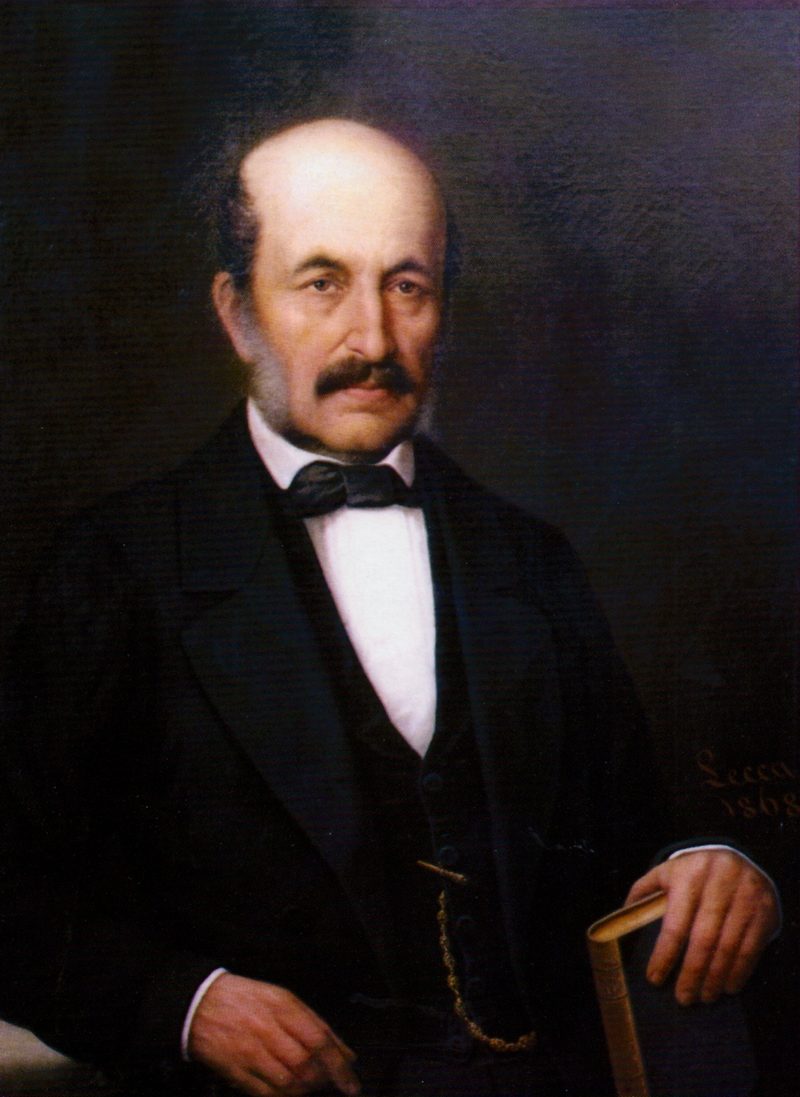
Petrache Poenaru is born on 10 January 1799 at Benești, in Vâlcea. He studies at the Obedeanu school in Craiova, works as a copyist for the Râmnic bishopric, and between 1820 and 1821 teaches Greek at the Metropolitan School in Bucharest.
In 1821 he joins Tudor Vladimirescu. He proves useless in a fight, but Vladimirescu sees his sharp mind and makes him his trusted aide: Poenaru writes the army's proclamation, counted today among the first Romanian newspapers. Sent away on a diplomatic mission, he escapes his leader's fate and shelters in Sibiu.
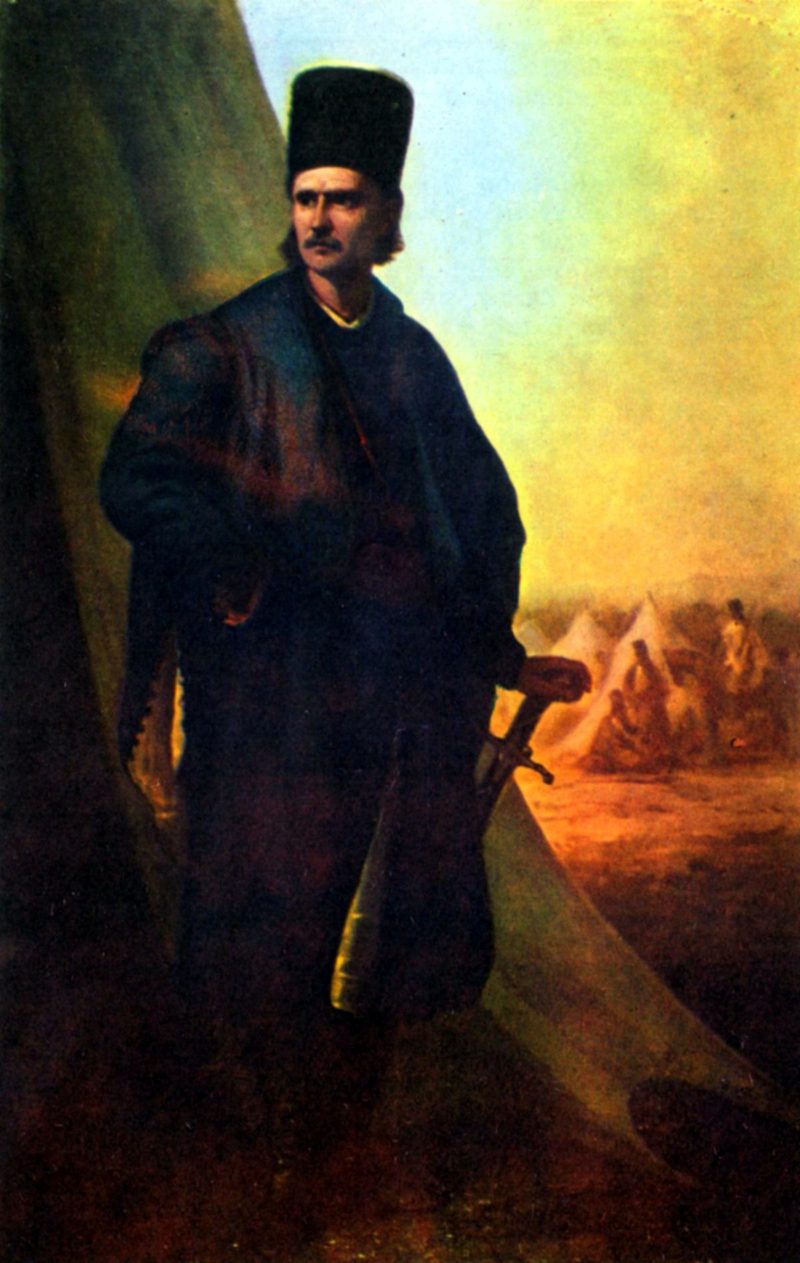
In 1822 he wins a scholarship to Vienna, where he discovers measuring instruments and micrometers, and in 1824 Prince Grigore Ghica grants him a new scholarship with one condition: to return and teach. In 1826 he leaves for Paris, to the École Polytechnique, to study geodesy and surveying.
The sweetest pleasure a man can experience is learning.
from a letter home, Vienna, about 1822
Meanwhile: Meanwhile, in London: in May 1809 Frederick Fölsch receives the first English patent for a reservoir pen, and in September 1809 Joseph Bramah patents an improved feed.
Chapter II
The patent
1826–1827 · Paris, rue de Tournon 17
- Chapter
- 1826–1827
- Arrives in Paris
- 1826
- Patent application
- 26 April 1827
- Patent granted
- 25 May 1827
- Patent term
- 5 years
In Paris, Poenaru takes notes and copies lectures without pause, and the goose quill, dipped forever in the inkwell, slows him down. So he draws a portable pen: a large swan-quill tube for a barrel, an ordinary goose quill for a nib, and a cap with a needle that stops the ink.
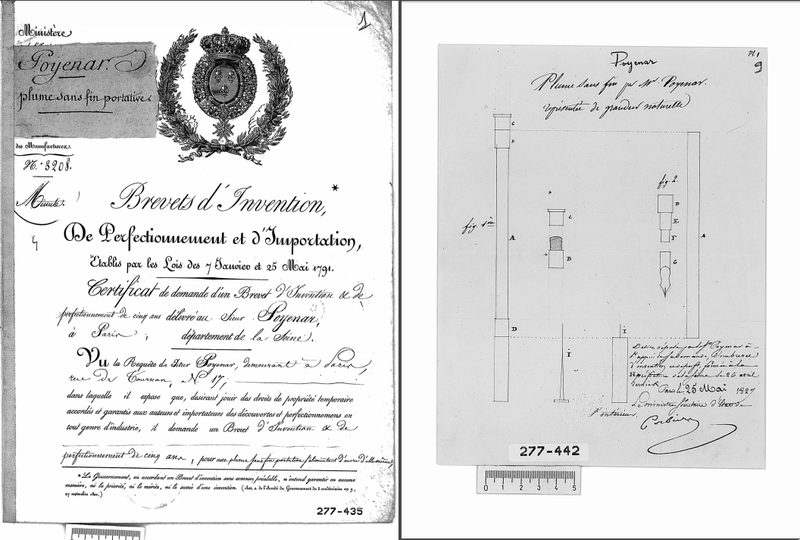
The application is filed under the name “Pierre Poyenar” on 26 April 1827, in the published reading of the INPI file. On 25 May 1827 the Manufactures Department of the French Ministry of the Interior registers the invention under file 3,208, as a five-year patent.
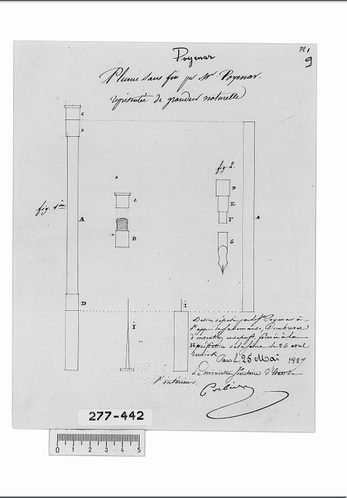
The title, in the document's French: plume portable sans fin, qui s'alimente elle-meme avec de l'ancre – the endless portable quill, feeding itself with ink. Plate 1 shows the pen “full size”, its parts lettered A to I.
Plume portable sans fin, qui s'alimente elle-meme avec de l'ancre.
the patent title, 25 May 1827
Meanwhile: Meanwhile, in Birmingham: in 1828 Josiah Mason makes a cheap slip-in nib, and from 1830 steel nibs are mass-produced.
Chapter III
The train
1830–1841 · England and the return home
- Chapter
- 1830–1841
- Liverpool–Manchester opens
- 15 September 1830
- The train letter
- 27 October 1831
- Travellers in one train
- 240
- First algebra course
- 1841
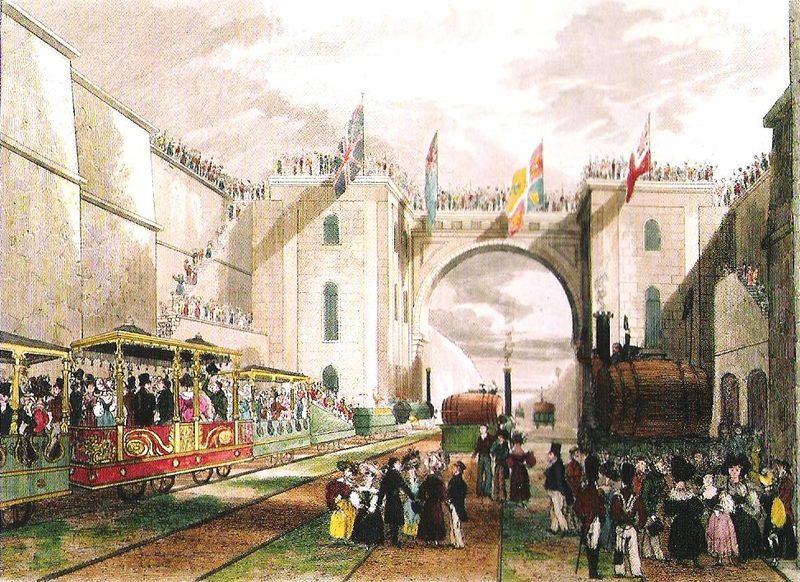
After the patent, Poenaru finishes his studies in England. On 15 September 1830 the Liverpool–Manchester line opens, the first passenger railway in the world, and Poenaru boards a train and writes home.
The letter of 27 October 1831 keeps the whole wonder: twenty carriages bound together, with 240 people, pulled by a single steam engine. He is counted the first Romanian who ever travelled by train.
Back home, he keeps the scholarship's pledge: he organises schools, founds the college in Craiova, and in 1841 prints the first algebra course in Romanian for Wallachia.
I made this journey by a new means of transport, one of the wonders of this century's industry: twenty carriages bound together, loaded with 240 people, pulled at once by a single steam engine.
letter from England, 27 October 1831
Meanwhile: Meanwhile, in America and England: in 1832 John Jacob Parker patents a pen with a screw-driven piston.
Chapter IV
The trace
1848–2010 · schools, academy, memory
- Chapter
- 1848–2010
- The 1848 revolution
- 12 July 1848
- Romanian Academy member
- 1870
- Dies in Bucharest
- 2 October 1875
- The postage stamp
- 2010, 5 lei
In 1848 Poenaru joins the Commission for freeing the Roma slaves and signs “P. Poenaru” on its first communiqué, on 12 July 1848, beside Iosafat Snagoveanul and Cezar Bolliac. The original is kept at the National History Museum of Romania.
Then come decades of schools: the School Board, the Pantelimon Agriculture School of 1835, the Bridges and Roads School of 1867, and in 1870 the Romanian Academy elects him a member. He dies in Bucharest on 2 October 1875.
His memory stayed tied to the pen: Bucharest's Petrache Poenaru metro station bears his name, and in 2010 Poșta Română honoured him with a 5 lei stamp, the inventor beside his pen drawing.
P. Poenaru
signature on the Commission's first communiqué, 12 July 1848
Meanwhile: Meanwhile, in America: in the 1880s the mass-production era begins, with Waterman and Wirt, and Waterman stays market leader into the early 1920s.
The patent, line by line
The certificate and plate below are file 3,208, as kept in the INPI archive. The filed name is “Poyenar”, the address is Paris, rue de Tournon 17, and the term is five years.
Six lines explain the mechanism, each lighting its parts on the diagram. Press a line and follow the letters.

-
Tube A is a large swan quill, of the brushmakers' sort for map notes. It holds the ink: the reservoir is quill, not metal.
-
At the top of the quill sits a thin metal tube, B, screwing into cap C. Unscrew the cap and pour the ink inside.
-
The barrel's lower end enters the three-step metal tube D, E, F. Step E grips the goose quill G, cut like an ordinary quill, which can be replaced at any time with a quill alike or a metal nib.
-
When you stop writing, you fit the metal cap H over the nib. In the cap's bottom is soldered the long needle I, which enters quill G and plugs the little hole in the base of piece F: no ink can escape.
-
Here is the whole feed: you need not shake the pen, only squeeze tube A with your fingers, and the ink passes through the little hole in F toward the nib. That is all – one small hole, with no device metering the flow.
-
Being quill rather than metal or glass, the pen is much lighter and harder to break, and the trouble heat makes for metals never appears.
The diagram that writes
Letters as on Plate 1. Press and hold the button: tube A squeezes, the ink sinks, a drop sets off toward the nib.
Patent honesty: the pen has no capillary feed. As historian David Nishimura notes, nothing meters the flow – “just a small hole through which it can drip”.
Does it write?
Four failures from 1827. Each has two cures: one from the patent text, one from the future. Choose the 1827 one.
-
1
The stained pocket
You pocket the pen like a pencil and ink creeps onto your coat.
The answer
The patent seals with needle I, soldered into the bottom of cap H. Vulcanised rubber is decades in the future.
-
2
The dry nib
You are writing and the ink line thins, then stops.
The answer
The patent text says it plainly: no need to shake – squeeze tube A and the ink comes to the nib.
-
3
The worn quill
Nib G has worn down and scratches the paper.
The answer
Step E is made for swapping: quill G slides out and back in tight, like a spare.
-
4
The cold morning
On a frosty morning, your classmates' metal pens misbehave.
The answer
The patent promises exactly this: the quill tube escapes the trouble heat and cold make for metals.
Pick a cure on every card.
The figures
Six numbers hold the whole story.
- 1,799
- is born at Benești, in Vâlcea
- 1,827
- the “Poyenar” patent in Paris
- 3,208
- the patent file's number
- 240
- people in one steam-hauled train, in the letter from England
- 1,848
- signs the freeing at Bucharest
- 2,010
- the year of the Poșta Română stamp
Four myths, briefly
“The first fountain pen in the world”
Not quite: in May 1809 Frederick Fölsch took the first English reservoir-pen patent, 18 years earlier, and Bion had drawn a “plume sans fin” back in 1709. What stays Poenaru's: the first French reservoir-pen patent granted to a Romanian, and the first pen whose swan-quill barrel you squeeze with your fingers.
“Patent number 3,208”
The digits are on the document, but they are not a patent number in today's sense: before 1844 French patents had no numbers, and 3,208 is the file reference. The researchers who pulled the file from the INPI archive say the same.
“First in Vienna”
They say he patented first in Vienna, then in Paris, but nobody shows any Viennese number, date, or document. Until proof appears it stays undocumented – which is why it appears nowhere on this page as fact.
“The real inventor is Waterman”
Half true: only in the 1880s, with Waterman and Wirt, does the capillary-feed pen become a mass-produced object – and Poenaru's pen, with no feed and no production run, never lived to see it. Waterman is the father of the practical pen; Poenaru keeps the loveliest idea of 1827.
Sources and method
Every date and figure comes from the two Wikipedia articles (English and Romanian) on Poenaru, from the fountain-pen history, and from the patent file seen in the INPI archive, through the Commons scan.
The mechanism is told from the English translation of the patent description, published in 2013 by historian David Nishimura, with short attributed excerpts; the French title is quoted in the document's spelling.
What could not be proven was left aside and marked undocumented – above all the supposed Vienna patent.
The copyist
The patent
- 25 May 1827, file 3208, 'plume portable sans fin, qui s'alimente elle-meme avec de l'ancre'
- The title in modern spelling, 'the endless portable quill'; the invention was never mass-produced
- Scan of the certificate and Plate 1 ('No. 3208', 'de cinq ans', 'Poyenar', rue de Tournon 17)
- Filed 26 April 1827; 3208 is the file reference, French patents had no numbers before 1844
The train
The trace
The game
The pictures
- Petrache Poenaru by Constantin Lecca, 1868, public domain · Wikimedia Commons
- Tudor Vladimirescu by Theodor Aman, public domain · Wikimedia Commons
- The railway opening by I. Shaw Jr., September 1830, public domain · Wikimedia Commons
- The patent file, INPI scan via Commons, CC BY-SA 4.0 MariusOrion · Wikimedia Commons
- Plate 1 from file 3,208, CC BY-SA 4.0 MariusOrion · Wikimedia Commons


