
Romania’s price list of 15 February 1982, next to today’s shelves
Bread took about the same work. Coffee took eight times more.


On 15 February 1982, Ceaușescu’s Romania printed its new state food prices in the newspapers. Turned into minutes of work at the average wage, they say two things: a kilogram of the cheapest bread took 12 min of work, and today it takes 14 min. A kilogram of coffee took 16 h; today it takes 1 h 56 min.
Of the 26 items on the list still sold today, 22 now take less work and 3 show no clear difference. The only one that takes more, black bread, has since become a pricier variety.
How many minutes of work each item took#
Each row is an item on the list, with its own line from the newspaper. The upper bar shows minutes of work in February 1982, the lower bar minutes of work today, at the median shop price. Tap a row for details.
Rows run from the items that took the most work in 1982, compared with today, to those that took the least.
Leave empty for the average net wage: 5,266 lei. The 1982 column stays at that year’s average.
February 1982November 2026
Your basket, on the 1982 receipt#
Pick what you buy. The receipt adds up the 1982 prices and today’s, and turns both into work at each era’s average net wage.
- Cheapest bread, 1 kg
- White loaf, 400 g
- White flour, 1 kg
- Cornmeal, 1 kg
- Rice, 1 kg
- Pasta, 500 g
- Milk, 1 l
- Yoghurt, 200 g
- Butter, 200 g
- Telemea (white brined cheese), 1 kg
- Cașcaval (yellow cheese), 1 kg
- One egg
- Pork, 1 kg
- Whole chicken, 1 kg
- Summer salami (dry sausage), 1 kg
- Sugar, 1 kg
- Sunflower oil, 1 l
- Ground coffee, 1 kg
- Milk chocolate, 100 g
- Lager, 0.5 l
- Pepsi, 250 ml
- Mineral water, 1 l
- Oranges, 1 kg
- Bananas, 1 kg
- Lemons, 1 kg
- Potatoes, 1 kg
What the list left out#
A price on a list does not say whether the item was in the shop. According to the researcher Corina Buțea, ration cards for bread, milk, oil, sugar and meat were brought back in autumn 1981. Decree 306 of 9 October 1981 made it a crime, punishable by six months to five years in prison, to buy oil, sugar, flour, cornmeal, rice or coffee “for stockpiling” beyond a family’s needs for one month. The minutes above are minutes of work; the hours spent queuing are not counted.
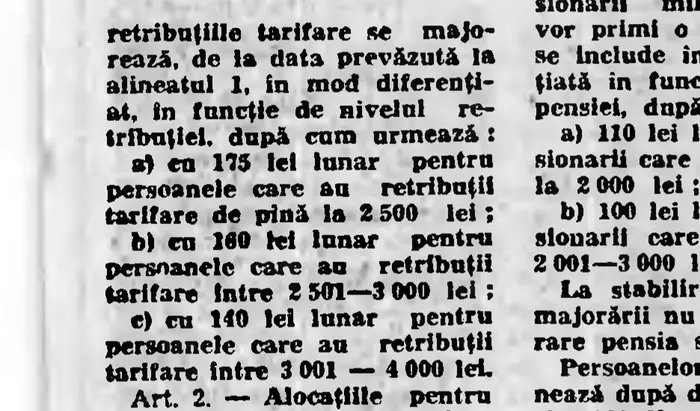
The list of 15 February 1982 recorded a price rise. The decree says retail food prices “rise on average by about 35 per cent”. In the same issue a second decree granted compensation: the basic pay of manual workers and foremen rose by 210 lei a month in mining, steel and heavy work and by 190 lei elsewhere; other staff got 175, 160 or 140 lei, more for lower pay and nothing above 4,000 lei. Against the 1981 average net wage of 2,340 lei, these amounts are 6% to 9%.
In July 1981 the party leadership ordered the 46-hour week to be made general that year, with a move to 44 hours to start in 1982. The calculation uses 46 hours for 1982 and 40 for today, as the Labour Code sets. So an hour of work at the average net wage was worth 12.67 lei in 1982 and is worth 30.38 lei today.
Limits of the comparison#
Some items have changed places on the shelf. Black bread was the cheapest bread; today it is a pricier variety, so it appears in two rows. The 1982 parizer (a bologna-type sausage) was made of beef, while the cheapest parizer today is made of poultry, so it is left out. Margarine and Carpați cigarettes stay only as references.
Today’s prices differ from shop to shop. For each item, the cheapest equivalent product in each shop was scaled to the 1982 quantity, then the median across shops was taken. The rows also show the range that holds half the shops.
Some 1982 prices were “bottle not included” or “jar not included”: the container was paid separately and returned. Today’s prices include packaging, which slightly favours 1982.
Today’s wage is the 2025 average, the latest full year published by Romania’s statistics institute (INS), while prices are from November 2026, which favours 1982. INS also publishes a monthly average, computed differently; for 2026 it shows 5,723 lei, which would make today’s minutes smaller still.
An item is marked “dearer in 1982” or “dearer today” only if it stays so in all 18 versions of the calculation: the 2025 annual wage or the 2026 monthly mean; a 46-, 40- or 48-hour week in 1982; the median, low or high shop price. Otherwise it says “no clear difference”, even when the main version shows one.
The calculation uses the average net wage. Many people earn less. For someone earning half today’s average wage, today’s minutes double: coffee and sugar stay far cheaper than in 1982, but milk, telemea, yoghurt, mineral water, Pepsi and bread end up taking more work than in 1982. You can enter your own wage in the field above the list.
The 1982 list gives prices in state shops; peasant markets had other prices. Today’s prices come from the chains that report to the price monitor: Auchan, Carrefour, Cora, Kaufland, Lidl, Mega Image, Penny, Profi, Selgros and Supeco. Small shops and markets are not covered.
Method#
The 1982 prices come from Annex 1 of the decree (potatoes from Annex 2), printed in Scînteia Tineretului of 15 February 1982. All 240 lines were transcribed twice, independently, from the 300 dpi scan; 228 prices matched. The 12 differences were checked on an enlarged image; none is among the items on this page. The decree took effect on 15 February 1982.
Minutes of work = price ÷ (average net monthly wage ÷ legal hours in a month) × 60. For 1982: 2,525 lei a month and a 46-hour week. For today: 5,266 lei a month (2025 average, INS) and a 40-hour week. A month has 52 ÷ 12 weeks.
Today’s prices were taken on 8 November 2026 from Monitorul Prețurilor, the price monitor run by Romania’s Competition Council, for the shops of the ten chains that report to it, in Bucharest, Cluj-Napoca, Iași, Timișoara, Constanța, Craiova, Brașov, Galați, Suceava, Bacău and Oradea. The matching rule was fixed before the pull: the same product and the same fat content or grade as in 1982, no organic or flavoured varieties. The rule was applied both to the monitor’s catalogue name and to the shop’s own label, which also gives the quantity; rows with an unclear unit were left out.
Sources#
- Decree on retail prices of agro-food products and its Annex 1, Scînteia Tineretului no. 10176, 15 Feb 1982, pp. 1–3 (scan: Biblioteca Județeană „Ovid Densusianu” Hunedoara-Deva)
- Average net monthly wage 1950–1990 (INS series), Annex 7 to Law 263/2010 on the public pension system
- INS TEMPO, table FOM106H: average net monthly earnings, whole economy, 2025; FOM106G: monthly series 2025–2026
- Monitorul Prețurilor, Consiliul Concurenței: shelf prices in 11 county seats, pulled on 8 Nov 2026
- Scînteia no. 12097, 15 Jul 1981, p. 1: the 46-hour week to be made general in 1981
- Labour Code (Law 53/2003), art. 112: 8 hours a day, 40 hours a week
- Corina Buțea, „Ideea de coadă în memorialistică”, Studium VII, 2014: ration cards from autumn 1981
- Decree 306 of 9 Oct 1981 on hoarding food (text of Buletinul Oficial no. 77)