Emil Racoviță and the Belgica, 1897–1899
A Romanian, a ship, and the first Antarctic winter
In 1898 the Belgica froze into the Bellingshausen pack ice with a Romanian naturalist aboard. Thirteen months of drift, a polar night, two deaths – and the science that founded a discipline. Read the voyage, then the expedition's own photographs.
The voyage in four chapters
Representative route
From Rio to the Bellingshausen Sea
In August 1897 the Belgica sailed from Antwerp with a Romanian naturalist, Emil Racoviță, as its scientist. By March 1898 the ship was frozen fast in the Bellingshausen pack ice, beginning the thirteen months of drift and the polar night below.
The routes on the map are representative, drawn through the verified places of the voyage. The photographs further down are the expedition's own, published in 1900.
Chapter I
The naturalist
1868 – 1897 · 1868–1897, the making of a naturalist
- Chapter
- 1868 – 1897
- Born in Iași
- 15 November 1868
- The Belgica sails
- 16 August 1897, Antwerp
- Joins the ship
- Punta Arenas
Emil Racoviță was born in Iași on 15 November 1868 and trained in Paris, then at the Arago marine laboratory in Banyuls-sur-Mer, under Henri de Lacaze-Duthiers. When the Belgian naval officer Adrien de Gerlache went looking for a naturalist for his Antarctic expedition, Racoviță came recommended by Henryk Arctowski, by Lacaze-Duthiers, and by Édouard van Beneden – and the invitation arrived by letter.
The ship was a converted Norwegian whaler, the Patria of 1884, bought in 1896, refitted and renamed Belgica. She sailed from Antwerp on 16 August 1897 – without her naturalist, who had gone ahead from Rio de Janeiro on a faster ship and rejoined at Punta Arenas, the last supply stop.
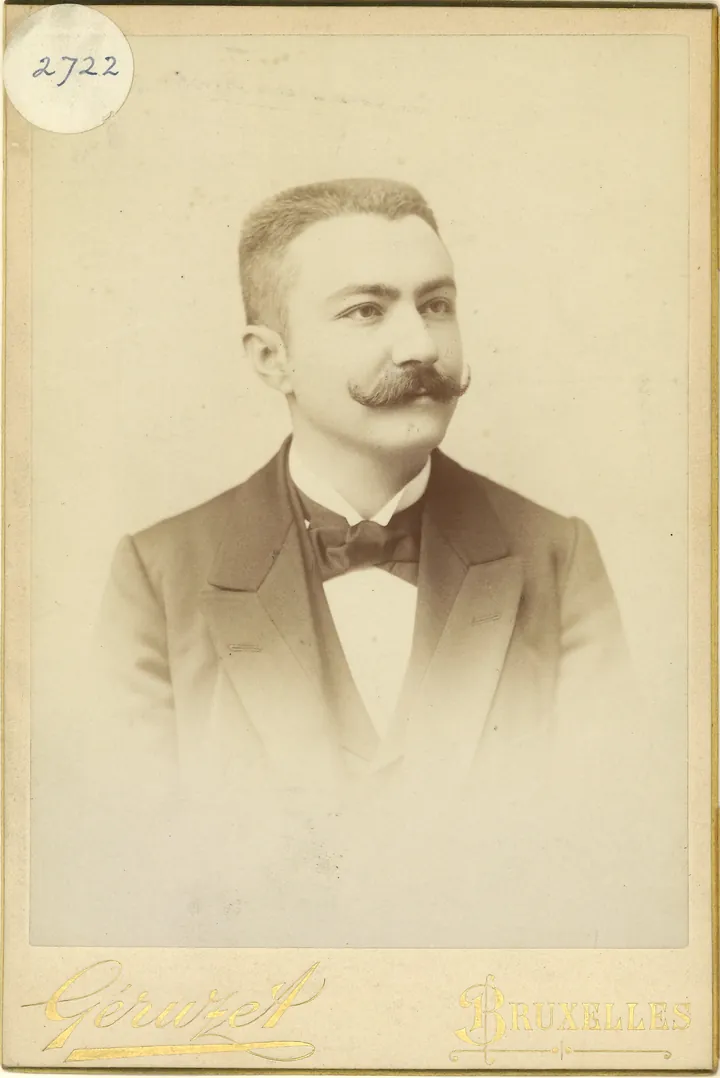

Racoviță was the expedition's only naturalist: zoologist and botanist, keeper of the shipboard laboratory. Aboard with him were a young Norwegian first mate, Roald Amundsen, and an American surgeon who doubled as photographer, Frederick Cook – names the polar night would make famous.
The aim of antarctic expeditions must, for the present, be scientific. It is of far less importance to reach high latitudes in those quarters than to bring as much scientific information as possible.
Emile Racovitza, Appendix I in Cook (1900), p. 409
Meanwhile Racoviță was 28 when the Belgica sailed from Antwerp.
Chapter II
The way south
1897 – 1898 · 1897–1898, south to the ice
- Chapter
- 1897 – 1898
- The Circle crossed
- 15 February 1898
- Landings
- some 20
- Beset in the ice
- 2–5 March 1898
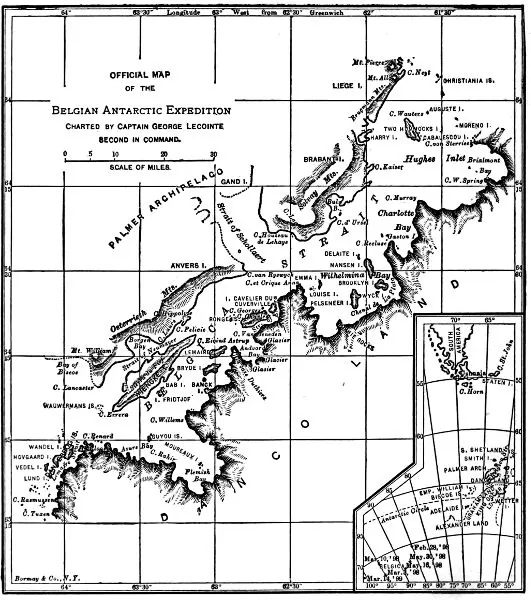
From Punta Arenas the Belgica worked south into uncharted water. Between 23 January and 12 February 1898 the expedition made some 20 landings, charting the strait de Gerlache first called Belgica Strait – the Gerlache Strait of today's maps.
On 15 February 1898 the ship crossed the Antarctic Circle. In January a Norwegian seaman, Carl August Wiencke, had already been washed overboard – Wiencke Island keeps his name. Along the strait the naturalist watched penguins in their thousands: Cook put one colony at 40,000 birds.
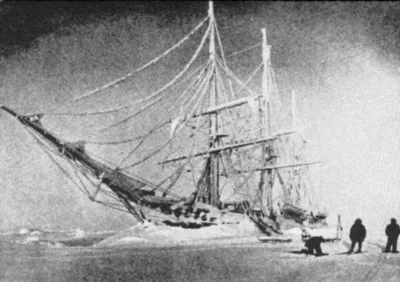

Pushing west past the strait, the Belgica entered thick pack ice on 28 February 1898 and was beset within days – the sources give 2 to 5 March – near Peter I Island, at 70°20′ S, 85° W. There was no way back: the expedition would winter where the ice carried it.
Meanwhile Wiencke Island and Danco Island are both named for men of this voyage.
Chapter III
The night
1898 – 1899 · 1898–1899, the polar night
- Chapter
- 1898 – 1899
- The polar night
- 17 May – 23 July 1898
- The dead
- 2: Danco and Wiencke
- Free of the ice
- 14 March 1899
The sun set on 17 May 1898 and did not return until 23 July. Cook diagnosed what he called polar anaemia: pallor, heart and head complaints, men unable to concentrate. De Gerlache and Lecointe grew so ill they wrote their wills; Cook and Amundsen took command. The cure was fresh meat – raw penguin and seal, rich in a vitamin C no one had yet named.
Two men died. Lieutenant Emile Danco, worn by a weak heart and exhaustion, died on 5 June 1898 – Danco Island keeps his name. And the darkness broke at least one mind: Cook wrote of a sailor forced 'to the verge of insanity', who recovered with the returning sun; the Norwegian seaman Adam Tollefsen, taken by paranoia and delusions, had to be institutionalised on the return.
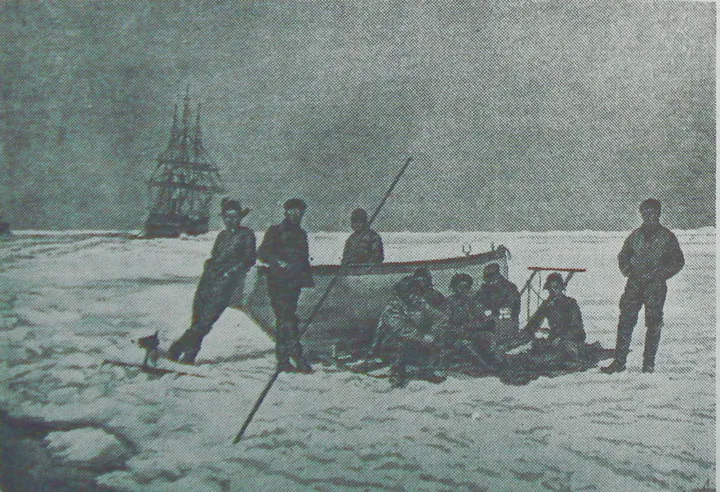

When the sun came back, the ice did not release the ship. Explosives failed in the cold – tonite, Cook wrote, 'will cut no ice' – so sixteen men sawed a canal of some 2,200 feet through ice up to seven feet thick, eight hours a day from the evening of 11 January 1899. The Belgica stirred on 14–15 February and stood clear of the ice on 14 March 1899, at 70°30′ S, 103° W.
It is but slowly that this blackness of the polar night is dissolved by the whiteness of the coming day... We have all felt the effects of the night severely. The death of Danco, and also the insanity of a sailor, are due to this withdrawal of light.
F. A. Cook, Through the First Antarctic Night (1900), ch. 27, p. 365
If we are to get freedom, we must seek it by our own muscular efforts with the saw and the axe.
F. A. Cook, Through the First Antarctic Night (1900), p. 395
Meanwhile The sawn canal measured some 2,200 feet – over 650 metres.
Chapter IV
The legacy
1899 – 2011 · 1899–2011, the science and the names
- Chapter
- 1899 – 2011
- Cétacés
- 1903
- The Cluj institute
- 26 April 1920
- Law-Racoviță
- 2006
The Belgica reached Punta Arenas on 28 March 1899 and Antwerp on 5 November 1899, to state honours. Racoviță came home with 1,200 zoological and 400 botanical samples – the first collections ever made beyond the Antarctic Circle – including the type specimens of the flightless midge Belgica antarctica and of the hairgrass Deschampsia antarctica.
The whale monograph Cétacés (1903) stayed the reference work for years; 74 specialists worked through his material. A 513-page seals manuscript stayed unfinished in Bucharest. And the caves came next: the 1907 Essai founded biospeleology, and the law of 26 April 1920 raised the world's first speleological institute at Cluj, under his direction until his death in November 1947.
.jpg)
The honours followed the man. Louis Dollo named a Southern Ocean fish genus Racovitzia for him in 1900; three islands off Graham Land bear the French spelling, Racovitza; and Romania's Antarctic station, raised on the Larsemann Hills in 2006, is the Law-Racoviță Station – Law-Racoviță-Negoiță since December 2011.
Meanwhile The station bearing his name works only in the southern summer.
The Belgica quiz
Four questions about the ice, the night, and what came home. Choose, then check against the sources.
-
1
The trap
The pack ice closed around the Belgica in:
What happened
March 1898. Beset between 2 and 5 March at 70°20′ S, 85° W, the Belgica drifted for some thirteen months and stood clear of the ice on 14 March 1899.
-
2
The polar night
The sun stayed below the horizon for:
What happened
17 May to 23 July 1898. Darkness, tinned food and cold wore the crew down to what Cook called polar anaemia – cured by fresh penguin and seal meat.
-
3
The cure
What saved the crew from scurvy?
What happened
Raw penguin and seal meat. Cook prescribed fresh meat – vitamin C, though no one knew it yet – and de Gerlache and Lecointe, who had written their wills, recovered.
-
4
Cluj
In 1920 Racoviță founded at Cluj:
What happened
The world's first speleology institute, by the law of 26 April 1920. Romania's Antarctic station, Law-Racoviță, followed in 2006.
Answer a card to begin.
Seven photographs from the ice
Seven expedition photographs, in the order of the voyage: the ship, the laboratory, the sawn canal, the winter's mark on faces, the chart, the commander, the mate. Tap a photograph to study it – or read the whole voyage straight through.
Photograph 1898The ship in the ice
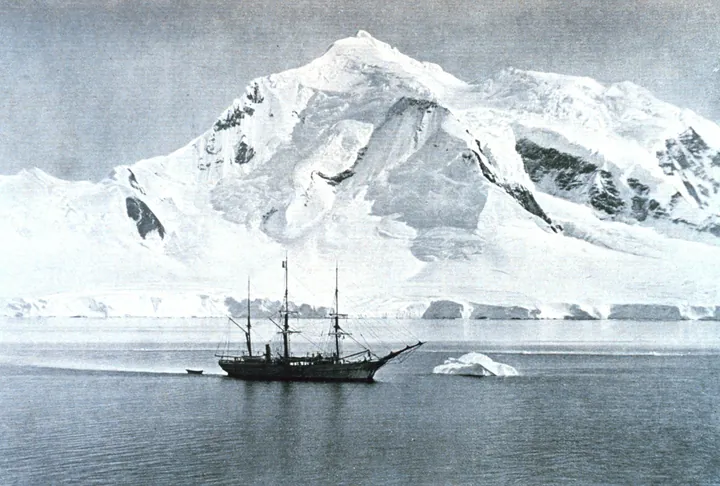
The ship in the ice Frederick Cook, 1898 · Wikimedia Commons - The Belgica in Antarctica, 1898, photographed by Frederick Cook – surgeon, anthropologist and photographer in one.
- A converted Norwegian whaler, the Patria of 1884: bought in 1896, refitted, renamed.
- She sailed from Antwerp on 16 August 1897 and came home on 5 November 1899.
Photograph Cook 1900, p. 208The laboratory
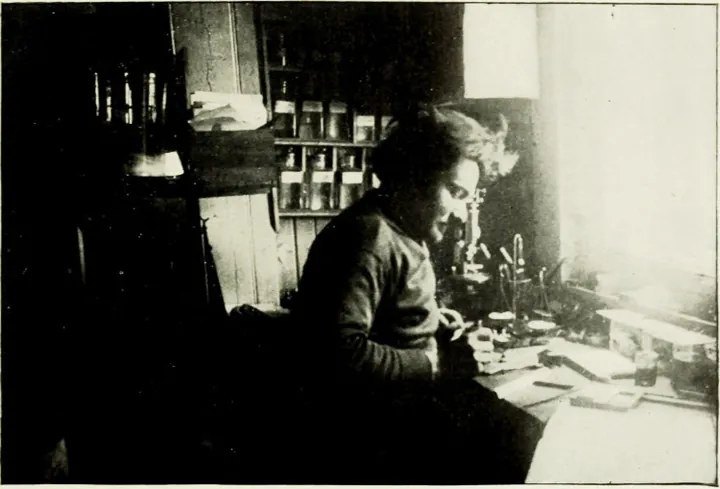
The laboratory Cook (1900), p. 208 · Project Gutenberg - Racovitza at the microscope: the shipboard laboratory where the only naturalist worked through two polar summers of collecting.
- 1,200 zoological and 400 botanical samples – the first ever gathered beyond the Antarctic Circle.
- Cook (1900), p. 208.
Photograph 1899The sawn canal
The sawn canal Frederick Cook, 1899 · Wikimedia Commons - January 1899: the crew sawed a canal of some 2,200 feet to open water – Cook's photograph of the 'five o'clock tea' rest.
- Explosives had failed in the cold; sixteen men sawed eight hours a day, through ice up to seven feet thick.
- The ship stirred on 14–15 February and stood clear on 14 March 1899.
Photograph Cook 1900, p. 360Before and after
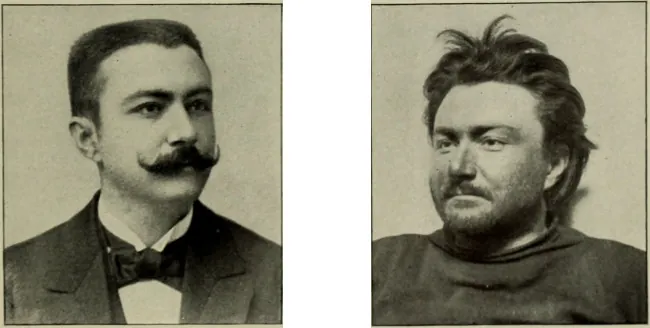
Before and after Cook (1900), p. 360 · Project Gutenberg - Racovitza at embarkation and after the polar night: the winter's mark on one face.
- The same pairing exists for Amundsen and for Cook – the book's quiet argument about what the night cost.
- Cook (1900), p. 360.
Photograph Lecointe 1900The expedition chart
The expedition chart Georges Lecointe, in Cook (1900) · Project Gutenberg - Georges Lecointe's chart of the voyage: the strait, the landings, the drift.
- Lecointe fell so ill in the night that he wrote his will – and recovered on Cook's fresh-meat cure.
- In Cook (1900), frontispiece map.
Photograph BnFThe commander
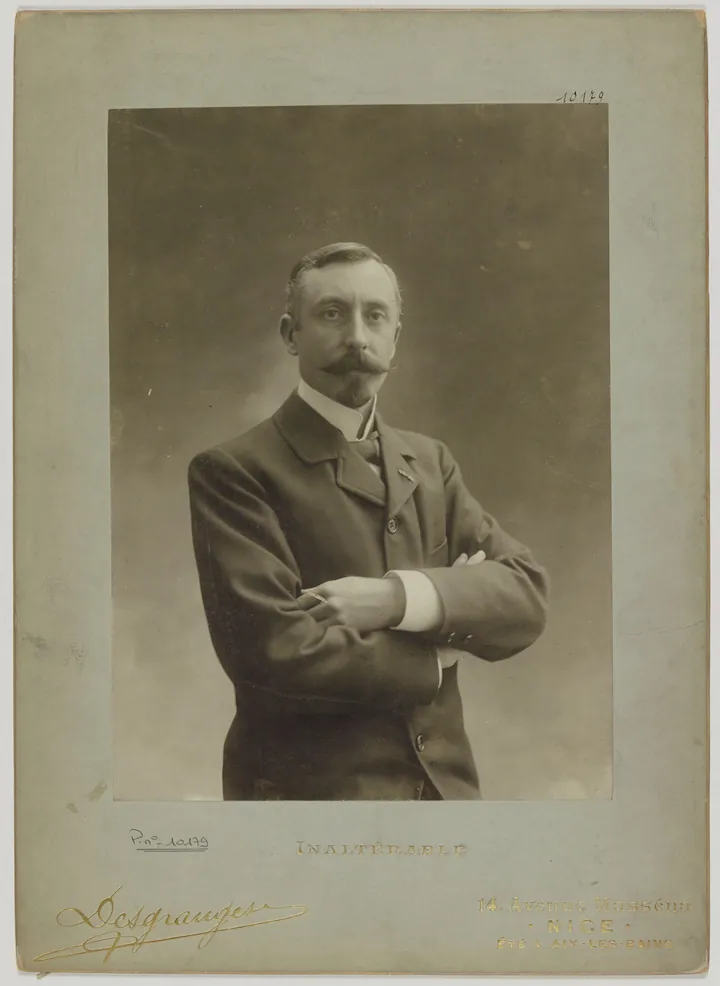
The commander André Desgranges (BnF) · Wikimedia Commons - Adrien de Gerlache, photographed by André Desgranges. BnF.
- He planned a scientific expedition and got an involuntary winter – the first in the Antarctic region.
- Antwerp welcomed the Belgica home with state honours on 5 November 1899.
Photograph Cook 1900, p. 360The mate
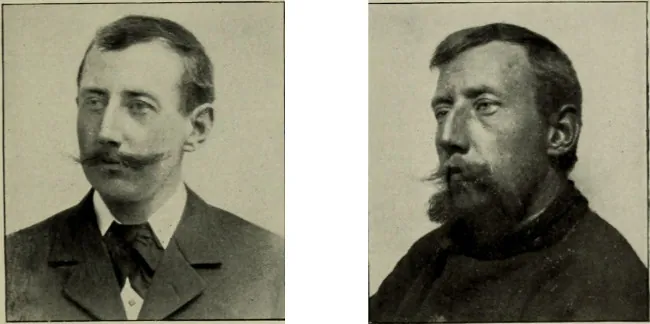
The mate Cook (1900), p. 360 · Project Gutenberg - Roald Amundsen, the Norwegian first mate, at embarkation and after the night.
- With Cook he took command while de Gerlache and Lecointe lay ill.
- Cook (1900), p. 360.
Photographs: F. A. Cook, Through the First Antarctic Night (Heinemann, London, 1900), via Project Gutenberg; portraits via Wikimedia Commons (MAS Antwerp, BnF). Page numbers are the book's.
The voyage in six numbers
Every figure below comes from the cited histories and the expedition's own book. Disputed figures stay out.
- 1,897
- Belgica sails from Antwerp
- 13
- months adrift in the pack
- 1,600
- samples brought home, zoological and botanical (1,200 + 400)
- 71°36′
- farthest south, 31 May 1898
- 2
- dead: Wiencke and Danco
- 1,920
- the Cluj institute, first in the world
Three things people get wrong
The first Romanian in Antarctica
True, in the standard telling: Racoviță was the first Romanian on a scientific expedition to Antarctica, and the station naming honours him as the first Romanian to reach the continent. No earlier claimant is known.
The first to winter in Antarctica
True with a qualifier: the Belgica was the first expedition to winter in the Antarctic region – involuntarily, aboard ship, frozen in pack ice. The first to overwinter on the continent was Borchgrevink's Southern Cross at Cape Adare in 1899.
Racoviță discovered it
Half true at most: he described the blind cave isopod Typhlocirolana moraguesi in 1905, but the Antarctic fish genus Racovitzia was named for him by Louis Dollo in 1900 – do not turn the honour around.
Sources and methods
Cook is quoted from Through the First Antarctic Night (Heinemann, London, 1900), public domain; the expedition photographs come from the same book, via Project Gutenberg. The Romanian renderings are our own.
The beset date is given as the 2–5 March 1898 range the sources support; the freed date, 14 March 1899, is Cook's. Positions are the published ones: 70°20′ S, 85° W beset, 70°30′ S, 103° W freed.
Racoviță's later, speleological life has its own page in this catalogue, listed among the sources.
The naturalist
The way south
The night
- F. A. Cook, Through the First Antarctic Night (1900): the polar night, polar anaemia, the deaths, sawing the canal (public domain)
- Machowski (1998): the c.13-month drift, 71°36′ S on 31 May 1898, freed on 14 March 1899 (PDF)
- Wikipedia, Belgian Antarctic Expedition: Punta Arenas, 28 March 1899; Antwerp, 5 November 1899
The legacy
- E. Racovitza, Cétacés (1903) and La vie des animaux et des plantes dans l'Antarctique (1900): 1,200 zoological + 400 botanical samples
- The law of 26 April 1920: the Cluj Speleology Institute, the first in the world; the Essai (1907)
- Wikipedia, Racovitzia: the fish genus named for Racoviță by Dollo, from 1900
- The Racovitza Islands (SCAR, 3 islands at 64°31′ S, 62°05′ W) and Law-Racoviță Station (2006, Law-Racoviță-Negoiță since 2011)
- The companion page in the catalogue: the speleology institute of 26 April 1920
The seven photographs
Images
- Géruzet, expedition portrait (MAS) · Wikimedia Commons
- Frederick Cook, 1898 · Wikimedia Commons
- Belgica at Mount William, c.1898 · Wikimedia Commons
- Frederick Cook, 1899 · Wikimedia Commons
- André Desgranges (BnF) · Wikimedia Commons
- Cook (1900), p. 208 · Project Gutenberg
- Cook (1900), p. 360 · Project Gutenberg
- Cook (1900), p. 360 · Project Gutenberg
- Georges Lecointe, in Cook (1900) · Project Gutenberg
