On 8 February, a few hundred peasants came to Flămânzi town hall to sign the spring leases. A month later the army was shelling the villages of Oltenia. The death toll was never established: the records say one thing, the press another.
Published 18 September 2026 · Bilingual Romanian–English edition · Every date carries its calendar style
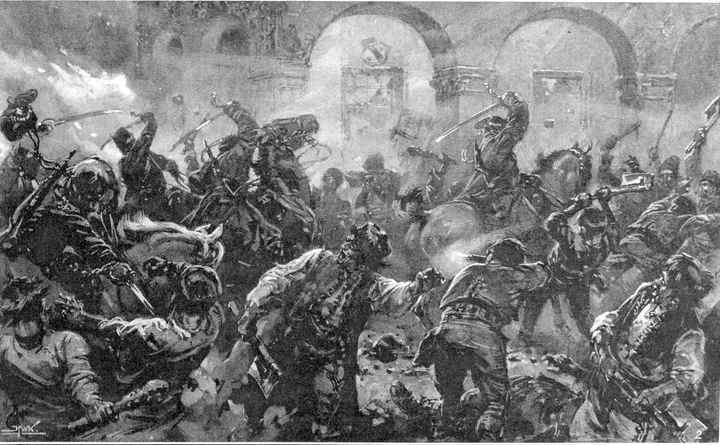
Cavalry clashing with peasants at Comănești: Illustrated London News, 6 April 1907. public domain · Wikimedia Commons
On 8 February 1907 (Old Style), a few hundred peasants came to Flămânzi to sign the leases — and beat the administrator when no contract came. Within three weeks Moldavia was burning; leaping the Milcov, the revolt erupted in Teleorman and Vlașca, peaking on 12–15 March; by 29 March, 140,000 soldiers were shooting peasants. The documented dead are counted in records — 419, 421, 1,786; the famous 11,000 come from the press.
Romanian dates of the period are Old Style (O.S.); Western ones are New Style (N.S.). 8 February O.S. = 21 February N.S.
I
Flămânzi
8–12 February 1907 (O.S.)
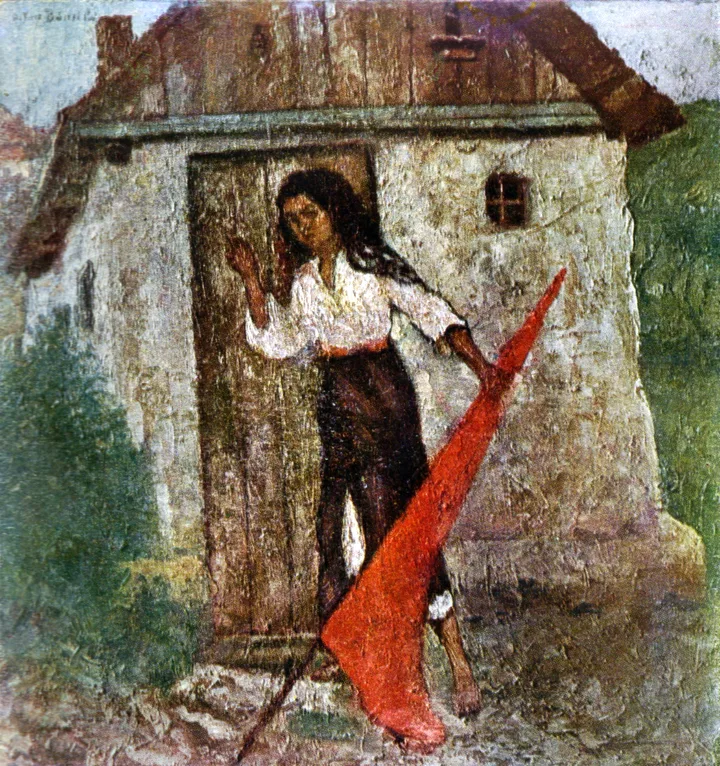
On the morning of 8 February 1907, between 400 and 500 inhabitants gathered at the town hall of Flămânzi, in Botoșani county. The estate administrator, Gheorghe Constantinescu, had summoned them to sign the spring farm leases. The estate of boyar Mihalaki Sturdza was leased to Mochi Fischer — the country's largest lease trust, with 11 estates — and contracts with the peasants of the estate's 22 villages had been suspended for months while Fischer's lawsuit against his rival Berman Juster ran its course.
The administrator drove past at 10–11, then the peasants were told he had gone to lunch. At about half past one they threatened to burn down the house he was in. Dragged out by force, Constantinescu promised the lessee would come; the crowd beat him on the head with sticks, leaving him unable to work for 15 days. Fischer fled to Cernăuți. Within days, Flămânzi had set Botoșani alight.
In the sources' own words
“On 8 February, 400-500 inhabitants gathered at Flămânzi town hall in the morning… some retorted that ‘if he is the administrator, why did he call them to stand hungry all day’.”
— Report of the Hârlău district communal inspector to the Botoșani prefect
Archival image: Peasants gathered before the storm: “Prevestirea răscoalei” by Octav Băncilă. public domain · Wikimedia Commons
II
The wave
February – 11 March 1907 (O.S.)
For three weeks the fire stayed in Moldavia: from Flămânzi across Botoșani county, then into Dorohoi and Iași, then into the other Moldavian counties. By early March the army was already being called for: a battalion of the 13th “Ștefan cel Mare” Regiment at Hârlău, cavalry squadrons at Deleni and Târgu Frumos, rifles at Cristești.
Past the Milcov, the revolt made a leap: it erupted in Teleorman, whence it spread into Vlașca and Olt. In Vlașca it began on 10 March and seized 52 of the county's 96 communes. It struck hardest in Buzău, Teleorman, Vlașca and Râmnicu Sărat; weaker in Muscel, Prahova and Dâmbovița.
In the sources' own words
“Whoever does not rise will get no land!” — the cry that carried the news from village to village.
— quoted in Crisia, Muzeul Țării Crișurilor, 1977
Archival image: A cavalry vedette waits on the Brăila highway for news of the rebels: Illustrated London News, 13 April 1907. public domain · Wikimedia Commons
III
The fire
12 March – early April 1907 (O.S.)
The Conservative government fell on 12 March; Dimitrie Sturdza's Liberals took power, with Ion I. C. Brătianu at the Interior and General Alexandru Averescu at War. On 18 March a state of emergency and general mobilization were decreed: by 29 March, 140,000 soldiers were under arms.
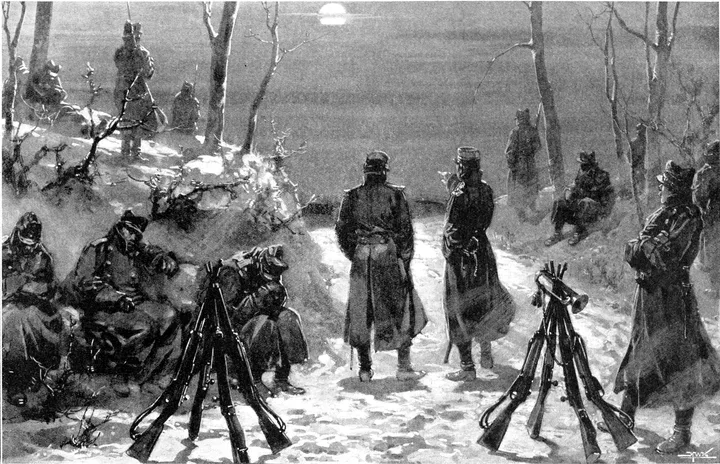
The army opened fire on the peasants — in Oltenia with artillery. Soldiers fell too: Sub-Lieutenant I. Nițulescu, killed at Stănești in Vlașca, two sergeants and seven soldiers; Captain Grigore Mareș, wounded also at Stănești. And 75 soldiers of the 5th “Vlașca” Dorobanți Regiment faced military courts on revolt charges: 61 were sentenced to hard labor for life, 14 to 5 years in prison each.
In the sources' own words
“Fully six hundred killed and four hundred wounded,” wired the London Daily News on 30 March.
— London Daily News, 30 March 1907, via Trofin 2016
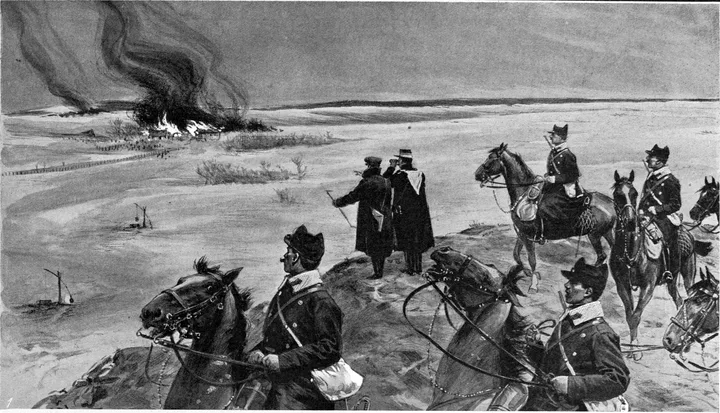
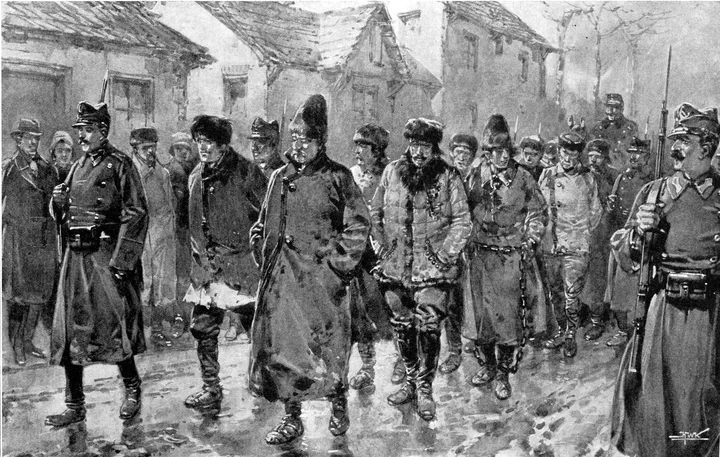
Archival image: A cavalry patrol watches rioters burn farmhouses near Bujeu: Illustrated London News, 6 April 1907. public domain · Wikimedia CommonsArchival image: Infantry escorts arrested peasants through Piatra Neamț: Illustrated London News, 13 April 1907. public domain · Wikimedia Commons
IV
The trace
April 1907 – April 1908
In April 1907 an aid table was drawn up at Giurgiu listing 4 dead inhabitants — two from Toporu, one each from Preajba and Băbăița — whose families had been left with no means of subsistence: they were granted relief of 20 to 60 lei. Their names did not survive in the papers that reached us; their communes did.
The government began reforms, but without expropriation: the farm-contracts law of 23 December 1907 capped rents, set minimum wages and founded Casa Rurală, for lots of 5 hectares each; on 12 April 1908 leasing more than 4,000 hectares at once was banned. Iorga, Vlahuță, Caragiale, Stere, Dobrogeanu-Gherea and Rosetti had protested; teachers, priests and the universal-suffrage militants Vasile Kogălniceanu and Alexandru Vălescu had been arrested.
In the sources' own words
“2 from Toporu and one each from Preajba and Băbăița” — the death table of a single county, April 1907.
— relief table, Giurgiu, via Studii și articole de Istorie, 2007
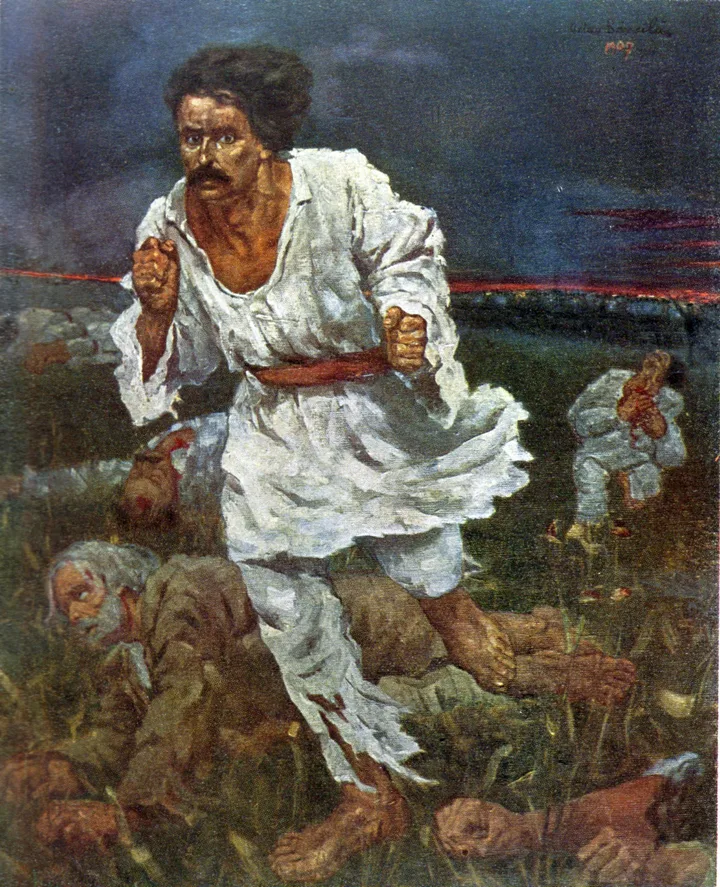
Archival image: “1907”: Octav Băncilă's canvas, painted in the year of the revolt. public domain · Wikimedia Commons
The spread map
Five weeks, from Flămânzi to the Danube. Every dot is a source-attested locality; the weeks are county-level approximations, Old Style.
Week 1 · Flămânzi8–15 February (O.S.)
attested locality
refuge (outside the theater)
Borders are today's, shown for reference; localities by real coordinates. The weeks are county-level approximations: exact commune dates remain, for the most part, undocumented.
Every locality on the map
Locality
County (1907)
Week
Basis
Cernăuți
Bucovina, Austro-Ungaria
Week 1
Fischer's refuge at Cernăuți (Feb 1907)
Copălău
Botoșani
Week 1
Hârlău inspector's report (Feb–Mar 1907)
Flămânzi
Botoșani
Week 1
Hârlău inspector's report (Feb–Mar 1907)
Frumușica
Botoșani
Week 1
Hârlău inspector's report (Feb–Mar 1907)
Rădeni
Botoșani
Week 1
Flămânzi–Frumușica–Rădeni villages, attested together
Botoșani
Botoșani
Week 2
Archives Review: Botoșani → Dorohoi, Iași
Dorohoi
Dorohoi
Week 2
Archives Review: Botoșani → Dorohoi, Iași
Hârlău
Botoșani
Week 2
Hârlău inspector's report (Feb–Mar 1907)
Iași
Iași
Week 2
Archives Review: Botoșani → Dorohoi, Iași
Suceava
Suceava
Week 2
Hârlău inspector's report (Feb–Mar 1907)
Bacău
Bacău
Week 3
Moldavia, the three weeks of February
Bârlad
Tutova
Week 3
Moldavia, the three weeks of February
Comănești
Bacău
Week 3
ILN sketches from the place (Apr 1907)
Focșani
Putna
Week 3
Moldavia, the three weeks of February
Galați
Covurlui
Week 3
Moldavia, the three weeks of February
Piatra Neamț
Neamț
Week 3
ILN sketches from the place (Apr 1907)
Vaslui
Vaslui
Week 3
Moldavia, the three weeks of February
Alexandria
Teleorman
Week 4
Crisia: the Milcov → Teleorman → Tulcea jump
Brăila
Brăila
Week 4
Independența Română: intensity map
Buzău
Buzău
Week 4
Independența Română: intensity map
Giurgiu
Vlașca
Week 4
National Museum: Vlașca, 10 March
Ploiești
Prahova
Week 4
Independența Română: intensity map
Roșiori de Vede
Teleorman
Week 4
Crisia: the Milcov → Teleorman → Tulcea jump
Râmnicu Sărat
Râmnicu Sărat
Week 4
Independența Română: intensity map
Stănești
Vlașca
Week 4
Stănești fighting (10 army dead)
Turnu Măgurele
Teleorman
Week 4
Crisia: the Milcov → Teleorman → Tulcea jump
Caracal
Romanați
Week 5
Independența Română: intensity map
Craiova
Dolj
Week 5
Independența Română: intensity map
Câmpulung
Muscel
Week 5
Independența Română: intensity map
Călărași
Ialomița
Week 5
Independența Română: intensity map
Pitești
Argeș
Week 5
Independența Română: intensity map
Slatina
Olt
Week 5
Independența Română: intensity map
Tulcea
Tulcea
Week 5
Crisia: the Milcov → Teleorman → Tulcea jump
Târgoviște
Dâmbovița
Week 5
Independența Română: intensity map
Weighing the numbers
Every source gives a death toll. Weigh each provenance: does it come from the records or is it an estimate? At the end only documented ground remains.
419 dead — the figure Ion I. C. Brătianu spoke in Parliament.
Answer: From the records.
The official figure, recorded in the parliamentary debates — historian Markus Bauer deems it greatly underestimated, but its presence in the records is undisputed.
421 dead between 28 March and 5 April — the data that reached Prime Minister Dimitrie Sturdza, plus 112 wounded and 1,751 detained.
Answer: From the records.
A government count for a precise interval — not a balance sheet of the whole revolt.
1,786 peasants shot — Major Gheorghe Dabija's 117-page report, drawn up in February 1910 from 32 files.
Answer: From the records.
The only file-based inquiry — but the files were 32, and the revolt had seized hundreds of communes.
11,000 dead — the figure fixed by the newspaper Adevărul, later repeated by communist historiography.
Answer: Estimate.
First it was 12–13,000 in Adevărul and Dimineața; then 11,000, with no concrete evidence — the figure of political opponents and of Roller's 1948 collection.
3,000–5,000 dead — the figures of the Austrian diplomats in Bucharest.
Answer: Estimate.
A diplomatic estimate from outside, with no access to records — valuable, but still an estimate.
10,000–20,000 dead — the figure of the French Embassy in Bucharest.
Answer: Estimate.
The widest range of all — a sign that nobody in Bucharest was truly counting.
Score: 0 of 6
Myths
“11,000 dead”
The figure comes from the press, not the records. Constantin Mille's papers, Adevărul and Dimineața, first wrote of 12–13,000 victims, then Adevărul fixed the number at 11,000 — with no concrete evidence. The figure was taken up by the political opponents of the King and the Liberals, and in 1948 by Mihai Roller's document collection. Archive studies point to 2–3,000 victims.
False as a toll: an unproven press figure.
“It was an antisemitic revolt”
At first, in northern Moldavia, anger also struck Jewish lessees — many lessees were Jewish, and the Fischer trust was the largest. But the revolt quickly lost its antisemitic character as it moved south and became a rising against the lease system. That is also how the British minister's reports from Bucharest read it.
Partly true at the start, false as an account of the whole revolt.
“The peasants got land after the revolt”
No. The 1907–1908 laws capped rents, set minimum wages, founded Casa Rurală and banned leases of more than 4,000 hectares — but expropriated not a single landlord. Land distribution would have to wait.
False: relief without expropriation.
The numbers
Six figures from the records — each with its source below.
1,907the year of the revolt
8February (O.S.): Flămânzi
22villages on the Flămânzi estate
140,000soldiers mobilized by 29 March
419dead — the Parliament figure
1,786shot — the Dabija report, 1910
Sources and method
Flămânzi
The Hârlău report: 8 February, 400–500 people at Flămânzi town hall, the beating of administrator Constantinescu (15 days incapacity), Dolhescu and the Roman Grosu brothers ro.wikipedia.org
The Fischer trust: 11 estates, the lease renewed 1 September 1906 to 1914, the Dieppe counter-offer (+60,000 lei), the court win on 20 January 1907, the 22 villages with suspended contracts ro.wikipedia.org
Fischer's flight to Cernăuți; the dual date 8/21 February; the peasants of Flămânzi, Frumușica, Rădeni and Storești en.wikipedia.org
The wave
Three weeks in Moldavia only, then the spread into Wallachia and Oltenia en.wikipedia.org
The leap from the Milcov into Teleorman, then Vlașca and Olt; Vlașca from 10 March, 52 of 96 communes; intensities by county biblioteca-digitala.ro
Finland, 15–16 March 1907: 19 women elected, the first women MPs in the world en.wikipedia.org
The fire
The government's fall on 12 March; Sturdza–Brătianu–Averescu; emergency and mobilization on 18 March; 140,000 soldiers by 29 March en.wikipedia.org
Artillery in Oltenia; 10 army dead (Nițulescu at Stănești), 4 wounded (Mareș at Stănești); 75 dorobanți tried, 61 to hard labor for life ro.wikipedia.org
Daily News, 30 March: “six hundred killed and four hundred wounded”; the London campaign and the British minister's reports www.europeanproceedings.com
The trace
The Giurgiu table, April 1907: 4 dead (2 Toporu, one each Preajba and Băbăița), relief of 20–60 lei biblioteca-digitala.ro
Laws without expropriation: 23 December 1907 (rents, Casa Rurală, 5-hectare lots) and 12 April 1908 (at most 4,000 hectares leased) en.wikipedia.org
The Hague, 15 June – 18 October 1907: the Second Peace Conference, 44 delegations en.wikipedia.org
11,000: from Mille to Roller (1948); archives point to 2–3,000. The antisemitic character lost southward. Reforms without expropriation. ro.wikipedia.org
The spread map
Natural Earth, 1:50m boundaries (public domain); today's borders for reference; weeks are county-level approximations www.naturalearthdata.com
Every fact on this page points to an open source, cited in SOURCES.md with the exact passage. Figures run identically in both editions; only the language differs.
What cannot be proven is marked as such: the map weeks are county-level approximations, and the nameless dead stay nameless — the communes of Toporu, Preajba and Băbăița are all the Giurgiu table left us.