December 1916 · Iași
The whole country moved to Iași
In December 1916 a town of 70,000 people took in a whole country: more than 300,000 souls, not counting the armies. Then came the typhus winter, with 500,000 cases and more than 300,000 dead in Moldavia.
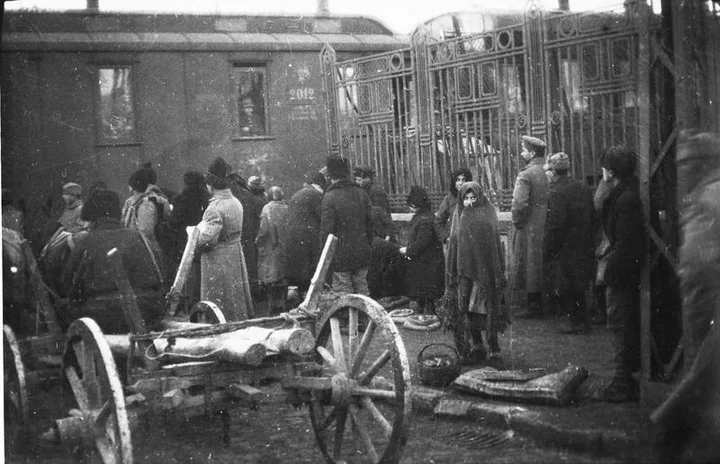
Four chapters, one exile
The road north, day by day
From the first special trains to the dying out of typhus: 230 days in which Romania moved to Moldavia. Drag the cursor and see which phase is lit each day.
·
„Whoever caught the train caught Moldavia.”
- 13.11.1916 The first special trains
The parliamentarians leave Bucharest on special trains, and some 4,000 boy scouts set off on foot for the 56 kilometres to Ploiești, through rain. - 30.11.1916 Headquarters leaves Periș
The General Headquarters evacuates from Periș, near Bucharest, and moves its command to Moldavia, to safety. - 06.12.1916 Occupation and residence
Bucharest and Ploiești are occupied by the Central Powers. At Iași, the queen chooses her residence in the Fourth Army Corps building. - 11.12.1916 Reunion at Zorleni
The queen meets her husband again at Zorleni, near Bârlad, after leaving Bucharest: the king had come with the headquarters from the retreat. - 28.12.1916 The treasure train
At 3 in the morning the train with 17 treasure cars, 200 guards and the National Bank delegates leaves Iași for Moscow. - 15.02.1917 February, the peak month
Not one day in particular: the whole month of February was the peak of the typhus epidemic. The cursor day is the middle of the month. - 30.06.1917 The winter ends
The epidemic is almost extinguished. The winter's account: some 500,000 typhus cases and more than 300,000 dead in Moldavia.
The same seven markers, day by day:
Four chapters, two years
Each chapter opens with a scene lived by real people, then sets the numbers beside it. Dates from the winter of 1916–1917 are new style; where the source gives the pair, the old style appears too.
The chapters hold the people, each with a name and a day.
Chapter I
The road north
2 November – 15 December 1916
Bucharest–Iași, by whatever means
- Chapter
- 1916
- First to leave
- 13/26 November 1916
- The occupation
- 6 December 1916
- The retreat
- night of 14–15 December
On 2 November 1916 the royal family hurriedly buried their 3-year-old child, Prince Mircea, dead of typhoid fever at Buftea, in the chapel of Cotroceni Palace, as the guns drew nearer to Bucharest. The rushed funeral was the prologue of the exile: the court would leave for Iași.
From 13/26 November the parliamentarians and politicians started leaving Bucharest on special trains, and the Royal House set off for Iași at the same time. The General Headquarters evacuated from Periș on 17/30 November. Those with no seat on a train went on foot: some 4,000 boy scouts, children between 12 and 17, walked the 56 kilometres to Ploiești in more than two days, through autumn rain, towards the colonies at Solești, Sculeni and Bâlca.
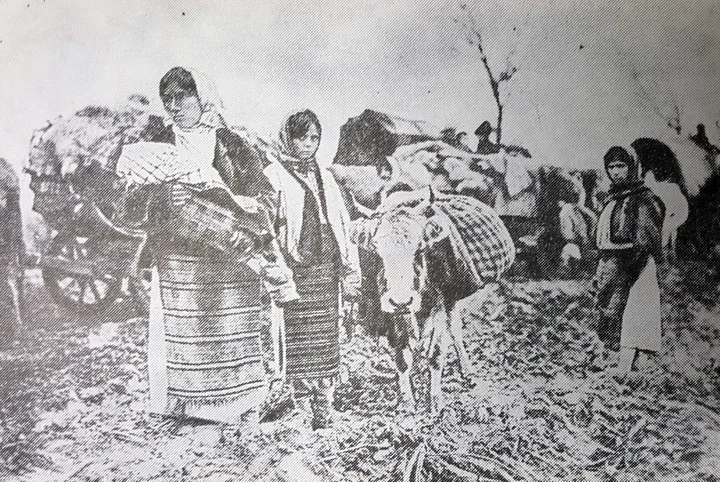

On 6 December Bucharest and Ploiești were occupied by the Central Powers, and in the night of 14–15 December the Romanian troops withdrew from Wallachia to Moldavia. There was no civilian evacuation plan; the authorities had feared that a flood of people would tangle the army's movement.
It was a vision of hell.
Daniel Șandru, on the November 1916 columns (translated)
Meanwhile: on 11 December, German and Austro-Hungarian troops were crossing the Ialomița, advancing towards southern Moldavia.
Chapter II
The stuffed city
6 – 31 December 1916
70,000 locals and everyone else
- Chapter
- 1916
- Before
- 70,000 inhabitants
- After
- more than 300,000
- Galați
- 130,000 at the end of 1916
Towards noon the train stopped at a halt called Grajduri, a stone's throw from Iași, and the queen stayed in her carriage waiting for news: she did not know where she would live, nothing had been decided, and an officer had gone ahead with an engine to scout the town. That was what moving a country looked like: a train stopped in a field, with the sovereign inside.
In just a few weeks the population of Iași shot up from 70,000 inhabitants to more than 300,000 inhabitants, not counting the Romanian and Russian troops stationed here or nearby. To the 2,131,527 people counted by the 1912 census in Moldavia were added some 1,500,000 Romanian refugees, civilians and soldiers, plus 1,000,000 Russian soldiers, plus thousands of prisoners and civilian internees.
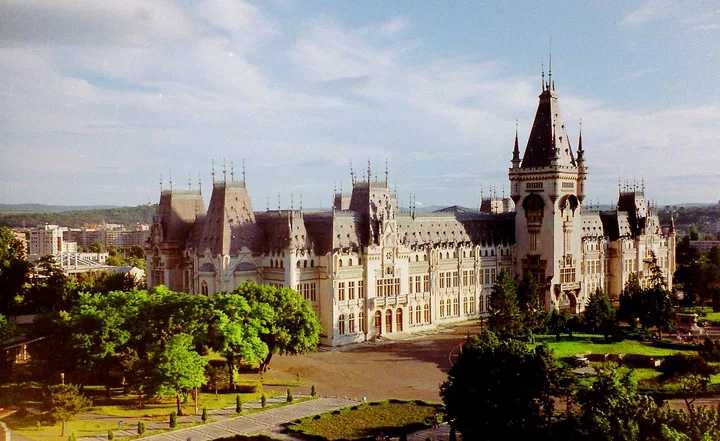

The headcount is not set in stone: an American diplomat spoke of 300,000 refugees in Iași, an army doctor of 510,000, others of 400,000–450,000 at the start of 1917 without troops. Mayor Gheorghe Mârzescu carried those days with what the city administration had; he would become minister of agriculture in the coalition government. King and queen met again at Zorleni, near Bârlad, on 28 November old style, 11 December new style, and on 6 December the queen had chosen as her residence the Fourth Army Corps building, the Cantacuzino-Pașcanu palace, turned into a relief centre for the wounded and civilians.
Towards noon we reached a station called Grajduri, where we stopped for now, while Ballif went ahead to Iași with an engine, to scout the town and see where I might live.
Queen Marie, December 1916 note, as quoted by Daniel Șandru (translated)
Meanwhile: in the night of 15/28 December, at 3 in the morning, the treasure train was leaving Iași for Moscow.
Chapter III
The winter of lice
December 1916 – June 1917
exanthematic typhus runs wild
- Chapter
- 1917
- Estimated cases
- 500,000
- The peak
- February 1917
- Dead in Moldavia
- more than 300,000
In February 1917 the hospital doors of Iași were guarded by piles of the dead: the sick fell on platforms, on roads, on hospital thresholds, whitened by lice, while the regiments quartered in the villages slept 25–30 to a cramped cottage. That was what the peak of the exanthematic typhus epidemic looked like.
The epidemic had started in December 1916, peaked in February 1917 and by June 1917 was almost extinguished, with some 500,000 estimated cases. Together with relapsing fever, typhus caused more than 300,000 deaths across Moldavia, soldiers and civilians together.
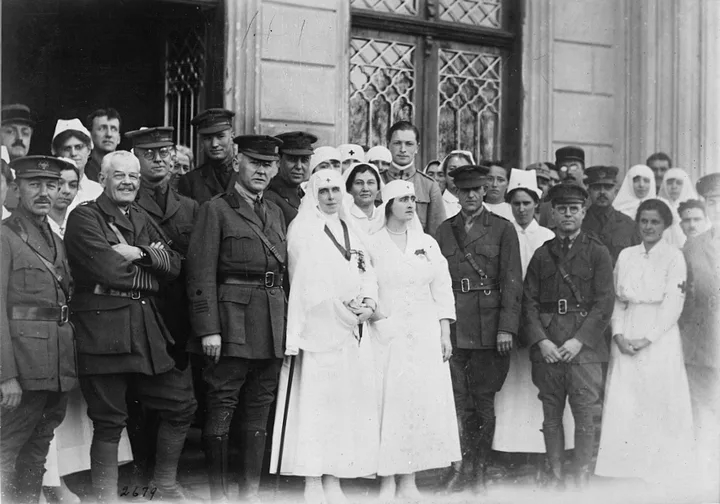

The queen's hospital network, built since the neutrality years, took the flood: every morning the sovereign walked the wards in a nurse's uniform, and at Roman the American Red Cross mission had raised a hospital under the Allied flags. The following summer the rebuilt army held the front at Mărășești, full thread at marasesti-1917.
Whitened by lice, they were scattering disease in their path; some of them fell dead in the road, on the railway station platforms, roadways, hospital doors, where stood piles of corpses crowded by hundreds on top of one another.
Ion Cantacuzino, as quoted in Clujul Medical
Every morning the queen, in a nurse's uniform, walked the hospitals.
Count de Saint-Aulaire, as quoted by Daniel Șandru (translated)
Meanwhile: in the summer of 1917, the army rebuilt with the Berthelot Mission was stopping the German advance towards Moldavia.
Chapter IV
The road back
27 March – 1 December 1918
1918: the unsigned peace and the Union
- Chapter
- 1918
- Bessarabia
- 27 March 1918
- Alba Iulia
- 1 December 1918
- The capital
- back to Bucharest
On the morning of 1 December 1918 the delegates gathered at Alba Iulia adopted the proclamation of union with the Romanian Kingdom, and the news travelled east, towards the town where the Romanian state had spent its exile. A few months earlier, on 27 March, the Sfatul Țării of Bessarabia had proclaimed union, and Bukovina had voted its union with the country on 15 November.
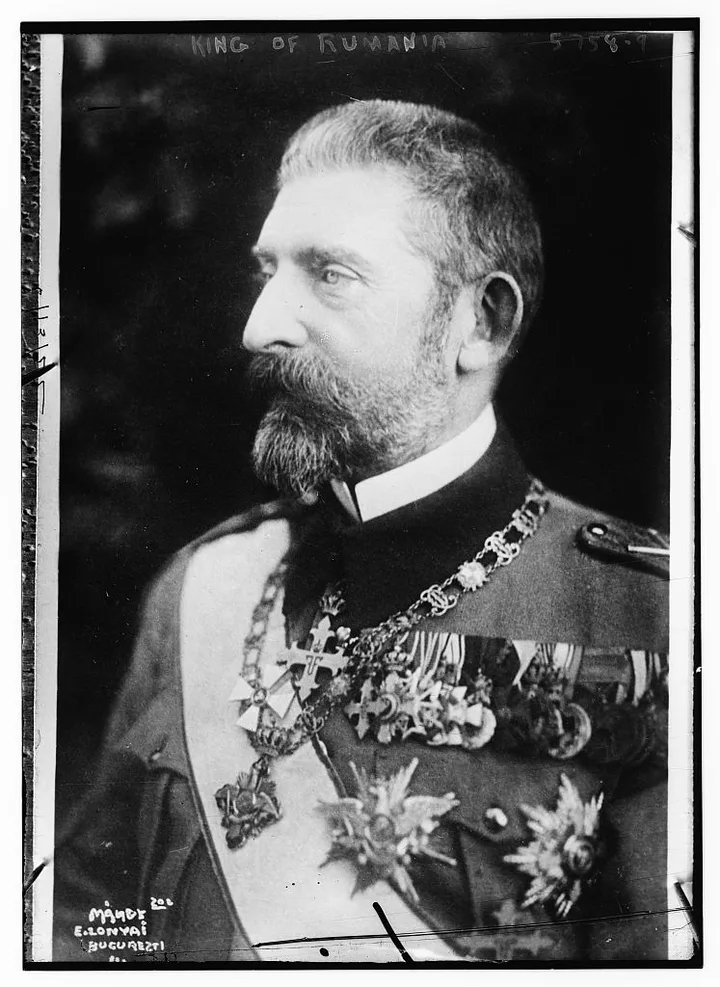
Ferdinand had refused to sign and ratify the Treaty of Bucharest, had ordered the army remobilized, and Romania had re-entered the war on the Entente side, after the Thessaloniki front knocked Bulgaria out of the fight. The capital moved back from Iași to Bucharest in 1918, after two years of wandering.

What stayed behind is hard to count: hundreds of thousands of dead of the winter lie in Moldavia's soil. The thread of the cases that left the Iași station in December 1916 is at tezaurul-de-la-moscova, and Union day at alba-iulia-1918.
Ferdinand refused to sign and ratify the Treaty of Bucharest, then ordered the army remobilized.
After the Ferdinand I of Romania article
Meanwhile: Iași had hosted the Jassy Conference, the meeting of Entente diplomats in November 1918.
The stationmaster
You are the stationmaster of the departure station, in November 1916: 9 trains wait in the yard, and the three lines run towards Moldavia. Divide the trains, then release them and see how many lines stay open.
Divide the 9 trains across the lines, then release them.
The historical answer
The Iași line 5, The Bârlad line 3, The Galați line 1: An illustrative scenario, not a simulation: the weights follow the historical ranking, Iași first, Bârlad with the headquarters, Galați doubled to 130,000, not a train timetable.
How it happened
An illustrative scenario, not a simulation: the weights follow the historical ranking, Iași first, Bârlad with the headquarters, Galați doubled to 130,000, not a train timetable.
Two numbers the size of a winter
70,000300,000+
More than four times the pre-war town, in just a few weeks.
Not counting Romanian and Russian troops. Other counts climb higher; the spread is in the chapters.
500,000300,000
The dead of the winter were more than four times all the people of pre-war Iași.
Estimated typhus cases by June 1917; dead of typhus and relapsing fever across Moldavia.
The winter in figures
Eight figures, each with its quote in the sources and recomputed as the page is built.
- 70,000
- people of Iași before the war, say historians (others count 65,000)
- 300,000
- inhabitants within weeks, not counting soldiers
- 1,500,000
- Romanian refugees, civilians and soldiers, added to Moldavia
- 1,000,000
- Russian soldiers gathered in Moldavia too
- 500,000
- estimated typhus cases by June 1917
- 130,000
- inhabitants Galați had at the end of 1916, nearly double
- 1,738
- cases of gold loaded at Iași for Moscow
- 17
- freight cars in the train of the night of 15/28 December

Four myths, researched
The whole country fled
No. Between 10% and 22% of the nearly 396,000 people of Bucharest left for Moldavia: Kirițescu, the soundest, says not more than 10% without soldiers. The rest stayed under occupation.
Iași reached a million
No. More than a million people of Iași in December 1916, as Ethel Pantazzi wrote in 1921, is an inflated reckoning; historians converge on 70,000 at the start and more than 300,000 at the end, with other estimates up to 400,000–450,000 without troops.
The treasure was unloaded at Iași
The other way round: at Iași the treasure was loaded. The 1,738 cases went into 17 cars and left for Moscow in the night of 15/28 December. The full story is at tezaurul-de-la-moscova.
Typhus struck only the army
No: the disease reaped civilians, refugees and hospitals alike, with more than 300,000 dead across Moldavia. The queen herself walked the wards in a nurse's uniform.
Sources and method
Romania was on the old style in 1916: every winter date appears in both styles at first mention, otherwise new style. The neighbour calendarul-1919 tells the story of the change.
Headcounts are estimates and sources count different categories: the page gives the historians' convergent thresholds (from 70,000 to more than 300,000, troops excluded) and the full spread in the chapters and myths. Field hospital addresses are undocumented, so the map marks towns, not buildings.
The map is a schematic drawn by the page, with representative routes; the game is an illustrative scenario. Days without verified events stay unmarked.
The road north
- Bucharest and Ploiești occupied on 6 December 1916; the Romanian retreat from Wallachia to Moldavia in the night of 14–15 December; the Ialomița crossed on 11 December
- Prince Mircea dead of typhoid fever at Buftea on 2 November 1916; hurried burial at Cotroceni before the retreat
- Parliamentarians' special trains from 13/26 November 1916; the Royal House to Iași at the same time; headquarters evacuated from Periș on 17/30 November; the 56 km on foot of the 4,000 scouts; the Solești, Sculeni, Bâlca colonies
The stuffed city
- Iași 70,000 → more than 300,000 within weeks, troops excluded; Moldavia 2,131,527 in 1912 + 1,500,000 refugees + 1,000,000 Russian soldiers; Galați 130,000
- The queen's train at Grajduri; the Zorleni reunion on 28 November/11 December 1916; the Fourth Army Corps residence from 6 December; mayor Mârzescu; the Vopicka 300,000, Bianu 510,000, others 400,000–450,000 estimates
The winter of lice
The road back
The images and their licences
- Library of Congress, public domain · Wikimedia Commons
- Lieutenant Marié, Médiathèque de l'architecture et du patrimoine · Wikimedia Commons
- Pierre André Leclercq, recent photograph · Wikimedia Commons
- Unknown author, 1916, public domain · Wikimedia Commons
- American Red Cross at Roman, 1917, public domain · Wikimedia Commons