paragraf despre Româniatext încă secret
Romania - Warsaw Pact:
Paragraf intitulat «Romania - Warsaw Pact», încă secret în întregime.
President's Daily Brief, 17 aprilie 1970, pagina 10 a scanului · documentul la CIA · pagina la Internet Archive
CIA · President's Daily Brief · declasificat în 2015 și 2016
12 zile din 1970 în care buletinul CIA pentru președintele SUA numește România: 13 paragrafe, scanate și transcrise, cu pasajele încă secrete marcate.
Paragraf intitulat «Romania - Warsaw Pact», încă secret în întregime.
President's Daily Brief, 17 aprilie 1970, pagina 10 a scanului · documentul la CIA · pagina la Internet Archive
La deschiderea centenarului Lenin, Brejnev a vorbit despre situația actuală a URSS. Înainte de a pleca la Moscova, Ceaușescu a criticat vehement, ca și Tito, „doctrina Brejnev”.
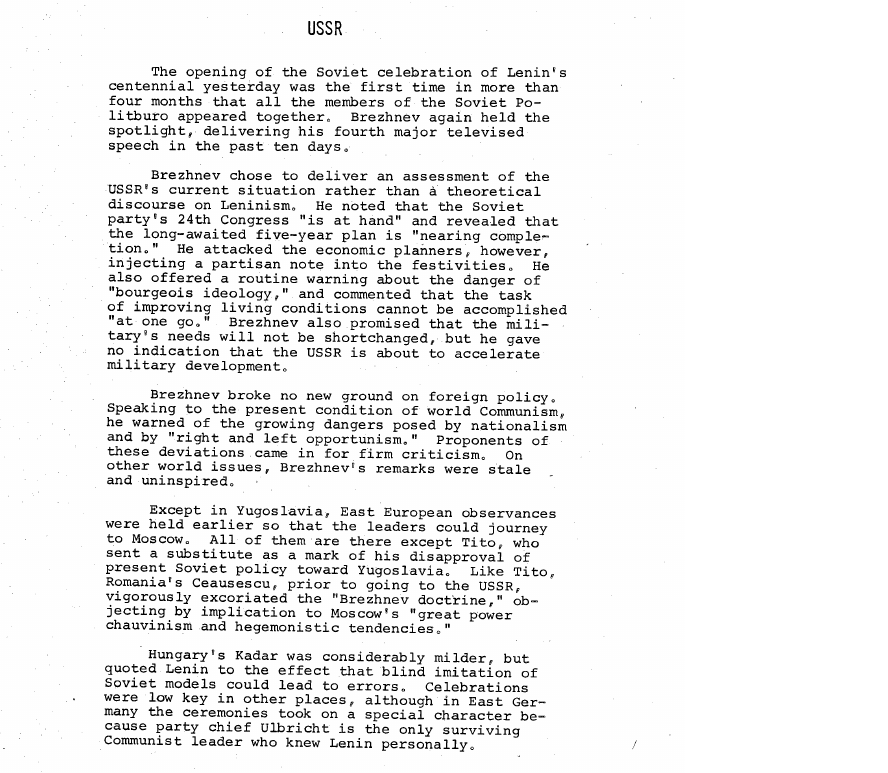
The opening of the Soviet celebration of Lenin's centennial yesterday was the first time in more than four months that all the members of the Soviet Politburo appeared together. Brezhnev again held the spotlight, delivering his fourth major televised speech in the past ten days.
Brezhnev chose to deliver an assessment of the USSR's current situation rather than a theoretical discourse on Leninism. He noted that the Soviet party's 24th Congress "is at hand" and revealed that the long-awaited five-year plan is "nearing completion." He attacked the economic planners, however, injecting a partisan note into the festivities. He also offered a routine warning about the danger of "bourgeois ideology," and commented that the task of improving living conditions cannot be accomplished "at one go." Brezhnev also promised that the military's needs will not be shortchanged, but he gave no indication that the USSR is about to accelerate military development.
Brezhnev broke no new ground on foreign policy. Speaking to the present condition of world Communism, he warned of the growing dangers posed by nationalism and by "right and left opportunism." Proponents of these deviations came in for firm criticism. On other world issues, Brezhnev's remarks were stale and uninspired.
Except in Yugoslavia, East European observances were held earlier so that the leaders could journey to Moscow. All of them are there except Tito, who sent a substitute as a mark of his disapproval of present Soviet policy toward Yugoslavia. Like Tito, Romania's Ceausescu, prior to going to the USSR, vigorously excoriated the "Brezhnev doctrine," objecting by implication to Moscow's "great power chauvinism and hegemonistic tendencies."
Hungary's Kadar was considerably milder, but quoted Lenin to the effect that blind imitation of Soviet models could lead to errors. Celebrations were low key in other places, although in East Germany the ceremonies took on a special character because party chief Ulbricht is the only surviving Communist leader who knew Lenin personally.
President's Daily Brief, 22 aprilie 1970, pagina 8 a scanului · documentul la CIA · pagina la Internet Archive
Ceaușescu a plecat pe neașteptate la Moscova, probabil la cererea sovieticilor, pentru care problema centrală e „obstrucționismul” României în Tratatul de la Varșovia, inclusiv refuzul manevrelor pe teritoriul ei.
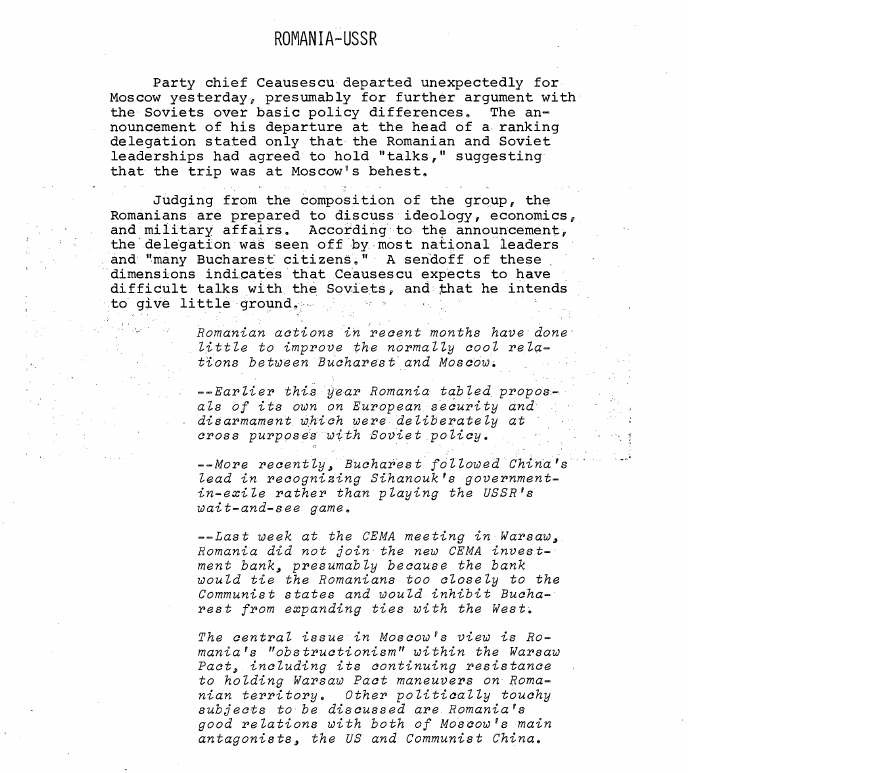
Party chief Ceausescu departed unexpectedly for Moscow yesterday, presumably for further argument with the Soviets over basic policy differences. The announcement of his departure at the head of a ranking delegation stated only that the Romanian and Soviet leaderships had agreed to hold "talks," suggesting that the trip was at Moscow's behest.
Judging from the composition of the group, the Romanians are prepared to discuss ideology, economics, and military affairs. According to the announcement, the delegation was seen off by most national leaders and "many Bucharest citizens." A sendoff of these dimensions indicates that Ceausescu expects to have difficult talks with the Soviets, and that he intends to give little ground.
Romanian actions in recent months have done little to improve the normally cool relations between Bucharest and Moscow.
--Earlier this year Romania tabled proposals of its own on European security and disarmament which were deliberately at cross purposes with Soviet policy.
--More recently, Bucharest followed China's lead in recognizing Sihanouk's government-in-exile rather than playing the USSR's wait-and-see game.
--Last week at the CEMA meeting in Warsaw, Romania did not join the new CEMA investment bank, presumably because the bank would tie the Romanians too closely to the Communist states and would inhibit Bucharest from expanding ties with the West.
The central issue in Moscow's view is Romania's "obstructionism" within the Warsaw Pact, including its continuing resistance to holding Warsaw Pact maneuvers on Romanian territory. Other politically touchy subjects to be discussed are Romania's good relations with both of Moscow's main antagonists, the US and Communist China.
President's Daily Brief, 19 mai 1970, pagina 7 a scanului · documentul la CIA · pagina la Internet Archive
Anexă intitulată «Recent Floods Causing Extensive Damage in ROMANIA», din care s-a publicat doar mențiunea „zona generală a inundațiilor majore”.
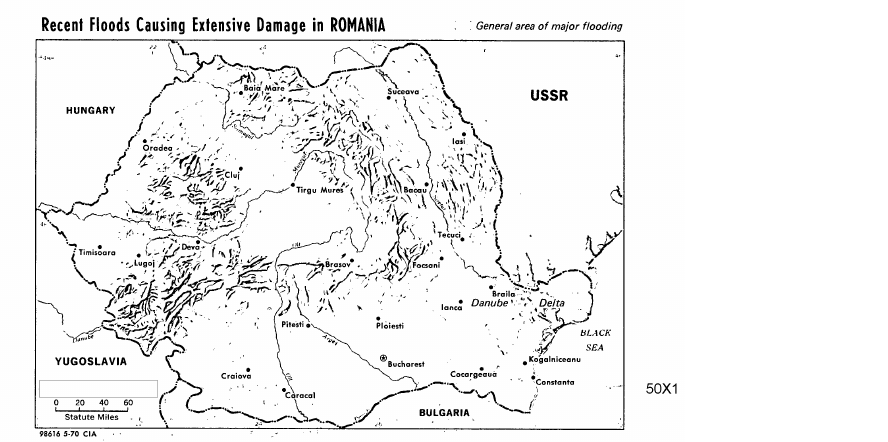
General area of major flooding
În română
Zona aproximativă a marilor inundații
President's Daily Brief, 22 mai 1970, pagina 9 a scanului · documentul la CIA · pagina la Internet Archive
Inundațiile au afectat grav aproape jumătate din România, cu peste 100 de morți și circa 120.000 de sinistrați. Dintre țările comuniste, doar RDG și Iugoslavia au oferit ajutor, URSS nu.
Nearly one-half of Romania has suffered serious flood damage, and rains are continuing in many parts of the country. The death toll is over 100, with approximately 120,000 homeless and over a million acres of farm land under water. Flood waters have subsided slightly in the north, but southern Romania is in grave danger from the Danube and its tributaries. East Germany and Yugoslavia are the only Communist countries to offer relief thus far. The USSR, which is also affected by the floods, has not offered to help, although the Soviets had ample opportunity during President Ceausescu's visit to Moscow early this week.
În română
Aproape jumătate din România a suferit pagube grave din cauza inundațiilor, iar ploile continuă în multe părți ale țării. Numărul morților trece de 100; aproximativ 120.000 de oameni au rămas fără adăpost și peste un milion de acri de teren agricol sunt sub apă. În nord, apele s-au retras puțin, dar sudul României este în mare pericol din cauza Dunării și a afluenților ei. Germania de Est și Iugoslavia sunt, până acum, singurele țări comuniste care au oferit ajutor. URSS, afectată și ea de inundații, nu s-a oferit să ajute, deși sovieticii au avut destule ocazii în timpul vizitei președintelui Ceaușescu la Moscova, la începutul acestei săptămâni.
President's Daily Brief, 22 mai 1970, pagina 10 a scanului · documentul la CIA · pagina la Internet Archive
Potrivit TASS, Brejnev va semna luna viitoare la București tratatul de prietenie sovieto-român, amânat de două ori, din cauza crizei cehoslovace și a iritării sovietice față de vizita președintelui Nixon.
After long delay, the Soviet-Romanian friendship treaty will be renewed early next month. TASS has announced that Brezhnev will head a party-government delegation to Bucharest to sign the treaty.
The new accord will replace the 20-year mutual assistance pact which expired in 1968, but which nonetheless remains in effect under an automatic five-year renewal clause. Though the new treaty was initialed in 1968, its formal signing was twice postponed--first as a result of the Czechoslovak crisis, then as a consequence of Soviet irritation over President Nixon's visit to Bucharest last year. Final agreement to sign the treaty was probably reached during the visit of Romanian party leader Ceausescu to Moscow on 18-19 May.
This represents a victory of sorts for Bucharest. The Romanians have almost certainly resisted Soviet pressures for closer ties and obligations to Moscow. The true measure of the Romanian "victory," however, depends on the concessions that Bucharest has made. For instance, the Soviets probably demanded and received Romanian agreement to closer economic and military cooperation. The Soviets may have insisted on holding Warsaw Pact maneuvers on Romanian territory, something Bucharest has resisted since 1962. Nevertheless, the Romanians can be counted on to pursue their own independent course.
President's Daily Brief, 13 iunie 1970, pagina 11 a scanului · documentul la CIA · pagina la Internet Archive
Brejnev nu va merge la semnarea tratatului de prietenie, oficial din cauza unei „afecțiuni catarale”, iar Kosîghin îi va lua locul, un afront deliberat la adresa lui Ceaușescu.
A "CATARRHAL AILMENT," AS ANNOUNCED BY TASS YESTERDAY, MAY BE ONE OF THE REASONS WHY BREZHNEV IS NOT GOING TO BUDAPEST TO SIGN THE FRIENDSHIP TREATY, BUT THERE ARE OTHERS. THE ROMANIANS' OF COURSE BELIEVE--NOT WITHOUT GOOD REASON-- THAT MOSCOW HAS DOWNGRADED ITS REPRESENTATION. KOSYGIN WILL GO IN BREZHNEV'S PLACE--A DELIBERATE SNUB TO CEAUSESCU, WHO OF LATE HAS BEEN TALKING UP ROMANIA'S INDEPENDENCE WITH RENEWED VIGOR.
ALSO, BREZHNEV IS NOW INVOLVED IN THE NASIR TALKS, WHICH MAY HAVE DRAGGED ON LONGER THAN HAD BEEN EXPECTED. BREZHNEV MAY ALSO WANT TO BE IN MOSCOW WHILE THE REGIME ASSESSES PRESIDENT NIXON'S REPORT ON INDOCHINA AND HIS TELEVISION INTERVIEW.
În română
O «afecțiune catarală», anunțată ieri de TASS, ar putea fi unul dintre motivele pentru care Brejnev nu merge la Budapesta să semneze tratatul de prietenie, dar mai sunt și altele. Românii cred, firește, și nu fără temei, că Moscova a trimis intenționat un reprezentant de rang mai mic. În locul lui Brejnev va merge Kosîghin: un afront deliberat la adresa lui Ceaușescu, care în ultima vreme a vorbit cu și mai multă vigoare despre independența României.
De asemenea, Brejnev este prins acum în discuțiile cu Nasser, care s-ar putea să fi durat mai mult decât se aștepta. Se poate și ca Brejnev să vrea să fie la Moscova cât timp regimul cântărește raportul președintelui Nixon despre Indochina și interviul lui televizat.
President's Daily Brief, 5 iulie 1970, pagina 4 a scanului · documentul la CIA · pagina la Internet Archive
Aparența de cordialitate s-a destrămat la sfârșitul vizitei lui Kosîghin: TASS s-a grăbit să publice un rezumat al tratatului de prietenie, românii au protestat energic, iar TASS l-a retras.
Studious efforts on both sides to maintain a facade of cordiality fell apart at the end of Soviet Premier Kosygin's visit to Romania for the signing of a new treaty of friendship and mutual assistance. TASS promptly published a summary of the treaty's contents, including a provision obliging each side to come to the assistance of the other, if it is attacked by any enemy. If this is a true rendering, then Romania's mutual defense commitments to the Soviets have been extended beyond Europe. There was no hint, however, that the Romanians accepted inclusion of the Brezhnev doctrine in the agreement.
The Romanians vigorously protested publication of the Soviet version, angered by what apparently was a violation of a previous agreement to publish the texts simultaneously in Moscow and Bucharest today. TASS has rescinded its summary.
It is possible that TASS made a mistake, but it is equally likely that a deliberate affront to the Romanians was intended, just as Brezhnev's last-minute boycott of the treaty signing appears to have been. Although the treaty is designed as the basis for correct relations between the two, the circumstances of the signing may leave Romanian-Soviet relations less friendly than before.
President's Daily Brief, 8 iulie 1970, pagina 7 a scanului · documentul la CIA · pagina la Internet Archive
În ochii lui Ceaușescu, tratatul de prietenie semnat cu sovieticii săptămâna trecută nu compromite calea independentă a României. El nu vrea ca țara să fie târâtă într-un conflict armat sovieto-chinez.
In the eyes of Romanian party chief Ceausescu, the friendship treaty signed with the Soviets last week does not compromise his country's independent course (see The President's Daily Brief, dated 8 July 1970). Ceausescu does not intend that Romania be dragged by the treaty into any Soviet military conflict with Communist China. Instead, Ceausescu looks to the leaders of the two Communist giants to resolve their quarrel. He said Romania would be preoccupied with working toward this goal and asked the Soviets and the Chinese to accept diversity within the movement as a basis for relations among all Communists. Ceausescu's remarks on the subject were made to Romanian party leaders on 9 July and were later summarized in public pronouncements.
President's Daily Brief, 13 iulie 1970, pagina 10 a scanului · documentul la CIA · pagina la Internet Archive
Zhou Enlai a acceptat în principiu să viziteze Yemenul de Sud, semn că diplomația chineză devine mai activă, și ar putea adăuga alte țări, precum Pakistanul, Nepalul și România.
Chou En-lai's acceptance in principle of an invitation to visit Southern Yemen underlines the movement of Chinese diplomacy into a more active phase and emphasizes Peking's interest in the Middle East. This area has received increasing Chinese attention in recent weeks, largely in hopes of countering Soviet influence in the region. The visit--which would be Chou's first to a non-Communist country since the cultural revolution--will almost certainly not take place before the conclusion of the upcoming National People's Congress and the celebration of National Day on 1 October. Chou may combine visits to other countries, such as Pakistan, Nepal, and Romania, with this trip. The last Chinese leader to make a swing of several countries outside the Communist world was former head of state Liu Shao-chi in 1966, before the infamous cultural revolution.
President's Daily Brief, 15 august 1970, pagina 12 a scanului · documentul la CIA · pagina la Internet Archive
Potrivit atașatului militar român la Sofia, România trimite elemente de stat-major, dar nu trupe, la manevrele Tratatului de la Varșovia care ar urma să înceapă săptămâna viitoare în RDG.
Combined Warsaw Pact military maneuvers are expected to begin next week in East Germany. They may be the first to involve participants from all of the Pact countries. Hungary and Bulgaria have announced that units of their armed forces will take part and, according to the Romanian military attaché in Sofia, Romania will send staff elements but no troops. The "southern tier" countries have not previously participated in maneuvers in East Germany. Observers are expected from Mongolia, North Korea, North Vietnam, and Yugoslavia.
President's Daily Brief, 23 septembrie 1970, pagina 15 a scanului · documentul la CIA · pagina la Internet Archive
La ONU, Ceaușescu a criticat cu măsură și Estul, și Vestul: a numit SUA în legătură cu Vietnamul și a făcut aluzie, prin drepturile națiunilor mici, la hegemonia sovietică.
Ceausescu's address to the UN General Assembly Monday was a typical Romanian performance of measured criticism directed at East and West. While he did not hesitate to call on the United States by name in connection with the war in Vietnam, his repeated references to the rights of small nations were an obvious allusion to Romania's struggles against Soviet hegemony. His remark that a "people can be truly free" only to the extent that it has a powerful economic and scientific foundation seems aimed primarily at preparing the United States for talks on closer economic ties. This topic, along with Romania's championship of Communist China's cause, is likely to be on Ceausescu's mind when he talks with President Nixon next Monday.
President's Daily Brief, 21 octombrie 1970, pagina 8 a scanului · documentul la CIA · pagina la Internet Archive
Ulbricht și-a amânat vizita din 2 decembrie în România din cauza unei reuniuni la vârf a Tratatului de la Varșovia la Berlinul de Est, spune un diplomat român la Washington.
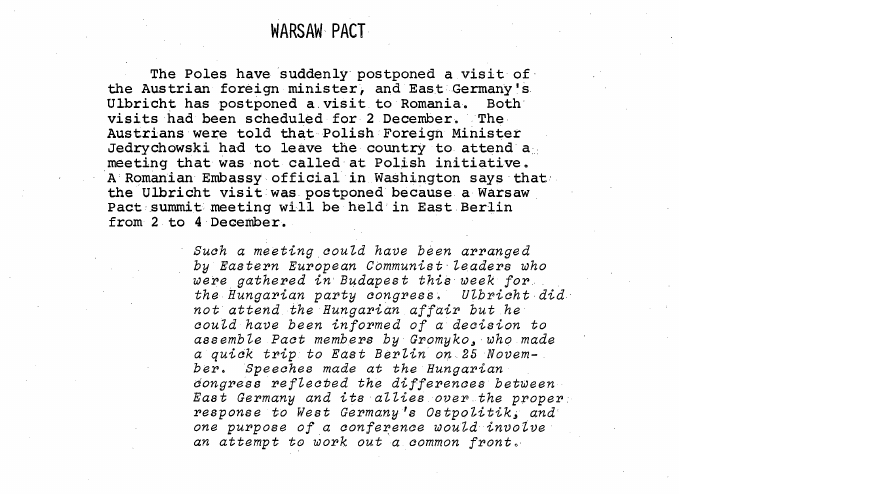
The Poles have suddenly postponed a visit of the Austrian foreign minister, and East Germany's Ulbricht has postponed a visit to Romania. Both visits had been scheduled for 2 December. The Austrians were told that Polish Foreign Minister Jedrychowski had to leave the country to attend a meeting that was not called at Polish initiative. A Romanian Embassy official in Washington says that the Ulbricht visit was postponed because a Warsaw Pact summit meeting will be held in East Berlin from 2 to 4 December.
Such a meeting could have been arranged by Eastern European Communist leaders who were gathered in Budapest this week for the Hungarian party congress. Ulbricht did not attend the Hungarian affair but he could have been informed of a decision to assemble Pact members by Gromyko, who made a quick trip to East Berlin on 25 November. Speeches made at the Hungarian congress reflected the differences between East Germany and its allies over the proper response to West Germany's Ostpolitik, and one purpose of a conference would involve an attempt to work out a common front.
President's Daily Brief, 28 noiembrie 1970, pagina 3 a scanului · documentul la CIA · pagina la Internet Archive