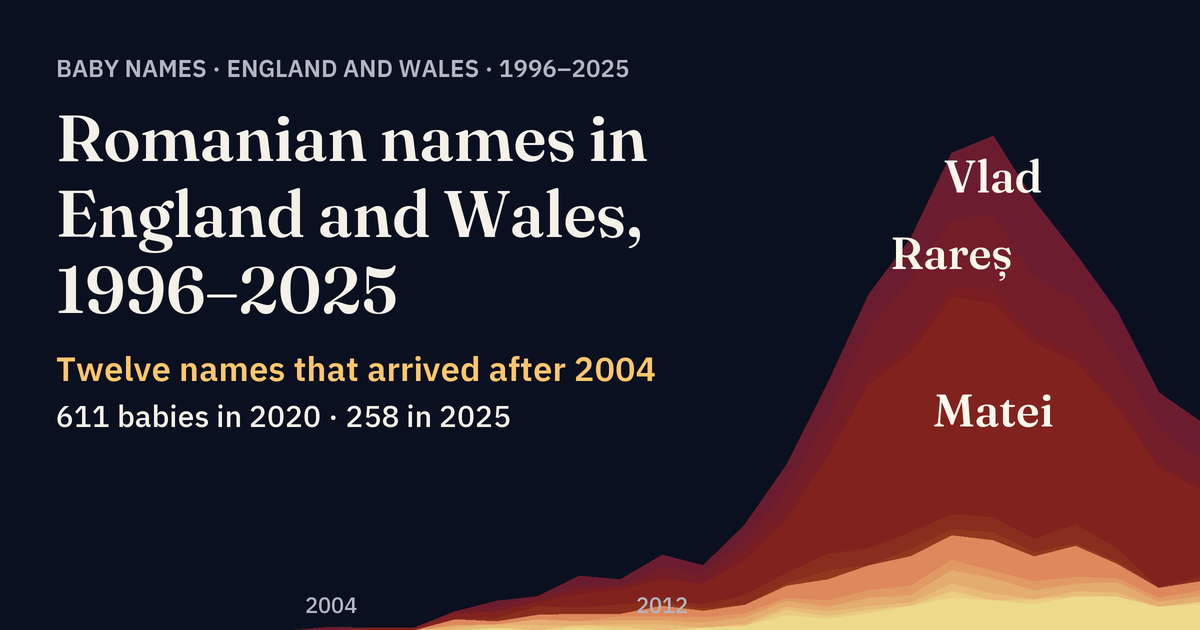
Babies given one of twelve Romanian names, England and Wales.
Baby names · England and Wales · 1996–2025
Romanian names in England and Wales, 1996–2025
Matei, Rareș, Vlad, Ilinca: twelve names from Romania’s lists of its 20 most common names that appear in no official list of baby names for England and Wales from 1996 to 2003. In 2020 they were given to 611 babies. The lists record the arrival of the names. They are a poor way to count a community, and a test on Polish names shows one way that can happen: the names become rarer as more children have one parent from elsewhere.
The account, in eleven steps ↓
Twelve names that were not in the tables
Each year the Office for National Statistics (ONS) lists every first name given to at least three girls or three boys born in England and Wales. For Romania there is a table of the 20 most common names for girls and for boys born in each year from 2002 to 2022, attributed to the population register and published by the broadcaster ProTV in 2023. It holds 71 names in all.
Twelve of them appear in no table for England and Wales from 1996 to 2003: Bogdan, Cătălin, Ilinca, Ionela, Ionuț, Matei, Mihaela, Mădălina, Nicolae, Nicoleta, Rareș and Vlad. Each band in the picture is one of the twelve. Its height is the number of babies given that name in that year.
2004: four boys named Vlad
Vlad was the first to reach the threshold, in 2004. Matei followed in 2005, with three boys. By 2012 all twelve had been in a table at least once.
In 2020 the twelve were given to 611 babies. In 2025 the number was 258.
Matei is more than two-fifths of the peak
Matei was given to 269 boys in 2019 and 264 in 2020, the year the twelve reached 611. Without it, the other eleven never pass 347.
Matei was also climbing in Romania. It entered the top 20 there for boys born in 2011, in 20th place, and was 5th for boys born in 2022; its largest count in Romania is for boys born in 2020. So part of the rise in the picture may be a name coming into fashion in Romania, and a fashion says nothing about how many parents from Romania there were in England.
Names are a poor head-count
The ONS also counts births by the mother’s country of birth. Births to mothers born in Romania rose from 1,804 in 2008 to 16,069 in 2019 and stood at 10,649 in 2025. From 2020 (15,713) to 2025 they fell by 32.2%. The twelve names fell by 57.8%.
Per 1,000 of those births, the twelve names were given 16.1 times in 2013 and 38.9 times in 2020. Suppose someone had measured that rate over 2008–2013 (19 per 1,000) and then estimated births from the names alone. For 2020 the estimate would be 32,202 births. There were 15,713: an error of 105%.
Without Matei and Bogdan, no trend
Three of the twelve also appear in Poland’s list: Bogdan (up to 130 boys a year there), Matei (up to 11) and Vlad (up to six). A stricter version of the rule drops any name that Poland lists ten or more times in a year, which removes Bogdan and Matei. For Matei that evidence is thin, so this is a test of how much the curve owes to one name, not a claim about where the name belongs.
The ten names left were given 13.3 times per 1,000 births to Romania-born mothers in 2008 (24 babies) and 13.0 times in 2025. In between the rate moved between 9.5 and 19.7, with no lasting rise or fall.
A wider list gives the same answer. The atlas of Romanian names on this site holds 477 given-name forms, with no counts; most come from cited name dictionaries, the rest from Wiktionary. 125 of them pass the same test: in no table from 1996 to 2003, in a table later. Besides the twelve they include Iosif, Estera, Cezar, Beniamin, Răzvan and Dragoș. Together they were given to 1,293 babies in 2019 and 733 in 2025: between 66 and 81 per 1,000 births to Romania-born mothers in every year from 2012 to 2025. A list this wide lets in more names used by other parents too. It already counts 113 babies in 2007, which may be why its rate is higher in the first years, when births to Romania-born mothers were few.
The three-baby threshold does affect the early years. If only as many of the babies given these ten names in 2019 are kept, chosen at random, as the smaller number of births in 2008 would give, about 82% of them still have a name given three or more times and so stay in the tables; for 2013 it is 96%. So the true rate in 2008 was probably somewhat above 13.3, and the tables give no sign that the ten names were gaining ground.
The same rule, run on Polish names
Poland publishes its full list of first names each year, down to names given twice (five times before 2013), so there the rule can be compared with how often the same names are given in the country of origin. Twelve names from Poland’s top-20 lists were absent from England and Wales in 1996–2003: Bartłomiej, Franciszek, Iga, Ignacy, Marcelina, Michalina, Nikodem, Paweł, Pola, Stanisław, Tymon and Wojciech.
In Poland their share of all the babies on that list rose from 4.7% in 2008 to 13.3% in 2025. The dashed line shows how many babies in England and Wales would have these names if mothers born in Poland gave them as often as parents in Poland do, year by year. The bands are what the tables hold: 42% of the dashed line in 2008 and 28% in 2025.
Set against births with both parents born in Poland, no decline
In 2010, 75% of the babies of Poland-born mothers had a father born in Poland too. In 2025 it was 47%.
Measured against births where both parents were born in Poland, the twelve names were given 0.52 times as often as in Poland in 2010 and 0.60 times as often in 2025, and never less than 0.48. So even on this comparison the names are given only about half to two-thirds as often as in Poland. The comparison overstates what these couples do, because some of the babies had one parent born in Poland, or none. Set against every birth with at least one Poland-born parent, the same babies give a figure that falls from 0.38 in 2010 to 0.24 in 2025.
If the figure for both-parent births had stayed at its 2010 value of 0.52 and all other couples had given none of these names, the wider figure would have fallen to 0.21 in 2025, further than the 0.24 observed. So a rising share of mixed couples is enough, on its own, to produce a fall of this size. The tables do not say whose babies got which names, so they cannot show that it did. Wider versions of the rule, with 24 and 38 names, give 0.59 and 0.68 for both-parent births in 2010 and 0.60 and 0.70 in 2025.
Which Polish names are given in England, and which are not
The chart takes 24 Polish names: those with at most eight babies in England and Wales in all of 1996–2003. Each bar sets the babies given the name in England and Wales, 2010–2025, against the number that couples with both parents born in Poland would give at Poland’s rate. Nikodem is given slightly more often than that; Tymon, Pola, Zuzanna and Oliwia almost as often. Wojciech stands at 0.22, Bartłomiej at 0.26, Paweł at 0.34.
The order holds over time. The ranking for 2010–2014 and the ranking for 2020–2025 correlate at 0.84. Each name’s ratio from 2010–2014 predicts its count in 2020–2025 with a median miss of 14%, although those later years played no part in the ratio. A value above 1, as for Nikodem, has three possible readings: parents from Poland favour the name more in England than parents in Poland do; babies with only one Poland-born parent are counted in the bar but not in the births it is set against; or other parents use the name too.
Why Romania cannot be given the same test
The table for Romania stops at 20th place, and its last complete year is 2022. It does not say how a double name is counted: whether a girl registered as Eva-Maria appears under Maria, under Eva or under both. The tables for England and Wales count her as Eva-Maria and nothing else. In Iași, a city in north-east Romania whose civil registry published a summary of its 2023 births, 73% of newborns were given two first names.
Without counts for the same names, made by the same rule in both countries, there is nothing to compare the English counts with. One thing the ONS does publish: in 2022, 83% of births to Romania-born mothers had a father born in Romania; in 2025, 78%. Among Poland-born mothers the figure for 2025 is 47%, so the shift to mixed couples, which may have thinned the Polish names, is far smaller among Romania-born mothers. A full list of first names by year of birth, with a stated rule for double names, would allow the comparison made here for Poland.
What the hyphen hides
A hyphenated name enters the tables for England and Wales only when three babies share the exact pair. 70 pairs made of two names from the Romanian table have done so: Eva-Maria, Ana-Maria, Sofia-Maria, David-Andrei, Antonia-Maria, Anastasia-Maria and others. Together they were given to 158 babies in 2021 and 56 in 2025, against four in all of 1996–2003.
Some of these pairs are used in other languages too. And every pair given to only one or two babies in a year is missing; the tables give no way to know how many there are.
Where this picture misleads
It leaves out every baby whose name was already in use in England. David, Sofia, Maria, Luca and 41 more names in the Romanian table each had more than 40 babies in England and Wales in 1996–2003, so a David with Romanian parents cannot be told from any other. None of those names is in the picture.
It may include babies with no link to Romania. Bogdan, Matei and Vlad all appear in Poland’s list as well. Mothers born in the Republic of Moldova are not part of the ONS figure for Romania, and how many of these babies are theirs is unknown.
Every count is a minimum: a name given to one or two babies in a year is not published. And the page counts names. It does not count families, and a name says nothing certain about where any one child’s parents were born.
The 71 names on Romania’s lists, in England and Wales
Counts are babies given the exact name, accents removed, as the ONS publishes it. “None published” means the name is in no table in any of those years: fewer than three babies of that sex each year.
| Name | In Romania’s top 20: first and last birth year, number of years | England and Wales, 1996–2003 | First year in a table | Most in one year | 2025 |
|---|---|---|---|---|---|
| Bogdan ♂ | 2007–2008 · 2 | none published | 2007 | 38 (2020) | 11 |
| Cătălin ♂ | 2002–2003 · 2 | none published | 2012 | 11 (2016) | fewer than 3 |
| Ilinca ♀ | 2018–2022 · 5 | none published | 2008 | 42 (2022) | 32 |
| Ionela ♀ | 2002–2009 · 8 | none published | 2010 | 8 (2019) | 3 |
| Ionuț ♂ | 2002–2022 · 21 | none published | 2008 | 24 (2022) | 5 |
| Matei ♂ | 2011–2022 · 12 | none published | 2005 | 269 (2019) | 109 |
| Mihaela ♀ | 2002–2019 · 18 | none published | 2007 | 19 (2020) | 7 |
| Mădălina ♀ | 2002–2004 · 3 | none published | 2007 | 9 (2019) | fewer than 3 |
| Nicolae ♂ | 2002–2005 · 3 | none published | 2010 | 17 (2020) | 6 |
| Nicoleta ♀ | 2002–2017 · 16 | none published | 2011 | 13 (2019) | 7 |
| Rareș ♂ | 2014–2022 · 9 | none published | 2007 | 91 (2020) | 31 |
| Vlad ♂ | 2019–2022 · 4 | none published | 2004 | 99 (2020) | 47 |
| Cosmin ♂ | 2002–2004 · 3 | 3 | 2003 | 8 (2021) | fewer than 3 |
| Florentina ♀ | 2002–2005 · 4 | 3 | 2003 | 13 (2016) | 4 |
| Mihai ♂ | 2002–2022 · 21 | 4 | 2003 | 36 (2017) | 9 |
| Marian ♂ | 2002–2017 · 16 | 5 | 2003 | 17 (2016) | 5 |
| Andreea ♀ | 2002–2022 · 21 | 6 | 2002 | 84 (2019) | 16 |
| Ioana ♀ | 2002–2022 · 21 | 7 | 1998 | 50 (2017) | 16 |
| Teodora ♀ | 2005–2022 · 17 | 7 | 2001 | 42 (2020) | 34 |
| Constantin ♂ | 2002–2021 · 19 | 8 | 2000 | 23 (2021) | 8 |
| Florin ♂ | 2002–2018 · 17 | 12 | 1999 | 18 (2017) | 9 |
| Valentin ♂ | 2002–2006 · 5 | 17 | 1998 | 29 (2020) | 8 |
| Eduard ♂ | 2009–2022 · 14 | 18 | 1999 | 130 (2018) | 29 |
| Alexandru ♂ | 2002–2022 · 21 | 21 | 1996 | 179 (2019) | 55 |
| Vladimir ♂ | 2020–2021 · 2 | 22 | 1997 | 64 (2021) | 23 |
| Denisa ♀ | 2002–2013 · 12 | 37 | 1999 | 29 (2016) | 9 |
| Roxana ♀ | 2002–2003 · 2 | 44 | 1996 | 32 (2011) | 12 |
| Tudor ♂ | 2018–2022 · 3 | 46 | 1996 | 80 (2020) | 50 |
| Ștefania ♀ | 2002–2022 · 21 | 54 | 1996 | 81 (2020) | 39 |
| Andrei ♂ | 2002–2022 · 21 | 57 | 1996 | 186 (2019) | 61 |
| Marius ♂ | 2002–2006 · 5 | 61 | 1996 | 45 (2019) | 18 |
| Daria ♀ | 2004–2022 · 19 | 80 | 1996 | 153 (2019) | 45 |
| Cristian ♂ | 2002–2022 · 21 | 85 | 1996 | 64 (2018) | 24 |
| Rebeca ♀ | 2014–2022 · 9 | 105 | 1996 | 89 (2019) | 27 |
| Cristina ♀ | 2002–2015 · 14 | 152 | 1996 | 35 (2017) | 9 |
| Georgiana ♀ | 2002–2016 · 15 | 176 | 1996 | 56 (2019) | 33 |
| Mario ♂ | 2007–2008 · 2 | 186 | 1996 | 98 (2019) | 37 |
| Gabriela ♀ | 2002–2022 · 21 | 204 | 1996 | 205 (2016) | 81 |
| Ariana ♀ | 2020–2022 · 3 | 219 | 1996 | 524 (2017) | 247 |
| Denis ♂ | 2006–2020 · 15 | 219 | 1996 | 193 (2017) | 80 |
| Alessia ♀ | 2011–2012 · 2 | 220 | 1996 | 193 (2019) | 160 |
| Bianca ♀ | 2002–2013 · 12 | 265 | 1996 | 110 (2018) | 73 |
| Daniela ♀ | 2002–2007 · 6 | 396 | 1996 | 74 (2012) | 29 |
| Darius ♂ | 2008–2022 · 15 | 435 | 1996 | 172 (2019) | 81 |
| Ioan ♂ | 2002–2022 · 21 | 442 | 1996 | 129 (2007) | 31 |
| Ana ♀ | 2002–2022 · 21 | 455 | 1996 | 167 (2016) | 91 |
| Diana ♀ | 2002–2010 · 9 | 455 | 1996 | 181 (2019) | 165 |
| Anais ♀ | 2017–2022 · 6 | 529 | 1996 | 140 (2015) | 58 |
| Alexia ♀ | 2006–2013 · 7 | 541 | 1996 | 306 (2011) | 33 |
| Nicolas ♂ | 2012–2022 · 11 | 552 | 1996 | 197 (2016) | 115 |
| Eric ♂ | 2022 · 1 | 708 | 1996 | 470 (2018) | 300 |
| Natalia ♀ | 2016–2022 · 7 | 877 | 1996 | 430 (2009) | 114 |
| Adrian ♂ | 2002–2011 · 10 | 942 | 1996 | 273 (2013) | 161 |
| Anastasia ♀ | 2014–2022 · 9 | 995 | 1996 | 369 (2021) | 221 |
| Ștefan ♂ | 2002–2022 · 21 | 1,118 | 1996 | 222 (1996) | 95 |
| Antonia ♀ | 2011–2022 · 12 | 1,615 | 1996 | 234 (1996) | 91 |
| Elena ♀ | 2002–2022 · 21 | 1,755 | 1996 | 394 (2017) | 307 |
| Sofia ♀ | 2010–2022 · 13 | 1,765 | 1996 | 1,728 (2018) | 1,490 |
| Eva ♀ | 2016–2022 · 7 | 1,981 | 1996 | 1,946 (2012) | 758 |
| Luca ♂ | 2009–2022 · 14 | 2,188 | 1996 | 3,266 (2025) | 3,266 |
| Maya ♀ | 2014–2015 · 2 | 2,747 | 1996 | 1,592 (2024) | 1,259 |
| Gabriel ♂ | 2002–2022 · 21 | 2,982 | 1996 | 1,022 (2018) | 666 |
| Sara ♀ | 2008–2022 · 15 | 3,033 | 1996 | 653 (2017) | 427 |
| Maria ♀ | 2002–2022 · 21 | 3,596 | 1996 | 853 (2016) | 522 |
| Sebastian ♂ | 2004–2013 · 8 | 3,649 | 1996 | 1,990 (2016) | 1,077 |
| Dominic ♂ | 2020–2022 · 3 | 8,718 | 1996 | 1,519 (1996) | 246 |
| Alexandra ♀ | 2002–2022 · 21 | 9,074 | 1996 | 1,595 (1996) | 202 |
| David ♂ | 2004–2022 · 19 | 13,940 | 1996 | 2,517 (1996) | 712 |
| Robert ♂ | 2002–2012 · 11 | 14,237 | 1996 | 2,644 (1996) | 310 |
| George ♂ | 2002–2007 · 6 | 32,747 | 1996 | 5,263 (2016) | 3,082 |
| Daniel ♂ | 2002–2022 · 21 | 57,399 | 1996 | 10,338 (1996) | 804 |
How this was counted
The rule
The list is every first name in the top 20 for its sex in the country of origin, for any birth year from 2002 to 2022. A name is counted as newly arrived if the tables for England and Wales hold no count for it, for that sex, in any year from 1996 to 2003. This rule was fixed before any curve was drawn. Wider versions allow at most 8 or at most 40 babies over those eight years. The stricter version, which also drops names that Poland lists ten or more times in a year, was added after the first curves, as a test of what they owe to names shared with other countries. For Romania the two wider versions give 20 and 26 names; their rates per 1,000 births to Romania-born mothers run from 47.7 (2008) to 32.9 (2025) and from 105.9 to 45.4. The wider the rule, the more babies of other origins it may let in. In every version the babies counted may have parents born anywhere, while the births they are set against are those to Romania-born mothers.
The wider list
The 477 given-name forms are those of this site’s atlas of names: most from cited name dictionaries such as Behind the Name, the rest from the Romanian section of English Wiktionary (CC BY-SA 4.0). It is a list of forms with no counts, and it holds names that are also used in other languages. 18 of the forms were added to the atlas on 13 October 2026, after a check against these tables; all 18 pass the test, which is how they were found. Without them the list has 107 names, 1,197 babies in 2019 and a rate of 61 to 76 per 1,000. Each form is tested with boys and girls counted together. 125 forms pass, 113 of them not in the top-20 table. Without Matei and Bogdan the rate runs from 57 per 1,000 in 2012 to 58 in 2025.
The ratio to Poland’s rate
For Poland, the share of each year’s births given the twelve names (first-name field of the national register) is multiplied by a number of births in England and Wales; the babies in the English tables are divided by the result. Three denominators are used: births to Poland-born mothers, births where both parents were born in Poland (2010–2025), and births with at least one Poland-born parent (mothers plus fathers minus both). Until 2012 the Polish list left out names given fewer than five times a year; none of the names used here is near that limit. Poland’s rate is each name’s share of the babies on the published list, not of official births, and the list’s threshold changed in 2013.
What was tested on years left out
The three-baby threshold: each of the ten names’ counts for 2019 was scaled to an earlier year’s births and redrawn at random 4,000 times, keeping only counts of three or more (for all twelve names, 91% of the babies stay in at the 2008 size). A head-count from names: the ratio for Polish names fixed on 2008–2013, then used to predict births to Poland-born mothers in 2014–2025, misses by −3% to −29% (median −12%), always too low. For Romanian names, with no rate from the country of origin, the miss reaches 105%. Which names are given in England: ratios from 2010–2014 predict the 2020–2025 counts of the 24 names with a median miss of 14%; in total, 4,942 predicted against 4,958 counted.
Counting rules that differ
The ONS removes accents and counts exact spellings, so Rareș is Rares and Oliwia is not Olivia. Until 2017 it cut a name at the first space; from 2018 it joins a hyphenated name written with spaces. The number of distinct hyphenated names in the tables shows no step at that point (424 boys’ names in 2017 and 440 in 2018; 1,196 and 1,188 for girls). Births are counted by the year in which they happened in both ONS series. Births by parents’ country of birth are known for Romania from 2008 (mothers), 2012 (fathers) and 2022 (both parents).
What exists already
Anna Powell-Smith noticed the “big jump in Eastern European names” in these tables in a 2012 post on the 1996–2010 data, without a comparison to births or to a home register. Studies of naming among migrants mostly rely on surveys and census records: Gerhards and Hans (2009) found in German panel data that giving a child a name common in the host country depends, among other things, on interethnic networks. A search for this page found no published work that sets the English tables against births by parents’ country of birth or against a home register.
Related pages
The name you were given traces any name in England and Wales back to 1904. Is this name still given? shows Romania’s top 20 by year of birth.
Sources
- Office for National Statistics, Baby names in England and Wales: from 1996, edition 1996 to 2025. Open Government Licence v3.0.
- Office for National Statistics, Births by parents’ country of birth, England and Wales, editions 2010 to 2025 (mothers: table 1; fathers: table 2a, later 2b; both parents: table 3). Open Government Licence v3.0.
- Office for National Statistics, Baby names QMI (last revised 5 October 2022): threshold, accents, spaces and hyphens.
- Ministerstwo Cyfryzacji, Imiona nadawane dzieciom w Polsce, first-name field, 2000–2025, from PESEL, Poland’s population register. CC0 1.0.
- Romania: table of the 20 most common first names by sex and year of birth, 2002–2022, attributed to the population register (DGEP) and published by the broadcaster Știrile ProTV on 29 March 2023 (PDF). The register has not published the table on its own site.
- Atlasul numelor (this site): Romanian given-name forms, from English Wiktionary via kaikki.org (dump of 5 August 2026, CC BY-SA 4.0) and from cited name dictionaries (Behind the Name; Mică enciclopedie onomastică via dexonline).
- Direcția Locală de Evidență a Persoanelor Iași (the city’s civil registry), births registered in 2023: names (7,036 births).
Contains public sector information licensed under the Open Government Licence v3.0.