Ștefan cel Mare, 1457 – 1504
The saint who lost his greatest battle
On 10 January 1475 Stephen of Moldavia destroyed an Ottoman army in the fog at Vaslui, and Europe called him the Champion of Christ. Eighteen months later the Sultan himself crushed him at Valea Albă. He reigned 47 years and died a saint.
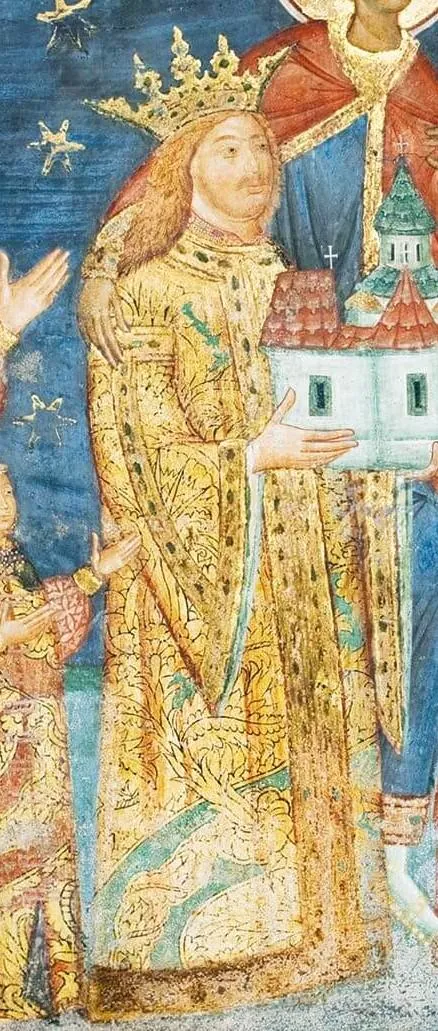
Stephen in four chapters
Representative route
From the throne to Putna, in four campaigns
In April 1457 a 19-year-old prince took Moldavia with 6,000 borrowed horsemen. In January 1475 he destroyed an Ottoman army in the fog at Vaslui; in July 1476 the Sultan himself destroyed his. He reigned 47 years and died in his bed.
Below, Stephen in four chapters – the throne, Vaslui, Valea Albă, and Putna. The routes on the map are representative, drawn through the verified places of the story.
Chapter I
The throne
1457 – 1474 · 1457–1474, the making
- Chapter
- 1457 – 1474
- The throne
- Doljești, 12 April 1457
- Chilia
- failed 1462, taken 23 January 1465
- Baia
- 15 December 1467, the king flees
Stephen stormed into Moldavia in the spring of 1457 at the head of 6,000 horsemen lent by his cousin Vlad Țepeș. He routed Petru Aron at Doljești on Thursday 12 April, beat him again at Orbic, and at Direptate the boyars and Metropolitan Teoctist acclaimed him prince. He was about 19; the birth year itself is undocumented.
His obsession was Chilia, the Danube port. In June 1462, while Vlad fought the Sultan, Stephen besieged it with Ottoman help and failed: on 22 July a shot struck his ankle, a wound that never healed in 42 years. He took Chilia on 23 January 1465 instead, with Cetatea Albă, and spent a decade walling Moldavia – Suceava, Neamț, Hotin, Roman, Orhei, Soroca.
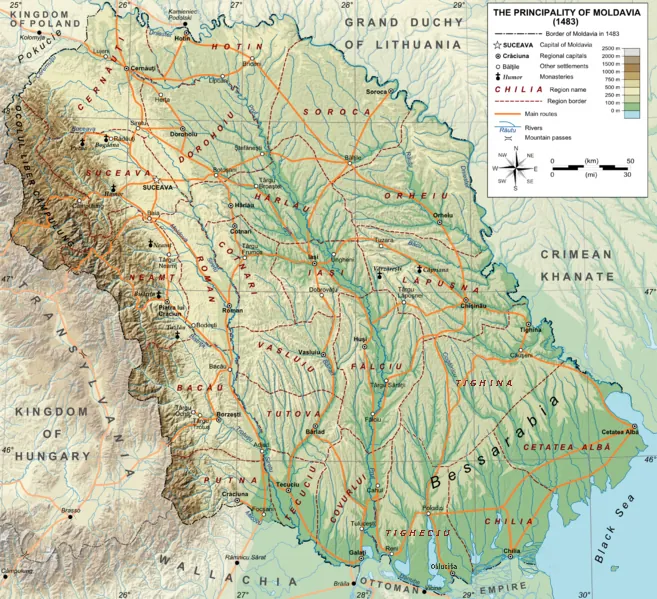

The neighbors tested him and bled. Matthias Corvinus of Hungary invaded in 1467 and was carried off the field at Baia on 15 December, thrice wounded by arrows; the Tatars were broken at Lipnic on 20 August 1470. In 1473 Stephen stopped the yearly tribute to the Porte and beat Radu's Wallachians at Râmnicu Sărat in November. The Sultan answered with an ultimatum – and an army.
Then Stephen gathered the boyars of the country, great and small, with Metropolitan Teoctist and many monks, at the place called Direptate, and asked them all: is it their will that he be their prince? And they all cried with one voice: “May you reign many years, from God.” (Own translation from Ureche.)
Ureche on the acclamation, April 1457
Meanwhile Constantinople had fallen on 31 May 1453, four years before Stephen took the throne.
Chapter II
Vaslui
1475 · 1475, the fog victory
- Chapter
- 1475
- The fog
- Tuesday, 10 January 1475
- The bridge
- Podul Înalt, over the Bârlad
- The fast
- 40 days on bread and water
Mehmed ordered Hadım Suleiman Pasha to finish Moldavia in the winter of 1474–75: Ureche counts 120,000 Ottomans with Tatars and Wallachians, modern records far fewer, either way several times Stephen's host. Stephen burned his own villages, poisoned the wells and waited with about 40,000 Moldavians – the standing army plus Oastea Mare, every free man over 14 – 2,000 Polish horse, Székely and Hungarians. It was one of only two times he ever raised the Great Army.
He chose the ground his father had used in 1450: a marshy semi-oval below Vaslui, hills and forest on every side, one wooden bridge over the Bârlad. On Tuesday 10 January 1475, in fog so thick the guns aimed by sound, the Székely center retreated on orders to draw the column in; the bridge broke under the cavalry; hidden buglers sounded behind Ottoman lines; the boyars charged from all sides. The pursuit ran three days to Oblucița on the Danube.
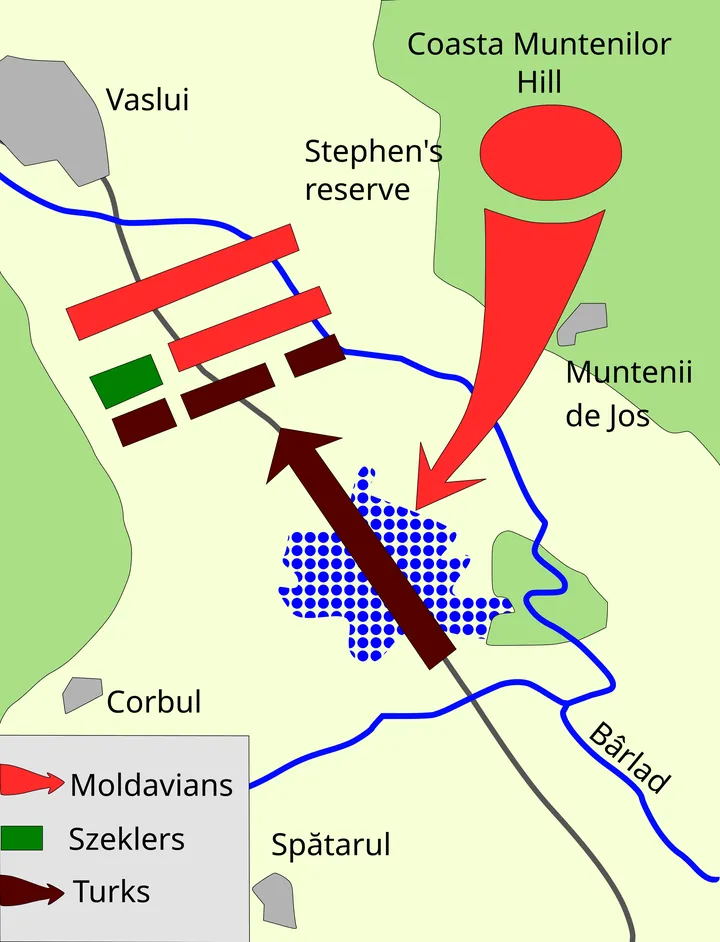

Europe noticed. Stephen sent 36 captured standards to King Casimir and wrote to the Pope and Matthias Corvinus – who replied by claiming the victory as his own. Długosz reports that Stephen fasted 40 days on bread and water and forbade anyone to credit him. Sixtus IV named him Athleta Christi, the Champion of Christ. Nobody sent soldiers.
Stephen went out to meet the Turks above Vaslui, at Podul Înalt – and beat them not so much with bravery as with craft. First he had the grass burned everywhere, so the Turks' delicate horses grew weak. Then, God helping, the fog so wrapped the Turks that none could see another. (Own translation from Ureche.)
Ureche on 10 January 1475
Meanwhile Six months later, on 6 June 1475, the Ottoman fleet took Caffa, the Genoese capital of the Black Sea trade.
Chapter III
Valea Albă
1476 · 1476, the defeat
- Chapter
- 1476
- The Sultan
- in person, from May 1476
- The defeat
- Războieni, 26 July 1476
- The retreat
- August 1476: plague, hunger, held walls
Mehmed came himself. In May 1476 the Conqueror marched from Sofia with the imperial host while Crimean Tatars raided from the north; Stephen beat the Tatars off, then – Iorga tells it – let his peasants go home for two weeks to see their burning villages. Some 10,000 to 20,000 men stood with him when he dug a wagon-and-trench camp on a wooded hill above Pârâul Alb.
On 26 July the Ottomans attacked uphill all day. The Janissaries lay flat under the guns until the Sultan rode forward with his shield; then Gedik Ahmed Pasha opened a breach in the Moldavian front and the camp fell at dusk. Ureche names the fallen boyars two by two; Stephen was unhorsed but unharmed and slipped away with a few men. Some 7,000 to 8,000 prisoners were beheaded.
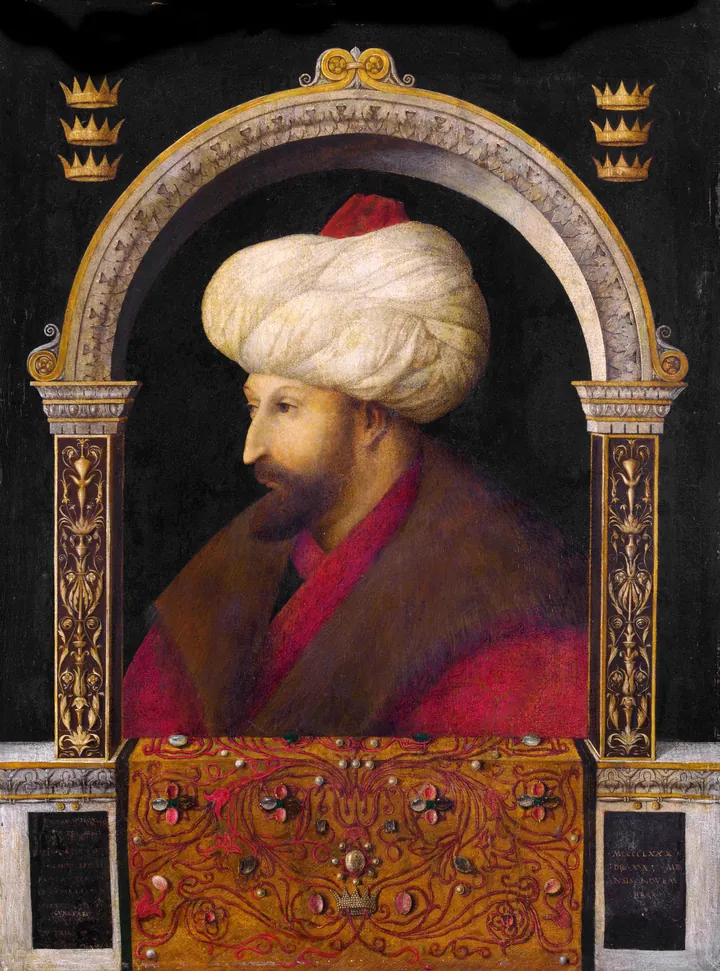

It was a victory that conquered nothing. Suceava, Neamț and Hotin all held – Neamț through August – while plague and hunger emptied the Ottoman camp, and Mehmed withdrew the same month. Stephen was back in the field by autumn: with Hungarian help he put Vlad Țepeș on the Wallachian throne that November, with 200 Moldavian guards. Vlad was dead by December.
They fell not anyhow, but defending themselves to the death – not beaten out of their arms, but crushed by the multitude of the Turks. And so many of ours perished that the meadow whitened with the bodies of the fallen. (Own translation from Ureche.)
Ureche on 26 July 1476
Meanwhile In November 1476 Vlad Țepeș retook Wallachia with Stephen's help; by December the Janissaries had killed him near Bucharest.
Chapter IV
Putna
1476 – 1504 · 1476–1504, what the defeat built
- Chapter
- 1476 – 1504
- The loss
- Chilia 14 July, Cetatea Albă August 1484
- The churches
- 21 documented by inscription
- The death
- 2 July 1504, buried at Putna
The Sultan's revenge came anyway. In July 1484 Chilia fell on the 14th, and Cetatea Albă followed in August; Moldavia lost its sea gates and Stephen swore fealty to Casimir at Colomeea on 12 September 1485. He beat the raiders at Cătlăbuga that November, then nearly died at Șcheia on 6 March 1486 – saved, tradition says, by Aprod Purice – and resumed the yearly tribute the same year.
The last wars were in the north. When John Albert of Poland marched on Suceava in 1497, Stephen with Hungarian and Ottoman auxiliaries destroyed the retreating army in the Cosmin Forest that October; the treaty he ratified at Hârlău in 1499 ended Polish suzerainty over Moldavia. In 1502 he told his Venetian doctor Matteo Muriano that he had fought 36 battles and lost two.
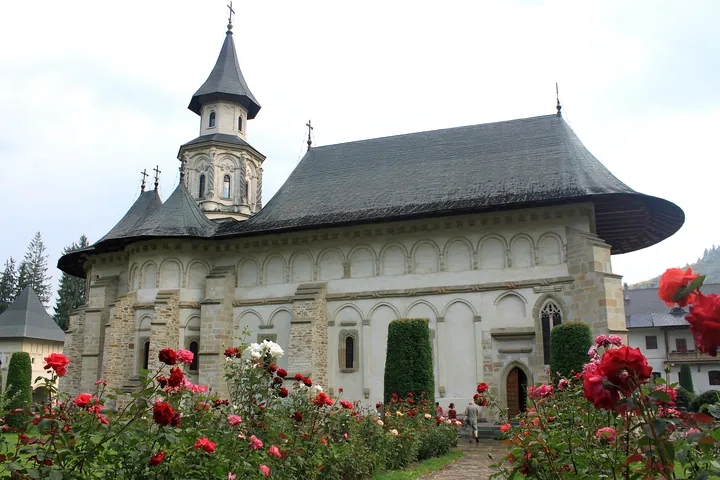

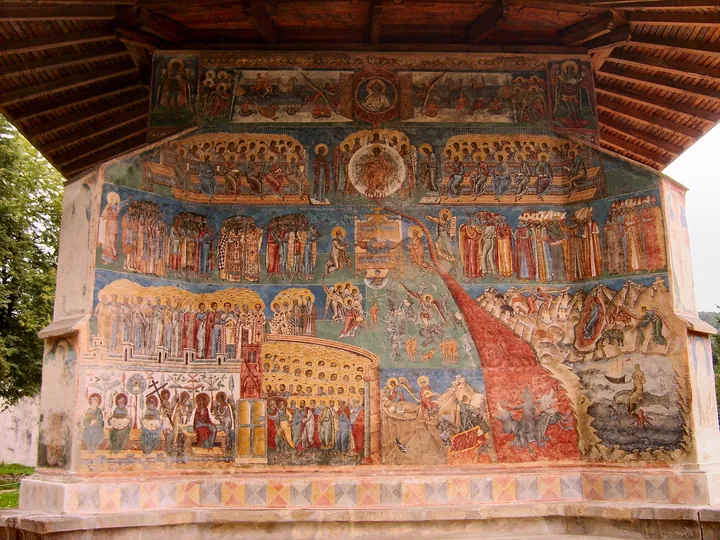

Then the building. Between May and September 1488 he raised Voroneț for Vaslui; the Războieni church of 1496 stands over the bones of the defeated; 21 churches in all are documented by surviving inscriptions. He died at Suceava on 2 July 1504, was buried at Putna, and in June 1992 the Romanian Orthodox Church canonized him: Stephen the Great and Holy.
He was a whole man by nature, never lazy, and he knew how to cover his work – where you least thought, there you found him. A master at things of war; where need was, he threw himself in person. And where others beat him, he did not lose hope: knowing himself fallen, he rose above his conquerors. (Own translation from Ureche.)
Ureche on Stephen's death, 2 July 1504
Meanwhile In 1490 Matthias Corvinus died; Hungary's pressure on Moldavia died with him.
Two battlefields, one scale
Vaslui and Valea Albă, eighteen months apart, drawn to the same scale from Ureche's and Iorga's accounts. Fog, marsh and one bridge won the first; July sun and a second front lost the second.
Vaslui, 10 January 1475
- One wooden bridge over the Bârlad, guns trained on it
- Marsh underfoot and fog overhead: Ureche's “negura”
- Forest wings close on the column trapped in the valley
Valea Albă, 26 July 1476
- A wagon-and-trench camp on a wooded hill above Pârâul Alb
- July sun: no fog, and the streams run low
- Gedik Ahmed Pasha opens the breach; the Janissaries pour in
Schematic, drawn for this page – the same scale on both maps, with a 1 km bar. Troop blocks mark directions of attack, not surveyed positions.
Vaslui, 10 January 1475: your orders
Four decisions with Stephen's real constraints: outnumbered several times over, one bridge, winter dusk, fog. Choose, then check against the chronicles.
-
1
The bridge
Suleiman's vanguard crowds toward the wooden bridge over the Bârlad. Your guns are trained on it. Do you:
What happened
Let them come: the guns fired as the column crowded the planks, the bridge broke under the cavalry, and the marsh held the rest.
-
2
The fog
Your archers cannot see the enemy for the fog. Do you:
What happened
By sound: Ureche says the Moldavians could not see the enemy for the fog and aimed at the noise of marching feet.
-
3
The trap
The Székely center faces the Ottoman push up the valley. Do you:
What happened
Retreat on orders: the Székely center bent backward exactly as instructed, and the Ottoman column pushed into the pocket.
-
4
The pursuit
The Ottoman host breaks and runs south. Do you:
What happened
Three days to Oblucița: Stephen hunted the fugitives to the Danube crossing still called Vadul Turcilor, the Turks' Ford.
Answer a card to begin.
Stephen in six numbers
Every figure below comes from the cited chronicles and histories. The years are the reign's spine, 1457 to 1504.
- 1457
- the throne is taken
- 1475
- the fog victory
- 1476
- the defeat at Războieni
- 1504
- the death at Suceava
- 47
- years of reign, 1457–1504
- 21
- churches documented by inscription
Four things people get wrong
He never lost a battle
False, and he knew it: Valea Albă in 1476 was a crushing defeat, the 1462 siege of Chilia failed with Stephen wounded, and Șcheia in 1486 went the Ottomans' way. In 1502 he told his Venetian doctor Matteo Muriano that he had fought 36 battles and lost two.
A church after every battle
False: 21 churches are documented by surviving inscriptions, against 36 claimed battles – and the Războieni church of 1496 commemorates a defeat, standing over the bones Ureche says Stephen gathered from the field.
His mother sent him back to fight
Legend: Bolintineanu's 1865 poem “Muma lui Ștefan cel Mare” put the words in her mouth four centuries later. Ureche – searched cover to cover – has no mother at any gate.
A giant of a warrior
Ureche says the opposite: “om nu mare de stat”, a man not large of stature, and tradition puts him under 160 cm. The frescoes flatter; the chronicle measures.
Sources and methods
The story follows Ureche's chronicle (1642–47) and Iorga's 1904 history for the narrative spine, cross-checked against the English and Romanian battle histories. Romanian quotes are verbatim from Wikisource; English quotes from Ureche and Iorga are the author's own translations, marked as such.
Army sizes are the sources' own and disagree: Ureche's 120,000 against Ottoman records near 30,000 for the 1475 host. Both figures are given, labeled; nothing is averaged or smoothed. Day-dates are Julian, contemporary style.
All six images are public domain, CC0 or attribution-licensed CC, via Wikimedia Commons. The battlefield schematics are drawn for this page from the chronicle accounts – representative, not surveyed.
The throne
- Ureche: the reign from 12 April 1457, Doljești and Orbic, the Direptate acclamation
- Ureche: the ankle wound at Chilia, 22 July 1462; Chilia taken 23 January 1465
- Baia, 15 December 1467: the Hungarian disaster, the king wounded by arrows
- Ureche: the Tatars beaten at Lipnic, 20 August 1470; the tribute stopped in 1473
Vaslui
Valea Albă
Putna
- Ureche: the death of 2 July 1504, the portrait, the Putna burial, 'sveti Ștefan vodă'
- Chilia and Cetatea Albă lost in July–August 1484; Șcheia 1486; Cosmin 1497; Hârlău 1499
- 21 churches documented by inscription; Voroneț 1488 for Vaslui; the June 1992 canonization
- The Churches of Moldavia in UNESCO heritage, 1993
The battlefields
Images
- Ninhursag3, CC0 · Wikimedia Commons
- Spiridon Manoliu, CC BY-SA 4.0 · Wikimedia Commons
- Bogdan / Rafy, CC BY-SA 3.0 · Wikimedia Commons
- Gentile Bellini, 1480 · Wikimedia Commons
- Veronica Dumitrescu, CC BY-SA 3.0 RO · Wikimedia Commons
- Alessio Damato, CC BY-SA 3.0 · Wikimedia Commons
_1488,_Vorone%C5%A3_Monastery.jpg)