Shooting stars · Global Meteor Network cameras, 2025
Where shooting stars come from: the paths of 854,755 grains through the solar system
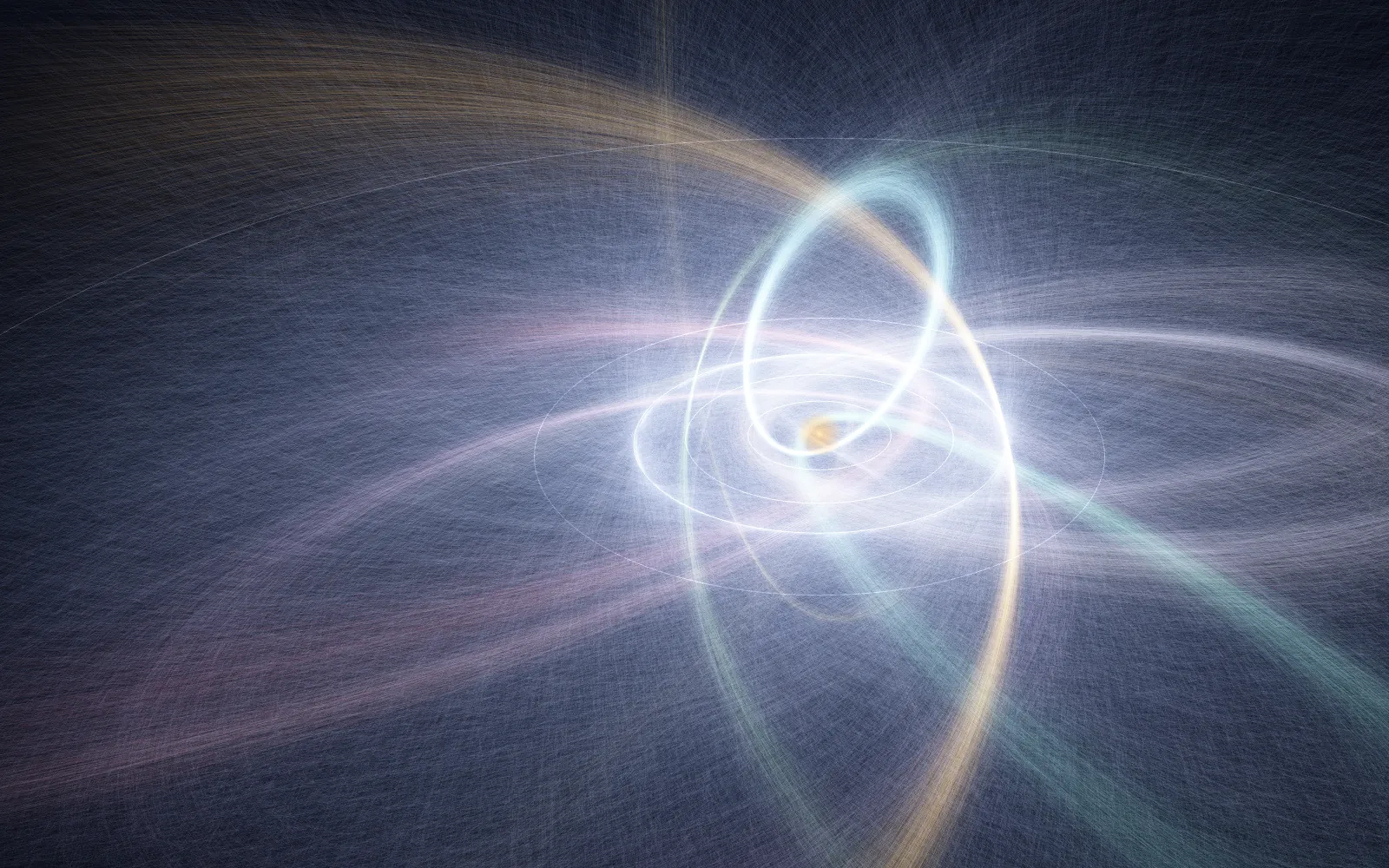
A shooting star is a grain of dust, usually lighter than a gram, that hits the air at tens of kilometres a second and burns up about 100 km high. When two cameras some way apart film it at the same moment, the two angles give its path through the air and, from that, the orbit it was following around the Sun. In 2025, 1,841 cameras of the Global Meteor Network, in 40 countries, managed this 854,755 times. Every thread on the screen is one of those orbits.
19 October 2025, 02:46 UTC
A grain of Halley’s Comet over Romania
Five cameras filmed it, two of them in Romania. It began to burn 117 km above the village of Vințu de Jos in Alba county and went out 0.55 seconds later at 91 km, above Ighiu. It had entered the air at 67 km/s. Seen from 100 km it would have outshone Venus (absolute magnitude −5.2), and from its light the cameras estimate it weighed 1.3 grams.
The highlighted thread is the orbit it came on: a long ellipse much like Halley’s, crossing the Earth’s path at the point where the planet was that morning. Its far end, out beyond the planets, is measured with a wide margin of error; the part near the Earth is secure.
Every thread touches the Earth’s path
A grain is seen only if the Earth runs into it. So every orbit passes through the circle the Earth travels in a year, at the point where the planet was on the night of the meeting. The dense ring where all the threads gather is 2025 seen from above, night after night.
Threads gathered in bundles are the showers
Some grains travel together, on nearly the same orbit, because they came off the same body, most often a comet that sheds dust when it passes the Sun. The Earth crosses these trails on the same days every year, and their grains seem to come from one point in the sky, which gives the shower its name: the Perseids from Perseus, the Geminids from Gemini.
The network placed 27% of the orbits in known showers; 163 of those showers have at least 150 members.
The Perseids, dust of Comet Swift–Tuttle
The cameras recorded 24,702 Perseids in 2025. Their threads and the orbit of Comet 109P/Swift–Tuttle (the thicker line) almost overlap. On the scale astronomers use for such comparisons (the Southworth–Hawkins D criterion) the distance between them is 0.07; below 0.2, orbits are usually taken as a sign of a common origin.
The comet climbs to 51 times the Earth–Sun distance, nearly twice as far as Neptune, and was last closest to the Sun in December 1992. It returns in 2126. Perseids hit the air at 59 km/s.
The Geminids come on an asteroid’s orbit
The median orbit of the 36,415 Geminids of 2025 is almost identical to that of the asteroid (3200) Phaethon (D = 0.03), a rock a few kilometres across that dips to 0.14 of the Earth–Sun distance, nearly three times closer to the Sun than Mercury. Almost all the big showers come from comets; the Geminids are the best-known exception.
Their orbit is small and barely tilted, so Geminids reach the Earth slowly: 34 km/s, against 59 km/s for Perseids. They also go out lower: half of them below 84 km, against 95 km for Perseids.
Most belong to no shower
73% of the orbits of 2025 were placed in no shower. Most are probably grains from old trails, scattered by the pull of the planets; some may belong to faint showers the method does not recognise. A measure of the orbit relative to Jupiter (the Tisserand parameter) still shows what kind of body it resembles: 49% move like long-period comets, 25% like the comets steered by Jupiter’s pull and 26% like asteroids (the colours are in the picture’s key).
The classes describe the orbit, not the body the grain left: by this measure the Geminids too would be “asteroidal”. Phaethon at times shows comet-like activity, and how the Geminid stream formed is still being studied.
More arrive in the morning. In January and December, between 35 and 60 degrees north, the cameras recorded 3.1 times as many unassigned shooting stars between 4 and 6 am as between 7 and 9 pm (local solar time). The usual explanation: in the morning your side of the Earth faces forward, in the direction the planet moves along its orbit, and runs into grains like a car’s windscreen.
Your day: which dust the Earth runs through
Pick a day of the year. The Earth moves to where it is then, and the threads that light up are the orbits of grains recorded around that day in 2025. In 2025, on about 226 of the 365 days of the year, no shower reached even five in 100 shooting stars.