Aedes albopictus in Romania, 2012–2026
The tiger mosquito has been found in 71 Romanian communes. For 27 of the country’s 42 counties, the European map has no data.
Winters have warmed meanwhile. 69% of Romanians now live in communes where January is milder than −1 °C; in 1961–1990 it was 6%. In colder communes the tiger mosquito has been found only very rarely.
Tap your place on the map to see how far away the nearest record is and how January has changed there.
The first was caught in southern Bucharest, in 2012#
In autumn 2012 a team of entomologists caught 45 adult tiger mosquitoes in a neighbourhood in the south of Bucharest. They found it there again in 2013, from summer to October, and then in the city centre too. In 2014, after a resident complained about bites, they found larvae in water containers in his yard (Prioteasa et al., 2015).
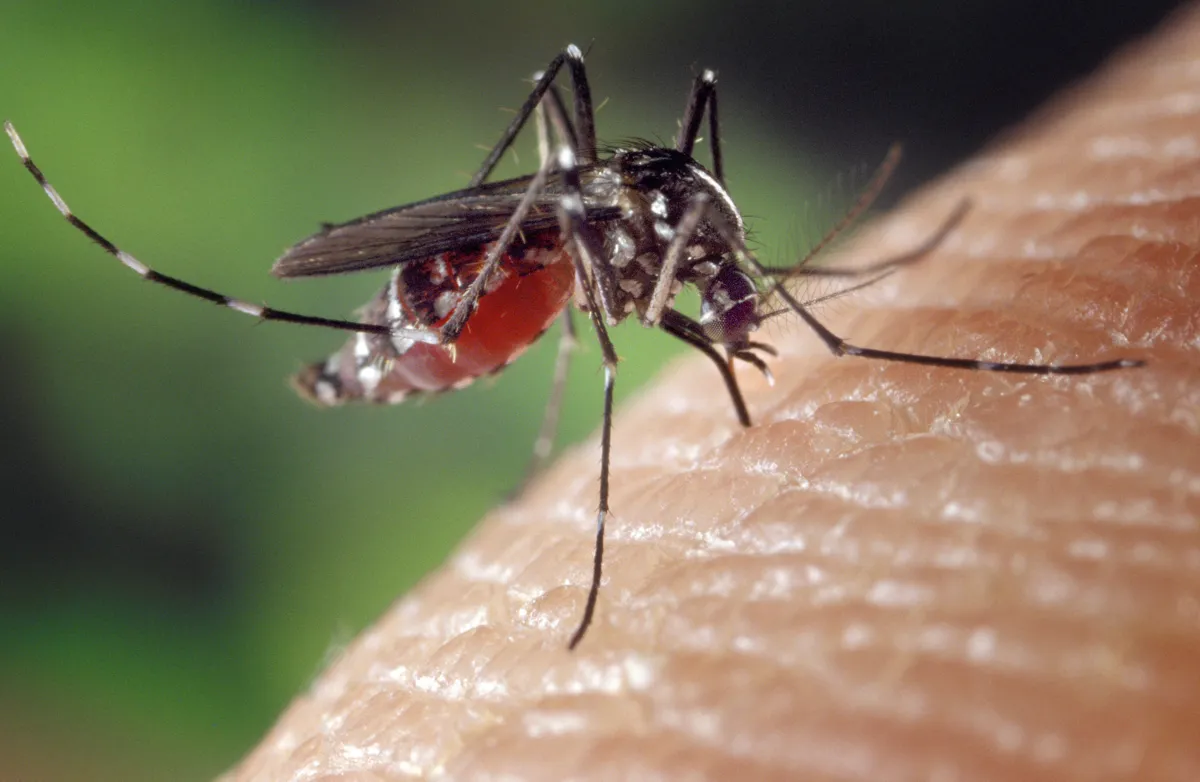
The female bites aggressively, usually by day and outdoors. The larvae grow in water held in containers: tyres, barrels, pots left in a yard (ECDC). The common house mosquito, Culex pipiens, bites mostly in the evening and at night.
In Europe its eggs travelled in used tyres and in pots of “lucky bamboo”, and adults rode in cars along motorways (ECDC). No source consulted says by which route it reached Romania.
The years on the map mostly show when someone looked#
Since then 241 records with coordinates have been published, from 71 communes and towns. For 37 of them the first record dates from 2021. For that year, the dataset that gathers the non-native invertebrates found in Romania, from fieldwork, papers and volunteer observers, has records from 791 communes (Preda et al., 2026).
The link between distance from Bucharest and the year of the first record is weak and could be chance (ρ = 0.13, p = 0.26). With more than half of the first records gathered in a single year, the data cannot say which way the mosquito spread or when it reached a place. The year mostly shows when someone found it.
The European map has no data for 27 counties#
The European Centre for Disease Prevention and Control (ECDC) publishes, with EFSA, the official map of the tiger mosquito by county. In its April 2026 version Romania has 10 counties where the mosquito is established, one where it has only been introduced, four where it was looked for and not found, and 27 with no data (ECDC). Bulgaria and Hungary have data for every county.
In 12 of the counties with no data there are open records: Argeș, Buzău, Caraș-Severin, Dolj, Dâmbovița, Ialomița, Maramureș, Olt, Satu Mare, Teleorman, Vaslui and Vrancea. Dolj has eight communes with records, Craiova among them. Many come from the Preda dataset, published in July 2026, after the April version of the map. The map does change: Brăila, Timiș and Tulcea moved to “established” in 2026.
A record is not an established population. ECDC calls it established only once there is evidence that the mosquito breeds and survives the winter in the same place (ECDC).
Where someone looked, it turned up almost only in communes where January is milder than −1 °C#
Between 2020 and 2023 the same dataset has records of non-native species, from snails to insects, from 1,072 communes. The tiger mosquito turns up in 50 of them. In each of these communes someone noticed and reported other non-native species, so the mosquito’s absence there means something, even if nobody was looking for it in particular.
In communes where January is milder than −1 °C (the mean of the last 20 winters) it was found in 47 of 697 (6.7%). In colder communes, in 3 of 375 (0.8%). The −1 °C threshold was chosen after seeing these data: it describes them and is not a biological limit. It is checked on new data below.
Take a pair of communes from this set, one with the mosquito and one without. The one with the mosquito has the milder January in 71 pairs out of 100 and is closer to Bucharest in 56, close to a coin toss. You recognise it better by how many other non-native species were reported there: 84 out of 100. With models checked on counties held out of the fit, the numbers are 68, 46 and 83.
The places where it has been found here have colder winters than in western Europe#
The VectorNet network has found it at 905 places in 19 countries in western and southern Europe. Only 2% of them have a January colder than 0.6 °C. A rule learned there would say that 86 of the 139 places in Romania where it was found are too cold for it (62%). In Hungary the same rule is wrong for 19 of 342 places.
One possible explanation: in the west, lowlands with frosty winters are rare, while here they make up most of the plain. The −1 °C threshold, taken from Romanian communes, was checked on places the calculation never saw: of 456 places with the tiger mosquito in Hungary, Serbia, Bulgaria, Moldova, Ukraine and Slovakia, only six are colder (1.3%). In Japan the northern limit runs where January averages above −2 °C and the year above 11 °C (Kobayashi et al., 2002).
The −1 °C line has moved across the country#
In 1961–1990 January was milder than −1 °C only in Dobruja, the Banat and a few places along the Danube. 6% of Romanians live there (by the 2021 census). For 1991–2006 the share is 30%; for the last 20 winters (2007–2026), 69%.
In Bucharest January averaged −2.0 °C in 1961–1990 and 0.1 °C over the last 20 winters. The communes where it was found had a median of −1.9 °C then and 0.4 °C now.
Winter is only one of the conditions. A long, warm summer matters too, as do water in yards and the roads it is carried along. A mild winter does not show that the mosquito is already there.
What it can and cannot carry#
The tiger mosquito can transmit dengue and chikungunya viruses (ECDC). To do so it must first bite an infected person, usually a traveller back from places where these diseases are common. ECDC counts locally acquired cases in Europe: dengue reached 83 cases in France and 213 in Italy in 2024 (ECDC), and chikungunya hundreds of cases in France and Italy in 2025 (ECDC). These tables list no locally acquired case in Romania.
In 1996, 393 patients with confirmed or probable West Nile infection were identified in Bucharest and south-eastern Romania. The virus was found in the common house mosquito Culex pipiens, considered the most likely carrier (Tsai et al., 1998). A 2024 study also found the virus in tiger mosquitoes caught in Romania (Dinu et al., 2024); that does not show that they transmit it.
The larvae need standing water, so emptying containers in the yard, buckets, plant saucers and tyres stops them breeding (ECDC). Against bites, Romania’s National Institute of Public Health advises long sleeves and long trousers and screens on windows and doors (CNSCBT), and ECDC adds repellent (ECDC).
Your place#
Tap anywhere in Romania on the map or search for a place by name. For each of the 3,181 communes and towns the result is computed once, and its share page says the same thing.
How it was calculated#
Records. Every Aedes albopictus record with coordinates from Romania on GBIF as of 8 November 2026: ECDC’s VectorNet sets, the Preda et al. (2026) dataset, iNaturalist (community-confirmed observations only), Mosquito Alert (photos validated by entomologists only) and naturgucker. Genetic sequences without a collection place were removed. Rows from a 2020 synthesis that carry only a window of years are counted at the window’s last year. Each point is placed in the commune it falls in.
Winter. The January mean of daily mean temperature from E-OBS v34.0e, on a 0.1° grid (about 11 km), for every year from 1950 to 2026. For a commune it is the cell under its main village. E-OBS is interpolated from weather stations; it does not capture the extra warmth in city centres.
The test on communes with other records. The unit is the commune in the GADM set GBIF uses. A commune enters the test if the Preda et al. dataset has at least one record of a non-native species there between 2020 and 2023, from fieldwork, papers or volunteers. The number of these records stands in for search effort, which is not published. The test fixed in advance asked January temperature alone to reach at least 0.7 in a model checked on held-out counties; it reached 0.68. So the question of what predicts where it arrived has no clear answer. The −1 °C threshold was chosen after this test and then checked on the neighbouring countries.
The rule learned in the west. Places with the mosquito in VectorNet’s observation set from 19 countries outside Romania and its neighbours; the threshold is the 2nd percentile of January temperature at those places.
What the data cannot say. When the mosquito arrived somewhere: the data say when it was first found. Whether it is absent from a place with no records. Whether a commune where a single mosquito was found has a population that survives the winter.
Sources
- Prioteasa F. L., Dinu S., Fălcuță E., Ceianu C. S. (2015). Established population of the invasive mosquito species Aedes albopictus in Romania, 2012–14. Journal of the American Mosquito Control Association 31(2): 177–181
- Fălcuță E. et al. (2020). The invasive Asian tiger mosquito Aedes albopictus in Romania: towards a country-wide colonization? Parasitology Research 119: 841–845
- Preda C. et al. (2026). From soil to stream and sea: species richness and distribution of alien invertebrates in Romania. NeoBiota 108: 21–52; dataset on GBIF
- ECDC, invasive mosquito maps (definitions of the status by region)
- VectorNet, ECDC, EFSA (2026). VectorDistributionStatus_2026, v1.2, GBIF
- VectorNet, ECDC, EFSA (2025). VectorNet observations, v1.5, GBIF
- GBIF: Aedes albopictus records from Romania and its neighbours, downloaded 8 November 2026 (iNaturalist, Mosquito Alert, VectorNet, Preda et al.)
- Cornes R. et al. (2018). An ensemble version of the E-OBS temperature and precipitation datasets, v34.0e, Copernicus Climate Change Service / ECA&D
- Kobayashi M. et al. (2002). Analysis of northern distribution of Aedes albopictus in Japan by geographical information system. Journal of Medical Entomology 39(1): 4–11
- ECDC, Aedes albopictus factsheet
- ECDC, locally acquired dengue cases in the EU/EEA by year
- ECDC, locally acquired chikungunya cases in Europe by year
- Tsai T. F. et al. (1998). West Nile encephalitis epidemic in southeastern Romania. The Lancet 352: 767–771
- Dinu S. et al. (2024). Microorganisms 12(10): 2080
- CNSCBT (Romania’s National Institute of Public Health), West Nile: general information and advice for the public, annex to the 2018 surveillance methodology (in Romanian)
- ECDC, Guide to a safe summer
- Photo: James Gathany, CDC Public Health Image Library (public domain), via Wikimedia Commons