TOWER BRIDGE · LONDON · 1894
Lift 1,200 tons so a ship can pass
A steamer signals from downriver and the road has to stand up. You are the bridge operator: hold the valve, spend the pressure six accumulators saved for this minute, and lift two arms of over twelve hundred tons each — then bring them down and let the city move again.
One lift, July 1894: the signal, the valve, the rising road, the engine rooms that paid for it. Every figure dated, every figure sourced — and a rule that still holds: on the Thames, the river outranks the road.
The lift: the valve is yours
Any vessel with a nine-metre-or-more mast or superstructure, booked a day ahead, owns this minute. Press and hold the valve: stored water pressure drives the arms up to near-vertical in about a minute — on screen the minute fits in a few held seconds — the ship passes, and you lower the road. The still bridge below is the honest state: arms at rest, boats on the river.
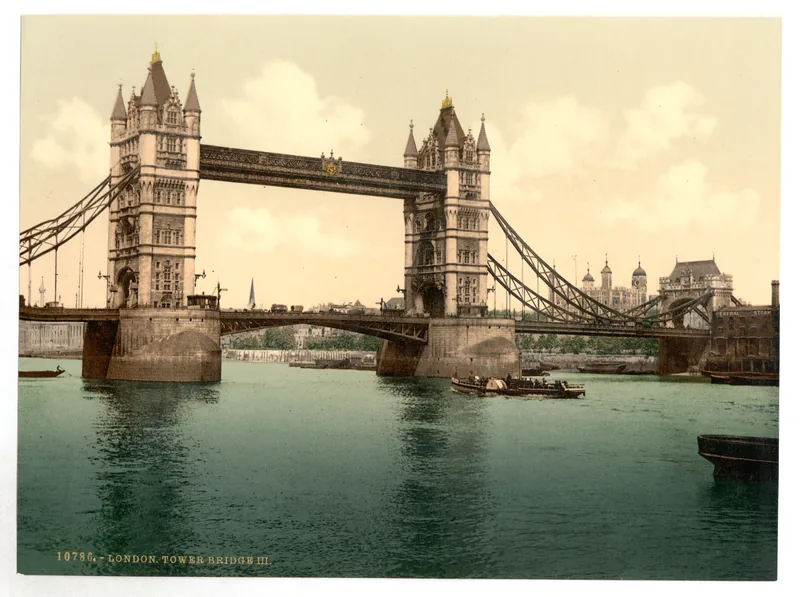
Figure receipt
Detroit Publishing Co. photochrom, c. 1890–1900 · Library of Congress · public domain
Work the valve
Press and hold the button: while you hold, pressure flows and the arms rise; let go and they stop where they are. On screen a minute fits in a few held seconds — the real machine lifted in a minute. Finish the lift, pass the ship, then lower the arms.
Arms down. The ship waits.
Prefer the plain account? The whole lift, without controls, is below, in The lift, in brief.
The Engine Rooms: what paid for the minute
Two steam pumping engines of 360 horsepower each push water to 700 pounds per square inch into six accumulators — four in the piers, two at the engine house. The accumulators feed one hydraulic engine per bascule, through gearing, on demand. Armstrong built the machinery at Elswick; the original engines still stand where visitors can see them.
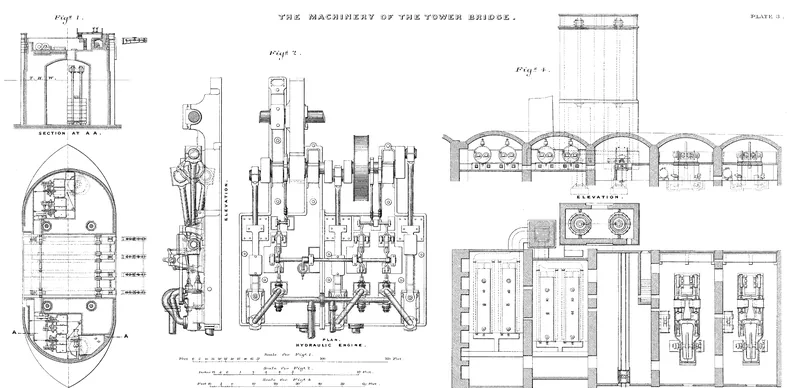
Figure receipt
S. G. Homfray, Proc. ICE vol. 127 (1897) · public domain
The lab: the lift in figures
Every number below was read in its source — Homfray’s 1897 engineering paper, the bridge operator’s own pages, or the Illinois engineering page. Each row carries its whole hedge: what is measured, what is practice, what one source says alone.
The lift in figures
Read in the source named on each row. Practice beats theory where they differ.
| Measure | Figure | What it means |
|---|---|---|
| Each bascule | Over 1,200 tons | The bridge operator’s own figure, bascule-chambers page. |
| Counterweights | Hundreds of tons | Four hundred tons on the operator’s chambers page; another operator page says four hundred and twenty-two — two figures, neither averaged. |
| Lift angle | Eighty-six degrees | To the horizontal, one engineering source alone — read as near-vertical. |
| One motion | About a minute | Raising or lowering, Homfray 1897; in practice about a minute and a quarter. |
| Full cycle | About five minutes | Arms up, ship through, arms down, traffic resumed — one engineering source. |
| Water pressure | Seven hundred psi | Pounds per square inch, Homfray 1897 — the source gives a single value. |
| Stored pressure | Six accumulators | Four in the piers, two at the engine house, Homfray 1897. |
| Pumping engines | Two, 360 horsepower each | Double tandem compound surface-condensing, Homfray 1897; contractor Sir W. G. Armstrong, Mitchell and Co, built at Elswick. |
| First year | 6,194 lifts | Eighteen ninety-four: about seventeen a day, the operator’s count; the record day, sixty-four lifts, came in 1910. |
Years and machines
Two rails: the dated spine from the 1885 Act to today’s eight hundred lifts a year, and the machine rail — the six numbers the lift stands on. Read them against the minute you just worked.
The dated spine
Six dated stops, from the Act to this year.
1885: Parliament binds the bridge to the river
1885 · Tower Bridge Act — river traffic has priority over road traffic source
1886–1894: eight years a-building
1886–1894 · Barry engineer, Jones architect source
1894: opens at noon, lifts seventeen times a day
30 June 1894 · opened by the Prince of Wales; 6,194 lifts in the first year source
1897: the machinery on paper
1897 · Homfray’s engineering paper: one minute a motion, 700 psi, six accumulators source
1974–76: steam gives way to electricity
1974–76 · electro-hydraulic conversion; the steam era ends in 1976 source
Today: eight hundred lifts a year
Lift times published · the lift free since 1894 source
The machine rail
The six numbers the lift stands on.
Over 1,200 tons a bascule
The operator’s figure · counterweighted in the hundreds of tons source
Eighty-six degrees
To the horizontal · one engineering source source
One minute a motion
Homfray 1897 · about a minute and a quarter in practice source
700 psi water pressure
Homfray 1897 · six accumulators hold it ready source
Two 360-horsepower engines
Sir W. G. Armstrong, Mitchell and Co · built at Elswick source
Steel frame, stone clothes
11,000 tons of steel · Cornish granite and Portland stone source
Ships have priority
The arms come down, the omnibuses roll, and the city forgets — until the next signal. The same arms have risen for over one hundred and thirty years — electro-hydraulic since the mid-seventies; the lift has been free since 1894, and the operator still publishes its lift times. The river outranks the road, by Act of Parliament.
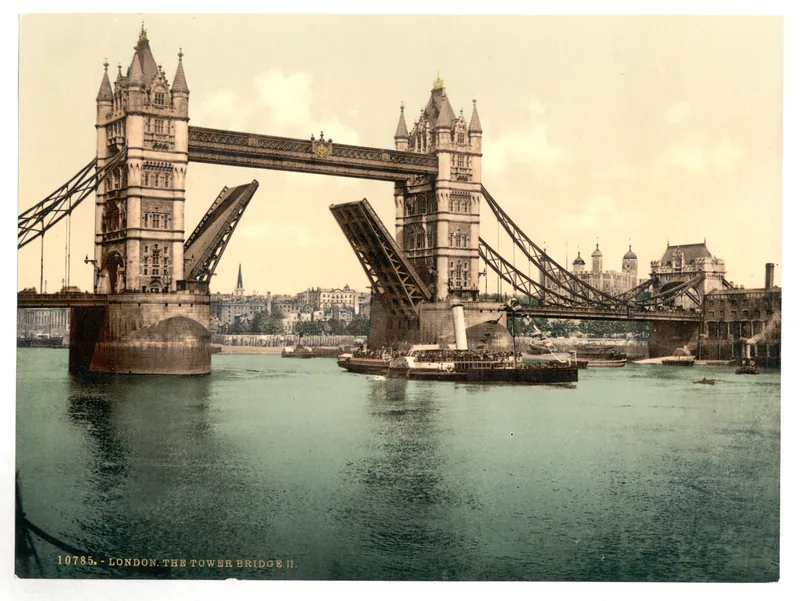
Figure receipt
Detroit Publishing Co. photochrom, c. 1890–1900 · Library of Congress · public domain
The lift, in brief
A vessel books a day ahead; on its signal you spend the stored pressure, the arms rise in about a minute, the ship passes, and you lower the road. The figures behind it follow.
Figure receipt
Detroit Publishing Co. photochrom, c. 1890–1900 · Library of Congress · public domain
The signal: any vessel with a nine-metre-or-more mast or superstructure, booked twenty-four hours ahead, may ask for a lift.
The valve: you release pressure saved in six accumulators; each bascule rises on its own hydraulic engine, through gearing.
The minute: the arms reach near-vertical — eighty-six degrees to the horizontal, one engineering source — in about a minute.
The pass: the ship goes through; full close-and-resume takes about five minutes.
The lower: you bring the arms down and the city moves again.
| Measure | Figure | What it means |
|---|---|---|
| Each bascule | Over 1,200 tons | The bridge operator’s own figure, bascule-chambers page. |
| Counterweights | Hundreds of tons | Four hundred tons on the operator’s chambers page; another operator page says four hundred and twenty-two — two figures, neither averaged. |
| Lift angle | Eighty-six degrees | To the horizontal, one engineering source alone — read as near-vertical. |
| One motion | About a minute | Raising or lowering, Homfray 1897; in practice about a minute and a quarter. |
| Full cycle | About five minutes | Arms up, ship through, arms down, traffic resumed — one engineering source. |
| Water pressure | Seven hundred psi | Pounds per square inch, Homfray 1897 — the source gives a single value. |
| Stored pressure | Six accumulators | Four in the piers, two at the engine house, Homfray 1897. |
| Pumping engines | Two, 360 horsepower each | Double tandem compound surface-condensing, Homfray 1897; contractor Sir W. G. Armstrong, Mitchell and Co, built at Elswick. |
| First year | 6,194 lifts | Eighteen ninety-four: about seventeen a day, the operator’s count; the record day, sixty-four lifts, came in 1910. |
Scaffolding and steam
Eight years, one bridge, one command
Five beats from bare steel to the lift you just worked — the building, the costume, the opening, the rule, and the engines' long afterlife.
Bare steel first, 1886–1894
For eight years the crossing was scaffolding and rivets: Barry’s engineering and Jones’s architecture rising together over the Pool. The photographs of 1892 show the frame with its clothes still off — the towers unclad, the walkway missing, the stone yet to come.
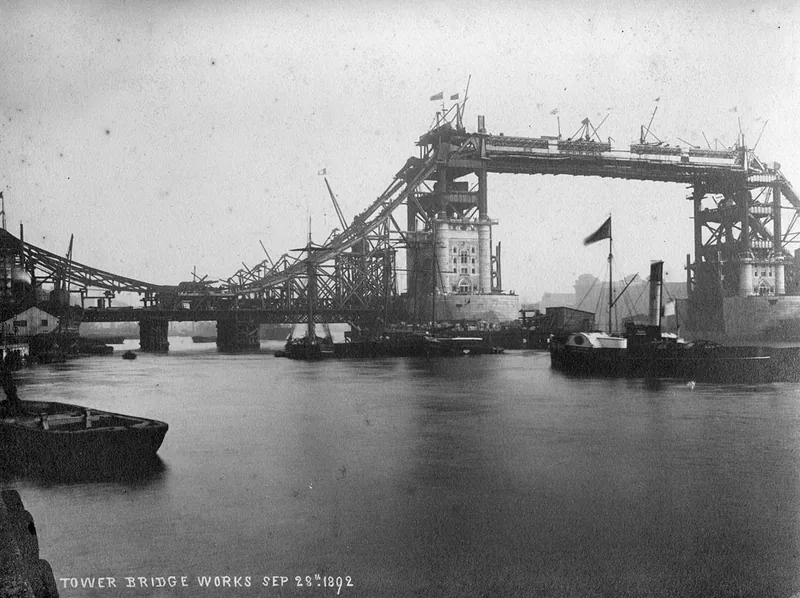
The frame before the costume: scaffolding, rivets, and open steel — the works on 28 September 1892. Figure receipt
Commons, dated 28 September 1892 · public domain
The castle is a costume
Over eleven thousand tons of steel carry the bridge; the stone — Cornish granite and Portland stone — was designed to protect the underlying steelwork and to give the bridge a more pleasing appearance. The fairy-tale towers are cladding over a machine. Beer photographed them half-dressed in 1892.
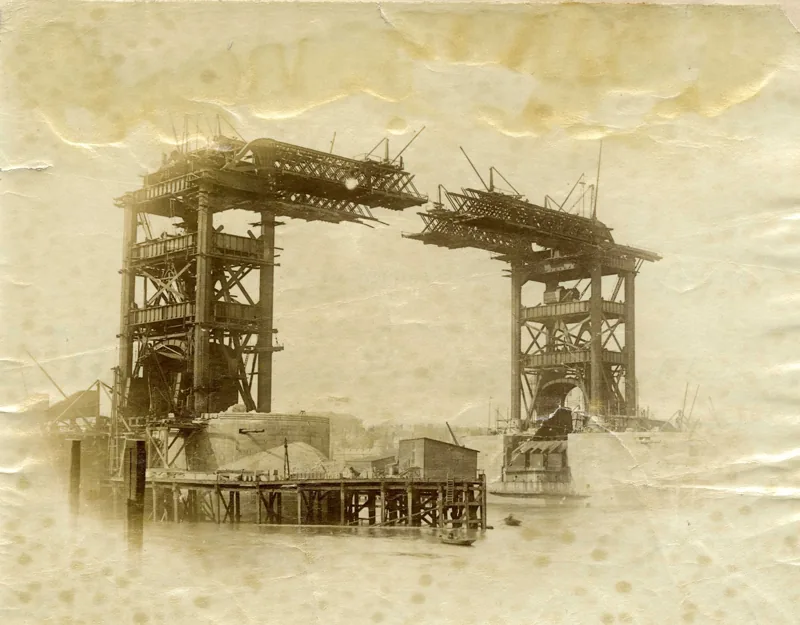
Half-dressed: the towers unclad, no walkway yet — the machine before its masonry. Figure receipt
Sidney Alfred Beer, 1892 · via The National Archives · no restrictions
Noon, 30 June 1894
The Prince of Wales opens the bridge at noon. In its first year the bascules lift six thousand one hundred and ninety-four times — about seventeen lifts a day — and the busiest days are still ahead: sixty-four lifts in a single day in 1910.
The river outranks the road
An Act of Parliament says so: river traffic has priority over road traffic, and any vessel with a nine-metre-or-more mast or superstructure, booked a day ahead, may ask for a lift — free, as it has been since 1894. The Pool it serves was, in the Victorian era, the busiest port in the world.
Steam until the seventies
The steam engines ran from 1894; the change to electro-hydraulics began in 1974 and the steam era ended in 1976. The originals were kept where visitors can see them in the Engine Rooms, and the same arms still rise some eight hundred times a year.
Two sentences
Two sentences, one machine
The engineer who measured the machine, and the verdict history gave it.
First Homfray, in 1897 — then the scope history allows the superlative.
- “In practice, however, it has never been found necessary to use more power than that exerted by one small engine.”
- “When it was built, Tower Bridge was the largest and most sophisticated bascule bridge ever completed.”
1897: S. G. Homfray, Minutes of the Proceedings of the Institution of Civil Engineers, vol. 127. Scope of the second: at the time of building.
The paper behind the first sentence is linked below.
Sources
Sources and receipts
The engineering paper read in full; the operator’s pages read one by one. Open any of them.
The machine
The operator
- Why does Tower Bridge open — priority, first-year lifts, record day
- The bascule chambers — 1,200-ton arms, counterweights
- What type of bridge is Tower Bridge
- How was Tower Bridge built — eight years, steel and stone
- Timeline: the construction of Tower Bridge
- How did the Engine Rooms work — 1974–76 conversion
- Request a bridge lift — nine metres, twenty-four hours
- Bridge lifts — times, eight hundred a year
Listing and scope
Images
- Bascules open, c. 1890–1900 (Library of Congress Photochrom)
- Bridge closed, c. 1890–1900 (Library of Congress Photochrom)
- Construction works, September 1892 (Wikimedia Commons)
- Towers under construction, 1892 — Beer (via National Archives)
- Homfray 1897, the third plate — hydraulic engine and pumping plant

.jpg)
Set in open-licensed fonts, served locally.
Keep walking
Paxton’s glass palace rose in Hyde Park four decades earlier, in iron and panes — the Victorian engineering vein, another machine.
Apollodorus crossed the Danube on stone piers eighteen centuries before this steel — the bridge lane, another machine.
Answers, dated
How long does a lift take?
One motion — up or down — takes a minute, about a minute and a quarter in practice (Homfray, 1897). Arms up, ship through, arms down, traffic moving again: about five minutes.
Why the Gothic towers?
They are cladding, not structure: over eleven thousand tons of steel carry the bridge, and the Cornish granite and Portland stone were designed to protect the steelwork and to please the eye. The operator’s pages say exactly that.
Who has priority — ships or cars?
Ships, by law: the Tower Bridge Act of 1885 binds the bridge to give river traffic priority over road traffic. Any vessel with a nine-metre-or-more mast or superstructure, booked twenty-four hours ahead, may ask for a lift — free since 1894.
Does it still run on steam?
No: the change to electro-hydraulics began in 1974 and the steam era ended in 1976. The original Victorian engines are kept in the Engine Rooms for visitors, and the bridge still lifts some eight hundred times a year — the operator publishes the times.