Wallachia, January – June 1821
Whose revolution was 1821?
At Padeș, Tudor called the whole human folk against the Phanariotes; at Iași, Ypsilantis called the Hellenes against the Sultan. For five months two revolutions shared one country – then Bucharest forced them to choose.
Representative route
Two revolutions, one country
Follow the lines: Tudor's road runs from Târgu Jiu through Padeș and Craiova to Bucharest, then to Golești and Târgoviște; the Eterist road runs from Sculeni through Iași and Ploiești to the same cities. Every line on this map is representative – the places are verified, the dashes are not footprints.
Dates below give the Old Style first, then the New Style: Wallachia lived 12 days behind Gregorian Europe in 1821.
Chapter I
Padeș
January – February 1821 · 1821, the call
- Chapter
- January – February 1821
- The call
- Padeș, 23 January 1821
- The camp
- Țânțăreni: 4,000 foot, 500 horse
- The answer
- the people, not the plunderers
In January 1821 Prince Alexandros Soutzos died, and the boyar regency – the Comitet de oblăduire – agreed with the Pandurs to raise Oltenia before a new Phanariote prince could reach Bucharest. Their instrument was Tudor Vladimirescu, born around 1780 at Vladimiri in Gorj and decorated by Russia in the war of 1806–1812: on 15 January he wrote to the Sultan that his quarrel was with the Phanariotes, not the Empire.
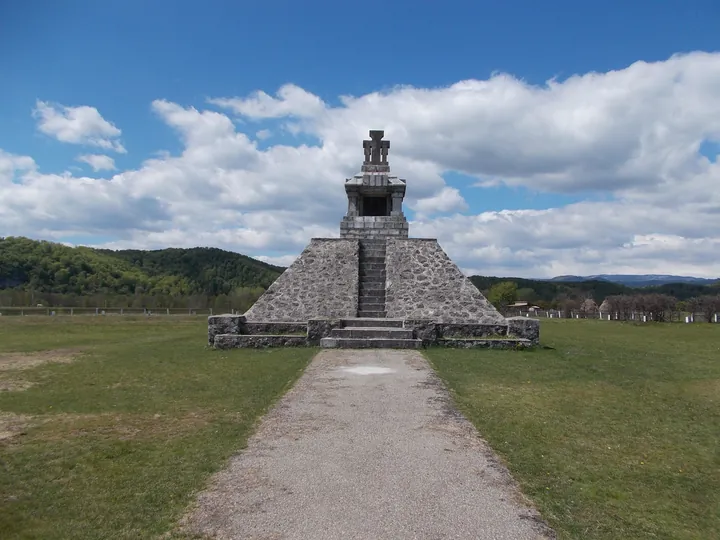
On 21 January he seized the prefect at Târgu Jiu; on 22 January his men took Tismana Monastery; on Sunday 23 January, at Padeș, before about 100 plăieși, he read the call 'to all the human folk' remembered as the Padeș proclamation. No law, it said, stops a man from meeting evil with evil – and it summoned an Assembly of the People to strike the snake on the head with a cane.



The march through Mehedinți – Broșteni, Cerneți, Strehaia – emptied Craiova of its boyars by 29 January, and on 4 February the camp at Țânțăreni held some 4,000 foot and 500 horse. When the Divan sent Nicolae Văcărescu on 11 February to halt the march on Bucharest, Tudor answered that the fatherland is 'the people, and not the Coterie of plunderers'.
There is no law that would prevent a man from meeting evil with evil.
The Padeș proclamation, 23 January 1821
Meanwhile In the Russian port of Odessa, Alexandru Ypsilantis had just taken command of the Filiki Eteria, whose Bucharest council of May 1820 had approved a general anti-Ottoman rising.
Chapter II
Bucharest
4 – 21 March 1821 · 1821, the capital
- Chapter
- 4 – 21 March 1821
- The price
- 500,000 thaler
- The crossing
- the Olt, 10 March
- The entry
- bread and banner, 21 March
On 4 March the Pandurs took Slătioara, and Tudor sent the regents a five-point ultimatum: the Phanariotes out, a levy army, tax relief, and 500,000 thaler for his expenses. The Demands of the Romanian People added offices by merit instead of purchase, and the main tax reduced and split into quarterly instalments.
Pitești fell on 7 March; on 10 March the columns crossed the Olt and camped at Vadu-Lat; on 16 March they held Bolintin, and appeals of 16 and 20 March told Bucharest that 'we are all parts of the same people'. The army's size runs from 4,000 to 24,000 men depending on the source; Tudor himself claimed at least 12,000, with five to eight cannons.

.jpg)
On 21 March the column entered Bucharest down Podul Calicilor behind a white-and-blue banner, Tudor holding a loaf of bread as a sign of plenty. Metropolitan Dionisie received him with 'great joy', the remaining boyars called the movement 'useful and redeeming', and the Arnaut commander Sava Fochianos accepted a ceasefire after facing the Pandurs at the Metropolitan Church.
We are all parts of the same people.
Tudor's appeal to Bucharest, 20 March 1821
Meanwhile In Moldavia the Sacred Band was forming, and Tsar Alexander's minister Capodistria was already drafting the denunciation that would strip Ypsilantis of his Russian rank.
Chapter III
The break
22 February – 15 May 1821 · 1821, the rupture
- Chapter
- 22 February – 15 May 1821
- The crossing
- Sculeni, 22 February
- The partition
- 25 March: two domains
- The firman
- 'pity and justice' vs the outcast
On 22 February Ypsilantis crossed the Prut at Sculeni, and on 24 February, at Iași, he proclaimed 'Fight for Faith and Motherland', promising the Hellenes the support 'of a great power' and summoning them to the Ionian and Aegean shores, to Marathon and Thermopylae. Russia answered by disowning him, and Patriarch Gregory V answered with an anathema – yet the Sacred Band marched on toward Bucharest.
Kept outside the city at the Colentina manor, the Eterists met Tudor on 25 March and divided the country: Oltenia, Bucharest and southern Muntenia stayed his; the Carpathian counties went to the Sacred Band, 7,000 men on paper. In April Tudor barricaded himself in Cotroceni – fortifications drawn by Gheorghe Lazăr – and on 14 April his boyars denounced Ypsilantis as a dishonoured guest; on 18 April his envoys Jianu and Borănescu left for Silistra to parley with the Ottomans, and Jianu was arrested there.

In the last days of April the Ottoman armies crossed the Danube – 20,000 to 32,000 men in two columns, through Calafat and Călărași – and by 14 May they stood at Copăceni, in sight of Bucharest. The Sultan's firman promised justice separating 'the exploited from the exploiters', praised Tudor as a loyalist demanding 'pity and justice', and dismissed Ypsilantis as an outcast.
To arms, then, friends, the Motherland calls us!
Ypsilantis's Iași proclamation, 24 February 1821
Meanwhile In the Peloponnese the Greek rising was beginning, the southern front of the Eteria's plan.
Chapter IV
Golești
21 May 1821 – 1822 · 1821–1822, the price
- Chapter
- 21 May 1821 – 1822
- The arrest
- Golești, 21 May
- The night
- Târgoviște, 27–28 May
- The end
- Drăgășani, 7 June
Tudor retreated toward Oltenia and Ypsilantis toward the northern hills, and discipline collapsed on the road: Tudor hanged men for desertion – Ioan Urdăreanu at Golești – and may have killed as many as 30 of his own soldiers, some by his own hand. The Macedonski brothers then charged him with embezzling 1 million thaler and threatened to hand him to the Divan for trial.
On 21 May the Eterists walked into the camp at Golești and seized Tudor without a shot, showing the Pandurs his correspondence with the Porte; the leaderless men rallied to their new captains, and the prisoner was carried to the Eterist headquarters at Târgoviște. There, in the night of 27–28 May, he was tortured, shot and cut to pieces, and his body was thrown into a pit.
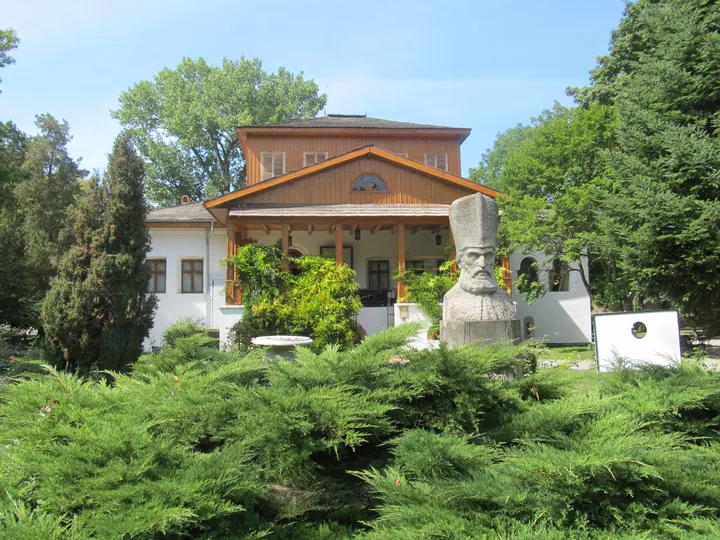

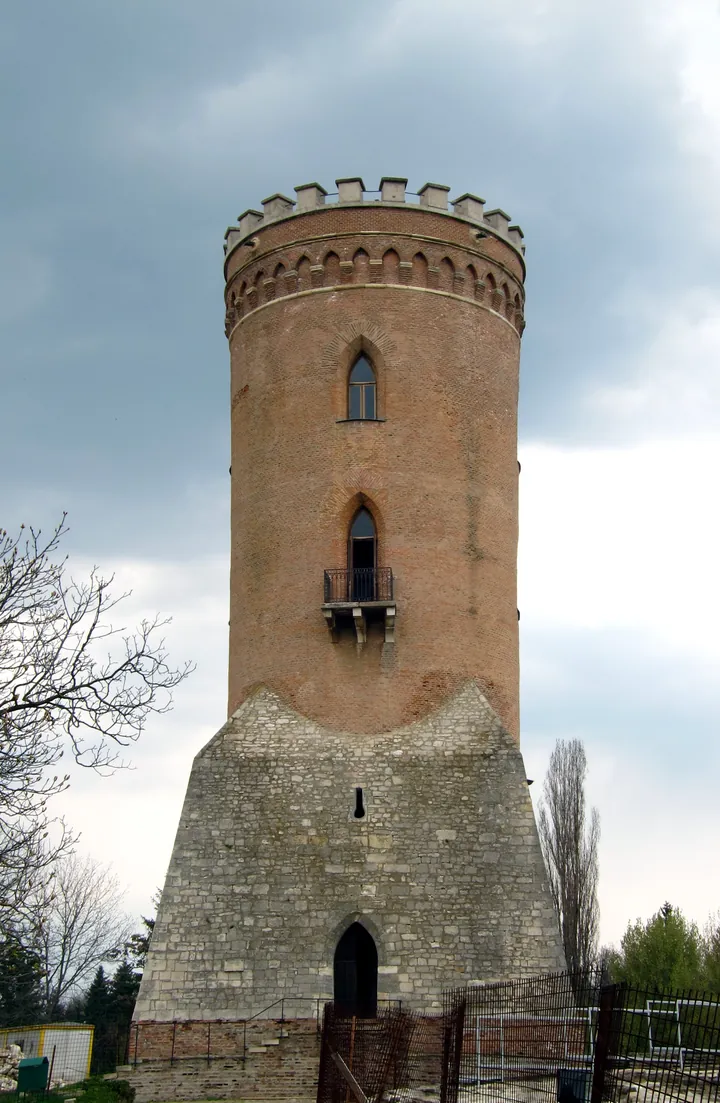

The collaboration charge was never confirmed, and the Eteria never took command of his army: most of the Pandurs simply went home. At Drăgășani, on 7 June, the Sacred Band was destroyed by 2,000 Ottoman horsemen; in 1822 the Sultan gave the thrones to native princes – Grigore IV Ghica and Ioan Sturdza – and the Phanariote century ended.
You have broken your oaths, you have betrayed God and your country.
Ypsilantis's farewell to his army, June 1821
Meanwhile At Secu Monastery in Moldavia the last Eterists made their final stand – Olympios blew himself up with the powder store, Pharmakis was taken and beheaded.
Whose revolution is it?
Four documents, two authors. Give each demand to Tudor or to Ypsilantis – then see what the papers say.
-
1
The Assembly of the People
A proclamation summons 'all the human folk' to strike the snake on the head with a cane and elect new captains 'who can be good'.
What the papers say
Tudor's: the Padeș proclamation of 23 January 1821 calls the folk, not the Hellenes, and asks for good captains – not war on the Sultan.
-
2
Faith and Motherland
A proclamation calls the Hellenes to the Ionian and Aegean shores, to Marathon and Thermopylae: 'To arms, then, friends, the Motherland calls us!'
What the papers say
Ypsilantis's: the Iași proclamation of 24 February 1821 promises the support 'of a great power' – Russia, which disowned him within weeks.
-
3
Offices by merit
A programme demands the end of purchased offices, promotion by merit, and a reduced main tax split into quarterly instalments.
What the papers say
Tudor's: the February demands and the Demands of the Romanian People target the Phanariote administration, not the Ottoman Empire.
-
4
The great power
A leader banks everything on Russia: his plan assumes the Tsar will turn an Ottoman invasion of the Principalities into a Russian war.
What the papers say
Ypsilantis's: the Eterist plan needed Russian intervention; instead Capodistria denounced him and the Patriarch anathemised him.
Answer a card to begin.
Six documents of 1821
Six plates, one per month from January to June: the two proclamations, the capital, the prince without a throne, the camp, and the last battle.
Plate ian 1821The Padeș call
The Padeș call The Padeș proclamation monument · Nicu Farcaș, CC BY-SA 4.0 · Wikimedia Commons - Read on 23 January 1821 before about 100 plăieși in a Gorj village.
- 'No law stops a man from meeting evil with evil': the right to resist, in biblical dress.
- Loyal to the Sultan, merciless to the Phanariotes: the programme fits on one page.
Plate feb 1821The Iași answer
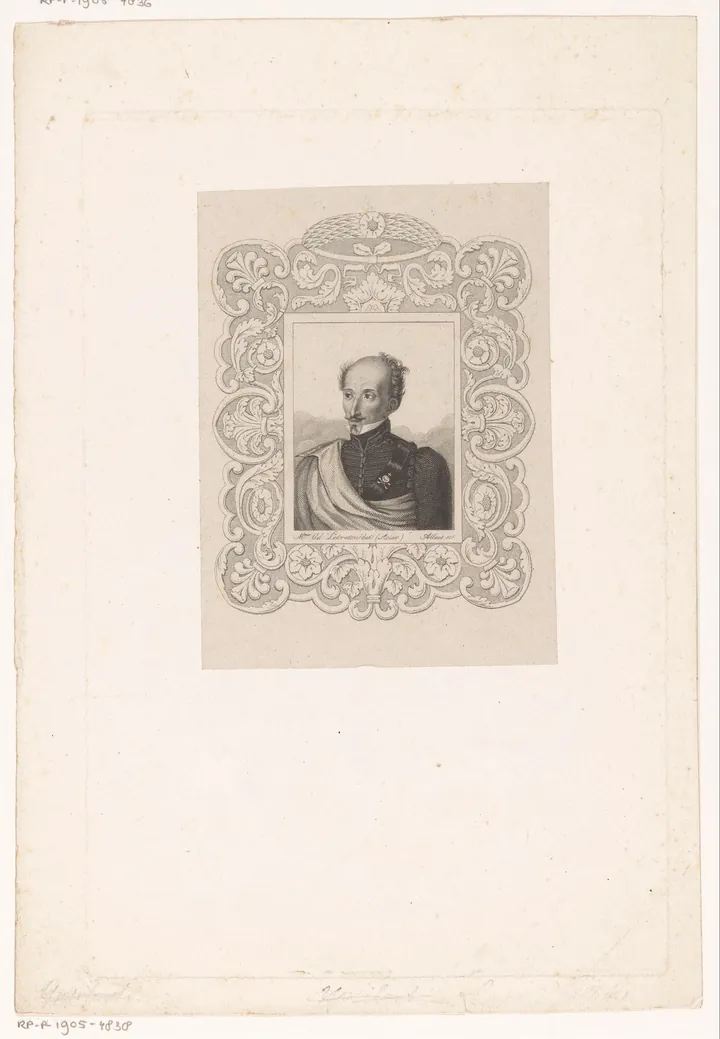
The Iași answer Alexander Ypsilantis · Rijksmuseum, CC0 · Wikimedia Commons - Proclaimed on 24 February 1821, two days after the Prut crossing at Sculeni.
- 'Of a great power': Russia is named nowhere and meant everywhere.
- Marathon and Thermopylae, not Padeș and Tismana: this revolution aims at Greece.
Plate mar 1821The capital taken
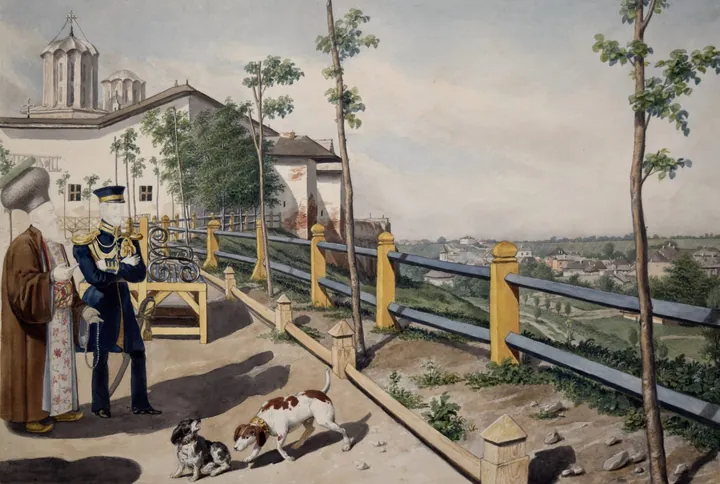
The capital taken Miklós Barabás, Dealul Mitropoliei 1832 · public domain · Wikimedia Commons - Entered on 21 March 1821 down Podul Calicilor, behind a white-and-blue banner.
- A loaf of bread in Tudor's hand: the sign of the plenty to come.
- Dealul Mitropoliei, drawn here in 1832, became his residence and his trap.
Plate apr 1821The prince without a throne
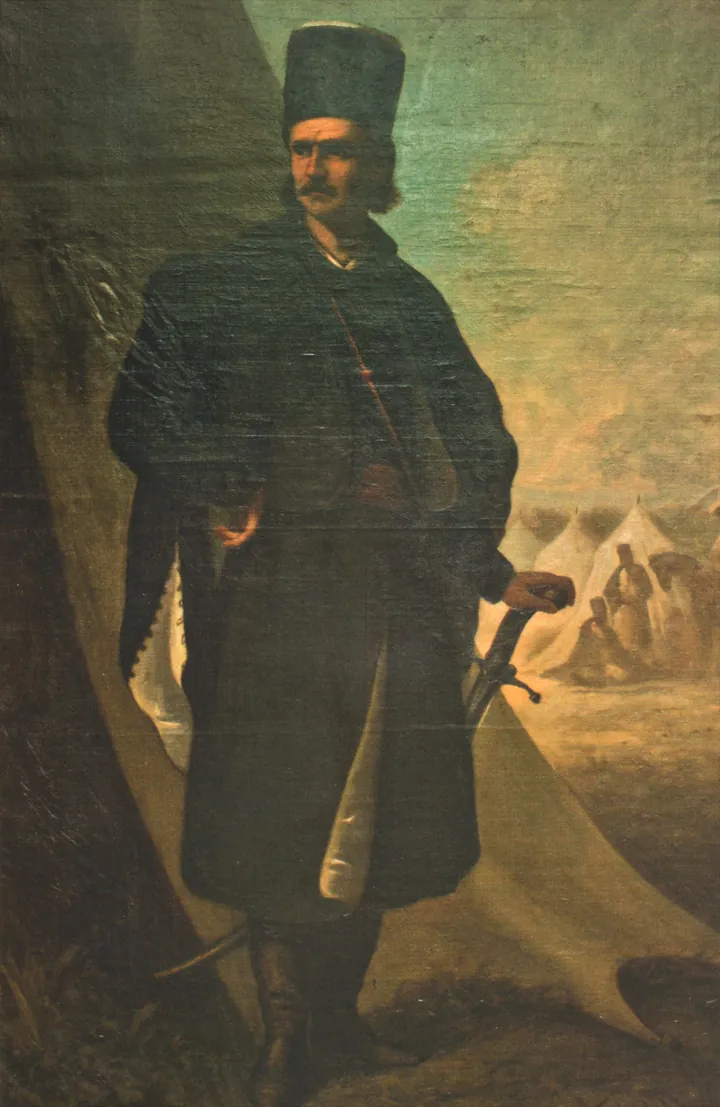
The prince without a throne Theodor Aman, Tudor Vladimirescu · public domain · Wikimedia Commons - In April 1821 Tudor wore the kalpak and signed as Domn from Cotroceni.
- His 18 April envoys to Silistra sought peace; the pasha arrested Jianu.
- The firman praised him as the loyalist asking 'pity and justice'.
Plate mai 1821The camp at Golești
The camp at Golești The Golescu manor, Golești · Nenea hartia, CC BY-SA 4.0 · Wikimedia Commons - Seized on 21 May 1821 in the middle of his own camp, without resistance.
- The charge sheet: a million embezzled thaler and letters to the Turks.
- The Pandurs watched, then chose new captains and marched home.
Plate iun 1821The Sacred Band's end
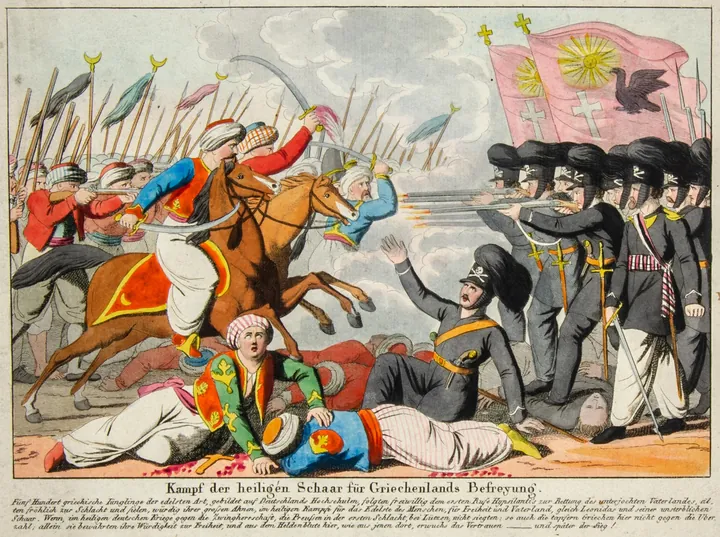
The Sacred Band's end Friedrich Campe, the Sacred Band in battle · public domain · Wikimedia Commons - On 7 June 1821, at Drăgășani, 2,000 Ottoman horsemen met the Sacred Band.
- The charge went in drunk, in column, without squares – and was cut down.
- Ypsilantis blamed his men in writing, then fled toward Austria.

Images via Wikimedia Commons (public domain, CC0, or CC BY-SA with credit). Plate references are months of 1821.
1821 in six numbers
Every figure below comes from the cited histories. The years are the spine of the story, 1780 to 1822.
- 1,780
- Tudor's birth year at Vladimiri, still debated
- 1,821
- the year of Padeș, Bucharest and Târgoviște
- 100
- plăieși heard the call at Padeș
- 12,000
- men Tudor claimed to have under arms
- 7,000
- men of the Sacred Band, on paper
- 1,822
- native princes return to Bucharest and Iași
Three things the papers correct
Tudor, the stainless national hero
The documents stain him: he hanged his own men – perhaps 30 – for desertion, ordered Urdăreanu's hanging at Golești, and taxed Bucharest while ruling it. A hero of the nation he remains; stainless he was not.
Tudor sold the revolution to the Turks
Unproven: the 'collaboration' rests on the same letters to the Porte that every Wallachian government wrote, displayed by his killers after his arrest. The Porte's own firman treated him as a supplicant for 'pity and justice' – and the Eterists who shouted 'traitor' looted the country themselves.
The film death: shot in the back, falling like spring grass
The 1962 film lets Emanoil Petruț die cleanly on horseback. The papers say Târgoviște: torture through the night of 27–28 May 1821, then shooting, sabres, and a body thrown into a pit.
Sources and methods
The story follows the English and Romanian uprising histories, the Tudor and Ypsilantis biographies, Britannica, and the CEUP reader for the Iași proclamation. Day-dates give the Old Style first: Wallachia lived 12 days behind Gregorian Europe in 1821.
Document quotes appear in the original where the edition language matches, otherwise in the editors' translation; the modern Ypsilantis translation is quoted only in short excerpts. All eight images are public domain, CC0 or attribution-licensed CC BY-SA, via Wikimedia Commons.
What the sources leave open stays open on this page: the birth year, the execution night, the army's size, the collaboration charge and the missing million are all marked disputed – never smoothed, never invented.
Padeș
- Tudor Vladimirescu (c.1780–1821): Vladimiri, Glogoveanu, vătaf at Cloșani 1806, the 1806–1812 Russo-Turkish war, the Order of St Vladimir 3rd class
- Soutzos dies 19/31 January 1821; the 15 January agreement; 21 January Otetelișanu, 22 January Tismana, 23 January/4 February Padeș with c.100 plăieși; Țânțăreni 4 February (4,000 foot, 500 horse); Văcărescu's embassy 11 February
- The Padeș proclamation: 'no law stops a man from meeting evil with evil'; the Assembly of the People (1821 document, public domain)
Bucharest
- Slătioara 4 March; the five-point ultimatum and the 500,000 thaler; the Demands of the Romanian People; the army between 4,000 and 24,000 men by source, Tudor claimed at least 12,000
- Pitești 7 March; the Olt crossing 10 March; Vadu-Lat; Bolintin 16 March; the appeals of 16 and 20 March; the Bucharest entry 21 March/2 April, the white-and-blue banner, the bread, Dealul Mitropoliei
The break
- Ypsilantis: the Prut at Sculeni 22 February O.S.; the Iași proclamation 24 February/8 March, 'Fight for Faith and Motherland', the support 'of a great power'; Russia's disavowal, the Patriarch's anathema
- The Iași proclamation text: the Hellenes, the Ionian and Aegean shores, Marathon and Thermopylae, 'To arms, then, friends, the Motherland calls us!' (modern translation, short excerpts)
- The 25 March meeting and the partition; Lazăr's Cotroceni; the 14 April anti-Eterist proclamation; the 18 April Silistra parley, Jianu arrested; the Ottoman push (20,000–32,000); the May firman ('pity and justice')
Golești
- The retreat toward Oltenia; Urdăreanu's hanging at Golești; the 1-million-thaler charge; the 21 May/2 June arrest; Târgoviște: torture, the night of 27–28 May O.S. execution; the Ottoman collaboration, never confirmed
- Drăgășani 19 June N.S. (7 June O.S.): 2,000 Ottoman horse, the Sacred Band charge; native princes 1822 (Grigore IV Ghica, Ioan Sturdza); 21 March, Oltenia Day (2017)
- Tudor Vladimirescu (b. c.1780, d. 7 June 1821, Târgoviște): life, the 1962 film, legacy
The quiz
The six plates
Images
- Theodor Aman, Tudor Vladimirescu · public domain · Wikimedia Commons
- The Padeș proclamation monument · Nicu Farcaș, CC BY-SA 4.0 · Wikimedia Commons
- Tismana Monastery · Alexandru Ene, CC BY-SA 3.0 · Wikimedia Commons
- Miklós Barabás, Dealul Mitropoliei 1832 · public domain · Wikimedia Commons
- Alexander Ypsilantis · Rijksmuseum, CC0 · Wikimedia Commons
- The Golescu manor, Golești · Nenea hartia, CC BY-SA 4.0 · Wikimedia Commons
- Chindia Tower, Târgoviște · Andrei Stroe, CC BY-SA 3.0 · Wikimedia Commons
- Friedrich Campe, the Sacred Band in battle · public domain · Wikimedia Commons