Svinița, on the Danube
Three towers guarded the Danube at Svinița. Today the third sleeps underwater
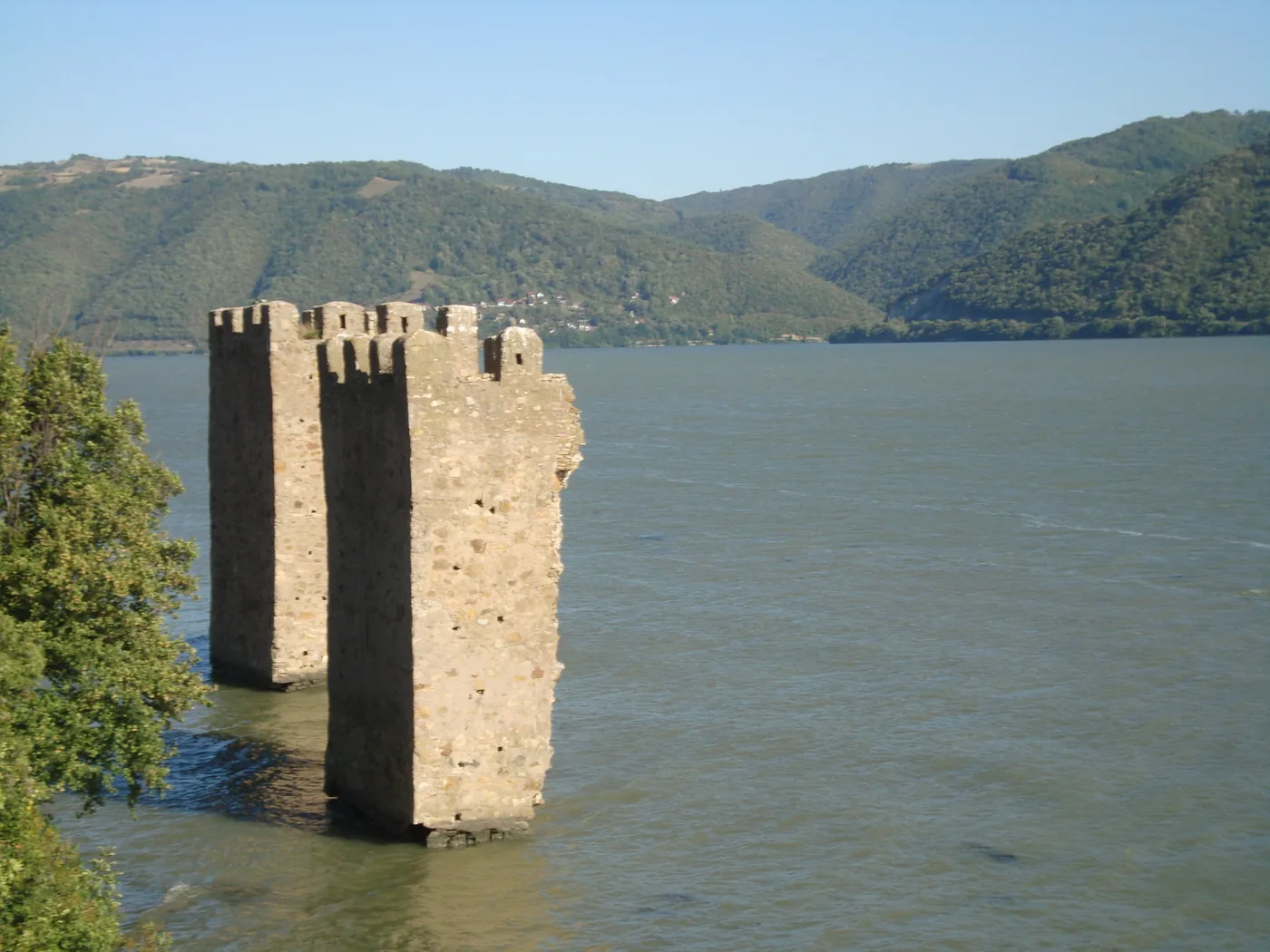
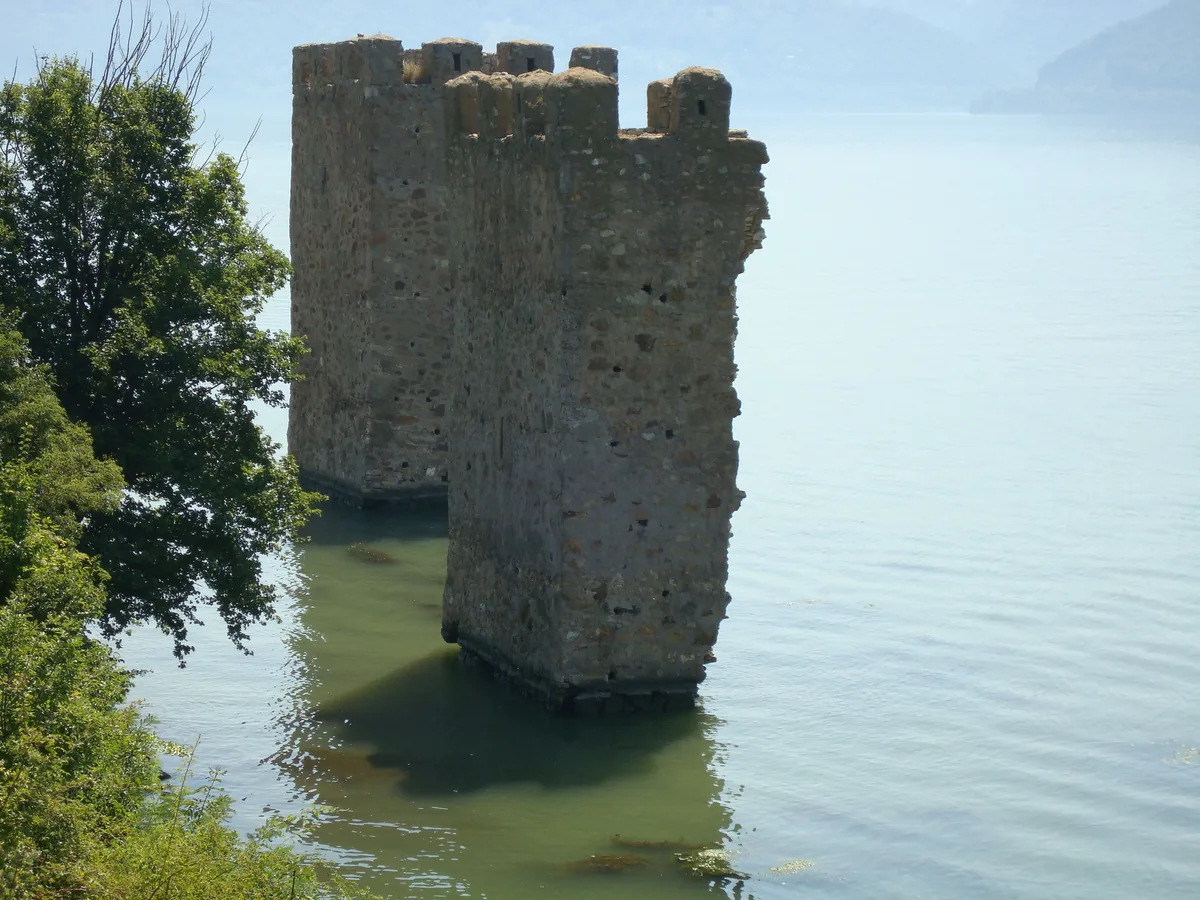
They are called Tricule — “three towers”. From the bank you see two: stone walls rising straight out of the water. The third is still there, under the surface. For five hundred years all three stood on dry land. Then came the dam.
Why “three”, when you see two
The name alone tells the story: three towers on a rocky spur.
Tricule comes from tri kule: three towers. Kule is the Turkish word for tower, the same word Romanian borrowed as culă, the fortified house of Oltenia. Three towers on the northern bank of the Danube, near Svinița: that was the fortress.
Each tower is a square-based donjon: thick stone walls, the dwelling above, the defence below. The type is called a residential tower, and artillery made it obsolete. Tricule was built just as walls of its kind stopped holding against cannon: a fortress born old.
Today two towers show. The rocky spur lies under silt, and the third tower stands, as the archaeologists write, “almost always covered by the waters of the Danube”. Only at very low water does it show again.
- Where
- Northern bank of the Danube, near Svinița, Mehedinți county; 44.4801° N, 22.1431° E
- When
- First half of the fifteenth century
- Name
- Tri Kule — “three towers”
- Today
- Two towers above water; the third, below
- How to see them
- From the bank at Svinița or from the river

Five hundred years on dry land
The fortress at Svinița is recorded in the first half of the fifteenth century, as a link in the defensive chain raised by the Banate of Severin against the Ottoman Empire. King Sigismund of Luxembourg entrusts its defence to the Teutonic knights.
The military role fades with time. After the peace of Sistova, in 1791, the building serves as an Austrian customs house; around 1872 the customs move away, and the walls fall into ruin.
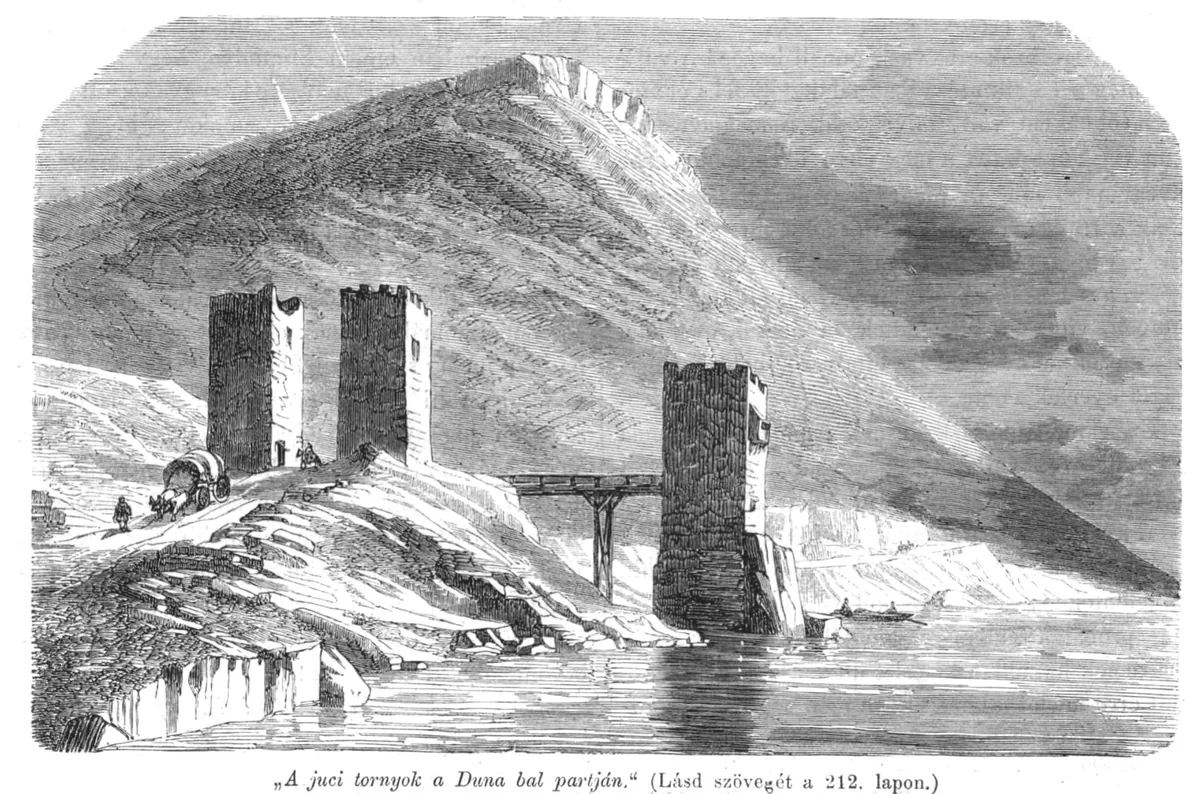
An 1865 engraving catches all three still on dry land: two towers on the spur, the third lower down toward the water, a wooden bridge beside them. Within a century the spur and the bridge would be gone — taken by water, not by war.

- First half of the fifteenth centuryThe Svinița fortress joins the anti-Ottoman defensive chain of the Banate of Severin.
- 1791Peace of Sistova. The building becomes an Austrian customs house.
- 1865The “Hazánk s a Külföld” engraving shows three towers on dry land.
- 1872The customs move away; the walls fall into ruin.
- 1964Work starts on the Iron Gates I hydropower system.
- 1972The system is complete; the reservoir lake covers the spur and the third tower.
When the water came
On 7 September 1964 Romania and Yugoslavia start building the Iron Gates I hydropower and navigation system. On 16 May 1972 the opening ceremony seals a reservoir lake stretching far upstream, past Svinița.
For Tricule the lake means the end of dry land: the rocky spur sinks under silt, and the third tower stays almost always underwater. Move the water below between river and lake, to see what it covered.
Lake, after 1972: two towers above water, the third below.
The two remaining towers still show from the bank at Svinița, rising straight out of the water. The third sleeps below.
Sources
The history of the walls comes from the museum press of Banat; the dam years, from documents and the press of the time. Renderings into English by Marius Comper.
- Muzeul Banatului Montan, Banatica 20/1 (2010): “Turnurile-locuință de la Svinița” — the three towers on the northern bank, the spur under silt, the third tower underwater. biblioteca-digitala.ro
- Dumitru Țeicu, Cetăți medievale din Banat (2009) — the Svinița fortress in the records of the first half of the fifteenth century. biblioteca-digitala.ro
- Simić–Mitrović, “Djerdap Through the Centuries” (2020) — Tricule, fifteenth century, drowned by the hydropower plant, partly visible at low water. zenodo.org
- Hidroelectrica, fifty years after the opening of the Iron Gates I system (16 May 1972); works started on 7 September 1964. thediplomat.ro · stiintasiinginerie.ro
- Wikipedia: “Cetatea Tricule” (ro) — the Teutonic knights, the Austrian customs house, 1872. ro.wikipedia.org/wiki/Cetatea_Tricule
- Wikipedia: “Culă” (en) — from Turkish kule, “tower”. en.wikipedia.org/wiki/Culă
- Wikidata: Tricule Fortress (Q44013106) — coordinates. wikidata.org/wiki/Q44013106
- The pictures come from Wikimedia Commons; each one carries its author and licence.