What the plate shows
A distribution of names
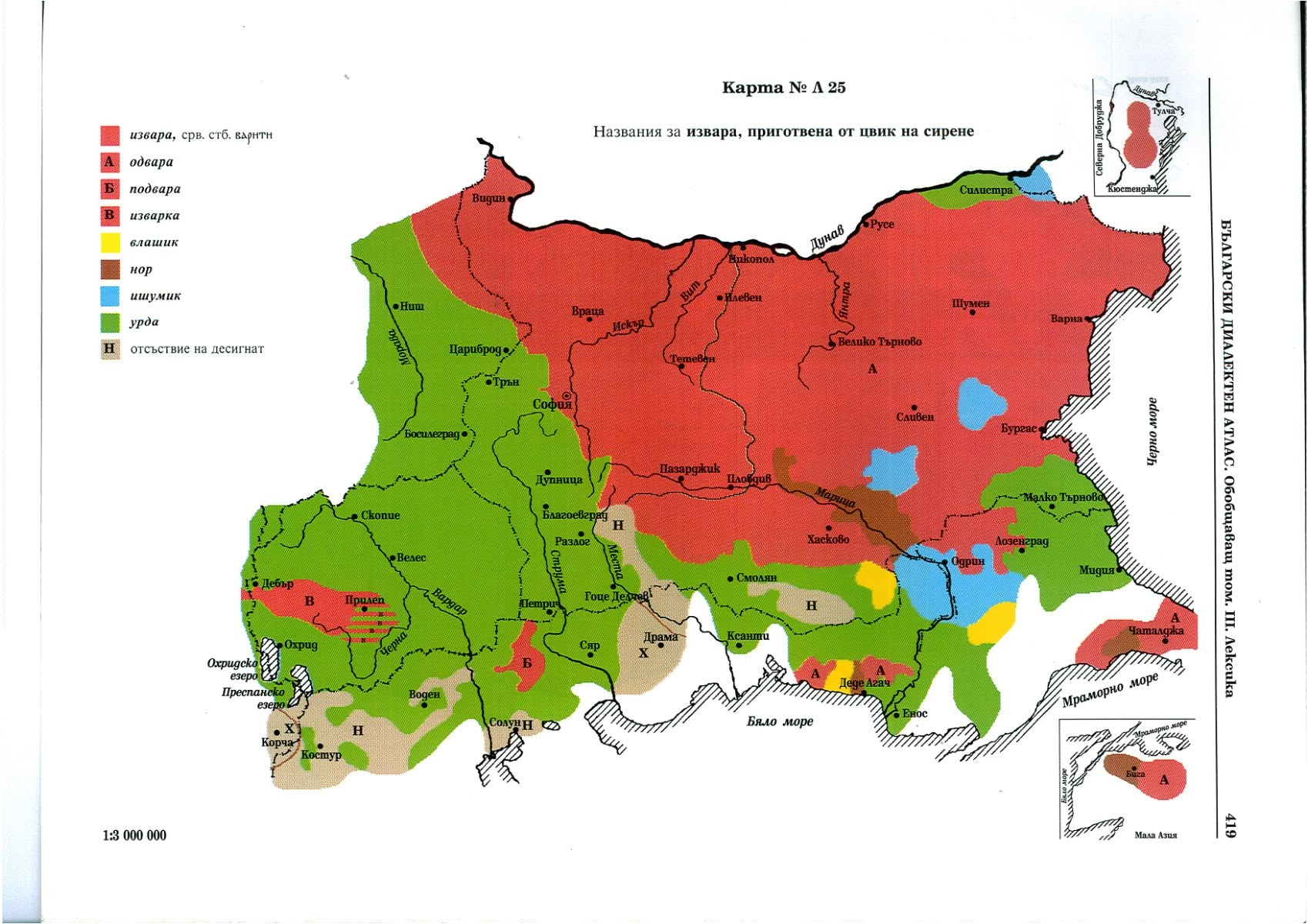
The plate groups local answers into name families. Green shows the urda family, red the izvara family and H the absent referent.
Dialect map · urda and izvara
On a Bulgarian dialect map, urda and izvara name a product made from whey. In a comparative reading of the atlas, the same form, urda, also appears on a map for a product made from milk. That changes the question: before you trace a word across the Balkans, you have to know what was in the pot.
L26 appears in Nicolae Saramandu’s comparative reading. S8
Why this map matters
In Romanian, it is urdă. On L25, the green area groups urda forms across western and southern Bulgaria; red groups the izvara family across much of the north and east. The question becomes concrete: did the name and the technology travel together?
The comparison starts with three checks: what the term names, how the product is made and how the atlas built the coloured area. Chronology, sound history and social history can then help us weigh the possible routes.
What the plate shows
The plate groups local answers into name families. Green shows the urda family, red the izvara family and H the absent referent.
The historical question
Chronology, sound history, meaning and social history can separate borrowing, shared inheritance and repeated circulation. Each explanation needs different evidence.
Plate L25, up close
The Bulgarian title names a product made from the whey left after cheese-making. The legend groups local answers, and H marks places where the product is absent as a referent.
direct observation
The title, legend and frame show what the atlas set out to map. The plate stays beside the explanation so each step can be checked.
source S1
lexical reading
Izvara, odvara, podvara and izvarka point through their forms to boiling and extraction. Urda has a less transparent history in Bulgarian. It may be a term introduced through contact or retained from an older layer. The map gives the distribution; chronology must explain how it got there.
source S1
cartographic method
Colour is a cartographic generalisation based on local answers. H marks the absent referent. The point network, question and drawing rules show how the answers were grouped.
source S1
Plate legend
Two maps, one form
Nicolae Saramandu notes that the atlas has two maps for urda: L25 for the product made from cheese whey and L26 for the product made from milk. The scan here is L25. Choose between the two recipes and see how the question about the name changes.
L25 · from whey / The product made from leftover whey
The same name can cover different products.
the plate we can see
Milk is coagulated for caș, and the remaining whey is heated again. Soluble proteins rise and can be gathered. This is the recipe described by plate L25.
source S1
the map cited by S8
The second map cited by Saramandu asks about urda made from milk. The form УРДА appears on both maps, but the recipe changes the product being compared. Meaning, process and distribution have to be read together.
source S8
Three checks for one form
A form resembles another only after we check what it names, how the product is made and how the answer was collected.
We compare spelling, pronunciation, derivatives and how speakers use the term.
Fatty whey? Whey left after caș? Milk added? The product after a second heating? The recipe tells us whether we are talking about the same thing.
Year, question, localities, points and grouping rules show how local answers became a coloured area.
Word, product, process and local classification need to be checked together.
From milk to urda
On L25, the whey left after the first cheese is heated again. Its soluble proteins coagulate and can be gathered. Press a step to see the product take shape.
Now in the pot
01 / Milk
matter
The raw material may be sheep, cow or goat milk. Species, season and local economy can change the recipe from the start.
technology
Milk is coagulated for caș or another product. The first coagulation leaves the whey named in the atlas question.
classification
Whey is the liquid left after the curd is removed. Some households heat it again; others use it differently. This choice determines whether the product appears as a distinct category.
transformation
When heated, soluble proteins denature and coagulate. This step explains the product. The history of the word requires a different kind of evidence.
visible transformation
Soluble proteins form clusters that rise and can be strained. This is where the product becomes visible, before each community gives it a name.
lexicon
This is where social history begins: who used the name, who kept it and who adapted it? A practice can travel while its name changes from one community to another.
Each stage can be read on its own; the button above joins them into one transformation.
From plate to explanation
Choose a level and see what each step adds: a local answer, an area, a relationship between forms, a contact direction, a social network or an origin hypothesis. Each step needs new evidence.
Observation
An informant, in a locality and a survey, supplied a form for the atlas question.
This level needs the point record: what the informant said, where and under what conditions.
The transcription, date, exact question and interview conditions.
Area
The green colour shows that atlas editors assigned the area to the urda family.
The plate shows the area; the point network and drawing rules show how the answers were grouped.
The point network and drawing rules.
Relationship
urdă, urda and urdhë resemble each other enough to demand historical comparison.
The distribution gives us a strong reason to compare them.
Sound correspondences, morphology, aligned meanings and comparable attestations.
Direction
We can propose a direction: Romance to Slavic, Albanian to Romance or another route.
A direction needs chronology, sound paths and differences in contact between communities.
Historical distribution and evidence that one side could transmit the form to the other.
Transmission
Shepherds, traders, seasonal workers and bilingual communities enter the hypothesis.
Mountain geography shows where circulation could have taken place.
Social history, migration, pastoral economy, documents and local networks.
Origin
An older-population hypothesis links a word to a homeland, continuity or ethnic origin.
At this level, the comparison needs an archive wider than plate L25.
Independent evidence from history, archaeology, demography and historical philology.
The form on the plate opens a question about the people who carried it. These six levels show what evidence must be added to move from observation to origin.
map cited at levels 1–2 S1
The etymologist’s bench
Choose a question and place the product, map, archive, sounds and social networks side by side. Each test answers a different part of the same question.
01 / Product
six testsProduct
L25 asks about urda made from cheese whey. A Romanian description also records a version with milk added. Comparing recipes comes before comparing forms.
L25 fixes the whey product, while the Romanian description documents variation. Matching the product is the starting point for the comparison.
Map
L25 assigns an area to the urda family; H keeps the absent referent. Colour is the atlas’s interpretation; the detail comes from points, the question and drawing rules.
The plate shows the area assigned by its editors. Points, the question and drawing rules show how it was built.
Archive
A study cites a written attestation from 1550 for urdă. A comparison brings together Bulgarian, Romanian, Albanian, Greek, Serbian and Turkish dialect forms. The area is wide, and the documentation is uneven.
Forms cited in the Balkan comparison
plus forms in Czech, Slovak, Polish, Ukrainian, Russian and Hungarian
1550 fixes a Romanian written mention. Albena Mircheva shows that dictionaries and studies propose different etymologies. An attestation and a hypothesis have to be read at different levels.
Sound
urdă, urda and urdhë resemble each other in writing and sound. A full model must explain vowels, consonants, stress, inflection and local adaptation.
Formal resemblance starts the comparison. Sound correspondences can support a route.
Network
Pastoral terms can travel with people, practices and markets. Saramandu notes such terms on atlas maps. A concrete route needs social evidence and chronology.
Geography shows the setting for circulation. Chronology and social history show which communities could make the route plausible.
Layer
Dan Ungureanu separates “substrate” from the label “Dacian” and shows that Romanian–Albanian resemblance can have several explanations. For urdă, the comparison must distinguish substrate, borrowing, inheritance and contact.
A shared word may come from substrate, an old loan, shared inheritance or contact. Each possibility needs its own evidence.
The bench rule: resemblance starts the comparison. Evidence chooses the explanation. S9
Four explanations for one map
The same area can come from different histories. Each model below names the evidence that would separate it from the others.
The term travelled from Romance varieties to Slavic, Greek or other neighbours, perhaps with pastoral activity.
Integration in Romanian and Aromanian; southern-Danubian forms; possible pastoral contact.
The earliest attestations in each language, sound paths and a demonstrated historical centre.
The comparison between urdă and dialectal Albanian urdhë may point to an Albanian route or an older contact zone.
Formal resemblance and scholarship that discusses the forms together.
Historical distribution, chronology and an account of every sound and meaning change.
The forms may preserve an older Balkan layer, before modern standards and borders.
The areal pattern and the technical character of the vocabulary.
Phonological and distributional predictions that distinguish substrate from borrowing.
The word travelled with a practice, was borrowed repeatedly, adapted, replaced locally and preserved in pastoral communities.
The area crosses several borders; occupational vocabulary travels readily.
Field data, historical documents, mobility networks and a verifiable chronology.
Circulation becomes an explanation when we can say who transmitted the term, when, along which route and through what changes.
What dictionaries keep
Romanian kept urdă as its ordinary term. Standard Bulgarian chose извара, while урда remained regional. Modern dictionaries therefore preserve different traces of contact.
Romanian standard term
Romanian dictionaries define the product through boiled and coagulated whey, and DEX marks the etymology as unknown. Urdă is ordinary in standard Romanian; older contact forms have to be sought in historical and dialect dictionaries.
Bulgarian standard term
The izvara family is transparent to a Slavic speaker through its link with boiling. The meaning is clear today; the term’s age requires historical evidence.
Standardisation leaves regional, competing and forgotten words outside common vocabulary. Those words may hold important evidence about contact.
Sources and open questions
Here you will find the atlas, dictionaries, contact studies and the etymological comparison. Each source answers a different question: a recipe identifies the product, a map shows distribution and etymology compares forms through time.
The institute’s official page describes the generalising volume on phonetics, accentuation and lexicology, published in Sofia in 2001. Plate L25 is the artifact this dossier starts from.
Open sourceThe entry defines the product through boiling and coagulating fatty whey. DEX marks the etymology as unknown; MDA records a comparison with Albanian.
Open sourceIt discusses Aromanian urda, Albanian urdhë and Greek forms as part of a contact history. Alongside chronology and sound paths, it proposes a route worth testing.
Open sourceIt shows how a modern atlas separates the linguistic survey-point database from the geographic database and generates interpretive maps from them.
Open sourceIt provides context for how Bulgarian culinary projects treat linguistic territory, cultural exchange and food technology.
Open sourceThe plate is reproduced as a visual artifact; its bibliographic identification comes from the atlas’s official page. The image opened the question about the word and the product.
Declared provenanceDescribes whey products made by heat-coagulating soluble proteins; the coagulated proteins gather at the surface and drain through cloth.
Open sourceNotes that the Bulgarian atlas gives urda two maps: L25 for the whey product and L26 for the milk product, with the same form УРДА reported in a recurring area. Saramandu describes L26; the image here reproduces L25.
Open sourceSeparates substrate from the label “Dacian” and treats Romanian–Albanian resemblance as a starting point for comparison. It includes urdă in a list of historical proposals.
Open sourceCites a written attestation from 1550 for urdă and records a version in which milk is added to the whey product. It dates a written mention and documents recipe variation; the word’s origin needs other sources.
Open sourceIn a critical survey of Balkan vocabulary, it places Bulgarian dialect forms урда, хурда, вурда beside Romanian urdă, Albanian udhos and hurdë, dialectal Greek ούρδα, Serbian урда/vурда and Turkish urda. It compares Dacian, Turkic, Paleo-Balkan and Romanian hypotheses and shows that a wide area needs chronology, sound history and social history before it can support an etymon.
Open sourcemain sources
These sources keep atlas data, dictionary entries, methodological papers and contact studies distinct. The supplied image stays beside the atlas bibliography as the visual source object.
how to read the plate
Observation, area, relationship, direction, transmission, origin. Each level adds a different test.
What stays in view