Aspern, near Vienna · 23–30 June 1912 · 50 hp Gnome engine
Vlaicu II at Aspern what 16 seconds, 14.39 metres and 10 metres took
At the Aspern flying week, the Romanian engineer Aurel Vlaicu flew round a pylon in 16 seconds, stopped 14.39 m from the centre of an 80-metre “forest clearing” and dropped a sandbag 10 m from the centre of a target. A flight model built from his aeroplane’s dimensions shows what each of those numbers took. On the 1912 field, choose the bank and the speed, then start the stopwatch.
Final classification, 30 June 1912
- BathiatSommer13.0 s≥ 57°
- VlaicuVlaicu II16.0 s≥ 45°
- GarrosBlériot16.6 s≥ 43°
- AudemarsBlériot17.6 s≥ 40°
- MoineauBreguet18.2 s≥ 38°
Each pilot’s best time. On 27 June Vlaicu had flown 27⅕ s. Degrees: the least bank that gives that time.
Try: · ·
Round the pylon: 16 seconds mean at least 45 degrees
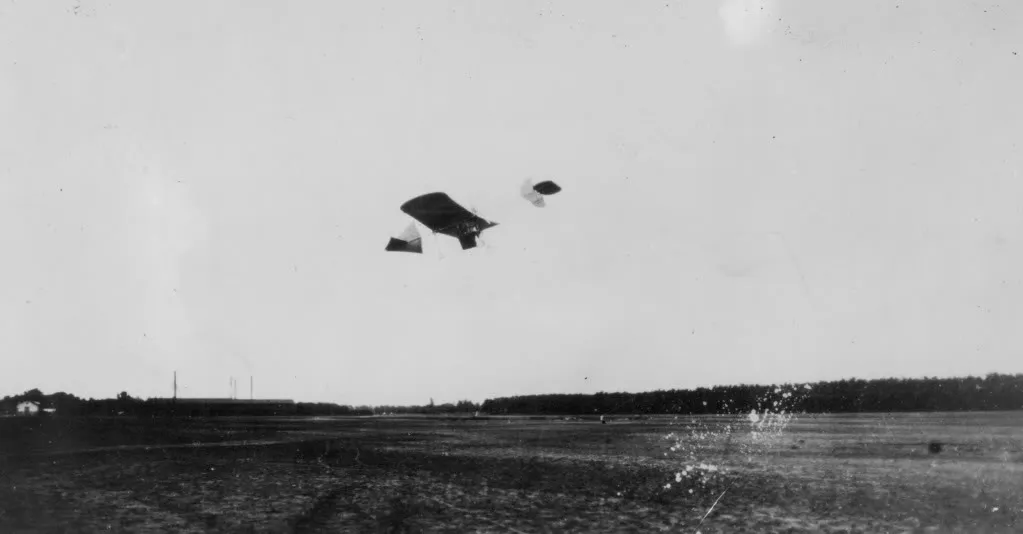
The rules, printed in the Wiener Luftschiffer-Zeitung on 1 June 1912, asked for a complete circle round a pylon “in the shortest possible time”. A white line was drawn on the ground 100 m from the pylon. The pilot crossed it at right angles, flying towards the pylon, went once all the way round the pylon and crossed the line again at right angles. Everything was flown below 60 m, with no landing and the engine running. A timekeeper stood at a sighting pole and took the two crossings.
Even the shortest path imaginable, two straight legs of 100 m and a half circle round the pylon, sets a limit. Any fuller circle is longer, so the angles that follow are minima. The legs reward speed. The turn rewards slowness, because its radius grows with the square of the speed. In between lies a best speed, and then the best time depends on one thing only: how steeply the aeroplane banks. The formula is T = 2·√(2π·100 m / (g·tan φ)). Mass, wing and engine do not appear in it; they only decide whether the machine can fly at the best speed in that bank.
With this formula, the five prize-winning times become five bank angles: Bathiat, 13 s, at least 57°; Vlaicu, 16 s, 45°; Garros, 16⅗ s, 43°; Audemars, 17⅗ s, 40°; Moineau, 18⅕ s, 38°. Wind cannot shorten the path. For 27 June, the day of the first round, the next day’s Neue Freie Presse weather column most likely refers to a west wind averaging 24 km/h. Any wind adds time on the legs, so the still-air angles are the minimum. An extra full 360° circle would have needed more than 70° for 16 s and almost 78° for 13 s: sustained turns of over 3 g and almost 5 g, which the Vlaicu II in the model could not hold.
The Vlaicu II had no ailerons and no wing warping. It turned with the two rudders at the front, and the wing, set with a dihedral, followed. For 45° at the best speed of 90 km/h, the model needs 16–24 kW at the propellers. The 50 hp engine delivered about 23 kW there, so 16 s was at the edge of its power. There is also a slower way. Of the first round, on 27 June, a reporter for the Neues Wiener Tagblatt wrote that Garros, Moineau and Vlaicu “threw their machines round” on circles of no more than 30–40 metres. If the 16 s circle, most likely flown on 30 June, had a radius like that, only the 40 m end fits the model: 73 km/h and 47° of bank, just above the 72 km/h below which the wing could not hold the aeroplane in that turn. A circle of 30–35 m would have needed a lower minimum speed than the 60 km/h Vlaicu gave. The official programme also asked for the circle to be flown climbing. At 45° and 90 km/h the engine had no power left to climb; on the slow 40 m circle it had 6–11 kW to spare, enough to climb at 2–3 m/s. Of 30 June, Der Montag wrote that Vlaicu was applauded “for his small, if slowly flown, circle”.
The 80-metre clearing: the brake was the wind
The forced-landing event on 29 June pictured an aviator forced down into a forest clearing. An 80 m square was marked out on the field. Poles 7 m high stood at the corners, joined at the top by string with pennants and small balloons to show the height of the trees. The engine had to be stopped before the wheels touched the ground. Any contact with the string or the white lines failed the attempt. The judges measured from the centre of the square to the hub of the nearest propeller. The Vlaicu II had two, one ahead of the wing and one behind it.
Garros stopped 14.37 m from the centre and Vlaicu 14.39 m, “two centimetres further than the Frenchman”, as the Wiener Luftschiffer-Zeitung put it. Der Montag saw the landing this way: Vlaicu “comes in slowly, clears the string and then sinks vertically to the ground, to stop at once”. The reporter called it “without doubt the finest landing”.
In still air the model does not fit inside the clearing. From the string, the engine-off glide, with a lift-to-drag ratio of about 5.5 at 69 km/h, takes 42 m to get near the ground. Then come 18 m of floating before touchdown at 63 km/h, and the roll on grass. With rolling friction alone, that adds up to 111–215 m, more than the side of the square. A headwind changes everything: the speed over the ground drops, and the roll falls with its square. To stop 14.39 m from the centre coming in along the diagonal, the model needs a headwind of at least 4.5–8.5 m/s. The Neue Freie Presse weather columns note a “lively” west wind, most likely for 25 and 27 June; no measured speed has been found for 29 June. The “vertical” descent the reporter saw is what the model shows in a wind: a slow aeroplane making little headway over the ground.
The sandbag: half a second
In the target event each pilot got five small sandbags. He dropped them one at a time, in a single flight of at most 20 minutes, from at least 200 m (checked by a barograph carried on board), onto a white circle 40 m across. On 23 June only Vlaicu and Garros flew it. Vlaicu’s best bag landed 29.56 m from the centre, outside the circle but the best of the day. On 25 June, in wind and rain, Garros hit 3.20 m from the centre, the throw that won him the overall prize. On 30 June Vlaicu hit 10 m from the centre and won the day prize of 1,500 crowns. Garros landed 26 m out that day.
From 200 m a bag falls for 6.9–8.2 s, depending on how much the air slows a bag whose mass was never published. Meanwhile it travels 90–142 m forward. So the pilot had to let go well before the target. The rules allowed release devices; none is recorded for Vlaicu. At 75–90 km/h, Vlaicu’s 10 m mean a release error of only 0.40–0.48 s. The slow aeroplane got more time per metre: at 75 km/h one second late moves the bag 21 m, at 100 km/h 28 m.
5 bags left
The machine: a large wing for 50 horsepower
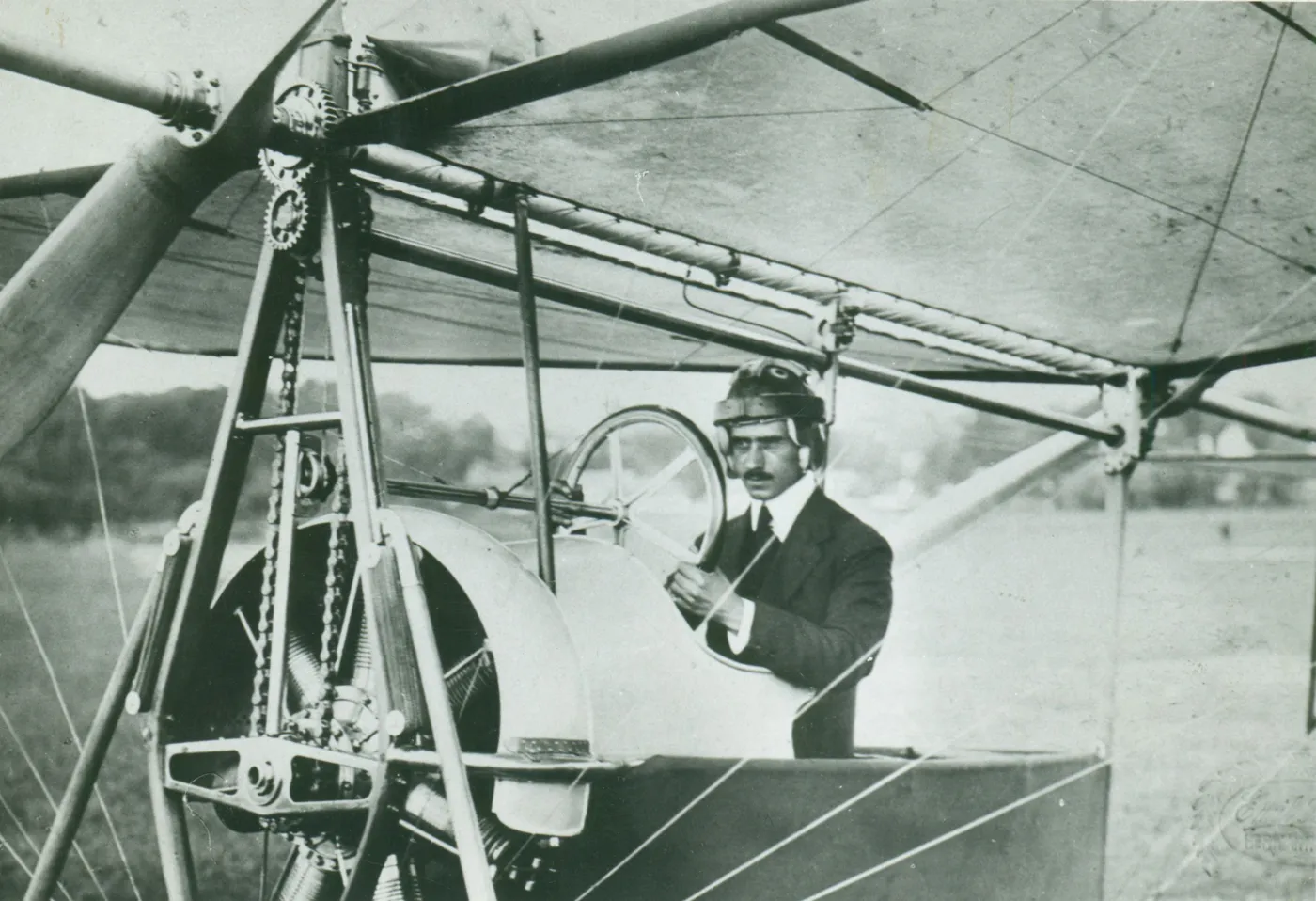
The Vlaicu II weighed 200 kg empty and 300 kg with its pilot, according to a Die Zeit article reprinted by the Arad paper Românul in June 1912. The book by Gudju, Iacobescu and Ionescu (1974) gives the wing 26 m² on a 10 m span. Jane’s 1913 gives a span of 9.15 m; with the same shape the wing would be about 21.8 m². That makes the wing loading 11.5–13.8 kg/m². A Blériot single-seater with the same 50 hp engine, the type XXVIII in Jane’s 1913, had 15 m² and weighed 240 kg empty: close to 23 kg/m² with pilot and fuel.
Vlaicu wrote in 1911 that he took off and landed at 60 km/h. The model takes its maximum lift coefficient (0.68) from that. It takes the drag from the top speed: 110 km/h in Gudju, and 92 km/h, the average of his flight from Hațeg to Orăștie, towns 49 km apart, in 32 minutes, recorded by the Wiener Luftschiffer-Zeitung. With the 21.8 m² wing, the minimum speed would rise from 60 to 66 km/h. The results above move by a few degrees and a few metres; they do not change.
The rest of Vlaicu’s life, and the other two Romanian pioneers of the same years, are told in How did Romania learn to fly?.
Sources and method
Point-mass model: parabolic drag polar, constant power at the propellers (an assumed efficiency of 0.62 for the 50 hp engine), level turns, engine-off glide, a ground roll with a constant retarding coefficient (0.1–0.3) and a sandbag fall with quadratic drag. Air density is 1.20 kg/m³. Assumed values are marked as such; the ranges in the text come from the limits of the data. The event results are those printed in the Vienna papers of 24 June–2 July 1912. Where papers differ (29.56 or 29.60 m), the text follows the majority.
- Wiener Luftschiffer-Zeitung 11 (1912), no. 11, pp. 197–198: the rules of the flying week (pylon, forced landing, target); no. 13: the daily report and final results; no. 17: the Hațeg–Orăștie flight
- Neues Wiener Tagblatt, 21 June 1912, pp. 10–11: the official programme; 28 June, p. 12: the “30–40 metre” circles
- Der Montag, 1 July 1912, pp. 3–4: Vlaicu’s landing, the “small, slowly flown circle”, final results
- Neue Freie Presse, 28 June 1912, pp. 11 and 30: the first pylon round and the day’s wind; 1 July, p. 7: the forced landing
- Illustrierte Kronen Zeitung, 24 June 1912, p. 9: the target, first day
- Jane’s All the World’s Aircraft 1913: Vlaicu II (span 9.15 m) and Blériot XXVIII
- I. Gudju, G. Iacobescu, O. Ionescu, Romanian Aeronautical Constructions 1905–1974, Bucharest, 1974, pp. 85–87 (26 m² wing, 300 kg, 60 and 110 km/h, three-view drawing)
- V. Avram, P. G. Sandachi, A. M. Gușă, Contribuții românești în aeronautică la începutul secolului XX, Europa Nova, 2000, pp. 93–127 (the mass, after Die Zeit and Românul, 1912)
- Jahrbuch der Luftfahrt 1912, pp. 148–149: the Vlaicu II’s controls and drive
- Photographs: Wikimedia Commons, “A Vlaicu II 01.jpg” (1912) and “Aurel Vlaicu II in flight.jpg”, unknown photographers, public domain