Romanian
presentomul
omman -uldef.art.m.sg“the man”
The suffix -ul continues the Latin pronoun ille, “that,” attached after the noun as far back as the vulgar Latin spoken along the Danube.
Languages in contact
“O să merg.” “Ще отида.” “Do të shkoj.” “Θα πάω.” “Va s-cãntu.” Romanian, Bulgarian, Albanian, Greek, and Aromanian arrived, after centuries as neighbors, at the same kind of future tense: a particle that, in each, comes from its own verb meaning “to want.” Below, the same five languages split apart again on the other two patterns, though not always in the same place.
Romanian and Aromanian are close relatives: both descend from the Latin spoken along the Danube. Beyond that pair, Bulgarian is Slavic, Albanian is its own branch of Indo-European, and Greek represents the Hellenic branch. Four branches of one family, separated for thousands of years: in the usual classification they meet again only at Proto-Indo-European, the reconstructed ancestor of them all.
And yet, for centuries, their speakers lived as neighbors: in the same villages, at the same markets, under the same Ottoman rule. And their languages did something no family tree predicts: they borrowed whole pieces of grammatical architecture from one another. Linguists call the result a Balkan sprachbund: languages that stayed on separate branches of the family tree while converging structurally like sisters.
Below are all three convergences, checked sentence by sentence across five languages: one with no exception at all, the other two with real limits, shown exactly where they fall.
Starting point
On the family tree, Romanian and Aromanian share one node, Latin. The other branches meet only at the root, a reconstructed ancestor spoken at least six thousand years ago. The contact network, drawn from the three grammatical features below, groups the languages completely differently. And differently again for each feature.
Pick a pattern; see who connects to whom. The convergence didn't happen all at once, in the same century, for everyone.
Pick a pattern above to see the network.
Four branches, one distant common ancestor.
Simplified: each branch actually holds dozens of other languages. Only the ones relevant to this comparison are shown.
Pattern 1 of 3
In nearly every Romance language (French, Italian, Spanish), the definite article comes before the noun: le loup, il lupo. Only in the Balkans does the article attach after the word, like a suffix. The phenomenon is called a postposed article, and four of these five languages have it, regardless of which branch they come from.
omul
omman -uldef.art.m.sg“the man”
The suffix -ul continues the Latin pronoun ille, “that,” attached after the noun as far back as the vulgar Latin spoken along the Danube.
luplu
lupwolf -ludef.art.m.sg“the wolf”
The same mechanism as Romanian, with a slightly different suffix shape. The two Balkan Romance languages grew their postposed article from the same Latin source before splitting apart geographically.
мъжът
мъжman -ътdef.art.m.sg“the man”
The article -ът continues the Old Church Slavonic demonstrative tǔ, “that one,” a completely different source from Romanian's -ul, attached in exactly the same position, after the word.
libri
libërbook -idef.art.m.sg“the book”
Albanian builds its postposed article from its own demonstrative system, independent of Slavic or Romance. That's part of why some Balkanists consider the postposed article the single oldest Balkan feature of all, older than the Slavic arrival.
ο άνθρωπος
οdef.art.m.sg άνθρωποςman“the man”
The one language here that puts the article first, exactly like French or English. The exception is part of the argument: on the next two patterns, Greek is the fullest participant of all five.
Pattern 2 of 3
“I want to go” feels like the most natural sentence in the world, but French says je veux aller, “I want (to) go,” with a full infinitive, same as English. The languages here gave up that pattern, to varying degrees, and build the wish instead as a full subordinate clause: “I want that I go.” Not all of them gave it up equally, and that's the most important nuance on this page.
vreau să merg
vreauwant.1sg săsubjunctive merggo.1sg“I want to go”
Standard Romanian kept the infinitive as a dictionary form (a merge, “to go”) and after a handful of modal verbs, in formal register (poate merge, “he can go”). In everyday speech the să-subjunctive has taken over nearly all the ground, but not quite all of it: a partial participation, unlike the other four.
voi s-cãntu
voiwant.1sg s-subjunctive cãntusing.1sg“I want to sing”
Aromanian went further than mainland Romanian: the infinitive has nearly vanished, not just from speech but as a dictionary form too.
искам да отида
искамwant.1sg даsubjunctive отидаgo.1sg“I want to go”
Bulgarian lost the infinitive outright: it doesn't exist in the standard language, in any register. Da is the subjunctive conjunction, equivalent to English “that.”
dua të shkoj
duawant.1sg tësubjunctive shkojgo.1sg“I want to go”
That's the picture in Tosk, the dialect standard Albanian is built on. Gheg, the northern dialect, kept its own infinitive (due me shkue), an internal exception worth remembering before saying “Albanian” did anything as a whole.
θέλω να πάω
θέλωwant.1sg ναsubjunctive πάωgo.1sg“I want to go”
Modern Greek has no infinitive left at all. It lost it earliest of any Balkan language, back in the early medieval period, and many Balkanists consider Greek the model that started the whole areal shift.
Pattern 3 of 3
Latin had its own future tense (cantabo, “I will sing”), and so did Ancient Greek. All five languages here dropped their inherited future forms and built a new one from the same material: a verb meaning “to want,” frozen into a fixed particle placed before the main verb.
o să merg
ofuture, invariable săsubjunctive merggo.1sg“I will go”
“O” is the frozen third-person form of a vrea, “to want,” generalized across every person: exactly the Balkan pattern. (Romanian also has a second colloquial future, am să merg, built from a avea, “to have,” but that one is a separate, internal Romanian development, not the genuine Balkan parallel. The dictionary form, voi merge, with an auxiliary still conjugated by person, belongs to a more literary register.)
va s-cãntu
vafuture, invariable s-subjunctive cãntusing.1sg“I will sing”
The same source as Romanian (va, from a vrea), kept here as its own standalone particle, without Romanian's reduced “o” variant.
ще отида
щеfuture, invariable отидаgo.1sg“I will go”
Šte comes from an old Slavic verb that also meant “to want,” frozen, just like Romanian's “o,” into a single particle valid for every person.
do të shkoj
dofuture, invariable tësubjunctive shkojgo.1sg“I will go”
“Do” is the frozen form of dua, “I want”: same mechanism, same semantic source, a completely different grammar from the point of origin.
θα πάω
θαfuture, invariable πάωgo.1sg“I will go”
“Θα” is what's left, after centuries of erosion, of θέλει να, “it wants that,” in the third person. The path is documented step by step in medieval Greek, between the fifth and seventeenth centuries.
The mechanism
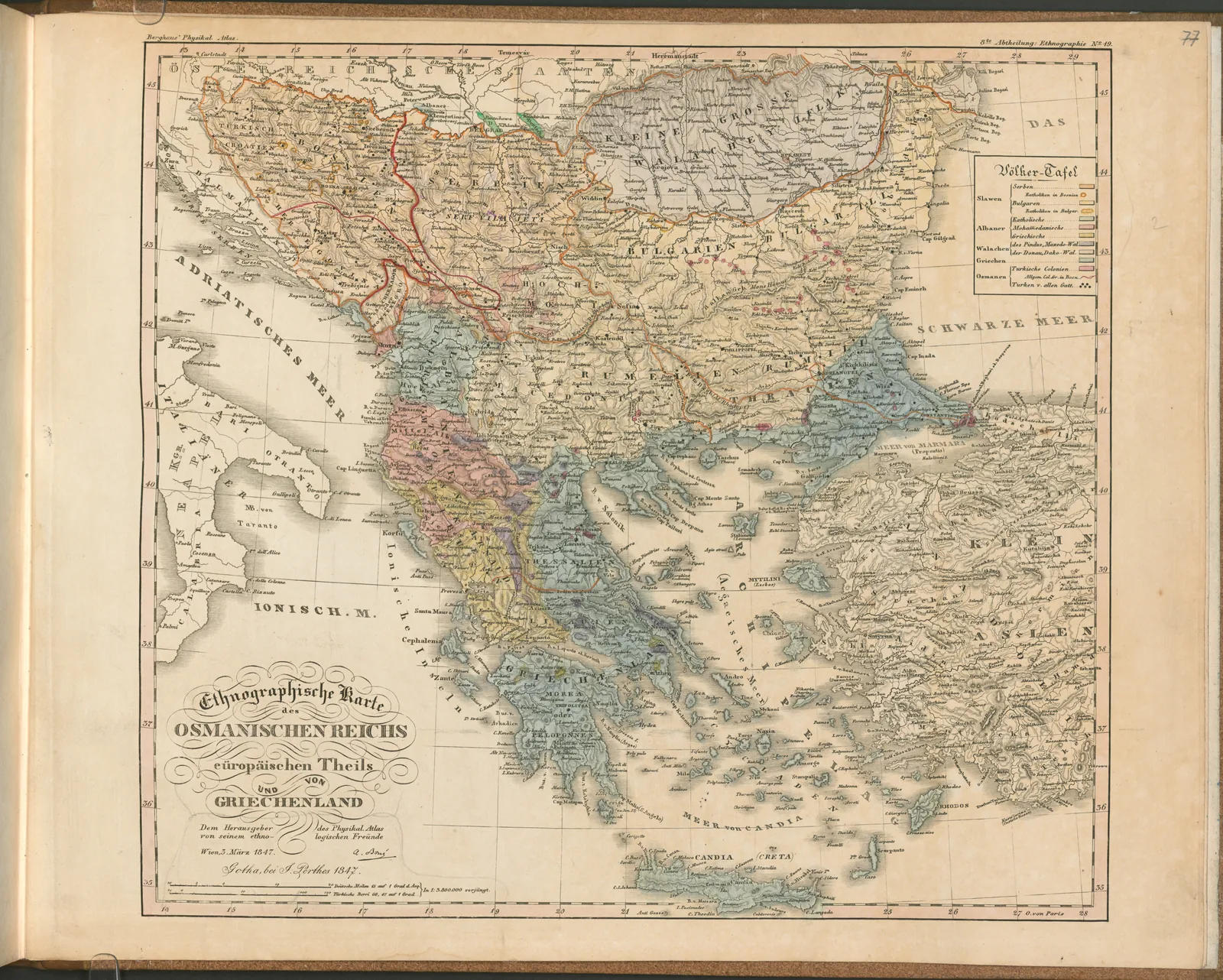
How do languages from four different branches end up structurally alike without being closely related? The root goes back further than their meeting under the Ottomans. The Balkans had already fallen, a thousand years earlier, under the same ruler: Rome. Even then, the region was split linguistically in two, along a rough line running from Lissus, near today's Lezhë in Albania, to Serdica, today's Sofia, and on toward the Black Sea: Latin took hold to the north, Greek held on to the south. Historians call it the Jireček Line, after the scholar who described it in 1911. The explanation Balkanists accept today for what happened later, under the Ottomans, puts the weight on people: bilingual villages, marketplaces where four languages could be heard in one afternoon, transhumant shepherds crossing the mountains from one linguistic community into another twice a year.
6th–7th c.
Slavic speakers arrive in the Balkans and settle onto this ground, already split between Latin and Greek, alongside communities that spoke an ancestor of Albanian. In the same period, Emperor Heraclius drops the Latin title Augustus for the Greek Basileus in 629, the visible marker of a longer shift in which the eastern half of the Roman Empire moves from Latin to Greek as its language of state, even as it keeps calling itself Roman. Four linguistic layers on the same territory, not four communities meeting for the first time.
10th–15th c.
Medieval Greek loses the infinitive first among all Balkan languages: a change documented step by step, from θέλω ἵνα γράφω to θέλω να γράφω. Many Balkanists consider it the model that started the wave.
1453–1912
Under shared Ottoman rule, Balkan communities live in sustained multilingualism, generation after generation. Aromanians, transhumant shepherds and, later, urban traders (the town of Moscopole was their commercial and cultural hub, until its destruction in the eighteenth century), are frequently cited as a plausible contact vector between Slavic-, Albanian-, Greek-, and Romance-speaking communities otherwise separated by geography and religion.
1923 / 1928
Nikolai Trubetzkoy proposes the term Sprachbund at the First International Congress of Linguists in The Hague (1928), preceded by a similar Russian term he had used himself in 1923, for languages converging through contact rather than shared descent, with the Balkans as the textbook case.
1926 / 1930
Kristian Sandfeld publishes Linguistique balkanique (Paris, 1930), the French expansion of his 1926 Danish original, the field's founding synthesis, cataloguing roughly thirteen Balkan features.
1983 → 2006
Brian Joseph traces the history of the Balkan infinitive's loss in a landmark monograph (1983). Olga Mišeska Tomić publishes, in 2006, the most complete morphosyntactic map of the phenomenon to date.
Further out
The Balkan sprachbund doesn't stop at the three patterns above; Balkanists have catalogued nearly a dozen. Four more are useful here precisely because they don't follow the same map: they group the five languages differently than the article, the infinitive, or the future do.
| Feature | Romanian | Aromanian | Bulgarian | Albanian | Greek | Note |
|---|---|---|---|---|---|---|
| Evidential mood | no | no | yes | yes | no | Splits the group differently from every other row here: Slavic and Albanian yes, Romance and Hellenic no. Usually explained by contact with Ottoman Turkish, not the Balkans themselves. |
| Dative–genitive syncretism | yes | yes | yes | yes | partial | The mechanism differs language to language: Bulgarian, having lost almost all case marking, expresses everything analytically with the preposition na. Some linguists debate whether the phenomenon is genuinely Balkan or just typological coincidence. |
| Object clitic doubling | partial | yes | yes | yes | partial | Bulgarian: Гледам го Георги, literally “I-see him George.” Some accounts treat the pattern as spreading from South Slavic into Albanian and Aromanian. |
| “One-on-ten” numerals (11–19) | yes | yes | yes | yes | no | Checkable by eye: Romanian unsprezece breaks down as “one toward ten”; Greek έντεκα doesn't break down at all, a single root inherited straight from Indo-European. |
| Vocative case | yes | yes | yes | yes | yes | Bulgarian is the most striking case: it lost nearly every other case, yet kept the vocative precisely because it had become, in isolation, the most frequently used of all. Aromanian keeps it just as clearly: bărbate!, “man!,” from bărbat. |
Ottoman Turkish isn't one of the five languages above, despite leaving real traces: the evidential mood in the table, hundreds of loanwords in all five. Structurally, though, Turkish stayed elsewhere: agglutinative, subject-object-verb word order, morphology with no relation to the article, infinitive, or future discussed here. Balkanists treat it as a source of contact, not a member of the sprachbund.
A separate page compares Romanian with the world's languages on words, grammar and sounds: Which language is closest to Romanian? Three measures, three answers. There, in the WALS atlas, Romanian and Italian have different values on eight grammar features for which Albanian is described too; on five of them, Albanian has Romanian's value. The count is not a test of the Balkan sprachbund: of the three patterns on this page, WALS has a feature only for the article. Grambank, the other large grammar database, has no record for Romanian in version 1.0.3.
Method
The three patterns above, and the four at the end, come from a century of Balkanist scholarship: from Kristian Sandfeld's founding synthesis (Linguistique balkanique, 1930) to Brian Joseph's monograph on the infinitive (1983) and Olga Mišeska Tomić's morphosyntactic survey (Balkan Sprachbund Morpho-Syntactic Features, 2006). The features at the end draw, among others, on Victor Friedman's work on evidentiality and Nicola Catasso's discussion of case syncretism. The Aromanian forms were checked directly against Theodor Capidan's grammar, Aromânii: Dialectul aromân (1932), still the most thorough academic description of the language. Every form in all five languages was checked against a reference grammar or an academic source before publication.