1989 in China's People's Daily: the fall of communism in Eastern Europe, day by day
The night the Berlin Wall opened reached readers of the Chinese Communist Party's newspaper two days later, on page 4, in 554 characters, a short paragraph, without the word “wall”. Every issue of 1989 can be opened here, with the 729 news items the paper printed about Poland, Hungary, East Germany, Czechoslovakia, Bulgaria and Romania.
人民日报11 November 1989page 4 (international news)554 characters
GDR announces opening of the border / A well-known GDR woman writer urges citizens to stay in their homeland and take part in reform / West German interior minister points out that GDR citizens should think carefully about the question of moving away
From the report: “This step means that the GDR has in effect opened the border between the two Germanys and between East and West Berlin. It is the first time in the GDR's 40 years.”
The night of 9 November in Berlin, as printed two days later. The word 柏林墙, Berlin Wall, is not in the report.
On the evening of 9 November 1989 East Germany opened its borders, and that night people walked through the Berlin Wall. The People's Daily (人民日报, Renmin Ribao), the newspaper of the Chinese Communist Party, printed it on 11 November, on page 4, under the headline above. Page 1 of the same issue carried Deng Xiaoping's words to Henry Kissinger: “China is now very stable, and I am at ease.”
Most of the year reads like that. This page counts what the paper printed in 1989 about Poland, Hungary, East Germany, Czechoslovakia, Bulgaria and Romania: on which day, on which page, at what length and in which words. From late April the same paper filled with the protests in Beijing, first under one word, 动乱 (turmoil), and from June under a second, 暴乱 (riot).
The count describes one newspaper, read in an unofficial transcription of it. It does not measure what people in China knew: the foreign-press digest Reference News (参考消息), radio and television are outside it.
The strip shows 1989 from left to right, one column for each issue. Above the line are the characters printed that day about each of the six countries. Below it, in red, is the number of articles that use 动乱 (dongluan, turmoil) or 暴乱 (baoluan, riot), the paper's words for the Beijing protests from late April and from June. Before then the two words turn up in other news, mostly from abroad.
Under the strip is the issue of the chosen day: its pages side by side, every article a block as tall as its text is long. The coloured blocks are the reports about the six countries; their headlines are listed beneath.
10 Jun · Poland11 Nov · the GDR's border27 Dec · Romania
characters about the six countriesarticles with 动乱 or 暴乱
JanFebMarAprMayJunJulAugSepOctNovDec
Poland
Hungary
East Germany
Czechoslovakia
Bulgaria
Romania
Eastern Europe
uses 动乱 or 暴乱
every other article
Each column is one issue. The grey band marks 7–24 June, when the paper printed four pages instead of eight. An article about two countries counts for both.
人民日报11 November 1989, Saturday1989年11月11日 星期六
82 articles, 48,115 characters, eight pages. About the six countries or Eastern Europe: three articles. With 动乱 or 暴乱: two articles.
1top news
2top news
3general
4international news
5domestic features, education, science, culture
6readers' letters
7international features
8supplement
In these days
· East Germany: The GDR opens its borders; that night Berliners pass through the Wall.
· Bulgaria: Todor Zhivkov is removed after 35 years in power; Petar Mladenov succeeds him.
East Germany民主德国宣布开放边界 民德一著名女作家呼吁公民留在家乡参与改革 西德内政部长指出民德公民慎重考虑移居问题GDR announces opening of the border / A well-known GDR woman writer urges citizens to stay in their homeland and take part in reform / West German interior minister points out that GDR citizens should think carefully about the question of moving awaypage 4 (international news) · 554 characters · dispatch dated 10 November
Czechoslovakia捷共中央主席团成员克诺特克说 捷决心走社会主义道路 社会和经济稳定是改革成功前提Knotek, member of Czechoslovak Communist Party Presidium, says / Czechoslovakia is determined to take the socialist road / Social and economic stability is the precondition for successful reformpage 4 (international news) · 233 characters · dispatch dated 7 November
East Germany德国统一社会党将召开党代会Socialist Unity Party of Germany to convene a party congresspage 4 (international news) · 160 characters · dispatch dated 9 November
A page column is full at 9,000 characters. Lengths are counted in Chinese characters of body text, without the headline.
What the year adds up to
The transcription holds 30,049 articles for 1989. Of these, 729 are news items about one or more of the six countries: 2.4 in every hundred articles and 1.4 in every hundred characters. At least one appears on 316 of the 365 days.
Most are short. Leaving aside the 41 columns of news in brief and the 18 captioned photographs, half of the other 670 reports have fewer than 298 characters, and 26 run to 1,000 or more. A 300-character report is four or five sentences.
They sit where foreign news sat. Until 19 February the international pages were 6 and 7; from 20 February they were pages 3 and 4, where 497 of the 625 items printed from that day sit. A page number alone says little about weight. What the count shows is how rarely this news left its page: 49 items reached page 1 (see below).
They are not late. 545 of the items open with a dated dispatch line, and 473 of those (87 in a hundred) were printed within two days of that date. A long wait has two parts: the first report of the Prague march of 17 November is a dispatch dated three days after it and printed three days after that.
In June the paper itself shrank. A notice on page 1 of 7 June says that paper has been hard to obtain and printed copies “cannot be sent out”, so the issue will have four pages; a second notice, on 25 June, blames “the counter-revolutionary riot in Beijing” and counts 18 days of four pages. On 18 June, 21 of the 30 articles use 动乱 or 暴乱.
October and November are the fullest months for the six countries, with 93 and 104 items. In December, the month in which the governments in Prague and Bucharest went, there are 59; without Romania the five other countries fall from 94 items in November to 38.
Six countries: what happened and what was printed#
For each country the table sets the event, by the day it happened, against the first report in the paper, by the date of the issue. Event dates follow The Revolutions of 1989: A Handbook and the dispatches themselves. Where a row says there is no article, the sentence names what was searched.
Poland
204 news items in 1989 · 8 on page 1 · half shorter than 330 characters
JanFebMarAprMayJunJulAugSepOctNovDec
Poland has the most reports of the six. The Round Table talks reach page 1 twice in the spring. The election of 4 June fell on the day the army put down the protests in Beijing by force. Its first report is in the issue of 10 June, from a dispatch of 8 June, the day the official results came out: 503 characters on page 4 of a four-page paper. It says the party's leaders admit the result is unfavourable and that the Solidarity side has won a “victory”, with the word in quotation marks.
The next issue carries an analysis signed by a Xinhua correspondent, 1,075 characters, which puts the result down mainly to the worsening economy. No signed analysis of Polish politics follows it in the 1989 issues; two signed pieces on the Polish economy do, in July and August. When Tadeusz Mazowiecki is appointed prime minister, the report of 25 August has 265 characters and does not say that he is the first non-communist to hold the post; the paper says so on 3 September, when it writes of “the first government led by a non-communist in Poland in more than 40 years”. Lech Wałęsa is named in 34 articles during the year, and in none from October to December.
Date
What happened
In the People's Daily
Round Table talks between the government and the opposition open in Warsaw.
汇集社会各方人士 探索克服危机办法 波兰“圆桌会议”开幕Bringing together people from all sectors of society / Seeking ways to overcome the crisis / Polish “round table” opens8 Feb · page 3 · 1,070 characters · two days later
The Round Table agreement is signed: free trade unions, a freely elected Senate, elections in June.
波“圆桌会议”取得积极成果 双方签署一项《公报》和三个协议Polish “round table” achieves positive results / The two sides sign one communiqué and three agreements7 Apr · page 1 · 692 characters · two days later
Solidarity is registered again as a legal trade union.
团结工会获准登记注册后 瓦文萨说将牢记感情用事的教训After Solidarity is granted registration / Wałęsa says he will remember the lesson against acting on emotion19 Apr · page 3 · 384 characters · two days later
First round of the parliamentary election. Solidarity wins almost every seat it may contest; official results follow on 8 June.
波首轮大选结果出人意料 拉科夫斯基等人落选Results of Poland's first round of elections are unexpected / Rakowski and others fail to be elected10 Jun · page 4 · 503 characters · six days later 波兰大选结果说明了什么?What do the results of the Polish election show?11 Jun · page 4 · 1,075 characters · seven days later In the issues of 5–9 June Poland appears in two articles: a football match and a proposed trade agreement with the European Community.
Second round. After both rounds Solidarity holds 99 of the 100 Senate seats.
波兰大选第2轮选举揭晓 执政的联盟派在议会中占65%Second-round results of Polish election announced / Ruling coalition camp holds 65% in parliament22 Jun · page 3 · 478 characters · four days later
The National Assembly elects General Jaruzelski president.
雅鲁泽尔斯基当选总统 他将尽快任命总理组成政府 瓦文萨保证与总统合作解决波兰问题Jaruzelski elected president / He will appoint a prime minister as soon as possible to form a government / Wałęsa pledges to cooperate with the president to resolve Poland's problems21 Jul · page 3 · 941 characters · two days later
The Sejm appoints Tadeusz Mazowiecki, a Solidarity adviser, prime minister: the first non-communist head of government in the Soviet bloc.
波兰议会任命 马佐维耶茨基为政府总理Polish parliament appoints / Mazowiecki as head of government25 Aug · page 3 · 265 characters · the next day
The Sejm amends the constitution: the country becomes the Republic of Poland again and the party's leading role is removed.
波兰决定更改国名和国徽Poland decides to change its name and coat of arms31 Dec · page 4 · 158 characters · two days later
Hungary
115 news items in 1989 · 7 on page 1 · half shorter than 283 characters
JanFebMarAprMayJunJulAugSepOctNovDec
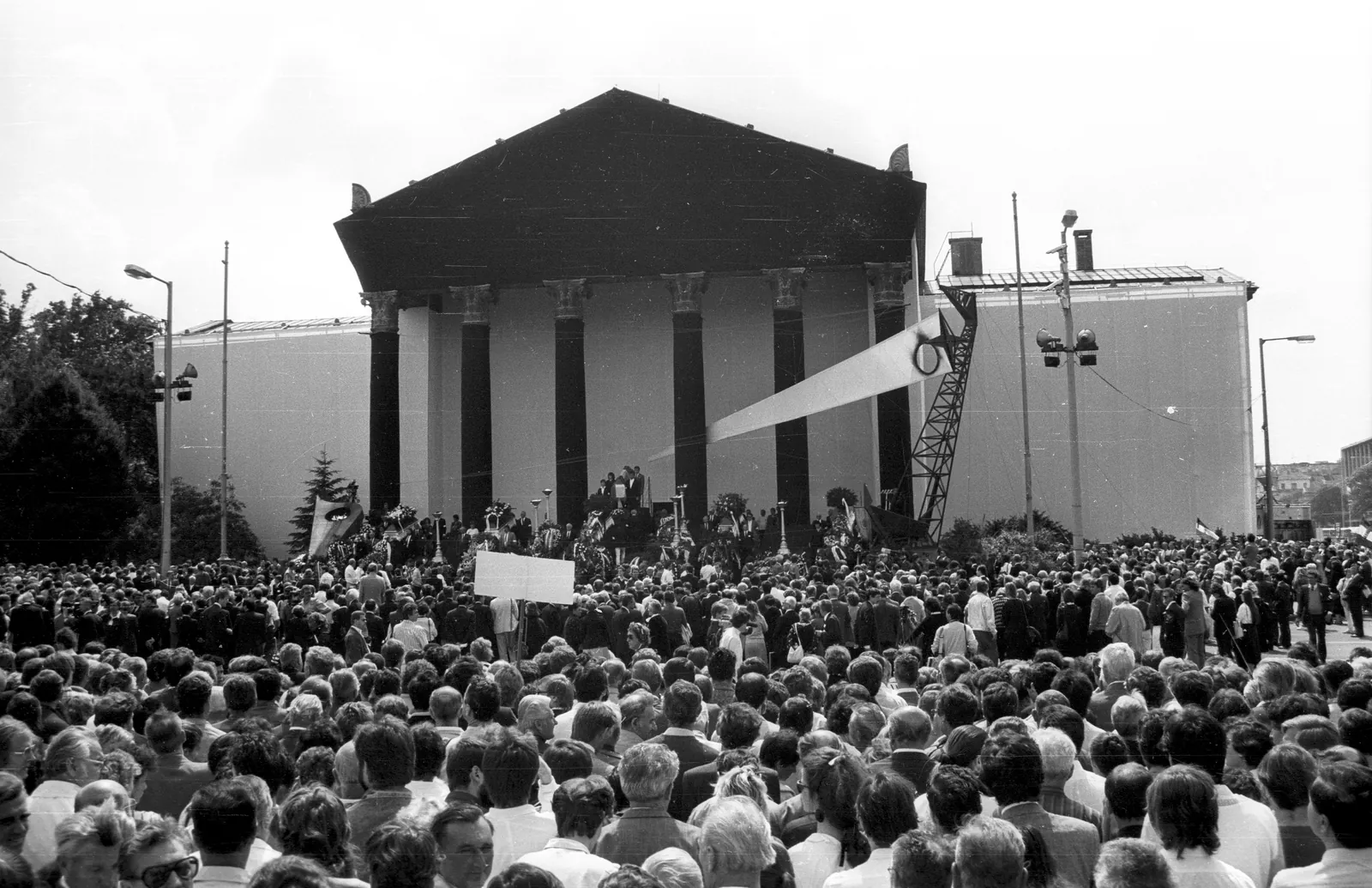
In the first half of the year the paper follows the Hungarian party closely: its Central Committee's communiqué on a multi-party system and on 1956 gets 1,340 characters in February, and János Kádár's removal is on page 1 in May. The reburial of Imre Nagy, under a headline that puts 250,000 people at the funeral, has 271 characters.
Budapest, Heroes' Square, 16 June 1989: the crowd at the ceremony before the reburial of Imre Nagy and the others executed after 1956. Photograph: Fortepan / tm, no. 2093, CC BY-SA 3.0; resized.
In August and September the reports thin out. The departure of East Germans through Hungary is mentioned in a report from Berlin on 18 August and not again until November; the Sopron picnic of 19 August and Hungary's decision of 10 September to let them leave do not appear. The October congress at which the party turned itself into the Hungarian Socialist Party is reported at length (1,685 characters), with the verb 改建, “rebuilt”, for the change. Hungary has five articles in December.
Date
What happened
In the People's Daily
The Central Committee accepts a multi-party system and debates the reassessment of 1956.
匈党发表中央全会公报 评价一九五六年十月事件 匈党中央决定进一步发展政治多元化Hungarian Socialist Workers' Party publishes Central Committee plenum communiqué / Assessing the events of October 1956 / The party's Central Committee decides to develop political pluralism further14 Feb · page 6 · 1,340 characters · three days later
Hungary begins, in front of the press, to dismantle the fence on its border with Austria.
东西方关系缓和又迈新步 匈拆除匈奥边境军事障碍Another new step in the easing of East–West relations / Hungary dismantles military barriers on the Hungarian–Austrian border4 May · page 3 · 406 characters · two days later
Imre Nagy, the prime minister executed in 1958, is reburied in Budapest after a ceremony on Heroes' Square.
匈牙利重新安葬纳吉 国家领导人及二十五万群众参加葬礼Hungary reburies Nagy / The country's leaders and 250,000 people attend the funeral19 Jun · page 3 · 271 characters · three days later
The “Pan-European Picnic” at Sopron: several hundred East Germans cross into Austria.
No article. In the issues of 20–31 August none of the articles searched mentions Sopron, the picnic or the Hungarian–Austrian border. The crossings through Hungary had been mentioned on 18 August, in a report from Berlin.
Hungary announces that from midnight its border with Austria is open to East German citizens; tens of thousands leave.
No article. In the issues of 10–25 September none of the articles searched links Hungary or Austria with East German citizens.
The ruling party turns itself into the Hungarian Socialist Party.
匈社会主义工人党召开十四大 决定将党改成社会党 格罗斯和许多人反对Hungarian Socialist Workers' Party holds its 14th congress / Decides to turn the party into a Socialist Party / Grósz and many others oppose10 Oct · page 3 · 1,685 characters · three days later
The Republic of Hungary is proclaimed, on the anniversary of the day the 1956 uprising began.
匈正式更名为匈牙利共和国 匈外长表示匈尊重对华约承担的义务Hungary officially changes its name to the Republic of Hungary / Hungarian foreign minister says Hungary respects its obligations to the Warsaw Pact25 Oct · page 3 · 598 characters · two days later
East Germany
186 news items in 1989 · 9 on page 1 · half shorter than 312 characters
JanFebMarAprMayJunJulAugSepOctNovDec
East Germany has more reports in the autumn than any other of the six: 31 items in October and 39 in November. The people leaving through the embassies appear twice before October: on 18 August, as “a very small number of GDR citizens attempting by illegal means to go to West Germany and West Berlin”, and on 15 September, when 290 of them leave the West German embassy in Prague to go home. The October demonstrations reach the paper mainly through the GDR Interior Ministry's own notice, under a headline that says it “rebuts Western slander of the GDR's quelling of trouble”, and through two court reports from Dresden, whose headlines call the accused 肇事者, troublemakers, and 暴徒, thugs. At the end of the first, the paper's correspondent adds a sentence of his own: “demonstrations and marches” took place in Berlin, Leipzig, Dresden, Potsdam and Magdeburg.
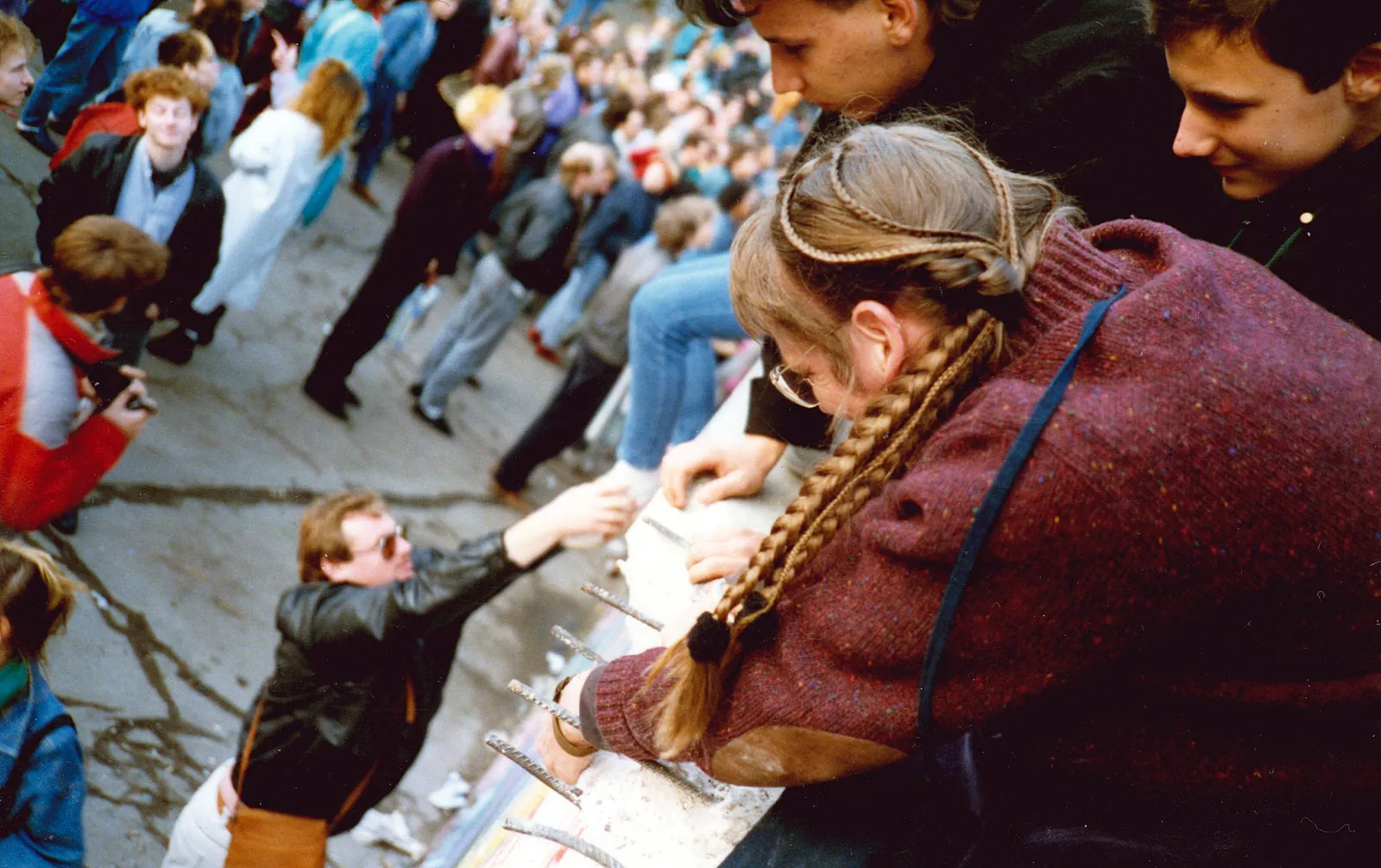
Berlin, November 1989: young people on top of the Wall, above the crowd. The photographer dates the picture 10 November. Photograph: Vietinghoff, Wikimedia Commons, CC0.
Erich Honecker's resignation is on page 3, in 393 characters; the next day Jiang Zemin's telegram to his successor is on page 1. Egon Krenz had been in Beijing three weeks earlier, on page 1 twice. The opening of the border is the report at the top of this page. The word 柏林墙 appears in eight articles of the whole paper in 1989, in none from September to November, and next on 14 December, in a signed article on German unification: “with the opening of the Berlin Wall”.
Date
What happened
In the People's Daily
Local elections; citizens' groups count the votes and show the result was falsified.
No article. In the issues of 7–20 May none of the articles searched speaks of elections in the GDR.
The People's Chamber adopts a declaration backing the Chinese leadership after 4 June.
民德人民议院就中国事态发表声明 北京发生的事件纯属中国内部事务 反对任何外国的干涉GDR People's Chamber issues statement on the situation in China / Events in Beijing are purely China's internal affair / Opposes any foreign interference12 Jun · page 1 · 324 characters · four days later
The GDR turns 40. Gorbachev and the Chinese deputy premier Yao Yilin are in Berlin; around the anniversary more than 3,000 protesters are detained across the country.
民德隆重庆祝建国四十周年 昂纳克强调坚持社会主义道路 姚依林应邀出席大会和阅兵式GDR solemnly celebrates 40 years since its founding / Honecker stresses keeping to the socialist road / Yao Yilin attends rally and military parade at invitation8 Oct · page 3 · 837 characters · the next day
Seventy thousand people march in Leipzig; the security forces do not intervene.
民主德国内政部发表公告 斥西方对民德平息闹事的诬蔑GDR Ministry of the Interior issues announcement / Rebuts Western slander of GDR's quelling of trouble12 Oct · page 3 · 553 characters The text reports the GDR Interior Ministry's notice about “trouble”. The correspondent adds one sentence of his own: around the anniversary “demonstrations and marches” took place in Berlin, Leipzig, Dresden, Potsdam and Magdeburg. The march of 9 October is not described.
Erich Honecker resigns; Egon Krenz becomes general secretary.
德国统一社会党中央全会 接受昂纳克辞职请求 选举克伦茨为总书记Plenum of the Central Committee of the Socialist Unity Party of Germany / Accepts Honecker's request to resign / Elects Krenz general secretary19 Oct · page 3 · 393 characters · the next day 江泽民总书记昨致电祝贺克伦茨当选德国统一社会党中央总书记General Secretary Jiang Zemin yesterday sent a telegram congratulating Krenz on his election as General Secretary of the Central Committee of the Socialist Unity Party of Germany20 Oct · page 1 · 351 characters
Hundreds of thousands demonstrate on Alexanderplatz in Berlin.
No article. In the issues of 4–12 November none of the articles searched mentions Alexanderplatz or links Berlin with a rally, march or demonstration.
The GDR opens its borders; that night Berliners pass through the Wall.
民主德国宣布开放边界 民德一著名女作家呼吁公民留在家乡参与改革 西德内政部长指出民德公民慎重考虑移居问题GDR announces opening of the border / A well-known GDR woman writer urges citizens to stay in their homeland and take part in reform / West German interior minister points out that GDR citizens should think carefully about the question of moving away11 Nov · page 4 · 554 characters · two days later
Hans Modrow is elected prime minister.
莫德罗当选民德部长会议主席Modrow elected chairman of GDR Council of Ministers15 Nov · page 4 · 389 characters · two days later
The Politburo and the Central Committee resign in a body.
民德党中央委员会辞职 成立工作委员会暂时主持党的工作GDR party Central Committee resigns / Working committee set up to run the party's affairs temporarily5 Dec · page 4 · 166 characters · two days later
Czechoslovakia
106 news items in 1989 · 8 on page 1 · half shorter than 276 characters
JanFebMarAprMayJunJulAugSepOctNovDec
Czechoslovakia has fewer reports in 1989 (106) than in 1988 (131). The August demonstration in Prague is printed under the headline “Illegal organisations in Prague launch demonstration”, with the state news agency's verdict as its second line.
The march of 17 November first appears in the issue of 23 November, in two dispatches dated 20 and 21 November. The headline is the government's meeting and Miloš Jakeš's appeal “to stay rational”; the text, 797 characters, says that demonstrations of students and townspeople have gone on “since the 17th”, that more than 100,000 gathered on Wenceslas Square on the 20th and about 200,000 “in a peaceful demonstration” on the 21st, and gives their demands, among them “free elections”. The police action of the 17th is not in it. Václav Havel's election as president is 157 characters on the last day of the year.
Date
What happened
In the People's Daily
Václav Havel is sentenced to nine months in prison over the January demonstrations.
捷判决一月示威被捕者 77宪章成员哈维尔被判刑九个月Czechoslovakia sentences those arrested at January demonstrations / Charter 77 member Havel sentenced to nine months24 Feb · page 3 · 233 characters · three days later
A demonstration in Prague, 21 years after the 1968 invasion.
布拉格非法组织发动示威 捷通社说示威是破坏秩序的挑衅Illegal organisations in Prague launch demonstration / Czechoslovak news agency says the demonstration is a provocation to disrupt order23 Aug · page 3 · 311 characters · two days later
Police break up a student march in Prague with violence; over the following days the protests grow daily.
捷政府开会讨论布拉格局势 雅克什呼吁捷人民保持理智Czechoslovak government meets to discuss the situation in Prague / Jakeš calls on the Czechoslovak people to stay rational23 Nov · page 4 · 797 characters · six days later
Miloš Jakeš and the party leadership resign.
捷共中央全会做出重大人事变动 乌尔班内克当选中央总书记Czechoslovak Communist Party Central Committee plenum makes major personnel changes / Urbánek elected general secretary of the Central Committee26 Nov · page 4 · 611 characters · two days later
A two-hour general strike across the country.
No article on the strike. In the issues of 27 November – 6 December the word “strike” appears in no text about Czechoslovakia; the call to strike had been mentioned on 25 November.
The Federal Assembly removes the party's leading role from the constitution.
No article. In the issues of 29 November – 10 December no text about Czechoslovakia mentions the constitution or the leading role.
A government with a non-communist majority; President Gustáv Husák resigns.
恰尔法出任捷总理Čalfa becomes Czechoslovak prime minister12 Dec · page 4 · 262 characters · two days later
Václav Havel is elected president.
捷选出新总统和联邦议会主席Czechoslovakia elects new president and chairman of the Federal Assembly31 Dec · page 4 · 157 characters · two days later
Bulgaria
78 news items in 1989 · 8 on page 1 · half shorter than 260 characters
JanFebMarAprMayJunJulAugSepOctNovDec
Todor Zhivkov's removal after 35 years is reported two days later on page 4. The third line of the headline is the new leader's: the country's “only way out is to advance along the socialist road”. Jiang Zemin's congratulations to Petar Mladenov are on page 1 three days after that, and Qiao Shi, a member of the Politburo Standing Committee, is in Sofia at the end of the month.
When demonstrators surround parliament on 14 December, the paper prints a report of the parliament's statement, 198 characters, under the headline “Bulgarian parliament stresses that stirring up turmoil will not be allowed”. In the dispatch the parliament refuses to let the country be pushed into 混乱, chaos; the headline's word is 动乱, the one the paper had used since April for Beijing. Zhivkov's name appears in 28 articles in 1989 and in none in 1990.
Date
What happened
In the People's Daily
Todor Zhivkov is removed after 35 years in power; Petar Mladenov succeeds him.
保共中央全会接受日夫科夫辞职请求 姆拉德诺夫当选保共总书记 强调国家唯一出路是沿社会主义道路前进Bulgarian Communist Party Central Committee plenum accepts Zhivkov's resignation / Mladenov elected general secretary / Stresses that the country's only way out is to advance along the socialist road12 Nov · page 4 · 584 characters · two days later 江泽民电贺姆拉德诺夫当选为保共中央总书记Jiang Zemin sends telegram congratulating Mladenov on his election as Bulgarian Communist Party general secretary15 Nov · page 1 · 196 characters
A mass rally surrounds parliament in Sofia and demands the immediate removal of Article 1 of the constitution, on the party's leading role.
保议会强调不准制造动乱Bulgarian parliament stresses that stirring up turmoil will not be allowed17 Dec · page 4 · 198 characters · three days later
Romania
84 news items in 1989 · 10 on page 1 · half shorter than 261 characters
JanFebMarAprMayJunJulAugSepOctNovDec
Nicolae Ceaușescu gave the paper's own correspondent an interview that was printed five weeks before his death: 2,803 characters on page 4 of 18 November, the longest text about any of the six countries in the last quarter of the year. Qiao Shi was in Bucharest for the party congress from 20 November, and the Chinese party's message of congratulations was on page 1 on the 23rd.
The events in Timișoara, where the army and the security forces opened fire on demonstrators on 17 December, first appear on 22 December, in a dispatch of the 20th that reports Ceaușescu's television address in his own terms: a “terrorist action” by “hooligan gangs”. On page 2 of the same issue the Chinese Foreign Ministry's spokesman believes that Romania “can handle its own affairs”. The issue of 23 December has no report on Romania. On 24 December the headline is: “Bucharest, the Romanian capital, falls into serious chaos.”
On 27 December the execution of Nicolae and Elena Ceaușescu is one sentence of 90 characters on page 4, given as an announcement by Romanian television. Page 1 of the same issue has three items on China's position; one headline reads “China respects the choice of the Romanian people”. Ceaușescu's name is in 57 articles of the paper in 1988, in 46 in 1989 and in one in 1990.
Date
What happened
In the People's Daily
The 14th Congress of the Romanian Communist Party opens; on 24 November Ceaușescu is re-elected general secretary. The Chinese delegation is led by Qiao Shi of the Politburo Standing Committee.
罗共14大开幕 齐奥塞斯库总书记在会上作工作报告 乔石率中国共产党代表团出席Romanian Communist Party's 14th Congress opens / General Secretary Ceaușescu delivers report to the congress / Qiao Shi leads Chinese Communist Party delegation to attend21 Nov · page 4 · 189 characters · the next day 我党代表团团长乔石转交 中共中央致罗共十四大的贺词Qiao Shi, head of the Chinese Communist Party delegation, conveys / the Chinese Communist Party Central Committee's congratulatory message to the Romanian Communist Party's 14th Congress23 Nov · page 1 · 836 characters
The protests in Timișoara begin; on 17 December the army and the security forces open fire on the demonstrators.
罗马尼亚一县进入紧急状态 齐奥塞斯库呼吁全国团结One Romanian county enters state of emergency / Ceaușescu calls for national unity22 Dec · page 4 · 416 characters · six days later
Ceaușescu flees Bucharest; the Council of the National Salvation Front takes power.
罗首都布加勒斯特陷入严重混乱Bucharest, the Romanian capital, falls into serious chaos24 Dec · page 4 · 580 characters · two days later
Nicolae and Elena Ceaușescu are tried and shot at Târgoviște; television announces the execution that evening.
罗电视台宣布罗特别军事法庭判处齐奥塞斯库死刑Romanian television announces that a special military tribunal has sentenced Ceaușescu to death27 Dec · page 4 · 90 characters · two days later 田曾佩会见罗驻华大使时说 中国尊重罗人民的选择 我红十字会提供紧急人道主义援助Tian Zengpei, meeting the Romanian ambassador to China, says / China respects the choice of the Romanian people / China's Red Cross provides emergency humanitarian aid27 Dec · page 1 · 188 characters
The counts in this section are taken from the whole paper, every article of 1988, 1989 and 1990, and each gives the number of articles in which the word occurs at least once.
Two words for Beijing
19881119891,1941990348
Articles of the whole paper that contain 暴乱 (riot), by month, January 1988 to December 1990.
暴乱, riot, is in 12 articles from January to May 1989 and in 290 in June, one article in every six that month. 动乱, turmoil, rises from 239 articles in 1988 to 1,169 in 1989. The same words then turn up in the reports from Eastern Europe: 23 of the 729 items contain 暴乱, and in every one the subject is China: a statement of support for the Chinese leadership, a meeting in Beijing, greetings on the fortieth anniversary of the People's Republic. In the headlines over the reports of the six countries' own unrest the paper's words are 闹事 (making trouble, 12 October), 非法 (illegal, 23 August) and, for Bulgaria in December, 动乱 itself. In the text of the dispatches the events are 示威, demonstrations, and in Prague on 21 November a “peaceful demonstration”.
Peaceful evolution
1988019891091990216
Articles of the whole paper that contain 和平演变 (peaceful evolution), by month, January 1988 to December 1990.
和平演变, peaceful evolution, is the paper's name for a Western strategy to turn socialist states capitalist without war. It is in no article of 1988. In 1989 it is in 109, all but two of them from July onwards, and in 1990 in 216. Its first use in that sense in 1989 is on 24 June, about China. On 9 July a long article on the Voice of America names Eastern Europe among the targets of American policy in the 1950s. The first article to apply the phrase to the Eastern Europe of 1989 is a commentary of 14 July on the Soviet and American leaders' visits to Europe, which says that George Bush “openly encouraged, in Poland and Hungary, a peaceful evolution towards the West”.
Words for what happened in Europe
Word
1988
1989
1990
柏林墙Berlin Wall; with the variant 柏林围墙
0
8
9
东欧剧变the drastic change in Eastern Europe
0
0
3
东欧局势 · 东欧形势the situation in Eastern Europe
0
26
51
团结工会Solidarity
27
71
21
圆桌会议round table
27
69
13
多党制multi-party system
29
84
80
和平演变peaceful evolution
0
109
216
The phrase by which the events are known in China today, 东欧剧变, the drastic change in Eastern Europe, does not occur in the paper in 1989. Its two words first share a sentence on 30 December, when the foreign minister, Qian Qichen, says that “drastic change has recently occurred in Eastern Europe” (最近东欧发生剧变). A looser form, 东欧局势剧变, follows on 20 January 1990, and the fixed phrase itself on 31 October 1990. The neutral 东欧局势 or 东欧形势, the situation in Eastern Europe, is in 26 articles in 1989, 19 of them in December.
The names
Name
1988
1989
1990
齐奥塞斯库Ceaușescu, Romania
57
46
1
昂纳克Honecker, East Germany
60
49
1
日夫科夫Zhivkov, Bulgaria
21
28
0
雅克什Jakeš, Czechoslovakia
47
28
1
胡萨克Husák, Czechoslovakia
30
9
1
卡达尔Kádár, Hungary
11
11
0
克伦茨Krenz, East Germany
4
36
1
瓦文萨Wałęsa, Poland
23
34
13
戈尔巴乔夫Gorbachev, Soviet Union
404
390
333
The table counts the articles of the whole paper that contain each name. Each of the leaders who fell in 1989, Krenz among them, is named in one article or in none in 1990; Wałęsa and Gorbachev are there for comparison.
49 of the 729 items are on page 1. In 37 of them the headline is about China's own dealings with the country: a meeting in Beijing, a telegram, a delegation, a spokesman's answer. The other 12 are events abroad, all printed before August: the Polish Round Table, Kádár's removal, the Hungarian party's statement on Nagy.
On the days of change the two kinds of news part. Honecker's resignation is on page 3 and the telegram to Krenz on page 1. Zhivkov's removal is on page 4 and the telegram to Mladenov on page 1. The Ceaușescus' execution is on page 4 and “China respects the choice of the Romanian people” on page 1.
All 49 page-1 items, in order of date
China's dealings · 681 characters赵紫阳会见罗马尼亚客人时谈国内形势 治理整顿取得成效 今后任务更加艰巨Zhao Ziyang, meeting Romanian guests, talks about the domestic situation / Improvement and rectification has produced results / Tasks ahead are more arduous
event abroad · 299 characters波“圆桌会议”讨论政治改革 就设立参议院和总统制取得一致意见Polish “round table” discusses political reform / Agreement reached on establishing a Senate and a presidential system
China's dealings · 137 characters莱比锡春季博览会中国荣获四项金奖China wins four gold medals at Leipzig Spring Fair
event abroad · 692 characters波“圆桌会议”取得积极成果 双方签署一项《公报》和三个协议Polish “round table” achieves positive results / The two sides sign one communiqué and three agreements
event abroad · 276 characters波兰当局同教会方面 草签保障信仰自由法Polish authorities and the church / Initial a law guaranteeing freedom of belief
event abroad · 245 characters匈党中央全会重新选举政治局成员 格罗斯继任总书记Hungarian Socialist Workers' Party Central Committee plenum re-elects Politburo members / Grósz succeeds as general secretary
event abroad · 205 characters格罗斯谈匈党面临的最大危险 党内存在派别组织活动Grósz on the greatest danger facing the Hungarian Socialist Workers' Party / factional activity exists within the party
China's dealings · 705 characters李鹏会见匈牙利客人时重申 我国改革开放方向不变Li Peng, meeting Hungarian guests, reiterates / China's direction of reform and opening up will not change
China's dealings · 570 characters胡启立会见保加利亚客人时说 建设民主政治是渐进过程Hu Qili, meeting Bulgarian guests, says / building democratic politics is a gradual process
event abroad · 476 characters波党全国代表会议开幕 将讨论波党在改革中的地位和任务Polish United Workers' Party national conference opens / will discuss the party's position and tasks in reform
event abroad · 330 characters瓦文萨谴责非法示威游行Wałęsa condemns illegal demonstrations and marches
event abroad · 962 characters把为人民服务作为竞选纲领 波党号召党员人民参加六月大选Making service to the people the election platform / Polish United Workers' Party calls on members and the people to take part in the June elections
event abroad · 414 characters匈党中央主席 卡达尔因重病被免职Hungarian Socialist Workers' Party Central Committee chairman / Kádár removed from post because of serious illness
China's dealings · 458 characters赵紫阳会见保加利亚客人时指出 政治体制改革步子要稳 中心是民主和法制建设 没有政治体制改革,经济改革中的困难很难克服Zhao Ziyang, meeting Bulgarian guests, points out / The pace of political reform must be steady / Its core is the building of democracy and the legal system / Without political reform, the difficulties in economic reform will hardly be overcome
event abroad · 335 characters内梅特总理说 匈牙利面临动荡潜在危险 不准用军队解决内政问题Prime Minister Németh says / Hungary faces a latent danger of upheaval / the army must not be used to resolve internal affairs
event abroad · 753 characters匈党中央就重新安葬纳吉发表公报 称纳吉是社会主义改革政策代表人物Hungarian Socialist Workers' Party Central Committee issues communiqué on the reburial of Nagy / calls Nagy a representative figure of the policy of socialist reform
China's dealings · 324 characters民德人民议院就中国事态发表声明 北京发生的事件纯属中国内部事务 反对任何外国的干涉GDR People's Chamber issues statement on the situation in China / Events in Beijing are purely China's internal affair / Opposes any foreign interference
China's dealings · 291 characters保加利亚反对外国干涉中国内政 支持我稳定国内局势的措施Bulgaria opposes foreign interference in China's internal affairs / supports China's measures to stabilise the domestic situation
China's dealings · 228 characters捷共领导人列纳尔特接见我驻捷大使时说 相信中国根据国情继续改革Communist Party of Czechoslovakia leader Lenárt, receiving the Chinese ambassador to Czechoslovakia, says / he believes China will continue reform in line with its national conditions
China's dealings · 146 characters江泽民电贺涅尔什当选匈党主席Jiang Zemin cables Nyers congratulating him on his election as chairman of the Hungarian Socialist Workers' Party
China's dealings · 887 characters江泽民总书记昨天分别会见罗马尼亚和埃塞俄比亚客人General Secretary Jiang Zemin yesterday meets Romanian and Ethiopian guests separately
China's dealings · 435 characters在会见民主德国客人时 江泽民说:患难知真交 沙博夫斯基说中共四中全会所做的事都是必要的Meeting GDR guests / Jiang Zemin says: in hardship one knows true friends / Schabowski says everything done at the Fourth Plenum of the CCP was necessary
China's dealings · 881 characters李鹏会见捷副总理日阿克时强调 改革开放必须坚持四项基本原则 同日会见即将离任的尼加拉瓜大使Li Peng, meeting Czechoslovak deputy prime minister Žák, stresses / Reform and opening up must uphold the Four Cardinal Principles / Meets the departing Nicaraguan ambassador the same day
event abroad · 367 characters拉科夫斯基出任波党第一书记Rakowski becomes first secretary of the Polish United Workers' Party
China's dealings · 151 characters我愿继续发展同波兰关系China is willing to continue developing relations with Poland
China's dealings · 822 characters李鹏会见捷克斯洛伐克客人时说 中国警惕外来颠覆阴谋 在平等互利原则下同西方开展交往Li Peng, meeting Czechoslovak guests, says / China is on guard against foreign subversive plots / and will conduct exchanges with the West on the principle of equality and mutual benefit
China's dealings · 310 characters江泽民会见捷国防部长 宾主希望发展中捷两国友好合作关系Jiang Zemin meets Czechoslovak defence minister / Host and guest hope to develop friendly and cooperative relations between China and Czechoslovakia
China's dealings · 822 characters乔石同克伦茨举行会谈 双方就加强中德两党两国关系取得一致意见Qiao Shi and Krenz hold talks / Both sides agree to strengthen China–GDR relations at party and state level
China's dealings · 1,223 characters江泽民万里分别会见克伦茨一行 高度评价中德两党两国关系Jiang Zemin and Wan Li separately meet Krenz and his party / Highly praise relations between the two parties and two countries of China and the GDR
China's dealings · 561 characters江泽民会见捷工会代表团 同日分别会见美国教授和企业家Jiang Zemin meets Czechoslovak trade union delegation / Meets an American professor and an American businessman the same day
China's dealings · 180 characters姚依林率党政代表团出访民德Yao Yilin leads Party and government delegation on visit to GDR
China's dealings · 527 characters江泽民会见罗共访华代表团时说 发展中罗友谊是我党一贯方针Jiang Zemin, meeting Romanian Communist Party delegation visiting China, says / Developing Sino-Romanian friendship is the consistent policy of the Chinese Communist Party
China's dealings · 351 characters江泽民总书记昨致电祝贺克伦茨当选德国统一社会党中央总书记General Secretary Jiang Zemin yesterday sent a telegram congratulating Krenz on his election as General Secretary of the Central Committee of the Socialist Unity Party of Germany
China's dealings · 140 characters外交部发言人发表谈话 中国民德友好合作关系相信将进一步得到发展Foreign Ministry spokesman makes statement / Believes friendly and cooperative relations between China and the GDR will develop further
China's dealings · 168 characters乔石会见捷客人Qiao Shi meets Czechoslovak guests
China's dealings · 640 characters江泽民李鹏分别会见捷外长 宾主表示要进一步扩大两国合作Jiang Zemin and Li Peng separately meet Czechoslovak foreign minister / Host and guest say they will further expand cooperation between the two countries
China's dealings · 625 characters李鹏分别会见尼泊尔和保加利亚客人Li Peng meets Nepalese and Bulgarian guests separately
China's dealings · 116 characters江泽民会见保外长Jiang Zemin meets Bulgarian foreign minister
China's dealings · 133 characters宋平会见保中友协代表团Song Ping meets delegation of the Bulgaria–China Friendship Association
China's dealings · 189 characters宋平会见捷共客人Song Ping meets Czechoslovak Communist Party guests
China's dealings · 196 characters江泽民电贺姆拉德诺夫当选为保共中央总书记Jiang Zemin sends telegram congratulating Mladenov on his election as Bulgarian Communist Party general secretary
China's dealings · 266 characters乔石率团赴罗保两国访问Qiao Shi leads delegation on visits to Romania and Bulgaria
China's dealings · 836 characters我党代表团团长乔石转交 中共中央致罗共十四大的贺词Qiao Shi, head of the Chinese Communist Party delegation, conveys / the Chinese Communist Party Central Committee's congratulatory message to the Romanian Communist Party's 14th Congress
China's dealings · 767 characters齐奥塞斯库再次当选罗共总书记 江泽民总书记致电表示热烈祝贺Ceaușescu re-elected general secretary of the Romanian Communist Party / General Secretary Jiang Zemin sends telegram of warm congratulations
China's dealings · 292 characters杨主席回答科威特新闻界提问时说 希望罗马尼亚尽快恢复平静 无论发生什么变化都希望东欧同中国保持友好President Yang, answering questions from Kuwaiti press, says / Hopes Romania will restore calm as soon as possible / Whatever changes occur, hopes Eastern Europe will keep up friendship with China
China's dealings · 188 characters田曾佩会见罗驻华大使时说 中国尊重罗人民的选择 我红十字会提供紧急人道主义援助Tian Zengpei, meeting the Romanian ambassador to China, says / China respects the choice of the Romanian people / China's Red Cross provides emergency humanitarian aid
China's dealings · 148 characters外交部发言人发表谈话 愿在和平共处五项原则基础上继续同罗马尼亚发展友好关系Foreign Ministry spokesman makes statement / China is willing to continue developing friendly relations with Romania on the basis of the Five Principles of Peaceful Coexistence
China's dealings · 256 characters杨主席李总理分别致电祝贺罗马尼亚新领导人President Yang and Premier Li separately send telegrams congratulating Romania's new leaders
What the leaders said then, and what was published later#
In print, the position is one sentence, repeated from August to December by the Foreign Ministry's spokesmen: what happens in these countries is their internal affair. The premier, Li Peng, goes a step further in Dhaka on 19 November; the headline of the next day's report is “advises certain people not to rejoice too early over the situation in Eastern Europe”.
奉劝某些人不要对东欧局势高兴太早
“[He] advises certain people not to rejoice too early over the situation in Eastern Europe.”
People's Daily, 20 November 1989, page 4, headline
An instruction, as reported by a historian
The historian Péter Vámos, working from Hungarian diplomatic and intelligence files, writes that after 4 June all news about Poland and Hungary was examined politically before publication, and that a Central Committee instruction forbade commentary and analysis: “Only short, factual news items were allowed to be released” (Vámos, 2015, pp. 106–107). The instruction itself has not been published; his sources are Hungarian reports from Beijing.
The count can be set beside that account. Signed analyses of Polish politics stop after 11 June; two signed pieces on the Polish economy follow. No signed analysis is devoted to Hungary in the whole year, before or after June; the commentary of 14 July treats it together with Poland. Length changes little for Poland: half of the reports are shorter than 336 characters before 4 June and shorter than 316 after it. For Hungary the figures are 336 and 245.
Vámos also writes that the execution of the Ceaușescus “came closer to disturbing Beijing's uneasy calm than any other upheaval in Eastern Europe”. The historian M. E. Sarotte argues, from East German and American records, that fear of contagion from Europe was already “one of the main motivations” for sending in the army in June (Sarotte, 2012).
Deng Xiaoping, in the paper and in the Selected Works
On 24 November the paper reports on page 1 that Deng Xiaoping has called on Julius Nyerere of Tanzania, the day before. In its 424 characters Deng tells him that he has come to see an old friend, “but not to talk politics”. The report ends: “the two old friends then talked in a very cordial and friendly atmosphere”. It prints nothing of what was said, and the words Eastern Europe are not in it.
我来看望你,是为了看看老朋友,叙叙友情,但不谈政治。
“I have come to see you in order to see an old friend and talk of friendship, but not to talk politics.”
People's Daily, 24 November 1989, page 1, given as reported speech
The third volume of Deng's Selected Works, published in November 1993, carries an excerpt of a talk with Nyerere dated 23 November, the day of the visit (Chinese edition, p. 344; Deng Xiaoping, 23 November 1989).
东欧的事情对我们说来并不感到意外,迟早要出现的。东欧的问题首先出在内部。
“We are not surprised at the developments in Eastern Europe. These changes were bound to take place sooner or later. The trouble there started from inside.”
Deng Xiaoping, Selected Works, vol. III, p. 344; official English translation
The same volume dates to 4 September 1989 Deng's three phrases on the international situation, 冷静观察、稳住阵脚、沉着应付: “observe the situation coolly”, “hold our ground”, “act calmly” (p. 321; Deng Xiaoping, 4 September 1989). And the outline of a speech that Jiang Zemin gave to a seminar on press work on 28 November 1989, saying that “hostile international forces” were stepping up their strategy of peaceful evolution and that “several East European countries are in sharp upheaval” (动荡), was printed on page 1 on 2 March 1990.
The text. The source is an unofficial transcription of the People's Daily, with a date, a page label, a headline and a body for each article. The three years used here hold 95,319 articles: 33,551 for 1988, 30,049 for 1989 and 31,719 for 1990. No exact duplicates were found in these years. Lengths are counted in characters of body text without spaces, the dispatch line included and the repeated headline left out.
The dates were corrected. In the months when China kept summer time, the transcription dates every issue one day early: the editorial known everywhere as the 26 April editorial is filed under 25 April, and the paper's own notice that “summer time ends tomorrow” under 15 September. All dates on this page are issue dates after that correction (16 April to 16 September 1989, and the matching months of 1988 and 1990). The issues of 16 and 17 April 1989 are filed under one date in the transcription; 77 articles of those two days could not be assigned with certainty and are shown under 16 April.
Which articles count. An article is “about” a country when its headline names it (in full, by the paper's shorthand such as 波, 匈, 民德, or through a leader or party), when the first 120 characters of its body name it, or when it was filed from one of its cities and names it. Sport is left out of the counts where the rule recognises it; features and news in brief are shown in the issue view, and the totals in the text count news, news in brief and captioned photographs. The rule was checked by hand on 100 items drawn at random from those that name one of the six countries or are counted for one: it was wrong 11 times. Three times it counted a country that was not the subject: twice the country is only listed in the opening lines, and once 奥匈帝国 (Austria-Hungary) was read as Hungary. Eight times it missed a country: four briefs lower down in a column of news in brief, two countries named by shorthand in a list in the headline, and two texts whose headline and opening lines name a party, a leader or a product instead of the country. The totals are therefore more likely to be a little too low than too high. A signed analysis here means a text of 600 characters or more on the news pages that opens with a correspondent's byline instead of a dispatch line.
“No article” means searched and not found. Each such statement names the dates and the words searched, in the articles kept in full: every article of the three years that names one of the six countries, Yugoslavia, Albania, Eastern Europe, the Warsaw Pact, a list of leaders, parties and cities, or the phrase 和平演变. Word counts in the section on words are from every article of the paper.
Translations. The headlines were translated from Chinese for this page. 我 (“our”), as in 我外交部, is rendered as “China's”. The quotations from Deng Xiaoping's Selected Works are in the official English translation.
What this is not. It is a count of one newspaper. Page numbers are the transcription's, and the page a report sat on depended on the paper's layout as well as on its weight. The count is narrower than the one on the page about Romania in the same paper: that page counts every article that names Romania, 196 in 1989; this one counts news items about Romania, 84. Earlier studies of how the Chinese press treated the region exist, among them Tubilewicz (1997), which could not be consulted for this page; no claim is made here about what they did or did not count.