The Alhambra, Granada
Are all 17 in the Alhambra? It depends who counts. Count them yourself.
Mathematics says a pattern that repeats in every direction across a flat surface can do so in exactly 17 ways. The walls of the Alhambra are said to hold them all. Those who counted, from Edith Müller in 1944 to Lynn Bodner in 2013, found 11, 12, 13, 14 or 17, each by different rules. Set your rules and count.
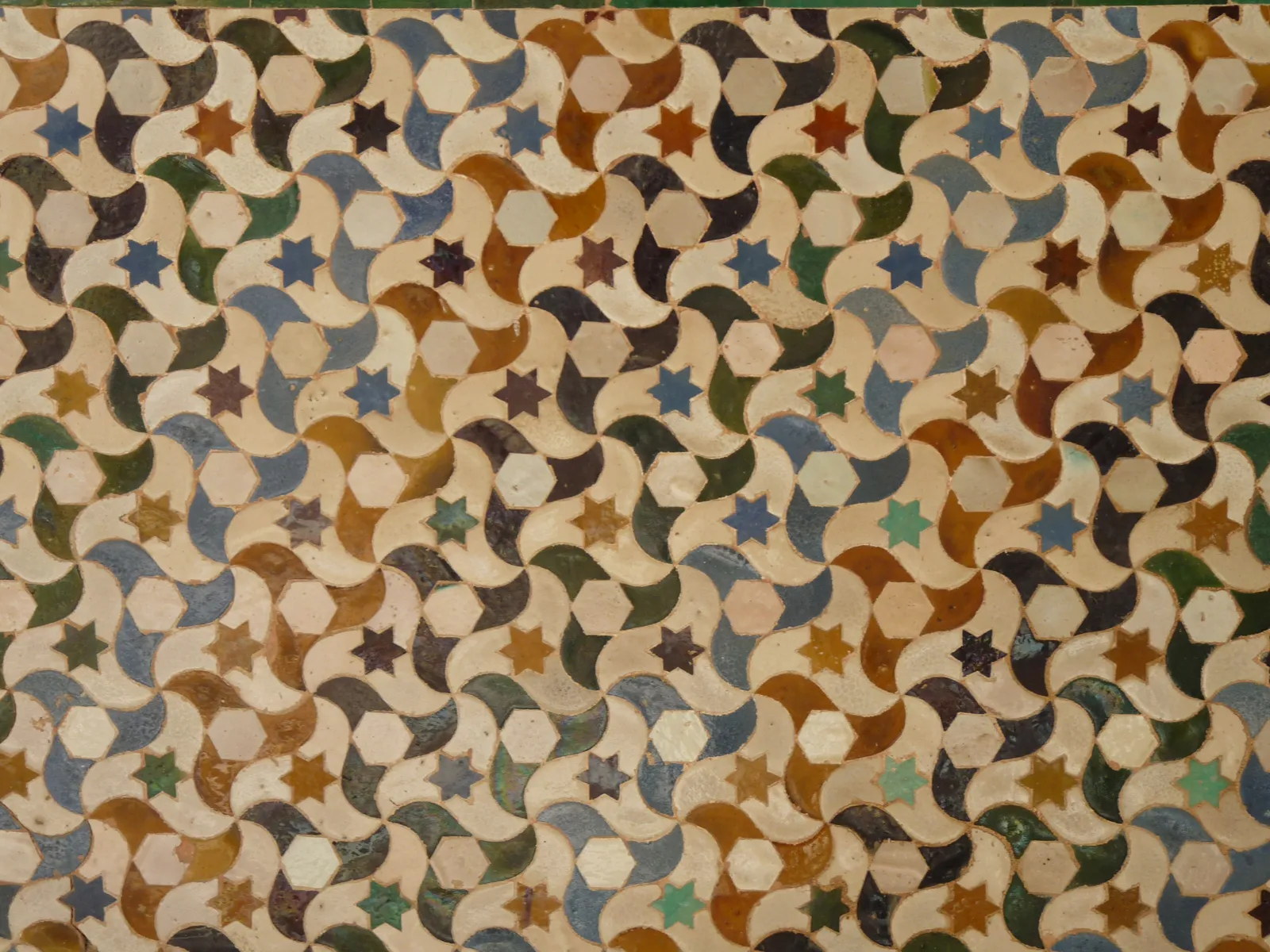
With all the colours, this wall no longer lands on itself after any turn: the colours follow no visible rule, so no mirrors or glides survive either. Only the shifts remain: p1, the least symmetric of the 17.
How many of the 17 are in the Alhambra, by your rules?
Below is every example four researchers have published for each of the 17 kinds, with where it is. Choose whose eyes you trust and which rules you accept. The count updates as you go.
Who counted, and what did they find?
| Who | When | How many | How they counted |
|---|---|---|---|
| Edith Müller | 1944, thesis, Zürich | 11 or 12 | The first count. The sources below disagree on her result. |
| Grünbaum, Grünbaum and Shephard | 1986 | at most 13 | Found p2, pg, pgg and p3m1 missing. |
| José María Montesinos | 1987, book | 17 | Photographs for all, counting colours or not, case by case; a reviewer wrote that it settled the question “once and for all”. |
| Rafael Pérez-Gómez | 1987, article | 17 | Hunted the missing groups; found them in the museum, on a chair, in a 10 by 5 cm detail, on floors. |
| Branko Grünbaum | several days in 1983; published 2006 | 13 | Müller’s groups and one more. The criteria, he asks, must be explicit and applied consistently. |
| Blanco and Harris | 2011 | 17 | Counted colours and overlooked damage; three examples are museum pieces. |
| Lynn Bodner | 2013 | 14 | Only patterns in place in the palace today, on walls, floors or ceilings, at least a square metre, colour ignored, interlace counted. Missing: p2, pmg, p3m1. |
| Patronato de la Alhambra | official website | 17 | Does not say by which rules. |
The first number is already uncertain. Edith Müller wrote her thesis in Zürich in 1944, supervised by the mathematician Andreas Speiser. Bodner, Pérez-Gómez and Emparán say she found 11 kinds; Grünbaum says 12. Grünbaum seems to have worked closest to it: he mentions a 1984 letter from Müller and explains where the figure 14 came from, a misreading of a remark in the thesis.
The claim that the Alhambra holds all 17 also appears on the monument trust’s own website, without saying by which rules. Grünbaum explains how it spread: authors copying from authors who copied from others, “all without any actual investigation”.
Why don’t they agree?
Colour. A Nasrid craftsman could set the same shape in three colours, to a rhythm of his own. Count the colours and the symmetry breaks; ignore them and it appears. Emparán shows how one drawing was classified three ways, depending on how much of the colour each researcher kept. Grünbaum reproaches Montesinos for counting colours “whatever he finds convenient”.
Interlace. Many patterns are bands passing over and under one another. If you track which one is on top, some mirrors vanish. Pérez-Gómez’s only example of p2 exists only if you count the interlace.
Size and place. Lynn Bodner counted only patterns of at least about one square metre that are in the palace today, on walls, floors or ceilings. So she rejected a hexagonal tile in the museum that would have given p3m1. Pérez-Gómez found the same group on the back of a museum chair and in a detail about 10 by 5 centimetres above a doorway.
Restoration. Rafael Contreras remade whole decorations in the second half of the 19th century, and the museum keeps tiles that were reused and recut. Pérez-Gómez notes that the pm paving in the Cuarto Dorado courtyard is a 1965 restoration.
What do the rules look like on the walls today?
The photographs below were published freely by visitors. The classifications are ours and can be checked by eye; where a researcher described the same kind of panel, I quote them.
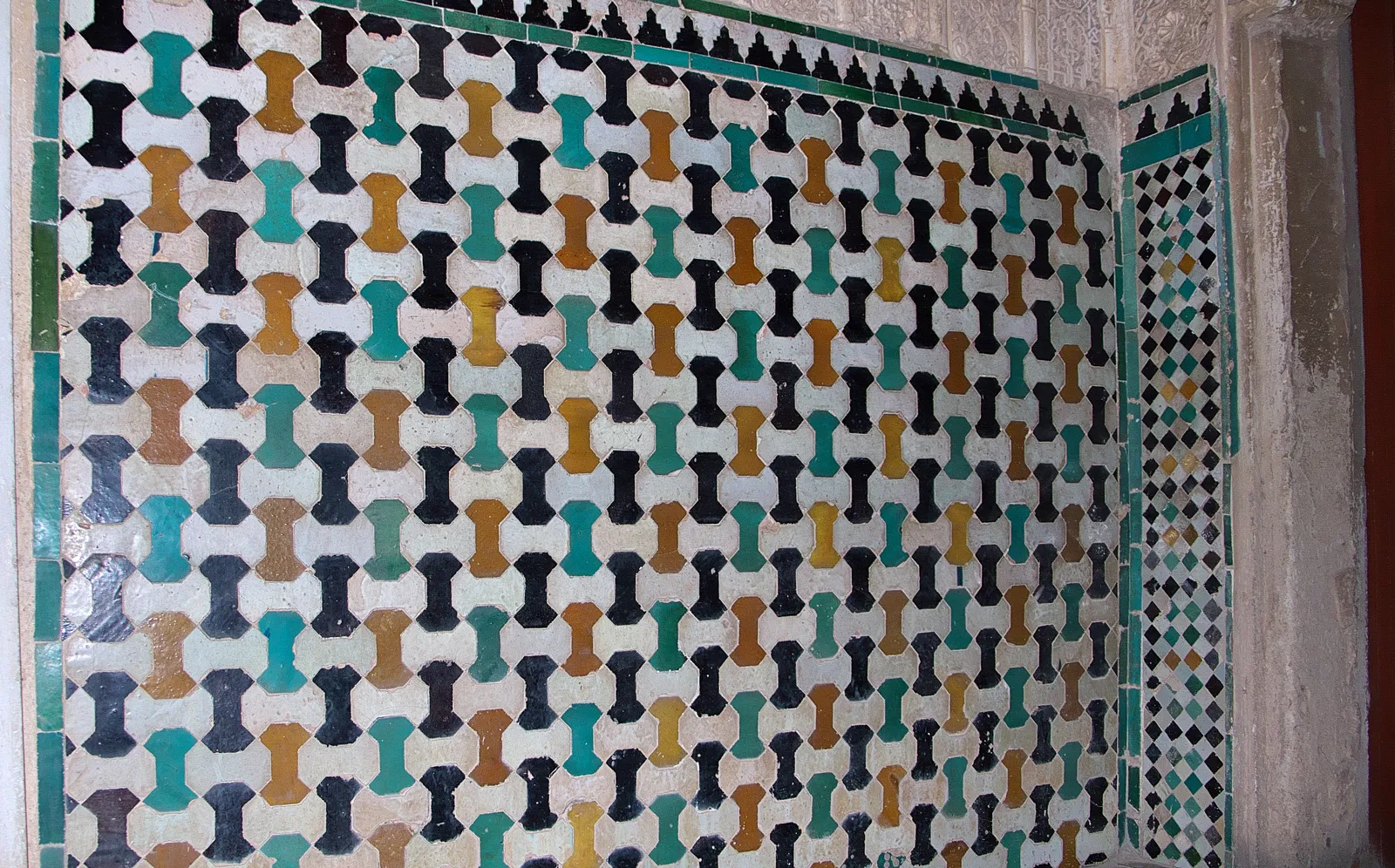
The Nasrid “bone”, the dado of a niche in the Salón de Embajadores cmm
At first sight the white and coloured bones look alike and the pattern seems to have quarter-turns. Close up, the white bones are wider: the quarter-turn goes, leaving crossed mirrors and half-turns, cmm. Bodner classifies the dado in the same hall the same way: the white bones are “substantially larger”.
Foto / Photo: Jl FilpoC, CC BY 4.0.
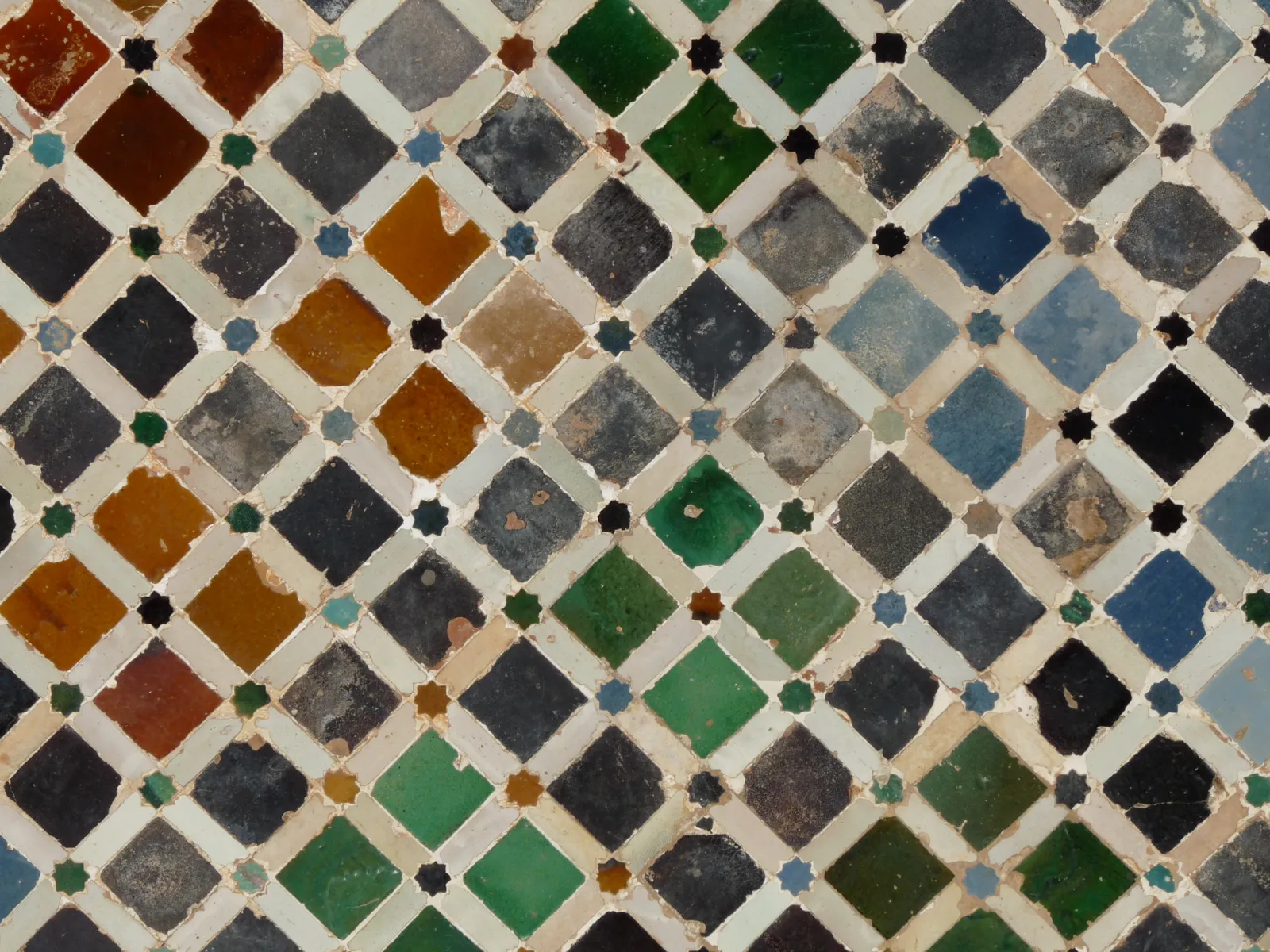
Squares and small stars, Patio de los Arrayanes according to the photo’s file page p4m
Without colour, the squares and stars have quarter-turns, and mirrors pass through every centre of rotation: p4m. With colour nothing survives: neighbouring squares differ in colour with no visible rule.
Foto / Photo: michael clarke stuff, CC BY-SA 2.0.
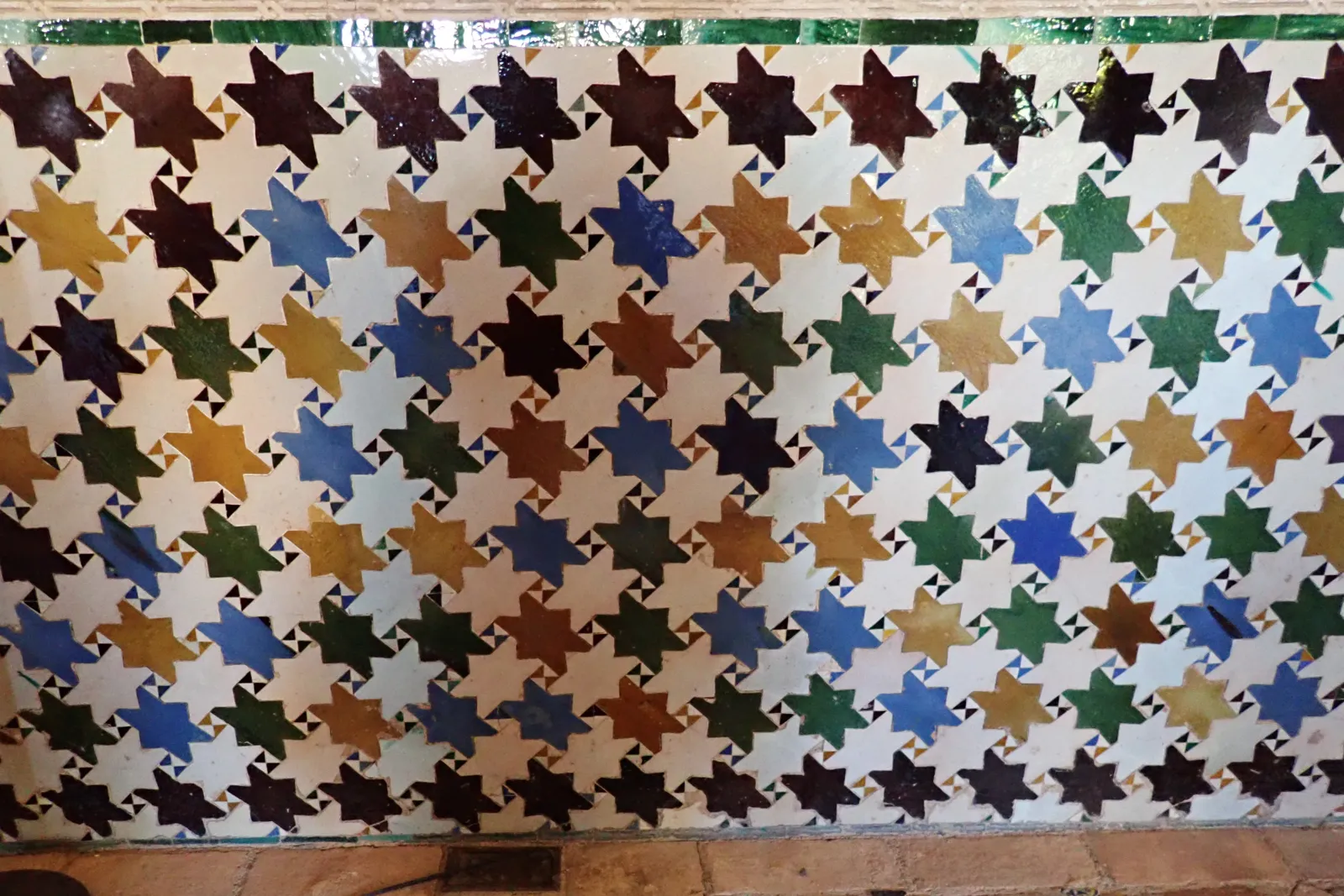
Interlocking stars, the dado of the Mexuar according to the photo’s description p4g
The quarter-turns are certain. Bodner finds p4g in the Mexuar dado and recognises it by the small squares made of four triangles. On this photo I could not confirm the mirrors through the stars, so the classification stays p4g after Bodner or, if the mirrors are missing, p4.
Foto / Photo: Ashaio, CC BY 4.0.
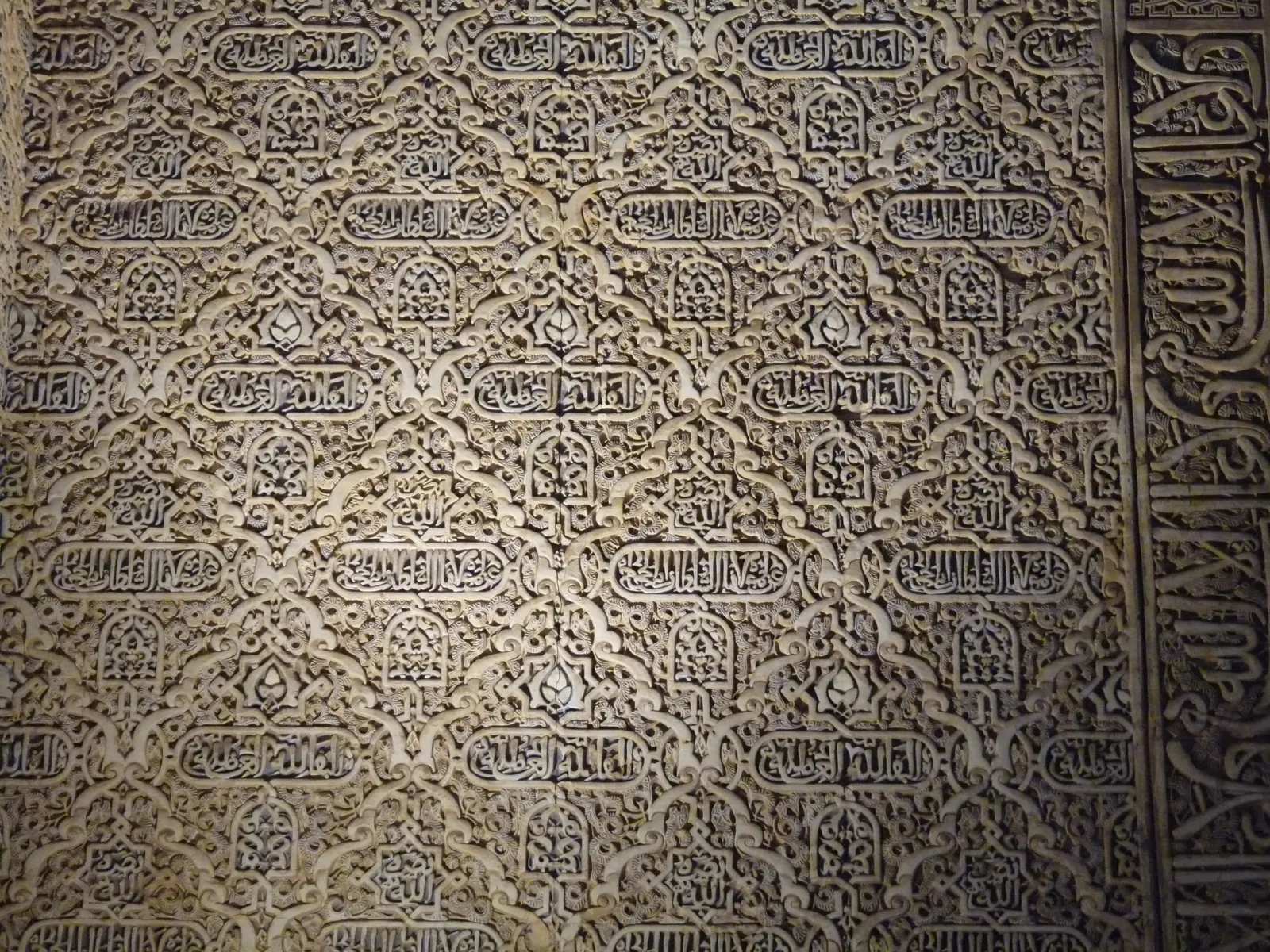
A lattice of lozenges with inscriptions, carved plaster, Salón de Embajadores p1
The lattice alone would have mirrors. But the cartouches hold text, and writing has no symmetry: it reads one way only. Count the inscriptions and only shifts remain, p1. Bodner uses the same argument for her p1 example.
Foto / Photo: michael clarke stuff, CC BY-SA 2.0.
Who made these walls?
The Nasrid dynasty settled in Granada in 1238, under Muhammad I, called al-Ahmar. Most of the palaces with glazed tile mosaic, alicatados, and carved plaster, yeserías, date from the 14th century, the reigns of Yusuf I and Muhammad V. After 1492 the Catholic Monarchs repaired the palace, largely with Morisco craftsmen.
To those craftsmen, Grünbaum writes, symmetry groups meant nothing. The list of 17 would be drawn up only in 1891, by the Russian crystallographer Evgraf Fedorov. On some walls, he says, one has the feeling the craftsmen broke the symmetry on purpose, so the pattern would not be monotonous.
M. C. Escher came here in October 1922 and copied a tiled panel. He returned in May 1936 with his wife, Jetta, and they filled notebooks with sketches. Later Escher copied out by hand the 1924 paper in which George Pólya illustrated all 17 kinds.
What the 17 are, and why a band can have only seven kinds of border, you can try for yourself, by stitching, at Seven borders.
Sources and method
The count uses only the examples each author published with their location: Bodner, Blanco and Harris, Pérez-Gómez and Emparán. Grünbaum and Montesinos do not name all their groups, so they appear in the table but not in the count. Disputed or rejected examples are shown but not counted.
When a source does not say whether an example depends on colour, interlace or size, the example passes that rule. Blanco and Harris write that they counted colours, but not for which examples it mattered, so the strict rules cannot exclude their examples.
The classifications of the photographs are ours. Locations come from the photos’ file pages on Wikimedia Commons.
The examples resting on Pérez-Gómez alone (the paving restored in 1965, the chair, the 10 by 5 cm detail, piece 1361) were read in his article once; the independent check could not reopen it.
- Bodner, B. L. (2013). The Planar Crystallographic Groups Represented at the Alhambra. Bridges 2013, 225–232. archive.bridgesmathart.org/2013/bridges2013-225.pdf
- Blanco Blanco, M. F., Nogueira de Camargo Harris, A. L. Symmetry groups in the Alhambra. VisMath (2011). www.mi.sanu.ac.rs/vismath/blanco2011mart/BL.pdf
- Pérez-Gómez, R. (1987). The four regular mosaics missing in the Alhambra. Computers & Mathematics with Applications 14(2), 133–137. doi.org/10.1016/0898-1221(87)90143-X
- Grünbaum, B. (2006). What symmetry groups are present in the Alhambra? Notices of the AMS 53(6), 670–673. www.ams.org/notices/200606/comm-grunbaum.pdf
- Emparán, M. A. (2019). The Planar Crystallography Groups as an Iconographic Analysis Tool in Islamic Art. Bridges 2019. archive.bridgesmathart.org/2019/bridges2019-303.pdf
- Grünbaum, B., Grünbaum, Z., Shephard, G. C. (1986). Symmetry in Moorish and other ornaments. Computers & Mathematics with Applications 12B, 641–653. doi.org/10.1016/0898-1221(86)90416-5
- Patronato de la Alhambra y Generalife: Geometría y matemática en los alicatados. www.alhambra-patronato.es/geometria-matematica-alicatados
- Escher in Het Paleis: Escher’s wall mosaic in the Alhambra; The life of Escher. escherinhetpaleis.nl/en/about-escher/escher-today/wall-mosai
- MacTutor History of Mathematics: Maurits Cornelis Escher. mathshistory.st-andrews.ac.uk/Biographies/Escher/
- Hargittai, I. Appeal of symmetry. IUCr Newsletter 33(5) (Fedorov 1891; Escher’s hand copy of Pólya). www.iucr.org/news/newsletter/volume-33/number-5/appeal-of-sy
- Patronato de la Alhambra y Generalife: history of the monument and the Nasrid palaces. www.alhambra-patronato.es/