A game of stitching and geometry
Every border ever stitched, if it repeats, is one of seven kinds
Stitch a motif in cross-stitch. The page repeats it every way a border can repeat. By shape, leaving colour aside, there are seven, and it has been proved there is no eighth. You can still try to find one.
The cloth you stitch on needs the page's scripts. Below, the seven families are described in words, with a table and photographs.
Wolf's teeth, the wave, the lying S, the rhomb and the snail are among the motifs Romania's heritage inventory lists on the altiță of Oltenia.
The seven ways a border can repeat
Every border below starts from your motif. The first only moves it along, step by step. The others also turn it over: they mirror it left to right or top to bottom, spin it half a turn, or flip it and move it at once, the way footprints fall: left, right, left.
Pick one to see it large. The coloured lines show the symmetries the page found in the finished border.
- mirror across
- mirror along
- glide
- half-turn centre
If your motif is already symmetrical, some ways merge. A diamond mirrored left to right looks exactly like a diamond moved along, because the diamond was already its own mirror image. The page looks at what you stitched, not what you asked for, and tells you when a border has moved into another family.
Try to make an eighth
Here you decide how each copy of the motif is turned: up to four copies in a row and, if you like, a second row underneath. Press a copy to turn it. However you arrange them, the result falls into one of the seven families. Each new family you hit lights up below and stays lit the next time you open the page.
The copies, left to right:
- hop
- step
- sidle
- spinning hop
- spinning sidle
- jump
- spinning jump
A result that looks new can be an old one seen from the other end: the same border, started one copy further along. That is why the page compares finished borders, not lists of copies.
Why there are only seven
A border is a band that repeats in one direction. Any move that leaves it unchanged must lay the band back on top of itself. That leaves very few possible moves besides simply sliding it one step.
A mirror can only lie along the band, on its midline, or across it. The only rotation that keeps the band in place is the half-turn: a quarter-turn would stand it across the page. A glide can only run lengthways; running any other way, doing it twice would shift the band off itself. That leaves four kinds of move: the mirror across, the mirror along, the glide and the half-turn.
Four moves, each present or not, give 16 combinations. But moves combine: two mirrors at right angles make a half-turn, so you cannot have the mirrors without it. Donald Crowe, a mathematician and co-author of “Symmetries of Culture” (1988), writes that nine of the 16 combinations are impossible. Seven remain: no move; the glide alone; the mirror along with the glide; the mirror across alone; the half-turn alone; the mirror across with the glide and the half-turn; all four. Switch on the moves below and see where you land.
No moves switched on: you land on the hop (∞∞), the border that only slides.
The seven families, with the names John Conway gave them after the tracks left by someone moving that way: hopping on one foot, stepping, sidling, jumping with feet together.
| Family | What symmetry it has | Conway's notation | Conway's name |
|---|---|---|---|
| hop | Sliding only: the motif repeats unchanged, step after step, with no mirror anywhere. | ∞∞ | hop |
| step | A glide: each copy is flipped over the midline and moved half a step on, like a trail of footprints. | ∞× | step |
| sidle | Mirrors across the strip: fold the border along a vertical line and the two sides match. | *∞∞ | sidle |
| spinning hop | Half-turns: spun 180° about points on the midline, the border looks the same. | 22∞ | spinning hop |
| spinning sidle | Mirrors across the strip, a glide and half-turns, all three at once. | 2*∞ | spinning sidle |
| jump | A mirror along the strip: the top half reflects the bottom half. | ∞* | jump |
| spinning jump | Everything a strip allows: mirrors both ways and half-turns. | *22∞ | spinning jump |
Who first listed all seven depends on whom you ask. Gwen Fisher writes that Paul Niggli was the first to enumerate the seven border groups, in 1926. Slavik Jablan names three people together: George Pólya (1924), Niggli (1926) and Andreas Speiser (1927). Fisher also writes that Evgraf Fedorov appears to have been the first to count, in 1891, the 17 ways a pattern can repeat across a whole surface, like wallpaper.
Borders are far older than the proof. Jablan gives as an example glide borders from the Neolithic art of Butmir, in today's Bosnia, from around 3500 BC.
Your border on the sleeve of an altiță blouse
On the altiță blouse, borders have fixed places. Romania's Ministry of Culture describes the altiță blouse like this: from the shoulder down, a three-part structure, altiță, încreț and râuri, and within each part “the motifs repeat rhythmically, in horizontal and vertical registers”. The altiță is the wide band of embroidery on the shoulder. The încreț, a narrower band, gathers the sleeve cloth to the width of the altiță. The râuri (literally “rivers”) are the bands running down the sleeve: borders again, only stood on end.
The embroidery is worked, says the inventory of Romania's National Heritage Institute, “directly on the counted threads of the cloth”, with no printed pattern. Among the stitches it lists is the cross-stitch, also called muscă (“fly”) or the Romanian stitch. The 7 by 7 cloth at the top of this page is a small piece of such a grid of threads.
Since 2022 the altiță blouse has been on UNESCO's list of the intangible cultural heritage of humanity, inscribed jointly by Romania and the Republic of Moldova. The nomination file says the craft is “exclusively female”, learnt in the family, and that its heritage value is held by people aged 7 to 80.
Henri Matisse painted “La Blouse roumaine” in 1940; it belongs to the collection of the Centre Pompidou in Paris. Since 2013, 24 June has been celebrated as the Universal Day of the Romanian Blouse, begun by the “La Blouse Roumaine” community, and a law promulgated in June 2022 set 24 June as “Ie Day” in Romania.
The same seven, all over the world
Because this is a limit of geometry rather than of a tradition, the list is the same on every continent. Donald Crowe shows all seven families on the pottery of San Ildefonso pueblo in New Mexico, and writes that all seven also occur in Kuba and Benin art in Africa. Lynn Bodner looked for them on the walls of the Alhambra.
What differs from place to place is how often each family turns up. Crowe gives two examples from the collections he studied: in Anasazi pottery from the south-western United States, some 70% of the identifiable borders have only half-turns; on smoking pipes from Begho in Ghana, nearly 70% have every symmetry possible. For Romanian embroidery we found no study that has counted the families.
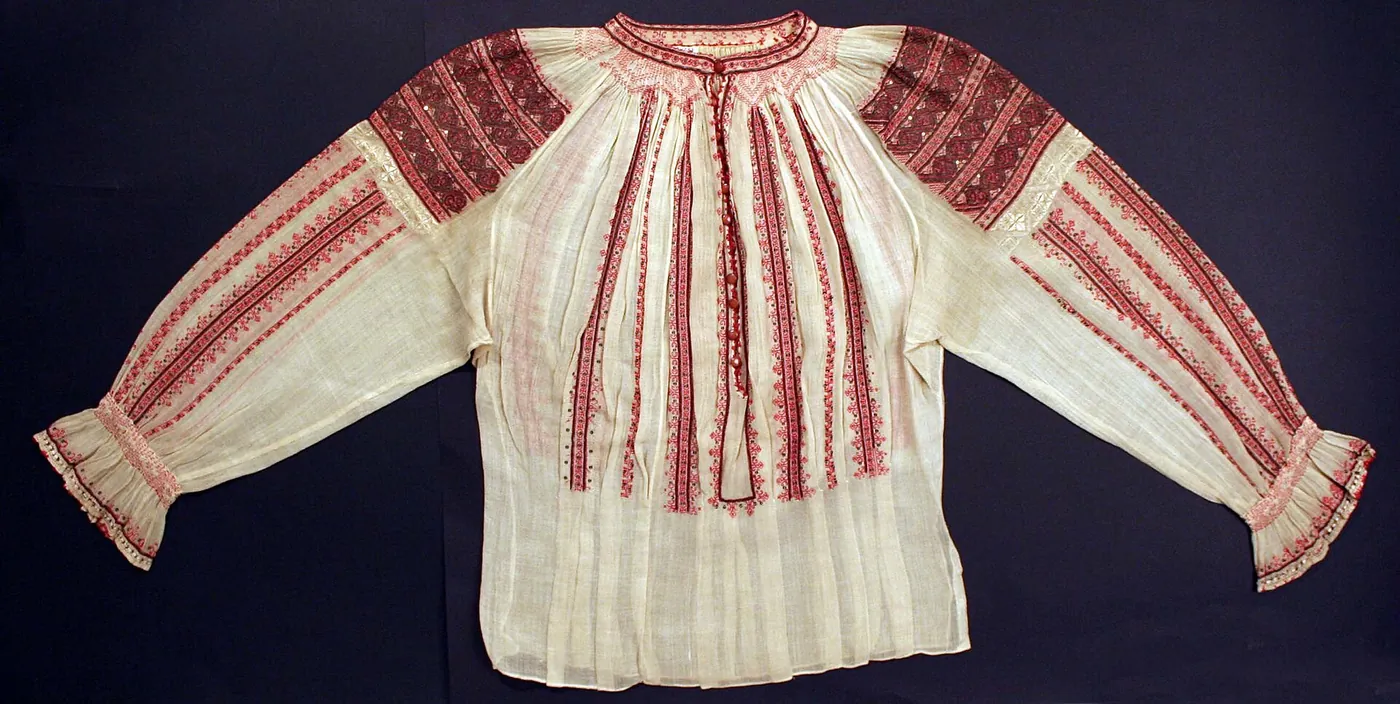
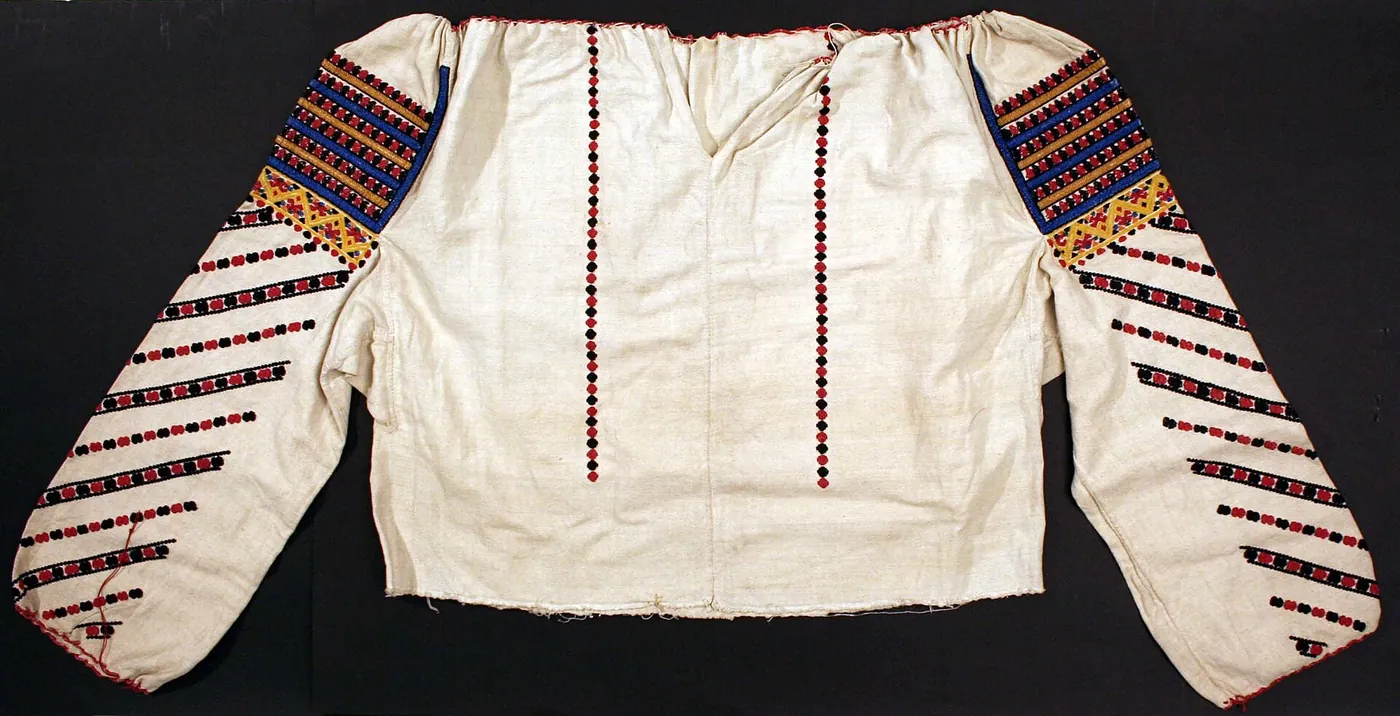

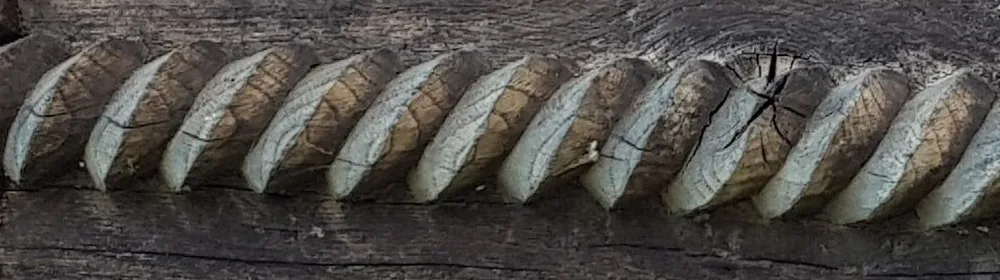
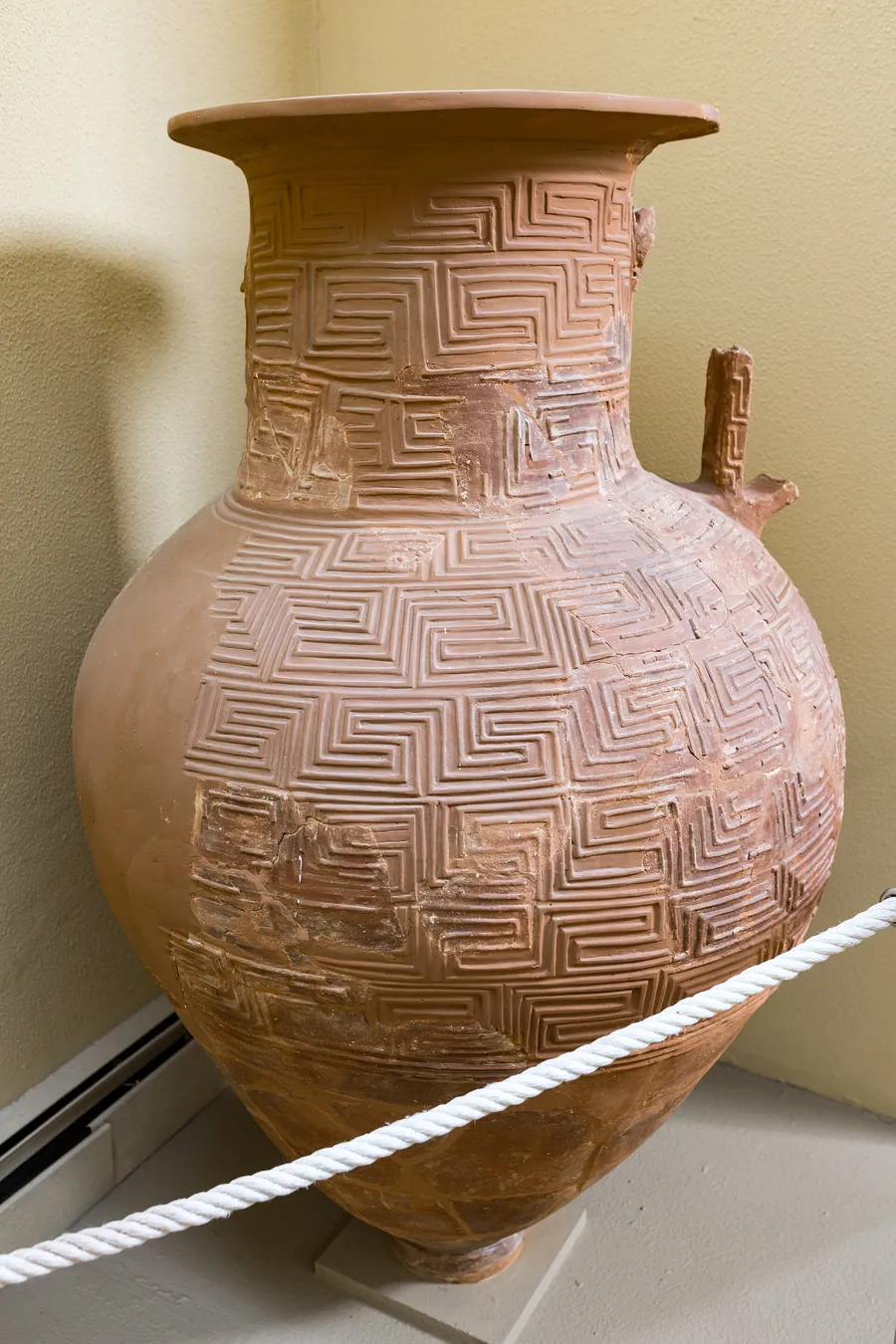
Colour splits the families further: if swapping red for black also counts as a symmetry, Crowe counts 17 types of two-colour border. The seven families above concern shape alone: where there is a stitch and where there is not.
Send it to someone, or take it to a class
The link below keeps your exact motif and border. Whoever opens it sees what you stitched and can carry on from there. The stitch chart downloads as an image, one square per cross-stitch, ready to work on cloth.
For a geometry lesson, from about age ten up:
- The border hunt. Pupils look for borders around the school and on the way home: fences, floor tiles, rugs, the edge of an exercise book. For each one they draw one step and name its family. Who can find all seven?
- The footprints. In snow, in sand, or with paper footprints along a corridor: hop on one foot, walk normally, sidle, jump with feet together. Conway named the families after tracks like these.
- The proof. In “Why there are only seven”, pupils switch the moves on two at a time and note which move appears by itself. Of the 16 combinations, how many survive?
- The stitching. With the downloaded chart, each pupil stitches one step of their border on aida cloth. Laid end to end, the borders show whether the rule held.
The page needs no account, sends nothing anywhere, and remembers the families you found only on your own device.
Sources and method
The page classifies the geometry of the stitching: which squares carry a cross and which do not. Colour is a further layer that splits the families further, and it is left out here. A hand-stitched border is never perfectly periodic; the family describes the rule the stitcher repeats, not every thread.
The classification runs on the finished border, not on the button pressed. The program finds the shortest step after which the pattern repeats, then tries every mirror across the strip (on a stitch or between two), the mirror along the midline, every glide and every half-turn centre. The midline is that of the stitched band: empty rows above and below are ignored. A border with no stitches gets no family.
The notation with ∞ is John Conway's orbifold notation. There are two clashing conventions for letter names such as “p1m1”: in the short form used by Wikipedia, p1m1 has mirrors across the strip; in the four-symbol form used by Washburn and Crowe or by Bodner, p1m1 has the mirror along it. The page uses neither.
- Wikipedia, “Frieze group” (notation table: IUC, orbifold, Conway): en.wikipedia.org/wiki/Frieze_group
- Donald W. Crowe, “Symmetries of Culture”, Bridges 2001: archive.bridgesmathart.org/2001/bridges2001-1.pdf
- Gwen L. Fisher, “A Method for Illustrating Border and Wallpaper Patterns”, Bridges 2005: archive.bridgesmathart.org/2005/bridges2005-511.pdf
- Slavik Jablan, Theory of Symmetry and Ornament, ch. 2.3: emis.de/monographs/jablan/chap23.htm
- Slavik Jablan, Theory of Symmetry and Ornament, ch. 2.4 (border examples): emis.de/monographs/jablan/chap24.htm
- B. Lynn Bodner, “Frieze Patterns of the Alhambra”, Bridges 2007: archive.bridgesmathart.org/2007/bridges2007-203.pdf
- DePaul University, “The Seven Types of Frieze, Band, or Border Patterns” (course notes): condor.depaul.edu/ppereira/sym/Notes/Seven.pdf
- UNESCO, “The art of the traditional blouse with embroidery on the shoulder (altiță)”, 2022: ich.unesco.org/en/RL/the-art-of-the-traditional-blouse-with-embroidery
- Romanian Ministry of Culture, “The art of the blouse with altiță” (2022, archived copy): web.archive.org/web/20220601181522/http://www.cultura.ro/arta-camasii-
- Romanian National Heritage Institute, national inventory of living intangible heritage: the art of the blouse with altiță (archived copy): web.archive.org/web/20221012143039/https://patrimoniu.ro/images/imater
- UNESCO, nomination file 01861 (archived copy): web.archive.org/web/20240413151940/https://ich.unesco.org/doc/download
- Wikimedia Commons: blouse MET 43.106.1: commons.wikimedia.org/wiki/File:Blouse_MET_43.106.1.jpg
- Wikimedia Commons: blouse MET 23.123.2: commons.wikimedia.org/wiki/File:Blouse_MET_23.123.2.jpg
- Wikimedia Commons: meander jar from Andros (ArchaiOptix): commons.wikimedia.org/wiki/File:Relief_pithos_from_Andros_-_meander_-_
- Capital.ro, promulgation of the “Ziua iei” law, 21 June 2022: capital.ro/ziua-iei-in-romania-se-va-celebra-oficial-pe-24-iunie-klaus
- Wikimedia Commons: rug from Bezdead (Felix Pirvan): commons.wikimedia.org/wiki/File:Rug_from_Bezdead,_Romania.jpg
- Wikimedia Commons: church gate at Breb (DiaRo): commons.wikimedia.org/wiki/File:Poarta_bisericii_din_Breb_detaliu.jpg
- Centre Pompidou, “La Blouse roumaine” by Henri Matisse: centrepompidou.fr/fr/magazine/article/la-blouse-roumaine
- Basilica.ro, “24 June, Universal Day of the Romanian Blouse”: basilica.ro/24-iunie-ziua-iei/