mariuscomper.uk RO
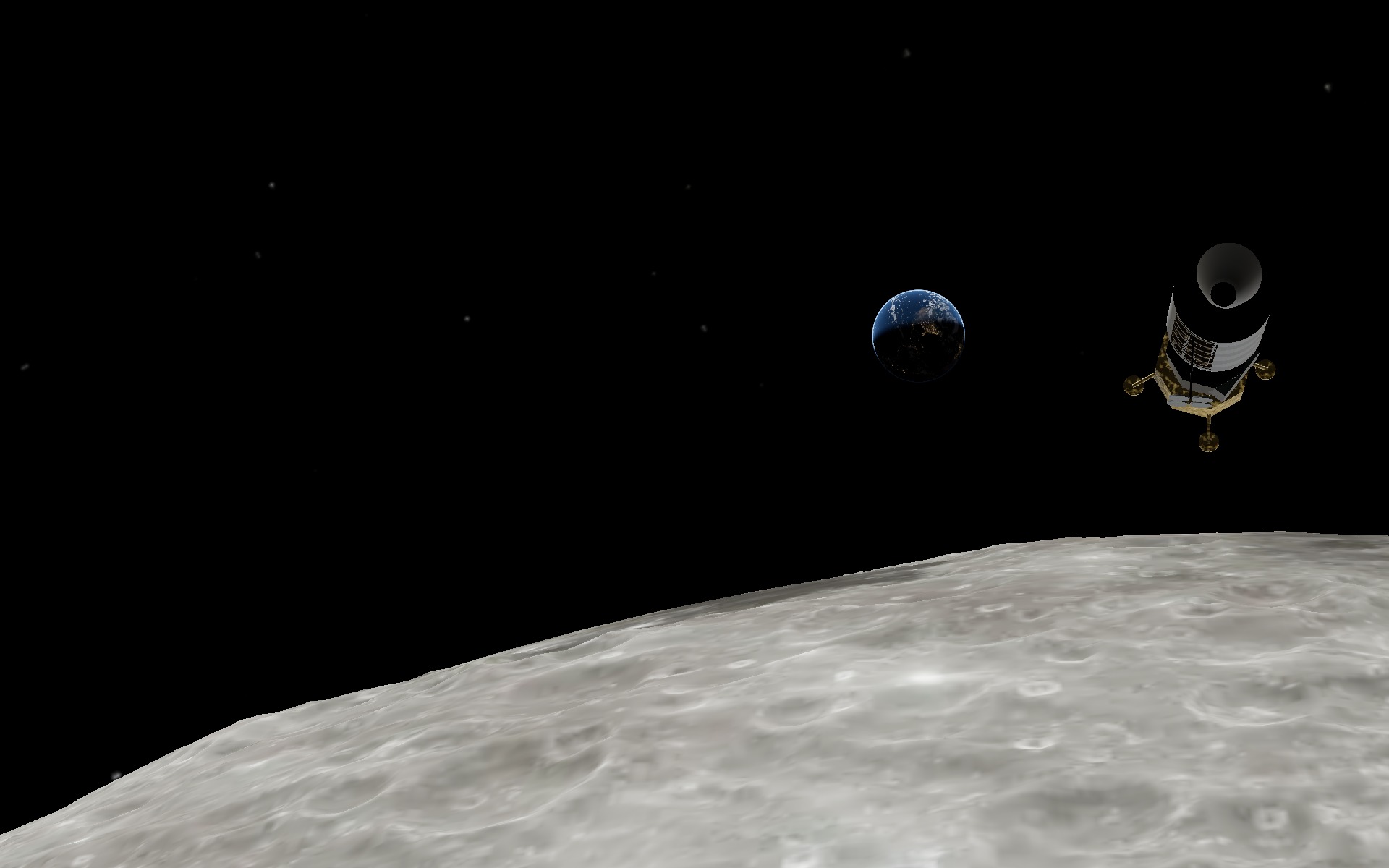
The damaged spacecraft above the far side of the Moon, with the Earth rising.

11–17 April 1970 · Odyssey and Aquarius

Apollo 13

Two days out, an oxygen tank blew apart 330,000 kilometres from Earth. Three men flew round the Moon and home in a lunar module built for two people and two days. Here is the flight on its own clock, with the Earth, the Moon and the Sun where they really were.

Drawn: the spacecraft and the tank · Source: Apollo 13 Review Board, 1970

The damage was done fifteen days before launch

On 27 March 1970, after a countdown rehearsal at Cape Kennedy, oxygen tank 2 in the service module would not empty properly. Technicians switched on the heaters inside it and left them on for about eight hours.

The heaters had thermostatic switches meant to cut out at 27 °C (80 °F). They were rated for the spacecraft’s 28-volt supply; the ground equipment fed them 65 volts. The Review Board concluded that the switches welded shut and that parts of the heater tube may have reached about 540 °C (1,000 °F), baking the insulation off the wires inside the tank.

Nobody could see it. The tank flew with bare wires inside it, in supercritical oxygen, next to a fan.

Measured: the Earth and the Sun as they stood (JPL Horizons) · Drawn: the clouds · Source: mission report MSC-02680

Lift-off, 19:13 UTC

Apollo 13 left Pad 39A at 19:13:00 UTC on 11 April 1970, a little after two in the afternoon at the Cape. Its target was the Fra Mauro highlands, where Apollo 14 would land the following year.

The first problem in flight came early. During the second stage’s burn the centre engine shut down 132 seconds too soon; the other four burned about 34 seconds longer and the third stage made up the rest. The parking orbit came out at 186 by 181 km (100.2 by 98.0 nautical miles), almost exactly as planned.

Measured: the Earth and the Moon (Horizons) · Calculated: the path, from the tracking states in the mission report

Out of Earth orbit, over the Pacific

At 2 hours 35 minutes 46 seconds, over Australia, the third stage fired again for 350.8 seconds. When it shut down, over the Pacific, the spacecraft was moving at 10.8 kilometres a second, 338 kilometres up.

From there the Earth falls away. By the time the spacecraft separated from the spent stage, at 4 hours 1 minute, it was about 23,000 kilometres out. The gold line is its path.

Measured: the Moon’s orbit (Horizons) · Calculated: the path

Leaving the safe road

The third stage had sent Apollo 13 out on a free return: if nothing else fired, the Moon’s gravity would swing the spacecraft round and back to Earth.

At 30 hours 40 minutes the service module’s engine fired for 3.5 seconds. It lowered the planned pass over the Moon to about 110 km (60 nautical miles), as the landing at Fra Mauro required, and took the spacecraft off the free-return road. From then on, coming home depended on that engine.

Measured: tank 2 telemetry (Review Board, table 4-II) · Drawn: the spacecraft, the open bay, the oxygen cloud

“Houston, we’ve had a problem”

At 55 hours 53 minutes 20 seconds into the flight the crew switched on the fans in the oxygen tanks, as they had several times before. Inside tank 2 the bare wires shorted. The pressure climbed to 1,008 psi (about 70 bar), and at 55 hours 54 minutes 53 seconds (03:07:53 UTC on 14 April, just after nine in the evening of the 13th in Houston) the signal was lost. The spacecraft was 330,000 kilometres from Earth.

A panel on the side of the service module blew off. Within about two and a half minutes, two of the three fuel cells had failed, and the oxygen that fed them was leaking into space.

Even the famous words are disputed. NASA’s 1970 transcript gives “I believe we’ve had a problem here” to the commander, Jim Lovell; the Flight Journal, corrected from the audio, gives that first call to Jack Swigert. Both agree that fifteen seconds later Lovell said: “Houston, we’ve had a problem. We’ve had a Main B Bus Undervolt.” No version has “we have a problem”.

Measured: the Earth’s turning and the Moon (Horizons) · Calculated: the spacecraft’s place in your sky

Where it was in your sky

At that moment the spacecraft stood above the horizon for 49 per cent of the planet, the glowing cap on the globe. In Houston it was 68 degrees up.

Type a town to see where the spacecraft stood in your own sky at the moment of the explosion, and what time it was there.

Measured: the Moon and the Sun (Horizons) · Calculated: the spacecraft’s position and the cap · Source: NASA image S70-34857

Photographed from Houston

On the roof of building 16A at the Manned Spacecraft Center, a small team was following the spacecraft with a 41 cm (16-inch) telescope and a television camera. Their picture shows three points of light: the spacecraft, the spent third stage and, around the spacecraft, the cloud of escaping oxygen.

One of them, the flight surgeon George Hoffler, later said they reckoned the glowing cloud to be about 40 km (25 miles) across.

Drawn: the spacecraft · Source: mission report MSC-02680, §§7 and 14

Into the lifeboat

The command module, Odyssey, had to keep its batteries for re-entry. It was switched off completely at 58 hours 40 minutes, and the three men moved into the lunar module, Aquarius.

Aquarius was built to keep two men alive for about two days. Its supplies now had to last three men until re-entry: the mission report says the lunar module’s life support was stretched “from a nominal 44 hours to a required 83 hours plus margins”.

Measured: the Moon (Horizons) · Calculated: the path flown and the path not taken

Back onto the road home

At 61 hours 29 minutes 43 seconds the lunar module’s descent engine, built to land on the Moon, fired for 34 seconds and changed the speed by 11.5 metres a second (37.8 ft/s). Apollo 13 was back on a free return.

The grey line is the course they left, carried forward without that burn: it does not come back to the Earth. The free return on its own would have brought them down in the Indian Ocean, south of Mauritius, at about 152 hours.

Measured: the far side’s relief (LOLA laser altimeter, LRO) and colour (LROC); the Sun (Horizons) · Calculated: the path · relief ×1.5

Behind the Moon

At 77 hours 8 minutes the spacecraft passed behind the Moon and out of radio contact. For about 25 minutes the three men were cut off from everyone, looking down on the far side.

Below is the far side as the Lunar Reconnaissance Orbiter’s laser mapped it, lit as the Sun lit it then. How close they came depends on the source: the mission report predicted, after the 61:29 burn, a closest pass 252 km (136.3 nautical miles) above the landing-site level; a 2009 analysis of the tracking data puts it at 264 km.

Measured: the Moon’s distance (Horizons) · Calculated: the farthest point on the path

The farthest anyone had been

Somewhere behind the Moon, Apollo 13 set a record that stood for 56 years: no one had ever been farther from the Earth. The sources differ on how far, and exactly when.

The figure NASA still quotes, 400,171 km (248,655 miles), comes with no time; the 1992 Guinness book it goes back to timed it at 00:21 UTC, the predicted moment of loss of signal, 13 minutes before the closest pass. Calculated from the positions tracked in flight, the farthest point came at about 00:34 UTC and some 120 km closer; Guinness’s page later carried 400,041 km, timed at 00:33, until Artemis II took the record.

The calendar helped. The Moon reached apogee, its farthest point from Earth, at 06:19 UTC on 15 April, about 6 hours after the spacecraft swung round it.

Measured: the seismogram (Apollo 12 passive seismic experiment, XA.S12, via EarthScope); the relief (LOLA) · Calculated: the wave front, at 4.8 km a second

The Moon rang

At 77 hours 56 minutes 40 seconds the spent third stage, steered there on purpose, struck the Moon at about 2.6 kilometres a second, 135–139 kilometres from the seismometer that Apollo 12 had left five months earlier. The first waves reached it about half a minute later.

The trace below is that instrument’s own record. The mission report says the shaking went on for more than four hours.

The reports written in 1970 agree on when it hit; on much of the rest they differ: an impact equal to 7.7 or 11.5 tons of TNT; the strongest shaking 10 minutes or 7 minutes after the start; a signal 8 times, or 20 to 30 times, larger than that of Apollo 12’s lunar module.

Calculated: the path flown and the free return without the burn

Buying back nine hours

Two hours after the closest pass, at 79 hours 27 minutes 39 seconds, the descent engine fired again, for 263.8 seconds, adding 262 metres a second (860.5 ft/s). The landing moved from the Indian Ocean to the Pacific, where the prime recovery ship, USS Iwo Jima, was waiting, and the trip home was about nine hours shorter.

The paler line is the free return without that burn. It meets the Earth at about 152 hours.

Drawn: the spacecraft and the frost · Source: mission report, §§5, 6 and 9

The air goes bad, the cold sets in

Aquarius’s lithium-hydroxide canisters, which scrub carbon dioxide from the air, were meant for two men. By about 85 hours the gas was building up. The allowed limit was raised from 7.6 to 15 millimetres of mercury; the reading reached 14.9.

Odyssey had plenty of canisters, but they would not fit Aquarius’s system. On the ground, engineers built an adapter out of a plastic bag, cardboard and tape, tested it, and radioed the instructions up. Once fitted, it held the gas at 0.1 to 1.8 millimetres.

Then came the cold. Odyssey’s cabin fell to about 6 °C (43 °F). Aquarius, run on 350 to 400 watts, stayed at 12–16 °C (54–60 °F), and for the last 16 hours or so it was too cold to sleep.

Calculated: the Earth’s phase and position as seen from the spacecraft · Drawn: the clouds and the sight’s cross-hairs · Source: Flight Journal transcript

Steering by the edge of the Earth

With the guidance platform switched off to save power, the course correction at 105 hours 18 minutes was flown by eye. Lovell lined up the Earth in the lunar module’s sight: the lit crescent in the top half, its tips on the horizontal line. The Sun gave the pitch reference.

The 14-second burn changed the speed by 2.4 metres a second (7.8 ft/s) and brought the entry angle back into the corridor.

Drawn after the crew’s photographs · Source: Flight Journal transcript

“One whole side of that spacecraft missing”

At 138 hours 1 minute 48 seconds the crew cast off the service module. Three minutes later Lovell saw it: “And there’s one whole side of that spacecraft missing.” The panel over bay 4 was gone. They photographed the damage as the module drifted away.

Calculated: the path to entry · Source: the mission reports of Apollo 8 to 17

Re-entry, and the silence

Aquarius was cast off at 141 hours 30 minutes (“Farewell, Aquarius, and we thank you,” said Mission Control). Odyssey met the top of the atmosphere at 142 hours 40 minutes 46 seconds, moving at 36,210.6 feet per second, about 11 kilometres a second.

Then came the radio blackout. It is often said to have been the longest of any flight, but the records do not settle that. The final prediction was 3 minutes 19 seconds. The first words from the crew came 5 minutes 22 seconds after entry. The flight director’s log, quoted decades later, says six minutes. Apollo 8’s blackout lasted 5 minutes 5 seconds in one table of its mission report, which another table contradicts.

Measured: sea-floor depth (ETOPO 2022, NOAA) · Calculated: the depths within the coordinates’ precision · Drawn: the markers · depth ×10

Where the plutonium went

Aquarius burned up over the South Pacific. Fixed to its outside was the fuel cask of the nuclear generator meant for the experiments at Fra Mauro, filled with plutonium-238. The cask was built to survive re-entry; air sampled afterwards showed no release. None of the reports gives the time it came down.

Where it lies is another matter. The mission report puts the impact at 25.5° S, 176° W. A 1978 US document filed at the United Nations says the cask is at the bottom of the Tonga Trench, in about 6,100 metres (20,000 feet) of water; a table in the same document gives 10,000–20,000 feet, another place 20,000–30,000, and adds that the exact location is unknown.

On modern bathymetry, the point in the mission report is not in the trench: it lies 3,200 metres down, on the slope to the west. Within the precision of those coordinates (a quarter of a degree of latitude, half a degree of longitude) the water is nowhere deeper than 5,200 metres, short of 20,000 feet. Water that deep starts 64 kilometres to the east; the trench floor at that latitude, 7,080 metres down, is 80 kilometres away. Only one of the document’s ranges, 10,000–20,000 feet, takes in the mission report’s point.

Calculated: the Sun’s height · Drawn: the capsule, the parachutes, the sea · Source: mission report, §10.3

18:07:41 UTC

Odyssey came down under three parachutes at 142 hours 54 minutes 41 seconds, at 21°38′24″ S, 165°21′42″ W, about 1.9 km (one nautical mile) from the target. At that spot the Sun stood 11 degrees above the east-north-eastern horizon: early morning.

How far away the recovery ship, USS Iwo Jima, stood is given three ways: 7.3 km (8,000 yards) by the ship’s radar, 6.5 km (3.5 nautical miles) in NASA’s operations report, “4 miles” in the commentary on air. The crew were on board at 18:53 UTC.

The mission report adds that the lunar module pilot, Fred Haise, had a urinary tract infection.

Measured: Artemis II’s path and the Moon (JPL Horizons) · Calculated: the apogee times and the plutonium’s decay

Fifty-six years later

On 6 April 2026 the four people aboard Artemis II passed Apollo 13’s mark at 17:56 UTC and reached 406,771 kilometres (252,756 miles) from Earth at 23:02 UTC. Like Apollo 13, they were close to the Moon’s farthest point from Earth: 9 hours before that month’s apogee, against Apollo 13’s 6.

The rest is still out there. The third stage’s crater, about 30 metres across, appears in a Lunar Reconnaissance Orbiter image published in 2010. And somewhere in the South Pacific lies the plutonium, which has lost about 36 per cent of its heat to decay since 1970.

Sources

What is measured, what is calculated and what is drawn. Measured: the positions of the Moon, the Sun and Artemis II (JPL Horizons), the Moon’s relief and colour, the sea floor, the seismogram, the tank telemetry and every time and figure quoted from the 1970 reports. Calculated: the spacecraft’s path, carried forward with the pull of the Earth, the Moon and the Sun from the positions and speeds printed in the mission report (table 4-II), restarted at each burn; the third stage’s path to its published impact point; the two courses not taken; the visibility cap; your sky; the Sun at splashdown; the apogee times; the plutonium’s decay. Drawn: the spacecraft and its damage (after the crew’s photographs), the oxygen cloud, the clouds on the Earth, the frost, the capsule and parachutes. Lunar relief is exaggerated 1.4 to 2.2 times and the sea floor 10 times; the spacecraft is drawn at its true size.

  1. NASA Manned Spacecraft Center (1970). Apollo 13 Mission Report, MSC-02680. Primary. ntrs.nasa.gov
  2. NASA (1970). Report of Apollo 13 Review Board (Cortright). Primary. ntrs.nasa.gov
  3. NASA (1970). Apollo 13 Mission Report, Supplement 1: Guidance, Navigation and Control. Primary. ntrs.nasa.gov
  4. NASA HQ (1970). Apollo 13 Mission Operation Report, M-932-70-13 (post-launch). Primary. apollojournals.org
  5. NASA MSFC (1970). Saturn V Launch Vehicle Flight Evaluation Report, AS-508. Primary. apollojournals.org
  6. NASA (1970). Apollo 13 Technical Air-to-Ground Voice Transcription. Primary. apollojournals.org
  7. Woods D. et al. Apollo 13 Flight Journal (transcript corrected from the audio, with commentary). apollojournals.org
  8. Mission reports of Apollo 8, 10, 14, 15, 16 and 17 (sequence of events: blackout times). Primary. ntrs.nasa.gov
  9. Apollo 12 Passive Seismic Experiment, station S12, network XA: waveform data via EarthScope (formerly IRIS) FDSN web services, fetched 26 Nov 2026. Primary. service.earthscope.org
  10. NASA image S70-34857: the spacecraft, the oxygen cloud and the third stage, photographed from the Manned Spacecraft Center. www.nasa.gov
  11. Klesius M. (2010). Apollo 13: Eyewitness to the explosion. Air & Space / Smithsonian. www.smithsonianmag.com
  12. Adamo D. R. (2009). The elusive human maximum altitude record (draft). www.aiaahouston.org
  13. Guinness World Records: farthest distance from Earth reached by humans (2016, 2025 and current versions). www.guinnessworldrecords.com
  14. NASA (6 April 2026). NASA’s Artemis II crew eclipses record for farthest human spaceflight; Artemis II Flight Day 6 blog. www.nasa.gov
  15. Parsons, Hawkins, Glaze (2026). NASA’s Artemis II test flight: lessons learned, IAC-26-111000. ntrs.nasa.gov
  16. United Nations COPUOS (1978). Uses of radioactive (nuclear) materials by the United States, A/AC.105/L.102. www.unoosa.org
  17. LROC (2010). Rocket impacts recorded by the Apollo seismic network (the S-IVB-13 crater in NAC image M109420042LE). www.lroc.asu.edu
  18. JPL Horizons: the Moon, the Sun and Artemis II (Integrity), vectors fetched 26 Nov 2026. ssd.jpl.nasa.gov
  19. NASA PDS Geosciences: LOLA gridded elevation LDEM_16; NASA SVS CGI Moon Kit (LROC colour). pds-geosciences.wustl.edu
  20. NOAA NCEI. ETOPO 2022 60 arc-second global relief model. www.ncei.noaa.gov
  21. NASA Earth Observatory: Blue Marble Next Generation and Earth at Night; NASA SVS Deep Star Maps 2020. earthobservatory.nasa.gov
  22. Orloff R. W. (2000). Apollo by the Numbers, NASA SP-2000-4029. www.nasa.gov
  23. Atkinson N. (2015). 13 more things that saved Apollo 13, part 6: the longer-than-expected blackout (quoting Gene Kranz). Universe Today. www.universetoday.com
  24. GeoNames: cities15000 (towns for your sky), CC BY 4.0. www.geonames.org