
Chapter 6 · Bacteria, protists, fungiLesson 6.2
Bacteria and Archaea: the prokaryotes, the oldest and most numerous organisms
If a bacterium can double every 20 minutes, why has it not yet covered the whole Earth?
- Size
- from 100 nm to 30 m
- Level
- single-celled organisms and communities
- Time
- 20 minutes and billions of years
Before you read: what do you think?
A single cell of Escherichia coli divides every 20 minutes, and every daughter cell does the same. How many cells would there be after eight hours, if none died and the food never ran out?
See the answer
Almost 17 million. Eight hours means 24 doublings, and 2 to the power of 24 gives 16,777,216 cells. In a real culture, growth stops much sooner, because the food runs out and waste builds up.
Between 4 × 10³⁰ and 6 × 10³⁰ prokaryotic cells live on Earth: a number with 31 digits. Together they hold about a sixth as much carbon as all the world’s plants. The first traces of life preserved in rock, about 3.5 billion years old, are theirs too.
Two domains with the same organisation
Bacteria and archaea are prokaryotes: their cell has no nucleus, and the DNA sits in the nucleoid, a region of the cytoplasm without a membrane. Many also have plasmids, small circular molecules of DNA that can carry useful genes, for example for resistance to antibiotics. The cell usually measures between 0.1 and 5 µm, much less than an ordinary eukaryotic cell, which is 10–100 µm across.
The membrane is wrapped in a cell wall. In bacteria, the wall contains peptidoglycan (murein); archaea have no peptidoglycan, and the lipids in their membrane are built differently. By shape alone, a bacterium and an archaeon cannot be told apart under the microscope; the differences are chemical and molecular.
Many bacteria have a capsule outside the wall, a sticky layer that protects them and helps them cling to surfaces. Some have one or more flagella, long filaments they swim with, and short hairs (pili) they use to attach themselves.
Cocci, bacilli, vibrios, spirilla
Under the microscope, bacteria come in a few basic shapes. Cocci are spheres, bacilli are rod-shaped, vibrios are rods bent like a comma, and spirilla are long and twisted like a corkscrew. Escherichia coli, from the human gut, is a bacillus.
Cocci often stay stuck together after dividing. Two cocci side by side form a diplococcus, a chain of cocci forms a streptococcus, and a cluster of cocci, like a bunch of grapes, forms a staphylococcus.
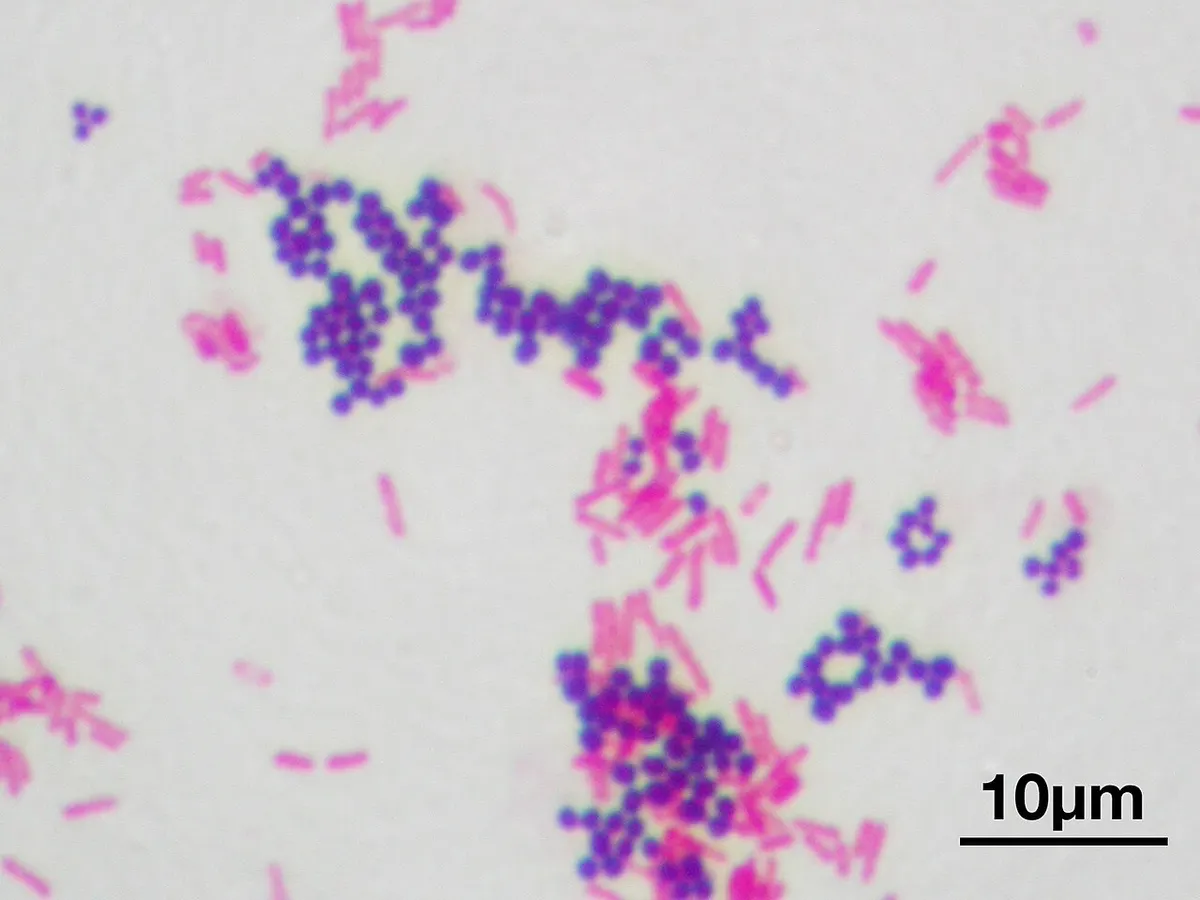
Photo: Y tambe, CC BY-SA 3.0, source. Resized.

Every way of feeding
Prokaryotes feed in more ways than all other organisms put together. Autotrophic bacteria make their own organic substances from carbon dioxide. Photosynthetic ones, such as cyanobacteria, use the energy of light. Chemosynthetic ones take their energy from chemical reactions with inorganic substances, such as hydrogen sulfide or iron compounds, and can live in total darkness.
Heterotrophic bacteria take in ready-made organic substances. Saprophytic ones break down the remains of dead plants and animals. Parasitic ones live at the expense of a living organism, and some cause disease. Others live in symbiosis, to the benefit of both partners.
Respiration differs too. Aerobic bacteria need oxygen; strict anaerobic bacteria are killed by oxygen, like those of the genus Clostridium; others, such as the bacteria in the family of E. coli, live with or without oxygen.
Direct division (binary fission) and a growth curve in four phases
Bacteria multiply by direct division (binary fission): the cell grows, copies its DNA, pinches in at the middle and splits into two identical daughter cells. Amitosis is also called “direct division”, but it divides the nucleus of a eukaryotic cell, without a spindle; a bacterium has no nucleus. Under ideal laboratory conditions, E. coli can double in just 20 minutes; the same species needs whole days in a poor medium.
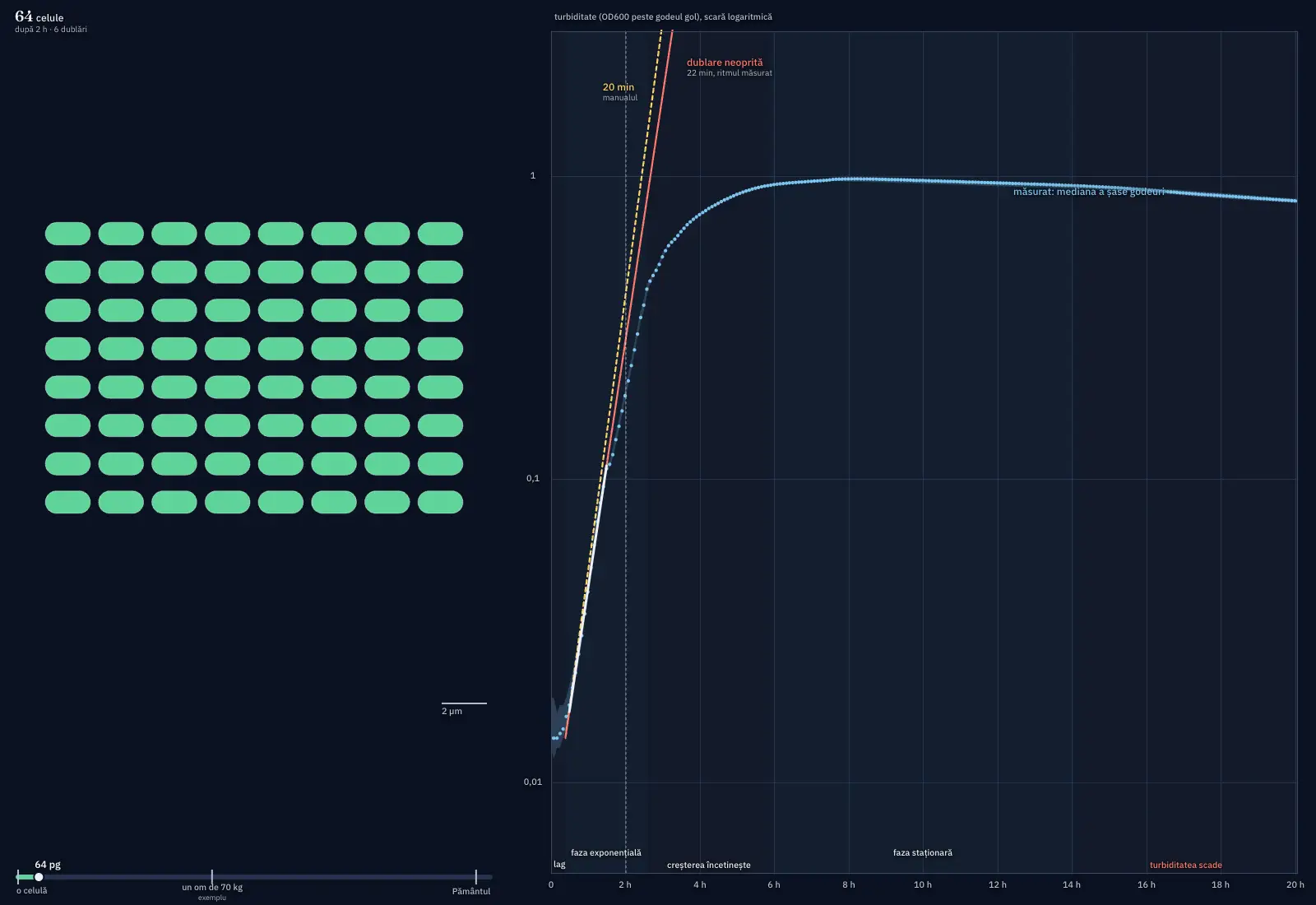
Placed in a dish of food, a culture goes through four phases. In the lag phase, the number of cells does not rise: they are adjusting to the medium. In the exponential phase, the cells divide as fast as they can, and their number doubles with every generation. In the stationary phase, the number of living cells levels off: as many cells form as die. In the decline phase, more die than form.
Growth stops because the food is used up, waste builds up and the oxygen in the medium falls. Some bacteria, Clostridium for example, then form endospores, tough resting forms with a thick coat that survive for years without food or water. An endospore does not multiply the bacterium; one cell makes a single endospore.
| Time | Doublings | Cells | Mass |
|---|---|---|---|
| 0 min | 0 | 1 | 1 pg |
| 20 min | 1 | 2 | 2 pg |
| 40 min | 2 | 4 | 4 pg |
| 1 h | 3 | 8 | 8 pg |
| 2 h | 6 | 64 | 64 pg |
| 4 h | 12 | 4,096 | 4.1 ng |
| 8 h | 24 | 16,777,216 | 16.8 µg |
| 10 h | 30 | 1,073,741,824 | 1.07 mg |
| 18 h 40 min | 56 | 7.2 × 10¹⁶ | 72.1 kg |
| 24 h | 72 | 4.7 × 10²¹ | 4,722 t |
| 44 h 20 min | 133 | 1.1 × 10⁴⁰ | 1.1 × 10²² t |
| Hour | At the start | At the end | Doubling |
|---|---|---|---|
| 0–1 h | 0.014 | 0.043 | 36 min |
| 1–2 h | 0.043 | 0.189 | 30 min |
| 2–3 h | 0.189 | 0.541 | 39 min |
| 3–4 h | 0.541 | 0.746 | 133 min |
| 4–5 h | 0.746 | 0.869 | 272 min |
| 5–6 h | 0.869 | 0.936 | 560 min |
| 6–7 h | 0.936 | 0.960 | over 10 h |
| 7–8 h | 0.960 | 0.978 | over 10 h |
| 8–9 h | 0.978 | 0.974 | no longer grows |
| Phase | Interval |
|---|---|
| lag phase | 0 min – 23 min |
| exponential phase | 23 min – 2 h 34 min |
| growth slows | 2 h 34 min – 5 h 54 min |
| stationary phase | 5 h 54 min – 14 h 4 min |
| turbidity falls | 14 h 4 min – 20 h 4 min |
The fastest hour (29–89 min): a doubling every 22 minutes (the six cultures: between 21.5 and 24.1 min; with a background of 0.084 or 0.088: 22–24 min). The lesson: 20 minutes, in ideal laboratory conditions.
Calculation and measurements. The calculated part: one E. coli cell (about 2 µm long, about 1 pg) that would double every 20 minutes without ever stopping; the rods are an enlarged drawing, with a calculated scale bar. The measured part: the turbidity (OD600) of six cultures of E. coli RU1 in LB broth at 37 °C, read every five minutes (Saxer and colleagues, Dryad, CC0), minus the background: the reading of two wells on the same plates where nothing grew, which is an estimate (with another background, 0.084 or 0.088, the fastest doubling comes out at 22–24 minutes). Turbidity shows how much biomass there is, without telling living cells from dead ones.
Sources and credits. Measured curve: Saxer G. et al. (2015), Data from: Mutations in global regulators lead to metabolic selection during adaptation to complex environments, Dryad, doi:10.5061/dryad.3mj3m, CC0 1.0. Cell size and mass: R. Milo and R. Phillips, Cell Biology by the Numbers (BioNumbers, BNID 101788). Mass of the Earth: NASA Earth Fact Sheet.
From the gut to hot springs
Prokaryotes live wherever there is moisture: in soil, in water, on skin, in the gut. Some are extremophiles: they grow best at 60–80 °C, in acid or in very salty water. Many extremophiles are archaea, but archaea live in every kind of environment, including the ocean and the human gut. No archaeon is known to cause disease.
Without prokaryotes, matter would not return to nature: they break down dead remains, and some, such as the bacteria in the root nodules of beans and clover, fix nitrogen from the air. Bacteria are used to make cheese and yoghurt; only some cause disease.
Worked example
The culture that stops
Sample calculation: one E. coli cell lands in a dish of food, under ideal conditions, doubling every 20 minutes. How many cells are there after two hours, if none die?
Two hours are 120 minutes, that is, 120 ÷ 20 = 6 generations. The number doubles with each generation: 1 → 2 → 4 → 8 → 16 → 32 → 64. Written another way, 2⁶ = 64 cells. The general formula is N = N₀ × 2ⁿ, where N₀ is the starting number and n the number of generations.
If the doubling went on, after 10 hours (30 generations) there would be more than a billion cells from a single one. In the dish, the number levels off: this is the stationary phase. The food has been used up and the waste has piled up.
An activity without cultures: plot the number of cells every 20 minutes for 4 hours, then a second curve that flattens out after 3 hours. The gap between them shows the effect of food running out.
In Romania
Movile Cave, where light never reaches
Movile Cave lies a few kilometres from the Black Sea, near the town of Mangalia. It was discovered in 1986 by Cristian Lascu at the bottom of a shaft dug for geological work. The air deep inside holds only 7–16% oxygen, against 21% at the surface, and a lot of hydrogen sulfide.
Mats of chemosynthetic bacteria grow on the water and the walls. They make their organic substances from carbon dioxide using the energy of hydrogen sulfide and methane, without a single ray of sunlight. The cave’s invertebrates live on what they produce. By 2021, 52 species of invertebrates had been found here, and 37 of them live only in the cave and the groundwater around it.
In 1996 the biologist Șerban Sârbu and his colleagues showed in the journal Science, by analysing carbon and nitrogen isotopes, that these animals’ food comes from chemosynthesis. It was then the only known land ecosystem based on chemosynthesis.
In short
- Bacteria and archaea are prokaryotes: the DNA lies in the nucleoid, with no nuclear membrane; many have plasmids, a capsule and flagella.
- The bacterial cell wall contains peptidoglycan (murein); archaea have no peptidoglycan and have different lipids in their membrane.
- By shape, bacteria are cocci, bacilli, vibrios or spirilla; cocci form diplococci, streptococci and staphylococci.
- Bacteria can be autotrophic (photosynthetic or chemosynthetic) or heterotrophic (saprophytic, parasitic, symbiotic), aerobic or anaerobic.
- Bacteria multiply by direct division (binary fission); a culture goes through the lag, exponential, stationary and decline phases, and growth stops when the food runs out and waste builds up.
- Endospores are resting forms, not a way of multiplying; archaea live both in extreme and in ordinary environments.
Common mistakes
WrongAll bacteria are dangerous.
RightOnly some species cause disease. Most break down dead remains, fix nitrogen or live in the gut without doing harm; some are used to make yoghurt and cheese.
WrongEndospores are how bacteria multiply.
RightBacteria multiply by direct division. One cell forms a single endospore, a resting form that survives without food or water.
WrongArchaea live only in hot springs and salty water.
RightMany extremophiles are archaea, but archaea live in every environment, including the ocean and the human gut. They differ from bacteria in the chemistry of the cell, not in where they live.
Check yourself
Eight questions. For the first seven you see the explanation at once, with the paragraph of the lesson that supports it; for the written ones you compare with a good answer.
Under the microscope you see rods bent like a comma. Which bacterial shape is this?
Answer
c) Vibrios. Vibrios are bent rods. Spirilla are long and twisted, cocci are spheres, and staphylococci are clusters of cocci.
In which phase of the growth curve does the number of living cells stay constant, even though the cells are still dividing?
Answer
c) The stationary phase. In the stationary phase as many cells form as die. In the lag phase the number is also constant, but because the cells are not dividing yet.
The bacteria in Movile Cave make their organic substances from carbon dioxide, in the dark. What is this way of feeding called?
Answer
b) Chemosynthesis. They are autotrophs, but the energy comes from chemical reactions with inorganic substances, not from light.
Which substance in the cell wall sets bacteria apart from archaea?
Answer
c) Peptidoglycan, present in bacteria and absent in archaea. Peptidoglycan (murein) is typical of the bacterial wall. Cellulose is in the wall of plants, chitin in that of fungi, and the nucleoid is not part of the wall.
Sample calculation: a culture starts from 100 cells that double every 20 minutes. How many cells are there after one hour, with no cells dying?
cellsAnswer
800 cells. One hour means three generations: 100 × 2³ = 100 × 8 = 800 cells.
Put the phases of a bacterial culture’s growth curve in the order in which they happen.
Answer
The correct order:
- Lag phase: the cells adjust, the number does not rise
- Exponential phase: the number doubles with every generation
- Stationary phase: the number of living cells stays on a plateau
- Decline phase: more cells die than form
The cells first adjust to the medium, then divide fast; when the food runs out and waste builds up, growth stops, and in the end the population falls.
Choose how each bacterium feeds.
Answer
Autotrophic: A cyanobacterium photosynthesising in a lake; A bacterium from Movile Cave that uses hydrogen sulfide.
Heterotrophic: A bacterium that breaks down dead leaves in the soil; A bacterium that causes a disease in humans; A bacterium living in the root nodules of clover.
Autotrophs make their organic substances from carbon dioxide, with energy from light or from chemical reactions. Saprophytes, parasites and symbionts take in ready-made organic substances.
A yoghurt left open on the table turns sour within a few hours, then its taste hardly changes any more. Using the growth curve, explain what happened to the bacteria in it.
A good answer
At first the bacteria adjusted (the lag phase), then they divided fast, their number rose exponentially and they produced a lot of acid. As the sugar was used up and the acid built up, division slowed down to a plateau, the stationary phase, in which as many cells form as die. That is why the taste hardly changes any more.
A complete answer names the phases in order and links the end of growth to the food being used up and the waste building up.
Practical work for this lesson
- Three microorganisms, three evidence cards – Case study on cards and qualitative observation, 35–40 minutes
Terms
- nucleoid
- The region of the prokaryotic cytoplasm that holds the DNA, without a nuclear membrane.
- plasmid
- A small circular molecule of DNA, separate from the bacterial chromosome.
- chemosynthesis
- Making organic substances from carbon dioxide with energy from chemical reactions with inorganic substances.
- direct division
- Division without a spindle: in bacteria, the whole cell splits into two identical daughter cells (binary fission); in eukaryotes, only the nucleus divides directly (amitosis).
- exponential phase
- The growth phase of a culture in which the number of cells doubles with every generation.
- stationary phase
- The phase in which the number of living cells stays constant, because as many cells form as die.
- endospore
- A tough resting form of some bacteria, with a thick coat, that survives without food or water.
- extremophile
- An organism that grows best in extreme conditions of temperature, acidity or salinity.
Sources and link to the programme
- OpenStax – Microbiology, 9.1 How Microbes Grow – E. coli can double in just 20 minutes under optimal laboratory conditions and needs days in poor media; binary fission; the four phases (lag, log, stationary, decline) and what happens in each; growth stops as food is used up, waste accumulates and oxygen falls
- OpenStax – Microbiology, 3.3 Unique Characteristics of Prokaryotic Cells – cocci, bacilli, vibrios (curved rods), spirilla (long spirals), diplococci, streptococci, staphylococci; nucleoid; small circular plasmids with antibiotic-resistance genes; endospores allow survival without food and water and are not reproductive spores
- OpenStax – Biology 2e, 22.2 Structure of Prokaryotes: Bacteria and Archaea – the bacterial wall with peptidoglycan, the archaeal wall without peptidoglycan, the different membrane lipids of archaea; capsule, flagella, pili, plasmids
- OpenStax – Biology 2e, 4.2 Prokaryotic Cells – diameter of prokaryotic cells: 0.1–5.0 µm
- OpenStax – Biology 2e, 4.3 Eukaryotic Cells – eukaryotic cells are usually 10–100 µm
- OpenStax – Biology 2e, 22.1 Prokaryotic Diversity – fossil traces from about 3.5 billion years ago; prokaryotes cover every moist surface; extremophiles: thermophiles at 60–80 °C, acidophiles, halophiles
- OpenStax – Biology 2e, 22.3 Prokaryotic Metabolism – photoautotrophs, chemolithoautotrophs (energy from inorganic compounds, for example of sulfur or iron), heterotrophs; decomposers; nitrogen fixation by bacteria in legume roots and by cyanobacteria
- OpenStax – Biology 2e, 22.5 Beneficial Prokaryotes – cheese and yoghurt are made with bacteria; rhizobia form nodules on legumes
- OpenStax – Microbiology, 9.2 Oxygen Requirements for Microbial Growth – obligate aerobes, obligate anaerobes killed by oxygen (Clostridium), facultative anaerobes (enterobacteria)
- OpenStax – Microbiology, 4.6 Archaea – archaea are found in every habitat, including the ocean and the human gut; no disease-causing archaea are known; the archaeal wall has no peptidoglycan
- Whitman, Coleman, Wiebe (1998), PNAS – Prokaryotes: the unseen majority – 4–6 × 10³⁰ prokaryotic cells on Earth
- Bar-On, Phillips, Milo (2018), PNAS – The biomass distribution on Earth – plants ≈450 Gt C, bacteria ≈70 Gt C, archaea ≈7 Gt C: prokaryotes hold about a sixth as much carbon as plants
- Sarbu, Kane, Kinkle (1996), Science – A chemoautotrophically based cave ecosystem (rezumat, USF Digital Commons) – chemoautotrophic bacteria fixing carbon with the energy of hydrogen sulfide; carbon and nitrogen isotope analysis shows they are the food base for 48 invertebrate species, 33 endemic; the only known land community based on chemosynthesis
- Vlasceanu, Popa, Kinkle (1997), Applied and Environmental Microbiology – Thiobacillus thioparus LV43 from Peștera Movile – a bacterium isolated from a floating microbial mat in Movile Cave that grows autotrophically by oxidising sulfide and thiosulfate (a concrete example of a chemosynthetic bacterium)
- Brad, Iepure, Sarbu (2021), Diversity 13(3):128 – The Chemoautotrophically Based Movile Cave Groundwater Ecosystem – 52 invertebrate species (21 aquatic, 31 terrestrial), 37 of them endemic to the cave ecosystem and its associated groundwater
- GESS – Movile Cave – discovered in 1986 by Cristian Lascu, at the bottom of a shaft for geological work, near Mangalia; 7–16% oxygen in the air against 21% at the surface; hydrogen sulfide; bacteria that oxidise methane and sulfur; more than 50 invertebrate species, 37 endemic
From the programme: “PROKARYOTES. THE DOMAINS BACTERIA AND ARCHAEA – general features (morphology, nutrition, reproduction), habitats (including extreme environments), importance in ecosystems” (common core). Specific competences addressed: 1.1, 2.1, 2.2.