Chapter 10 · Humans and the biosphereLesson 10.5CS
The carbon footprint: units, boundaries and scenarios
How much CO2 does your journey to school produce, and why does the result depend on what you choose to count?
- Size
- from 6 km to 12,742 km
- Level
- biosphere
- Time
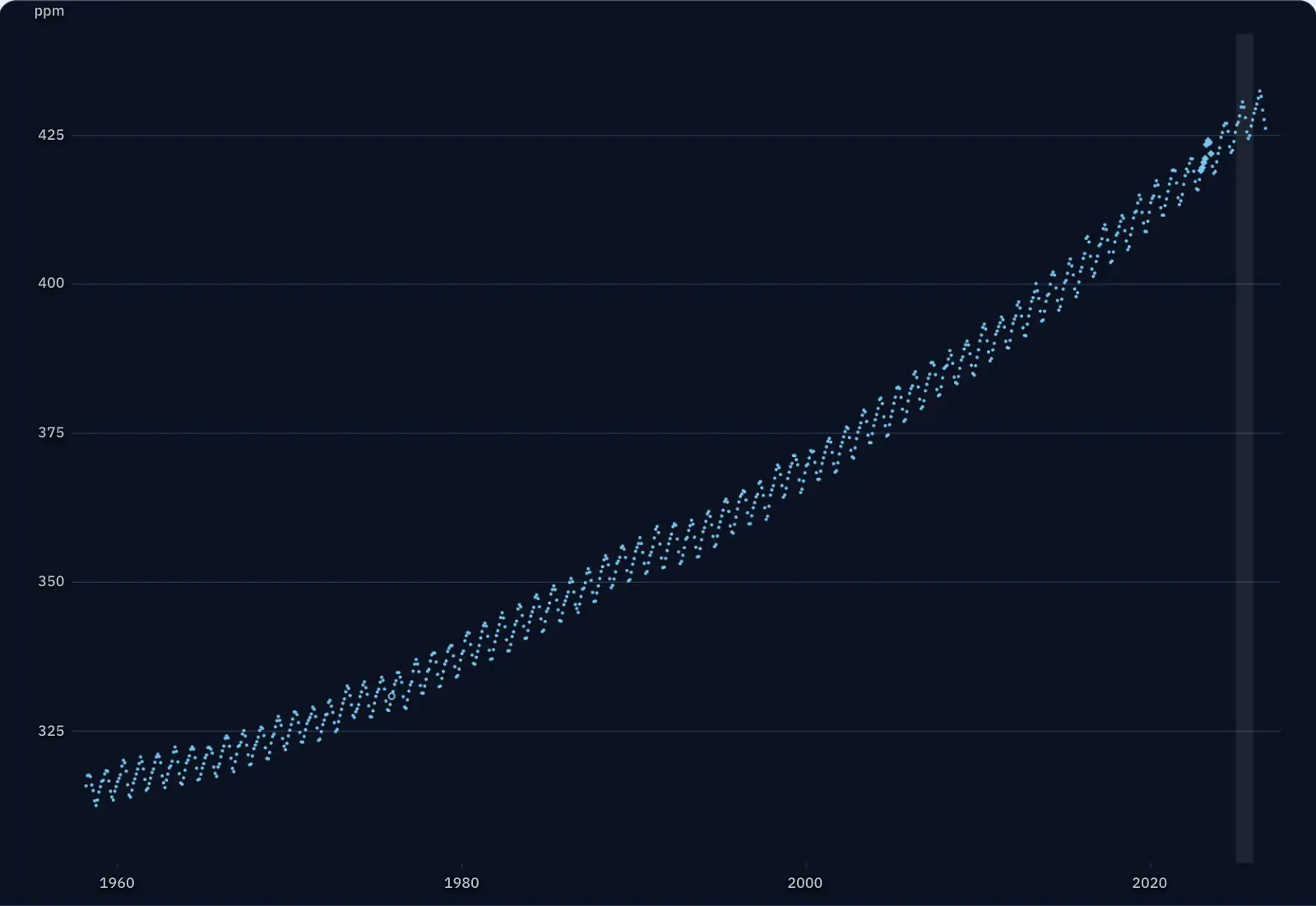
- from 1958 to today
Before you read: what do you think?
How many kilograms of carbon dioxide form when 1 kg of carbon burns completely?
See the answer
About 3.7 kg. Almost every carbon atom (mass 12) bonds with two oxygen atoms (16 + 16) taken from the air, and the CO2 molecule has a mass of 44. The mass increases by a factor of 44 ÷ 12 ≈ 3.67.
Petrol is made mostly of carbon and hydrogen atoms. When it burns in an engine, almost every carbon atom leaves bonded to two oxygen atoms taken from the air, so the mass of carbon dioxide released is greater than the mass of carbon in the petrol. To count emissions correctly, you need to know which unit you are using and what you have included in the calculation.
Three units that do not mix: kg C, kg CO2 and kg CO2e
Kilograms of carbon (kg C) count only the carbon atoms, as in the global carbon budget. Kilograms of CO2 count the whole molecule. The atomic mass of carbon is 12 and that of oxygen 16, so that of CO2 is 44. To go from kg C to kg CO2 you multiply by 44/12 (about 3.67), and the other way you multiply by 12/44.
Methane and nitrous oxide warm more than the same mass of CO2. The global warming potential over 100 years (GWP100) compares 1 kg of a gas with 1 kg of CO2: it shows how many times greater its warming effect is, added up over the first 100 years after it is emitted. According to the IPCC (2021), it is 29.8 for fossil methane, 27.0 for methane of other origin, for example from cows or rice paddies, and 273 for nitrous oxide. The result is given in kg CO2 equivalent (kg CO2e): 1 kg of methane from cows means 27.0 kg CO2e. The 44/12 ratio does not apply to methane.
The carbon footprint of a person, a product or an activity is the total of the greenhouse gases emitted because of it, in kg CO2e.
The boundary and the emission factors decide the result
The boundary says what goes into the calculation: only the gases from the exhaust pipe, or also the extraction and refining of the fuel, the making of the car, the roads. A calculation over the whole life cycle covers production, transport, use and disposal. Two options can be compared only with the same boundary.
An emission factor says how many kg CO2e correspond to one unit of activity: a kilometre, a kilowatt-hour, a kilogram of product. Factors differ from one country to another and from one year to the next, which is why each is quoted with its source, year and boundary. In 2025, according to Ember data, over the life cycle, a kilowatt-hour produced in Romania came with on average about 258 g CO2e, in Poland 591 g, and in France 41 g.
For example, a 2 kW electric heater left on for three hours uses 6 kWh. With Romania’s 2025 factor, the emissions are 6 × 0.258 ≈ 1.55 kg CO2e.
How to compare two scenarios
A scenario is a calculated version of an activity. The comparison starts from the baseline, that is, what would happen with no change, and a new option that provides the same service: the same journey, the same number of pupils carried, the same year.
The result depends on the assumptions. A factor for a car is given per vehicle kilometre, and one for a bus per passenger kilometre. To compare them, you divide the car’s emissions by the number of people in it. If an assumption changes the conclusion, it has to be stated next to the result.
Worked example
The journey to school over a year
The school is 6 km from home. There and back, for 180 days, that makes 2 × 6 × 180 = 2,160 km a year.
The emission factors are those published by the British government in 2026 for the UK fleet, for exhaust gases only: average petrol car, 0.16152 kg CO2e per vehicle kilometre; average local bus, 0.10151 kg CO2e per passenger kilometre.
By car, with a single pupil: 2,160 × 0.16152 ≈ 349 kg CO2e. By bus: 2,160 × 0.10151 ≈ 219 kg CO2e. If the car takes three pupils to the same school, each one’s share is 349 ÷ 3 ≈ 116 kg CO2e, less than by bus.
The conclusion depends on how many people are in the car and on the bus. The British factors do not describe a car or a bus in Romania exactly; a calculation for a Romanian town would need factors for the local fleet.
In Romania
5 tonnes of CO2e per person and electricity mostly free of fossil fuels
According to Eurostat, in 2024 Romania emitted 95.6 million tonnes of CO2e without the forests and land-use sector, or 5.0 tonnes per person. Counting the carbon taken up in that sector as well, mostly by forests, the figure falls to 3.4 tonnes per person. The same data give about 6.7 tonnes per person for the European Union. Burning fuel in transport produced 22.7 million tonnes of CO2e, and generating electricity and heat, 9.6 million tonnes of CO2e.
In 2025, according to Ember, 24.3% of Romania’s electricity came from hydropower plants, 20.5% from nuclear power, 17.0% from natural gas, 15.2% from coal, 12.0% from wind and 10.0% from solar panels.
In short
- Kilograms of carbon (kg C) count the carbon atoms; kilograms of CO2 count the whole molecule; to go from kg C to kg CO2 you multiply by 44/12.
- CO2 equivalent (CO2e) adds up different gases according to their global warming potential: according to the IPCC (2021), GWP100 is 29.8 for fossil methane, 27.0 for methane of other origin and 273 for nitrous oxide.
- The carbon footprint is the total of the greenhouse gases emitted because of a person, a product or an activity, in kg CO2e.
- The boundary says which stages go into the calculation; two scenarios are compared with the same boundary, for the same service and with emission factors quoted with source and year.
- In 2024 Romania emitted 5.0 tonnes of CO2e per person without the forests sector, and in 2025 a kWh produced in Romania came with about 258 g CO2e over the life cycle.
Common mistakes
WrongA tonne of carbon is the same thing as a tonne of CO2.
RightA tonne of carbon corresponds to 44/12 ≈ 3.67 tonnes of CO2, because the molecule also includes two oxygen atoms.
WrongMethane is converted to CO2e by multiplying by 44/12 as well.
RightThe 44/12 ratio is a chemical conversion for the carbon in CO2. For CO2e, the mass of methane is multiplied by its global warming potential, for example 27.0 for methane from animals.
WrongAn electric car or a tablet has zero emissions.
RightWhile in use they have no exhaust, but their electricity and their manufacture have emissions. A correct calculation includes them for both options, with the same boundary.
Check yourself
Seven questions. For the first six you see the explanation at once, with the paragraph of the lesson that supports it; for the written ones you compare with a good answer.
The global carbon budget gives emissions in Gt C. How do you convert them to Gt CO2?
Answer
b) Multiply by 44/12. The CO2 molecule has a mass of 44, the carbon atom 12; the mass increases by a factor of 44/12.
A farm emits 10 kg of methane from cows. How do you work out the emission in kg CO2e?
Answer
b) 10 × 27.0. Methane from animals is not fossil: GWP100 = 27.0 according to the IPCC (2021). The 44/12 ratio does not apply to methane.
A pupil compares the emissions of a petrol car, counting only the exhaust, with the emissions of an electric car, counting the making of the battery and the electricity. What is wrong?
Answer
b) Two different boundaries were used. Two options are compared with the same boundary: either use alone, or the whole life cycle, for both.
Why can you not compare 0.16152 kg CO2e/km for a car directly with 0.10151 kg CO2e/km for a bus?
Answer
a) The first is per vehicle kilometre, the second per passenger kilometre. The car’s emissions have to be divided by the number of people in it to give a figure per passenger.
How many kilograms of CO2 form from the complete burning of 6 kg of carbon?
kg CO2Answer
22 kg CO2. 6 × 44 ÷ 12 = 22 kg CO2.
A pupil travels 1,800 km a year by bus. Using the 2026 British factor for the average local bus, 0.10151 kg CO2e per passenger kilometre, how many kg CO2e is the pupil’s share? Round to a whole number.
kg CO2eAnswer
183 kg CO2e. 1,800 × 0.10151 = 182.7, or about 183 kg CO2e, from the exhaust only.
A school wants to find out whether switching from a diesel school bus to an electric one cuts emissions. What data does it need, and what boundary would it choose?
A good answer
It needs the distance travelled per year, the number of pupils carried, the diesel consumption and its emission factor, the electricity consumption of the electric bus and the factor for Romania’s grid for that year, each with its source. The boundary must be the same for both: either use together with the production of the energy (the extraction and refining of the diesel, the generation of the electricity), or the whole life cycle, with the making of the vehicles and the battery spread over the years of use.
A complete answer names the activity (km, pupils), emission factors quoted with source and year, the same boundary for both options and the baseline.
Practical work for this lesson
- What saving is left once you do the accounting? – A worked classroom calculation, without a personal footprint calculator, 40–50 minutes (CS)
Terms
- carbon footprint
- The total of the greenhouse gases emitted because of a person, a product or an activity, expressed in kg CO2e.
- global warming potential
- How many times greater the warming effect of emitting 1 kg of a gas is than that of emitting 1 kg of CO2, added up over a chosen period, usually 100 years (GWP100).
- CO2 equivalent
- The mass of CO2 that would have the same warming effect, added up over 100 years, as a given amount of another greenhouse gas.
- emission factor
- The amount of greenhouse gases, in kg CO2e, that corresponds to one unit of activity (km, kWh, kg).
- life cycle
- All the stages of a product: obtaining the raw materials, manufacture, transport, use and disposal or recycling.
- scenario
- A calculated version of an activity, compared with the baseline.
Sources and link to the programme
- IPCC AR6 WGI (2021) – Chapter 7, Table 7.15 – GWP100: fossil CH4 29.8; non-fossil CH4 27.0; N2O 273
- UK DESNZ – Greenhouse gas reporting: conversion factors 2026 (version 1.2) – average petrol car 0.16152 kg CO2e per vehicle km (Scope 1, exhaust); average local bus 0.10151 kg CO2e per passenger km; GWP from AR4/AR5 (2026 methodology paper); WTT factors, separate (car 0.04599, bus 0.02649 kg CO2e/km)
- Ember – Yearly electricity data (updated 2 November 2026, CC BY 4.0) – Romania 2025: intensity 258.43 g CO2e/kWh; hydro 24.3%, nuclear 20.5%, gas 17.0%, coal 15.2%, wind 12.0%, solar 10.0%; Poland 590.8 g; France 41.2 g; EU 211.0 g CO2e/kWh
- Ember – Electricity Data Methodology – Ember’s intensities are over the life cycle, with all gases in CO2e over 100 years
- Eurostat – Domestic net greenhouse gas emissions (sdg_13_10), updated 22 April 2026 – Romania 2024: 5.0 t CO2e per person without LULUCF, 3.4 t with LULUCF; 95.6 Mt CO2e
- Eurostat – Greenhouse gas emissions by source sector (env_air_gge), updated 2 June 2026 – Romania 2024: transport 22.71 Mt, electricity and heat 9.59 Mt CO2e; land use, land-use change and forestry (LULUCF) −31.01 Mt, of which forest land −24.55 Mt; EU 2024: 3,017.19 Mt CO2e without LULUCF
- Eurostat – Population change, demographic balance (demo_gind) – average EU population in 2024: 450,669,521 (for working out ~6.7 t CO2e per person)
- IPCC AR6 WGI (2021) – Annex VII: Glossary – the definition of GWP: the radiative forcing after the emission of a unit mass of a substance, added up over a chosen period, relative to that of CO2
From the programme: “The influence of human activities on the natural carbon cycle. The carbon footprint. The greenhouse effect” (specialism, Natural Sciences). Specific competences addressed: 2.1, 3.2, 4.2.