Chapter 4 · Membrane, osmosis, divisionLesson 4.5CS
The cell cycle, amitosis and mitosis: from interphase to two daughter cells
Under the microscope, in an onion root tip, most cells seem to be doing nothing. What is happening inside them, and why do only a few show chromosomes?
- Size
- from 10 nm to 100 µm
- Level
- membrane and cell
- Time
- minutes and hours
Before you read: what do you think?
The classic textbook example is a human cell grown in the laboratory, with a 24-hour cycle. How long does the M phase, that is mitosis and cytokinesis, take?
See the answer
About half an hour. The remaining 23 and a half hours are interphase: G1 lasts around 9 hours, S around 10 hours, G2 around 4 and a half hours. That is why, under the microscope, most cells are in interphase.
In a slide of root tips from onions grown in drinking water, researchers at the University of Pitești, in Romania, found only 7.64% of the cells dividing. The rest, more than nine in ten, were in interphase. Division is the short, visible part of a cycle that lasts much longer.
The cell cycle: interphase takes up almost all the time
The cell cycle is the sequence of stages a cell goes through from its formation to its own division. It has two parts: interphase and division.
Interphase is the period between two divisions, and it has three stages. In G1, the cell grows and makes proteins and organelles. In S, DNA replication takes place: every DNA molecule is copied, and the centrosome is duplicated. In G2, the cell makes the proteins it needs for division. Then comes the M phase: mitosis, followed by the division of the cytoplasm.
In the classic textbook example, a human cell grown in the laboratory with a 24-hour cycle, G1 lasts about 9 hours, S 10 hours, G2 4 and a half hours, and the M phase half an hour. Some cells leave the cycle for a state called G0: mature neurons stay there permanently, and heart muscle cells almost permanently, because they divide very rarely. The passage from one stage to the next is controlled; when that control breaks down, cells can divide without stopping, as in cancer.
Counting chromosomes and DNA molecules
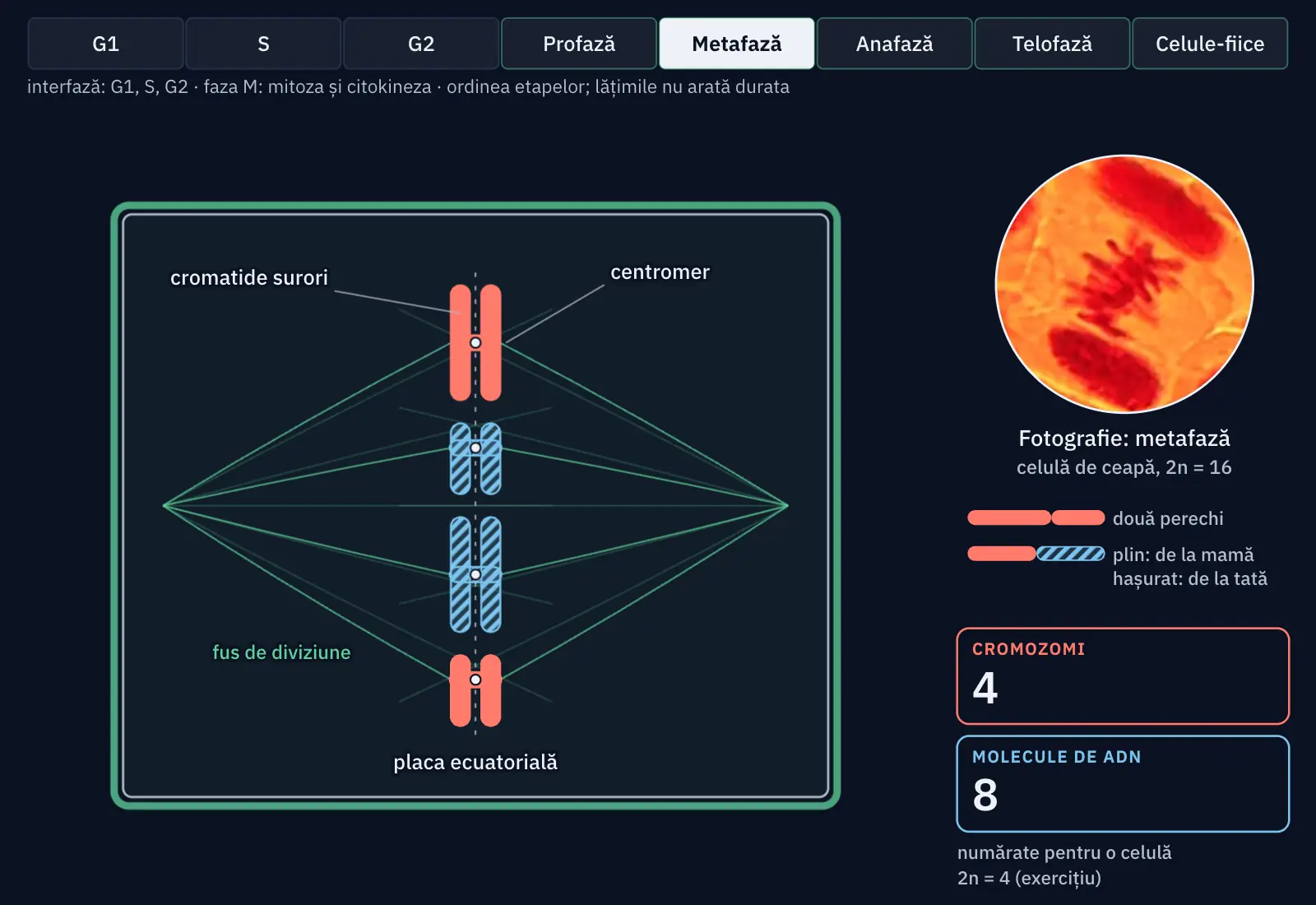
After the S phase, each chromosome has two sister chromatids joined at the centromere. It is still a single chromosome, but with two DNA molecules. Only in anaphase, when the chromatids separate, does each one become a chromosome.
In humans (2n = 46): in G1, 46 chromosomes and 46 DNA molecules; in G2 and in metaphase, 46 chromosomes and 92 DNA molecules; in anaphase, in the still undivided cell, 92 chromosomes and 92 DNA molecules; in each daughter cell, 46 chromosomes and 46 DNA molecules.
In the onion (2n = 16), the same stages give 16 and 16, then 16 and 32, 32 and 32 in anaphase, and each daughter cell has 16 chromosomes and 16 DNA molecules. The 92 chromosomes of anaphase are a passing state of a single cell, before it becomes two.
The phases of mitosis
Strictly speaking, mitosis is the division of the nucleus; together with the division of the cytoplasm, it produces the two daughter cells. Mitosis has four phases. In prophase, the chromosomes condense and become visible, the nuclear envelope breaks down, and microtubules form the spindle. In an animal cell, the two centrosomes move apart towards the poles.
In metaphase, spindle fibres attach to the centromere of each chromosome, and the chromosomes line up on the equatorial plate (the metaphase plate), across the middle of the cell. This is the phase in which chromosomes are easiest to count. In anaphase, the sister chromatids separate at the centromere and are pulled towards opposite poles. In telophase, the chromosomes decondense, a nuclear envelope re-forms around each set, and the spindle disappears.
The division of the cytoplasm is called cytokinesis. In an animal cell, a ring of proteins tightens the membrane around the middle and forms a furrow that pinches it in two. In a plant cell, the rigid wall does not allow pinching: vesicles from the Golgi apparatus fuse in the middle into a cell plate, from which the new wall forms.
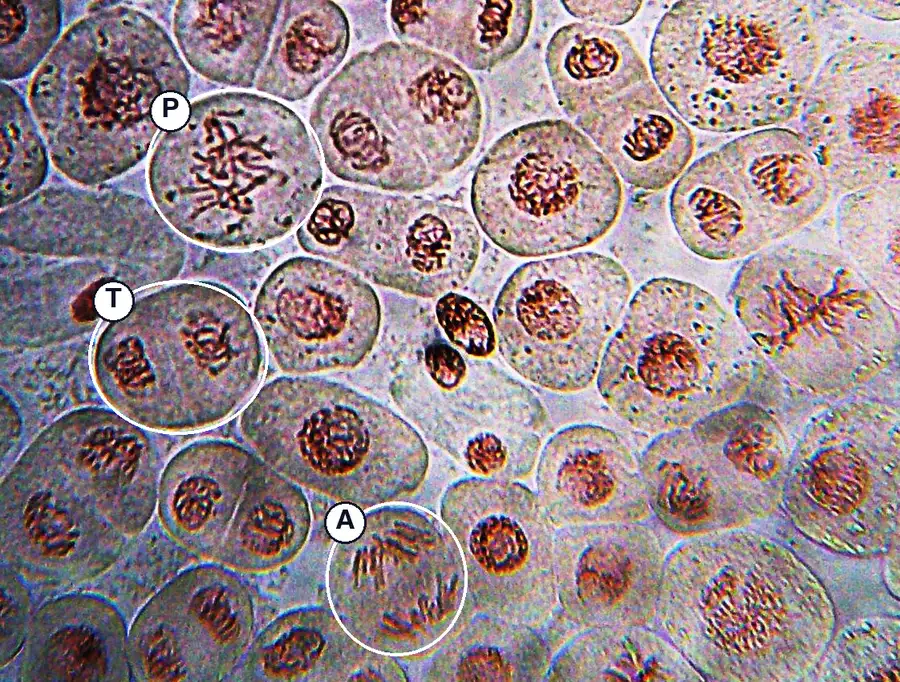
Photo: staticd, CC BY-SA 3.0, source. Cropped, resized, with the circles and the letters P, T and A added.

| Stage | What is seen | 2n = 4: chromosomes / DNA molecules | Human, 2n = 46: chromosomes / DNA molecules | Counted for |
|---|---|---|---|---|
| G1 | chromatin in the nucleus; one chromosome, one DNA molecule | 4 / 4 | 46 / 46 | one cell |
| S | DNA replication, at many places at once | 4 / 4→8, no fixed number | 46 / 46→92, no fixed number | one cell |
| G2 | each chromosome has two sister chromatids joined at the centromere | 4 / 8 | 46 / 92 | one cell |
| Prophase | chromosomes condense; the nuclear envelope breaks down; the spindle forms | 4 / 8 | 46 / 92 | one cell |
| Metaphase | chromosomes on the equatorial plate, attached to the spindle at the centromere | 4 / 8 | 46 / 92 | one cell |
| Anaphase | sister chromatids separate and move towards the poles | 8 / 8 | 92 / 92 | the whole cell, still undivided |
| Telophase | new nuclear envelopes; furrow (animal cell) or cell plate (plant cell) | 8 / 8 | 92 / 92 | the whole cell, still undivided |
| Daughter cells | two daughter cells, each with a complete set | 4 / 4 | 46 / 46 | each daughter cell |
In telophase the cell has not yet divided; each new nucleus has 4 chromosomes and 4 DNA molecules (human: 46 and 46). Typical durations, human cells in culture: G1 9 hours, S 10 hours, G2 4.5 hours, M phase 0.5 hours.
Diagram and photograph. The cell is a drawing with 2n = 4: two pairs of homologous chromosomes, one long and one short, with the copy from the mother solid and the one from the father hatched. The counters come from the same calculation as the table; for humans (2n = 46) only the numbers change. The band at the top shows the order of the stages, not their duration; the “Show typical durations” button displays the durations for rapidly dividing human cells in culture, with a cycle of 24 hours (OpenStax Biology 2e). The photographs are real: onion cells (2n = 16), with the phases identified by the author of the photographs; the images are cropped from “Mitosis in yellow onion cells”, Pixelmaniac pictures, Wikimedia Commons, CC BY-SA 3.0; no scale bar.
Amitosis: direct division of the nucleus
Amitosis is the direct division of the nucleus: with no condensing of chromosomes and no spindle. The genetic material splits into two masses, and the daughter cells can receive unequal amounts of DNA.
The best-studied example is the macronucleus of ciliates such as Paramecium and Tetrahymena. The macronucleus has small chromosomes without centromeres, present in many copies, which are shared out at random between the two daughter nuclei. Textbooks also use ‘direct division’ for the way bacteria reproduce, binary fission, but the processes differ: amitosis divides the nucleus of a eukaryotic cell, while a bacterium, which has no nucleus, copies its circular chromosome and splits in two as a whole.
Worked example
The mitotic index of a root tip
On a slide of an onion root tip, 1,000 cells are counted: 924 in interphase, 40 in prophase, 14 in metaphase, 10 in anaphase and 12 in telophase.
The mitotic index is the percentage of cells that are dividing: (40 + 14 + 10 + 12) ÷ 1,000 × 100 = 76 ÷ 1,000 × 100 = 7.6%.
The cells do not all divide at once, so the percentage of cells in a phase shows what share of the cycle that phase takes up. Here 92.4% of the cells are in interphase, so interphase takes up most of the cycle. Among the dividing cells, prophase has the most, 40 out of 76, so it is the longest phase of mitosis.
The numbers are a worked example, close to the value measured at Pitești (7.64%).
In Romania
Onions that test the water of the Argeș
In April 2016, researchers from the University of Pitești took water from the Argeș river at seven sites, from above the Vidraru dam down to Pitești’s sewage treatment plant. They grew onion roots (Allium cepa, 2n = 16) in it for 72 hours, then counted about 3,000 cells under the microscope for each sample.
In the drinking water used as the control, the mitotic index was the highest, 7.64%. The samples taken above Pitești and upstream of the treatment plant had the lowest values. The sample from downstream of the plant, at 6.2%, did not differ significantly from the control.
In the river water, many cells stayed stuck in metaphase: up to 42.79% of the dividing cells, in one of the samples. The chromosomes had lined up but were no longer separating, a sign that substances in the water could interfere with the working of the spindle.
In short
- The cell cycle consists of interphase (G1, S, G2) and the M phase; DNA replication happens in the S phase.
- After replication, each chromosome has two sister chromatids joined at the centromere; the chromatids become separate chromosomes only in anaphase.
- In humans, a cell has 46 chromosomes and 46 DNA molecules in G1, 46 chromosomes and 92 molecules in G2 and metaphase, 92 and 92 in anaphase, and each daughter cell has 46 and 46.
- Mitosis has four phases: prophase (chromosomes condense, the spindle forms), metaphase (the equatorial plate), anaphase (chromatids separate), telophase (the nuclei re-form).
- Cytokinesis happens by pinching in an animal cell and by a cell plate in a plant cell.
- Amitosis is the direct division of the nucleus, without condensed chromosomes and without a spindle, as in the macronucleus of ciliates.
Common mistakes
WrongDNA replication in the S phase doubles the number of chromosomes.
RightReplication doubles the number of DNA molecules. The number of chromosomes stays the same, because the two sister chromatids stay joined at the centromere until anaphase.
WrongIn interphase the cell is resting.
RightIn interphase the cell grows, makes proteins and organelles and copies its DNA. It is the busiest period of the cycle, but the chromosomes cannot be seen, because they are not condensed.
WrongA plant cell splits in two the same way as an animal cell, by pinching.
RightThe rigid cell wall does not allow pinching. In plants, a cell plate forms between the two nuclei, and the new wall grows from it.
Check yourself
Seven questions. For the first six you see the explanation at once, with the paragraph of the lesson that supports it; for the written ones you compare with a good answer.
At which stage of the cell cycle is DNA copied?
Answer
b) In S. DNA replication happens in the S phase of interphase. In metaphase the chromosomes are already duplicated and lined up.
An organism has 2n = 4. How many DNA molecules does one of its cells have in G2?
moleculesAnswer
8 molecules. In G2 each of the 4 chromosomes has two chromatids, each with one DNA molecule: 4 × 2 = 8. The number of chromosomes is still 4.
How many chromosomes do you count in a human cell in anaphase, before cytokinesis?
Answer
c) 92. In anaphase the sister chromatids have separated and each one is a chromosome: 2 × 46 = 92 in the still undivided cell. Each daughter cell will have 46.
Put the events in order, starting with interphase.
Answer
The correct order:
- DNA is copied, and each chromosome gains two chromatids
- The chromosomes condense and the spindle forms
- The chromosomes line up on the equatorial plate
- The sister chromatids separate and move towards the poles
- A nuclear envelope re-forms around each set of chromosomes
- The cytoplasm divides, giving two cells
The S phase, then prophase, metaphase, anaphase, telophase and cytokinesis.
In onion root tips grown in water from one of the Argeș samples, many cells stayed in metaphase. Which process was most probably being blocked?
Answer
b) The working of the spindle. In metaphase the chromosomes are already copied and lined up. If they do not move on to anaphase, what fails to happen is their separation by the spindle.
How does amitosis differ from mitosis?
Answer
b) In amitosis the chromosomes do not condense and no spindle forms. Amitosis divides the nucleus directly, into two masses, with no visible chromosomes and no spindle. Bacteria have no nucleus: they reproduce by binary fission, also a direct division, but of the whole prokaryotic cell.
A pupil says: ‘In anaphase a human cell has 92 chromosomes, so it becomes a cell with double the number of chromosomes, like another species.’ Explain why the pupil is wrong.
A good answer
In anaphase the sister chromatids, which were copies of the same chromosome, separate and each one is counted as a chromosome, so the still undivided cell holds 92. This state lasts only until cytokinesis. A set of 46 chromosomes moves to each pole, and each daughter cell still has 46 chromosomes, like the parent cell.
A complete answer says what separates in anaphase, why the number rises temporarily and how many chromosomes end up in each daughter cell.
Terms
- cell cycle
- The sequence of stages a cell goes through from its formation to its own division: interphase and the M phase.
- interphase
- The period between two divisions, with the stages G1, S and G2, in which the cell grows and copies its DNA.
- DNA replication
- The copying of DNA molecules, in the S phase of interphase.
- spindle
- A set of microtubules that attach to the centromeres and pull the chromatids towards the poles of the cell.
- equatorial plate
- The plane across the middle of the cell on which the chromosomes line up in metaphase.
- cytokinesis
- The division of the cytoplasm at the end of cell division, which produces two cells.
- amitosis
- The direct division of the nucleus, with no condensing of chromosomes and no spindle.
- mitotic index
- The percentage of cells on a slide that are dividing.
Sources and link to the programme
- OpenStax – Biology 2e, 10.2 The Cell Cycle – interphase (G1, S, G2), DNA replication and centrosome duplication in S; sister chromatids joined at the centromere; prophase, metaphase (the metaphase plate), anaphase, telophase; cytokinesis by a contractile ring in animals and by a cell plate from Golgi vesicles in plants; G0, neurons and heart muscle cells
- OpenStax – Biology 2e, 10.3 Control of the Cell Cycle – the 24-hour cycle of human cells: G1 about 9 hours, S 10 hours, G2 4 and a half hours, M half an hour
- OpenStax – Biology 2e, 10.4 Cancer and the Cell Cycle – cancer as uncontrolled division, when control of the cell cycle breaks down
- OpenStax – Biology 2e, 10.1 Cell Division – human somatic cells have 46 chromosomes
- Șuțan N. A., Blănaru R. G., Șuțan C. (2018) – Cytogenotoxic potential of surface water – a case study of Argeș River, Romania, Current Trends in Natural Sciences 7(13): 312–318 – Allium cepa 2n = 16; samples from April 2016, seven sites from upstream of Vidraru to the Pitești treatment plant; roots grown for 72 hours; about 3,000 cells per sample; mitotic index 7.64% in the control, 6.2% downstream of the treatment plant; metaphases up to 42.79%; possible spindle malfunction
- Cervantes M. D. et al. (2006) – The condensin complex is essential for amitotic segregation of bulk chromosomes, but not nucleoli, in the ciliate Tetrahymena thermophila, Molecular and Cellular Biology – the Tetrahymena macronucleus has fragmented, amplified chromosomes without centromeres and divides by amitosis, with random segregation and no chromatin condensation
- Rzeszutek I., Maurer-Alcalá X. X., Nowacki M. (2020) – Programmed genome rearrangements in ciliates, Cellular and Molecular Life Sciences – ciliate macronuclei divide amitotically, with no spindle and no chromatin condensation, and the daughter nuclei can receive unequal amounts of DNA
- Bergmann O. et al. (2009) – Evidence for cardiomyocyte renewal in humans, Science 324 (PMC) – heart muscle cells are renewed very slowly in humans: about 1% a year at age 20, 0.3% a year at age 75
From the programme: “The cell cycle. Amitosis and mitosis” (specialism, Natural Sciences). Specific competences addressed: 2.1, 2.2, 4.1.