Chapter 5 · Levels of organisationLesson 5.1
Levels of integration: from cell to organism, in plants and in humans
A beech leaf is made of cells. Why could a single leaf cell, however large, never do everything the leaf does?
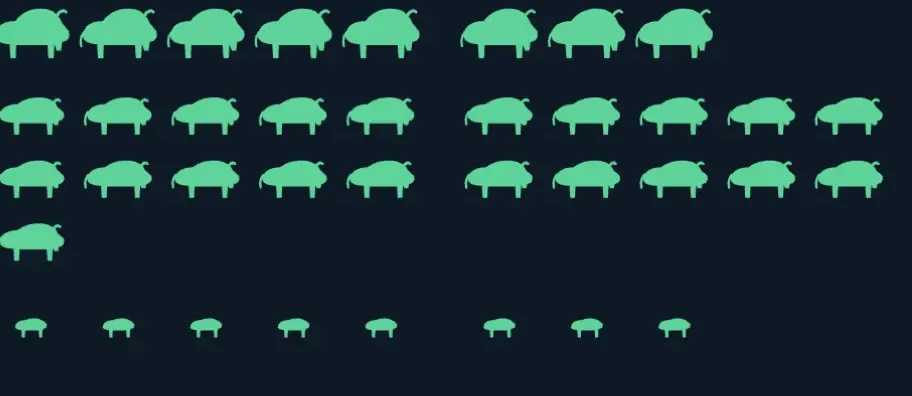
- Size
- from 10 µm to 20 km
- Level
- from tissue to ecosystem
- Time
- a season
Before you read: what do you think?
An adult human body has around 30,000 billion cells. Which kind of cell is the most numerous?
See the answer
Red blood cells: about 84% of all the cells in the body, according to a calculation published in 2016. They are small cells with no nucleus, specialised for a single job, carrying oxygen, and they belong to a liquid tissue, the blood.
Hold a beech leaf up to the window and you see the veins, paler threads branching out from the middle of the leaf. Under the microscope, the same leaf shows several layers of cells, and the cells of each layer have their own shape. The leaf works because these layers are arranged and connected in a particular way, and each does part of the work.
An organism can be a single cell
The paramecium in pond water, the amoeba and the yeast in bread dough are unicellular organisms: a single cell feeds, respires, gets rid of its waste and reproduces; the paramecium and the amoeba also move about. Inside, the cell has parts with different jobs, called organelles (nucleus, mitochondria, vacuoles), but it has no tissues and no organs. A mitochondrion is an organelle, a part of one cell; it is not a miniature organ.
A multicellular organism is made of many cells with different jobs. A specialised cell, such as a heart muscle cell, can no longer live on its own in nature: it depends on the body’s other cells for food and oxygen.
Between the two sit colonies, groups of cells that live stuck to one another. Green algae of the genus Volvox form spheres that float in fresh water. In Volvox carteri, one sphere has about 2,000 small cells with flagella, which move the sphere towards the light, and around 16 large cells that give rise to new spheres. The small cells can no longer divide and die after a few days: the work is already shared out, as in a multicellular organism.
Five levels, from cell to organism
In a multicellular organism, cells are grouped into steps called levels of integration. Each level is built from the elements of the level below.
A tissue is a group of cells similar in shape and origin, together with the substance between them, that carry out the same function. The cells of a tissue need not be identical; what matters is that they work together. An organ is a part of the body with a definite shape and place, made of several tissues: the leaf, the root, the heart, the stomach. An organ system, called an aparat (apparatus) in many Romanian textbooks, brings together the organs that jointly carry out one major function of the body: digestion, circulation, breathing. All the systems, linked to one another, make up the organism.
At each level new properties appear that the level below does not have. A heart muscle cell contracts, but only the whole heart, with its tissues arranged into chambers and valves, pushes blood in one direction. The new properties come from the way the parts are arranged and connected.
Plant and animal tissues, in brief
In plants, meristematic tissues (growth tissues) have cells that keep dividing; they sit at the tips of the root and the stem. They give rise to the permanent tissues: protective (the epidermis), ground (photosynthetic tissue, or mesophyll, with chloroplasts, and storage tissue, as in a potato tuber), conducting (xylem, which carries water and mineral salts upwards, and phloem, which carries sap with sugars), mechanical (supporting) and secretory.
Animals and humans have four types of tissue. Epithelial tissue covers the body and lines hollow organs on the inside; glands also form from it. Connective tissue binds and supports; bone, cartilage and blood are connective tissues. Muscle tissue contracts and comes in three kinds: striated (the skeletal muscles), smooth (the walls of the stomach and of blood vessels) and cardiac. Nervous tissue, with its neurons and glial cells, receives and transmits information.
The leaf and the heart, level by level
The leaf is an organ. On its surface is the epidermis, covered by a waxy layer, the cuticle; the epidermis of the lower side carries the stomata, openings through which carbon dioxide enters and water vapour leaves. Beneath the upper epidermis lies the palisade mesophyll, with elongated cells full of chloroplasts, and below it the spongy mesophyll, with air-filled spaces. The veins are bundles of xylem and phloem. In flowering plants, the root, stem and leaf are vegetative organs, which feed the plant, while the flower, fruit and seed are reproductive organs. The leaves, together with the stem, make up the shoot system; the roots make up the root system. The two systems form the plant.
The heart is an organ too. Its wall is made mostly of cardiac muscle tissue, lined on the inside by an epithelial tissue; connective tissue forms the valves and the outer coverings, and nervous tissue adjusts its rate. The heart, with the blood vessels and the blood, forms the circulatory system. An adult human body has around 30,000 billion cells, organised into these four types of tissue.
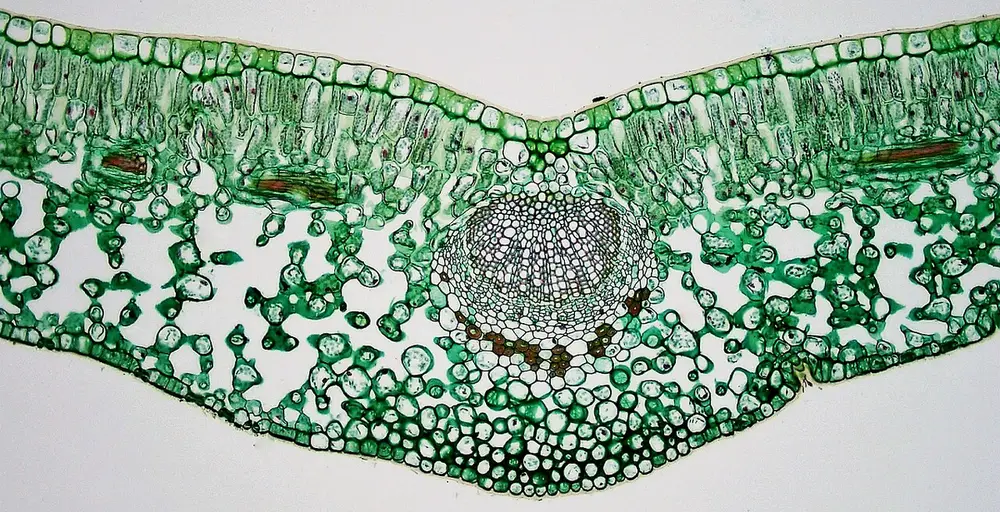
Photo: Berkshire Community College Bioscience Image Library, CC0, source. Cropped and resized.

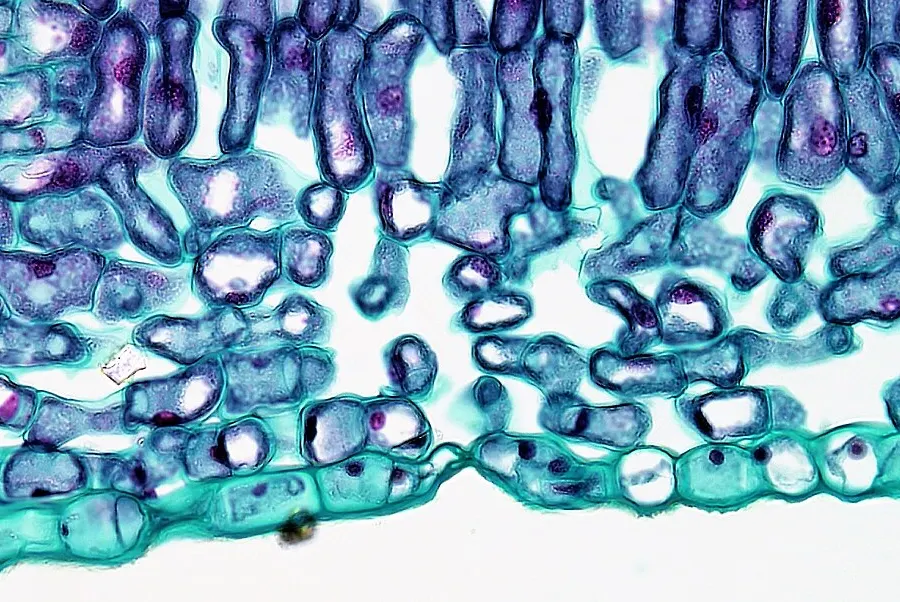
Photo: Berkshire Community College Bioscience Image Library, CC0, source. Cropped.

Worked example
Which level does each belong to?
The list to place: a mitochondrion, a palisade cell, the palisade mesophyll, a beech leaf, the whole beech tree.
The mitochondrion is a part inside the cell, so it is an organelle: it sits below the level of the cell. The palisade cell is a cell. All the palisade cells in a leaf, with the same role, form a tissue. The leaf has several tissues (epidermis, photosynthetic tissue, xylem and phloem), so it is an organ. The whole beech tree is the organism.
Size is not the rule here. A leaf and a mitochondrion differ in what they are made of: the leaf is made of tissues, the mitochondrion is part of a single cell.
Try it in a lab lesson: with tweezers, peel the thin skin from the inner face of an onion scale and look at it under the microscope. You see a single layer of cells pressed against one another: a protective tissue, the epidermis.
In Romania
The beech, the tree with the most wood
According to Romania’s National Forest Inventory (second cycle, measurements from 2013–2018), beech alone accounts for about 37% of the timber volume in Romania’s forests, more than all the conifers put together, which account for about 32%.
A beech forest shows you every level at a glance. A beech tree is an organism. Each of its leaves is an organ, with epidermis, photosynthetic tissue and veins, and the palisade cells in one leaf make up a tissue. The roots, which take water from the soil, and the leaves, which lose it through their stomata, are connected by the xylem of the trunk. If the wind snaps off a branch, its leaves wilt, even though at first their cells are still alive: cut off from the rest of the plant, the organ no longer receives water. The levels depend on one another.
In short
- A unicellular organism is a single cell that carries out all the functions of life; the parts inside it are organelles, not organs.
- In multicellular organisms, the levels of integration are: cell, tissue, organ, organ system (aparat), organism.
- A tissue is a group of similar cells, with the substance between them, that carry out the same function; an organ is made of several tissues.
- Plants have meristematic and permanent tissues (protective, ground, conducting, mechanical, secretory); animals have epithelial, connective, muscle and nervous tissue.
- New properties appear at each level: a cardiac cell contracts, but only the whole heart pumps blood.
- The Volvox colony has cells with different roles and sits between unicellular and multicellular organisms.
Common mistakes
WrongA leaf is really just a very large plant cell.
RightA leaf is an organ, made of several tissues, and each tissue is made of many cells. A single cell cannot have, all at once, an epidermis with stomata, photosynthetic tissue and conducting vessels.
WrongA mitochondrion is a small organ of the cell.
RightA mitochondrion is an organelle, a part of a single cell. An organ is made of several tissues and exists only in multicellular organisms.
WrongUnicellular organisms are unorganised, because they have only one cell.
RightThe cell of a unicellular organism has organelles with different roles and carries out all the functions of life on its own. Its organisation is simpler, with no tissues or organs, but it is still organised.
Check yourself
Seven questions. For the first six you see the explanation at once, with the paragraph of the lesson that supports it; for the written ones you compare with a good answer.
Why is a mitochondrion an organelle, while a leaf is an organ?
Answer
b) Because a leaf is made of several tissues, while a mitochondrion is part of a single cell. The criterion is the level of organisation, not size. An organelle is a part inside a cell; an organ is made of tissues. Mitochondria are found in plant cells too.
In Volvox carteri, what shows that the work is shared out among the cells?
Answer
c) The small cells move the sphere, and the few large cells give rise to new spheres. The small cells, with flagella, take care of movement and no longer divide; only the roughly 16 large cells reproduce. Volvox has no tissues or organs, though.
Which statement describes a new property that appears only at the level of the organ?
Answer
b) The heart pushes blood in one direction. Contraction already exists at the level of the cell. Pumping blood in one direction appears only when tissues are arranged into chambers and valves, that is, at the level of the organ.
A Volvox carteri sphere has 2,000 small cells and 16 large cells. What percentage of all the cells in the sphere can give rise to new spheres? Round to one decimal place.
%Answer
0.8 %. The total is 2,000 + 16 = 2,016 cells. The percentage of large cells is 16 ÷ 2,016 × 100 ≈ 0.8%. The rest, over 99%, are cells that only move the sphere.
Put the levels in order, from the simplest to the whole organism.
Answer
The correct order:
- a cardiac muscle cell
- cardiac muscle tissue
- the heart
- the circulatory system
- the human being
Cells form tissues, tissues form organs, organs form systems, and systems form the organism.
For each tissue, choose whether it is found in plants or in animals.
Answer
Plant tissue: phloem; palisade mesophyll; meristematic tissue.
Animal tissue: epithelial tissue; smooth muscle tissue; blood.
Plants have meristematic and permanent tissues (protective, ground, conducting, mechanical, secretory). Animals have epithelial, connective (which includes blood), muscle and nervous tissue.
A classmate says: “An amoeba is less organised than a cell from the human liver, because it is on its own.” Explain what is right and what is wrong in this statement.
A good answer
The amoeba is a unicellular organism: its cell feeds, moves, respires and reproduces on its own, using organelles with different roles. The liver cell does fewer things and cannot live alone, because it depends on the rest of the body. The only correct part is that the amoeba has no tissues or organs; that means a simpler organisation of the organism, not a less organised cell.
A complete answer separates the level of the cell from the level of the organism, names the organelles and explains why a specialised cell depends on the others.
Terms
- unicellular organism
- An organism made of a single cell, which carries out all the functions of life.
- colony
- A group of cells that live stuck to one another; in some colonies, such as Volvox, the cells have different roles.
- level of integration
- A level of organisation of a multicellular organism: cell, tissue, organ, organ system, organism.
- tissue
- A group of cells similar in shape and origin, together with the substance between them, that carry out the same function.
- organ
- A part of the body with a definite shape and place, made of several tissues, that carries out one or more functions.
- organ system
- A group of organs that together carry out one major function of the body; in Romanian textbooks, also called an aparat (apparatus).
- organelle
- A part inside a cell with a particular role, for example the nucleus or a mitochondrion.
Sources and link to the programme
- OpenStax – Biology 2e, 1.2 Themes and Concepts of Biology – levels of organisation: organelle, cell, tissue, organ, organ system, organism; unicellular organisms
- OpenStax – Biology 2e, 30.1 The Plant Body – the shoot system and the root system; meristematic and permanent tissues (protective, ground, conducting)
- OpenStax – Biology 2e, 30.4 Leaves – leaf structure: epidermis, cuticle, stomata, palisade and spongy mesophyll, veins with xylem and phloem
- OpenStax – Biology 2e, 33.2 Animal Primary Tissues – the four types of animal tissue: epithelial, connective (including bone, cartilage and blood), muscle (skeletal, smooth, cardiac), nervous
- OpenStax – Anatomy and Physiology 2e, 4.1 Types of Tissues – the definition of a tissue and the four types of human tissue; organs are made of several tissues
- Hallmann (2010), Sexual Plant Reproduction – Evolution of reproductive development in the volvocine algae (PMC) – Volvox carteri: about 2,000 flagellated somatic cells and about 16 reproductive cells (gonidia); somatic cells do not divide and die after a few days
- Sender, Fuchs, Milo (2016), PLOS Biology – Revised estimates for the number of human and bacteria cells in the body – about 3.0 × 10^13 human cells in a 70 kg reference adult; red blood cells make up 84% of the cell count
- Inventarul Forestier Național – Rezultate IFN, ciclul II (2013–2018) – standing timber volume by species group (table A.2.1): beech 881.7 million m³, conifers 752.8 million m³, out of a total of 2,354.8 million m³ (about 37% and 32%)
From the programme: “Levels of integration: from cell to organism (unicellular and multicellular) – overview” (common core). Specific competences addressed: 1.1, 2.1, 2.2.