Chapter 5 · From cell to biosphere
Where does an organism end and the forest begin?
- Size
- from 10 µm to 20 km
- Level
- from tissue to ecosystem
- Time
- a season
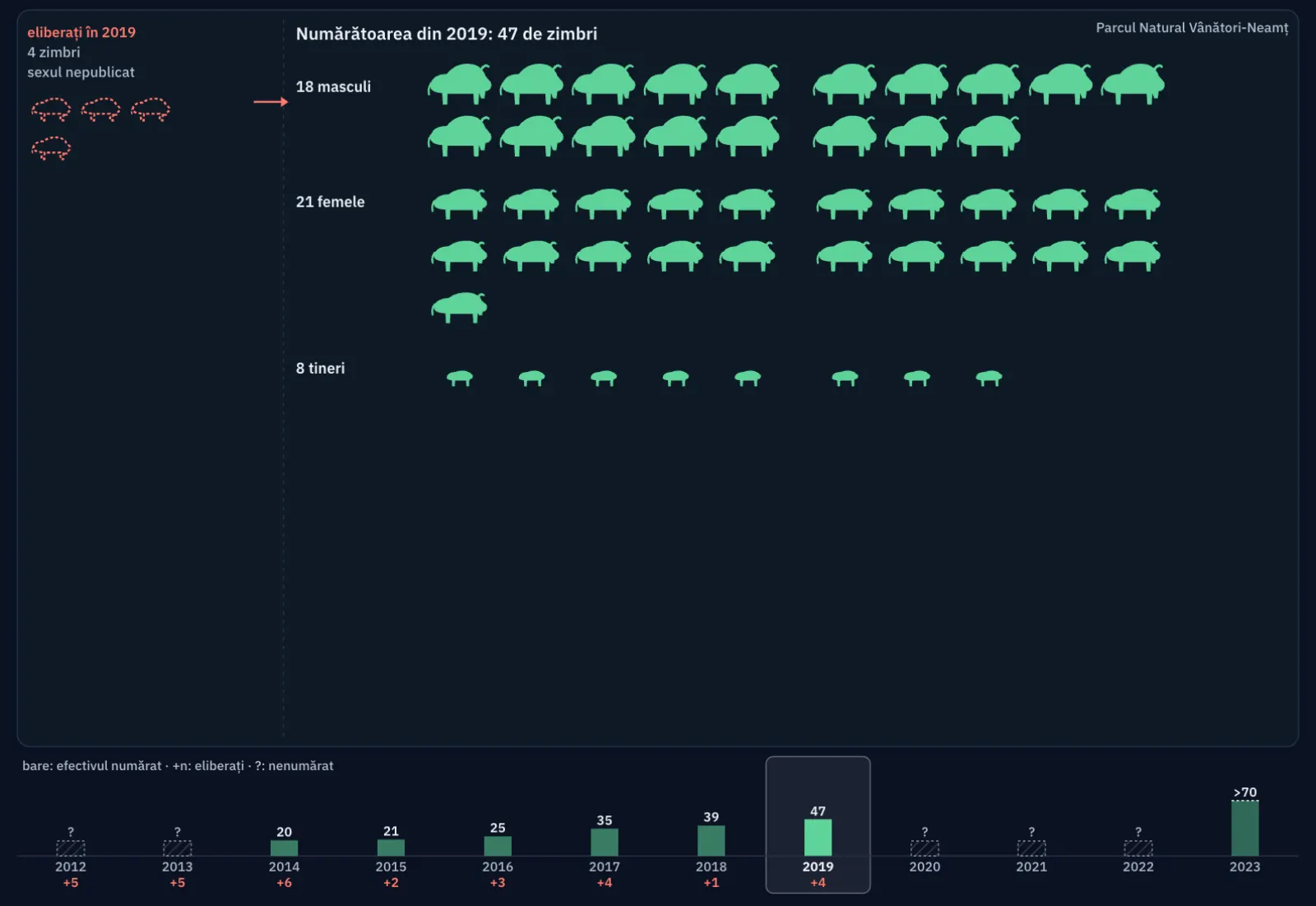
Until 22 March 2012, not a single bison lived free in Vânători-Neamț Nature Park, in Neamț county in north-eastern Romania. Each mark beside the text is one bison counted in 2019: males, females and young have different shapes. The count says how big the herd is; where it came from has to be worked out.
The park took in 30 bison. How many were born there?
Between 2012 and 2019, 30 bison were released into the park, brought in from zoos and reserves. After 2019, none was brought in.
How many calves do you think were born free in the park between 2012 and 2023?
The bison had to be brought back
The last wild bison was shot in 1927, in the Caucasus. All the bison alive today descend from the few animals that were left in zoos and reserves at that time.
The world’s wild population grew from about 1,800 animals in 2003 to more than 6,200 in 2019, and in 2020 the IUCN moved the bison from “vulnerable” to “near threatened”. In the same 2020 IUCN assessment, only eight of the world’s free herds were large enough to stay genetically viable in the long term.
On 22 March 2012, the first five bison were released in Vânători-Neamț: three males and two females. For the free-ranging population, they are immigrants.
New bison arrived eight years in a row
The first group was followed by releases every year until 2019: five, six, two, three, four, one and four. In total, 30 bison: 14 males and 16 females.
The marks with a dotted outline, on the left, are the bison released in the year shown. After 2012, it was not published how many of them were males and how many females, so they all have the same shape. The herd was first counted publicly in 2014: 20 bison, after 16 had been released.
In 2015, two bison arrived and the herd grew by one
At the 2014 count, the herd had 20 bison. In 2015, two more were released. With no births, no deaths and no emigration, the herd would have reached 22. The 2015 count found 21.
From the balance N₁ = N₀ + n − d + i − e it follows that n − d − e = 21 − 20 − 2 = −1. Births, deaths and emigration were not published separately, so only their combined result is known. If the two counts are complete and made in the same way, and both bison were released before the 2015 count, at least one bison died or left the herd between them, even if calves were born.
Added up over 2012–2019, these remainders give +17: the births minus the deaths and emigration of the whole period. The 2024 study says that of the 47 bison in 2019, 30 had been released and 17 were born in the wild. That split assumes that all 30 released bison were still in the herd in 2019; if some had died or left, more of the bison were born in the wild. Either way, at least 17 calves were born in the park.
After the last release, the herd grew by itself
After 2019, no more bison were brought in. In 2023, the herd exceeded 70 bison, against 47 in 2019. This growth, of more than 23 bison in four years, can no longer come from releases: births outnumbered deaths and emigration by at least that much. No counts were published for 2020–2022, so there is a single total.
The park also published totals for 2012–2023: almost 50 births in the wild and seven deaths, all from natural causes. A worked example, with births rounded to 50 and emigration taken as zero: 0 + 50 − 7 + 30 − 0 = 73. The park counted over 70, close to the result of the calculation.
Births ended up outnumbering the bison brought in.
A count does not say who was born and who died
For 2023, only the total was published, with no split into males, females and young; that is why the marks all have the same shape. Nobody knows how many young the herd has, or how many females can calve, which is exactly what shows whether the population will grow.
Even the published structure has to be read with care. Between 2014 and 2015, the young fell from four to one, while the adults rose: a young animal counted in one year can be counted as an adult the next.
Emigration stayed unknown in every year: a count says neither how many bison left the area nor why.
Now explain it yourself: the bison of the Țarcu Mountains
On 17 May 2014, a group of 17 bison was brought to Armeniș, in the Țarcu Mountains, in the Southern Carpathians. Within a few months, three of them died; at least two had been infected with the bluetongue virus. Of the 17, 14 were left.
More transports followed. In May 2026, over 250 bison lived free there, and almost half of them had been born in the wild.
Which terms of the balance increased this population, which reduced it, and what cannot be found out from these numbers?
Compare with an answer
Immigration (the bison brought in) and births (calves born in the wild) increased the herd; deaths, such as the disease of 2014, reduced it. These numbers do not reveal births and deaths year by year, emigration, or the age and sex structure, and “almost half” is only an approximate proportion.
The lesson on the population, with the balance worked out and questions