Chapter 4 · Membrane, osmosis, divisionLesson 4.1
Diffusion: how a substance spreads without being stirred
Why does the whole cup of tea turn sweet if you leave the sugar at the bottom and wait long enough, without stirring?
- Size
- from 10 nm to 100 µm
- Level
- membrane and cell
- Time
- minutes and hours
Before you read: what do you think?
Oxygen passes from the air sacs of the lungs into the blood by diffusion in a fraction of a second. How long would the same oxygen take to cross a single centimetre of still water, again by diffusion?
See the answer
A few hours, about seven. Diffusion time grows with the square of the distance: make the distance 10 times longer and the time becomes about 100 times longer. Diffusion is fast across a cell and very slow across an organ.
Let a drop of food colouring fall into a glass of water and leave the glass alone. An hour later the colour has spread through the whole glass, though nobody stirred it. The dye molecules move by themselves, because every particle in a liquid is constantly moving, and faint currents in the water carry them further, faster than diffusion could.
Particles move all the time, in every direction
The molecules of a gas or a liquid are never still. They move at random, collide with one another and keep changing direction. This motion is called thermal motion, because the higher the temperature, the faster it is.
The concentration of a substance is how much of it there is in a given volume. A difference in concentration between two places is called a concentration gradient. Where particles are crowded, more leave than arrive; where they are few, more arrive than leave. The result is a net movement from the crowded place towards the less crowded one.
Diffusion is the net movement of the particles of a substance from a region of higher concentration to a region of lower concentration, caused by their constant motion. No molecule heads for the less crowded region on purpose; each one moves at random, and a direction emerges only across millions of molecules.
When water or air flows or is stirred, the substance is carried along by the current, and that is no longer diffusion. That is why a smell from the kitchen reaches another room so quickly: air currents do most of the carrying.
Equilibrium does not mean the particles have stopped
Once the concentration is the same everywhere, net diffusion stops. The molecules keep moving, but on average as many cross in one direction as in the other. This state is called dynamic equilibrium. At equilibrium the concentrations become equal, while the amounts depend on the volumes. Worked example: if 8 units of a substance start in a compartment of volume 1 connected to one of volume 3, at equilibrium the concentration is 2 in both, and the amounts are 2 and 6.
Each substance diffuses down its own gradient, independently of the others. In a cell, oxygen can be coming in at the same time as carbon dioxide is going out.
Diffusion is passive transport: the cell spends no energy on it. The energy comes from the thermal motion of the particles. Small, non-polar molecules such as oxygen and carbon dioxide pass straight through the lipid layer of the cell membrane.
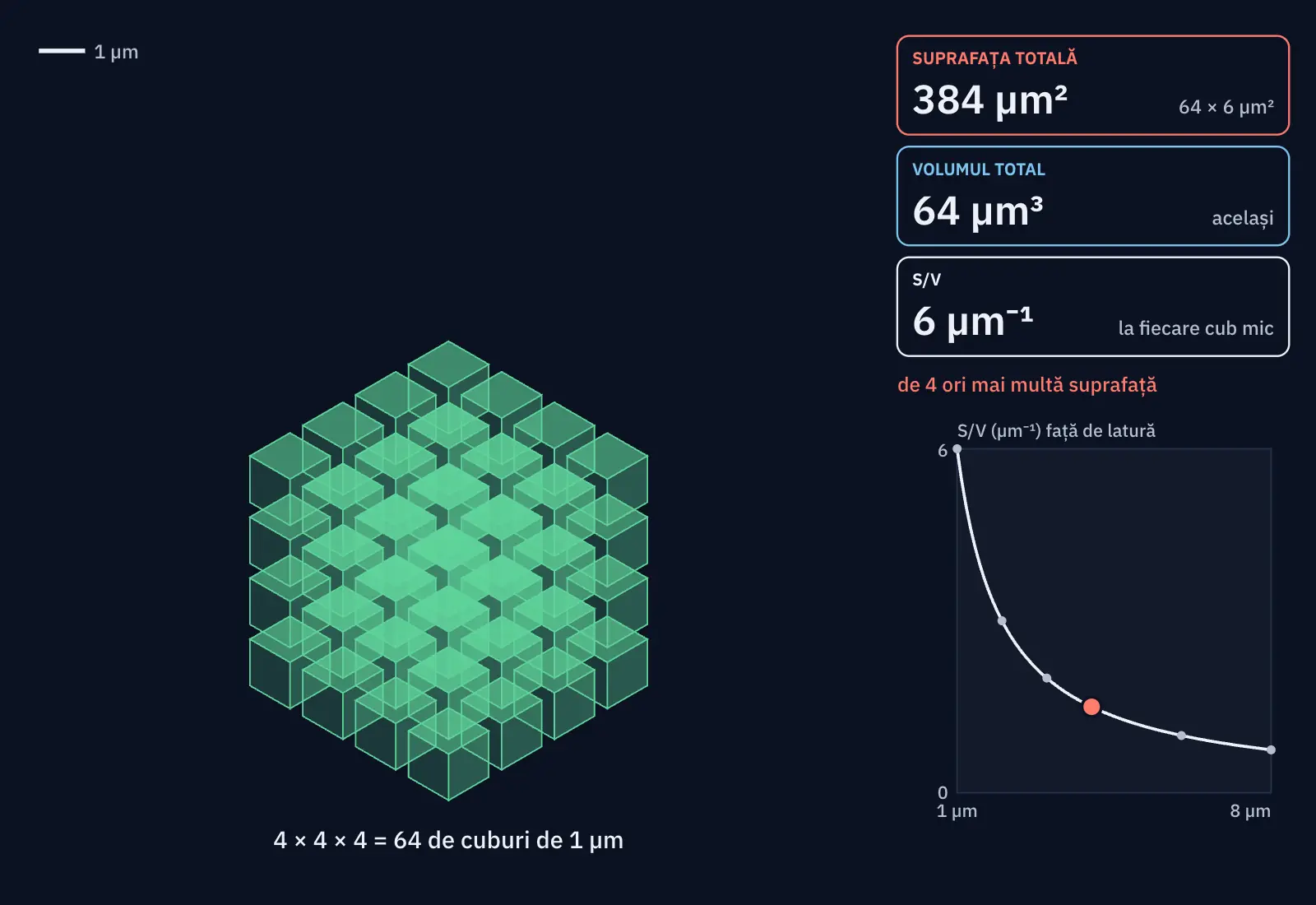
| Side a | Surface area S | Volume V | S/V | Cut into cubes of 1 µm: total surface area |
|---|---|---|---|---|
| 1 µm | 6 µm² | 1 µm³ | 6 µm⁻¹ | 6 µm² (the same) |
| 2 µm | 24 µm² | 8 µm³ | 3 µm⁻¹ | 48 µm² (2 times as much) |
| 3 µm | 54 µm² | 27 µm³ | 2 µm⁻¹ | 162 µm² (3 times as much) |
| 4 µm | 96 µm² | 64 µm³ | 1.5 µm⁻¹ | 384 µm² (4 times as much) |
| 6 µm | 216 µm² | 216 µm³ | 1 µm⁻¹ | 1,296 µm² (6 times as much) |
| 8 µm | 384 µm² | 512 µm³ | 0.75 µm⁻¹ | 3,072 µm² (8 times as much) |
| Model time τ | Amount on the left | Amount on the right | Concentration on the left | Concentration on the right |
|---|---|---|---|---|
| 0 | 8 | 0 | 8 | 0 |
| 0.5 | 5.08 | 2.92 | 5.08 | 0.97 |
| 1 | 3.58 | 4.42 | 3.58 | 1.47 |
| 2 | 2.42 | 5.58 | 2.42 | 1.86 |
| 3 | 2.11 | 5.89 | 2.11 | 1.96 |
| 5 | 2.01 | 5.99 | 2.01 | 2 |
| equilibrium | 2 | 6 | 2 | 2 |
The compartments have volumes 1 and 3; at the start the amount 8 is all on the left. The total stays 8. At equilibrium the concentrations are equal, 2, and the amounts differ, 2 and 6, because the volumes differ. The distance, as an estimate: with D = 2, a root-mean-square displacement of 2 along one direction needs the time 1, and one of 4 needs the time 4: double the distance, four times the time.
Calculation. Scale drawings of idealised shapes: cubes without folds, and two perfectly mixed compartments with fixed volumes. S = 6a², V = a³ and S/V = 6/a; the ratio has the unit 1/length. In part B the volumes, the amounts and the time are in model units, and the model time τ has no seconds; the starting case (volumes 1 and 3, amount 8 on the left) is a worked example. The particles are only a drawing.
What speeds diffusion up and what slows it down
Diffusion is faster when the difference in concentration is large, when the temperature is high, when the molecules are small and light, and when the surface they cross is large. It is slower through a thick membrane, in a dense medium and over a long distance.
Distance matters most. Diffusion time grows with the square of the distance: if the distance doubles, the time becomes four times longer. That is why diffusion alone is enough for organisms smaller than about 1 mm and for a single cell, but not for a large body, which needs flowing blood. Flatworms have flattened bodies, so every cell lies close to the surface.
Try it at home: put a drop of food colouring into a glass of cold water and another into a glass of warm water, without moving them. In the warm water the colour spreads faster. Part of the difference also comes from currents that form in warm water, so the experiment shows the effect of temperature without perfectly isolating diffusion.
Oxygen and carbon dioxide: diffusion in the lungs and in cells
Each lung has around 300 million alveoli, tiny air sacs whose walls are a single layer of cells thick. Their total surface area is about 75 m², the size of a square with sides of almost 9 m. Capillaries run past every alveolus, and their walls are also a single layer of cells.
The air in an alveolus holds more oxygen than the blood arriving in the capillaries, so oxygen diffuses from the alveolus into the blood. The arriving blood holds more carbon dioxide than the air in the alveolus, so carbon dioxide diffuses the other way. For gases, concentration is expressed as partial pressure: for oxygen, about 104 mm Hg in the alveolus against 40 mm Hg in the blood coming to the lungs.
Between the lungs and the muscles, oxygen no longer travels by diffusion: flowing blood carries it. In the tissues diffusion takes over again, in the opposite direction: cells use up oxygen and produce carbon dioxide, so oxygen passes from the blood into the cells and carbon dioxide passes from the cells into the blood. Because the cells use oxygen all the time, the difference in concentration never disappears and diffusion carries on.
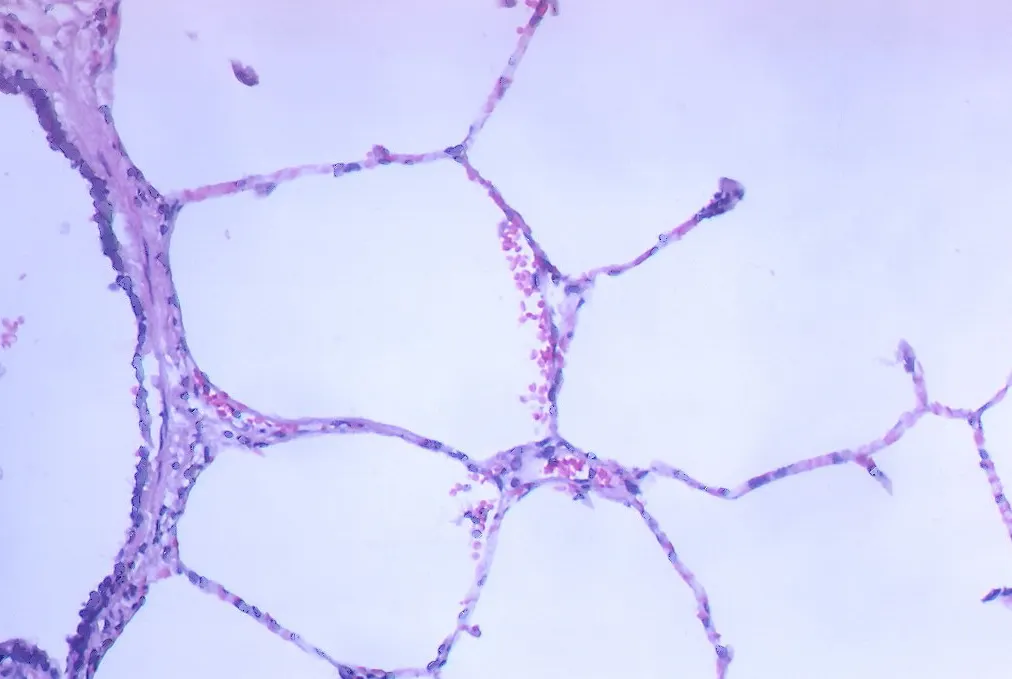
Photo: Yale Rosen, CC BY-SA 2.0, source. Unchanged.

Worked example
How long oxygen takes to diffuse through water
The order of magnitude of the diffusion time over a distance x can be estimated with the formula t ≈ x² ÷ (2D). D is the diffusion coefficient: for oxygen dissolved in water at 25 °C, D ≈ 2.1 × 10⁻⁹ m²/s.
For 10 µm, roughly the thickness of a cell: x² = 10⁻¹⁰ m², and t ≈ 10⁻¹⁰ ÷ (4.2 × 10⁻⁹) ≈ 0.024 s. For 1 mm: t ≈ 10⁻⁶ ÷ (4.2 × 10⁻⁹) ≈ 240 s, or about 4 minutes. For 1 cm: t ≈ 10⁻⁴ ÷ (4.2 × 10⁻⁹) ≈ 24,000 s, almost 7 hours. For 1 m, the result is more than 7 years.
The distance went up 100-fold, from 10 µm to 1 mm, and the time 10,000-fold. This is a worked example, using a formula that gives the order of magnitude: it shows why cells are small and why a large animal needs a circulatory system.
In Romania
The Black Sea, with no oxygen in its depths
The Black Sea, on whose coast the Romanian city of Constanța stands, has a rare feature: below a depth of about 150 m, which varies from place to place, the water holds no free oxygen, and no fish or other oxygen-breathing animals can live there.
Oxygen enters the sea only through the top layer, from the air and from algae carrying out photosynthesis. The sea’s waters lie in stable layers: on top is less salty water, brought largely by rivers such as the Danube, and underneath is saltier, heavier water that came from the Mediterranean beneath the Bosphorus. The two layers barely mix.
In the top layer, waves and currents carry oxygen downwards far faster than diffusion could. Lower down, where mixing is very weak, oxygen struggles to get through, and diffusion alone, going by the worked example, needs years to cross a single metre. What little oxygen does sink is used up by bacteria that break down the remains of organisms falling from the layer above.
In short
- Diffusion is the net movement of the particles of a substance from a region of higher concentration to a region of lower concentration, caused by their constant, random motion.
- A concentration gradient is the difference in concentration between two places; the larger it is, the faster diffusion goes.
- At dynamic equilibrium the concentration is the same everywhere, and the particles keep moving in both directions in equal numbers.
- Diffusion is passive transport: the cell uses no energy; oxygen and carbon dioxide pass straight through the membrane.
- Diffusion is faster at higher temperature, for small molecules, across large surfaces and over short distances; the time grows with the square of the distance.
- In the alveoli and in the tissues, oxygen and carbon dioxide move by diffusion, each away from where it is more concentrated.
Common mistakes
WrongParticles go where there are fewer of them because they want to even things out.
RightParticles move at random, in every direction. More of them simply leave the crowded place than arrive there, and that produces the net movement.
WrongOnce the concentration has evened out, the molecules stop.
RightThe molecules keep moving. At dynamic equilibrium as many cross in one direction as in the other, so there is no net movement.
WrongDiffusion is fast, so it can carry oxygen all round the body.
RightDiffusion is fast only over short distances, the size of a cell. Over centimetres it takes hours, so oxygen is carried round the body by flowing blood.
Check yourself
Seven questions. For the first six you see the explanation at once, with the paragraph of the lesson that supports it; for the written ones you compare with a good answer.
In which direction does the net movement of a substance by diffusion go?
Answer
b) From the region of higher concentration to the region of lower concentration. More particles leave the crowded place than arrive, so the net movement goes towards the lower concentration. The direction has nothing to do with the inside or outside of the cell, and it needs no energy.
In a glass of tea, the sugar has spread out evenly. What are the sugar molecules doing now?
Answer
c) They keep moving, but as many cross in each direction. This is dynamic equilibrium: the motion continues, but with no net movement.
Which change makes diffusion faster?
Answer
d) A larger difference in concentration. A steeper gradient means a bigger gap between the particles leaving and those arriving. A long distance, a thick membrane and a low temperature all slow diffusion down.
By diffusion, oxygen crosses 1 mm of water in about 4 minutes. In about how many minutes does it cross 3 mm?
minutesAnswer
36 minutes. The time grows with the square of the distance: the distance is 3 times longer, so the time is 3 × 3 = 9 times longer. 4 × 9 = 36 minutes.
For each situation, choose how the substance moves.
Answer
By diffusion: Oxygen passes from an alveolus into a capillary; Carbon dioxide leaves a cell for the blood; Sugar spreads through tea that you do not stir.
Carried by a current: Blood carries oxygen from the lungs to the muscles; A teaspoon stirs syrup into water; The wind scatters the smoke from a fire.
Diffusion comes from the random motion of particles, over short distances. When the liquid or gas flows or is stirred, the substance is carried along by the current.
Why does a large animal need circulating blood, while an organism smaller than 1 mm manages on diffusion alone?
Answer
c) Because diffusion over long distances takes too long. Across a cell, diffusion takes fractions of a second; across a few centimetres it takes hours. Diffusion uses none of the cell’s energy.
In an aquarium with no air pump and perfectly still water, the fish spend more and more time just below the surface. Explain why, using the words concentration and diffusion, and say what a bubbling pump changes.
A good answer
Oxygen enters the water only at the surface, from the air, while the fish use it up throughout the tank. In still water, oxygen reaches the depths only by diffusion, which takes hours over a few centimetres, so the oxygen concentration stays higher near the surface. The pump mixes the water and spreads oxygen through the whole volume far faster than diffusion.
A complete answer says where oxygen enters, compares the concentrations at the top and the bottom, links the slowness of diffusion to distance and explains that the pump replaces diffusion with mixing.
Terms
- diffusion
- The net movement of the particles of a substance from a region of higher concentration to a region of lower concentration, caused by their constant motion.
- concentration
- The amount of a substance in a given volume.
- concentration gradient
- The difference in the concentration of a substance between two places.
- dynamic equilibrium
- The state in which the concentration is the same everywhere and particles cross in equal numbers in both directions.
- passive transport
- The movement of a substance across a membrane down its concentration gradient, with no energy used by the cell.
- alveolus
- A microscopic air sac in the lung, with a wall one cell thick, through which gases pass by diffusion between air and blood.
Sources and link to the programme
- OpenStax – Biology 2e, 5.2 Passive Transport – diffusion from high to low concentration, each substance down its own gradient, dynamic equilibrium, the factors (gradient, mass, temperature, density, solubility, surface area, membrane thickness, distance), no energy used
- OpenStax – Biology 2e, 39.1 Systems of Gas Exchange – about 300 million alveoli per lung, a surface area of about 75 m², walls one cell layer thick; diffusion is enough for organisms under 1 mm; the flattened body of flatworms
- OpenStax – Anatomy and Physiology 2e, 22.4 Gas Exchange – gas exchange by simple diffusion; partial pressures: O₂ 104 mm Hg in the alveolus and 40 mm Hg in the blood, CO₂ 40 and 45 mm Hg; internal respiration in the opposite direction
- Wikipedia – Mass diffusivity (table of values) – the diffusion coefficient of oxygen dissolved in water at 25 °C: 2.10 × 10⁻⁵ cm²/s, that is 2.1 × 10⁻⁹ m²/s
- Alfred Wegener Institute (2021) – Sulfur promotes carbon storage in the Black Sea – below 150 m the Black Sea holds no free oxygen and supports no higher life forms; stable layers; less salty surface water from rivers such as the Danube; salty deep water from the Mediterranean beneath the Bosphorus
- Capet A. et al. (2016) – Decline of the Black Sea oxygen inventory, Biogeosciences 13: 1287–1297 – the depth to which oxygen reaches varies greatly from place to place (basin average: 140 m in 1955, 90 m in 2015); oxygen use by respiration thins the oxygenated layer
- Wikipedia – Black Sea (hydrology) – bacterial breakdown of sinking organic matter uses up the free oxygen; density layers isolate the deep water
From the programme: “Exchange of substances between the cell and its surroundings: diffusion, osmosis” (common core). Specific competences addressed: 1.1, 2.1, 2.2.