Chapter 6 · Bacteria, protists, fungiLesson 6.5
Fungi: yeasts, moulds, cap mushrooms and parasitic fungi
What do the yeast in dough, the green mould on a lemon and the mushroom in the forest have in common?
- Size
- from 100 nm to 30 m
- Level
- single-celled organisms and communities
- Time
- 20 minutes and billions of years
Before you read: what do you think?
What are fungi (mushrooms, yeasts and moulds) most closely related to?
See the answer
Animals. Comparing genes shows that fungi share a more recent common ancestor with animals than with plants. Like animals, they do not photosynthesise and they store their reserves as glycogen, not as starch.
In 1928 the Scottish researcher Alexander Fleming noticed that a mould had grown in a dish of bacteria, and that around it the bacteria had stopped growing. The mould was Penicillium, and its substance was named penicillin.
What fungi are
Fungi form a kingdom of eukaryotic organisms. They have no chlorophyll and do not photosynthesise, so they are heterotrophic. They feed by absorption: they release enzymes around themselves that break down large organic substances, then absorb the resulting small molecules through their wall. Digestion, in other words, happens outside the body.
Their cells have a cell wall containing chitin, the same substance insects’ outer shells are made of, and their food reserve is glycogen. Most fungi are multicellular, with a body made of hyphae, thin filaments usually divided into cells by cross-walls. All the hyphae of a fungus make up the mycelium, which spreads through the soil, the wood or the food it lives on.
Fungi reproduce mainly by spores, small cells carried by wind or water, from which a new mycelium grows. Spores can be produced asexually or sexually. Fungi also reproduce from fragments of mycelium, and yeasts by budding.
Yeasts and moulds
Yeasts are single-celled fungi. Brewer’s and baker’s yeast (Saccharomyces cerevisiae) reproduces by budding: a bulge appears on the edge of the cell, grows and breaks off as a daughter cell. Without oxygen, yeast breaks sugars down into carbon dioxide and ethyl alcohol. The process is called alcoholic fermentation: the carbon dioxide makes dough rise, and the alcohol collects in beer and wine.
Moulds are fungi with a mycelium that grow on food, fruit and other organic remains. Black bread mould (Rhizopus) often appears on bread: the black dots on it are sporangia, little sacs full of spores. The mould Mucor grows on almost any material that holds nutrients. Blue-green mould (Penicillium) produces penicillin, and some species are used to ripen cheeses.
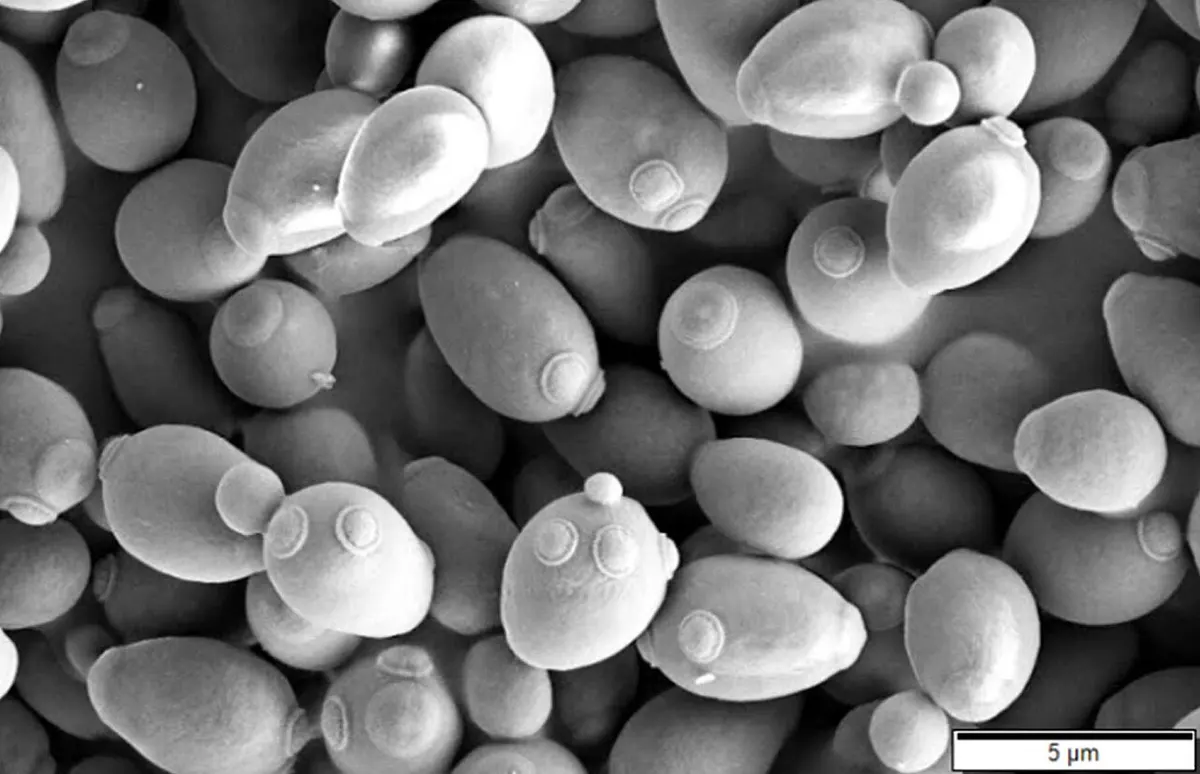
Photo: Mogana Das Murtey and Patchamuthu Ramasamy, CC BY 3.0, source. Resized.

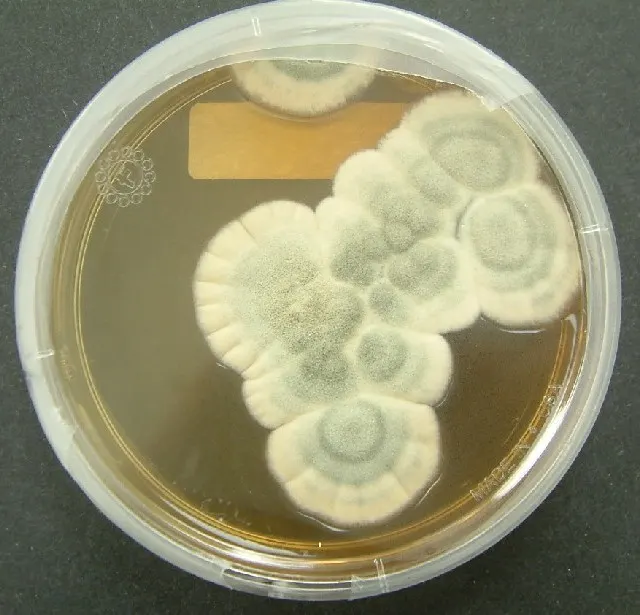
Photo: Crulina 98, CC BY-SA 3.0, source. Unchanged.

Cap mushrooms
The mushroom you pick is only a small part of the fungus: the fruiting body, which pushes out of the ground to produce spores. The mycelium stays in the soil or the wood. Under the cap are gills or tubes, made of tightly packed hyphae, on whose walls the spores form. Many caps can grow from the same mycelium.
The field mushroom (Agaricus campestris) and the cultivated mushroom are edible. The death cap (Amanita phalloides), however, causes more deaths than any other wild-picked mushroom, worldwide. Its poison is not destroyed by cooking, and the first signs appear only after 6–24 hours, when the liver is already under attack.
Many edible mushrooms look like highly poisonous relatives. No mushroom can be recognised as edible by its colour, smell, taste or from a photograph; only a mushroom specialist can identify it. If you suspect poisoning at all, call a doctor or 112, the emergency number, at once.
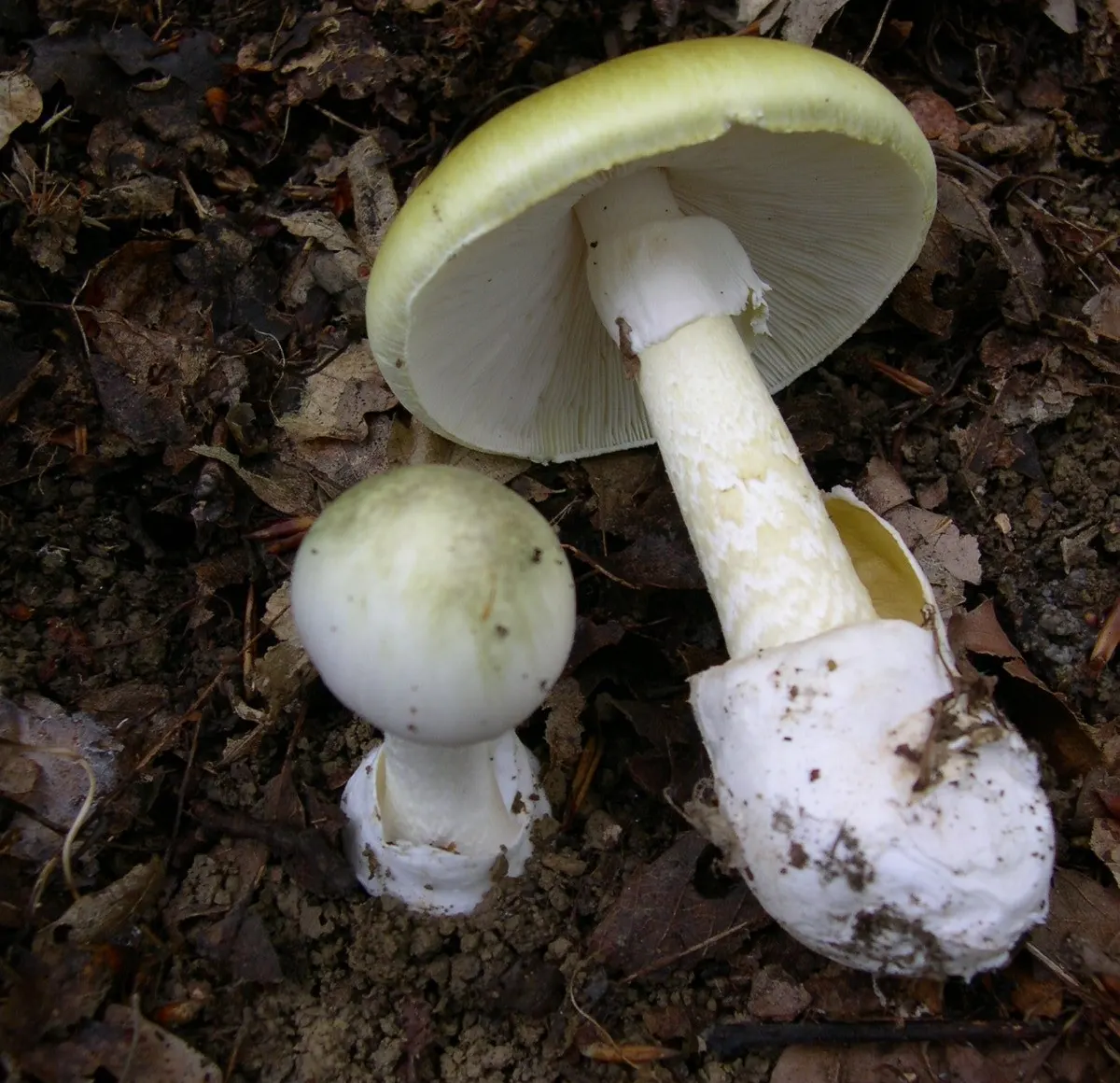
Photo: Archenzo, CC BY-SA 3.0, source. Cropped.

Decomposers, partners and parasites
Most fungi are saprophytes: they break down wood, leaves and dead animals and release the mineral substances that plants then use. Others live in symbiosis: almost 90% of vascular plants have partner fungi on their roots, which bring them water and mineral salts and receive sugars in return; these partnerships, like lichens, are covered in detail elsewhere.
Parasitic fungi live at the expense of living plants or animals. Wheat stem rust (black rust), caused by Puccinia graminis, is the rust disease that does the most damage when an epidemic breaks out: in some American states, the epidemics of the first half of the 20th century destroyed on average 19–28% of the harvest. Ergot (Claviceps purpurea) attacks the ears of rye; contaminated grains that end up in flour cause convulsions, hallucinations and gangrene. Potato late blight looks like these diseases, but it is not caused by a fungus: Phytophthora infestans, which causes it, is an oomycete, an organism related to brown algae and classified in Chromista.
Worked example
The yeast that blows up a balloon
An experiment to do at home: put 100 ml of lukewarm water into each of three small bottles. In the first put a teaspoon of yeast, in the second a teaspoon of sugar, in the third both yeast and sugar. Stretch a deflated balloon over the neck of each bottle and wait an hour somewhere warm.
Result: usually, the balloon on the third bottle inflates visibly, while the other two stay almost flat. In the first bottle the yeast has no sugar; in the second the sugar has nothing to consume it. Conclusion: living yeast breaks down sugar and releases a gas, carbon dioxide. Bottles one and two are controls: they show that the result does not come from the yeast alone or from the sugar alone.
Sample calculation: if the number of yeast cells doubled by budding every two hours, one cell would give 2⁴ = 16 cells after eight hours. The numbers are chosen for the exercise; the real rate depends on temperature and food.
In Romania
From Fleming’s mould to the factory in Iași
In 1945 Alexander Fleming, Howard Florey and Ernst Chain shared the Nobel Prize in Physiology or Medicine for the discovery of penicillin and its curative effect in various infectious diseases.
In December 1955, Chemical Plant No. 2 started work in Iași, a city in north-eastern Romania: the first penicillin factory in Romania and in south-eastern Europe, known today as Antibiotice Iași.
The same factory became the world’s leading producer of nystatin, a medicine against fungi that cause infections. Nystatin is made by bacteria of the genus Streptomyces. So a fungus (Penicillium) gives a medicine against bacteria, and a bacterium gives one against fungi.
In short
- Fungi are heterotrophic eukaryotes that feed by absorption, after breaking down their food outside the body with enzymes; they have a wall containing chitin and store glycogen.
- The body of multicellular fungi is made of hyphae, and all the hyphae together form the mycelium; fungi reproduce mainly by spores.
- Yeast (Saccharomyces cerevisiae) is single-celled, reproduces by budding and carries out alcoholic fermentation, which yields carbon dioxide and alcohol.
- Moulds (Rhizopus, Mucor, Penicillium) grow on food; cap mushrooms have a fruiting body with gills or tubes, on whose walls the spores form.
- Fungi can be saprophytes (decomposers), symbionts (partners of roots) or parasites (wheat rust, ergot).
- Amanita phalloides causes the most fatal mushroom poisonings; no mushroom can be judged edible by its appearance.
Common mistakes
WrongMushrooms are plants, because they do not move and grow out of the ground.
RightFungi have no chlorophyll and do not photosynthesise, and they have a wall containing chitin and glycogen as a reserve. They form a separate kingdom, more closely related to animals than to plants.
WrongThe mushroom I pick is the whole organism.
RightThe cap and stalk form the fruiting body, which produces spores. Most of the fungus is the mycelium in the soil or the wood.
WrongA poisonous mushroom becomes safe to eat if it is boiled well.
RightThe death cap’s poison is not destroyed by cooking. A mushroom can be identified with certainty only by a specialist.
Check yourself
Seven questions. For the first six you see the explanation at once, with the paragraph of the lesson that supports it; for the written ones you compare with a good answer.
How do fungi feed?
Answer
c) By absorption, after breaking down the food outside the body with enzymes. Fungi are heterotrophs; they release enzymes into their surroundings and absorb the resulting small molecules.
Which substance is found in the cell wall of fungi?
Answer
b) Chitin. Chitin is in the wall of fungi; cellulose in that of plants, peptidoglycan in that of bacteria, silica in the diatom frustule.
How does brewer’s yeast usually reproduce asexually?
Answer
a) By budding. A bud appears on the yeast cell, grows and breaks off. Yeast is single-celled, so it has no mycelium to break into fragments; seeds belong to plants, and bacteria reproduce by binary fission (direct division).
What are the black dots on mould growing on bread?
Answer
b) Sporangia full of spores. Sporangia are little sacs in which spores form; fungi have no seeds.
Sample calculation: the number of yeast cells doubles by budding every two hours. How many cells come from a single one after eight hours?
cellsAnswer
16 cells. Eight hours means four doublings: 2⁴ = 16.
Choose the way of life of each fungus.
Answer
Saprophyte: The mould growing on a stale loaf; The fungus breaking down a fallen trunk.
Parasite: Wheat stem rust; Ergot.
Symbiont: The fungus on a tree’s roots that brings it water and receives sugars.
Saprophytes break down dead matter, parasites live at the expense of a living organism, symbionts trade to the benefit of both partners.
A neighbour says you can recognise a poisonous mushroom because a silver spoon turns black when you boil it, and that boiling destroys the poison anyway. Explain why his advice is dangerous.
A good answer
No home test can tell poisonous mushrooms from edible ones; many edible mushrooms look like highly poisonous relatives. The death cap’s poison is not destroyed by cooking, and the signs appear after 6–24 hours, when the liver is already damaged. A mushroom can be identified with certainty only by a specialist, and if you suspect poisoning, you call a doctor.
A complete answer rejects the test, says that cooking does not destroy the poison, mentions the delay before the signs appear and points to a specialist and a doctor.
Practical work for this lesson
- Three microorganisms, three evidence cards – Case study on cards and qualitative observation, 35–40 minutes
- Fermentation: the indicator and the process – Optional guided experiment or case study, 15 minutes of exposure and 25 minutes of analysis, after preparation (CS)
Terms
- fungi
- A kingdom of heterotrophic eukaryotes that feed by absorption and have a cell wall containing chitin.
- hypha
- A thin filament that makes up the body of multicellular fungi.
- mycelium
- All the hyphae of a fungus together.
- spore
- A small reproductive cell of fungi from which a new organism can grow.
- budding
- Reproduction in which a bulge forms on the mother cell and breaks off as a daughter cell.
- alcoholic fermentation
- The breakdown of sugars without oxygen, producing carbon dioxide and ethyl alcohol.
- fruiting body
- The part of a mushroom that comes up above the surface and produces the spores, for example the cap and stalk.
- saprophyte
- An organism that feeds on dead organic matter and breaks it down.
Sources and link to the programme
- OpenStax – Biology 2e, 24.1 Characteristics of Fungi – wall containing chitin; glycogen as a reserve; hyphae, mycelium, septa; enzymes released outside the hyphae; asexual and sexual spores; budding, fragmentation; fungi are more closely related to animals than to plants
- OpenStax – Biology 2e, 24.2 Classifications of Fungi – the bread mould Rhizopus stolonifer, with black sporangia full of spores; the yeasts of baking, beer and wine; a Penicillium colony killed the bacteria around it; the fruiting body that comes out of the ground, gills made of hyphae on which the spores form; rusts and smuts, parasites of plants
- OpenStax – Biology 2e, 24.3 Ecology of Fungi – fungi, major decomposers that release the elements from dead matter; mycorrhizae: water and minerals for the plant, products of photosynthesis for the fungus; almost 90% of vascular plants have mycorrhizal partners
- OpenStax – Biology 2e, 24.4 Fungal Parasites and Pathogens – ergot (Claviceps purpurea) on rye: convulsions, hallucinations, gangrene; rusts as parasites of crops; many edible mushrooms look like highly poisonous relatives
- OpenStax – Biology 2e, 24.5 Importance of Fungi in Human Life – Saccharomyces cerevisiae, brewer’s yeast; fermentation of sugars into CO₂ and ethyl alcohol; penicillin isolated from fungi; Penicillium in ripening cheeses; Agaricus campestris, the field mushroom
- Zygomycetes.org – Mucor – at least one species of Mucor can be found on almost any material with soluble nutrients; globular sporangia
- OpenStax – Biology 2e, 23.3 Groups of Protists – oomycetes were named for their resemblance to fungi; Phytophthora infestans causes potato late blight
- Ruggiero et al. (2015), PLOS ONE – A higher level classification of all living organisms – oomycetes belong to Chromista, not to the fungi
- Singh et al. (2015), Phytopathology 105 – Emergence and spread of new races of wheat stem rust fungus – wheat stem rust is caused by Puccinia graminis f. sp. tritici; it can do the most damage in epidemics (average harvest losses of 19–28% in American states in the epidemics of the first half of the 20th century)
- CDC – MMWR: Amanita phalloides Mushroom Poisonings, Northern California, December 2016 – A. phalloides causes the most deaths after eating wild-picked mushrooms, worldwide; symptoms after 6–24 hours; the toxins are not destroyed by cooking; identification by a mycologist
- Nobel Prize – Alexander Fleming, Facts – in 1928 Fleming noticed a mould that stopped bacteria growing; the 1945 Nobel Prize “for the discovery of penicillin”
- Nobel Prize – The Nobel Prize in Physiology or Medicine 1945 – the 1945 prize shared between Alexander Fleming, Ernst Boris Chain and Howard Walter Florey
- Antibiotice Iași – Istoric – in December 1955 Chemical Plant No. 2 was founded in Iași, the first producer of penicillin in Romania and south-eastern Europe
- Antibiotice Iași – Our company’s evolution over time – first place in the world for production of the active substance nystatin
- PubChem (ChEBI) – Nystatin – nystatin, an antifungal antibiotic produced by several species of Streptomyces
From the programme: “Fungi: types of fungi (yeasts, moulds, cap mushrooms, parasitic fungi) – general features – a comparative overview (morphology, nutrition, reproduction), habitats, importance in ecosystems” (common core). Specific competences addressed: 1.1, 1.2, 2.2.