
Chapter 6 · Bacteria, protists, fungiLesson 6.6CS
Diversity of prokaryotes: Bacteria and Archaea, from yoghurt to salt lakes
What do the bacteria that turn milk into yoghurt, the ones in the plaque on your teeth and the organisms that turn a salt lake red have in common?
- Size
- from 100 nm to 30 m
- Level
- single-celled organisms and communities
- Time
- 20 minutes and billions of years
Before you read: what do you think?
Bacteria live in an adult’s body, mostly in the large intestine. How does their number compare with the number of the body’s own cells?
See the answer
About as many. A 2016 estimate gives roughly 38,000 billion bacteria and 30,000 billion human cells in a 70 kg man, that is, about 1.3 bacteria per human cell. The 10-to-1 ratio, repeated for decades, came from an old, rough calculation.
Put a spoonful of yoghurt in a glass of lukewarm milk, leave it somewhere warm overnight, and in the morning you have yoghurt: the milk has thickened and turned sour. The work was done by lactic acid bacteria, organisms made of a single cell, with no nucleus. An archaeon that lives in brine ten times saltier than the sea follows the same rules of organisation, although the two groups are very different in their chemistry.
Bacteria and Archaea: the same organisation, different chemistry
What the two domains share: they are prokaryotes, with no nucleus and no membrane-bound organelles; they usually have a single circular chromosome in the nucleoid, may have plasmids and multiply by direct division (binary fission). Under the light microscope, a rod-shaped bacterium and a rod-shaped archaeon look the same.
The differences show up in chemical analysis. The cell wall of bacteria contains peptidoglycan (murein); the wall of archaea contains no peptidoglycan. In the bacterial membrane, fatty acids are joined to glycerol by ester bonds, while in the archaeal membrane branched chains are joined to glycerol by ether bonds. Archaea are not sensitive to streptomycin, an antibiotic that stops many bacteria from growing.
Archaea do not live only in extreme environments. Methanobrevibacter smithii, a methane-producing archaeon, commonly lives in the human gut. So far, no archaeon has been convincingly shown to cause disease in humans.
Two representative species: Lactobacillus and Halobacterium
Bacteria of the genus Lactobacillus are rods that carry out lactic acid fermentation: they break down sugars, such as the lactose in milk, without oxygen, and produce lactic acid. The acid lowers the pH of the milk, and the milk proteins curdle. Under the international food standard (the Codex Alimentarius), yoghurt is made with two bacteria that grow together: Streptococcus thermophilus and Lactobacillus delbrueckii subsp. bulgaricus.
Halobacterium salinarum is, despite its name, an archaeon. It is halophilic: it grows best at a salinity about ten times that of seawater and does not survive in fresh water. Its membrane contains bacteriorhodopsin, a protein that uses light to pump protons and so helps produce ATP. Carotenoid pigments called bacterioruberins colour the cells, and the water where they are plentiful, pinkish-red.
For the curious
To avoid losing water by osmosis, Halobacterium keeps a high concentration of potassium ions in its cytoplasm, which balances the salt outside. Its proteins have many acidic groups and keep working in this very salty cytoplasm.
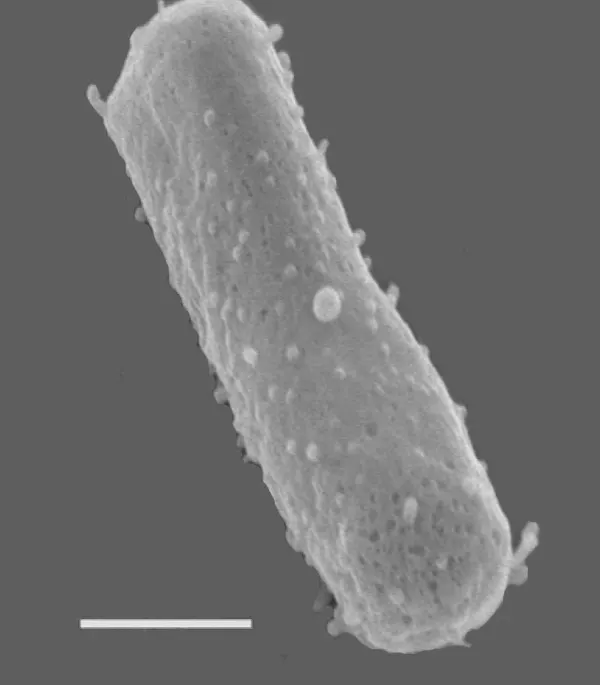
Photo: Helga Stan-Lotter and Sergiu Fendrihan; photograph by Chris Frethem, University of Minnesota, CC BY-SA 4.0, source. Cropped.

Beneficial or pathogenic: the species and the strain matter
Bacteria of the genus Rhizobium live in the nodules on the roots of legumes and fix nitrogen from the air, which the plant uses. Gut bacteria help with digestion and produce some vitamins. Escherichia coli lives in the human gut, and most strains are harmless; strains that produce Shiga toxin cause bloody diarrhoea and, sometimes, a serious kidney disease. A pathogenic bacterium causes disease: Mycobacterium tuberculosis causes tuberculosis, which spreads through the air, and Salmonella species cause salmonellosis, which spreads through food.
Antibiotic resistance is the ability of some bacteria to survive and multiply in the presence of an antibiotic that kills other bacteria of the same species. The antibiotic kills the sensitive bacteria, and those that already have a resistance gene survive and multiply: this is natural selection. Resistance genes also pass from one bacterium to another, on plasmids. Antibiotics do not act on viruses, so using them for colds and flu speeds up selection to no purpose. The World Health Organization estimates that bacterial resistance was associated with more than 4.7 million deaths worldwide in 2021.
Biofilm and microbiome: prokaryotes live in communities
A biofilm is a community of microorganisms attached to a surface in a matrix they produce themselves, made of polysaccharides, proteins, nucleic acids and lipids. The matrix glues the cells to the surface and keeps enzymes close to them. Less oxygen and fewer nutrients reach the depths of the biofilm, and the cells there grow slowly. Cells in a biofilm tolerate antibiotics much better than the same bacteria living free. The plaque on your teeth is a biofilm: the bacteria in it turn sugars into acids, which draw minerals out of the enamel and lead to tooth decay.
The microbiota is all the microorganisms in a particular place, such as the gut, the skin or the soil. The microbiome includes the microbiota together with its genes, substances and activity in that place. The human microbiome differs from one part of the body to another and from one person to another. In an adult, the number of bacteria, around 38,000 billion, is close to the number of the body’s own cells, around 30,000 billion. Plants have a microbiome too: in the rhizosphere, the thin layer of soil around the roots, live bacteria that fix nitrogen or produce substances that protect the plant from pathogens.
For the curious
In 2020 the genus Lactobacillus, which had grown to more than 260 species, was split into 25 genera after their genomes were compared. Lactobacillus delbrueckii, the yoghurt bacterium, stayed in the genus Lactobacillus; other well-known species were given new genus names.
An association between a particular microbiome and a disease does not show, on its own, which is the cause and which the effect. That takes separate experiments.
Worked example
Home-made yoghurt as an experiment
With an adult’s help, boil half a litre of milk and let it cool to about 43 °C, hot to the touch but not burning. Divide it between two clean jars. In the first put a spoonful of yoghurt with live cultures; leave the second with nothing. Cover the jars and keep them warm, wrapped in a towel, for 6 to 12 hours.
The milk in the first jar has thickened and tastes sour. The lactic acid bacteria from the yoghurt have multiplied and turned the lactose into lactic acid, and the acid has curdled the milk proteins. The milk in the second jar has stayed liquid, so the change was caused by the added bacteria, not by the heat.
The jar without yoghurt is the control. The milk is cooled before the yoghurt goes in, because too high a temperature kills the bacteria.
In Romania
The archaea of the salt lakes at Ocna Sibiului
At Ocna Sibiului, 15 km from the city of Sibiu in Transylvania, lies the largest complex of salt lakes in Romania: 14 lakes, 12 of which formed on the site of old salt mines. Lake Brâncoveanu appeared in the 17th century, and Lake Fără Fund (“Bottomless Lake”) in the 18th century, when the salt mines collapsed after water had dissolved the salt.
Their water lies in layers that do not mix. At the top, salinity is 2–10%, while at depth it exceeds 30% and there is almost no oxygen. Seawater holds about 3.5% salts.
Researchers at Babeș-Bolyai University in Cluj-Napoca have isolated 191 strains of halophilic archaea from the salt lakes of Transylvania. Most belong to the genus Haloferax (about 47%), followed by Halobacterium (about 12%). The greatest diversity turned up in Lake Brâncoveanu, the oldest and saltiest of the lakes studied.
In short
- Bacteria and Archaea are prokaryotes: no nucleus, a circular chromosome, multiplication by direct division (binary fission).
- The bacterial wall contains peptidoglycan and the archaeal wall does not; the archaeal membrane has lipids with ether bonds, the bacterial membrane lipids with ester bonds.
- Lactobacillus carries out lactic acid fermentation and produces lactic acid; yoghurt is made with Streptococcus thermophilus and Lactobacillus delbrueckii subsp. bulgaricus.
- Halobacterium salinarum is a halophilic archaeon, with bacteriorhodopsin that uses light to produce ATP.
- A biofilm is a community of microorganisms attached to a surface in a matrix they produce themselves; dental plaque is a biofilm.
- Antibiotic resistance arises through the selection of resistant bacteria; antibiotics do not act on viruses.
Common mistakes
WrongArchaea are bacteria that live in hot or salty water.
RightArchaea form a separate domain, with a wall without peptidoglycan and membranes with ether bonds. They also live in ordinary environments, for example in the human gut.
WrongIf you take antibiotics often, your body becomes resistant to them.
RightIt is the bacteria that become resistant. The antibiotic kills the sensitive bacteria, and the resistant ones remain and multiply.
WrongThe bacteria in dental plaque wash away as easily as those floating free in saliva.
RightDental plaque is a biofilm: the cells are held in a matrix stuck to the tooth and are removed mechanically, by brushing.
Check yourself
Seven questions. For the first six you see the explanation at once, with the paragraph of the lesson that supports it; for the written ones you compare with a good answer.
What sets the cell wall of bacteria apart from that of archaea?
Answer
b) The bacterial wall contains peptidoglycan, the archaeal wall does not. Peptidoglycan (murein) is typical of the bacterial wall. Archaea have other wall components. Habitat is not the criterion for classification.
Halobacterium salinarum is:
Answer
d) a halophilic archaeon that grows in brine. The name contains “bacterium” from a time when archaea were not separated from bacteria. The organism is an archaeon that grows at very high salinity.
Why do more and more resistant bacteria appear where antibiotics are used often?
Answer
a) The antibiotic kills the sensitive bacteria, and the resistant ones multiply. This is natural selection: the resistance gene already existed in some bacteria, and the antibiotic removes their sensitive competitors.
Which is the best example of a biofilm?
Answer
c) The plaque on your teeth. A biofilm is a community attached to a surface, in a matrix produced by microorganisms. Dental plaque meets every condition.
An adult has about 38,000 billion bacteria and 30,000 billion human cells. How many bacteria are there per human cell? Round to one decimal place.
bacteria per cellAnswer
1.3 bacteria per cell. 38,000 ÷ 30,000 ≈ 1.27, that is, about 1.3. The ratio is close to 1 to 1, not 10 to 1.
For each feature, choose the domain it belongs to.
Answer
Bacteria only: Cell wall with peptidoglycan; Sensitivity to streptomycin.
Archaea only: Membrane lipids joined to glycerol by ether bonds; Halobacterium salinarum.
Both domains: No nucleus; Multiplication by binary fission (direct division).
Prokaryotic organisation and binary fission are shared. Peptidoglycan and sensitivity to streptomycin belong to bacteria, ether bonds in the membrane to archaea.
The water in the ponds where salt is produced by evaporation sometimes turns pinkish-red. Explain which organisms can produce the colour and why ordinary freshwater bacteria do not survive there.
A good answer
The colour comes from halophilic archaea, for example Halobacterium salinarum, whose cells contain red carotenoid pigments (bacterioruberins). They grow at a salinity several times that of the sea and keep a lot of potassium salts in their cytoplasm, which balance the salt outside. A freshwater bacterium placed in brine loses water by osmosis, because the medium is strongly hypertonic, and dies.
A complete answer names the halophilic archaea, links the colour to pigments, explains the adaptation (the salts in the cytoplasm) and uses osmosis for the freshwater bacterium.
Practical work for this lesson
- Biofilm or a collection of cells? – Case study on diagrams with sources, 30–40 minutes (CS)
Terms
- halophile
- An organism that lives and grows in environments with a very high concentration of salt.
- lactic acid fermentation
- The breakdown of sugars without oxygen, producing lactic acid.
- pathogen
- A microorganism that causes a disease.
- antibiotic resistance
- The ability of some bacteria to survive and multiply in the presence of an antibiotic that kills other bacteria of the same species.
- biofilm
- A community of microorganisms attached to a surface in a matrix they produce themselves.
- microbiome
- The microorganisms in a particular place, together with their genes, substances and activity.
- rhizosphere
- The thin layer of soil around the roots, influenced by the root and rich in microorganisms.
Sources and link to the programme
- OpenStax – Biology 2e, 22.2 Structure of Prokaryotes: Bacteria and Archaea – shared features of prokaryotes; the bacterial wall with peptidoglycan, the archaeal wall without peptidoglycan; lipids with ester bonds in bacteria and ether bonds with branched chains in archaea; archaea resistant to streptomycin
- Microbiology Society – Why don’t archaea cause disease? – Methanobrevibacter smithii, the most abundant methanogen in the human gut; it has not been convincingly shown that archaea cause disease in humans
- FAO/WHO – Codex Alimentarius, Standard for Fermented Milks (CXS 243-2003) – yoghurt: symbiotic cultures of Streptococcus thermophilus and Lactobacillus delbrueckii subsp. bulgaricus
- University of Guam Cooperative Extension – Making Yogurt at Home – incubating the milk at about 43 °C, 6–12 hours; the lactic acid produced by the bacteria curdles the milk
- Ng et al. (2000), PNAS – Genome sequence of Halobacterium species NRC-1 – Halobacterium grows best at a salinity about ten times that of seawater; high concentration of potassium ions in the cell; bacteriorhodopsin, a light-driven proton pump, contributes to ATP synthesis; carotenoids (bacterioruberins)
- PMC – Xanthorhodopsin: a bacteriorhodopsin-like proton pump with a carotenoid antenna – bacterioruberin, the carotenoid that gives halophilic archaea their red colour
- Zheng et al. (2020), IJSEM – A taxonomic note on the genus Lactobacillus (PubMed) – the split of the genus Lactobacillus into 25 genera; the emended genus keeps the L. delbrueckii group
- OpenStax – Biology 2e, 22.5 Beneficial Prokaryotes – rhizobia in legume nodules fix nitrogen; gut bacteria aid digestion and produce some vitamins
- WHO – E. coli (fact sheet) – E. coli lives in the gut and most strains are harmless; Shiga toxin-producing strains cause bloody diarrhoea and haemolytic uraemic syndrome
- WHO – Tuberculosis (fact sheet) – tuberculosis is caused by bacteria and spreads through the air
- WHO – Salmonella (non-typhoidal) (fact sheet) – Salmonella causes foodborne disease
- OpenStax – Biology 2e, 22.4 Bacterial Diseases in Humans – antibiotic resistance through natural selection; transfer of resistance genes on plasmids; antibiotics do not treat colds and flu; biofilms and dental plaque; the tolerance of biofilms to antibiotics
- WHO – Antimicrobial resistance (fact sheet, 2026) – bacterial antimicrobial resistance, associated with more than 4.7 million deaths in 2021; misuse and overuse as the main driver
- Flemming & Wingender (2010), Nature Reviews Microbiology – The biofilm matrix – the biofilm matrix: polysaccharides, proteins, nucleic acids, lipids; adhesion to surfaces; enzymes kept close to the cells
- Høiby et al. (2010) – Antibiotic resistance of bacterial biofilms (PubMed) – oxygen and nutrient gradients in the biofilm, slow-growing cells and increased tolerance to antibiotics
- OpenStax – Microbiology, 9 Introduction – biofilms form on teeth as plaque
- NIDCR (NIH) – Tooth Decay – bacteria in the mouth make acids from sugars; the acids draw minerals out of the enamel
- Berg et al. (2020), Microbiome – Microbiome definition re-visited – microbiota and microbiome are separate terms: the microbiome includes the microbiota together with its activity in the given environment
- OpenStax – Microbiology, 4.1 Prokaryote Habitats, Relationships, and Microbiomes – the human microbiome varies between body sites and between people; the bacteria-to-human-cell ratio revised down from 10:1 towards 1:1; plant-associated bacteria that fix nitrogen or protect plants from pathogens
- Sender, Fuchs & Milo (2016), PLoS Biology – Revised estimates for the number of human and bacteria cells in the body – 3.8·10¹³ bacteria and 3.0·10¹³ human cells in a 70 kg reference man; the bacteria mostly in the colon
- Alexe et al. (2018), Journal of Limnology – Limnology and plankton diversity of salt lakes from Transylvanian Basin (Romania): a review – Ocna Sibiului, 15 km from Sibiu, the largest complex of salt lakes in Romania: 14 lakes, 12 man-made; Brâncoveanu (17th century) and Fără Fund (18th century) formed by the collapse of salt mines; layers with 2–10% salinity at the surface and over 30% at depth, without oxygen; seawater about 3.5%
- Baricz et al. (2015), Extremophiles – Culturable diversity of aerobic halophilic archaea from hypersaline, meromictic Transylvanian lakes (PubMed) – 191 isolates of halophilic archaea; Haloferax about 47%, Halobacterium about 12%; the greatest diversity in Lake Brâncoveanu, the oldest and saltiest
From the programme: “DIVERSITY OF PROKARYOTES – shared and distinguishing features of Bacteria and Archaea; representative species (e.g. Lactobacillus sp. and Halobacterium salinarum respectively); beneficial bacteria, pathogenic bacteria; interactions and adaptations (e.g. biofilm, human/plant microbiome)” (specialism, Natural Sciences). Specific competences addressed: 1.2, 2.1, 2.2, 3.2.