Chapter 6 · Bacteria, protists, fungiLesson 6.8CS
Diversity of fungi: lichens, mycorrhizae, decomposers and parasites
Is the orange patch on a tree’s bark or on a roof a plant, a fungus or something else?
- Size
- from 100 nm to 30 m
- Level
- single-celled organisms and communities
- Time
- 20 minutes and billions of years
Before you read: what do you think?
What are lichens, the green, grey or orange patches on trees and stones, made of?
See the answer
A lichen is a stable partnership between a fungus and a photosynthetic partner, a green alga or a cyanobacterium. The fungus builds the lichen’s body, and the partner makes sugars by photosynthesis. In 2016 it was discovered that many lichens also have a second fungus living in their outer layer, a yeast.
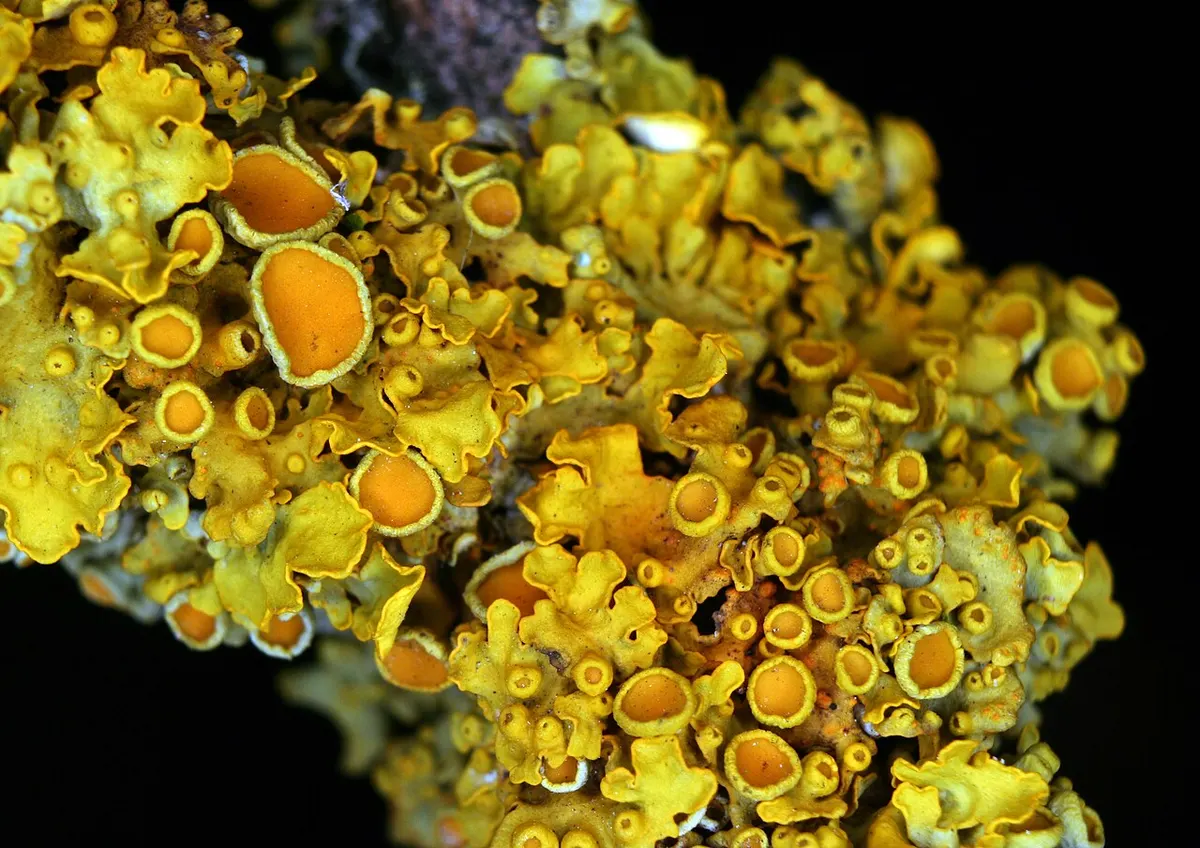
Orange patches, like tiny leaves pressed flat against the surface, often appear on the bark of roadside trees and on roofs. They are lichens of the species Xanthoria parietina, a fungus and an alga living together so closely that they form a new body. Fungi can be partners, as here, but also decomposers of dead wood or parasites that kill trees and frogs.
The lichen: a fungus and a photosynthetic partner
A lichen is a stable partnership between a fungus and a green alga or a cyanobacterium. The photosynthetic partner is called the photobiont; in about 90% of lichens it is a green alga. The fungus builds the lichen’s body, called the thallus, and receives from the photobiont sugars made by photosynthesis. The photobiont gets shelter and conditions in which its population grows far larger than outside the lichen. Lichens with cyanobacteria also receive nitrogen fixed from the air.
The relationship is generally considered a mutualism, a symbiosis in which both partners gain, although some researchers describe it as the fungus farming the alga. Many lichens reproduce by small granules that contain both hyphae and algal cells, so the partners spread together.
For the curious
In 2016 a team led by Toby Spribille showed that many common lichens have, besides the known fungus and the photobiont, a yeast from another group of fungi living in their outer layer. In these lichens, then, the partnership involves at least three organisms.
Three thallus forms, and lichens as air-quality indicators
By shape, the thallus can be crustose, a thin crust that cannot be lifted off the stone or bark; foliose, flattened like a leaf, with an upper and a lower surface, like Xanthoria parietina; or fruticose, like a tiny shrub attached to the surface at a single point, such as the lichens of the genus Usnea, which hang from branches like a beard.
Lichens ask little of the soil and are among the pioneer species, the first to settle on bare rock, and they help form soil. They are very sensitive to air pollution, because they absorb water and dissolved substances directly from rain and fog. In Britain, in the second half of the 20th century, sulfur dioxide from burning coal left the centres of industrial cities almost without lichens. Today, nitrogen oxides and ammonia are making species such as Usnea disappear, while Xanthoria thrives where the air brings plenty of nitrogen. That is why lichens are bioindicators: the species present show what kind of air a place has.

Mycorrhizae: the fungi at plants’ roots
Almost 90% of vascular plant species live in partnership with fungi at their roots. The partnership is called a mycorrhiza: the fungus’s hyphae bring the root water and mineral salts from the soil, and the plant gives the fungus carbohydrates made by photosynthesis. In an ectomycorrhiza, the hyphae wrap the root like a sleeve and push in between its cells; many forest cap mushrooms are partners of this kind for trees. In an arbuscular mycorrhiza, the hyphae enter the root cells and form fine branchings there, called arbuscules.
Hyphae can link the roots of several trees. The claim that old trees feed their seedlings through these networks, however, has no published evidence, and the transfer of substances between trees via fungi has not been shown to be a general feature of forests.
Decomposers and parasites
Wood rots slowly because it contains lignin. The only organisms that break down lignin in large amounts are the fungi that cause white rot; brown-rot fungi break down cellulose and leave the lignin.
Other fungi are parasites. Dutch elm disease, caused by a fungus of the genus Ophiostoma and carried from tree to tree by bark beetles, wiped out the elms of North America’s cities. Chytrid fungi of the genus Batrachochytrium, such as B. dendrobatidis, infect the skin of frogs; the disease they cause, chytridiomycosis, has contributed to the decline of at least 501 species of amphibians over the past half-century, 90 of which are thought to be extinct. In humans, some fungi cause infections of the skin and nails, and the yeast Candida, normally present in the body, causes infections when conditions in the body change; diagnosis and treatment are for a doctor to decide.
Potato late blight and grapevine downy mildew look like diseases caused by fungi, but they are caused by oomycetes, organisms related to brown algae and classified today in Chromista. Potato late blight set off the Irish famine of the mid-19th century, in which around a million people died.
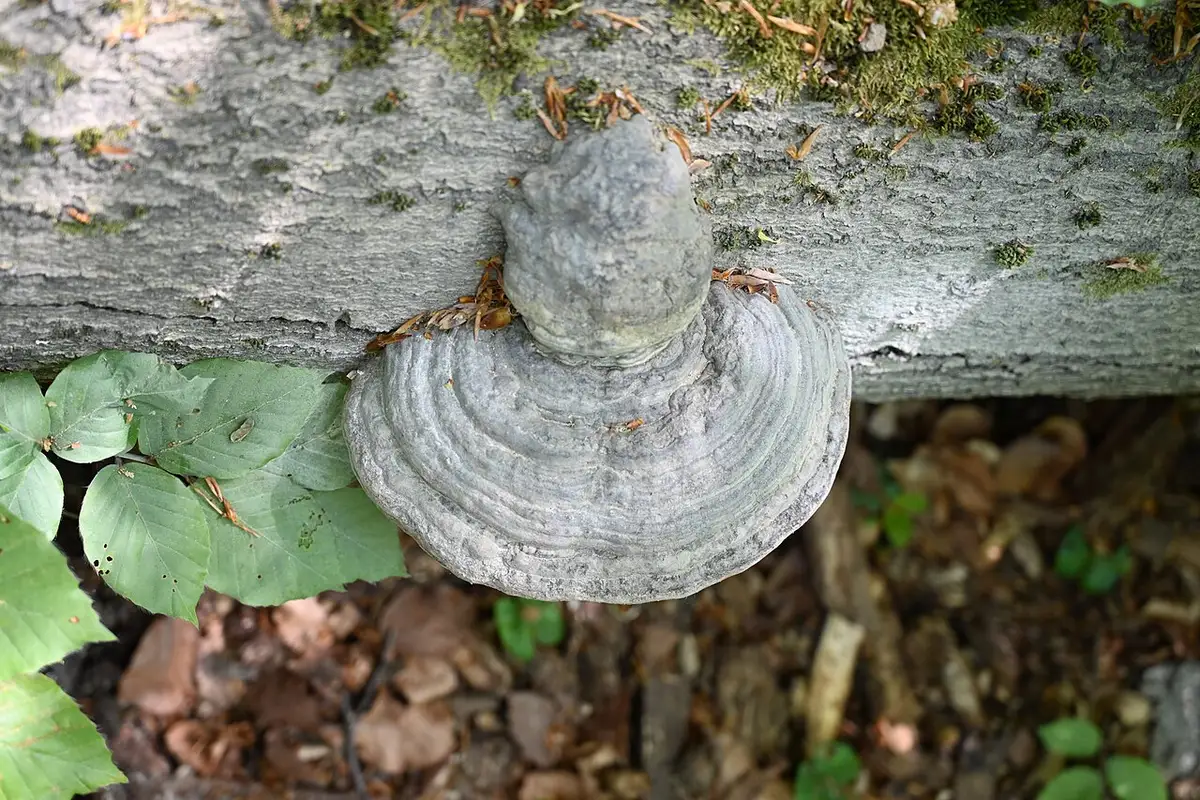
Photo: Agnieszka Kwiecień, Nova, CC BY-SA 4.0, source. Resized.

Worked example
A lichen survey in the school grounds
Two pupils photograph the trunks of 10 lime trees of the same age at each of two sites: 10 next to a busy boulevard and 10 in a park. On each trunk they look for fruticose lichens between 1 and 2 m above the ground. The lichens are photographed where they grow, without being pulled off, so that they are not destroyed.
In the sample calculation, with values chosen for the exercise, fruticose lichens appear on 1 out of 10 lime trees by the boulevard and on 6 out of 10 in the park. The frequency is 1 ÷ 10 × 100 = 10% by the boulevard and 6 ÷ 10 × 100 = 60% in the park.
The difference fits the idea that the air by the boulevard, with more nitrogen oxides, does not let sensitive lichens grow. The comparison is fair only between trees of the same species and age, getting the same light; otherwise, the difference may come from the bark or from shade. To find out whether nitrogen oxides are the cause, they have to be measured too, in the air at both sites.
In Romania
Tinder fungus on old beech trees
The Romanian word iască, “tinder fungus”, comes from the Latin esca, “food”. Dictionaries explain it as the name of certain fungi of the genera Fomes and Phellinus: hard, woody and hoof-shaped, they live for several years on tree trunks and cause white rot in the wood. A Romanian encyclopedic dictionary from 1926–1931 says that tinder for lighting fires was prepared from a bracket fungus that grows on old beeches, on birches and on fruit trees. Dried tinder caught the spark struck from flint with a steel, and in a story by Ion Creangă, the 19th-century Romanian storyteller, someone “strikes a spark and sets it alight with a piece of burning tinder”.
In 2017 several Romanian beech forests became UNESCO World Heritage sites, among them the Șinca and Slătioara old-growth forests, Izvoarele Nerei and Groșii Țibleșului. In a forest that is not logged, dead trees stay where they fall, and fungi such as the tinder fungus break down their wood and release the substances in it, which become food for other organisms.
In short
- A lichen is a stable partnership between a fungus and a photobiont, a green alga or a cyanobacterium; the fungus receives sugars, and the photobiont receives shelter.
- By shape, the lichen thallus is crustose, foliose (Xanthoria parietina) or fruticose (Usnea).
- Lichens are pioneer species on bare rock and bioindicators of air pollution, sensitive to sulfur dioxide, nitrogen oxides and ammonia.
- A mycorrhiza is the partnership between a fungus and a plant root: the fungus brings water and mineral salts, the plant gives carbohydrates; it can be an ectomycorrhiza or an arbuscular mycorrhiza.
- White-rot fungi are the only organisms that break down lignin in large amounts.
- Parasitic fungi cause disease in plants (Dutch elm disease), in animals (chytridiomycosis in amphibians) and in humans (fungal infections); blight and downy mildew are caused by oomycetes, organisms in Chromista.
Common mistakes
WrongLichens are mosses or small plants that grow on trees.
RightLichens are not plants. They are partnerships between a fungus and a green alga or a cyanobacterium, and their body is built by the fungus.
WrongLichens on the bark make the tree ill.
RightLichens use the bark only as a surface to grow on; they get their food from the photobiont, by photosynthesis, and from rainwater.
WrongIf a lichen grows on a tree, the air around it is perfectly clean.
RightSome species, such as Xanthoria parietina, thrive even in air rich in nitrogen. What counts is which species are present and how many, compared between similar places.
Check yourself
Seven questions. For the first six you see the explanation at once, with the paragraph of the lesson that supports it; for the written ones you compare with a good answer.
Who are the partners in a lichen?
Answer
b) A fungus and a green alga or a cyanobacterium. A lichen always has a photosynthetic partner, the photobiont, which makes the sugars. The fungus builds the thallus.
A lichen is shaped like a tiny branched shrub and is attached to a branch at a single point. What kind of thallus does it have?
Answer
c) Fruticose. A fruticose thallus is branched like a shrub and attached at a single point. “Arbuscular” refers to a mycorrhiza.
What does a plant receive from the fungus it forms a mycorrhiza with?
Answer
b) Water and mineral salts brought from the soil by the hyphae. Fungi do not photosynthesise. Their hyphae bring water and mineral salts from the soil, and the plant gives carbohydrates.
Which organism causes potato late blight?
Answer
d) An oomycete. Oomycetes resemble fungi in their way of life, but they are related to brown algae and are classified in Chromista.
In a survey, foliose lichens appear on 9 out of 12 trees in a park. What is their frequency, as a percentage?
%Answer
75 %. 9 ÷ 12 × 100 = 75%.
For each situation, choose the relationship the fungus is in.
Answer
Mutualism: The fungus of a lichen receives sugars from the alga and gives it shelter; A fungus’s hyphae wrap a beech’s roots and trade mineral salts for carbohydrates.
Parasitism: Batrachochytrium infects the skin of a living frog; An Ophiostoma fungus kills an elm.
Decomposition: Tinder fungus breaks down the trunk of a fallen beech; A brown-rot fungus breaks down a dead beam.
In mutualism both partners gain; a parasite lives at the expense of a living host; a decomposer uses dead matter.
Many orange patches of Xanthoria grow on the trees next to a large pig farm, but not a single Usnea lichen, which is common in a forest a few kilometres away. Explain what this difference shows about the air and why lichens are good indicators.
A good answer
The farm releases ammonia, and the air around it brings a lot of nitrogen. Xanthoria is a species that thrives in air rich in nitrogen, while Usnea is sensitive to nitrogen compounds and disappears. Lichens absorb water and dissolved substances directly from rain and fog, with no roots to filter them, so the species present reflect the quality of the air. The comparison is fair only between trees that are alike in species, age and light.
A complete answer names the source of nitrogen (ammonia), tells the tolerant species from the sensitive one, explains why lichens respond to the air and mentions the conditions for a fair comparison.
Practical work for this lesson
- Fermentation: the indicator and the process – Optional guided experiment or case study, 15 minutes of exposure and 25 minutes of analysis, after preparation (CS)
Terms
- lichen
- A stable partnership between a fungus and a photosynthetic partner, a green alga or a cyanobacterium.
- photobiont
- The photosynthetic partner in a lichen, a green alga or a cyanobacterium.
- symbiosis
- Organisms of different species living together closely over a long time.
- pioneer species
- A species that is the first to settle on ground without soil, such as bare rock, and prepares the place for others.
- bioindicator
- An organism whose presence, absence or abundance shows the state of the environment.
- mycorrhiza
- A partnership between a fungus and a plant root, trading water and mineral salts for carbohydrates.
- white rot
- The breakdown of wood by fungi that destroy lignin together with cellulose.
Sources and link to the programme
- British Lichen Society – What is a lichen? – the lichen, a stable symbiotic partnership between a fungus and algae and/or cyanobacteria; photobionts; 90% of lichens have a green alga; the fungus builds the thallus and receives sugars; photobionts have larger populations in the lichen; the mutualism–controlled parasitism debate
- British Lichen Society – Lichen biology – lichens with cyanobacteria fix nitrogen from the air; reproduction by propagules containing algal cells and hyphae; the orange pigment of Xanthoria parietina protects against ultraviolet
- British Lichen Society – Lichen morphology – crustose thallus (cannot be lifted off the surface), foliose (two-sided), fruticose (shrubby, attached at one point)
- British Lichen Society – Lichen ecology – sulfur dioxide left city centres without lichens in the 20th century; ammonia and nitrogen oxides remove sensitive species (Usnea, Evernia); Xanthoria is nitrophilous
- Spribille et al. (2016), Science – Basidiomycete yeasts in the cortex of ascomycete macrolichens (PubMed) – basidiomycete yeasts in the outer layer of many common lichens, found on six continents
- OpenStax – Biology 2e, 24.3 Ecology of Fungi – almost 90% of vascular plants have mycorrhizal partners; the ectomycorrhiza with a sheath and a network between cells; the arbuscular mycorrhiza with arbuscules in the root; the exchange of water and minerals for carbohydrates; lichens very sensitive to air pollution
- OpenStax – Biology 2e, 45.6 Community Ecology – lichens among the pioneer species of primary succession; they contribute to soil formation
- Karst, Jones & Hoeksema (2023), Nature Ecology & Evolution – Positive citation bias and overinterpreted results lead to misinformation on common mycorrhizal networks in forests – the lack of published evidence that old trees send resources to seedlings through mycorrhizal networks; transfer and the spread of networks insufficiently demonstrated
- Floudas et al. (2012), Science – The Paleozoic origin of enzymatic lignin decomposition (PubMed) – the only organisms that substantially break down lignin are white-rot fungi; brown rot does not break down lignin; the Agaricomycetes also include ectomycorrhizal species
- OpenStax – Biology 2e, 24.4 Fungal Parasites and Pathogens – Dutch elm disease (Ophiostoma), spread by the bark beetle; Batrachochytrium dendrobatidis infects the skin of frogs; dermatophytes and skin infections; Candida, normally present in the body, causes infections when conditions change
- Scheele et al. (2019), Science – Amphibian fungal panzootic causes catastrophic and ongoing loss of biodiversity (PubMed) – chytridiomycosis, implicated in the decline of at least 501 amphibian species over the past half-century, with 90 presumed extinctions
- OpenStax – Biology 2e, 23.4 Ecology of Protists – Phytophthora infestans causes potato late blight and set off the Irish famine (about a million deaths); Plasmopara viticola, grapevine downy mildew
- Ruggiero et al. (2015), PLoS ONE – A higher level classification of all living organisms – oomycetes such as Phytophthora, formerly treated as fungi, belong to Chromista
- dexonline – iască (DEX ‘09, CADE 1926–1931, the quotations from Creangă and Sadoveanu) – iască: fungi of the genera Fomes and Phellinus, woody, perennial, on tree trunks, cause white rot; used to light fires with steel and flint; from the Latin esca; CADE (1926–1931): tinder is prepared from a bracket fungus that grows on old beeches, birches, apple, plum and willow trees; the Creangă quotation “scapără și-i dă foc cu o bucată de iască aprinsă”
- Wikipedia – Ancient and Primeval Beech Forests of the Carpathians and Other Regions of Europe – the 2017 extension with forests from Romania: Codrul secular Șinca, Codrul secular Slătioara, Izvoarele Nerei, Groșii Țibleșului and others
From the programme: “Diversity of fungi: examples of representative species, interactions and adaptations (e.g. symbiosis in lichens)” (specialism, Natural Sciences). Specific competences addressed: 1.1, 2.2, 4.2, 5.1.