
Chapter 8 · AnimalsLesson 8.3
Molluscs: snails, bivalves and cephalopods, built to the same plan
What do a Roman snail, a mussel and an octopus have in common, three animals that look nothing alike?
- Size
- from 1 mm to 30 m
- Level
- organism
- Time
- hundreds of millions of years
Before you read: what do you think?
The rapa whelk, a large sea snail in the Black Sea, feeds on mussels. How does it reach the mussel’s soft body, shut between two hard valves?
See the answer
It makes a hole or prises the valves apart. Young rapa whelks scrape a hole in the mussel’s shell with their radula, their toothed tongue. Large ones open the valves and use a toxic substance that weakens the muscles the mussel uses to hold its shell shut.
After a summer shower, the Roman snail comes out of its shell and leaves a shiny trail of mucus on the leaves. The mussel on the rocks of the Black Sea and the octopus of the Mediterranean are its relatives. They look very different, yet every one of them has a body with a foot and a visceral mass, covered by a mantle; the snail and the octopus also have a head, while the mussel has no distinct head.
A soft body, with a mantle and a shell
Molluscs are triploblastic animals with bilateral symmetry and a soft, unsegmented body. The body has three parts: the head, with the mouth and sense organs; the foot, a muscular organ used for moving; and the visceral mass, which holds most of the internal organs. In bivalves the head is not distinct.
Over the visceral mass lies the mantle, a fold of the body wall. In most molluscs the mantle makes the shell, out of calcium carbonate. Between the mantle and the body there is a space, the mantle cavity, which holds the gills in molluscs that live in water.
Many molluscs have a radula in their mouth, a ribbon of small, hard teeth with which they scrape up food. Most have an open circulatory system: the blood does not stay inside vessels all the time. Nearly 100,000 species of molluscs are known, in the sea, in fresh water and on land. They are food for many animals and for people, and bivalves filter the water they live in.
For the curious
The shell has three layers; the innermost, smooth and shiny, is mother-of-pearl. When a foreign particle gets between the mantle and the shell in some bivalves, the mantle coats it with layers of mother-of-pearl and a pearl forms.
Gastropods: snails and slugs
The Roman snail (Helix pomatia) has a coiled shell 3.8–5 cm tall. On its head are two pairs of tentacles that can be pulled in; the longer pair carries an eye at each tip. It crawls on the sole of its foot, over the layer of mucus it produces.
The Roman snail lives on land and breathes with a lung: the air-filled mantle cavity, which opens through a hole on the right-hand side. Most water snails have gills, but some freshwater snails breathe air with a lung. With its radula, the snail scrapes at leaves, flowers and fruit.
The Roman snail is a hermaphrodite with internal fertilisation: two snails mate and exchange sperm, then each lays its eggs in a hole in the soil. In winter it seals the opening of its shell with a layer of hardened mucus. The slug is a gastropod too, but it has no shell.
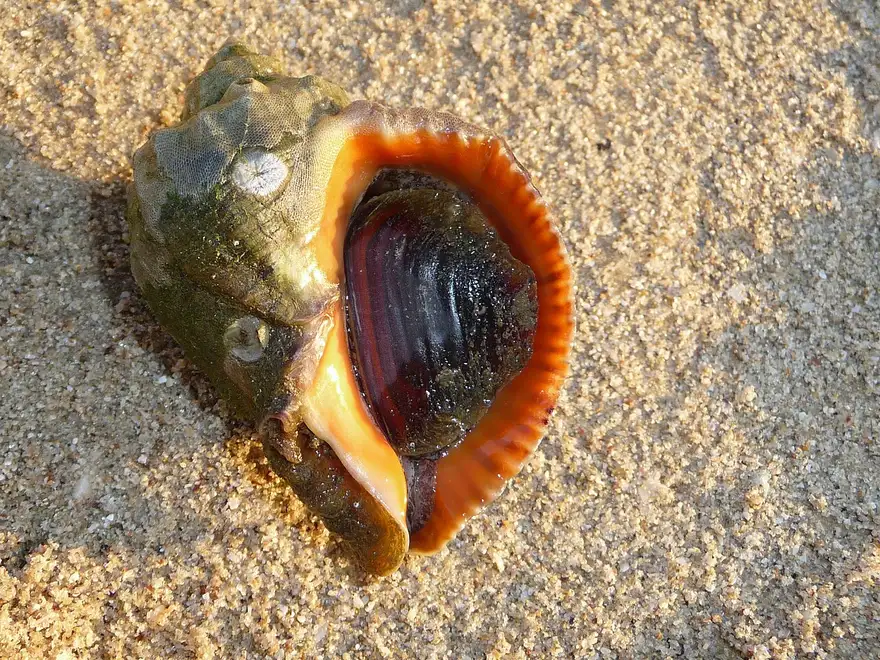
Photo: George Chernilevsky, Public domain, source. Cropped and resized.

Bivalves: mussels and clams
Bivalves, such as the Mediterranean mussel (Mytilus galloprovincialis), have their body enclosed between two valves, the two halves of the shell. They have no well-formed head and no radula. The foot is wedge-shaped.
Bivalves are filter feeders. Water enters the mantle cavity, and the gills trap the food particles in it and take up oxygen at the same time. A bed of mussels clears the water of suspended particles this way. Most bivalves have separate sexes, and fertilisation takes place in the water. Mussels are food for other marine animals, such as the rapa whelk, and for people.
Cephalopods: cuttlefish, squid and octopus
In cephalopods, the foot has turned into arms and tentacles arranged in a ring around the head. The common octopus (Octopus vulgaris) has eight arms with suckers. All cephalopods are predators: they catch snails, bivalves and other small animals and cut them up with a hard beak that works alongside the radula.
They move by jet propulsion, forcing water out of the mantle cavity through a siphon. When attacked, they release ink, and coloured cells in the skin, the chromatophores, change their colour. They have eyes that form images and a closed circulatory system, the only molluscs that do. They are the most intelligent molluscs: the octopus learns and tells objects apart by shape, touch and taste.
In many cephalopods the shell has shrunk. The squid has a thin blade inside, the cuttlefish has the cuttlebone, and the octopus has no shell at all. The nautilus is the only one with an outer shell, divided into chambers.
Worked example
Three shells found on the beach
In the biology lab’s shell collection you find three objects. A: a large shell in a single piece, coiled into a spiral. B: two long, dark valves joined to each other by a hinge. C: a white, oval, light plate with no spiral at all.
Step 1: count the pieces of the shell. A is in one piece and coiled, so it belongs to a gastropod, for example a rapa whelk.
Step 2: B has two joined valves, so it belongs to a bivalve. The long shape points to a mussel.
Step 3: C is not an outer shell. It is a cuttlebone, the internal shell of a cephalopod.
A shell tells you a lot, but not everything: the slug and the octopus have no shell and are still molluscs. What counts for classification is the body plan: mantle, foot, visceral mass.
In Romania
The mussels of Vama Veche and the rapa whelk
In the 2 Mai – Vama Veche Marine Reserve, a protected area of about 5,000 hectares near Mangalia, on the Romanian coast, more than half of the seabed is rock. Between 20 and 30 m down, the rocks are covered with beds of mussels (Mytilus galloprovincialis).
Among them lives the rapa whelk (Rapana venosa), a gastropod native to the seas of Japan, China and Korea. It was first recorded in the Black Sea in 1947, in Novorossiysk Bay, and reached the Romanian coast in 1963. It most likely arrived on ships’ hulls or in ballast water.
The rapa whelk feeds mainly on bivalves, and mussels, with their thin shells, are its favourite prey. The same mollusc plan shows in both: a predatory gastropod with a radula, and a filter-feeding bivalve without one.
In short
- Molluscs have a soft, unsegmented body with a foot and a visceral mass, and gastropods and cephalopods also have a head; the mantle covers the visceral mass and makes the shell.
- The radula is a toothed ribbon with which many molluscs scrape up food; bivalves have no radula.
- Gastropods (the Roman snail, the slug) have a head with tentacles and a broad foot, and the land species breathe with a lung; the snail is a hermaphrodite.
- Bivalves (the mussel, clams) have a shell made of two valves, no distinct head, and feed by filtering, using their gills.
- Cephalopods (cuttlefish, squid, octopus) have arms and tentacles around the head, move by jet propulsion, release ink, and have well-developed eyes and a closed circulatory system.
Common mistakes
WrongThe octopus is not a mollusc, because it has no shell.
RightThe octopus has the mollusc body plan: a mantle, a visceral mass and a foot turned into arms. In many cephalopods the shell has shrunk or disappeared.
WrongAn octopus’s arms are jointed legs, like an insect’s.
RightAn octopus’s arms are soft, with no joints, and come from the mollusc’s muscular foot. Jointed legs are a feature of arthropods.
WrongAll molluscs have a radula.
RightBivalves have no radula: they get their food by filtering water through their gills.
Check yourself
Seven questions. For the first six you see the explanation at once, with the paragraph of the lesson that supports it; for the written ones you compare with a good answer.
Which part of a mollusc’s body makes the shell?
Answer
c) The mantle. The mantle is the fold that covers the visceral mass and secretes the calcium carbonate shell.
How does a mussel get its food?
Answer
c) It traps particles from the water with its gills. The mussel is a filter-feeding bivalve with no radula. Its gills trap food from the water that enters the mantle cavity.
What does the Roman snail breathe with?
Answer
b) A lung formed from the mantle cavity. In land snails the mantle cavity is filled with air and works as a lung. Most water snails have gills.
Which feature does the octopus have that no snail or bivalve has?
Answer
c) A closed circulatory system. Cephalopods are the only molluscs with a closed circulatory system. A soft body, a mantle and sexual reproduction are common to molluscs.
How many years passed between the first record of the rapa whelk in the Black Sea and its arrival on the Romanian coast?
yearsAnswer
16 years. The first record was in 1947, and it reached the Romanian coast in 1963: 1963 − 1947 = 16 years.
Choose the class of each mollusc.
Answer
Gastropods: Roman snail; Slug; Rapa whelk.
Bivalves: Mussel.
Cephalopods: Cuttlefish; Octopus.
Snails, the slug and the rapa whelk have a head with tentacles and a single broad foot; the mussel has two valves; the cuttlefish and the octopus have arms around the head.
In a bay, the number of rapa whelks rises sharply, and the mussels vanish from the rocks they once covered. Explain what may change in the water of the bay, using what you know about how bivalves feed.
A good answer
Rapa whelks eat mussels, so the number of mussels falls. Mussels are filter feeders: water passes through the mantle cavity, and the gills trap the particles in it. With fewer mussels, less water is filtered and the particles stay in suspension. Fish and other animals that feed on mussels also find less food.
A complete answer links the predator to its prey, explains filtering through the gills and draws a conclusion about the water or about other animals.
Practical work for this lesson
- Identify the example and keep the exception – Case study on characters, 30–35 minutes
Terms
- mantle
- A fold of the body wall in molluscs, which covers the visceral mass and makes the shell.
- visceral mass
- The part of a mollusc’s body that holds most of the internal organs.
- radula
- A ribbon of small, hard teeth in the mouth of many molluscs, which they use to scrape up food.
- shell
- A hard covering of calcium carbonate, made by the mantle, that protects the mollusc’s body.
- gills
- Breathing organs of aquatic animals, through which oxygen passes from the water into the blood.
- valves
- The two halves of a bivalve’s shell, joined by a hinge.
- chromatophore
- A pigment cell in the skin of cephalopods that spreads out or contracts and changes the animal’s colour.
Sources and link to the programme
- OpenStax – Biology 2e, 28.4 Mollusks and Annelids – mantle, visceral mass, mantle cavity, calcium carbonate shell, three layers and mother-of-pearl, pearls; radula with chitinous teeth; gills, lungs in land species; open circulatory system, closed in cephalopods; gastropods with head, tentacles and eyes, slugs without a shell; filter-feeding bivalves with no radula, poorly developed head, wedge-shaped foot; predatory cephalopods with a beak, jet propulsion, ink, chromatophores, image-forming eyes, the most intelligent molluscs; the squid’s pen, the cuttlebone, the nautilus’s chambered shell; separate sexes and external fertilisation in most; nearly 100,000 species
- Virginia Cooperative Extension (Virginia Tech) – Freshwater snails – freshwater snails with an operculum breathe with a gill; those without an operculum breathe with a modified ‘lung’
- Lander University, Invertebrate Anatomy OnLine – Helix – the mantle cavity as a lung, breathing hole on the right-hand side, two pairs of retractile tentacles with eyes on the rear pair, the sole of the foot and mucus, hermaphroditism with internal fertilisation
- Animal Diversity Web – Helix pomatia – shell 3.8–5.0 cm, hermaphrodite, eggs laid in a hole, mucus epiphragm in winter, plant food, radula
- Animal Diversity Web – Octopus vulgaris – the octopus has no internal shell, eight arms with suckers, predator of snails and bivalves, colour change, learning from visual, tactile and chemical cues
- Smithsonian NEMESIS – Rapana venosa – origin of the rapa whelk, first record in the Black Sea at Novorossiysk, transport on ships’ hulls or in ballast water, feeding on bivalves, preference for mussels, drilling of the shell by young whelks and opening of the valves with a toxin by adults
- Brustur, Bălan, Briceag, Geo-Eco-Marina 27 (2021) – Rapa whelk trails from the Romanian inner shelf (SE Mangalia) – the rapa whelk is native to the seas around Japan, China and Korea; first record in 1947 (Novorossiysk Bay); Romanian coast in 1963; 2 Mai – Vama Veche Marine Reserve, about 5,000 ha; rocky seabed over more than half the area, 20–30 m, with beds of Mytilus galloprovincialis and Rapana venosa
From the programme: “Animals. Invertebrates: sponges, cnidarians (coelenterates), worms (flat, round, segmented), molluscs (snails, bivalves, cephalopods), arthropods (arachnids, crustaceans, insects) - general characteristics – comparative overview (morphology, nutrition, relation, reproduction), examples of representative species, habitats, importance in ecosystems” (common core). Specific competences addressed: 1.1, 1.2, 2.2, 3.1.